Mobile Cloud Computing (MCC) Enables Storage
Smartness for Every Smart Mobile Agent
Swetha M.S
1, Muneshwara M.S
2, Dr. Anil G .N
31Assistant Professor, Dept. of ISE, BMSIT & Management, Bangalore, India
2Assistant Professor, Dept. of CSE, BMSIT & Management, Bangalore, India
3Associate Professor, Dept. of CSE, BMSIT & Management, Bangalore, India
ABSTRACT: Our everyday life experience shows a phenomenon of large scale usage of applications specifically devised for mobile devices. However the remarkable growth generated by the current lifestyle doesn’t match with a parallel improvement on mobile handset batteries, where there is no improvement in its lifetime at the same pace. Hence there is no sufficient energy to maintain and run the devices, to overcome this obstacle we can offload the most energy-consuming task to nearby fixed servers, popularly feature of cloud computing. The offloading method requires the installation of multiple VMs on demand which results in improvement of efficiency of overall system computation. Hence the process of virtualization was used in MAUI. Mobile assistance using infrastructure (MAUI) makes use of saves information about past offloading methods and uses online profiling to create an energy consumption model. The interaction of mobile agents and radio networking was further narrowed by the study in European paper which enhanced the use of Femtocloud in mobile cloud computing for the development of future mobile generation. i.e TROPIC Thus this need for offloading which related to the approach towards cloud computing brought forward the group computer servers called the cloudlet, andthe features of cloud storage found in the divided cells or clouds called as the Femtocells which are stored in the Femtocloud.
KEYWORDS: Cloud Computing, Cloudlet, Femtocells, Femtoclouds, MAUI, Mobile cloud Computing, TROPIC
I.INTRODUCTION
The concept of offloading has been studies for a long time under the name of cyber for aging or computation offloading
Figure1: Mobile cloud computing
The recent scenario shows strong impulse to computation offloading enlightened through cloud computing (CC) which enables users to utilize resources as per their needs and demands. The available resources through cloud computing are:
Infrastructure as a service
Software as a service
CC has many features out of which one of the key features is Virtualization, which enables us to run multiple operating systems and applications over the same machine while providing isolation and protection of the programs and their data. Through virtualization a number of virtual machines (VMs) can be scaled on demand which in turn improves the efficiency of the overall system computation.
MCC is a case of CC where the user can access the cloud services through their mobile handsets which has given in the figure1.The key Con of today’s MCC is the energy being consumed which is associated to radio access and the latency being experienced in reaching the cloud provider through a Wide area network (WAN).
Humans are very sensitive to delay and jitter, as latency increases the interactive responses suffer. A strict latency control must somehow be inculcated in the immediate future of MCC. To execute this constraint we require to rethink the overall service chain right from the physical layer to virtualization.
II.LITERATURE SURVEY/ RELATED WORK
Cloud computing is the evolution and use of existing technologies. The aim of cloud computing is to enable users to be privileged from all of technologies, without any need expert knowledge. It aims to reduce costs, and helps the users overcomes IT obstacles. The main technology for cloud computing is virtualization, which separates a physical computing device into one or more virtual devices, operating system–level virtualization mainly consists of creating a scalable system for multiple independent computing devices, other computing resources can be allocated and used efficiently. Virtualization provides speed required to optimize IT operations, and reduce cost by increasing infrastructure utilization. Users can enable resources on demand by automatic automation system. This decreases user involvement and speeds up the process, decreases labor expenditure and reduces the possibility of human errors.
Cloud computing makes use of the concepts from Service-oriented Architecture (SOA) this can help the user break the problems into the services that can be integrated to provide an optimal solution. It provides all of the resources it consists as services. Cloud computing also consists of concepts from utility computing which provide metrics for services being used. These metrics are at the core of the public cloud as pay-per-use models. With this measuring services is an essential part of the feedback loop in autonomic computing, which allows services to scale on-demand and performs automatic failure recovery.
Cloud computing is similar to grid computing; by addressing the QoS (quality of service) it has evolved and reduced reliability problems. Cloud computing provides tools and technologies to compute intensive parallel applications with affordable prices compared to traditional parallel computing techniques
Mobile Cloud Computing is the combined stock of cloud computing, mobile computing and wireless networks to bring out abundant computational resources to mobile users, network operators, as well as providers of cloud computing. The ultimatum of MCC is to enable execution of mobile applications on a plethora of mobile devices. It provides business opportunities for mobile network operators as well as cloud providers. Comprehensively, MCC can be defined as "a rich mobile computing technology that leverages unified elastic resources of varied clouds and network technologies toward unrestricted functionality, storage, and mobility to serve a multitude of mobile devices anywhere, anytime through the channel of Ethernet or Internet regardless of heterogeneous environments and platforms based on the pay-as-you-use principle.
Offloading computing for mobile cloud computing:
MCC can enable following advantages:
Prolonged battery lifetime, by offloading energy-consuming tasks from mobile handset’s to cloud.
Allow mobile devices to run sophisticated application’s and provide significant higher storage data capability. Higher reliability, since the data is stored and is provided with backup features from mobile devices to a set of
fixed reliable storage devices.
discussed earlier requires the installation of VMs on the servers, ex: Mobile Assistance Using Infrastructure (MAUI), Clone Cloud, and Mob cloud.
Methods based on mobile agents use a mobile approach to partition and distribute the jobs and are suitable for disconnected operations typically wireless, ex: scavengerOffloading doesn’t mean loading all the executable programs onto the remote server. A program is subdivided into modules out of which some are required to be run on the mobile handsets such as modules controlling the I/O peripherals, the remaining modules undergo a decision session where it comes to the conclusion of which of these are appropriate for offloading.
Offloading can be either static or dynamic. Static means that the partitioning of program is given before execution, and the decision of which module to transfer is taken once for all at the beginning of execution. In contrast dynamic offloading the decision of which module to be transferred is taken at the run-time based on the concurrent conditions. In principle dynamic offloading is more efficient when compared to static offloading. But due to more over-head on the system to results in latency, profiling, and run time decision making. Offloading depends on contextual parameters, such as intensity of computation in each module, size of the program state which has to be transferred for execution from one site to the other, level of battery, constraints of delay, channel state, and so on. An example of an offloading is MAUI method aiming to select which program modules to be offloaded to minimize energy consumption at the mobile terminal. The approach is based on call graph representation of a program. A call graph is a representation that shows the relations between the modules of a computer program in the form of a directed graph G = (, V E), where each vertex V is representing a procedure in the call stack, and each directed edge e u = ( , y) is representing the invocation of procedure y from procedure u. The call graph also includes auxiliary information concerning the number of instructions within each module and the amount of data being exchanged among modules. As for the non recursive languages with reasonable assumptions on the program structure, the call graph is a directed acyclic graph. When a call graph is given for an application the MAUI collects information about consumption of energy and requirements of data transfer and then solve an integer linear program to determine which modules are more suitable for offloading. It can be seen that MAUI does not offload the whole application but only the most energy-consuming modules. It is the critical aspect in the prediction of energy consumption. MAUI saves information about past offloading methods and uses online profiling to create an energy consumption model. When request for new offloading are received, MAUI uses the history data which is stored and predicts the execution time required for the task.
Besides the aspects of computation, there are two major issues about offloading associated with radio access i.e. Power consumption and latency. These are major bottlenecks in the deployment of an effective MCC for the current cellular networking. In macro cellular systems, the power spent from mobile users, especially ones located at the edge of the cell, may be significant. In some cases this large transmit of power may nullify all potential benefits of energy saving. A possible way to reduce the power consumption is bringing computational resources closer to the mobile users. When this idea was put forward, the concept of a cloudlet was introduced. In this case, the mobile handset workload is offloaded to a local cloudlet which comprises of a set of multi core computers which is connected to the remote cloud server. The storage and computation capabilities of the cloudlet are much smaller than that of the cloud server, but at the same time, installing a cloudlet is significantly less expensive than installing a cloud server. The main advantage of this solution is scalability-the powerful cloud resources are used only when they are really necessary, else computation is offloaded to a cloudlet. Radio access to the cloudlet could be achieved through Wi-Fi.
The European Union project name “distributed computing, storage and radio resource allocation over cooperative femtocells “(TROPIC) brought the idea of cloud services closer to the mobile users. Where they have proposed to endow small-cell base stations with additional cloud functionalities.
III.WORKING PROCEDURE & RESULT
What is Femtocell and how does it work?
The Femtozone services has a triggering mechanism that's activated when the phone arrives home and camps onto the Femtocell.
Figure2: Femtocell storage
This triggering can come from two places:
1. An application in the phone (which uses an API to detect the Femtocell ID and initiate an action – e.g. large file transfers),
2. From the network (e.g. the Fem to cell Access Point or Femto Gateway initiates an SMS message or a presence update on a Web 2.0 service when it detects the phone has entered the Fem to zone).
The Fem to cell gateway will provide two main types of services:
a) Fem to zone services: This service will allow you to switch from external to internal as soon as it comes into the Remtocell range. This will save you money because you will be using the Fem to cell gateway via your broadband connection.
Examples of this service are:
Receive an SMS when your kids enter or leave the home
Automatic “I’m at home” profile / presence update on Plazes and other Web 2.0 sites
Automatic podcast reload & photo/video upload to the web (Flickr, YouTube etc) when you get home
Virtual home number (rings all mobile phones currently in the home).
b) Connected home services: This is where the handheld device access other equipment in your home via the
Femtocell gateway.
Examples of connected home services are:
Back up music downloaded on your phone to your PC
Play a slide show of photos from your phone on your TV
Stream videos from your DVR to your phone at high quality
Use your phone to control other devices in the home (e.g. to instruct the HiFi to play music stored on a home
media server).
request are met by the local femtocloud. Else the gateway may ask the intervention of the cloud server through high capacity wired links.
Scalability is improved in both radio and computational resources by bringing them closer.The radio which is based on LTE also yields few advantages over Wi-fi such as : QoS is guaranteed and single technology solution is provided for offloading with no need of switching from Wi-fi to 3G/4G.Power consumption at the terminal side not only arises by bringing resources closer to user but leads to latency which is a major issue.
Latency consists of 3 terms:
𝓵 = ∆𝑻 + ∆𝒓𝒆𝒎 exe + ∆R
here, ∆T is the time needed to send the information necessary to transfer the program execution to the cloud from the mobile device, ∆rem exe is the time necessary to run the program at the remote side, ∆R is the time necessary to the cloud to send the result back to the mobile unit.
IV.MOBILE CLOUD COMPUTING IN FUTURE GENERATION (ULTRA) DENSE CELL DEPLOYMENT
In 4G evolution, the deployment of small cell is already a part of it whereas in coming generation major role would be played by network “densification”. Femtocell networks consist of small-cell networks which are devised to cover the indoor environment.
Advantages of deployment of small cell base station with respect to MCC are: The probability for the mobile handset is increased to find an access point within short range. The transmit power necessary for computational offloading and latency over wireless access channel is reduce
Millimeter-wave links: An effective way for the radio access points to forward the user’s offloading requests to the cloud with reduced latency is done by using wideband links of high capacity and directivity, which in turn overcomes the limitations of ADSL backhaul links that are used in femtocell networks
Massive multiple-input, multiple-output(MIMO):Time necessary to transfer the program execution from mobile site to cloud is reduced as spectral efficiency is improved by MIMO transceivers; furthermore, an efficient management of intercell interference through adaptive null steering is done by using extensive beam forming
Monticello cooperation: computation offloading involves both computational aspects and communication, the most effective way is cooperation among cells which is fundamental to distribute radio access and computing requests that is cooperation may occur at application level and radio level to implement distributed cloud capability and to reduce interference.
Cognitive radio: the overall system efficiency is improved with the help of incorporation of cognitive radio capabilities.
Quality of experience (QoE) versus quality of service (QoS): a design driven by user’s QoE implies a system approach that does not consider radio or networking aspects separated from application requirements, this change os perspective matches perfectly with synergic approach which is going to br most effective for MCC
V.CONCLUSION AND SCOPE FOR FUTURE DEVELOPMENT
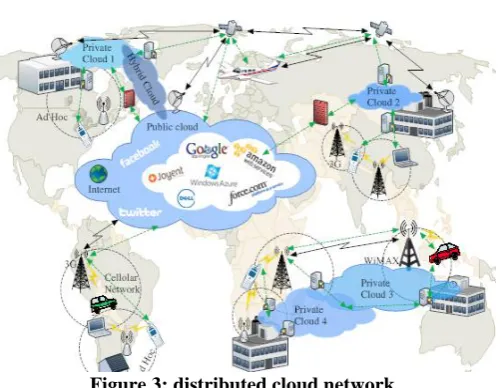
Figure 3: distributed cloud network.
REFERENCES
1. Benjamin Welton Dries Kimpe, Jason Cope, Christina M. Patrick, Kamil Iskra, Robert Ross “Improving I/O Forwarding Throughput with Data Compression”
2. Dr. Anil G.N, Mrs. Swetha M.S & Mr. Muneshwara M.S “A Smarter Way of Securing and Managing Data for Cloud Storage Applications Using High Throughput Compression in the Cloud Environment” IJARCSMS Volume 2,Issue 9, September 2014.
3. M. R. Palacin, “Recent advances in rechargeable battery materials: A chemists perspective,” Chem. Soc. Rev, 2009.
4. M. Sharifi, S. Kafaie, and O. Kashefi, “A survey and taxonomy of cyber foraging of mobile devices,” IEEE Commun. Surveys Tutorials, 2012. 5. N. Fernando, S. W. Loke, and W. Rahayu “Mobile cloud computing: A survey,”, Jan. 2013.
6. K. Kumar, J. Liu, Y.-H. Lu, and B. Bhargava, “A survey of computation offloading for mobile systems,” Mobile Networks Applicat, Feb. 2013. 7. E. Cuervo, A. Balasubramanian, D. Cho, A. Wolman, S. Saroiu, R. Chandra, and P. Bahl, “MAUI: Making smartphones last longer with code
offload”, June 2010
8. M. Satyanarayanan, P. Bahl, R. Caceres, and N. Davies, “The case for VM-based cloudlets in mobile computing,” IEEE Pervasive Comput, Dec. 2009.
9. M. V. Barbera, S. Kosta, A. Mei, and J. Stefa, “To offload or not to offload? The bandwidth and energy costs of mobile cloudcomputing,”Apr. 2013,
10. J. Flinn, S. Park, and M. Satyanarayanan, “Balancing performance, energy,and quality in pervasive computing,” 2002 11. R. Balan, M. Satyanarayanan, S. Park, and T. Okoshi, “Tactics-based remote execution for mobile computing,” 2003. 12. R. Kemp, N. Palmer, T. Kielmann, and H. Bal, “Cuckoo: A computation offloading framework for smartphones,” Oct. 2010. 13. B.-G. Chun and P. Maniatis, “Augmented smartphone applications through clone cloud execution,” May 2009.
14. D. Huang, X. Zhang, M. Kang, and J. Luo, “Mobicloud: Building secure cloud framework for mobile computing and communication,” in Proc. 5th IEEE Int.Symp. Service Oriented System Eng. (SOSE), June 2010.
15. M. D. Kristensen and N. O. Bouvin, “Scheduling and development support in the scavenger cyber foraging system,” 2010. 16. Sergio Barbarossa, Stefania Sardellitti, and Paolo Di Lorenzo, “Communicating While Computing” Nov 2014.
17. European Project METIS. [Online].
18. ETSI summit on future mobile and standards for 5G. [Online] Nov 2013. 19. G. Fettweiss, “A 5G wireless communication vision,”Dec. 2012.
ACKNOWLEDGEMENT
The authors would like to thank the editor and reviewers for their priceless suggestions that appreciably improved the eminence of this paper.
I heartily thank to Principal, BMS Institute of Technology &Management, Yelahanka , Bangalore -560064, Karnataka and HOD Department of ISE, , BMS Institute of Technology & Management, affiliated to VTU,Karnataka, INDIA.
BIOGRAPHY
Mrs. Swetha M.S is an Assistant Professor in the Department of Information Science and Engineering at BMS Institute of Technology & Management, Bangalore, affiliated to Visvesvaraya Technological University, KARNATAKA, INDIA. She has Completed M. Tech in Computer Science & Engineering Branch Visvesvaraya Technological University, KARNATAKA. & B.E.Degree in Computer Science & Engineering Branch from Visvesvaraya Technological University, KARNATAKA and She has around 7 years of experience in teaching.
Mr. Muneshwara M.S is an Assistant Professor in the Department of Computer Science and Engineering at BMS Institute of Technology & Management, Bangalore, affiliated to Visvesvaraya Technological University, KARNATAKA, INDIA He has Completed M. Tech in Computer Science & Engineering Branch & B.E. Degree in Information Science & Engineering Branch from Visvesvaraya Technological University, Belgaum, KARNATAKA, INDIA. He has around 9 years of experience in teaching.