A Critical Study of ICT Implementation in
School Education with Special Reference to
the Selected Schools of Satara District
Anita A. Patil, Dr. A.V. Nikam
BHARATI VIDYAPEETH (DEEMED to be UNIVERSITY), Pune, Yashwantrao Mohite Institute of Management
Karad, India
ABSTRACT: Information and Communication Technology (ICT) is playing a vital role in today’s complex world and
government services in particular. ICT in schools provide an opportunity to teachers to transform their practices by providing them with improved educational content and more effective teaching and learning methods. Wireless Technology improves the learning process through the provision of more interactive educational materials that increase learners’ motivation and facilitate the easy acquisition of basic skills. The use of virtual classroom and various multimedia devices such as television, videos, and computer applications offers more challenging and engaging learning environment for students of all ages.
It is observed that most of the schools especially in rural region are reluctant to change their style and pattern of teaching pedagogy. The difficulties for academic staff in changing approaches to teaching are substantial. Academicians can change only if they are willing to take on every issue like validation, external bodies, IT issues and so on. ICT can be beneficial to the educational world with computers to help students and teachers in their academic activities.
KEYWORDS: ICT , Cloud Technology, Wireless Technology, School Education
I. INTRODUCTION
Teaching-learning process is concerned with student and teacher in education, it may be in Private or Government sector schools or colleges. It deals with the process of developing students and also the teachers, in accordance with their aspirations and to suit the educational needs. Students have all the right of enjoying the humanly modern education. In this light ICT, the newer technology plays a vital role in bringing success to education. Growth of a nation depends upon the progress of education. It benefits students as it can help them type up work quickly e.g. long essays. It gives them confidence on their vocabulary and if they commit a mistake at the beginning when handwritten they do not have to write up the whole essay again, making their presentation of work low rated.
Statement of the problem:
Research Gap:
On the basis of the literature review, it is evident that majority of the previous research works are focused on :
Implementation of ICT
Teaching and learning environment
Internet services
Student centric learning
Providing Digitalizing educational materials and educational equipment.
The researcher has found research gaps is in monitoring and evaluation of ICT implementation in schools and also effective solutions to overcome the lacking areas.
To bridge the gap between the previous research and present scenario of school education, the researcher has chosen the title of research as :
“A Critical Study of ICT Implementation in School Education with Special Reference to the selected schools of Satara District”
Objectives of the Study:
The research work is concerned with the prime objective of identifying the various problems and solution thereof in school education using ICT. The other major objectives of the research are:
1. To study the present scenario of ICT implementation in selected schools in Satara District of Maharashtra. 2. To identify the problems faced during ICT implementation in the selected schools.
3. To analyze the effective of ICT implementation in the selected schools.
4. To design a working model for efficient and effective ICT implementation in schools education. 5. To suggest measures for effective implementation of ICT in Schools.
Hypotheses of the Study
The researcher has set out the following hypotheses:
1. ICT helps to enhance innovative learning and self study of the students. 2. The availability of ICT infrastructure affects the teaching learning process.
3. There is difference in the level of ICT implementation in Private and Government schools
Scope of the Study
In order to have an exhaustive study and to achieve maximum accuracy the scope has been determined as under:
Geographical Scope: This research will be undertaken in the selected secondary schools.
Topical Scope: The focus of this research will be critical study of ICT implementation in the selected schools of
Satara District.
Functional Scope: This research will cover various aspects of increased effectiveness of teaching –learning-evolution
process due to ICT implementation in selected schools.
Analytical Scope: The data collected, as part of the study, will be analyzed to fulfill the objectives and to test the hypotheses.
Significance of the Study
ICT enabled school education has been beneficial in more than one-way. The significance of the proposed study is mentioned in the following lines:
Concept understanding and retention among the students will be improved considerably.
II. METHODS OF DATA ANALYSIS
Various statistical tools and techniques will be used for quantitative analysis of data generated as a result of the survey of the selected schools, students, teachers and the administrative staff. The survey was conducted with the help of a well designed questionnaire. The questionnaire contained dichotomous, multiple option questions and liker scale was also provided to collect opinions.
Respondents
Duration of use of computers by student
Total Students Never
Use
Less than
one year One
Year
Two year
More than Two Years
School Category
Private 11 (5.55%) 44 (22.22%) 4 (2%) 25 (12.63%) 114 (57.57%) 198
Government 45 (24.32%) 90 (48.65%) 14 (7.57%) 19 (10.3%) 17 (9.19%) 185 Total 56 (14.62%) 134 (34.99%) 18 (4.70%) 44 (11.49%) 131 (34.20%) 383
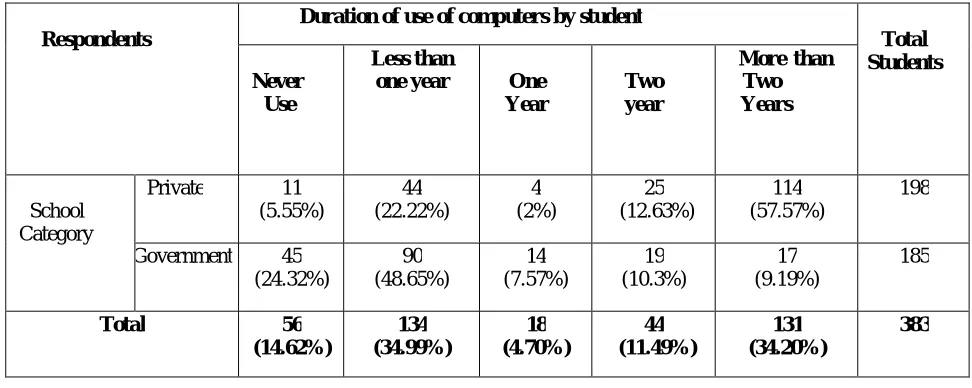
Figure No.4.1.1: Duration of use of computers by students
Figure No.4.1.1: Duration of use of computers by students
In private schools 5.55% of students have never used computers, 22.22%, have used them for less than one year, 2% of have used them for one year , 12.63% of have used computers for two years and 57.57% have used them for more than two years.
Therefore, it is concluded that, use of ICT is more among private schools compared to government schools.
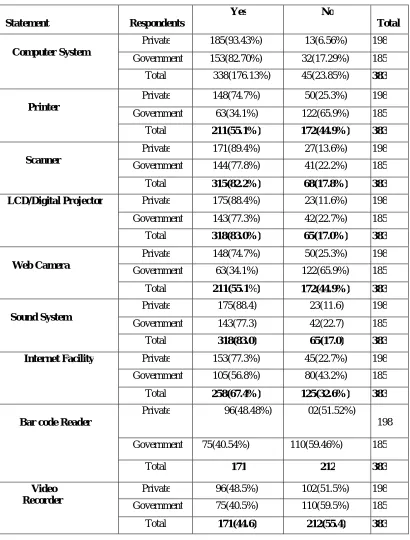
Table 4.1.4: Availability of ICT Infrastructure in the school.
Statement Respondents
Yes No
Total
Computer System
Private 185(93.43%) 13(6.56%) 198
Government 153(82.70%) 32(17.29%) 185
Total 338(176.13%) 45(23.85%) 383
Printer
Private 148(74.7%) 50(25.3%) 198
Government 63(34.1%) 122(65.9%) 185
Total 211(55.1%) 172(44.9%) 383
Scanner
Private 171(89.4%) 27(13.6%) 198
Government 144(77.8%) 41(22.2%) 185
Total 315(82.2%) 68(17.8%) 383
LCD/Digital Projector Private 175(88.4%) 23(11.6%) 198
Government 143(77.3%) 42(22.7%) 185
Total 318(83.0%) 65(17.0%) 383
Web Camera
Private 148(74.7%) 50(25.3%) 198
Government 63(34.1%) 122(65.9%) 185
Total 211(55.1%) 172(44.9%) 383
Sound System
Private 175(88.4) 23(11.6) 198
Government 143(77.3) 42(22.7) 185
Total 318(83.0) 65(17.0) 383
Internet Facility Private 153(77.3%) 45(22.7%) 198
Government 105(56.8%) 80(43.2%) 185
Total 258(67.4%) 125(32.6%) 383
Bar code Reader
Private 96(48.48%) 02(51.52%)
198
Government 75(40.54%) 110(59.46%) 185
Total 171 212 383
Video Recorder
Private 96(48.5%) 102(51.5%) 198
Government 75(40.5%) 110(59.5%) 185
Graph No.4.1.4: Availability of ICT Infrastructure in private and government Schools
The above table and graph furnishes information about availability of ICT infrastructure in the in private and government schools.
Computer system:
It is clear from the above table that 93.4% of the private schools have computer systems, while 82.70% of the government schools have computersystems.
Printer:
It is seen that 74.7% of the private schools have printer, while 34.1% of the government schools have printer.
Scanner:
Above table indicate that 89.4% of the private schools have scanner, while 77.8% of the government schools have scanner.
LCD/Digital projector:
It is clear from the above table that 88.4% of the private schools have LCD/Digital systems, while 77.3% of the government schools have LCD/Digital systems.
Web camera:
It is seen that 74.7% .of the private schools have web camera, while 34.1% of the government schools have web camera.
Sound system:
Above table indicate that 88.4% of the private schools have sound system, while 77.3% of the government schools have sound system.
Internet facility:
It is clear from the above table that 77.3% of the private schools have internet facility, while 56.8% of the government schools have internet facility.
Video recorder:
Above table indicate that 48.5% of the private schools have video recorder, while 40.5% of the government schools have video recorder.
Table No 4.7.6: Analysis of Teachers on the basis use of various ICT aids used.
Respondents Frequently use of various ICT aids Total
Never Rarely Sometimes Always
Medium
Marathi 19 28 71 187 305 6.2% 9.2% 23.3% 61.3%
Urdu 0 0 1 2 3 0.0% 0.0% 33.3% 66.7% lwEnglish 4 4 15 27 50
8.0% 8.0% 30.0% 54.0% Total 23 32 87 216 358
6.4% 8.9% 24.3% 60.3% 100.0%
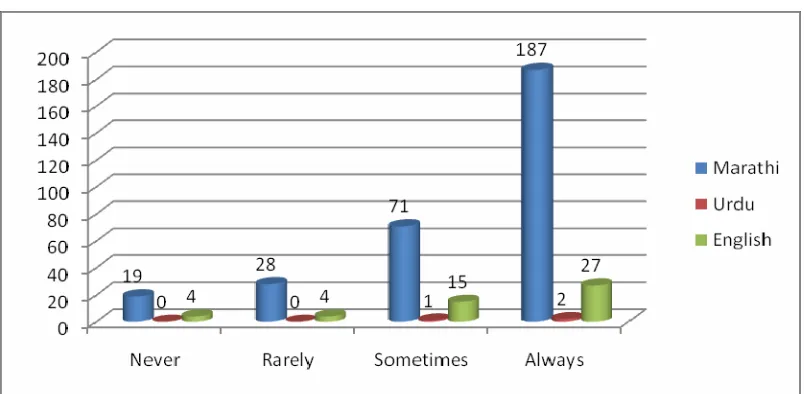
Graph No 4.7.6: Analysis of Teachers on the basis use of various ICT aids.
The above table and graph shows the information about frequently use of information and communication technology (ICT) aids.
It is found that 61.3% of Marathi medium teachers, 66.7% of Urdu medium teachers and 54% of English medium teachers make the use of ICT tools frequently (always).
It is also found that 23.3% of Marathi medium teachers, 33.3% Urdu medium teachers and 30% English medium teacher uses ICT sometimes.
Only 6.2% of Marathi medium teachers and 8% English medium teachers never uses ICT.
While 9.2% of Marathi medium schools and 8% English medium schools rarely use ICT respectively.
Table No 4.7.7: Use of ICT facilities.
Respondents
What types of ICT do you use frequently
Total Computer Internet Multimedia White
Screen
LCD Projector
Mediu m
Marathi 43 83 25 68 86 305
14.1% 27.2% 8.2% 22.3% 28.2%
Urdu 0 1 0 0 2 3 0.0% 33.3% 0.0% 0.0% 66.7%
English 8 15 5 8 14 50 16.0% 30.0% 10.0% 16.0% 28.0%
Total 51 99 30 76 102 358
14.2% 27.7% 8.4% 21.2% 28.5% 100.0%
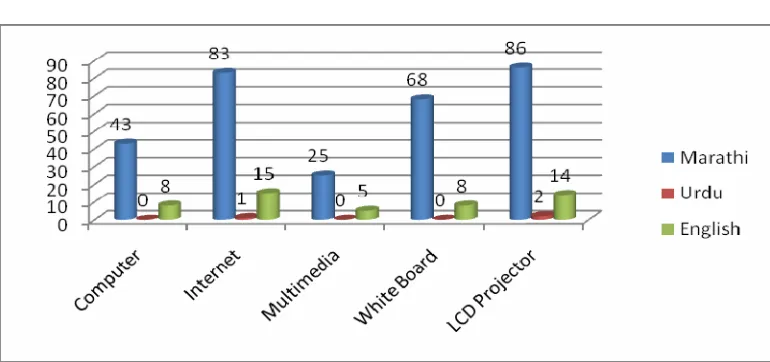
Graph No 4.7.7: Analysis of Teachers on the basis of using ICT
The above table No 4.7.7 and graph No. 4.7.7 reveals the information about different ICT facilities used by teachers in their school.
In Marathi medium schools 14.1% of respondents responded computer used frequently, while 27.2% respondents responded Internet used frequently, 25(8.2%) respondents responded multimedia used frequently, 22.3% respondents responded white screen used frequently and 28.2% respondents responded LCD projector used frequently. In Urdu medium schools 66.7% of respondents responded LCD projector used frequently, while 33.3% respondents responded Internet used frequently.
III. MAJORFINDINGS, CONCLUSIONS, SUGGESTIONS AND RECOMMENDATIONS
This chapter concerns with findings and conclusions presented in section-I and suggestions and recommendations in section-II
The findings are a result of the analysis of data pertaining to students, teachers and administrative staff of selected schools. Further also presented are finding as a result of the testing of hypotheses.
Section-I
A. Major Findings and Conclusions based on Analysis of Data from Survey of Students
Researcher covered 11 Taluka in Satara District and interacted with Marathi, Urdu and English Medium students regarding availability of ICT infrastructure in their school and major findings are as follows:-
1. It is found that there is a difference in availability of ICT infrastructure between private and government schools. It indicates that out of 198 private schools 191 (96.46%) schools responded the availability of ICT infrastructure and 36.22% government schools responded the availability of ICT infrastructure.
It is concluded that, availability of private schools are better in ICT infrastructure as compared to government schools. ( Ref. Table No. 4.1.3)
1. It is found from table 4.1.2 that out of 198 private schools 191 (96.46%) schools having required number of computers and out of 185 only 68(36.22) government schools have required number of computers.
Therefore it is concluded that, there is a difference in availability of computers between private and government schools. As compare to government and private schools more number of private schools are having required numbers of computers.
B. Major Findings and Conclusions based on Analysis of Data from Survey of Teachers
1. Majority of teachers are confident about their use of ICT and its applications.
2. The use of ICT is met with positivity from teachers, contradictory to its actual implementation and application. 3. Teachers responses reflect a high confidence in ICT use, especially for the most basic and intuitive PC tasks.
According to the classification used by the researcher, over half of the ICT skills or applications listed were rated as high, with the remainder rated as medium.
C. Major Findings and Conclusions based on Analysis of Data from Survey of Administrative staff
1. As per the government policies to improve the quality of education, financial support have been given to various schools in each district.
2. It is found that some government schools are not utilizing ICT equipment regularly even after receiving it from government due to negligence and irresponsibility.
Conclusion
The study was conducted to examine the ICT Implementation in school education with special reference to selected schools of Satara district’. ICT in school provide an opportunity to teachers to transform their practices by providing them improved educational content, environment and new learning methods. The present study examines the ICT implementation in private as well as government schools. Researcher covered ZP Schools, Nagarpalika School and private Schools which comprises all the medium.( English/Marathi/Urdu). On the basis of it findings reveal that in comparison to private schools and government schools are quite behind in terms of ICT implementation. Public schools are facing the financial difficulties to implement ICT infrastructure in effective manner and need government support.
Section-II E. Suggestions and Recommendations to Schools
2. As findings reveals that government schools are behind in terms of availability of computers thus, researcher suggested that government should take necessary actions for enhancing the number of computers in government schools for student improvement.
F. Suggestions and Recommendations to Teachers
1. Numbers of computers were very less in Government schools in comparison to Private schools. Researcher suggests that ICT infrastructure should be improved because due to poor ICT infrastructure performance of teachers affects.
2. There is a need to provide appropriate training to teachers for effective use of ICT.
G. Suggestions and Recommendations to Administrative staff
1. Majority of schools were lacking from good ICT aids and need financial support to establish required ICT infrastructure. State Government should provide financial assistance to set up ICT infrastructure.
2. School Management should take initiative for ICT implementation
Conclusion
After accomplishing the smart school development, researcher found that the system is easy to use and user centered. The suggested system smart school successfully finishes user’s requirement by providing instant information.
It has been found that the system effectively registers students along with parental information, easily retrieves information about a student and generates the required reports. In addition to generating a feasible master timetable it produces a timetable for each teacher. Furthermore it has been shown that the web application of the system helps attendance recording by the homeroom teacher and parents can view the status of their children using the Internet or Intranet of the school. It can fulfill all the set objectives.
REFERENCES
1. Teaching ICT, The ICT-Ed Project, The report on learning outcomes and curriculum development in major university disciplines in Information and Communication Technology, Computing Education
2. Research Group, Faculty of Information Technology, Monash University, pp. 275.
3. Multimedia Victoria (2004) Attitudes to ICT careers and study among 17-19 year old Victorians,
4. Department of Innovation, Industry and Regional Development, pp.23.).
5. http://www.mmv.vic.gov.au/Skillsandcareers [Viewed 10 October 2008]