An Efficient Irrigation System with
Environmental Data Analysis Using SVM
Techniques
Dr.M.Rameshkumar, Ramya.G,
Associate professor, Department of Computer Science and Engineering, Dhirajlal Gandhi College of Technology,
Salem, India
Master of Engineering, Department of Computer science and Engineering, Dhirajlal Gandhi College of Technology,
Salem, India
ABSTRACT: Power conservation has become an important research area as the use of cloud computing technology
became more due to the ease of internet usage, processing and storage on cloud. Even small organisations started to use cloud solutions for their customers. This led to the growth of cloud computing techniques, also, to the growth of the data centers in cloud for processing which resulted in significant amounts of drawbacks in the environment like carbon emissions. Agricultural technologies provide the ability to transfer Virtual Machines between the Physical Machines using live agricultural migration in cloud computing. Dynamic physical server consolidation is a technique to reduce the power usage in the data centers by migrating and consolidating green into reduced number of active energy. Since the problem is NP hard, Ant colony system a multi-objective online metaheuristic algorithm for online server consolidation.is used. ACS out performs other existing techniques in terms of underutilized resource usage and agricultural consumption.
KEYWORDS: Big data computing, green cloud, Agricultural consolidation, energy efficient
I. INTRODUCTION
Cloud computing is an internet based on- demand computing, pay as you use model and accessing the computing resources of third parties. The Computing resources have become cheaper, powerful and ubiquitously available than ever before due to the rapid growth in the processing and storage technologies and also the due to the success of Internet. This led to the establishment of more data centers that have significant contribution in the energy consumed worldwide and consequently environmental drawbacks like carbon emission.
The NIST definition for cloud computing[15]
“Cloud computing is a model for enabling ubiquitous, convenient, on-demand network access to a shared pool of configurable computing resources (e.g., networks, servers, storage, applications, and services) that can be rapidly provisioned and released with minimal management effort or service provider interaction”. The cloud model has five essential characteristics.
Essential Cloud Characteristics
On-demand self service
Board network access
Resource provisioning
Rapid elasticity
Measured services
Virtualization is a technique of abstracting the physical resources and make them appear as logical resources i.e., convert all hardware resources into software resources and it may be implemented at compute, storage, and network. The virtualization technology also provides the ability to migrate a VM from one PM to another. The virtualization technique has become attractive since it has many benefits that include optimizing utilization of IT infrastructure, reducing cost and management complexity, reduced deployment time and also increases flexibility.
A data center has four main components such as applications, operating system, network, and data. Modern data centers in the cloud computing environment host a variety of applications that run from few seconds to longer periods.However these data centers consume large amount of energy. According to McKinsey report on “Revolutionizing Data Center Energy Efficiency”:[20]A typical data center uses as much energy as 25,000 households uses. The total energy bill for data centers in 2010 was over $11 billion and energy costs in a typical data centerdoublesevery five years. About 50% of power in the data center is consumed by the servers/storage and computer AC room consumes about 34% of power. So, one of the main problems in a data center is power consumption since it emits more heat as a consequence of more power consumption and needs more cooling devices to reduce heat generated when the number of physical systems increase which results in more costs.Henceforth finding a way to conserve energy is important both for improved ROI and for efficient processing of resources. There have been taken several attempts to save power and currently two main techniques are being used. They are Dynamic Server provisioning and VM consolidation. Dynamic server provisioning saves energy by using reduce amount of resources for satisfying users request and unnecessary servers are switched off or put into standby mode. Dynamic VM Consolidation [5] is another techniquethat helps to reduce the power consumed by the Physical Machines in a data centerbymigrating the Virtual Machines from one physical server to another.
In this paper we have proposed one of the novel bin packing algorithms for efficient placement of VMs onto the Physical hosts. Best Fit Decreasing algorithm (BFD) is used to place the VMs into the physical machines. Here the Virtual Machines are placed in the physical machines such that the number of physical machines needed is minimal to run the VMs. After the initial, efficient placement of the Virtual Machines, the VM consolidation technique is applied to further improve the power conservation in the data centers i.e., minimise the number of active physical hosts and also to increase the resource utilization. Ant colony Optimization is used for the VM consolidation.
Eugen Feller et al had proposed a model in which the workload placement problem is considered as an instance of the multi-dimensional bin-packing (MDBP) problem and design a different, nature inspired algorithm based on the Ant Colony Optimization (ACO) meta-heuristic to figure the placements dynamically, according to the current workload.This is the first work to apply Ant Colony Optimization on the MDBP problem in the context of dynamic workload placement and applyACO in order to conserve energy. Similarly Xiao-Fang et al proposed an approach[19] based on Ant Colony Optimization for efficient VM Placement namely ACO-VMC to efficiently use the physical resource and reduce the number of active physical servers and thus reduce the power consumed in data centers.GaochaoXu et al proposed distributed and parallel ACO algorithm [9] namely DPACO that is executed on several physical servers to get a better solution by increasing the iterative times for the large scale VMs live migration problem. Here migration failures are easily detected since the algorithm runs distributedly and parallely on all hosts.
Not only the migration technique is applied for reducing the active physical servers, the migration and consolidation techniques are also applied for scheduling, load balancing, and resource provisioning paradigms. Ghribi et alhad proposed two exact allocation algorithm for energy efficient scheduling[10] of VMs. The authors had combined the energy efficient VM allocation to the hosts with a consolidation algorithm and thus it is seen as a combined algorithm for saving energy.
There are a number of other ant algorithms like AS, MinMax AS, ACS, Continuous orthogonal ant colony (COAC),that has many applications including Traveling Salesman Problem, Quadratic Assignment Problem, Network Model Problem, Vehicle routing. Here the proposed system uses ACS (Ant Colony System) that has better performance in power saving and some other existing techniques for power conservation in data centers include [6], [7], [11], [18].
Also the initial VM placement to the physical machines is usually done using heuristic algorithms [8], [12], [16].
II. PROPOSED SYSTEM
The proposed system is defined such that the number of active servers to execute the client’s requests is minimal. It places the Virtual Machines onto the Physical Machines using a novel bin packing algorithm. The bin packing problem is a combinatorial NP-hard problem. In these problems, the objects of different volumes must be packed into a finite number of bins of capacity M.Here the VMs are initially placed into the Physical Machines using Best Fit Decreasing (BFD) algorithm. Best Fit Decreasing is best known for offline bin packing. The context of BFD is applied to the proposed system such thatthePMs are assumed to be the bins and the VMs are considered as the objects. BFD first sorts all VMs by their utilization weights in the non-increasing order (i.e., utilization weights in decreasing order). Then, it starts with the VMs that need the largest amount of resources for processing the request. The objective of bin packing problems is to minimize the number of bins while packing all the objects. The BFD algorithm allocates VMs to the Physical Machines(PMs) in such a way that the unused capacity in the destination PMs is minimized. Best Fit can be easily implemented in O (N log N) time. Best Fit and First Fit never uses more than 1.7 times optimal.
The pseudocode of Best fit decreasing algorithm is given below:
1: sort the objects in non-increasing order. 2: for All objects i = 1, 2, . . . , n do 3: for All bins j = 1, 2, . . . do 4: if Object i fits in bin j then
5: Calculate remaining capacity after the object has been added. 6: end if
7: end for
8: Pack object i in bin j, where j is the bin with minimum remaining capacity after adding the object (i.e. the object “fits best”).
9: If no such bin exists, open a new one and add the object. 10: end for.
Algorithm1: Best Fit Decreasing for WSN Placement.
Due to varying workloads the initial efficient placement must be augmented with VM Consolidation technique since the resource utilization of a VM keeps on changing. Hence after the efficient initial placement of VMs into the Physical Machines, the Dynamic consolidation technique is applied periodically to further improve the system. The dynamic consolidation of VMs is used to consolidate the Virtual Machines into reduced number of active Physical Machines and thus minimising the amount of power consumed by the data center through switching off the unused servers. Here to consolidate the VMs, an optimal metaheuristic online algorithm namely Ant Colony System is used. The Ant Colony System is an NP hard problem and tries to get a near optimal solution for the VM placement. It is a reinforcement learning technique that modifies the problem representation at each iteration by iteratively adding solution components like Heuristic information also called heuristic value that gives a priori information about each instance or run time information provided by a source different from other ants. Most of the times it is the cost factor according to which the problem is designed and Trace/Pheromone trails are the long term memory about the entire ants traversal process and is updated by the ants themselves. The Ant Colony System is a well-known solution that is being used for more hard combinatorial problems. The proposed ACS-based VM Consolidation[5] (ACS-VMC) approach uses artificial ants for consolidating the VMs into a reduced number of active PMs according to the current resource needs so that power consumed by the idle machines can be reduced.
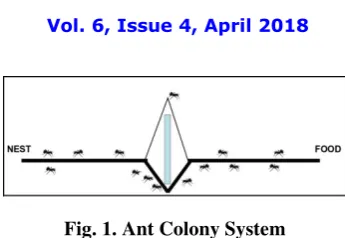
Fig. 1. Ant Colony System
While searching for food, the ants move in groups simultaneously searching the food in many different paths. Each ant deposits pheromone in its path so that the other ants follow it sensing that pheromone trails. The path which has high pheromone trail is the path which is used by other ants for communication and the ants always uses the path which has the shortest distance between its nest and the food source which is a well-known reason why many hard problems are solved using Ant System. The shortest path has more pheromone trails.
The VMs are migrated after their initial placements from a Physical Machine to another if they fall under any one of the following threshold levels.The host those which are to be migrated can be found using any one of the three ways namely periodic adaptation, threshold based, decision making based on the historical data. The proposed system uses the second way i.e., the threshold based.
Hot spots- the power consumed in a Physical Machine exceeds the upper threshold level so that some of its
VMs can be migrated from it.
Cold spots- the Physical Machine utilization is below the lower threshold and hence its VMs can be migrated
from it so, that Physical Machine can be put into sleep mode and thus providing a way for power conservation.
ACS based VM consolidation[5] doesn’t only decrease the power consumed by the Physical Machines in the data centers, it also results in minimum number of VM migrations but also improves the resource utilization of the Physical Machines in the data centers
Below is the general pseudocode for any Ant Colony System.
Input: a set of PMs and VMs
Output: reduced set of active PMs.
1. initialize pheromone trails
2. declare threshold values for nodes
3. ants move through nodes
4. if load<threshold
5. traverse to node with nearest maximum trailing pheromone
6. else
7. traverse to node with minimum foraging pheromone
8. reassign resources if node is needed.
Algorithm 2: Agricultural Consolidation
1. The PM where the VM resides is the source PM psoand a VM can be migrated to any other PM.
2. Any other PM is a potential destination PM pdeto which a VM has been migrated.
3. The algorithm creates tuples consisting of the source PM pso, the VM to be migrated v, and the destination PM pde. t= (pso,v,pde) (1) (4.1)
4. There are two constraints while making a tuple
1. Only a predicted overloaded, or an overloaded, or an under-loaded PM can be a source PM pso . 2. None of the overloaded Pover or predicted overloaded ^Pover PMs can become a destination PMpde .
𝑓 𝑀 = |𝑝𝑠|𝛾+ 1 |𝑀|(2) where, M is the migration plan,
Ps is set of PMs that will be switched to sleep mode 𝛾determines implementation of |ps| with respect to |M|
6. When all VMs are migrated from a PM then that PM can be put into sleep mode.
7. When the migration plan is enforced it restricts reduced number of active PMs and results in reduced underutilization of PMs.
8. A PM can only be switched to the sleep mode when all of its VMs migrate from it, that is, when the PM no longer hosts any VMs.
Ps = {p € P | Vp = 0} (3)
9. Each of the nA ants uses a stochastic state transition rule to select the next tuple to traverse.
kQ/ LK , if ( i,j ) Є path described
Δτ =
t0 , otherwise (4)
10. The probability ps of an ant k to choose tuple s to traverse next is defined as
k[𝜏ij (t)]α[ηij]β(5) p (t) =
ijΣ[τ
ik(t)α[ηik]β
11. The pheromone of each node is calculated as follows. It is calculated after all ants finished their traversals. k
Δ τ ij :=Δ τ ij+ Δ τ ij (6)
12. The pheromone value is calculated as above every time by each ant after each iteration. The heuristic value of a tuple s is defined as
ηs= (|Cpde– (U pde + Uv)|1)-1 if (U pde + Uv)<=Cpde 0, else (7)
13. It favours VM migrations that result in a reduced number of under-utilization of PMs. Furthermore, the constraint (U pde +Uv)<=Cpdeprevents migrations that would result in the overloading of the destination PM pde.Updedenotes the utilization capacity of pdeandUv denotes the utilized capacity in destination PM by a virtual machine v.
14. Local and Global migration evaporation rule are also applied at the end of each iteration.
15. Evaporation avoids unrestrictedincrease of the pheromone trails and enables the algorithm to forget bad decisions previously taken.
16. After evaporation, all ants deposit theirpheromonetrails on the arcs they have crossed in their tour.
At the end of ACS VMC, the number of active Physical Machines is restricted when the appropriate migration plan is enforced by migrating some of the Virtual Machines to other active Physical Machines. Thus a Physical Machine is switched on only when it is not possible to migrate a VM to an already active Physical server.
III. RESULTS AND DISCUSSIONS
The proposed system is simulated using a well-known platform calledCloudSim. The primary objective of
CloudSim is to provide a generalized and extensible simulation framework that enables seamless modelling, simulation, and experimentation of emerging Cloud computing infrastructures and application services. Two thresholds levels are proposed namely hot and cold threshold. If the CPU utilization falls below the cold threshold, the VMs are consolidated for energy conservation and if the CPU utilization becomes more than the hot threshold, the VMs are reassigned for balancing the load for resource utilization of PMs.
Fig.2. Resource Utilization.
The resource utilization by the Physical Machines before consolidation and after consolidation using ACS-VMC is computed when the threshold reaches the hot level. Fig.2 clearly shows that the resource utilization is more after consolidating the VMs.
Similarly the power consumption of the Physical Machines before and after consolidation is computed when the threshold falls below the cold threshold. It is compared and shown below.
Fig.3. Power Consumption.
It is clear from the above figure that the power consumption is minimal only after the consolidation of VMs.
IV. CONCLUSION AND FUTURE WORK
The future work of the proposed system is to compare the proposed approach with other heuristic algorithms and also to use other techniques for power saving similar to VM Consolidation and to compare their performance results.
REFERENCES
[1]Anton Beloglazov_ and RajkumarBuyya, “Optimal Online Deterministic Algorithms and Adaptive Heuristics for Energy and Performance Efficient Dynamic Consolidation of Virtual Machines in Cloud Data Centers”, CONCURRENCY AND COMPUTATION: PRACTICE AND EXPERIENCE Concurrency Computat.:Pract. Exper. 2012; 24:1397–1420 Published online in Wiley InterScience (www.interscience.wiley.com). DOI: 10.1002/cpe.1867
[2]A. Ashraf, M. Hartikainen, U. Hassan, K. Heljanko, J. Lilius,T.Mikkonen, I.Porres, M.Syeed, and S. Tarkoma, “Introduction to cloud computing technologies in Developing Cloud Software: Algorithms, Applications, and Tools”, Finland: Turku Centre for Computer Science (TUCS) General Publication Number 60, Oct. 2013, pp. 1–41.
[3]A. Ashraf, “Cost-efficient virtual machine management: Provisioning, admission control, and consolidation,” Ph.D. dissertation, Turku Centre for Computer Science (TUCS) Dissertations Number183, ^ Abo, Finland, Oct. 2014.
[4]B. Benita Jacinth Suseela, “A Survey on VM Placement on Cloud”International Journal of Engineering Trends and Technology (IJETT) – Volume 6 Number 7- Dec 2013-A.
[5]FahimehFarahnakian, Adnan Ashraf,TapioPahikkala“Using Ant Colony System to Consolidate VMs for Green Cloud Computing”. IEEE TRANSACTIONS ON SERVICES COMPUTING, VOL. 8, NO. 2, MARCH/APRIL 2015
[6]M. Ferdaus, M. Murshed, R. Calheiros, and R. Buyya, “Virtual machine consolidation in cloud data centers using ACO metaheuristic,” in Proc. 20th Int. Eur. Conf. Parallel Process., 2014, vol. 8632, pp. 306–317.
[7]E. Feller, C. Morin, and A. Esnault, “A case for fully decentralized dynamic VM consolidation in clouds,” in Proc. IEEE 4th Int. Conf. Cloud Comput. Technol. Sci., Dec. 2012, pp. 26–33.
[8]Fthiagoko, Albert, Batista, Gold, “Consolidation of VMs to Improve Energy Efficiency in Cloud Data Centers”. Institute of Mathematics and Statistics (IME) – University of Sao Paulo (USP) Sao Paulo, SP, Brazil2014.
[9]GaochaoXu, YushuangDong, Xiaodong Fu, “VM Placement Strategy Based On Distributed Parallel Ant Colony Optimization Algorithm”. Applied Mathematics & Information Sciences 2015
[10]F Ghribi, MakhloufHadji and DjamalZeghlache, “Energy Efficient VM Scheduling for Cloud Data Centers: Exact allocation and migration algorithms”
[11]M. Harman, K. Lakhotia, J. Singer, D. R. White, and S. Yoo, “Cloud engineering is search based software engineering too,” J.Syst. Softw., vol. 86, no. 9, pp. 2225–2241, 2013.
[12] Li Y, Li W, Jiang C,“A Novel Artificial Bee Colony Approach of Live Virtual Machine Migration Policy Using Bayes Theorem”- Proceedings of the 3rd International Symposium on Electronic Commerce and Security (ISECS '10); July 2010; pp. 332–336.
[13] Louis Rolling, Christine Morin, “Energy Aware Ant Colony Based Workload Placement in Cloud”. - Copyright 2014 ACM 978-1-4503-2662-9/14/07 2011 GECCO '14, July 12–16, 2014, Vancouver, BC, Canada.
[14] MakhloufHadji, Paul Labrogere,“Online Algorithm for Servers Consolidation in Cloud Data Centers”. Technological Research Institute - IRT SystemX8, Avenue de la Vauve, 91120 Palaiseau, France.
[15] P. Mell and T.Grance. (2011, Sept.). “The NIST definition of cloud computing” Recommendations of the National Institute of Standards and Technology.Special Publication 800-145 [Online]. Available: http://csrc.nist.gov/publications/nistpubs/800145/SP800-145.pdf
[16] G. Motta, N.S fondrini, and D.Sacco, “Cloud computing: An architectural and technological overview,” in Proc. Int. Joint Conf.Serv. Sci., 2012, pp. 23–27.
[17]I.Sriram and A.Khajeh-Hosseini, “Research agenda in cloud technologies,”Large Scale Complex IT Syst. (LSCITS), Univ. Bristol, U.K., 2010http://arxiv.org/ftp/arxiv/papers/1001/1001.3257.pdf
[18]P.-Y. Yin and J.-Y. Wang, “Ant colony optimization for the nonlinear resource allocation problem,” Appl. Math. Comput., vol. 174, no. 2, pp. 1438–1453, 2006.
[19]Xiao-Fang Liua, Zhi-HuiZhana(Corresponding Author), Ke-Jing Dub, Wei-NengChenc, “Energy Aware Virtual Machine Placement Scheduling in Cloud Computing Based on Ant Colony Optimization Approach”, Department of Computer Science, Sun Yat-sen University, Guangzhou, P. R. China. http://dx.doi.org/10.1145/2576768.2598265