University of Windsor University of Windsor
Scholarship at UWindsor
Scholarship at UWindsor
Electronic Theses and Dissertations Theses, Dissertations, and Major Papers
2010
Mechanisms Regulating the Composition, Structure and
Mechanisms Regulating the Composition, Structure and
Dynamics of Biological Communities: Insights from Freshwater
Dynamics of Biological Communities: Insights from Freshwater
Diatom Communities
Diatom Communities
Andrew Bramburger University of Windsor
Follow this and additional works at: https://scholar.uwindsor.ca/etd
Recommended Citation Recommended Citation
Bramburger, Andrew, "Mechanisms Regulating the Composition, Structure and Dynamics of Biological Communities: Insights from Freshwater Diatom Communities" (2010). Electronic Theses and
Dissertations. 378.
https://scholar.uwindsor.ca/etd/378
This online database contains the full-text of PhD dissertations and Masters’ theses of University of Windsor students from 1954 forward. These documents are made available for personal study and research purposes only, in accordance with the Canadian Copyright Act and the Creative Commons license—CC BY-NC-ND (Attribution, Non-Commercial, No Derivative Works). Under this license, works must always be attributed to the copyright holder (original author), cannot be used for any commercial purposes, and may not be altered. Any other use would require the permission of the copyright holder. Students may inquire about withdrawing their dissertation and/or thesis from this database. For additional inquiries, please contact the repository administrator via email
MECHANISMS REGULATING THE COMPOSITION, STRUCTURE AND
DYNAMICS OF BIOLOGICAL COMMUNITIES: INSIGHTS FROM FRESHWATER DIATOM COMMUNITIES
Andrew J. Bramburger
A Dissertation submitted to the Faculty of Graduate Studies through the Great Lakes Institute for Environmental Research, University of Windsor,
in partial fulfillment of the requirements for the degree of Ph.D. in Environmental Sciences.
Declatarion of Co-Authorship / Previous Publication
I. Co-Authorship Declaration
I hereby declare that this thesis incorporates material thatis result of joint research, as follows: Two paragraphs in the Methods and Results sections of Chapter 2 regarding phytoplankton counts in Lake Matano include contributions by Paul B. Hamilton of the Canadian Museum of Nature.
I am aware of the University of Windsor Senate Policy on Authorship and I certify that I have properly acknowledged the contribution of other researchers to my thesis, and have
obtained written permission from each of the co-author(s) to include the above material(s) in my thesis.
I certify that, with the above qualification, this thesis, and the research to which it refers, is the product of my own work.
II. Declaration of Previous Publication
This thesis includes no original papers that have been previously published/submitted. Chapters 2 and 4 contain interpretations of data that was included in the following papers:
Thesis Chapter Publication title/full citation Publication status*
Chapter 2 Bramburger, A.J., Hamilton, P.B., Hehanussa, P.E. & Haffner, G.D. (2008). Spatial patterns of planktonic and benthic diatom distribution and assemblage similarity in Lake Matano (Sulawesi Island, Indonesia). In Likgisgwat, T. ed. Proceedings of the 19th International Diatom Symposium. pp 1-13.
published
Chapter 2 Bramburger, A.J., Hamilton, P.B., Hehanussa, P.E. & Haffner, G.D. (2008). Factors regulating the community composition and relative abundance of taxa in the diatom communities of the Malili Lakes, Sulawesi Island, Indonesia. Hydrobiologia 615, 215 - 224.
published
Chapter 4 Bramburger, A.J., Hamilton, P.B., Hehanussa, P.E. & Haffner, G.D. (in press). Colonization of artificial substrates by the littoral diatom community of an ancient, tropical lake. Journal of Phycology. 18pp.
In press
I certify that I have obtained a written permission from the copyright owner(s) to include the above published material(s) in my thesis. I certify that the above material describes work completed during my registration as graduate student at the University of Windsor.
I declare that, to the best of my knowledge, my thesis does not infringe upon anyone’s copyright nor violate any proprietary rights and that any ideas, techniques, quotations, or any other material from the work of other people included in my thesis, published or otherwise, are fully acknowledged in accordance with the standard referencing practices. Furthermore, to the extent that I have included copyrighted material that surpasses the bounds of fair dealing within the meaning of the Canada Copyright Act, I certify that I have obtained a written permission from the copyright owner(s) to include such material(s) in my thesis.
iv
ABSTRACT
Since the time of Wallace and Darwin, ecologists have sought to describe the
“Rules of Assembly” – a set of basic, universal tenets that would regulate the
composition, structure, and dynamics of groups of organisms in the same manner as the
laws of physics and chemistry regulate interactions of matter in the universe. To date,
these “Rules of Assembly” have proven elusive, and several authors have postulated that
the inherent complexity of natural communities precludes investigators from ever
describing these rules. In this dissertation, I used data from benthic diatom communities
of tropical (Lake Matano, Sulawesi, Indonesia) and temperate (Mazinaw Lake, Ontario,
Canada) freshwater lakes to evaluate several novel models regarding the mechanisms that
regulate the composition, structure, and relative abundance of biological communities. I
demonstrated that in Lake Matano, diatom communities exhibited high degrees of
small-scale patchiness and were not regulated by geographic proximity or substrate
characteristics. The small scale patchiness exhibited by this system was a result of a high
degree of ecological specialization among the diatom taxa of the lake. Such elevated
levels of ecological specialization were shown to be characteristic of low-latitude
habitats. In general, groups of species with higher levels of ecological specialization
exhibited higher levels of taxonomic diversity and lower species abundances, and my
results demonstrate that more specialized taxa tended to partition resources while
generalists were more prone to competitive effects. In colonization experiments,
assemblages from low latitudes proceeded quickly through the early successional period
and exhibited deterministic community structure in as little as ten days. This
system and succession was frequently “reset” by weather events. Additionally, taxa from
within the tropical assemblage responded independently when subjected to a simulated
upwelling event, and neither simulated nor actual disturbances invoked changes in
community composition in this system. In summary, I proposed the following “Rules of
Assembly” as they pertain to diatom communities:
1. Niche breadth, or ecological specialization, is determined by tradeoffs between
temporal and spatial habitat variability.
2. Taxonomic richness and species abundance are regulated by ecological
specialization.
3. Whether community structure and dynamics are primarily influenced by
deterministic or stochastic mechanisms is regulated by ecological specialization
and environmental conditions.
vi DEDICATION:
To Shannon…
ACKNOWLEDGEMENTS:
viii TABLE OF CONTENTS
Declaration of Co-Authorship / Previous Publication iii
Abstract iv
Dedication vi
Acknowledgements vii
Chapter 1: The Malili Lakes: A natural laboratory for ecology and evolution.
12
Table 1 27
Figure Legend 28
Figure 1 29
Figure 2 30
Figure 3 31
Figure 4 32
Chapter 2: Spatial patterns of planktonic and benthic diatom distribution and assemblage similarity in Lake Matano (Sulawesi Island, Indonesia).
33
Abstract 33
Introduction 34 Materials and Methods 37
Results 39
Discussion 42
Table 1 48
Table 2 51
Table 3 52
Figure Legend 53
Figure 1 55
Figure 2 56
Figure 3 57
Chapter 3: Adapt or adopt: mechanisms that regulate the composition and structure of benthic diatom assemblages in freshwater lakes.
58
Abstract 58
Introduction 59
Materials and Methods 62
Results 65
Discussion 67
Table 1 73
Table 2 75
Table 3 81
Figure Legend 84
Figure 1 86
Figure 2 87
Figure 3 88
Figure 4 89
Figure 5 90
Figure 7 95 Chapter 4: Colonization of artificial substrates by the littoral diatom
communities of an ancient, tropical lake and a deep, temperate lake.
96
Abstract 96
Introduction 98
Materials and Methods 100
Results 103
Discussion 105
Figure Legend 112
Figure 1 114
Figure 2 115
Figure 3 116
Figure 4 117
Figure 5 118
Chapter 5: Effects of a simulated upwelling event on the littoral, epilithic diatom community of an ancient, tropical lake.
119
Abstract 119
Introduction 120
Materials and Methods 123
Results 128
Discussion 130
Table 1 137
Table 2 138
Table 3 139
Table 4 140
Figure Legend 144
Figure 1 145
Figure 2 146
Figure 3 147
Chapter 6: Effects of a small town on the benthic, episammic diatom community of an ancient tropical lake.
148
Abstract 148
Introduction 149
Materials and Methods 152
Results 154
Discussion 155
Table 1 159
Figure Legend 160
Figure 1 161
Figure 2 162
Figure 3 163
Figure 4 164
Figure 5 165
x Stochastic and Deterministic Regulation of Community
Structure
170
Community Dynamics and Response to Perturbation 172 Summary and Proposed “Rules of Assembly” 174
Literature Cited 178
Appendix 1: Count data for Lake Matano Benthic and Planktonic Diatom Assemblages
201
Vita Auctoris 219
“Nature seems to have taken every precaution that these, her choicest treasures, may not lose value by being too easily obtained.”
12 CHAPTER 1:
Before Ernst Haeckl coined the term “ecology,” naturalists have sought to
understand the manner in which species interact with one another, and with their abiotic
environments. Unlike physics and chemistry, ecology has yet to establish basic tenets that
govern the dynamics of biological assemblages. Identifying these “rules of assembly” has
proven elusive, and out of necessity, much of our understanding of community structure
in biological assemblages has been descriptive. Several authors have proposed general
“rules of thumb” for predicting community dynamics and pattern. Tilman (1982)
proposed a set of mechanistic models that served to predict the outcomes of interspecific
competition in simple food webs. Further simplification of these models demonstrated
that exploitative interspecific competition outcomes could be predicted by a simple rule
of thumb – the species that depresses limiting resources to the lowest level consistent
with its own maintenance (R*) is generally the most successful in competitive
interactions (Tilman 1990). Similarly, Holt et al. (1994) showed that the dominant prey
species in a competitive interaction is generally the one that maintains the highest density
of a shared predator. These authors cautioned, however, that the utility of these rules of
thumb is limited by the existence of multiple limiting resources and shared predators, and
general theories of competition and predation, they note, seem to be “lost in a sea of
special cases.” Drake (1990) reviewed a series of contolled laboratory and field
experiments that exhibited “assembly rule phenomena.” Drake postulated that while there
was sufficient evidence that assembly rules can regulate community pattern, the rules
themselves are difficult to uncover in natural communities. While “bundles” of rules
could apply to specific communities, Drake concluded that much further work was
14 The dynamics of most biological communities will remain difficult to resolve
without a set of basic constructs that provide a framework for community function and
biological interactions. Most natural systems harbor sufficient abiotic, biological, and
anthropogenic complexity in time and space to confound understanding of all but the
simplest interspecific relationships. Some authors have argued that this complexity
precludes the establishment of a set of general rules (Lawton 1999, Simberloff 2004).
Many investigators have therefore opted to study community by using manipulative
studies of pairwise species interactions (McGill et al. 2006), or by observing assemblages
that are taxonomically poor or existing in extreme or unique environments (Tilman 1977,
Hubbel 1980, Grover 1988, Wall & Virginia 1999 Shea & Chesson 2001).
Within community ecology, there is continued debate over whether natural
communities are regulated by stochastic or deterministic processes. Early focus on
dynamics of plant communities led to the concept of ecological succession to a stable
climax community (Clements 1916). Within Clements’ (1916) framework, disturbance
was considered to be relatively unimportant to community processes, and all
communities were thought to eventually arrive at the climax condition appropriate to
their regional microclimate. Subsequently, Tansley (1935) and Whittaker (1953)
argued that no single climax state existed for any community. Alternatively, they
suggested that a community could proceed towards any one of a number of multiple
steady states determined by subtle differences in ambient conditions.
Several other authors have argued against deterministic processes regulating
community structure, as well as the concept of climax communities (whether mono-or
Community,” Watt (1947 as cited in Wu & Loucks 1995) argued that plant communities
were not fixed climax communities, but mosaics of patches in various states of recovery
from perturbation. Stochastic mechanisms related to disturbance have been invoked to
describe dynamics in many habitats including grasslands (Loucks et al. 1985), forests
(Botkin et al. 1972, Shugart 1984) and intertidal zones (Paine 1966, Levin & Paine 1974,
1974).
Among the many lakes of the world, a few are unique in that they are several
orders of magnitude older than the majority (Brooks 1950). These ancient lakes are often
arenas of speciation and are hotspots of global biodiversity with their biota frequently
dominated by endemic taxa. The striking endemism of these systems alludes to their
uniqueness, and they are regarded by many ecologists and evolutionary biologists as
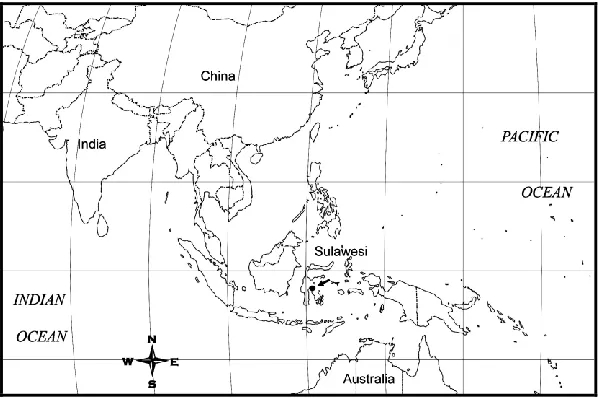
important “natural laboratories.” The Malili Lakes (Fig. 1), located on central Sulawesi
Island, Indonesia, are unique among ancient lakes in that they alone form a hydrological
continuum (Brooks 1950). Lake Matano, the headwater of the chain, is a graben lake with
a maximum depth of 590 m (Van Bemmelin 1970) and is estimated to be approximately
4 million years old (Brooks 1950, Haffner et al. 2001). Matano drains into Lake
Mahalona through the Petea River at a rate of 25–30 m3s -1
. Mahalona further drains via the
Tominonga River into Lake Towuti, which is in turn drained by the Larona River.
Although also tectonic in origin, due to the complex faulting of the region, the lower two
lakes are not graben lakes, and have maximum depths of 72 m and 220 m, respectively.
Lakes Masapi and Lontoa are small satellite lakes adjacent to Lake Towuti. Although
these smaller lakes share a common drainage with the other lakes within the chain, they
16 Studies of the limnology of the lakes began with Sarasin and Sarasin (1895) who
conducted a cursory examination of Lake Matano. Van Bemmelin (1970) described
Matano as classical example of a graben lake, located within a major strike-slip fault that
was probably created when Sulawesi was formed in the late Pliocene. Matano’s drainage
basin is comprised primarily of ultrabasic bedrock containing elevated concentrations of
several metals, specifically iron and nickel (Silver et al. 1978, Hope 2001). The
concentrations of many of these metals are also elevated in the water column of the lake
itself (Crowe et al. 2008), and are thought to influence algal and microbial production
dynamics within the planktonic community of the lake (Crowe et al 2008, Sabo et al.
2008). Water chemistry in Lakes Mahalona and Towuti remains very similar to that in
Matano (Table 1).
Despite the fact that the Malili Lakes represent the oldest island-based aquatic
ecosystems in the world (Haffner et al. 2001), their ecology has not been addressed until
relatively recently. The fishes of Lake Matano were first documented by Boulenger
(1897), and it wasn’t until the late 1980s that Kottelat (1990a, b, 1991, 1992) described
the fishes from the other lakes in the system. A German expedition led by Woltereck in
the late 1930s resulted in the description of many protozoa and small animal taxa from
the system, many of which were endemic (Woltereck 1937a, b). Hustedt (1942a, b)
reported over 250 taxa of diatoms from the Malili Lakes. Many of these species were
restricted to the drainage basin, or to individual lakes within the system, and Hustedt
(1942a) remarked that he anticipated the observation of a much higher degree of
endemism as further taxonomic work was conducted in the system. The high level of
consistent with the findings of several authors who have reported high levels of
endemism among Sulawesi’s terrestrial fauna and flora (Wallace 1860, Meyers et al.
1999, Whitten et al 2002).
More recent investigations of the biota of the Malili Lakes have not only verified
Hustedt’s (1942a) speculations, but have also revealed unexpected floristic and
distributional patterns in several taxonomic groups. The fishes represent the most
comprehensively studied group of organisms within the system. Kottelat (1990a, b, 1991,
1992) reported a total of 19 taxa of fishes representing four families from Lakes Matano,
Mahalona and Towuti. Subsequent analysis utilizing molecular techniques by Roy et al.
(2004, 2007a,b), Herder et al. (2006), Schwarzer et al. (2008) and Walter et al. (2008)
have helped elucidate phylogenetic relationships among fishes within the genera
Telmatherina and Paratherina, from the family Telmatherinidae. Currently, multiple
species are recognized within 3 distinct mitochondrial lineages within the Telmatherina
in Lake Matano (Roy et al. 2007a). Interestingly, geometric morphometrics of the
feeding apparatus of these fishes, coupled with diet and stable isotope analysis revealed
that the three genetic lineages correspond with three feeding guilds within the lake –
benthic, limnetic, and intermediate “generalist” feeding groups. This finding suggests that
food resource partitioning has had an important role in the sympatric radiation of
Telmatherinid fishes in Lake Matano. Walter (2008) demonstrated a similar pattern of
adaptive sympatric speciation in fishes of the genus Paratherina in Lakes Mahalona and
Towuti.
While both Roy et al. (2007a,b) and Walter et al. (2008) postulate that species
18 competitive environment, Herder et al. (2006, 2008) argued that introgressive
hybridization has also had an important influence on the development of Telmatherinid
fish taxa in the Malili Lakes system. Herder et al. (2006) also suggested that the
connecting channels and tributaries of the Malili Lakes have served as refugia and zones
of hybridization during times of stress or low water levels. Community dynamics in the
Malili Lakes Telmatherinids, therefore, appear to be driven largely by ongoing
deterministic processes related to resource partitioning in times of stability, and
components of generalism and stochasticity exert an influence on the community in times
of stress. Despite the assertion of Herder et al. (2006) that less taxonomically rich
endemic species flocks represent ideal systems in which to study patterns of adaptive
radiation and introgression, the fish community of the Malili Lakes is not sufficiently rich
to adequately test community ecology theory. Additionally, there remains substantial
uncertainty as to the taxonomy and systematics of the Malili Lakes fishes, and we must
therefore rely on other species-rich groups for community analysis.
Aside from the fishes, the best documented aquatic fauna from Sulawesi are the
Gastropods, Decapods, and more recently, zooplankton. Roy et al. (2006) demonstrated
that small-scale vicariance and micro-allopatric processes have functioned in the genetic
and morphological divergence of populations of the decapod Caridina lanceolata from
Lakes Matano and Mahalona. In this case, the Petea River was cited as an important
barrier to gene flow between the two lakes, and these data are consistent with data from
the Telmatherinid fishes of the system (Roy et al. 2004, 2007a). Similarly, von Rintelen
et al. (2004), von Rintelen & Glaubrecht (2005) and Glaubrecht & von Rintelen (2008)
influence on the development of endemic species flocks within the gastropod genus
Tylomelania in the Malili and Poso drainage basins. Currently, 25 species of Tylomelania
have been reported from the Malili Lakes system, with many taxa restricted to single
lakes, or indeed single islands or capes within lakes (Glaubrecht & von Rintelen 2008).
Although allopatric processes have had an influence on the gastropod evolution on
Sulawesi, adaptive differentiation of the trophic apparatus has provided the primary
driving force in the radiation of the lacustrine forms (von Rintelen et al. 2004) and within
Sulawesi’s lakes, up to seven species have been reported within single habitat patches
with sufficient structural complexity (Glaubrecht & von Rintelen 2008) as opposed to the
single species per patch typical of lotic systems. Additionally, taxa exposed to predation
by large, molluscivorous crabs have evolved thicker shells than those occupying crab-free
systems. In an interesting case of proposed co-evolution, the chelae of crabs within these
same systems are enlarged, and often bear multiple calcified dentitions (Glaubrecht &
von Rintelen 2008).
The zooplankton species of the Malili Lakes are consistent with the fishes and
other invertebrates in that they too are mostly endemic. Morphologically, copepods
appear to be the same taxon from lake to lake. Recent molecular work, however, has
shown subtle genetic differences among populations that may warrant distinction as
separate cryptic species (Cristescu unpublished data). In Lake Matano, zooplankton
density is typically very low, and the community is comprised of few taxa that show
a strong vertical structure in the water column (Sabo et al. 2008). The depauperate
nature of Matano’s zooplankton community is probably due to minimal primary
20
Peridinium palustre var. raciborskii. Additionally, community responses to possible
selective pressures such as Cr toxicity (Sabo et al. 2008) may exert a structuring
influence on the zooplankton community of the lakes (see Fernando 1987).
The evolutionary and distributional trends within various groups of macrofauna
within the Malili Lakes are remarkably congruent – taxonomically impoverished
communities typically comprised of ecologically specialist endemic taxa, many of which
have evolved through resource partitioning in sympatry. The question remains, however,
what are the mechanisms that generate ecological specialization within a community? Is
there a cost associated with being endemic? Are endemic taxa typically specialists? The
taxonomic groups discussed thus far simply do not provide sufficient numbers of taxa or
individuals to address these questions, and we must turn to more numerous, smaller taxa,
including the phytoplankton and microphytobenthos.
In the Malili Lakes, exceptional water clarity (Secchi disk depths of 20+ m in
Matano and Towuti) hints at an unproductive, highly oligotrophic system. In fact,
reported phytoplankton biomass estimates of 2.0 x 10⁻³ mg L -1
to 0.013 mg L -1
for Lake Matano
(Lehmuslotto et al. 1999, Sabo et al. 2008) place it among the most unproductive lakes
according to Reynolds et al’s (2000) classification system for lake productivity. In
contrast, Lake Tanganyika, another tropical lake with similar morphology to Matano
sustains a phytoplankton biomass of 0.9 mg L-1 (Reynolds et al. 2000). In the first
comprehensive study of the planktonic community of Lake Matano, Sabo et al. (2008)
reported that the taxonomic diversity of Lake Matano’s phytoplankton is reflective of
the low biomass, and is comprised primarily of small cyanoprokaryota (picoplankton)
pelagic assemblage is composed of desmids, single-cell and colonial chlorophytes, and
dinoflagellates. Many of these taxa, including B. longirostris, however, also figure
prominently in Matano’s littoral microbenthos, and may not represent truly planktonic
forms (Sabo et al. 2008, Bramburger et al. 2004). Interestingly, with the exception of
the diatoms, the majority of taxa within Matano’s phytoplankton community do not
represent strictly endemic forms and this result is in contrast with findings from other
taxonomic groups in the system. Despite their morphological similarity, ongoing
molecular work in this group also demonstrated the potential importance of adaptive
processes on a local scale.
The benthic diatom flora of the Malili Lakes was first described by Hustedt
(1942a, b). A more recent survey by Bramburger et al. (2004) revealed unexpected
fine-scale structure in the diatoms of Lakes Matano, Mahalona, Towuti, and Masapi. Like the
gastropods (Glaubrecht & von Rintelen 2008), the diatom assemblage of the Malili Lakes
is dominated by endemic taxa (~95% Bramburger et al. 2004, 2006), and many taxa are
restricted to single lakes, or even to specific areas within lakes. In fact, of the 265 taxa
reported from the Malili Lakes, only 7 were found in all 4 of the lakes surveyed
(Bramburger et al. 2004). These results stand in stark contrast to the classically held
paradigm of cosmopolitan diatom distributions (Cleve 1894, 1895) and current notions
concerning homogenization of freshwater biota on regional or larger scales (Simberloff
and Van Holle 1999, Rahel 2002). In all 4 of the lakes surveyed, Bramburger et al.
(2004) reported that very few taxa were responsible for the vast majority of the numerical
abundance of the diatom communities, and most taxa could be described as extremely
22 lake-to-lake differences.
In order to quantify differences and similarities in the diatom assemblages of the
Malili Lakes, Bramburger et al. (2004) used similarity indices. There were no significant
differences in assemblage similarity regardless of the lakes included in the pairing,
suggesting that the diatom assemblages of the lakes evolved independently, and advective
propagule input from Lake Matano had little influence on the assemblages of downstream
lakes. In addition to advective transport, diatoms disperse over long distances by a host of
vectors including suspension on wind currents as aerosols or dust particles (Darwin 1841)
and through various human and animal mediated means. It is therefore assumed that
diatom propagules have reached the Malili Lakes at least from other freshwater bodies in
the region. Surprisingly, unlike other lakes in the Southwest Pacific, and other lakes on
Sulawesi, the Malili Lakes are entirely devoid of the order Centrales, the centric diatoms
and other cosmopolitan planktonic taxa (Bramburger et al. 2004). In other ancient,
tropical systems, including Lake Poso, also on Sulawesi, centric diatoms comprise a
substantial portion of the planktonic diatom community (Hustedt 1942a, Richardson &
Richardson 1972, Haberyan 1985). These findings indicate that the Malili Lakes, as a
system, have been resistant to colonization from other systems and that processes
operating at the within-lake or smaller scales have had a strong influence on the
development and maintenance of the endemic species community of the Malili Lakes, but
what is the nature of these processes?
With minimal effects of colonization from external sources, very little
anthropogenic disturbance, a high degree of climatic stability and fewer taxa than other
an ideal system in which to examine the mechanisms that regulate the composition and
dynamics of biological communities. In this dissertation, I evaluate the influence of
spatial and temporal habitat heterogeneity on the composition, relative abundance,
distribution, and ecological function of taxa in natural diatom communities. I also
examined the interaction between perturbation regimes and intrinsic community
characteristics and its role in determining community dynamics on various spatial and
temporal scales.
Does determinism exist as an underlying mechanism in the organization and
structure of natural diatom communities? If so, we should observe evidence of
deterministic structure and dynamics across systems. Interestingly, the majority of more
recent descriptions of deterministic processes have come from studies of tropical systems
(Holway et al. 2002, Au et al. 2006, Radford et al. 2008) and most authors investigating
temperate or polar systems tend to describe stochastic dynamics (Kneitel & Perreault
2006, Östman et al.2006). Does latitude exert an influence on the relative importance of
stochastic and deterministic mechanisms in the regulation of biological communities?
Here, I seek to provide insight into the nature of stochasticity and determinism in
natural communities by synoptically and manipulatively evaluating community structure
and dynamics of benthic diatom communities from freshwater systems within 3
latitudinal categories – tropical, temperate, and polar. I also examine the case of the
southern shoreline of Lake Matano around the town of Sorowako to demonstrate the
influence of anthropogenic stress on the relative importance of stochastic and
deterministic processes on a larger scale.
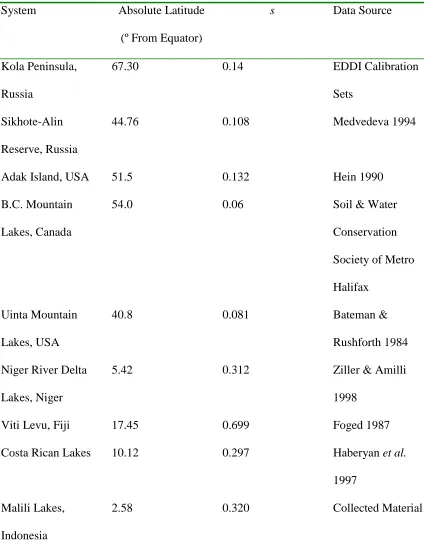
24 community structure and dynamics. The first model is a habitat specificity model that
uses distributional data to assess the degree of ecological specialization of groups of taxa
at various levels of organization (i.e. genus, lake assemblage, regional community).
Basically, this model uses a simple exponential decay function to approximate a
probability curve for predicting species occurrence in additional habitat patches. In
general, if a group is comprised primarily of specialist taxa, the probability of occurrence
in additional patches decreases rapidly, and the habitat specificity constant (k) is high.
Conversely, in a system comprised largely of generalist taxa, the decline of the
probability curve is much more gradual, and k is low (Fig 2). Here, I examine the
differences in the modeled habitat specificity constant among assemblages from systems
at different latitudes, and among genera within various systems. I hypothesize that taxa
are less specialized (more generalist) in systems at higher latitudes, corresponding to
increased temporal variability in habitat characteristics. Furthermore, I hypothesize that
the degree to which a group of species are specialized is related to the number of taxa
within the group and to the abundance of individuals within each taxon in the system.
The composition of an assemblage, in terms of the degree to which it is comprised
by generalist or specialist taxa affects not only the overall structure, but also the
dynamics of the community.
The second model I evaluated in this dissertation examines the colonization
dynamics of benthic diatoms onto bare glass microscope slides in lotic freshwater
systems. Preston (1948) proposed the idea of the “veil line,” the threshold abundance
below which the presence of individuals of a taxon cannot be detected by a given
sampling becomes more comprehensive, individuals of increasingly rare taxa are
encountered, and hypothetically, the relative abundance distribution (RAD) of the
assemblage approaches a normal distribution, provided sampling occurs in a random
fashion. Patrick (1967) demonstrated this sampling effect by counting tens of thousands
of diatom frustules. Although it is assumed that RAD curves should approximate a
normal distribution (Pachepsky et al. 2001), normal RAD curves are seldom encountered
in natural communities. Are community dynamics indeed deterministic, or are the
patterns commonly reported by community ecologists simply an artifact of
unrepresentative sampling regimes. In this study, the glass slides act as passive, random
samplers of colonizing diatoms. If community dynamics remain stochastic throughout the
course of the experiment, the modeled RAD should maintain its initial standard deviation,
and the maximum of the curve should migrate in a positive fashion relative to the veil
line. Alternatively, if community dynamics are driven by deterministic mechanisms, the
positive migration of the RAD maximum would be truncated, and the standard deviation
would be reduced, producing a left-shifted distribution (Fig. 3).
Just as assemblage composition can affect small-scale colonization dynamics; it
can influence community responses to perturbation events. In the third model, I
investigated whether the response of the littoral epilithic diatom community of Lake
Matano to a simulated upwelling event demonstrates community collapse, resistance, or
ecological redundancy. The general model here is a Principal Components ordination
model, with taxa whose relative abundances increased in the post-upwelling treatment
clustering to the left along axis 1 and those whose relative abundances increased in the
26 community collapsed after disturbance, all species would align with the positive extreme
of axis 1. If the community exhibits resistance, taxa should align along a gradient of
competitive ability from the top left to bottom right of the plot. Contrastingly, if the
community exhibits ecological redundancy, taxa should exhibit a disjointed distribution
along an unspecified resource gradient from top right to bottom left on the plot.
In this dissertation, my goal is to test, through general concordance among these
models, if there are a set of general tenets that regulate community composition,
Table 1: Surface water chemistry of Lakes Matano, Mahalona, Towuti, and Lontoa.
Elemental concentrations are reported in mg · L-1.
Lake Na Mg P K Ca Cr Fe Ni
Matano 0.93 13.87 0.01 0.17 13.09 0.01 0.07 0.004
Mahalona 1.07 22.68 0.01 0.23 9.42 0.02 0.08 0.010
Towuti 0.54 17.53 0.01 0.11 3.92 0.003 0.03 0.003
28 FIGURE LEGEND:
1. Map of Sulawesi Island, Indonesia, with detail of the Malili Lakes area.
2. General habitat selectivity model as a proxy for ecological specialization. Number
of habitat patches occupied is on the X-axis, and the probability of occupation of
additional habitat patches is on the Y-axis (extrapolated to 25 habitat patches).
Curves are generated by a simple exponential decay model, where s is a decay
constant representative of the level of ecological specialization of a group of taxa.
3. Shapes of hypothetical relative abundance curves characteristic of stochastically
(3a) and deterministically (3b) structured communities during succession. The
relative abundance of individuals of a given species is shown on the X-axis, and
the proportion of species within the community is shown on the Y-axis.
4. Hypothetical Principal Components ordination plots for 2 scenarios of community
response after perturbation events. 4a – Community resistance: Taxa maintain
their position within the competitive hierarchy under new environmental
conditions, and align along a gradient of competitive ability. 4b – Ecological
redundancy: Taxa occupy a patchy distribution along an unspecified resource
30 0 0.1 0.2 0.3 0.4 0.5 0.6 0.7 0.8 0.9 1
1 6 11 16 21 26 31
Habitat Patches Occupied
3a
32
4a
CHAPTER 2:
SPATIAL PATTERNS OF PLANKTONIC AND BENTHIC DIATOM
DISTRIBUTION AND ASSEMBLAGE SIMILARITY IN LAKE MATANO
(SULAWESI ISLAND, INDONESIA).
Abstract:
Aside from general taxonomic and floristic surveys, the diatom communities of
ancient lakes have been given little attention until recently, when several authors
began to investigate diatom distributions within lakes. In this study, we examine the
distribution of diatom taxa throughout the littoral and pelagic zones of Lake Matano,
an ancient, tectonically formed lake located on Central Sulawesi Island, Indonesia.
Diatom material was collected from 24 sites representing the benthic and planktonic
communities of the lake. I encountered 191 taxa in the samples, the majority of which
occurred in the benthic community of littoral zones. The planktonic community was
impoverished (19 taxa, mainly re-suspended benthic forms), and strongly dissimilar
to the littoral community. Although distance between sites exerted an influence on
similarity of assemblages, hierarchical clustering analysis demonstrated that other
factors such as bedrock type, physical disturbance, and habitat variability were more
important. Furthermore, dissimilarities between assemblages at various sites were
driven primarily by differences in the composition and relative abundances of the rare
species component of the community, consistent with patterns illustrated in other
34 Introduction:
While classically accepted paradigms of diatom dispersal (Cleve 1894,
1895) suggested that diatoms exhibit cosmopolitan distributional patterns, studies in the
East Indies have demonstrated that some taxa are more limited in their distribution
(Vyverman 1991, Moser et al. 1998, Hustedt 1942). In recent surveys of the benthic
diatom flora of the ancient Malili Lakes (Sulawesi Island, Indonesia), Bramburger et al.
(2004) demonstrated that geographic proximity did not play a significant role in
determining the similarity of diatom floras on a lake-to-lake scale, contrary to the
distance concept of the Theory of Island Biogeography (MacArthur and Wilson 1967).
Bramburger et al. (2004) further suggested that within-lake processes related to
speciation and extirpation through competitive exclusion have regulated the development
and maintenance of the highly endemic diatom communities in these lakes. The nature of
these processes and the scale upon which they are operating is not fully understood,
although Edlund & Stoermer. (2000), from paleolimnological studies on Lake Baikal,
have shown that endemic phytoplankton communities were maintained between each
glacial epoch.
Ancient lakes are well documented as global hotspots for biological endemism
and biological diversity. Although ancient lakes have originated from different geological
features, graben lake formations in regions protected from glacial events, comprise some
of the most biologically significant ecological lake systems (Brooks 1950, Herdendorf
1982). As summarized by Brooks (1950), the diversity of biological life within these
ancient lakes ranges across a wide range of zoological groups from mammals to
taxonomic groups on the Island of Sulawesi (Victor & Fernando 1982, den Bosch 1985,
White & Bruce 1986, Reudi 1995), and the aquatic biota of the Malili Lakes conform
well to this trend (Hustedt 1942, Bramburger et al. 2004, 2006, Roy et al. 2004, von
Rintelen et al. 2004).
Protoctista (excluding diatoms) have not received much study in ancient lakes
although they have been well documented as unique biological communities, and until
recently diatoms have only received general floristic study based on a minimum number
of collected samples (e.g. Hustedt 1937-1938, 1942, Skvortzow 1937, Skvortzow &
Meyer 1928). Selected taxa or taxonomic clusters (flocks) such as taxa within the genera
Denticula, Diploneis, Gomphonema, Placoneis and Surirella have typically been
highlighted to illustrate the unique endemic nature of prominent ancient lakes, even
though comprehensive studies on lake biodiversities linked to endemism are still missing
(Hustedt 1937-39, 1949, Mann 1999, Kociolek & Stoermer 1988, Bramburger et al.
2006, Edlund 2006). For instance, temporal processes (e.g. climate change, tectonic stress
events) could be reducing species occurrences and ultimately creating relict distributions
that form species endemism on regional or global scales. Although the relict distribution
concept is intriguing, few examples can be cited (Edlund & Jahn 2001). Recent research
efforts to further define spatial and temporal distributions in prominent ancient lakes have
provided insight into lakes distributional characteristics of endemic diatom communities,
including their contribution to lake productivity and the potential impacts of species
invasions on endemic floras (Cocquyt et al. 1993, Flower et al. 2004, Edlund et al. 2003,
Zlatko et al. 2006).
36 these were observed in Lake Matano (Hustedt 1942, Bramburger et al. 2004, 2006).
The taxonomic richness reported for the Malili Lakes diatoms is, in fact, lower than
similar systems at the same latitude, and many planktonic diatoms, including the entire
order Centrales, are essentially absent from this system. To date, however, no studies
have examined the distribution of diatom taxa within any individual lake in the Malili
Lakes system.
In this study, we examine spatial patterns of taxonomic richness, diatom
community composition, and relative abundance of taxa within the benthic and
planktonic diatom assemblages of Lake Matano. We also evaluate the influence of
distance, substrate grain caliber, and primary substrate type on the similarity of diatom
assemblages from sites within the lake.
Methods:
Site description and sampling
Lake Matano is a 590 m deep, tectonically formed lake located on central
Sulawesi Island, Indonesia (Van Bemmelin 1970). The lake is the headwater of the Malili
Lakes system, a chain of five ancient tropical lakes that share a common drainage
through the Larona River. In this study, diatom material was collected from a total of 24
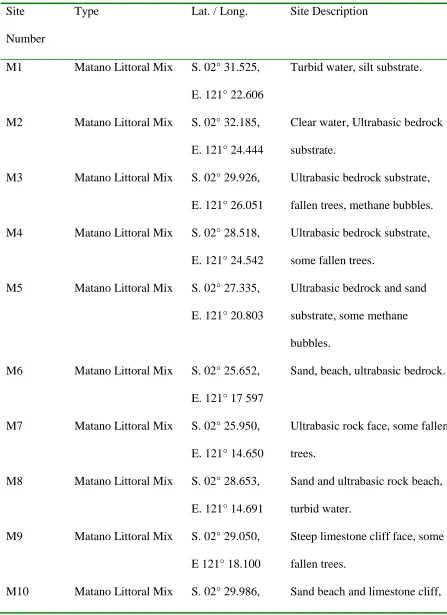
sites (Table 1), which represented littoral and pelagic habitats around the lake. The
littoral area of Lake Matano is dominated by bedrock and sand substrate types, with very
little visible algal growth present. Benthic diatom material was collected by snorkel at a
depth of 1 -5 m from 19 sites along the shoreline of Lake Matano (Fig. 1). These sites
the entire lake, with 5 sites on the each of the north and south shores. At each of the 10
main sites, 5 different microhabitat types were sampled (log, rock, macrophyte, sand, and
fine sediment) and pooled into composite samples by site. Episammic diatom material
was also collected on a finer spatial scale (3 samples from within a 30 cm x 30 cm
Eckmann dredge) from fine sediment at nine additional sites located between two of the
principal sites on the southern shoreline at Sorowako, the largest town on the shoreline of
the lake.
Phytoplankton profile samples were collected in the central region of the lake in
January 2000, August 2004 and October 2005. In 2005, discrete samples were collected
along two transects (Fig. 1) at a depth of 45 m using a Kemmerer sampler. A sample
depth of 45 m was selected based on the January 2000 and August 2004 studies which
determined that the highest stable biomass of algae was found within the 30-60m zone.
The samples, ranging in volume from 1400-1700 ml, were fixed with acidified Lugol’s
and concentrated to volumes between 50 and 200 ml for transport back to Canada. In the
lab, 10ml subsamples were settled for 18 hours in modified settling chambers (Hamilton
et al. 2002) and counted using a transect protocol (for low cell distributions) with a Leica
DMR-compound microscope at 200X and 400X magnifications. A minimum of 300
cells, colonies or filaments containing fixed cytoplasm were enumerated for each count.
Counting and the subsequent calculations of densities, biomass and carbon content were
performed with the program ALGAMICA (Gosselain & Hamilton 2000).
Sample Preparation and diatom enumeration
Raw benthic material was subjected to hot nitric/sulphuric acid digestion.
38 3000 rpm. Rinsing and centrifugation was repeated five times to remove extraneous acid.
Clean diatom material was dried onto microscope coverslips and mounted onto slides
using Naphrax ® mountant for examination under LM. Diatoms were counted under
brightfield and phase contrast optics on Leica DMR and Diaplan microscopes.
Enumerations were conducted within random fields of view until the 200th valve of the
dominant taxon was encountered for the benthic material (total counts between 600 2500
valves).
An additional set of subsamples (30-50 ml) for planktonic diatom valve counts
were concentrated into 7ml by centrifugation, and digested with a nitric/sulfuric acid
treatment. The digested samples were then washed five times and the complete sample
applied to 22x22mm square covers and mounted onto pre-cleaned microscope slides with
Naphrax® mountant. Diatom valve enumerations were conducted using a Leica
DMR-compound microscope following a transect-counting protocol (for low valve
distributions) at pre-selected positions evenly positioned across the coverslip (minimum
seven transects, total counts 500-600 valves). Counting and the subsequent calculations
of densities were aided with the program ALGAMICA. Statistical Methods
Count data, from cleaned diatom samples, were used to calculate taxonomic
richness, Shannon’s diversity, and evenness for each of the samples. The relative
abundance (RA) was also calculated for each taxon in each sample. Hierarchical Cluster
Analysis was performed on relative abundance data using the Hierarchical Clustering
function of SYSTAT 8.0 (Single linkage, nearest neighbour joining method) to
investigate the degree of similarity among assemblages at various sites. Additionally,
pairings of sites by the following equation:
S
P P bi
ai
SIMI (b a ) =
i=1
In this equation, Pai and Pbi are the proportion of the total assemblage represented by the
ith taxon in assemblages a and b, and S represents the total number of taxa in both
assemblages. SIMI has a maximum value of 1 when two assemblages are identical and a
minimum value of 0 when they share no taxa. Linear regression analysis (SPSS 15 for
Windows) was used to evaluate the relationship between distance and SIMI for littoral
zone samples from around the lake. One-way ANOVAs with post-hoc Bonferroni tests
were used to test for differences in Shannon’s diversity and evenness among groups of
sites.
Results:
The majority of littoral substrata in Lake Matano consist of bedrock and sand, and
diatoms are the dominant taxonomic group on these substrata. In this study, a total of 191
taxa were identified within the 24 samples from the littoral and pelagic zones of Lake
Matano. Taxonomic richness within a site ranged from 19 taxa (M10, DN4) to 77 taxa
(E2) (Table 2). Thirteen taxa account for 1% or more of the overall valve count of the
study: Psammothidium cf. helvetica (Hustedt) Bukhtiyarova & Round (17.8%),
40
longirostris (Hustedt) Mann in Round et al. (11.2%), Epithemia miranda Moser,
Lange-Bertalot & Metzeltin (7.7%), Fragilaria lapponica f. lanceolata Hustedt (7.5%),
Achnanthes wolterecki Hustedt (6.1%), Nitzschia amphibia Grunow (5.0%), Nitzschia cf.
frustulum (Kützing) Grunow in Cleve & Grunow (4.0%), Planothidium lanceolatum
(Brébisson) Round & Bukhtiyarova and its varieties (3.1%), Encyonopsis cryptocephala
(Hustedt) Krammer (2.2%) Cymbella (Encyonema) subalpina Hustedt (1.9%),
Achnanthidium minutissimum (Kützing) Czarnecki (1.5%), and Nitzschia cf.
philipinarum Hustedt (1.2%). Within any single sample, five or fewer of the above taxa
represented more than 10% of the total number of valves counted. The three most
abundant taxa in the littoral samples were Psammothidium cf. helvetica, Fragilaria cf.
capucina var. lanceolata, and Epithemia miranda, while Brachysira longirostris was the
dominant taxon in the plankton samples.
Shannon’s diversity measures ranged from 0.5946 (DN4) to 3.4220 (E2) and
evenness ranged from 0.2020 (DN4) to 0.8144 (S1) (Table 2). Both mean Shannon’s
diversity and mean evenness were significantly lower among the planktonic sites than
among either group of littoral sites (ANOVA, p < 0.001, n = 24). Among littoral sites,
mean Shannon’s diversity was slightly greater and evenness was slightly lower at
Sorowako sediment sites than at the Lake Matano littoral sites, but this difference was not
significant.
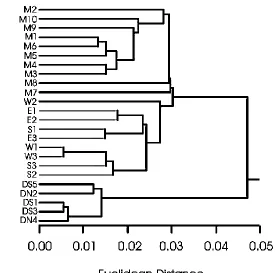
Hierarchical Cluster Analysis (HCA) was performed to examine similarity among
the assemblages observed at various sites. HCA identified three main clusters of sites at
Euclidean distances of less that 0.05 (Fig. 2). The cluster containing sites DS1, DS3,
deeply diverged from all other clusters (Euclidean distance = 0.047). Sites within this
cluster are more cohesive than those in other clusters, and were linked to their nearest
neighbour at a mean Euclidean distance of 0.0095. All of these sites were dominated by
Brachysira longirostris, centric diatoms were absent, and many of the heavier benthic
forms that were common at other sites did not occur at all in the plankton. The cluster
with sites E1 – W3 contained samples where only soft sediment was collected, and was
separated from the remaining group at a Euclidean distance of 0.30. Sites within this
cluster were joined to their nearest neighbour at a mean Euclidean distance of 0.018. The
final cluster (sites M1 – M10) represented sites with mixed habitat types from around the
Lake Matano shoreline. There was more variability in assemblage composition and
relative abundance between these sites than others, and they were linked to their nearest
neighbour at a mean Euclidean distance of 0.2025. Sites M2, M8, and M7 exhibited some
divergence from the main body of this cluster, and were linked to their nearest
neighbours at Euclidean distances of 0.028, 0.030, and 0.030, respectively. Additionally,
a one-way ANOVA performed using SIMI values calculated for all possible pairing
indicated that the diatom assemblages of planktonic samples were significantly more
similar to each other than to those of any different substrate type (p < 0.001, n=182).
Diatom assemblages from sites featuring other substrate types (ultrabasic rock, limestone,
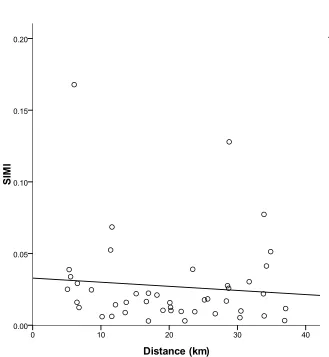
silt) were statistically indistinguishable from one another. Linear regression analysis did
not detect a significant relationship between distance and site similarity (Fig 3).
The phytoplankton community is low in both biomass and numbers for Lake
Matano (Table 3). Based on numbers and biomass, Chlorophyta were the most prominent
42 typically low in numbers (< 10,000 /L) but due to their large size were significant
contributors to total biomass (> 60%). Taxa within the Cryptophyta and Chrysophyta
were absent or extremely rare. In January 2000, the phytoplankton assemblage was
dominated by the chlorophytes Mougeotia sp., Oedigonium sp., desmids (primarily
Staurastrum cf. paradoxicum Meyens and Cosmarium sp.); cyanoprokaryotes Snowella
lacustris (Chodat) Komárek & Hindak, Aphanotheca sp., and a large pyrrhophyte
Peridinium cf. willei Huitfeld-Kaas. In August 2004, the same general community
structure was present with the notable addition of Merismopedia sp. In October 2005 the
phytoplanktic composition was also similar, although lacking populations of Snowella
lacustris and Merismopedia sp. and with the addition of Crucigenia cf. rectangularis
(Nägeli) Komárek.
Discussion:
Until recently, the diatom assemblages of ancient lakes had received little
attention beyond general floristic surveys, despite being recognized as unique biological
communities. Ancient lakes that have been recently studied in detail for diatom
distributions include: Lake Baikal (Skvortzow 1937; Flower et al. 2004), Lake Hovsgol
(Edlund et al. 2003); Lake Tanganyika (Cocquyt 1998), Lake Ohrid (Zlatko et al. 2006)
and Lake Biwa (Watanabe & Houki 1988, and additional references therein). In these
ancient lake studies, species richness estimates varied from 200 to more than 500 taxa.
Recent surveys of the diatom communities of the ancient Malili Lakes reported 267 taxa,
140 of which occurred in Lake Matano, and the majority of these taxa were described as
littoral habitats of Lake Matano, expanding on the 140 taxa reported by Bramburger et al.
(2004). Previously unobserved taxa occurred only rarely in our samples. This finding
supports the assertion of Hustedt (1942) that the reported taxonomic richness of Lake
Matano was likely to increase as investigators encountered increasingly rare forms.
Diatom communities are generally dominated in relative abundance by only a few taxa.
Flower et al. (2004) reported that no more than four taxa contributed more than 10% of
the total valves counted per sample in Lake Baikal. Similarly, in Lake Hovsgol, Edlund et
al. (2003) reported that nine or fewer taxa accounted for 5% or more of the total
abundance at any site. In this study, only four taxa contributed more than 10% of the
overall abundance to any sample, and only three taxa (Psammothidium cf. helvetica,
Brachysira longirostris, Fragilaria capucina var. lanceolata) contribute more than 10%
to the overall valve count. In both this study and our other studies (Chapter 3, 4, 6), the
same taxa were dominant in most samples and there was no discernible spatial pattern to
the shifts in relative abundance of these taxa. In all of these ancient lakes systems,
site-to-site dissimilarities are driven by differences in the rare species assemblages.
Mean SIMI was not significantly related to distance. This result is in contrast to
the distance concept of the Theory of Island Biogeography (MacArthur & Wilson 1961)
and suggests that factors other than proximity among sites were driving community
structure. Hierarchical Clustering Analysis revealed three main clusters within the Lake
Matano diatom flora, and dissimilarities between clusters clearly illustrate the importance
of habitat diversity in regulating the composition of diatom assemblages. The HCA tree
showed a strong differentiation between pelagic zone sites and littoral sites, with pelagic
44 ANOVA which showed that planktonic samples were significantly more similar to one
another than to littoral zone samples. The high degree of coherence within the cluster of
planktonic sites is not surprising considering the degree to which the overall abundance
of planters was dominated by a single species. The coexistence of so few planktonic taxa
is reflective of the lack of temporal habitat variability (i.e. seasonality) and
“contemporaneous disequilibrium” as proposed by Hutchinson (1961) to explain the
Paradox of the Plankton.
In contrast to the planktonic community, the relatively distant joining of
neighbours within the littoral samples from around the lake is due to the wider variety of
geographic situations, bedrock, and microhabitat types represented in this dataset. Sites
M9 and M10 were joined somewhat distantly to their nearest neighbours but still within
the main littoral cluster. These sites were situated on limestone bedrock, while all other
sites in the cluster were situated on ultrabasic rock. This rock type is rich in metals that
can influence diatom community dynamics. Despite the suggestion by this analysis that
bedrock influences assemblage composition, a one-way ANOVA was unable to detect a
differences in assemblage similarity from bedrock types within this dataset, indicating
that the underlying bedrock of a site does not necessarily determine resident diatom
assemblage. The most cohesive sub-cluster in the littoral group contained sites M3, M4,
M5, and M6, all located on the north shore of Lake Matano. Sites M2, M7, and M8,
which clustered outside the main littoral group, were characterized by high levels of
physical disturbance created through anthropogenic activity, river inflow, or heavy wind
and wave action. Variation among these assemblages may have also been influenced by
a limestone cliff with very little soft sediment available for collection. The final cluster
contains sites located near the town of Sorowako, and characterized by a lack of habitat
diversity, as only soft sediment samples were included in this group. Although nutrient
loadings are elevated directly in front of the town site, diatom community effects were
either insufficient, or too localized to be detected by HCA at this spatial scale. Although
they are considered important reserves of global aquatic biodiversity (Brooks 1950), the
world’s ancient lakes are increasingly threatened by the effects of accelerated
anthropogenic activity in their basins (Coulter 1963). Although major mining activities
have been occurring immediately adjacent to Lake Matano for approximately 30 years, it
is encouraging to note that the differences observed in the Sorowako sediment dataset
were related to differences in relative abundances within the indigenous species
community, and there is no evidence yet for the anthropogenically-facilitated “invasional
meltdown” hypothesized by several authors (Lodge 1993, Ricciarrdi 2001, Rahel 2002),
nor is there evidence that mining activities have affected biodiversity of these diatom
communities in a negative manner (Chapter 6).
In Lake Matano, planktonic diatom diversity is very low in comparison to
“individual habitat” littoral diversity. Similar observations have been reported from other
ancient lakes such as Malawi (Eccles 1974), Tanganyika (Coulter 1963) and Baikal
(Edlund 2006). In contrast, ancient lakes that have received substantial nutrient additions
(e.g. Lake Biwa, Watanabe et al. 1990; Lake Ohrid Zlatko et al. 2006) have more diverse
planktonic communities, which appear to follow disturbance models predicting increased
diversification after moderate disturbances. Hustedt (1942) and Bramburger et al. (2004)
46 confirmed that the vast majority of valves encountered in the Lake Matano plankton were
Brachysira longirostris, an endemic species. The planktonic diatom floras of Lakes
Baikal, Biwa, Hovsgol, Ohrid and Tanganyika, on the other hand, are dominated by
centric forms (Watanani & Houki 1988, Cocquyt 1998, Edlund et al. 2003, Flower et al.
2004, Zlatko et al. 2006). Centric diatoms were encountered on rarely in this study, but
abundances were extremely low, and no live centric diatoms were observed. We
speculate that elevated levels of several metals and a paucity of nutrients in the Lake
Matano water column (Haffner et al. 2001) may influence the ability of cosmopolitan
taxa and centric diatoms to successfully colonize the lakes. To date, no centric diatoms
have been observed in the benthic community of the lake. Viable plankton counts
indicate that diatoms are present but not a major component of the plankton community
as reported in Lakes Baikal and Hovsgol (Edlund 2006, Edlund et al. 2003). Brachysira
longirostris, Achnanthidium minutissimum complex and Surirella woltereckii Hustedt
were consistently observed with viable cytoplasm in the counts, while other diatom taxa
were extremely rare and often observed as empty frustules. In addition, the common
occurrence of the above mentioned taxa in the littoral regions of Lake Matano, illustrates
the tychoplanktonic nature of the taxa and their widespread spatial distribution across the
lake. Phytoplankton productivity was consistently low.
Although they have received little attention beyond general floristic and
taxonomic surveys, the diatom communities of the world’s ancient lakes provide valuable
insight into the mechanisms that function in the development and maintenance of highly
unique biological communities. In this study, we examined the spatial patterns of benthic
central Sulawesi Island, Indonesia. Our results revealed that although distance between
sites is related to the similarity of assemblages at those sites, other factors such as
substrate diversity and disturbance regime are more important. Dominant taxa remained
relatively consistent from site-to-site, but differences in the rare species assemblages
were sufficient to produce discernible dissimilarities among sites. Cluster analysis
illustrated the importance of habitat variability in regulating the composition and relative
abundance of taxa within episammic, mixed littoral, and planktonic diatom communities,
and suggest that physical disturbances (e.g. river inflow, wave action, anthropogenic
inputs) have a substantial influence on the littoral diatom communities of the lake. Our
data also demonstrated that disturbance effects are highly localized, and we are
encouraged by the lack of non-indigenous species even at disturbed sites. The paucity of
centric diatoms in Lake Matano and other lakes in the Malili chain continues to be an
intriguing paradox, and sets the diatom assemblages of Lake Matano apart from those of
other ancient lakes. Further work is required to elucidate the mechanisms that keep
centric diatoms, cosmopolitan forms, and many planktonic taxa from successfully
48 Table 1. Location and description of Lake Matano sample sites.
Site
Number
Type Lat. / Long. Site Description
M1 Matano Littoral Mix S. 02° 31.525,
E. 121° 22.606
Turbid water, silt substrate.
M2 Matano Littoral Mix S. 02° 32.185,
E. 121° 24.444
Clear water, Ultrabasic bedrock
substrate.
M3 Matano Littoral Mix S. 02° 29.926,
E. 121° 26.051
Ultrabasic bedrock substrate,
fallen trees, methane bubbles.
M4 Matano Littoral Mix S. 02° 28.518,
E. 121° 24.542
Ultrabasic bedrock substrate,
some fallen trees.
M5 Matano Littoral Mix S. 02° 27.335,
E. 121° 20.803
Ultrabasic bedrock and sand
substrate, some methane
bubbles.
M6 Matano Littoral Mix S. 02° 25.652,
E. 121° 17 597
Sand, beach, ultrabasic bedrock.
M7 Matano Littoral Mix S. 02° 25.950,
E. 121° 14.650
Ultrabasic rock face, some fallen
trees.
M8 Matano Littoral Mix S. 02° 28.653,
E. 121° 14.691
Sand and ultrabasic rock beach,
turbid water.
M9 Matano Littoral Mix S. 02° 29.050,
E 121° 18.100
Steep limestone cliff face, some
fallen trees.
E. 121° 19.079 some methane bubbles.
E1 Sorowako Littoral
Sediment
S. 02° 31.56,
E. 121° 22.92’
Ultrabasic bedrock, side of point,
turbid water.
E2 Sorowako Littoral
Sediment
S 02° 31.44,
E 121° 22.56
Embayment, sand beach,
ultrabasic bedrock.
E3 Sorowako Littoral
Sediment
S 02° 31.44,
E 121° 22.20
Public sand beach and dock,
ultrabasic bedrock.
S1 Sorowako Littoral
Sediment
S 02° 31.38,
E 121° 21.90
Ultrabasic bedrock, embayment
at eastern end of Sorowako.
S2 Sorowako Littoral
Sediment
S 02° 31.20,
E 121° 21.54
Soft sediment and ultrabasic
bedrock, central Sorowako.
S3 Sorowako Littoral
Sediment
S 02° 31.08,
E 121° 21.24
Western end of Sorowako,
ultrabasic bedrock, soft
sediment.
W1 Sorowako Littoral
Sediment
S 02° 31.50,
E 121° 20.88
Small beach near golf course,
sediment and ultrabasic rock.
W2 Sorowako Littoral
Sediment
S 02° 30.66,
E 121° 20.40
Steep shoreline just east of yacht
club, sand and ultrabasic rock.
W3 Sorowako Littoral
Sediment
S 02° 30.42
E 121° 20.10
Public swimming beach at
Salonsa, sand and ultrabasic
rock.
DS1 Plankton S 02° 27.00
E 121° 14.55
50 DS3 Plankton S 02° 28.50
E 121°19.35
Open water, 45 m depth.
DS5 Plankton S 02° 30.60
E 121° 25.00
Open water, 45 m depth.
DN2 Plankton S 02° 27.15
E 121° 19.20
Open water, 45 m depth.
DN4 Plankton S 02° 28.35
E 121° 18.90
Table 2: Species Richness, Shannon’s Diversity, and Evenness for Lake Matano diatom
samples.
Site Species Richness Shannon’s Diversity Evenness
M1 29 2.19419 0.651618
M2 39 2.578961 0.703949
M3 41 2.687788 0.723774
M4 42 2.704376 0.723546
M5 34 2.472515 0.701152
M6 32 2.349227 0.677844
M7 29 2.304346 0.684331
M8 29 2.528685 0.750954
M9 26 2.00603 0.615706
M10 19 1.114192 0.378406
E1 56 2.563665 0.63688
E2 77 3.422286 0.787854
E3 49 2.640069 0.678364
S1 36 2.91848 0.814417
S2 25 1.322856 0.410968
S3 35 1.937707 0.545012
W1 44 2.184698 0.577323
W2 49 2.404301 0.617783
W3 42 2.162365 0.578533
DS1 27 1.097771 0.333078
DS3 31 0.969821 0.282418
DS5 28 1.667554 0.500436
DN2 17 1.479076 0.522049
52 Table 3. Living phytoplankton across Lake Matano on October 11, 2005 at 45m depth. N
= 6.
Division Density (#/L)
(# = natural living units)
Biomass (µg/L)
Mean SD Mean SD
Bacillariophyta 2734 1124 1.20 0.57
Cyanoprokaryota 6332 2288 1.13 0.43
Chlorophyta 21744 5432 14.88 5.32
Chrysophyta 0 0
Cryptophyta (?)314 (?)0.13