Creating Keys For Cryptography: A Survey
Mohit K. Wadhwani, Prof. S. P. Medhane
M Tech Student, Dept. of Information Technology, Bharati Vidyapeeth Deemed University, COE, Pune, India
Assistant Professor, Dept. of Information Technology, Bharati Vidyapeeth Deemed University, COE, Pune, India
ABSTRACT: Cryptography is the branch of engineering which deals with the secrecy of the data now a days security plays an important role in the field of transferring data from sender to receiver. But actual cost of sending the data from one place to other is high so Central idea of this paper to survey the various key generating techniques but for low budget enterprises this paper shows the advantage disadvantages comparison of the various schemes which will help in rebuilding the new technique and at the end it concludes by relationship of each one of these traditions.
KEYWORDS: Cryptography,key generating techniques, low budget enterprises, hybrid key management.
I. INTRODUCTION
Secure correspondence takes place when one transmits private messages to other substance to interact with it. From Gambetta’s definition, we conclude that secure encryption has the following qualities:
We remember that secure communication is profitable and can be defined as “symmetrical cryptography is a particular level of the subjective probability with which a supervisor end can perform a particular message interaction, both ends can interact such interactive actions and can therefore understand each other’s actions.[1]
Message: A peer user’s ability and quality of interaction for message sharing using key generating schemes. It is acknowledgement that a supervisor makes through previous successful interactions [1].Message sharing is a social practice used by human beings to understand each other’s thoughts and ideas. A human being’s psychology is reflected through an individual’s thoughts and actions. So, social animals use encryption schemes for interacting with each other. This encryption scheme proves successful because of its unique engineering mathematical techniques.
The basic workflow model consists of encrypting the plaintext thrice using “Advanced Substitution” method, “Chive Unica” generator and “Applied Advanced Encryption” method.
Fig.1 Various Key Management Schemes
II. RELATED WORK
1. Two-part Authenticated[6]
with Key management it was proved that these 2 protocols are secure. Also, in “Chen-Kudla” model these two protocols are secure in the “Bellare-Rogaway” model for key generating schemes.
MQV is the first proposed scheme and the other one is ID-2-AK which has the central idea of addition in finite field
-
2. Secure Fuzzy Key Generation[8]
An excessive amount of time to be finished is done for the key generation, in this manner making the convention wasteful. length of every profound blur is the same. In this area we expel these two confinements by exhibiting a key-era framework that depends on secure fluffy data reconciliatory(SFIR), a primitive we present here. We will appear how SFIR can be instantiated and utilizing such primitive quick blunder amendment that is unequivocally secure; methodology in this segment will work autonomously of the lengths of the profound blurs.
Uses the concept of the random variable he understanding of the irregular variable that is delivered by the envelope that will be utilized as a part of this area is as per the following: given the irregular example ρ
The working procedure of the given scheme is here by given below
Key Generation System in view of a SFIR (Gen, Rep).
(1) The sender A will apply Gen to the irregular variableρA to acquire a couple of strings hf, pi; it will set key = f.
(2) the sender A will transmit to the beneficiary B the qualityp.
(3) the beneficiary B utilizes the capacity Rep and his perusing of the envelope ρB to recoup key = f.
The nearness of a slender band channel prior to the limit finder significantly decreases levels of obstruction and clamor for producing the bit vector. This gives heartiness to various levels of SINR that allow correspondence between the two hubs. additionally vigorous to channel estimation clamor, since it depends on recognizing profound blurs, and not the complete channel motivation reaction which endures estimation blunders, that may emerge at the edges of profound blurs and are appeared to be correctable. At long last, on the off chance that the hubs move, their sign envelopes change which expands the entropy and can offer ascent to key era at a speedier pace. In the event that the hubs are stationery it might still be workable for the hubs to present obstruction on reason so a key might be brought forth. It ought to be pushed that security of our key era components is not based on computational unmanageability presumptions, for example, those used to contend about security in plans, for example, the DiffieHellman key-trade.
3. Novel Key Distribution for MANET
System coding offers a magnificent answer for augmenting throughput in different systems. Since of its effortlessness and high productivity, the possibility of system coding can likewise be utilized for outlining a lightweight key conveyance plans for remote advertisement hoc system. It can oppose a progression of assaults endured in remote specially appointed system and has better execution[1].Once chose, the c1usterheads and the doors lessen the multifaceted nature of keeping up topology data, and can disentangle such key capacities as directing, transfer speed allotment, channel access, power control on the other hand virtual-circuit support[1].
4. Device Authentication and Secret Key Generation
shape, and even battery-upheld RAMs can be perused subsequent to putting away keys for quite a while [1, 2, 14]. For an abnormal state of physical security, the IC needs to be secured utilizing costly alter detecting hardware that should be persistently battery controlled. Second, for to a great degree asset obliged stages, for example, RFIDs, even basic cryptographic operations can be too immoderate.
A mediator PUF delay circuit. The circuit makes two postponement ways with the same format length for every information X, and produces a yield Y based on which way is speedier.
Because the PUF circuit is rather simple, attackers can tryto construct a precise timing model and learn the parametersfrom many input-output pairs [5]. Every ring oscillator is a basic circuit that wavers with a specific recurrence. Because of assembling variety, each ring oscillator sways with a somewhat diverse recurrence.
Keeping in mind the end goal to create a settled number of bits, an altered grouping of oscillator sets is chosen, and their frequencies are thought about to create a yield bit. The yield bits from the same grouping of oscillator pair examinations will fluctuate from chip to chip. Given that oscillators are indistinguishably laid out, the recurrence contrasts are controlled by assembling variety and a yield bit is similarly liable to be one or zero if irregular varieties command.
As specified before, an altered arrangement of ring oscillator sets is produced, this arrangement now should be k times longer than the sought number of bits to be created. At that point, for every k ring oscillator sets, we pick the pair that has greatest separation. The bit vector demonstrating these choices is spared so that the same sets can be utilized to re-create the yield. Other covering plans, for example, choosing from m, or utilizing a separation limit are likewise conceivable.
There is a little likelihood that key bits will have blunders once this veiling is performed. Contingent upon the application, the remaining blunders can be adjusted utilizing an blunder adjusting code or only pardoned (e.g., the chip is confirmed if the quantity of blunders is little)
For low-cost authentication shown in the next section, thePUF circuit must be able to produce exponentially-manychallenge-response pairs. Unfortunately, the RO PUF thatwas discussed can only generate a relatively small number of bits. There are a few ways to create many challenge response pairs. First, we can extend the oscillators to haveconfigurable delay paths similar to the one in the arbiterPUF shown in Figure 1. A challenge selects how to configurethe path within a delay loop so that different challengesresult in a different oscillation frequency. Second, in programmable logic such as FPGAs, a challenge can determine the oscillator configuration such as the number of inverters and which look-up tables and wires to be used. Each challenge will create a PUF circuit using different parts of thelogic, resulting in a unique response
5. Symmetric key Generation in Image Encryption
Cryptography is key for ensuring data as the significance of security is expanding day by day with the coming of online exchange preparing and e business. In now a day the security of computerized pictures pulls in much consideration, particularly when these advanced pictures are put away in memory or send through the correspondence systems. Hereditary calculations are a class of advancement calculations. Numerous issues can be explained utilizing hereditary calculations through demonstrating a rearranged form of hereditary procedures. In this paper, I proposed a strategy taking into account Genetic Algorithm which is utilized to create key by the assistance of pseudo irregular number generator. Arbitrary number will be produced on the premise of current time of the framework. Utilizing Genetic Algorithm we can keep the quality of the way to be great, still make the entire calculation sufficient. Symmetric key calculation AES has been proposed for encoding the picture as it is extremely secure technique for symmetric key encryption.In the proposed technique GA will be utilized as a part of key era process.
6. Commutative Cryptography Core with Key Generation
Information security amid correspondence is one of the dominating issues in present day various handset based correspondence. In this paper, we have introduced an exceedingly strong commutative cryptography center for conveyed FPGA design called commutative RSA with Key era. The commutative RSA calculation has been produced utilizing parallelization of Montgomery augmentation with high radix exponential measured increase plan to suit FPGA execution. The compositional configuration not just guarantees validation among various handsets or MIMO additionally decreases overheads brought about because of key trade process.
the commutative sort of conduct. As indicated by commutative nature, the request in which RSA encryption is done would not impact the decoding on the off chance that it is done in comparative route or in a succession. On the off chance that this one of a kind methodology is fused with typical RSA, it could be a development for improving RSA execution with MIMO handset based correspondence. This paper investigates the commutative RSA (CRSA) calculation with key era for acknowledgment utilizing appropriated FPGA centers.
Progressively applications, people in general key cryptosystems like RSA, Elliptic Curve Cryptography (ECC) do envelop tremendous number of multiplier modules. It contains higher information conditions also, accordingly the static sort of dormancy methodologies won't not be productive for quickening the single occurrence of open key cryptosystems like RSA, ECC or Digital Enhanced Cordless Telecommunication Standard (DECT) figure (DSC). Every one of these inadequacies can be dispensed with while making into note of uniform errand dividing where the single Montgomery Multiplier would be partitioned into shifted divisions with a supposition that all sub parts are allocated uniform burden.
7. Random key Generation Scheme
With the development of mechanical progressions, the dangers managed by a client develop exponentially. The 21st century is a time of data blast in which data has turned into an essential key asset, thus the assignment of data security has gotten to be progressively essential in information stockpiling and transmission. As conventional cryptographic frameworks are presently helpless against assaults, the idea of utilizing DNA Cryptography has been distinguished as a conceivable innovation that presents another desire for unbreakable calculations. Another field of cryptography is developing in light of DNA processing because of high capacity limit, tremendous parallelism and uncommon vitality productivity of organic DNA. This field is in beginning stage so a ton of examination must be done yet. This paper breaks down the diverse methodology on DNA Cryptography in light of lattice control and secure key era plan.
This is like voyaging sales representative way issue where vast conceivable arrangements produced to discover better ways to reach from source to destination. An picture encryption calculation in view of DNA succession
expansion operation is exhibited by Wang et. al. A DNA arrangement lattice is gotten by encoding the unique picture and it is partitioned into some equivalent pieces and two logistic maps, DNA complementarity what's more, DNA succession expansion operation are used
8. Key Generation Algorithm In Data Encryption Standard (DES)
At present security is the significant issue for private data. Data transmitted over system must be shielded from assaults of interlopers. Utilizing encryption we can shield our vital data from noxious clients. Encryption is the strategy changing data into configuration which is difficult to get it. There are a few calculations for encryption with their advantages, security level and execution. DES has additionally security requirements. Here, another technique is presented for key era utilizing two cluster of arbitrary numbers, of size eight. Utilizing this strategy issues of feeble and semi frail key can be determined totally. In this enhanced key era strategy security is improved due to arbitrary numbers exhibit without trading off the execution.
III.PROPOSED ARCHITECTURE
Creating Secure Keys for Cryptography
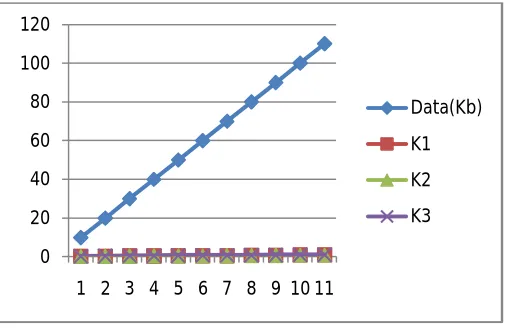
Experimental evaluation:
IV.RESULT AND DISCUSSION
System/ Protocol
Pros Cons Suitable for
3.1 Two-part Authenticated [2005]
modular arithmetic taken into context
Vulnerable to KCI attack Authenticated conversations
3.2 Novel Key Distribution Technique For Mobile AD-HOC
Network(MANET)[2013]
cluster-based topology, hash function and MAC(Message
Authentication Code)
unreliable wireless media, host mobility
wireless environments due to the networks’ scalability’
3.3 Device Authentication and Secret Key Generation
Non-volatile memory technologies
Delay characteristics of wires and transistors di er from chip
to chip
high level of physical security
3.4 Secure Fuzzy Key Generation
Certificate-based key management, relatively low risk
Complexity is high Random variability decisions in tree system
3.5 Symmetric key Generation in Image Encryption[2012]
Integrity and authentication of message
more complexity and randomness in the key
encrypting image and increasing the overall efficiency of the system 3.6 Commutative Cryptography
Core with Key Generation[2014]
avoids the key exchange complications
exhibits low processing speed MIMO transceiver based public infrastructure communication
3.7 Random key Generation Scheme[2014]
high storage capacity, vast parallelism and exceptional energy efficiency of biological DNA
cannot resist exhaustive attack, statistical attack and differential attack
a new DNA encryption technique which is based on mathematical matrix manipulation
3.8 Key Generation Algorithm In Data Encryption Standard (DES)[2016]
Size of array can be enlarged to make it difficult to find.
needs 56 bits key as well as two random arrays to generate sixteen keys
DES is fast and popular for secure conversations but needs some improvements regarding its security.
TABLE 1. Comparison of various Key Generating Schemes 0 20 40 60 80 100 120
1 2 3 4 5 6 7 8 9 10 11
Data(Kb)
K1
K2
V. ACKNOWLEDGEMENT
I acknowledge here my debt to those who have contributed significantly to this proposed paper. I indebted to my internal guide Mr. SampatMedhane,Department of Information Technology, BharatiVidyapeethUniversity,College of Engineering, Pune for helping me and his experience is very helpful to me.
REFERENCES
[1] Secure and Reliable Key Distribution Technique for MANET By Vishakha Sanghavi, Asst. Prof. Narent Tada[2013] [2] Using Genetic Algorithm for Symmetric key Generation in Image Encryption Aarti Soni, Suyash Agrawal[2012]
[3] Design of Commutative Cryptography Core with Key Generation for Distributed FPGA Architecture R. AmbikaȦ* , S. RamachandranḂ , K.R. KashwanĊ ȦVinayaka Missions University, Salem, India ḂDept. of ECE, SJB Institute of Technology, Bangalore, India ĊDept. of ECE, Sona College of Technology, Salem, India [2014]
[4] Cryptography Based on DNA Using Random key Generation Scheme P.Surendra Varma, K.Govinda Raju Department of Computer Science and Engineering Srinivasa Institute of Engineering and Technology, Cheyyeru [email protected][2014]
[5] Physical Unclonable Functions for Device Authentication and Secret Key Generation G. Edward Suh Cornell University Ithaca, NY 14853 [email protected] Srinivas Devadas Massachusetts Institute of Technology Cambridge, MA 02139 [email protected][2007]
[6 ]M. Scott, “Authenticated ID-based key exchange and remote log-in with insecure token and PIN number”, Cryptology ePrint Archiive, Report 2002/164..
[7] Towards Security Two-part Authenticated Key Agreement Protocols Songping Li 1, Quan Yuan1 and Jin Li 2 1 School of Mathematical Sciences, Peking University, Beijing 100871, P. R.China 1 {lsp,yq2uan}@pku.edu.cn 2 Huawei Technologies Co., Shenzhen 518129, P. R.China 2 [email protected][2005]