Available at
www.ijsred.com
ISSN : 2581-7175
©IJSRED: All Rights are Reserved
Page 96
SURVEY : CRYPTOGRAPHY OPTIMIZATION
ALGORITHMS
M.Geetha,K.Akila
KRS College of Engineering, Tamilnadu, India.
Abstract
:With the advent of e-commerce, it has become extremely essential to tackle the sensitive issues of affording data security, especially in the ever-blooming open network environment of the modern era. The encrypting technologies of the time-honored cryptography are generally employed to shelter data safety extensively. The term ‘cryptography’ refers to the process of safeguarding the secret data against access by unscrupulous persons in scenarios where it is humanly impossible to furnish physical protection. It deals with the methods which convert the data between intelligible and unintelligible forms by encryption/decryption functions with the management of key(s). Nowadays cryptographic key management issues that arise due to the distributed nature of IT resources, as well the distributed nature of their control. Recently these issues are solved by optimization algorithms utilized in the cryptographic algorithms. The purpose of this paper is to give a survey of optimal cryptographic keys that can be developed with the help of optimization algorithms, and to address their merits to the real-worldscenarios.
Keywords—Cryptography; Encryption; Decryption; Key Management; Optimization algorithm;
I.
I
NTRODUCTION
Cryptography (also known as cryptology) is an
art of achieving security by encoding messages to make
them non-readable using different encryption algorithms so
that only the intended user can see the original content [19-
23].
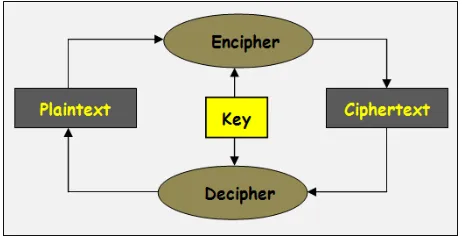
Fig. 1. Architecture of Cryptosystem
The basic block diagram of a cryptosystem is given in figure
1.
Cryptography prior to the modern age was effectively
synonymous with encryption, the conversion of
information from a readable state to apparent nonsense
[24-28]. A cryptographic algorithm technically called as cipher, is
a mathematical function used in the encryption and
decryption process. A cryptographic algorithm works in
association with a key to encrypt the message [1]. A
cryptographic algorithm with all possible keys and protocols is
known as a cryptosystem. Each security system must supply
some security process that guarantees the secrecy of the
system [29-32]. Some of the goals that can be achieved by
cryptography are as follows: Authentication, Confidentiality,
Access Control, Integrity, Non-repudiation, Availability and
Accountability. In the cryptographic process encryption and
decryption demands a key [33-36]. Some cryptosystems uses
the same key together for encryption and decryption called as
symmetric key or private key cryptography and asymmetric
key or public key cryptography may use different keys
together [2]. The mathematical optimization method, which is
a best method to choose an element from a group of obtainable
alternatives, is used in mathematics, computer science and
operation research [37-42]. Simply, an optimization issue
contains a set of maximum or minimum real functions from
which selecting an input value from an acceptable value and
calculating the value of the function [43-46]. Mostly, the
optimization theory and methods are used in the field of
applied mathematics [47-50]. The optimization method also
includes finding the best accessible value of target function
from a defined domain or variety of target functions from
different type of domain [3]. The main purpose of
optimization is to reduce the interval of a point multiplication
that depends on the number of required cycles [51-55].
Especially, the replicated arithmetic obstructs are used to
improve the parallelism for fundamental process. Most of the
execution takes place on algorithm optimization or improved
arithmetic architectures finds to be suitable for cryptographic
operations[4].
II.
S
COPE OF
O
PTIMIZATION
P
ROBLEMS
In a standard point of view, the process of optimization can
be described to find the best solution of the function from the
Available at
www.ijsred.com
system within constraints [56]. This process needs the
following components such as:
The result of the function requires a minimized or
maximized scalar quantitative process metrics and it
is based on systems cost, yield, andprofit.
This converts the optimization issue into a group of
equations and inequalities in order of constraints.
These constraints are used to comprise a possible
area which defines the limitations in process of the
system[57].
The predictive model variables must fulfill the constraints.
This can be achieved by multiple instances of variable values,
guiding to a possible area that is established by a subspace of
these variables. These subspaces are classified by a group of
decision variables in many engineering issues that can be
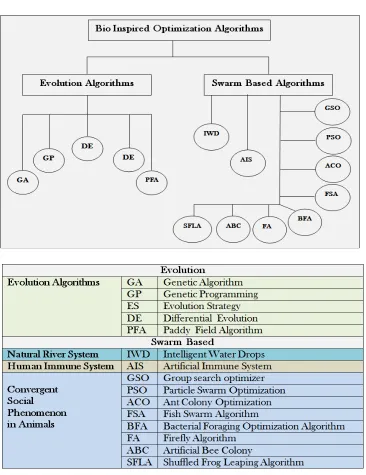
understood as degree of freedom in the process. Taxonomy of
various bio inspired optimization algorithms [16] grouped by
the area of inspirations as shown in figure2.
Available at
www.ijsred.com
ISSN : 2581-7175
©IJSRED: All Rights are Reserved
Page 98
III.
O
PTIMIZATION
A
LGORITHMS
The very best choosen algorithm makes sure system will
do the given problem at the best solution [58-119]
Some important traditional and modern optimization
algorithms are explained as follows [120-154].
Differential
Evaluation (DE) Algorithm
DE is mainly used for multi-dimensional real-valued
functions, but does not use the gradient of the issue being
optimized. This denotes that DE does not possess any
optimization issue, but requires classic optimization
techniques such as gradient descent and quasi-newton
techniques. DE can also be used for optimization issues
such as non-continuous, noisy and change overtime.
A.
Genetic Algorithm(GA)
An algorithm is initiated with a collection of solutions
(chromosomes) called population. One population’s
solution can be used to create a new population. Solutions
which are chosen to create new solutions (offspring) are
chosen according to their fitness for reproduction and the
most suited solution can be selected. In Genetic Algorithm,
thefitness operation of the optimization method can be
estimated by the chromosome in the hidden layer and
neurons. The cross over is created depending on
fitnessvalue.
B.
Cuckoo Search (CS)Algorithm
The Cuckoo Search algorithm is proposed by entrusting
brood parasitism of many cuckoo species i.e., placing their
eggs on the nest of host fledglings. The shades can be
copied by those female parasitic cuckoos and through the
example of host species’ eggs. For easiness, it is imagined
that there is only one egg at once in a nest. The initial
alignment can be interpreted by the accessible egg in the
host nest. An egg placed by a cuckoo act as a guide to
another alignment created by the strategy.
C.
Ant Colony Optimization (ACO)Algorithm
The ACO algorithm is one of the most competent
methods that indicate the main aspects of state transition
rules and pheromone modernize devices. In each iteration,
colonies of ants are sent to a particular place for solution.
Each ant works steadily in their state transition rules.
Suppose, if an ant completes a work, then the pheromone
modernized begins to search another ant with similar
strength. But it significantly reduces the opportunities and
changes the search methodology [61].
D.
Particle Swarm Optimization (PSO)Algorithm
The PSO strategy is engaged to differentiate the perfect
solutions from the identified data limits that denote to
obtain the perfect equation from the numerical model. The
PSO is a population-based search algorithm which is
initiated with unique population of randomly-produced
solutions which are known as particles. In PSO strategy, the
numbers of particles are initially prepared along with
initiation of population size after this process updated with
new solutions.
IV.
C
RYPTOGRAPHIC BASED
O
PTIMIZAT
ON
M
ETHODS
In 2012, AartiSoni
et al.
recommended that the
cryptography is crucial for ensuring data security with the
increased online exchange handling [5]. The research
exhibited that the Genetic Algorithm was employed to
create a key with the help of a pseudo-irregular number
generator. The Random number was created on the
premise of current time of the framework. The quality of
the way was kept to be great in spite of the entire strategy
which is adequate. The authors symmetric key calculation
which was utilized for scrambling the image was
extremely secure technique for symmetric key encryption.
Through the consequences, the effectiveness of strategy
was expanded as far as the processing time got obliged and
intricacy to assault themessage.
K.Shankar
et al.
[6], proposed an efficient method of
ECC based image encryption scheme with the aid of
optimization technique using the Differential Evolution
(DE) algorithm. In this method is used to improve the
performance of an image encryption in ECC method,
Differential Evaluation (DE) algorithm based optimization
process is applied on the private key generation phase. The
performance of the image is taken as a fitness value of the
optimization process such as PSNR value that shows the
efficiency of their method.
N. K. Sreelaja
et al.
proposed the method to encrypt
binary image [7] using stream cipher and ant colony
optimization technique for key generation. This method
reduced the number of keys to be stored and distributed.
The character code table is used to encode the keys and
characters in the plain text. The result ensures this
approach has the capability to encrypt binary images of
varioussizes.
The authors also proposed swarm intelligence approach
[8] or otherwise termed as Ant Colony Optimization key
Generation Algorithm (AKGA), for generating keys to
encrypt the text message. In this method, stream cipher is
used to encode the secret text and AKGA is used for
generating keys. Here the keys are reduced and the results
of the proposed framework ensure that it has the capability
for encrypting original message of varying size.
Available at
www.ijsred.com
ISSN : 2581-7175
©IJSRED: All Rights are Reserved
Page 99
lesser in the former than thelatter.
Genetic Algorithm is used by P. Saveetha
et al.
for
reducing
the
computational
complexity
of
the
cryptanalysis [10]. Encoding process on the stream cipher
using the GA with pseudor and omseries method
consumedlesser memory
and time when compared with the existing Fast Discrete
Fourier Spectra approach on stream cipher.
The concept of utilizing Genetic Algorithm and RSA in
modified approach is introduced by Abdel-karim S.O.
Hassan
et al.
[11]. This method combines both symmetrical
(using Genetic optimization) and asymmetrical (using RSA)
method to ensure that make the key very complex to
reinforce resistance to cryptanalysis. The first operation is
symmetrical using GIC to generate the key from plaintext
followed by the second operation of the new ciphering
technique which is performed by RSA algorithm.
Threshold recovering algorithm for key management
was developed by Xuanwu Zhou
et al.
[12]. In this method,
encryption was done on private keys which are from KGC
and then shared to applier group. The threshold
reconstruction of private keys provided protection for the
secrecy of private key parameters and also applier identity.
In order to make the key management scheme effective,
improved authenticated encryption scheme is presented.
K.Shankar
et al.
[13] proposed RGB-Based Secure
Share Creation in Visual Cryptography Using Optimal
Elliptic Curve Cryptography Technique. In this methods
shares of the secret image in visual cryptography process
are created by using the multiple shares creation method
with ECC. The shares are separately encrypted and
decrypted by means of the encryption and decryption
technique in line with ECC. In the decryption process we
generate the private key by using the cuckoo search
optimization technique and for evaluating the performance
of the optimization by using the peak signal to noise ratio
(PSNR).
V.S.ShankarSriram
et al.
[14] have developed a scheme
for scalar multiplication. In this scheme, the Encryption
process involves two stages of Modular Multiplication. So,
the time required to compute the keys is less and
timing-based attacks on the key will be difficult. This scheme can
be deployed in Mobile and other wirelessdevices.
In the method proposed by AartiSoni
et al.,
AES
algorithm is used for encrypting and decrypting digital
images [15] and GA is used for key generation process. The
Key length, for which the test is carried out, is 128 bit long.
Longer key sequence will also work but time constraint
doesn’t permit to check. The time taken to generate key for
300 iteration, with
10 new population each time, 10 crossover and mutation
operations each iteration, is75.382 seconds.
In 2014, Sindhuja
et al.
proposed the Genetic Algorithm
(GA)-based symmetric key cryptosystem for encryption and
decryption [15]. The basic content and the client
information (key) were distorted into content matrix and
key network separately. Additive matrices were produced
by including the content matrix and key network. Linear
substitution capacities were connected in the additive
matrix to create the transitional figure. At that point, the GA
capacities (hybrid and change) were connected to the
transitional cipher to deliver the last cipher content. It was
accomplished that the symmetric key substitution strategy
was utilized to guarantee the secrecy in systems, which was
linked and actualized with the assistance of genetic
capacities to furnish including security.
J.SaiGeetha
et al.
proposed Artificial Bee Colony
Random Number Generator [18], also called as ABCRNG
which is fit to all public key cryptosystem to increase the
strength of key as well as its security. It is proved through
statistical tests that ABC is more efficient than other
methods. Randomness of Random numbers is produced in
large volumes which are evaluated by run test (Up and
Down, above and below mean) method.
V.
C
ONCLUSIONThe survey has been investigated over many research
papers based on optimization algorithm applied in the
cryptographic algorithms. Each authors proposed some of
the optimization algorithm is used to optimize the key
values in particular cryptographic algorithm. Each method
is unique in its own way, which have their own advantages
and disadvantages. Based on existing research works the
optimization algorithms are used to optimize the key
values in complex cryptographic methods like ECC,
RSA.etc still remain significantly challenging tasks for the
research community.
R
EFERENCES
[1] Behrouz A. Forouzen, “Cryptography & Network security”, McGraw-Hill Companies, pp.1-56,2007.
[2] Shankar, K., and P. Eswaran. “An Efficient Image Encryption Technique Based on Optimized Key Generation in ECC Using Genetic Algorithm”, Artificial Intelligence and Evolutionary Computations in Engineering Systems. Springer India, 2016.705-714.
[3] https://en.wikipedia.org/wiki/Mathematical_optimization#Computati
onal_optimization_techniques].
[4] A.Durga Bhavani and P.Soundarya Mala, “Optimized Elliptic Curve Cryptography”, International Journal of Engineering Research and Applications (IJERA), Vol. 2, Issue 5, pages(s): 412–419,2012. [5] Aarti Soni and Suyash Agrawal, “Using genetic algorithm for
symmetric key generation in image encryption”, International Journal of Advanced Research in Computer Engineering & Technology (IJARCET), vol.1, issue.10, page(s): 137–140,2012. [6] K. Shankar, Dr.P.Eswaran: ECC Based Image Encryption Scheme
with aid of Optimization Technique using Differential Evolution Algorithm. International Journal of Applied Engineering Research 2015; 10:5:1841- 1845.
[7] N.K. Sreelaja and G.A. Vijayalakshmi Pai, “Stream cipher for binary image encryption using Ant Colony Optimization based key generation”, Applied Soft Computing, vol. 12, issue.9, age(s): 2879–2895,2012.
Available at
www.ijsred.com
ISSN : 2581-7175
©IJSRED: All Rights are Reserved
Page 100
[9] Sreelaja.N.K and G.A.Vijayalakshmi Pai, “Design of Stream Cipher for Text Encryption using Particle Swarm Optimization based Key Generation”, Journal of Information Assurance and Security, vol. 4, page(s): 30–41,2009.
[10] P. Saveetha, S. Arumugam and K. Kiruthikadevi, “Cryptography and the Optimization Heuristics Techniques”, International Journal of Advanced Research in Computer Science and Software Engineering, vol.4, issue.10, page(s): 408–413,2014.
[11] Abdel-karim S.O. Hassan, Ahmed F, Shalash and Naglaa F. Saudy, “Modifications on RSA Cryptosystem Using Genetic Optimization”, International Journal of Research and Reviews in Applied Sciences, vol.19, issue.2, page(s): 150,2014.
[12] Xuanwu Zhou, “Scheme Optimization in Key Management with Cryptograph Methods”, Applied Mechanics and Materials, vol. 20, page(s): 539–545,201.
[13] Shankar, K., and P. Eswaran. “RGB-Based Secure Share Creation in Visual Cryptography Using Optimal Elliptic Curve Cryptography Technique”, Journal of Circuits, Systems and Computers 25.11 (2016): 1650138.
[14] V.S.Shankar Sriram, S.Dinesh and G.Sahoo, “Multiplication Based Elliptic Curve Encryption Scheme with Optimized Scalar Multiplication (MECES)”, International Journal of Computer Applications, vol.1, no. 11, page(s): 65–70,2010.
[15] Aarti Soni and Suyash Agrawal, “Key Generation Using Genetic Algorithm for Image Encryption”, International Journal of Computer Science and Mobile Computing (IJCSMC), vol. 2, issue. 6, page(s):376– 383,2013.
[16] Binitha S, S Siva Sathya, “A Survey of Bio inspired Optimization Algorithms “, International Journal of Soft Computing and Engineering, Volume.2, Issue.2, page(s):137-151, May2012. [17] Sindhuja K and Pramela Devi S, “A symmetric key encryption
technique using genetic algorithm”, International Journal of Computer Science and Information Technologies, vol. 5, issue.1, page(s): 414–416,2014.
[18] J.Sai Geetha and D.I.George Amalarethinam, “ABCRNG-Swarm Intelligence in Public key Cryptography for Random Number Generation”, International Journal of Fuzzy Mathematical Archive, vol. 6, issue.2, page(s): 177–186,2015
[19] Jansirani, A., Rajesh, R., Balasubramanian, R., & Eswaran, P. (2011). Hi-tech authentication for pslette images using digital signature and data hiding. Int. Arab J. Inf. Technol., 8(2),117-123. [20] Shankar, K., Lakshmanaprabu, S. K., Gupta, D., Khanna, A., & de
Albuquerque, V. H. C. Adaptive optimal multi key based encryption for digital image security. Concurrency and Computation: Practice and Experience, e5122.
[21] Elhoseny, M., Shankar, K., Lakshmanaprabu, S. K., Maseleno, A., & Arunkumar, N. (2018). Hybrid optimization with cryptography encryption for medical image security in Internet of Things. Neural Computing and Applications,1-15.
[22] K. Shankar, Lakshmanaprabu S. K, “Optimal key based homomorphic encryption for color image security aid of ant lion optimization algorithm”, International Journal of Engineering & Technology, Volume. 7, Issue. 9, page(s): 22-27,2018.
[23] Gupta, D., Khanna, A., Shankar, K., Furtado, V., & Rodrigues, J. J. Efficient artificial fish swarm based clustering approach on mobility aware energy efficient for MANET. Transactions on Emerging Telecommunications Technologies, e3524.
[24] Uthayakumar, J., Metawa, N., Shankar, K., & Lakshmanaprabu, S. K. (2018). Financial crisis prediction model using ant colony optimization. International Journal of InformationManagement. [25] Uthayakumar, J., Metawa, N., Shankar, K., & Lakshmanaprabu, S.
K. (2018). Intelligent hybrid model for financial crisis prediction using machine learning techniques. Information Systems and e-Business Management,1-29.
[26] Shankar, K., Elhoseny, M., Kumar, R. S., Lakshmanaprabu, S. K., & Yuan, X. (2018). Secret image sharing scheme with encrypted shadow images using optimal homomorphic encryption technique.
Journal of Ambient Intelligence and Humanized Computing,1-13. [27] Lakshmanaprabu, S. K., Mohanty, S. N., Shankar, K., Arunkumar,
N., & Ramirez, G. (2019). Optimal deep learning model for classification of lung cancer on CT images. Future Generation Computer Systems, 92, 374-382.
[28] Elhoseny, M., Shankar, K., Lakshmanaprabu, S. K., Maseleno, A., & Arunkumar, N. (2018). Hybrid optimization with cryptography encryption for medical image security in Internet of Things. Neural Computing and Applications,1-15.
[29] Avudaiappan, T., Balasubramanian, R., Pandiyan, S. S., Saravanan, M., Lakshmanaprabu, S. K., & Shankar, K. (2018). Medical image security using dual encryption with oppositional based optimization algorithm. Journal of medical systems, 42(11),208.
[30] Lakshmanaprabu, S. K., Shankar, K., Gupta, D., Khanna, A.,Rodrigues,
J. J., Pinheiro, P. R., & de Albuquerque, V. H. C. (2018). Ranking analysis for online customer reviews of products using opinion mining with clustering. Complexity, 2018.
[31] Karthikeyan, K., Sunder, R., Shankar, K., Lakshmanaprabu, S. K., Vijayakumar, V., Elhoseny, M., & Manogaran, G. (2018). Energy consumption analysis of Virtual Machine migration in cloud using hybrid swarm optimization (ABC–BA). The Journal of Supercomputing, 1-17.
[32] Shankar K, Mohamed Elhoseny, Lakshmanaprabu S K, Ilayaraja M, Vidhyavathi RM, Mohamed A. Elsoud, Majid Alkhambashi. Optimal feature level fusion based ANFIS classifier for brain MRI image classification. Concurrency Computat Pract Exper. 2018;e4887.https://doi.org/10.1002/cpe.4887
[33] Lydia, E. L., Kumar, P. K., Shankar, K., Lakshmanaprabu, S. K., Vidhyavathi, R. M., & Maseleno, A. (2018). Charismatic Document Clustering Through Novel K-Means Non-negative Matrix Factorization (KNMF) Algorithm Using Key Phrase Extraction. International Journal of Parallel Programming,1-19.
[34] LakshmanaprabuSK,K.Shankar,AshishKhanna,DeepakGupta,Joel J. P. C. Rodrigues, Plácido R. Pinheiro, Victor Hugo C. de Albuquerque, “Effective Features to Classify Big Data using Social Internet of Things”, IEEE Access, Volume.6, page(s):24196-24204, April2018.
[35] Nur Aminudin, Andino Maseleno, K. Shankar, S. Hemalatha, K. Sathesh kumar, Fauzi, Rita Irviani, Muhamad Muslihudin, “Nur Algorithm on Data Encryption and Decryption”, International Journal of Engineering & Technology, Volume. 7, Issue-2.26, page(s): 109- 118, June2018.
[36] Pandi Selvam Raman, K. Shankar, Ilayaraja M, “Securing cluster based routing against cooperative black hole attack in mobile ad hoc network”, International Journal of Engineering & Technology, Volume. 7, Issue. 9, page(s): 6-9,2018.
[37] K. Sathesh Kumar, K. Shankar, M. Ilayaraja, M. Rajesh, “Sensitive Data Security in Cloud Computing Aid of Different Encryption Techniques”, Journal of Advanced Research in Dynamical and Control Systems, Volume. 9, Issue. 18, page(s): 2888-2899, December2017.
[38] I. Ramya Princess Mary, P. Eswaran, K. Shankar, “Multi Secret Image Sharing Scheme based on DNA Cryptography with XOR”, International Journal of Pure and Applied Mathematics, Volume 118, No. 7, page(s) 393-398, February2018.
[39] K. Shankar, Mohamed Elhoseny, E. Dhiravida chelvi, SK. Lakshmanaprabu, Wanqing Wu, , IEEE Access, Vol.6, Issue.1, page(s): 77145-77154, December
2018. https://doi.org/10.1109/ACCESS.2018.2874026
[40] E. Laxmi Lydia, K. Shankar, J. Pamina, J. Beschi Raja, “Correlating NoSQL Databases With a Relational Database: Performance and Space”, International Journal of Pure and Applied Mathematics, Volume 118, No. 7, page(s) 235-244, February2018.
Available at
www.ijsred.com
ISSN : 2581-7175
©IJSRED: All Rights are Reserved
Page 101
[42] M. Ilayaraja, K. Shankar and G. Devika, “A Modified Symmetric Key Cryptography Method for Secure Data Transmission”, International Journal of Pure and Applied Mathematics, Volume 116, Issue. 10, page(s): 301-308, October2017.
[43] G. Devika, M. Ilayaraja and K. Shankar, “Optimal Radial Basis Neural Network (ORB-NN) For Effective Classification of Clouds in Satellite Images with Features”, International Journal of Pure and Applied Mathematics, Volume 116, Issue. 10, page(s): 309-329, October2017.
[44] K. Shankar. “AnOptimal RSA Encryption Algorithm for Secret Images”, International Journal of Pure and Applied Mathematics,
Volume 118, No. 20 page(s): 2491-2500,2018.
[45] M Elhoseny, X Yuan, Z Yu, C Mao, H El-Minir, and A Riad,. Balancing Energy Consumption in Heterogeneous Wireless Sensor Networks using Genetic Algorithm”, IEEE Communications Letters, IEEE, (2015), 19(12), pp, 2194-2197.
[46] Mohamed Elhoseny, Khaled Elleithy, Hamdi Elminir, Xiaohui Yuan, and Alaa Riad. Dynamic Clustering of Heterogeneous Wireless Sensor Networks using a Genetic Algorithm, Towards Balancing Energy Exhaustion. International Journal of Scientific & Engineering Research, (2015), 6(8), pp,1243-1252.
[47] Mohamed Elhoseny, Xiaohui Yuan, Hamdy K El-Minir, and AM Riad, “ Extending self-organizing network availability using genetic algorithm”, In 2014 International Conference on Computing, Communication and Networking Technologies (ICCCNT), (2014),pp,11-13.
[48] K. Shankar and P.Eswaran. “An Efficient Image Encryption Technique Based on Optimized Key Generation in ECC Using Genetic Algorithm”, Advances in Intelligent Systems and Computing, Springer, Volume: 394, Page(s): 705-714,2016.
[49] Noura Metawaa, M. Kabir Hassana, and Mohamed Elhoseny. Genetic algorithm based model for optimizing bank lending decisions. Expert Systems with Applications, 2017, 80, pp,75–82.
[50] Xiaohui Yuan, Daniel Li, Deepankar Mohapatra, Mohamed Elhoseny. Automatic removal of complex shadows from indoor videos using transfer learning and dynamic thresholding. Computers and Electrical Engineering, 2017, 70, pp,813-825.
[51] Hamid Reza Boveiri, Raouf Khayami, Mohamed Elhoseny, M. Gunasekaran. An efficient Swarm-Intelligence approach for task scheduling in cloud-based internet of things applications, Journal of Ambient Intelligence and Humanized Computing, 2018. https://doi.org/10.1007/s12652-018-1071-1
[52] K. Shankar and P.Eswaran. “Sharing a Secret Image with Encapsulated Shares in Visual Cryptography”, Procedia Computer Science, Elsevier, Volume: 70, Page(s): 462-468,2015.
[53] Farahat I.S., Tolba A.S., Elhoseny M., Eladrosy W. Data Security and Challenges in Smart Cities. In: Hassanien A., Elhoseny M., Ahmed S., Singh A. (eds) Security in Smart Cities: Models, Applications, and Challenges. Lecture Notes in Intelligent Transportation and Infrastructure. Springer, Cham, 2019. https://doi.org/10.1007/978-3-030- 01560-2_6
[54] Elhoseny M., Hassanien A.E. Expand Mobile WSN Coverage in Harsh Environments. In: Dynamic Wireless Sensor Networks. Studies in Systems, Decision and Control, Springer, Cham, 2019, 165,pp, 29-52. https://doi.org/10.1007/978-3-319-92807-4_2
[55] Mohamed Elhoseny, Xiaohui Yuan, Hamdy K. El-Minir, Alaa Mohamed Riad. An energy efficient encryption method for secure dynamic WSN. Security and Communication Networks, 2016, 9(13), pp, 2024-2031.
[56] K. Shankar and P.Eswaran, “A New k out of n Secret Image Sharing Scheme in Visual Cryptography”, 2016 10th International Conference on Intelligent Systems and Control (ISCO), IEEE, page(s): 369–374, 2016.
[57] Mohamed Elhoseny, Hamdy Elminir, Alaa Riad, XiaohuiYuana. A secure data routing schema for WSN using Elliptic Curve Cryptography and homomorphic encryption. Journal of King Saud University - Computer and Information Sciences, 2016, 28(3), pp,262-275. [58] Maseleno, A., Hasan, M.M., Fuzzy Logic based analysis of the sepak
takraw games ball kicking with the respect of player arrangement, World Applied Programming, vol. 2, Issue 5, May 2012, pp. 285-293. [59] Maseleno, A., Hasan, M.M., Skin Diseases expert system using
Dempster-Shafer theory, International Journal Intelligent Systems and Applications, vol. 5, 2012, pp. 38-44.
[60] Mulung, B.R., Maseleno, A., Proposed SMART Traffic signal control in Brunei Darussalam, Telkomnika, Vol. 15, No. 2, 2015, pp. 1-7. [61] Huda, M., Maseleno, A., Jasmi, K.A., Mustari, I., Basiron, B.,
Strengthening interaction from direct to virtual basis: insights from ethical and professional empowerment, International Journal of Applied Engineering Research, Vol.12, No. 17, 2017, pp. 6901-6909.
[62] Maseleno, A., Tang, A.Y.C., Mahmoud, M.A., Othman, M., Saputra, S., Muslihudin, M., Fuzzy AHP method to determine headache types based
on symptoms, Investigacion Clinica, Vol. 58, 2017.
[63] Huda, M., Maseleno, A., Atmotiyoso, P., Siregar, M., Ahmad, R., Jasmi, K.A., Muhamad, N.H.N, Mustari, I.M., Basiron, B., Big Data Emerging Technology: Insights into Innovative Environment for Online Learning Resources, Vol. 13, No. 1, 2017, pp. 23-36.
[64] Muslihudin, M., Latif, A., Ipnuwati, S., Wati, R., Maseleno, A., A solution to competency test expertise of engineering motorcycles using simple additive weighting approach, Int J. Pure Appl. Math, Vol. 118, No. 7, 2018, pp. 261-267.
[65] Mukodimah, S., Mulihudin, M., Andoyo, A., Hartati, S., Maseleno, A., Fuzzy simple additive weighting and its application to toddler healthy food, Int. J. Pure Appl. Math, Vol. 118, No. 7, 2018, pp. 1-7.
[66] Muslihudin, M., Susanti, T.S., Maseleno, A., The priority of rural road development using fuzzy logic based simple additive weighting, Int. J. Pure Appl. Math, Vol. 118, No. 8, 2018, pp. 9-16.
[67] Irviani, R., Dinulhaq, I., Irawan, D., Renaldo, R., Maseleno, A., Areas prone of the bad nutrition based multi attribute decision making with fuzzy simple additive weighting for optimal analysis, Int. J. Pure Appl. Math, Vol. 118, No. 7, 2018, pp. 589-596.
[68] Oktafianto, Akbar, M.R.A., Fitrian, Y., Zulkifli, Sodikin, Wulandari, Maseleno, A., Dismisall working relationship using Analytical Hierarchy Process Method, Int. J. Pure Appl. Math, Vol. 118, No. 7, 2018, pp. 177-183.
[69] Susilowati, T., Anggraeni, E.Y., Fauzi, Andewi, W., Handayi, Y., Maseleno, A., Using profile matching method to employess position movement, International Journal of Pure and Applied Mathematics, Vol. 118, No. 7, 2018, pp. 415-422.
[70] Maseleno, A., Fauzi, Nungsiyati, Noviarti, T., Muslihudin, M., Irviani, R., Optimal dengue endemic region prediction using fuzzy simple additive weighting based algorithm, International Journal of Pure and Applied Mathematics, Vol. 118, No. 7, 2018, pp. 472-477.
[71] Muslihudin, M., Wanti, R, Hardono, N., Shankar, K., Ilayaraja, M., Maseleno, A., Mustofa, D.R., Fauzi, Masrur, M., Mukodimah, S., Prediction of layer chicken disease using fuzzy analytical hierarchy process, International Journal of Engineering & Technology (UAE), Vol. 7, No. 2.26, 2018, pp. 90-94.
[72] Maseleno, A., Pardimin, Huda, M., Ramlan, Hehsan, A., Yusof, Y.M., Haron, Z., Ripin, M.N., Nor, N.H.M., Junaidi, J., Mathematical theory of evidence to subject expertise diagnostic, ICIC Express Letters, Vol. 12, No. 4, 2018.
[73] Aminudin, N., Sundari, E., Shankar, K., Deepalakshmi, P., Irviani, R., Fauzi, Maseleno, A., Weighted product and its application to measure employee performance, International Journal of Engineering & Technology (UAE), Vol. 7, No. 2.26, 2018, pp. 102-108.
[74] Putra, D.A.D, Jasmi, K.A., Basiron, B., Huda, M., Maseleno, A., Shankar, K., Aminudin, N., Tactical steps for e-government development, International Journal of pure and applied mathematics, Vol. 119, No. 15, 2018, pp. 2251-2258.
[75] Sugiyarti, E., Jasmi, K.A., Basiron, B., Huda, M. Shankar, K., Maseleno, A., Decision support system of scholarship grantee selection using data mining, International Journal of Pure and Applied Mathematics, Vol. 119, No. 15, 2018, pp. 2239-2249.
[76] Kurniasih, D., Jasmi, K.A., Basiron, B., Huda, M., Maseleno, A., The uses of fuzzy logic method for finding agriculture and livestock value of potential village, International Journal of Engineering & Technology (UAE), Vol. 7, No. 3, 2018, pp. 1091-1095.
Available at
www.ijsred.com
ISSN : 2581-7175
©IJSRED: All Rights are Reserved
Page 102
[78] Maseleno, A., Sabani, N., Huda,M., Ahmad, R., Jasmi, K.A., Basiron, B., Demystifying learning analytics in personalised learning, International Journal of Engineering & Technology (UAE), Vol. 7, No. 3, 2018, pp. 1124 -1129.
[79] Amin, M.M., Nugratama, M.A.A., Maseleno, A., Huda, M., Jasmi, K.A., Design of cigarette disposal blower and automatic freshner using mq-5 sensor based on atmega 8535 microcontroller, International Journal of Engineering & Technology (UAE), Vol. 7, No. 3, 2018, pp. 1108 -1113.
[80] Assahubulkahfi, M., Sam, Y.M., Maseleno, A., Huda, M., LQR Tuning by Particle Swarm Optimization of Full Car Suspension System, International Journal of Engineering & Technology (UAE), Vol. 7, No. 2.13, 2018, pp. 328-331.
[81] Amin, M.M., Maseleno, A., Shankar, K., Perumal, E., Vidhyavathi, R.M., Lakshmanaprabu, S.K., Active Database System Approach and Rule Based in the Development of Academic Information System, International Journal of Engineering & Technology (UAE), Vol. 7, No. 2.26, 2018, pp. 95-101.
[82] Maseleno, A., Tang, A.Y.C., Mahmoud, M.A., Othman, M., Negoro, Y.S., Boukri, S., Shankar, K., Abadi, S. Muslihudin, M., The Application of Decision Support System by using Fuzzy SAW Method in Determining the Feasibility of Electrical Installations in Customer’s House, International Journal of Pure and Applied Mathematics, Vol. 119, No. 16, 2018, pp. 4277-4286.
[83] Lydia, E. L., Kumar, P.K., Shankar, K., Lakshmanaprabu, S.K., Vidhyavathi, R.M., Maseleno, A., Charismatic Document Clustering through Novel K-Means Non-negative Matrix Factorization (KNMF) Algorithm using Key Phrase Extraction, International Journal of Parallel Programming, Springer, 2018, pp. 1-19.
[84] Susilowati, T., Dacholfany, M.I., Amini, S., Ikhwan, A., Nasir, B.M., Huda, M., Prasetyo, A., Maseleno, A., Satria, F., Hartati, S., Getting Parents Involved in Child’s School: Using Attendance Application System Based on SMS Gateway, International Journal of Engineering and Technology (UAE), Vol. 7, No. 2.27, 2018, pp. 167-174.
[85] Abadi, S., Huda, M., Hehsan, A., Ripin, M.N., Haron, Z., Muhamad, NHN, Rianto, R., Maseleno, A., Renaldo, R., Syarifudin, A., Design of student score application for assessing the most outstanding student at vocational high school. International Journal of Engineering and Technology, Vol. 7, No. 2.27, 2018, pp. 172-177.
[86] Aminudin, N., Sundari, E., Shankar, K., Deepalakshmi, P., Fauzi, Irviani, R., Maseleno, A., Weighted Product and Its Application to Measure Employee Performance, International Journal of Engineering and Technology(UAE), Vol. 7, No. 2.26, 2018, pp. 102-108.
[87] Abadi, S. Huda, M., Basiron, B, Ihwani, S.S., Jasmi, K.A., Hehsan, A., Safar, J., Mohamed, A.K., Embong, W.H.W., Mohamad, A.M., Noor, S.S.M., Novita, D., Maseleno, A., Irviani, R., Idris, M., Muslihudin, M., Implementation of Fuzzy Analytical Hierarchy Process on Notebook Selection, International Journal of Engineering and Technology(UAE), Vol. 7, No. 2.26, 2018, pp. 102-108.
[88] Anggraeni, E.Y., Huda, M., Maseleno, A., Safar, J., Jasmi, K.A., Mohamed, A.K., Hehsan, A., Basiron, B., Ihwani, S.S., Embong, W.H.W., Mohamad, A.M., Noor, S.S.M., Fauzi, A.N., Wijaya, D.A., Poverty Level Grouping using SAW Method, International Journal of Engineering and Technology(UAE), Vol. 7, No. 2.27, 2018, pp. 218-224.
[89] Abadi, S., Huda, M., Jasmi, K.A., Noor, S.S.M., Safar, J., Mohamed, A.K., Embong, W.H.W., Mohamad, A.M., Hehsan, A., Basiron, B., Ihwani, S.S., Maseleno, A., Muslihudin, M., Satria, F., Irawan, D., Hartati, S., Determination of the Best Quail Eggs using Simple Additive Weighting, International Journal of Engineering and Technology(UAE), Vol. 7, No. 2.27, 2018, pp. 225-230.
[90] Abadi, S., Huda, M., Hehsan, A., Mohamad, A.M., Basiron, B., Ihwani, S.S., Jasmi, K.A., Safar, J., Mohamed, A.K., Embong, W.H.W., Noor, S.S.M., Brahmono, B., Maseleno, A., Fauzi, A.N., Aminudin, N., Gumanti, M., Design of Online Transaction Model on Traditional Industry in order to Increase Turnover and Benefits, International Journal of Engineering and Technology(UAE), Vol. 7, No. 2.27, 2018,pp. 231-237.
[91] Susilowati, T., Teh, K.S.M., Nasir, B.M., Don, A.G., Huda, M., Hensafitri, T., Maseleno, A., Oktafianto, Irawan, D., Learning Application of Lampung Language based on Multimedia Sofware, International Journal of Engineering and Technology(UAE), Vol. 7, No.
2.27, 2018, pp. 175-181.
[92] Abadi, S., Nasir, B.M., Huda, M., Ivanova, N.L., Sari, T.I., Maseleno, A., Satria, F., Muslihudin, M., Application model of k-means clustering: Insights into promotion strategy of vocational high school, International Journal of Engineering and Technology(UAE), Vol. 7, No. 2.27, 2018, pp. 182-187.
[93] Septiropa, Z., Osman, M.H., Rahman, A.B.A., Arifin, M.A.M., Huda, M., Maseleno, A., Profile of cold-formed steel for compression member design a basic combination, International Journal of Engineering and Technology(UAE), Vol. 7, No. 2.27, 2018, pp. 284-290.
[94] Junaedi, J., Irviani, R., Muslihudin, M., Hidayat, S., Maseleno, A., Gumanti, M., Fauzi, A.N., Application program learning based on Android for students experiences, International Journal of Engineering and Technology(UAE), Vol. 7, No. 2.27, 2018, pp. 194-198.
[95] Ristiani, Pardimin, Teh, K.S.M., Fauzi, A., Hananto, A.L., Huda, M., Muslihudin, M., Shankar, K., Maseleno, A., Decision Support System Model for Selection of Best Formula Milk for toddlers using Fuzzy Multiple Attribute Decision Making, Journal of Advanced Research in Dynamical and Control Systems, Vol. 10, 02-Special Issue, 2018. [96] Hamid, A., Sudrajat, A., Kawangit, R.M., Don, A.G., Huda, M., Jalal,
B., Akbar, W., Onn, A., Maseleno, A., Determining basic food quality using SAW, International Journal of Engineering and Technology(UAE), Vol. 7, No. 4, pp. 3548-3555, 2018.
[97] Oktafianto, Kawangit, A.S., Kawangit, R.M., Don, A.G., Huda, M., Saputri, A.D., Latif, A.A., Maseleno, A., Determining housing location using weighted product, International Journal of Engineering and Technology(UAE), Vol. 7, No. 4, pp. 3563-3568, 2018.
[98] Fauzi, Huda, M., Teh, K.S.M., Haron, Z., Ripin, M.N., Hehsan, A., Abas, H., Rafiq, M., Irawan, J., Abadi, S., Maseleno, A., The Design of Fuzzy Expert System Implementation for Analyzing Transmissible Disease of Human, International Journal of Pharmaceutical Research, Vol. 10, Issue 4, 2018.
[99] Abadi, S., Huda, M., Teh, K.S.M., Haron, Z., Ripin, M.N., Hehsan, A., Sarip, S., Hehsan, M.R., Amrullah, M., Maseleno, A., Hazard Level of Vehicle Smoke by Fuzzy Multiple Attribute Decision Making with Simple Additive Weighting Method, International Journal of Pharmaceutical Research, Vol. 10, Issue 4, 2018.
[100]Kamenez, N.V., Vaganova, O.I., Smirnova, Z.V., Bulayeva, M.N., Kuznetsova, E.A., Maseleno, A., Experience of the use of electronic training in the educational process of the Russian higher educational institution, International Journal of Engineering and Technology(UAE), Vol. 7, No. 4, pp. 4085-4089, 2018.
[101]Vaganova, O.I., Zanfir, L.N., Smirnova, Z.V., Chelnokova, E.A., Kaznacheeva, S.N., Maseleno, A., On the linguistic training of future teachers of unlike specialties under the conditions of Russian professional education, International Journal of Engineering and Technology(UAE), Vol. 7, No. 4, pp. 4090-4095, 2018.
[102]Vaganova, O.I., Kamenez, N.V., Sergeevna, V.I., Vovk, E.V., Smirnova, Z.V., Maseleno, A., Possibilities of information technologies to increase quality of educational services in Russia, International Journal of Engineering and Technology(UAE), Vol. 7, No. 4, pp. 4096-4102, 2018.
[103]Smirnova, Z.V., Zanfir, L.N., Vaganova, O.I., Bystrova, N.V., Frolova, N.V., Maseleno, A., WorldSkills as means of improving quality of pedagogical staff training, International Journal of Engineering and Technology(UAE), Vol. 7, No. 4, pp. 4103-4108, 2018.
[104]Aminin, S., Dacholfany, M.I., Mujib, A., Huda, M., Nasir, B.M., Maseleno, A., Sundari, E., Masrur, M., Design of library application system, International Journal of Engineering and Technology(UAE), Vol. 7, No. 2.27, 2018, pp. 199-204.
[105]Aminudin, N., Huda, M., Kilani, A., Embong, W.H.W., Mohamed, A.M., Basiron, B., Ihwani, S.S., Noor, S.S.M., Jasmi, K.A., Higher education selection using simple additive weighting, International Journal of Engineering and Technology(UAE), Vol. 7, No. 2.27, 2018, pp. 211-217.
Available at
www.ijsred.com
[107]Maseleno, A., Huda, M., Jasmi, K.A., Basiron, B., Mustari, I., Don,A.G., and Ahmad, R. Hau-Kashyap approach for student’s level of expertise. Egyptian Informatics Journal, 2018.
[108]Huda, M., Maseleno, A., Teh, K.S.M., Don, A.G., Basiron, B., Jasmi, K.A., Mustari, M.I., Nasir, B.M., Ahmad, R., Understanding Modern Learning Environment (MLE) in Big Data Era, International Journal of Emerging Technologies in Learning (iJET),Vol. 13, No. 5, 2018, pp. 71-85.
[109]Maseleno, A., Tang, A.Y.C., Mahmoud, M.A., Othman, M., Shankar, K., Big Data and E-Learning in Education, International Journal of Computer Science and Network Security, Vol. 18, No. 5, pp. 171-174. [110]Shankar, K., Lakshmanaprabu, S.K., Gupta, D., Maseleno, A., De
Albuquerque, V.H.C., Optimal feature-basedmulti-kernel SVM approach for thyroid disease classification, The Journal of Supercomputing, Springer, Vol. 74, no. 259, 2018, pp. 1-16.
[111]Amin, M.M., Sutrisman, A., Stiawan, D., Maseleno, A., Design Restful WebService of National Population Database for supporting E-health interoperability service, Journal of Theoretical and Applied Information Technology, vol. 96, issue 15, 2018.
[112]Surendar, A., Akhmetov, L.G., Ilyashenko, L.K., Maseleno, A., Samavatian, V., Effect of thermal cycle loadings on mechanical properties and thermal conductivity of a porous lead-free solder joint, IEEE Transactions on Components, Packaging, and Manufacturing Technology, 2018, pp. 1769-1776.
[113]Surendar, A., Samavatian, V., Maseleno, A., Ibatova, A.Z., Samavatian, M., Effect of solder layer thickness of thermo-mechanical reliability of a power electronic system, Journal of Material Science: Materials in Electronics, Springer, September 2018, Volume 29, Issue 17, pp. 15249-15258.
[114]Samavatian, M., Ilyashenko, L.K., Surendar, A., Maseleno, A., Samavatian, V., Effect of System Design on Fatigue Life of Solder Joints in BGA Packages Under Vibration at Random Frequencies, Journal of Electronic Materials, November 2018, Volume 47, Issue 11, pp. 6781-6790.
[115]Javanshir, I., Maseleno, A., Tasoujian, S., Oveisi, M., Optimization of suspension system of heavy off-road vehicle for stability enhancement using integrated anti-roll bar and coiling spring mechanism, Journal of Central South University, September 2018, Volume 25, Issue 9, pp 2289–2298.
[116]Surendar, A., Bozorgian, A., Maseleno, A., Ilyashenko, L.K., Najafi, M., Oxidation of Toxic Gases via Ge-B36N36 and Ge-C72 Nanocages as Potential Calaysts, Inorganic Chemistry Communications, Elsevier, Vol. 96, October 2018, pp. 206-210.
[117]Namdarian, A., Tabrizi, A.G., Maseleno, A., Mohammadi, A., Mossavifard, S.E., One step synthesis of rGO-Ni3S2 nano-cubes composite for high-performance supercapacitor electrodes, International Journal of Hydrogen Energy, Elsevier, vol. 43, Issue 37, 13 September 2018, pp.17780-17787.
[118]Motlagh, A.H., Klyuev, S.V., Surendar, A., Ibatova, A.Z., Maseleno, A., Catalytic Gasification of Oil Sludge with Calcined Dolomite, Petroleum Science and Technology, Taylor and Francis, pp. 1-5, 2018.
[119]Sriti Thakur, Amit Kumar Singh, Satya Prakash Ghrera, Mohamed Elhoseny. Multi-layer security of medical data through watermarking and chaotic encryption for tele-health applications, Multimedia Tools and Applications, 2018.https://doi.org/10.1007/s11042-018-6263-3 [120]Elhoseny M., Hassanien A.E. Hierarchical and Clustering WSN
Models: Their Requirements for Complex Applications. In: Dynamic Wireless Sensor Networks. Studies in Systems, Decision and Control, Springer, Cham, 2019, 165, pp, 53-71. https://doi.org/10.1007/978-3-319-92807- 4_3
[121]K. Shankar and P.Eswaran. “A Secure Visual Secret Share (VSS) Creation Scheme in Visual Cryptography using Elliptic Curve Cryptography with Optimization Technique”. Australian Journal of Basic and Applied Sciences. Volume: 9, Issue.36, Page(s): 150-163, 2015.
[122]Mohamed Elhoseny, Noura Metawa and Aboul Ella Hassanien, An automated information system to ensure quality in higher education institutions, Proceedings of 12th International Computer Engineering Conference (ICENCO), IEEE, 2016, pp, 196 - 201, https://doi.org/10.1109/ICENCO.2016.7856468
[123]AM Riad, Hamdy K El-Minir, Mohamed Elhoseny, “Secure Routing in Wireless Sensor Networks: A State of the Art”, International Journal of
Computer Applications, 67(7),2013
[124]Mohamed Elhoseny, HAMDY K Elminir, AM Riad, and Xiaohui Yuan, “Recent advances of secure clustering protocols in wireless sensor networks”, International Journal of Computer Networks and Communications Security, 2(11): 400-413,2014.
[125]Raja, J. Beschi, S. Chenthur Pandian, and J. Pamina. "Certificate revocation mechanism in mobile ADHOC grid architecture." Int. J.
Comput. Sci. Trends Technol 5 (2017):125-130.
[126]Raja, J. Beschi, and K. Vivek Rabinson. "Iaas for Private and Public Cloud using Openstack." International Journal of Engineering 5.04 (2016).
[127]Raja, J. Beschi, and V. Vetriselvi. "Mobile Ad Hoc Grid Architecture Based On Mobility of Nodes." International Journal of Innovative Research in Computer and Communication Engineering 2 (2014): 49- 55.
[128]Sivaram, M., B. DurgaDevi, and J. Anne Steffi. "Steganography of two LSB bits." International Journal of Communications and Engineering 1.1 (2012): 2231-2307.
[129]Manikandan, v., v. Porkodi, amin salih mohammed, and m. Sivaram. "Privacy Preserving Data Mining Using Threshold Based Fuzzy Cmeans Clustering." ICTACT Journal on Soft Computing 9, no. 1 (2018). [130]Malathi, N., and M.Sivaram. "An Enhanced Scheme to Pinpoint
Malicious Behavior of Nodes In Manet’s." (2015).
[131]Mohammed, Amin Salih, D. Yuvaraj, M. Sivaram, and V. Porkodi. "Detection And Removal Of Black Hole Attack In Mobile Ad Hoc Networks Using Grp Protocol." International Journal of Advanced Research in Computer Science 10, no. 6 (2018).
[132]Sivaram, M., D. Yuvaraj, Amin Salih Mohammed, V. Porkodi, and V. Manikandan. "The Real Problem Through a Selection Making an Algorithm that Minimizes the Computational Complexity."
[133]Porkodi, V., M. Sivaram, Amin Salih Mohammed, and V. Manikandan. "Survey on White-Box Attacks and Solutions." Asian Journal of Computer Science and Technology 7, no. 3 (2018): 28-32.
[134]Sivaram, M. "Odd And Even Point Crossover Based Tabu Ga For Data Fusion In Information Retrieval." (2014).
[135]Dhivakar, B., S. V. Saravanan, M. Sivaram, and R. Abirama Krishnan. "Statistical Score Calculation of Information Retrieval Systems using Data Fusion Technique." Computer Science and Engineering 2, no. 5 (2012): 43-45.
[136]Punidha, R., avithra K, Swathika R, and Sivaram M, “ Preserving DDoS Attacks sing Node Blocking Algorithm.” International Journalof Pure and Applied Mathematics, Vol.119, o. 15, 2018, pp 633-640.
https://acadpubl.eu/hub/2018-119-15/3/473.pdf
[137]M, Sivaram, et al. “Securing the Sensor Networks Along With Secured Routing Protocols for Data Transfer in Wireless Sensor Networks.” Journal of Emerging Technologies and Innovative Research,
vol. 5, no. 10, Oct. 2018, pp. 316–321.,
doi:http://doi.one/10.1729/Journal.18612.
[138]Steffin Abraham , Tana Luciya Joji , Sivaram M, D.Yuvaraj, “Enhancing Vehicle Safety With Drowsiness Detection Andcollision Avoidance” International Journal of Pure and Applied Mathematics, Volume 118 No. 22 2018, 921-927. https://acadpubl.eu/hub/2018-118-22/articles/22b/39.pdf
[139]Mahalakshmi.K, Sivaram.M, Shantha Kumari.K, Yuvaraj.D, Keerthika.R, “Healthcare Visible Light Communication”, International Journal of Pure and Applied Mathematics, Volume 118 No. 11 2018, 345-348, https://acadpubl.eu/jsi/2018-118-10-11/articles/11/41.pdf.
[140]Punidha.R, Sivaram.M, “Integer Wavelet Transform Based Approach For High Robustness Of Audio Signal Transmission”, International Journal of Pure and Applied Mathematics, Volume 116 No. 23 2017, 295-304,
https://acadpubl.eu/jsi/2017-116-23-24/articles/23/40.pdf
[141]Deepa.S, Sivaram.M, “Enabling Anonymous Endorsement In Clouds With Decentralized Access Control”, International Journal of Scientific Engineering and Applied Science (IJSEAS) - Volume-1, Issue-3, June 2015, 397-401.
Available at
www.ijsred.com
ISSN : 2581-7175
©IJSRED: All Rights are Reserved
Page 104
[143]M. Sivaram, K. Batri, Amin Salih Mohammed and V. Porkodi, “Exploiting the Local Optima in Genetic Algorithm using Tabu Search”, Indian Journal of Science and Technology, Vol 12(1), DOI: 10.17485/ijst/2018/v12i1/139577, January 2019.
[144]Sivaram M, Batri K, “ Odd and Even Point Crossover Based Tabu GA for Data Fusion in InformationRetrieval”, http://hdl.handle.net/10603/38935 ,10-Apr-2015.
[145]Sivaram.M, Yuvaraj.D, Amin Salih Mohammed, Porkodi.V “Estimating the Secret Message in the Digital Image” International Journal of Computer Applications, 181(36):26-28, January 2019.
[146]Mrs.V.Porkodi, Dr.D.Yuvaraj, Dr.Amin Salih Mohammed,V.Manikandan and M.Sivaram, “Prolong the Network Lifespan of Wireless Sensor Network by Using Hpsm”, International Journal of Mechanical Engineering and
Technology, 10(01), 2019, pp.2039–
2045.http://www.iaeme.com/IJMET/issues.asp?JType=IJMET&VType=10& Type=01
[147]Porkodi.V, Yuvaraj.D., Mohammed,A.S, Sivaram.M and Manikandan.V,”IoT in Agriculture” Journal of Advanced Research in Dynamical and Control Systems, Pages: 1986-1991,14-Special Issue, Pages: 1986-1991,2018. [148]Manikandan.V, Mohammed, A.S, Yuvaraj,D., Sivaram.M and Porkod.V,
“An Energy Efficient EDM-RAEED Protocol for IoT Based Wireless Sensor Networks” Journal of Advanced Research in Dynamical and Control Systems, Pages: 1992-2004,14-Special Issue,Pages: 1992-2004, 2018.
[149]Mohammed, A.S., Kareem, S.W., Al Azzawi, A.K., Sivaram, M. “Time series prediction using SRE-NAR and SRE-ADALINE”, Journal of Advanced Research in Dynamical and Control Systems, Pages:1716-1726, 2018.
[150]Sivaram, M., Yuvaraj, D., Porkodi, V., Manikandan, V. “Emergent news event detection from facebook using clustering” Journal of Advanced Research in Dynamical and Control Systems, Pages:1941-1947, 2018. [151] Nithya, S., Sundara Vadivel, P., Yuvaraj, D., Sivaram, M. “Intelligent
based IoT smart city on traffic control system using raspberry Pi and robust waste management”, Journal of Advanced Research in Dynamical and Control Systems, Pages: 765-770, 2018.
[152]Viswanathan, M., Sivaram, M., Yuvaraj, D., Mohammed, A.S. “Security and privacy protection in cloud computing”, Journal of Advanced Research in Dynamical and Control Systems, Pages 1704-1710, 2018
[153]Batri, K., Sivaram, M. “Testing the impact of odd and even point crossover of genetic algorithm over the data fusion in information retrieval”, European Journal of Scientific Research, 2012.