Weather Prediction with NetCDF Datasets
using Naive based Machine Learning
Sujata Ashok Jadhav, Prof.S.P Potdar
PG Student, Department of Information Technology, Sinhgad College of Engineering, Pune, Maharashtra, India.
Associate Professor, Department of Information Technology, Sinhgad College of Engineering, Pune, Maharashtra,
India.
ABSTRACT:NetCDF is network common data format which has property of self-describing and converting various heterogeneous data into some common format i.e. portable [4]. The proposed system mainly focuses on extraction of knowledge or weather prediction using NetCDF datasets with the help Naïve based Machine Learning algorithm. Machine learning techniques are better computing technologies continue to revolutionize the capability to solve larger and more complex problems in science and engineering. Machine learning optimizes a performance criterion using example data or past experiences or training datasets [7]. Naïve based algorithm perform optimal prediction. Knowledge discovery is the nontrivial extraction of implicit, previously unknown, and potentially useful information from data [17]. Moreover Machine learning for NetCDF datasets yields better statistical data prediction using R programming language.
KEYWORDS: Cloud CDL, prediction, Scientific data, training datasets, knowledge extraction, common data, R programming.
I. INTRODUCTION
Most Knowledge discovery in databases is the process of discovering useful knowledge from a collection of data. It is the organized process of identifying valid, novel, useful, and understandable patterns from large and complex data sets. Knowledge discovery is the process that includes data preparation and selection, data cleansing, incorporating prior knowledge on data sets and interpreting accurate solutions from the observed result. There are different approaches to discovery, which includes inductive learning [17].
Machine learning is a scientific discipline that deals with the construction and study of algorithms that can learn from data. Such algorithms operate by building a model based on inputs and using that to make predictions or decisions, rather than following only explicitly programmed instructions [7]. Designing a Learning System includes Problem Description, Choosing the Training Experience, Choosing the Target Function, Choosing a Representation for the NetCDF is network common data form which is developed by Unidata program centre normally used in atmospheric research. NetCDF is a platform independent format for representing multi-dimensional array-orientated scientific data. NetCDF is new to the GIS community but widely used by scientific communities for around many years [12]. The purpose of the Network Common Data Form (NetCDF) interface is to support the creation, efficient access, and sharing of data in a form that is self-describing, portable, compact, extendible, and achievable [4][7].
This paper is organized as follows: section II describes literature survey about NetCDF data model characteristics and components. It also focuses on some machine learning techniques. Section III presents overall idea about proposed system. Conclusion is presented in section IV.
II. LITERATURE SURVEY
A. The NetCDF DATA MODEL
1) CHARACTERISTICS
a) Self-Describing - A NetCDF file includes information about the data it contains. The header (metadata) describes the body (data)
b) Portable - A NetCDF file can be accessed by computers with different ways of storing integers, characters, and floating-point numbers.
c) Scalable - A small subset of a large dataset may be accessed efficiently. Both command-line programs (CDO)
and data servers (OpenDAP) allow quick and easy sub setting (and super setting).
d) Appendable - Data may be appended to a properly structured netCDF file without copying the dataset or redefining its structure.
e) Archivable - Access to all earlier forms of netCDF data will be supported by current and future versions of the software.
f) Initially Annoying - The spin-up is not trivial, but the payoffs are sweet.
g) Direct Access - A small subset of a large dataset may be accessed efficiently, without first reading through all the preceding data.
h) Sharable - One writer and multiple readers may simultaneously access the same NetCDF file [5].
2) COMPONENTS
A typical NetCDF file has three sections
a) Variables: variables are the basic unit of data in a NetCDF dataset. These are array of data. There can be multiple variable with different data types.
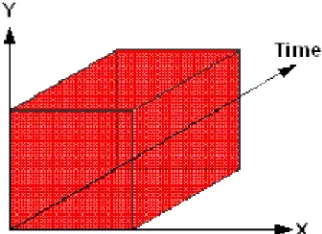
a) Dimensions: When a variable is defined, its shape is specified as a list of dimensions Dimension is integer parameter which defines the structure or shape of the data array stored in NetCDF files (e.g. Time, Depth, Latitude, and Longitude). Dimension may have attached attributes. Multidimensional data is represented in fig 1.
b) Attributes: Attributes are 1-dimensional array of value. Users are responsible to decide what attributes should include in netCDF files. There are two types of attributes:
Global attributes: Describe the contents of the file
Variable attributes: Attributes defines descriptive data associated with variable [1][11]
3) COMMON DATA LANGUAGE:
CDL (Common Data Language) is text notation for NetCDF objects and data. CDL is network Common Data form Language described as follow:
NetCDF name {
Dimensions: ...//Contains metadata
Variables:
Attributes:
Global attributes Local attributes }
Figure 1. CDL notation and NetCDF utilities
4) DATA TYPES
The NetCDF interface defines data types – char, byte, short, integer, float, and double. These types were chosen to provide a reasonably wide range of trade-offs between data precision and number of bits required for each value [2].
Figure 3. Multidimensional data representation
B. ADVANTAGE OVER EXISTING SYSTEM
1. Avoid many traverse i.e. one traverse 2. Quick data access within few seconds 3. Easy to apply logic
4. Cost : freely available on internet 5. Hardware requirement is very low 6. Easy to take a backup of file 7. Perform better prediction
C. MACHINE LEARNING TECHNIQUES
Learning is used when Solution needs to be adapted to particular cases orSolution changes in time.
Machine learning generally falls into categories:
1) Supervised Machine learning technique:
Figure 4. Supervised Machine learning
2) Unsupervised machine learning techniques:
UL is based on what normally happens. UL inspired by the brain’s ability to extract patterns. Clustering is the most important form of UL. It deals with data that have not been pre classified in any way, and does not need any type of supervision during its learning process. The most well-known example of clustering algorithm is k-means clustering [4]. In UL model not provided with correct results during the training. UL uses statistical properties to cluster the data. Normally UL is used when datasets involved hundreds of thousands of variables.This is the new technique of machine learning because most big datasets do not come with labels [7].
Figure 5. Unsupervised machine learning
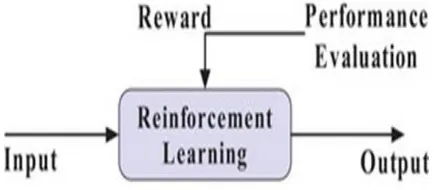
3) Reinforcement machine learning technique:
The reinforcement learning (RL) approach enables an agent to learn a mapping from states to actions by trial and error so that the expected cumulative reward in the future is maximized. RL is powerful since a learning agent is not told which action it should take; instead it has to discover through interactions with the system and its environment which action yields the highest reward [4] [7].
III.PROPOSED SYSTEM
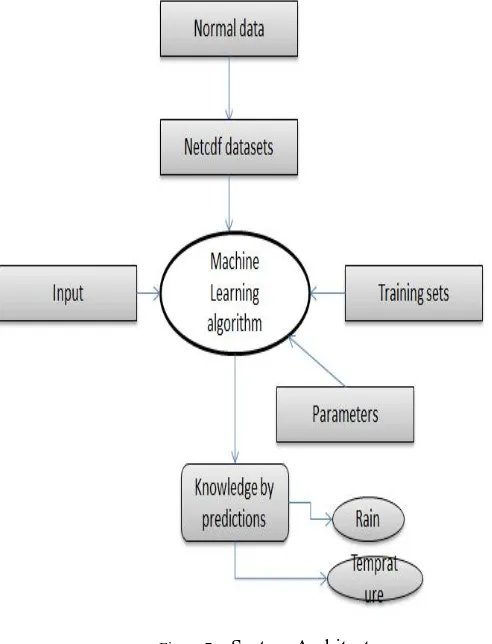
Propose system is going to performed knowledge discovery for NetCDF datasets using machine learning techniques. Hence an effective data extraction is performed from these NetCDF datasets. System architecture shown in fig: 7. First scientific data collected from various sources, and then this data is provided to NetCDF environment where it gets converted into NetCDF format [12]. Dimension and variable components of NetCDF files stored metadata while Attributes stored actual data. These NetCDF data is further provided to machine learning technique. There are different machine learning techniques available but propose system select best solution technique by comparing all and apply on NetCDF data.
Figure 7. System Architecture
Main function of machine learning technique is to predict output of certain input data by considering past result [7]. A computer program is said to learn from experience E with respect to some class of tasks T and performance measure P, if its performance at tasks in T, as measured by P, improves with experience E. Machine learning technique create training sets using NetCDF data, and then by extracting feature and characteristics of data statistical model is created. This statistical model generate hypothesis for input data. This hypothesis helps to discover knowledge. At the same time remaining data is considered as testing data, Machine learning techniques then compute model by extracting feature from these testing datasets. Both models get validated that helps for accurate prediction.
Finally we can discover knowledge by prediction with the help of past results and statistic graph generated by system with the help of R language.
Multidimensional parameters for the system to predict rainfall in India
2. India’s maximum temperature
3. District rainfall
IV.CONCLUSION
NetCDF is very popular and now globally accepted data representation format.NetCDF is a widely used file format in atmospheric and oceanic research [15]. Machine Learning technique is very well suited and effective for extracting knowledge in any application. Proposed system considered NetCDF and adds all the benefits of common data form in the system instead of other normal data forms.NetCDF programs are written with the help of CDL which ensure platform independency. Hence complex data such as heterogeneous data can be access with very high efficient way. More accurate prediction is done with the help of machine learning technique. The propose system ensures very effective knowledge discovery as it uses machine learning mechanism which includes statistical learning and prediction ability. System access large historical data i.e. over 100 years.
ACKNOWLEDGEMENTS
It is great pleasure for me to acknowledge the assistance and contribution of number of individuals who helped me in presenting “Knowledge Discovery and weather prediction of India using Machine Learning” paper.
First and foremost I wish to record my gratitude and thanks to Ms. S. P. Potdar for her enthusiastic guidance and help in successful completion of the paper. I would also like to thank Mr. R. P. Modi for his continuous support. I express my thanks to Mr. V. V. Puri, for his valuable guidance.
I would also extend my gratitude to Mr. P.R. Sonawane, Sonix Nano system, Pune, for being a constant source of inspiration.
REFERENCES
1. Harry L. Jenter and Richard P. singnell: “NetCDF- A public domain software solution to access a data problem for numerical modeler” 2. R. Rew, G. Davis, NetCDF: an interface for scientific data access, IEEE Computer Graphics and Applications 10 (4) (1990) 76–82 3. Edward Hartnett*, and R. K. Rew UCAR, Boulder, CO: “Experience with an enhanced NetCDF data model and interface for scientific
data access”
4. Shouyi Wang, Student Member, IEEE, WanprachaChaovalitwongse, Member, IEEE, and Robert Babuˇska: Machine Learning Algorithms in Bipedal Robot Control
5. Rew, G. Davis, S. Emmerson, H. Davies, and E. Hartnett. The NetCDF Users Guide, Version 3.6.1. Unidata Program Center, 2006 6. http://www.unidata.ucar.edu/software/netcdf/
7. Tom M. Mitchell, “Machine Learning”, Published October 1st 1997 by McGraw-Hill
8. Peter Barnum and VinithraVaradharajan: When to Picnic? - The Robotics Institute, Carnegie Mellon University Pittsburgh, PA 15213 9. Yu Su Computer Science and Engineering, The Ohio State University, Gagan Agrawal, Jonathan Woodring CCS-7.: Indexing and Parallel
Query Processing Support for Visualizing Climate Datasets - Applied Computer Science Group-Los Alamos National Laboratory 10. R. Castroa,∗, J. Vegaa, M. Ruizb, G. De Arcasb, E. Barrerab, J.M. Lópezb, D. Sanzb, B. Gonc¸ alvesc, B. Santosc, N. Utzeld, P.
12. Yi Wang ; Wei Jiang ; Agrawal, G.: Improving Data Analysis Performance for High-Performance Computing with Integrating Statistical Metadata in Scientific Datasets- Cluster, Cloud and Grid Computing (CCGrid), 2012 12th IEEE/ACM International Symposium 13. PavelMichna and Milton Woods: RNetCDF – A Package for Reading and Writing NetCDF Datasets
14. Rew, G. Davis, S. Emmerson, H. Davies, E. Hartnett, and D. Heimbigner. The NetCDF Users Guide, Version 4.1.3. Unidata Program Center, 2011
15. Eaton, J. Gregory, B. Drach, K. Taylor, and S. Hankin. NetCDF Climate and Forecast (CF) Metadata Conventions, Version 1.6, 2011 16. Mark Hall Pentaho Corporation Suite 340, 5950 Hazeltine National Dr. Orlando, FL 32822, USA, Eibe Frank, Geoffrey Holmes,
Bernhard Pfahringer Peter Reutemann, Ian H. Witten Department of Computer Science Hamilton, University of Waikato New Zealand-“ The WEKA Data Mining Software: An Update”
17. William J. Frawley, Gregory Piatetsky-Shapiro, and Christopher J. Matheus-“Knowledge Discovery in Databases: An Overview” 18. Nikhil Sethi, Dr.KanwalGarg “Exploiting Data Mining Technique for Rainfall Prediction”, (IJCSIT) International Journal of Computer