e-Vote: An Efficient E-Voting Application
using Android Platform
Ganaraj K1, Ankitha Bekal2, Kishor Shivathaya S3
M. Tech. Student, Department of Computer Science and Engineering, Bearys Institue of Technology, Mangalore,
Karnataka, India 1
Assistant Professor, Department of Computer Science and Engineering, Bearys Institue of Technology, Mangalore,
Karnataka, India 2
Assistant Professor, Department of Computer Science and Engineering, Bearys Institue of Technology, Mangalore,
Karnataka, India 3
ABSTRACT: The Advancement In The Mobile Devices, Wireless And Web Technologies Given Rise To The New Application That Will Make The Voting Process Very Easy And Efficient. The E-Voting Promises The Possibility Of Convenient, Easy And Safe Way To Capture And Count The Votes In An Election[1]. This Research Project Provides The Specification And Requirements For E-Voting Using An Android Platform. The E-Voting Means The Voting Process In Election By Using Electronic Device. The Android Platform Is Used To Develop An E-Voting Application. At First, An Introduction About The System Is Presented. Sections Ii And Iii Describe All The Concepts (Survey, Design And Implementation) That Would Be Used In This Work. Finally, The Proposed E-Voting System Will Be Presented. This Technology Helps The User To Cast The Vote Without Visiting The Polling Booth. The Application Follows Proper Authentication Measures In Order To Avoid Fraud Voters Using The System. Once The Voting Session Is Completed The Results Can Be Available Within A Fraction Of Seconds. All The Candidates Vote Count Is Encrypted And Stored In The Database In Order To Avoid Any Attacks And Disclosure Of Results By Third Person Other Than The Administrator. Once The Session Is Completed The Admin Can Decrypt The Vote Count And Publish Results And Can Complete The Voting Process.
.
KEYWORDS: Electronic voting; e-mail
I. INTRODUCTION
ISSN(Online): 2320-9801
ISSN (Print): 2320-9798
I
nternational
J
ournal of
I
nnovative
R
esearch in
C
omputer
and
C
ommunication
E
ngineering
(An ISO 3297: 2007 Certified Organization)
Website:
www.ijircce.com
Vol. 5, Issue 4, April 2017
The advanced e-voting technique makes use of main two phases- the registration and login phase. During the registration phase the user need to provide required information and can get a secured password in order to login the application for voting. In the second phase using the user-id and password provided the user can login and can cast the vote from home or office or anywhere securely. The votes are properly encrypted so that any third person cannot able to find voting information of any others. The whole operation is managed by an administrator. The admin can monitor the process and finally announces the result soon after voting session is completed. Even the vote counts are stored in the encrypted form while getting stored in the database maintained and managed by administrator. Hence the overall voting process will be safe and secure.
II. COMPARISON WITH THE EXISTING SYSTEMS
The current system which is present now is a machine and paper based voting system which needs much man power and requires lot of resources. The present voting system finds difficulty during the counting also because it is counted manually. To overcome this as we said earlier the e voting system provides an efficient way to complete the whole voting system. The e voting system is an android application which enables user to vote in his smart phone. This is more advanced compared to the present system because it doesn't need any man power. And voter doesn’t need to visit the polling booth. The application also reduces the complexity of counting since it is automatic.
III. PROPOSED SYSTEM
The application can be installed in the android phones and voting will be enabled by the administrator on the polling day. If there are different stages of polling then application will enable the user only on the polling day. The user can enter into the application by giving his voter id/Aadhar number(unique number) and a secret password which is provided to the user. As soon as the user enters into the application he selects his constituency and his booth number or place then the user can cast his vote and logout from the application. The vote should be kept secret and it should be available on the voting day in the counting center. To keep the vote secret an encryption and a decryption algorithm is used. So as soon as the user casts his vote the vote is encrypted so that it is secret and the same is encrypted on the polling day.
IV. E-VOTING SYSTEM DESIGN
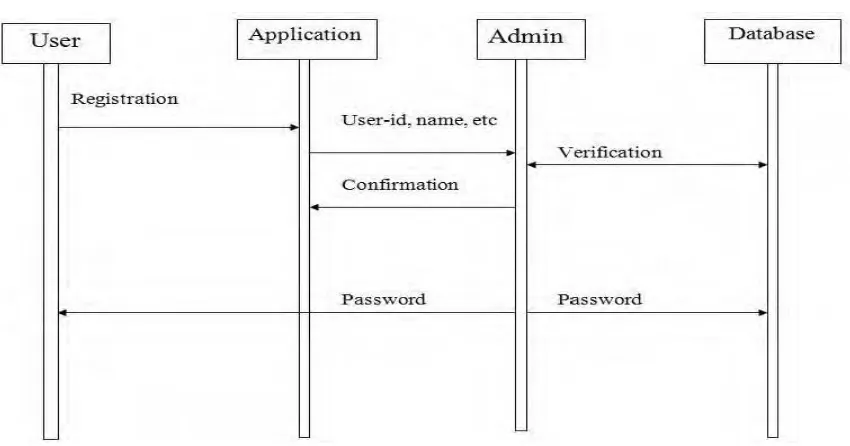
Figure 1: Sequence diagram of registration
ISSN(Online): 2320-9801
ISSN (Print): 2320-9798
I
nternational
J
ournal of
I
nnovative
R
esearch in
C
omputer
and
C
ommunication
E
ngineering
(An ISO 3297: 2007 Certified Organization)
Website:
www.ijircce.com
Vol. 5, Issue 4, April 2017
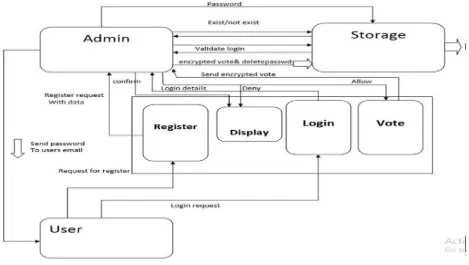
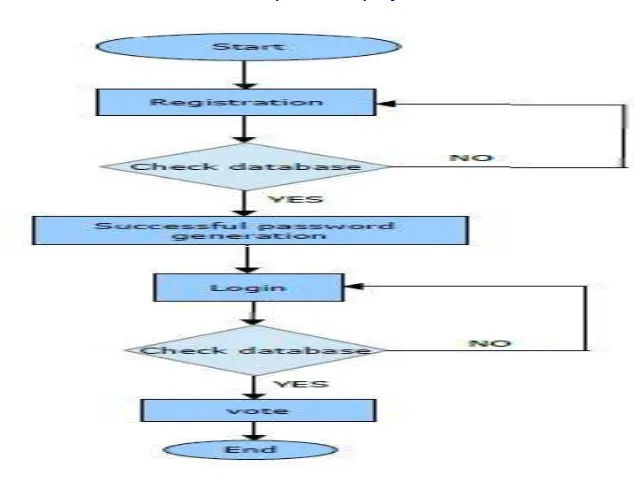
should register themselves to get a password for voting purpose. This constraint is imposed to ensure that only the genuine person is allowed to vote in the elections. The aim of this work is to design and implement an electronic voting application for the Android platform that will enable people to vote securely from anywhere. The application as a whole is aimed at being compatible with devices from many manufacturers and running different versions of the operating system. The application is also aimed at being localized [4]. Figure Below shows the overall voting process.
Figure 3 : Overall voting process
Figure 4 : Flowchart of Overall voting process
VI. E-VOTING SYSTEM SECURITY LEVELS
For the security, we use e-mail service to provide the secured password to the user. When the password is generated it will be sent to the users e-mail id which is linked to the aadhar-id stored in the database. The e-mail account is self managed and none of the other user can access the e-mail and get the password to login.
The most security part lies on securing the vote casted by the user. So the vote is encrypted using Java Cryptology Extension algorithm and sent to admin [7]. However only the admin has the permission to access the database. Even while storing the vote count it is stored in the encrypted form hence it becomes a secured data. At any moment the admin only have the permission for accessing and updating data in the server. To avoid fraud voters the aadhar-id which unique number uniquely identifies the user. The possibility is that any user may try to revote again once after voting. Some flag indicating that the user status (voted or not) is maintained at the server. Whenever user casts the vote the flag field is updated and can be referred for future analysis. This flag field also helpful to collect information about percentage of voting and will act as a reference data.
VII. RESULTS
When the system is implemented its user interfaces are obtained as described below. Using this application the user can easily cat their vote.
ISSN(Online): 2320-9801
ISSN (Print): 2320-9798
I
nternational
J
ournal of
I
nnovative
R
esearch in
C
omputer
and
C
ommunication
E
ngineering
(An ISO 3297: 2007 Certified Organization)
Website:
www.ijircce.com
Vol. 5, Issue 4, April 2017
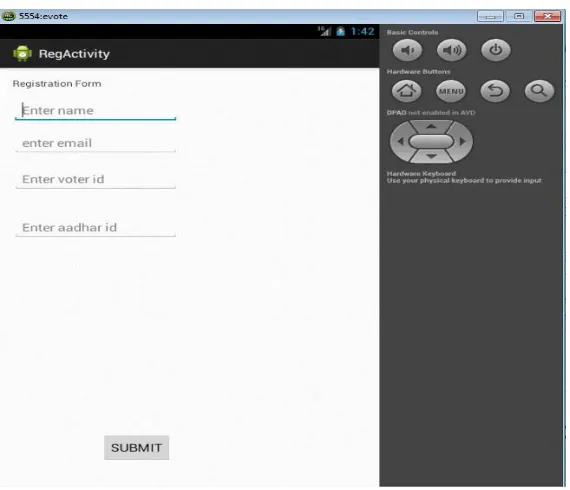
Figure 5 : User Registration example
The Figure5 illustrates the registration procedure example when the application is developed and installed in a smart phone for testing. It is clear that in the registration form the user need to provide valid details. Whenever the valid details are matching the registration procedure becomes successful. Else the user does not allowed for registration. After you submit the details asked by the registration the application will give you a toast message whether your registration is successful or not. At the same time if your registration is successful the application will send you a mail which contains the password which is needed later for logging in.
LOGIN AND VOTING PROCESS
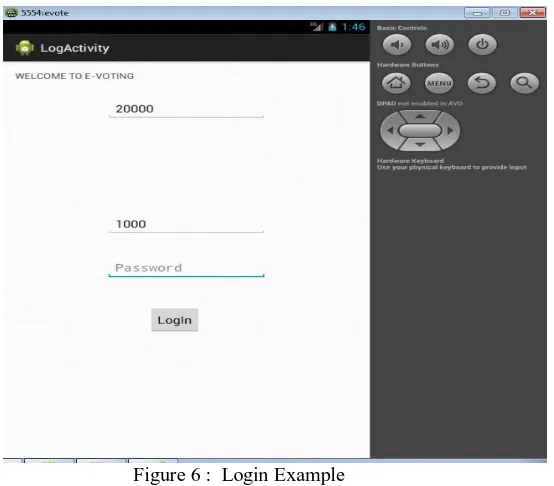
You need to login for voting by giving the the below details • Aadhar id
Figure 6 : Login Example
Once user submits the details the application checks the details given by the user in database at the server side. If the details provided are proper then login successful status is shown as a toast message. After this the user can choose voting option to cast the vote. A list of candidates contesting in the election along with their details is displayed in users Smartphone. The candidate list is updated from the server. Now it’s the right time to select a candidate from the available list. When user taps against a candidate the application asks for confirming the vote. When user confirms the candidate selected the information is sent to the server. Now vote count against the selected candidate is updated which is stored in an encrypted form. Also a flag field maintained in the database is enabled against the user once user casts the vote so that if the same user tries to vote again then the application should not allow for it. All these processes are done at the server side to make voting process safe and secured.
VIII. CONCLUSION
ISSN(Online): 2320-9801
ISSN (Print): 2320-9798
I
nternational
J
ournal of
I
nnovative
R
esearch in
C
omputer
and
C
ommunication
E
ngineering
(An ISO 3297: 2007 Certified Organization)
Website:
www.ijircce.com
Vol. 5, Issue 4, April 2017
Pallavi Ghadge, Sarika Kale ,Co-authors- Prof. N. J. Kulkarni, Prof. S. S. Mujgond, February 2012.
[5] “Electronic Voting,” Encyclopedia of Computers and Computer History, prepared by Lorrie Faith Cranor and edited by Raul Rojas, published
by Fitzroy Dearborn, 2001.
[6] “Voting – What is, What Could be,” Caltech/MIT Voting Technology Project (VTP) Report, July 2001.