Scholarship at UWindsor
Scholarship at UWindsor
Electronic Theses and Dissertations Theses, Dissertations, and Major Papers
1-1-1964
Personality differences between high scholastic aptitude-average
Personality differences between high scholastic aptitude-average
creativity and high creativity-average scholastic aptitude groups
creativity and high creativity-average scholastic aptitude groups
of college students.
of college students.
Richard T. Comstock University of Windsor
Follow this and additional works at: https://scholar.uwindsor.ca/etd
Recommended Citation Recommended Citation
Comstock, Richard T., "Personality differences between high scholastic aptitude-average creativity and high creativity-average scholastic aptitude groups of college students." (1964). Electronic Theses and Dissertations. 6346.
https://scholar.uwindsor.ca/etd/6346
PERSONALITY D IFFERENCES
BETWEEN HIGH SCHOLASTIC APTITUDE-AVERAGE CREATIVITY AND HIGH CREATIVITY-AVERAGE SCHOLASTIC APTITUDE
GROUPS OF COLLEGE STUDENTS
A T h e sis
Subm itted to th e F acu lty of G rad u ate Studies thro u g h the D ep artm en t of Psychology in P a r tia l F u lfillm en t
of th e R e q u ire m e n ts fo r th e D e g ree of M a s te r of A rts a t the
U n iv ersity of W indsor
by
RICHARD T . COMSTOCK
B . A . , A ssum ption U n iv ersity of W in d so r, 1962
INFORMATION TO USERS
The quality of this reproduction is dependent upon the quality of the copy submitted. Broken or indistinct print, colored or poor quality illustrations and photographs, print bleed-through, substandard margins, and improper alignment can adversely affect reproduction.
In the unlikely event that the author did not send a complete manuscript and there are missing pages, these will be noted. Also, if unauthorized copyright material had to be removed, a note will indicate the deletion.
®
UMI
UMI Microform EC52526 Copyright 2008 by ProQuest LLC.
All rights reserved. This microform edition is protected against unauthorized copying under Title 17, United States Code.
ProQuest LLC 789 E. Eisenhower Parkway
pf
' i o
>
A study w as u n d ertak en to in v e stig ate the p e rso n a lity d iffe re n c e s
betw een two g ro u p s of co lleg e stu d en ts. One group re c e iv e d high s c o r e s on a
sc h o la stic aptitude te s t (S .C .A . T . ) and r e g is te r e d a t a low le v e l on a te s t of
c re a tiv ity (G u ilfo rd 's A lte rn a te U ses T e st). The o th e r g ro u p , tak en fro m the
sam e o v e ra ll population, a tta in ed high s c o r e s on th e c re a tiv ity te s t and low
s c o r e s on the sc h o la stic aptitude te s t.
By em ploying th e C a tte ll Sixteen P e rs o n a lity F a c to r Q u e stio n n a ire a s
a m e a su rin g dev ice the g ro u p s w e re co m p ared w ith re s p e c t to p e rso n a lity
d iffe re n c e s.
Of th e six teen p e rso n a lity fa c to rs m e a s u re d by th e C a tte ll Sixteen
P e rs o n a lity F a c to r Q u e stio n n a ire , th re e fa c to rs w e re found to d iffe r sig n ifi
cantly betw een th e two g ro u p s. They w e re a s follow s:
1) The high c re a tiv ity -a v e ra g e sc h o la stic aptitude group w as found to be m o re
e n th u sia stic , ta lk a tiv e and su rg e n t than th e high sch o la stic a p titu d e -a v e ra g e
c re a tiv ity group who tended to be m o re g lu m , s ile n t and d e su rg en t.
2) The high c re a tiv ity -a v e ra g e sch o la stic aptitude group w as found to be m o re
c o n se rv a tiv e and accepting than th e high sc h o la stic a p titu d e -a v era g e c re a tiv ity
group who w e re m o re ex p erim en tin g , c r itic a l and ra d ic a l.
3) The high c re a tiv ity -a v e ra g e sc h o la stic aptitude group w as found to be m o re
dependent and im ita tiv e than th e high sch o la stic a p titu d e -a v e ra g e c re a tiv ity group
who w e re m o re s e lf-s u ffic ie n t and re s o u rc e fu l.
Upon in sp ec tio n , th e r e s u lts of th e p re s e n t study w e re found to be
in co m p atib le w ith th o se of p rev io u s r e s e a r c h . T h is in d icated th e n e c e s sity fo r
a re -e v a lu ta tio n of th e p sy ch o m e tric in s tru m e n ts and the e x p e rim e n ta l d esig n
u se d in th is in v estig atio n . I t w as concluded by th e au th o r th a t by including a
w id e r v a rie ty of m e a su re m e n ts and em ploying a m o re so p h isticated e x p erim en tal
d esig n in fu tu re s tu d ie s, an adequate sam p le and b e tte r o o n tro l of th e v a ria b le s
D uring th e p a s t decade probably a s m uch psychological r e s e a r c h h a s
been c a r r ie d out w ith re g a rd to the n u m ero u s a s p e c ts of c re a tiv ity a s in a ll
th e y e a r s p reced in g . C o n sid erin g th e im p o rta n c e of the p ro b le m , and view ing
th e fa c t th a t m o s t m o d ern day m ethods of education em p h asize th e developm ent
of individual p o ten tial (G a rris o n , 1959), th is e x p e rim e n te r w as le d to begin th e
p re s e n t study. Seeking a m o re thorough knowledge of th e c re a tiv e p e rso n a lity
and of how i t d iffe rs fro m th a t of a p e rso n w ith high sch o la stic aptitude w as the
p u rp o se of th is in v estig atio n .
The au th or re sp e c tfu lly w ish es to thank D r. J . E . C allag an and
D r. A. A. Sm ith fo r th e ir su g g estio n s and a s s is ta n c e in th e com pletion of th is
w o rk . G ratitu d e i s also due M r. M ey er S ta r r M .A . and M r. R o b e rt C . P into
M .A . fo r th e ir p a tie n ce and u n d erstan d in g in th e p re p a ra tio n of the fin al d ra ft
of th is th e s is . A fin al m etnion m u st also be m ad e re g a rd in g th o se p ro f e s s o r s
and stu d en ts who so w illingly found tim e to p a rtic ip a te in th is e x p erim en t.
TABLE OF CONTENTS
P a g e
P R E F A C E ... iv
LIST OF T A B L E S ... vii
LIST OF F I G U R E S ... v iii C h ap ter I IN T R O D U C T IO N ... 1
L im ita tio n s of E a rly C oncepts . . . . 1
The C oncept of C re a tiv ity . . . . 4
P e rs o n a lity C h a r a c te ris tic s and C re a tiv ity . . 8
P ro je c tiv e T e s t Studies . . . 13
P ro b le m of th e P r e s e n t Study . . . . 18
H DESIGN OF E X P E R I M E N T ... 19
Selection of Subjects . . . 19
M ethod . . . 22
P ro c e d u re . . . 23
A n aly sis . . . 24
E l PRESENTATION AND ANALYSIS OF RESULTS . . 26
M ain S ta tis tic a l A n aly sis . . . 26
IV D I S C U S S I O N ... 32
C o m p ariso n of R e s u lts to R elate d R e s e a rc h . 33 V SUMMARY AND CONCLUSIONS . . . . 40
Sum m ary . . . 40
C onclusions . . . 41
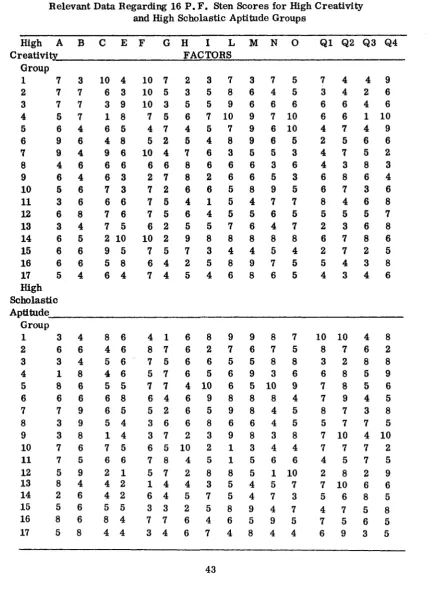
APPENDIX A R elev an t D ata R egard in g 16 P . F . Sten S c o re s fo r High C re a tiv ity and High S ch o lastic A ptitude G roups 43
APPENDIX B I. P . A. T . C a tte ll Sixteen P e rs o n a lity F a c to r
Q u estio n n aire F o rm A 44
APPENDIX C G u ilfo rd 's A lte rn a te U ses T e s t F o rm A 45
APPENDIX D A D etailed Scoring Guide of G u ilfo rd 's A lte rn a te
U ses T e s t F o rm A 46
B I B L I O G R A P H Y ... 4 7
VITA A U C T O R I S ... 5 0
LIST OF TABLES
T ab le P ag e
1 M ean, Standard D eviation and B ange fo r A ge, S .C . A. T.
and C re a tiv ity S c o re s fo r B oth G roups . . . 23
2 C a tte ll 16 P . F . M ean Sten S c o re s fo r Both G roups . 26
3 A n aly sis of V a ria n c e fo r N u m e ric al T ab le . . . 29
4 A n aly sis o f V a ria n c e Sim ple M ain E ffects . . . 31
5 R elev an t D ata R eg ard in g 16 P . F . Sten S co res fo r Both
E x p e rim en ta l G roups . . . . . 43
F ig u re
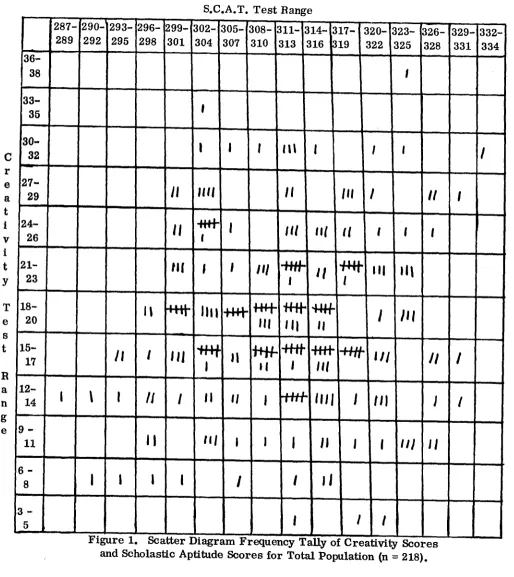
1 S c a tte r D iag ram F req u e n c y T ally of C re a tiv ity S c o re s and S ch o lastic A ptitude S co res fo r T o tal Population (N = 218)
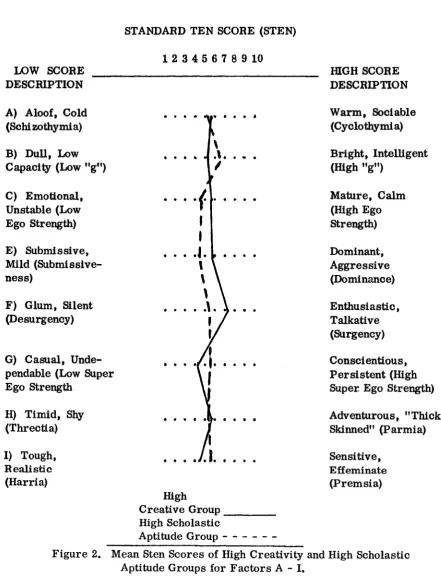
2 P r o file of 16 P . F . M ean Sten S c o re s fo r F a c to rs A -I .
3 P ro file of 16 P . F . M ean Sten S c o re s fo r F a c to rs L -Q 4 .
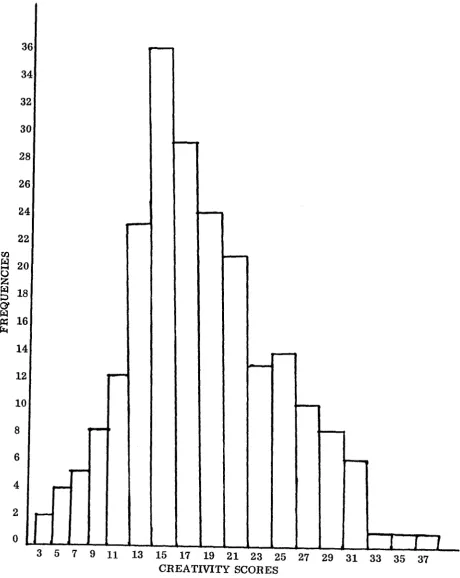
4 H isto g ram of C re a tiv ity S c o re s fo r P opulation (N = 218) .
v iii
P ag e
21
27
28
CHAPTER I
INTRODUCTION
O v er th e y e a r s , v a rio u s stu d ie s have been u n d ertak en to in v e stig a te ,
a s ob jectively a s p o ssib le , the hum an qu ality of 'feiftedness". H ow ever, due to
th e r e s e a r c h of T e rm a n and h is a s s o c ia te s on th e behavior of s u b je c ts w ith
high I .Q . 's th e te rm 'g ifte d " took on a lim ite d m eaning. T h is lim ita tio n i s r e
fle c ted in th e definition of ‘'gifted" a s sta te d in H in sie and C am pbeU 's P sy c h ia
tr i c D ictio n ary (1960, p. 319): "As u sed in ch ild p sy ch ia try , th is te r m i s m ean t
to r e f e r to a ch ild w hose in te llig e n c e i s in th e u p p er 2 p e r c e n t of th e to ta l
population of h is age. O ften, how ever, th e te rm is u se d m o re lo o sely to r e f e r
to a child who show s outstanding ab ility in any sin g le a r e a . " Subsequent r e
s e a rc h h a s , how ever, led to the conclusion th a t g ifted n e ss (in th e w id er sen se)
and high in te llig e n c e a r e n o t n e c e s s a rily synonym ous.
L im ita tio n s of E a rly C oncepts
E a rly stu d ie s on g ifted n e ss w e re review ed by G etzels and Jac k so n
(1962). In co nclusion, G e tze ls and Ja c k so n em p h asized the com plex n a tu re of
"g ifte d n e ss" and pointed ou t th re e m a jo r lim ita tio n s in co n sid erin g g ifted n e ss
a s synonym ous w ith high in tellig en ce.
F i r s t , i t su g g ests th a t the com m on in te llig e n c e te s t sa m p le s a ll, o r a t le a s t a sufficiently b ro ad ra n g e , of known cognitive a b ilitie s . I t thus d isc o u ra g e s th e o b se rv a tio n of o th e r iy p es of cognitive function ing. On th e c o n tra ry , th e ite m s on the ty p ic a l in te llig e n c e te s t
seem ed to u s to r e p r e s e n t a r a th e r n a rro w band of in te lle c tu a l ta s k s , re ly in g chiefly on th o se re q u irin g in G u ilfo rd ’s te r m s ’co n v erg en t thinking’ .o r neglecting th o se re q u irin g ’d iv e rg e n t th in k in g '. To do w ell on th e ty p ic a l in te llig e n c e te s t , th e su b ject m u st be able to r e c a ll and to re c o g n iz e , p e rh a p s even to solve; he need n o t n e c e s s a rily be able to in v en t o r innovate.
Second, although th e c o rre la tio n betw een th e I .Q . and le a rn in g i s p o sitiv e — and we ought to say a t once th a t we re c o g n ize th e I .Q . as probably th e b e s t single m e a s u re we have—i t n e v e rth e le s s r a r e ly accounts fo r m o re than o n e -q u a rte r of th e v a ria n c e in such c ru c ia l fa c to rs a s school ach iev em ent and acad em ic p e rfo rm a n c e . The
stu d en t w ith a h ig h e r I .Q . who i s doing poorly in school and th e stu d en t w ith a lo w er I .Q . who i s doing w ell ap p ea r too often fo r th e I .Q . to stan d a s the only p re d ic tiv e m e a s u re of in te lle c tu a l ab ility o r a s th e so le c r ite r io n of g ifted n e ss. M o re o v e r, i t i s com m only o b se rv e d th a t m any c h ild re n who a r e v e ry high in in te llig e n c e a s m e a s u re d by I .Q . a r e not concom itantly high in such o th e r in te lle c tu a l functions a s c re a tiv ity , and m any who a r e high in c re a tiv ity a r e n o t concom itantly high in in te llig e n c e a s m e a s u re d by I. Q . .
And th ird , th e I .Q . m e tric h a s been p e c u lia rly im m une to advances in o u r u n d erstan d in g of thinking and b eh av io r. D esp ite sig n ifican t tra n s fo rm a tio n s in o u r th e o rie s of cognition, le a rn in g , and pro blem
solving, th e conceptual b a se of th e in te llig e n c e te s t h a s re m a in e d un a lte re d . The soundness of a new in te llig e n c e te s t i s often m e a s u re d by th e d e g re e of it s c o rre la tio n w ith an old te s t, th a t i s , th e te s t m u st m e a s u re th e sam e m e n ta l p ro c e s s e s a s the old te s t. T his p e r p etu ates the o rig in a l conception of in te llig e n c e and g u a rd s i t fro m
s e rio u s th e o re tic a l and e m p iric a l sc ru tin y . (G etzels & Ja c k so n , 1962, p. 2).
G uilford (1956) believed th a t m o re atten tio n should be given to the
s u p e rio r hum an ad u lt in th e in v e stig atio n of in te lle c tu a l q u a litie s and functions.
P re v io u s stu d ie s, following B in et, had been v e ry lim ite d in th e ir in v estig atio n
of th e scope and v a rie ty of in te llig e n c e . G uilford re a liz e d th a t a g r e a t n u m b er
hum an n a tu re and su g g ested fa c to r a n a ly sis a s a p o ssib le m ethod of in v estig atin g
th e se a s p e c ts . He re p o rte d 40 known fa c to rs and suggested th a t a g r e a t m any
additional fa c to rs n eed to be studied b efo re an adequate p ic tu re of in te llig e n c e
can be e sta b lish e d . G uilford c laim ed th a t fo rty , sixty o r even a hun d red fa c to rs
would c e rta in ly be a s m a lle r n u m b er of co n cep ts than the num b er of p o ssib le
te s t s o r th e n u m b er of o b se rv a b le ty p es of a c tiv itie s of an in te lle c tu a l c h a ra o te r.
In th e fo rly fa c to rs d is c u s s e d by G u ilfo rd , 7 m em o ry fa c to rs and 33 thinking
fa c to rs w e re inoluded. The thinking fa c to rs involve cognitive (d isco v ery ), p ro
ductive (convergent o r d iv e rg e n t thinking) and evaluative m e n ta l activ ity w hich
a r e of a fig u ra l, s tr u c tu r a l o r conceptual n a tu re .
G uilford su g g ested th a t the te rm in te llig e n c e h as n e v e r been defined
uniquely o r s a tis fa c to rily . He fe lt th a t a s to g e n e ra l term in o lo g y , in te lle c t can
be m eaningfully defined a s th e sy ste m of thinking and m em o ry fa o to rs , functions
and p ro c e s s e s . G uilford continued to explain th a t on an I .Q . te s t , when m any
fa c to rs a r e p re s e n t, the co m posite s c o re b ased on a ll ite m s can m e a s u re each
com ponent only to a s m a ll d e g re e if they a r e equally w eighted in th e co m p o site.
He c laim ed th a t a Stanford B in et I .Q . o r any I .Q . fro m a te s t w hose com ponents
a r e p red o m in ately v e rb a l i s b ased m o stly on a v e rb a l-c o m p re h e n sio n fa c to r
th u s reducing th e effe ctiv en e ss of o th e r fa c to rs which m ight be re p re s e n te d in
th e s c a le . In n o n -v e rb a l te s ts th e re i s le s s dom ination by a sin gle fa c to r but
v a ria tio n stiU r e s u lts fro m one b a tte ry to a n o th er.
T h e re is evidence, th e re fo re , to in d ic a te th a t g ifted n e ss i s no t
obvious lim ita tio n s of the p re s e n t co n cep t of in te llig e n c e, a s ind icated above,
th a t re c e n t r e s e a r c h h a s c o n ce n tra te d on o th e r in te lle c tu a l functions a s ex
p re s s e d in sch o la stic aptitude and c re a tiv e ab ility .
T he C oncept of C re ativ ity
A s pointed out in S p rec h e r (1963), 'b r e a tiv ity " is not an unequivocal
te r m . H ow ever, v a rio u s d efin itio n s have been attem p ted and a r e com m only
a ccep ted . D re v e r (1952, p. 54) d efines c re a tiv e a s follow s: 'P ro d u c in g an
e ss e n tia lly new p ro d u ct, . . . ; u se d of im ag in atio n w h ere a com bination of id e a s
o r im a g e s in c o n stru c te d (s tric tly when i t i s s e lf-in itia te d r a th e r than im ita te d );
a lso of thought sy n th e sis w h ere th e m e n ta l p ro d u ct is not a m e re su m m a tio n ."
G uilford (1950), in attem p tin g to define c re a tiv ity , s ta te d th a t p rim a ry
ab ility i s th e m o s t e s s e n tia l fa c to r fo r an individual to be o re a tiv e . H ow ever,
con cern ing th e pro d u ctiv e a sp e c t of the c re a tiv e p e rso n , he c laim ed th a t
"W hether o r no t the individual who h a s the re q u is ite a b ilitie s w ill a ctu a lly p ro
duce r e s u lts of a c re a tiv e n a tu re w ill depend upon h is m o tiv atio n al and
te m p e ra m e n ta l tr a it s . To th e p sy ch o lo g ist, th e pro b lem is a s b ro ad a s th e
q u a litie s th a t c o n trib u te sig n ifican tly to c re a tiv e p roductivity. In o th e r w o rd s,
the p sy c h o lo g ist's p ro b lem i s th a t of c re a tiv e p e rs o n a lity ." A s a fin a l r e m a rk
he c laim ed th a t "A c re a tiv e p a tte rn i s m a n ife st in c re a tiv e b eh av io r, w hich in
clu d es such a c tiv itie s a s inventing, designing, co n triv in g , com posing, and
planning. P e o p le who exhibit th e se types of beh avio r to a m a rk e d d e g re e a r e
5
H a rrim a n 's E ncyclopedia of Psychology (1946) and T a y lo r's "T he
N atu re of the C re a tiv e P r o c e s s " (1959) both define c re a tiv e thinking fro m the
point of view of s ta g e s. T h ese s ta g e s , w hich had been reco g nized by H elm
ho ltz (1896) and Poincare^H iO S), w e re la te r defined by W allas (1926). A s
s ta te d in th e E ncyclopedia of Psychology (1946) no fu rth e r d e ta ils w e re given
/
w ith re s p e c t to th e e a rly reco g n itio n of th e se sta g e s by H elm holtz and P o in c a re .
W ith re g a rd to th e d efinition, h ow ever, H a rrim a n sp eak s of fo u r sta g e s v iz.
p re p a ra tio n , incubation, illu m in atio n (o r in sp iratio n ) and e lab o ratio n (o r v e r if i
cation). In th e f i r s t p erio d (p rep aratio n ) the su b ject a sse m b le s o r re c e iv e s
new id e a s by g a th erin g to g e th e r h is raw m a te ria l. Incubation follow s w h ere th e
pro b lem i s la id a sid e and no v o lu n tary w ork is done on it. E ventually renew ed
atten tio n to th e pro blem r e s u lts in a p ro m p t solution o r a t le a s t a p ro m p t
advance beyond th e p rev io u s stag e of m a s te ry . The th ird stag e (illum ination)
o c c u rs when th e id e a b eco m es defin itely re la te d to a sp ecific g o al, re s u ltin g in
th e com pletion of the e s s e n tia l s tru c tu re . F in a lly , in the e lab o ratio n stag e ,
th e id e a i s re v is e d and given the finishing to u ch es. Although th e se p e rio d s a r e
d istin g u ish ed in thought p ro c e s s they m ay o v e rla p . The length of th e se s ta g e s
also v a rie s betw een p e rs o n s and thoughts.
The above w r ite r also m ade a d istin ctio n betw een c re a tiv e thought and
fan tasy a s follow s: " C re a tiv e thought is d ifferen tia te d fro m the type of
im ag in ativ e activ ity found in r e v e rie o r daydream ing in th a t i t is d ire c te d by a
p u rp o se o r g oal" (H a rrim an , 1946, p. 110).
and events a s being p a r t of the c re a tiv e p ro c e s s . T h is o p en n ess allow s fo r
m o re d ire c t p e rc ep tio n of the w o rld its e lf , in ste a d of ju s t th e la b e ls attach ed
to o b je cts and ev en ts. He also c laim ed th a t the p a rtic u la r o v e rt c h a r a c te r is tic s
of th e individual m ay v a ry fro m tim e to tim e depending upon w hich quality is
playing the dom inant ro le in any c re a tiv e ex p erien ce (e. g. in te llig e n c e o r
o rig in ality ).
T a y lo r and B a rro n (1963) m ade a d istin ctio n betw een c re a tiv ity and
p roductivity. They c laim ed th a t prod u ctiv ity need not re q u ire o rig in a lity but
c re a tiv ity a s found in th e c re a tiv e s c ie n tis t, fo r in sta n c e , involves both
o rig in a lity and pro d u ctiv ity . In d isc u ssin g th e n a tu re of c re a tiv e thinking th e se
a u th o rs lis te d th e following a s being p re re q u is ite s fo r a c re a tiv e s c ie n tis t:
1) highly developed in te lle c tu a l ab ility , being o rd e rly , thorough and d is c i
plined in h is acq u isitio n of c u rre n t knowledge,
2) an open m ind (cf. Schachtel, 1959) w hich pays atten tio n to things w hich
a p p ear d is c o rd a n t and c o n tra d icto ry and a tte m p ts to find new p rin c ip le s w hich
w ill r e s to r e o r d e r ,
3) an independence of judgm ent and an ab ility to stand h is ground in th e face
of c r itic is m ,
4) a co m m itm en t to and re s p e c t fo r th e u n reaso n ab le.
S pearm an (1930) surv ey ed view s on c re a tiv ity c u r r e n t a t the tim e . He
quoted fro m R av aisso n : "G enius, by the a d m issio n of ev eryone, c o n s is ts above
a ll in inventing, in c r e a tin g ," and also G e ra rd : "G enius is p ro p e rly the
7
d is c o v e rie s in scie n c e o r fo r producing o rig in a l w orks of a r t . " (S pearm an,
1930, p. 6).
W ithin the psychoanalytic fra m e of re fe re n c e , Zilboorg (1959, p. 25)
r e f e r r e d to d iv e rs ity and a d v e rsity w ith re s p e c t to th e c re a tiv e life stating:
"We m u st re m e m b e r th a t th e psychology of th e c re a tiv e p e rso n i s th e psychology
of a p e rso n who w alks around in life , who lo o k s, and s e e s , and fe e ls , who
ta k e s into account w hat life i s and, somehow o r o th e r, w ants to g e t out fro m the
f e tte r s in o r d e r to e x p re s s som ething th a t h e h as w ithin h im s e lf ."
E x p e rim en ta l stu d ie s have shown, beginning w ith a p a p er by N ew ell,
Shaw and Simon (1962), the re la tio n sh ip betw een c re a tiv ity and p ro b lem solving.
T h e se a u th o rs fe e l th a t pro b lem solving i s c a lle d c re a tiv e to the ex ten t th a t one
o r m o re of th e following conditions a r e satisfied :
1) The p ro d u ct of the thinking h a s novelty and value (e ith e r fo r the th in k e r o r fo r h is c u ltu re ).
2) The thinking i s unconventional, in the se n se th a t i t r e q u ire s m odi ficatio n o r re je c tio n of p rev io u sly accep ted id e a s.
3) The thinking re q u ire s high m otivation and p e rs is te n c e , taking p lace e ith e r o v e r a c o n sid e ra b le span of tim e (continuously o r in te rm itten tly ) o r a t a high in te n sity .
4) The pro b lem a s in itia lly posed w as vague and illd efin ed , so th a t p a r t of the ta s k w as to fo rm u la te th e problem its e lf.
T h u s, c re a tiv e activ ity (at le a s t in the scien ces) a p p e a rs to be a s p e c ia l c la s s of p ro b le m -so lv in g activ ity c h a ra c te riz e d by novelty, unconventionality, p e rs is te n c e , and difficulty in p ro blem fo rm u la tion. (N ew ell, et. a l, 1962, p. 65).
P a r a e s and Meadow (1963) studied 350 students e n ro lled in a c re a tiv e
p ro b lem -so lv in g c o u rs e a t the U n iv ersity of Buffalo. They found th a t tra in in g
stu d en ts in th e u se of "d e fe rre d -ju d g m e n t" fo r problem solving in c re a s e d the
m entioned by the a u th o rs.
A study w as u n d ertak en by D rev d ah l (1956) in v estig atin g p a rtic u la r
fa c to rs w hich w e re a ssu m e d to be a ss o c ia te d w ith c re a tiv e in d iv id u als. He
u se d g ra d u a te stu d en ts, who w e re c la s s ifie d into c re a tiv e and n o n -c re a tiv e
g ro u p s and also scie n c e and a r t s g ro u p s (the fo rm e r on th e b a s is of ra tin g s
m ad e by the faculty m e m b e rs of the U n iv ersity of N eb rask a), and found no
sig n ifican t d ifferen c e betw een the g ro u p s on a fa c to r of "spontaneous fle x i
b ility ." T h is i s an in te re s tin g finding, fo r "spontaneous flex ib ility " i s the
fa c to r m e a s u re d by the A lte rn a te U se s T e s t, the te s t u sed in th is p a rtic u la r
study (e x p erim en tal d esig n , p. 2 0).
P e rs o n a lity C h a r a c te ris tic s and C re a tiv ity
A g re a t d eal h a s been w ritte n and m any stu d ie s have been c a r r ie d o u t
in v estig atin g the re la tio n sh ip betw een c re a tiv e ab ility and p e rso n a lity tr a i t s .
Stein (1963) fe lt th a t p sy ch o lo g ists have tended to m in im ize th e sig n ifi
c an ce of the so c ia l m ilieu c re a te d by th e individual h im se lf. In h is study, he
p laced e m p h asis on th e hum an p e rs o n 's ab ility to a lte r h is en v iro n m ent, and
th u s, a ctu a liz e h is own n eed s and p o te n tia litie s. Stein postu lated th a t c re a tiv ity
c o n s is ts of p ro c e s s e s th a t o c c u r w ithin th e individual which a r e th e r e s u lt of
so c ia l tra n s a c tio n . T h is tra n s a c tio n , w hich c o n sis ts of a ll th e so c ia l in te r
actio n s of th e individual w ith h is env iro n m en t, e ith e r en co u rag es o r in h ib its
c re a tiv ity in ad u lt life , depending on w h eth er novel w ork w as accep ted as
D ealing w ith the psychological f a c to rs , Stein saw the c re a tiv e p e rso n
a s having a m o re in te g ra te d p erso n ality ; being exposed to a m o re com plex
p a re n t-c h ild re la tio n sh ip which w as re s o lv e d e a rly in life by detach m ent, s e lf-
re lia n c e and a g r e a te r involvem ent in o u tsid e o b jects; exhibiting the indepen
dence of an individual w hose own v a lu e -h ie ra rc h y d e te rm in e s h is b eh av io r; and
displaying m o re self-co n fid en ce and p e rs e v e ra n c e .
Stein studied in d u s tria l r e s e a r c h c h e m ists in an a tte m p t to v a lid a te h is
h y p o theses. The se le c tio n of su b je c ts w as m ade by the ra tin g s of s u p e r io rs and
l a te r c o rro b o ra te d by ra tin g s fro m co lle ag u e s and su b o rd in a tes. The ab ility to
d is c o v e r, sy ste m a tiz e and com m unicate knowledge w as th e c r ite r io n by which
th e se su b jects w e re ra te d . The c re a tiv e su b je c ts re p o rte d th e m se lv e s a s being
m o re d ista n t fro m e ith e r p a re n t and fro m ad u lts in g e n e ra l; a s having p a re n ts
who w e re m o re in c o n siste n t in th e ir a ttitu d e s to w ard them ; and a s having en
gaged in s o lita ry a c tiv itie s e a rly in life.
A fin al o b serv atio n w hich Stein m ade co n cern ed th e p re s e n t psychologi
c a l sta tu s of c re a tiv e s u b je c ts. The c re a tiv e su b je c ts w e re found:
1) to be autonom ous in d iv id u als, m o re d iffe re n t fro m th e ir co lleag u es;
2) to p o s s e s s a ttitu d e s w hich su g g est th a t they s triv e fo r d ista n t g o als;
3) to have a g r e a te r num b er of in te g ra te d attitu d es;
4) to be cau tio u s and re a lis tic ;
5) to be c o n sis te n t in th e ir d e s ir e s fo r re w a rd s;
6) to have a m o re d ifferen tia te d v a lu e -h ie ra rc h y ;
7) to re g a rd th e m selv e s a s a s s e r tiv e , a u th o rita tiv e , and p o sse ssin g le a d e rs h ip
C ru tch field (1962) co m p ared the p e rs o n a litie s of th e conform ing
individual and th e n o n -c re a tiv e individual, and th e p e rs o n a litie s of the indepen
d ent individual and th e c re a tiv e individual. He c ited th re e stu d ie s c a r r ie d out
a t th e In s titu te of P e rs o n a lity A ss e ss m e n t and B e s e a rc h in B e rk e le y , C alifo rn ia .
In th e se stu d ie s, th e conform ity of th e individual su b jects in th re e s e p a ra te
g ro u p s w as te ste d .
The c r ite r io n of con fo rm ity fo r the f i r s t two g roups involved p erc ep tiv e
judgm ent. The su b je c ts w e re re q u ire d to say which of two stim u li fla sh ed on a
m ovie s c re e n w as la r g e r . A conform ity p e rc en ta g e w as d e te rm in e d by noting
th e num b er of re s p o n se s in w hich the su b jec t u se d the group re s p o n se to d e te r
m in e h is re a c tio n in s te a d of re ly in g on h is own p e rc ep tiv e judgm ent. The th ird
group w as given a conform ity s c a le e m p iric a lly d e riv e d fro m th o se ite m s of a
p e rso n a lity inv en to ry w hich significantly d ifferen tia te d betw een a rc h ite c ts who
yield ed m o s t to e x p erim en tal group p r e s s u r e and th o se who y ield ed le a s t.
The f i r s t group c o n siste d of 34 fu ll-tim e r e s e a r c h s c ie n tis ts betw een
th e ag es of 25 and 54 y e a r s — 17 ra te d a s m o re highly o rig in a l and 17 ra te d a s
le s s highly o rig in a l. When the conform ity te s t w as a d m in iste re d , th e m o re
highly o rig in a l group achieved a conform ity s c o re of 1 0% w hile th e le s s highly
o rig in a l group obtained 18%. The sig n ifican ce of th e se p e rc e n ta g e s and o th e r
p e rta in e n t in fo rm atio n d e sc rib in g th e su b jec ts w as n o t given by C ru tch field in
h is rev iew of the study.
In the second group w e re 24 se n io r women a t M ills C ollege. Tw elve
11
s e n io r s , m atch ed w ith the c re a tiv e group fo r field of study, w as se le c te d a t
random fro m the r e s t of the se n io r c la s s , and s im ila rly a s s e s s e d . On th e sam e
conform ity te s t the highly c re a tiv e group s c o re d 23% w hile th e a v e ra g e group
s c o re d 41%. A gain, th e sig n ifican ce of the d iffe re n c e s betw een th e se p e r
c en ta g e s w as not included.
T he th ird group c o n siste d of 40 A m e ric an A rc h ite c ts nom inated a s m o s t
highly c re a tiv e in th e ir p ro fe ssio n . On th e co nfo rm ity s c a le fth is highly c re a tiv e
g ro u p w as found to have a s ta tis tic a lly sig n ific a n t low er m ean co n fo rm ity s c o re
than 84 o th e r a rc h ite c ts no t nom inated fo r being o rig in a l.
In su m m a ry , th e se stu d ie s a p p e a r to give stro n g supporting evidence
fo r the ex isten c e of a n eg ativ e c o rre la tio n betw een conform ity and c re a tiv ity .
C ru tc h fie ld concluded th a t 'T a k e n to g e th e r, th e se findings fro m c u r r e n t stu d ie s
of c re a tiv e p e rs o n s and the o th e r findings on p e rso n a lity a ttrib u te s of co nfo rm
i s t s o ffer c o n sis te n t evidence fo r a sig n ific a n t e m p iric a l re la tio n sh ip betw een
co n fo rm ity te n d en c ie s in the p e rso n and la c k of m a n ife st c r e a tiv i ty ." (C ru tch
fie ld , 1962, p. 135).
T he a r tis tic p re fe re n c e s of c re a tiv e a s co m p ared to n o n -c re a tiv e
su b jec ts w as studied by B a rro n (1958). He found th a t a r t is t s fro m v a rio u s
c itie s and s c ie n tis ts (the la tte r , P h . D. can d id a te s a t the U n iv ersity of
C alifo rn ia , ra te d by th e faculty m e m b e rs on th e dim ension of o rig in ality ) p re
f e r r e d d raw in gs th a t w e re c a ta g o riz e d a s being d iso rg a n ize d by an o th er group
of P h . D. can d id a te s who had low s c o r e s on the sam e o rig in a lity d im ension.
c re a tiv e su b je c ts than the fig u re s which w e re sim p le and m o re sy m m e tric a l.
B a rro n c la im s that:
The c re a tiv e not only r e s p e c ts the ir r a tio n a l in h im se lf, but c o u rts i t a s the m o s t p ro m isin g s o u rc e of novelty in h is own thought. He r e je c ts the dem and of so ciety th a t he should shun in h im se lf the p rim itiv e , the u n c u ltu re d , the n aiv e, the m a g ic al, the n o n sen sical; th a t he m u s t be a 'c iv iliz e d ' m e m b e r of the com m unity. C re a tiv e indiv id u als r e je c t th is dem and b ecau se they w ant to own th e m selv e s to ta lly , and b ecau se they p e rc e iv e a sh o rtsig h te d n e ss in the c laim of so ciety th a t a ll its m e m b e rs should adapt th e m selv e s to a n o rm fo r a given tim e and p lace. (B a rro n , 1958, p. 163).
B a rro n (1963a) m entioned th a t 'b rig in a l" p e rs o n s p re fe r com plexity and
som e d e g re e of a p p a re n t im b alan ce in phenom ena and m a n ife st a g r e a te r p e rso n a l
sco p e, independence, s e lf - a s s e r tiv e n e s s and dom inance. F in a lly , the c re a tiv e
p e rso n r e je c ts su p p re ssio n a s a m ech an ism fo r th e c o n tro l of im p u lse s.
B a rro n d o e sn 't e n la rg e on th is but i t i s p o ssib le th a t p erso n s who he c o n s id e rs
o rig in a l u tiliz e im p u lse energy in a m o re c o n stru c tiv e , p o sitiv e m a n n er. In
th is way energy would not be w asted a s in tu rn in g i t inw ard o r denying i t e x p re s
sion.
In a n o th er a r tic le by B a rro n (1963b) the c re a tiv e p e rs o n 's need fo r
com plexity and a p re fe re n c e fo r d is o rd e r w as em p h asized . He u s e s the
W e b s te r's D ictio n ary definition of 'd is o r d e r " i. e. 'T h e w ant of o r d e r o r re g u la r
d isp o sitio n; im m eth o d ical d istrib u tio n ; confusion; n e g lec t of ru le ; i r r e g u l a r i t y ."
In h is g e n e ra l app ro ach to the pro b lem of c re a tiv ity , B a rro n c laim ed th a t
c re a tiv e su b jec ts show m o re co n ce rn fo r the o b ject. F o r in sta n c e , they tend
to place s p e c ia l em p h asis on the com ponent p a rts of the whole a s w ell a s th e
13
c re a tiv e p e rs o n s a r e m o re independent in thought, su fferin g g r e a t p e rso n a l pain
if th e ir c au se dem ands it. T h e ir liv e s a r e m o re com plex, filled w ith a ten sio n
w hich when d isch a rg e d p ro v id es p le a s u re . The im p u lse life of the c re a tiv e
individual is ric h and he allow s it to e x p re s s its e lf m o re in the in te r e s t of tru th .
P ro je c tiv e T e s t Studies
P ro je c tiv e te s t s have often been u se d to a s s e s s the p e rso n a lity t r a its
of c re a tiv e p e rs o n s , and to d isc o v e r p o ten tial c re a tiv e ability in o th e r s u b je c ts.
M u n ste rb e rg and M usson (1953) in v e stig ate d the p e rso n a lity s tr u c tu r e s
of a r t stu d en ts. On the b a s is of e a r lie r stu d ie s in v estig atin g th e p e rso n a lity of
the a r t i s t seven hyp o theses w e re s e t up. T hese co n sid e re d the a r t i s t a s being
see n in co n flict w ith h is p a re n ts , of having o v e rt a g g re ssiv e te n d en c ie s, p o s s e s
sing in te n se g u ilt fe e lin g s, being in tro v e rte d and living a ric h in n e r life , d is
playing a stro n g need fo r c re a tiv e s e lf-e x p re s s io n , re fle c tin g need fo r accep tan ce
of h is w ork but no t stro n g p e rso n a l s u c c e s s and accep tan ce and, fin ally , ex
hibiting a s unw illingness to com ply to hom e sta n d a rd s.
In te stin g th e se hy p oth eses M u n ste rb e rg and M ussen em ployed 30
su b jec ts who w e re outstanding a r t stu d en ts a t Ohio State U n iversity reco m m en d ed
by th e ir in s tr u c to r s on the b a sis of the o rig in ality and p ro m ise of th e ir w ork.
T h irty n o n -a rt m a jo rs fro m o th e r v a rio u s fie ld s of study a t th e U n iv ersity w e re
m atched w ith the ex p erim en tal group fo r ag e, se x and y e a r in co lleg e. Ten
T . A. T. c a r d s w e re then a d m in iste re d to a ll 60 su b jec ts. C h i-s q u a re te s ts w e re
u se d to d e te rm in e w h ether o r not each of the re le v a n t T. A. T. and q u e stio n n aire
of one group than of the o th e r. Of the 52 c h i-s q u a re s com puted, 16 w e re found
a t the 5 p e r cen t le v el of significance o r b e tte r. F iv e m o re c h i-s q u a r e s w e re
found at about the 1 0 p e r cen t le v el of sig n ifican ce. W ith re s p e c t to th e se
r e s u lts the au th o rs claim ed:
Six of the seven hy p o th eses w e re a t le a s t p a rtia lly supported. Although th e re w as no evidence th a t m o re a r tis ts than n o n - a r tis ts ex p erien c e co n flict w ith th e ir p a re n ts , th e re w as evidence th a t th e se co n flicts a r e handled d ifferen tly by m e m b e rs of the two g ro u p s, m o re of the n o n - a r tis ts showing o v e rt a g g re ssio n a s a re a c tio n to th e co n flict, m o re of th e a r tis ts leaving hom e in r e sponse to it. (M u nsterb erg & M u ssen , 1953, p. 465).
Stein and M eer (1954) u se d 18 in d u s tria l r e s e a r c h c h e m ists (ra te d by
th e ir co lleag u es and s u p e rio rs on th e global v a ria b le cre ativ ity ) and in v e stig ate d
th e ir re s p o n se s on B o rsch a c h c a rd s u tiliz in g fo u r d iffe re n t le v e ls of ex p o su re
tim e to the c a r d s . T h e ir findings w e re a s follow s:
As ex p o su re le v e l becam e lo n g e r, the d ifferen ce in a u tis tic re s p o n se s betw een th e high and low su b je c ts d isap p e a re d ( 8 p e r cen t a s a g ain st
4 p e r cent) w hile th e d ifferen c e in w e ll-in te g ra te d re s p o n se s betw een the two g ro u p s in c re a s e d (41 p e r c en t a s a g ain st 16 p e r cent).
The o v e ra ll a n a ly sis showed the 'h ig h s" achieved sig n ifican tly m o re w e ll-in te g ra te d re s p o n s e s than the 'lo w s" (. 0 0 1 le v e l of confidence).
(Stein & M e e r, 1954, p. 42).
On the b a s is of the p o ssib ility th a t the d iffe re n c e s w e re due to in te llig e n c e,
W e c h sler-B elle v u e F u ll Scale S c o re s w e re c o rre la te d w ith c re a tiv ity s c o r e s
and w ith R o rsc h a c h s c o r e s fo r a ll the su b je c ts. The effects of in te llig e n c e w e re
then p a rtia lle d out. M ost of th e v a ria n c e w hich re m a in ed w as id en tified a s
indicating a re la tio n sh ip betw een c re a tiv ity and R o rsch ach re s p o n s e s . F ro m
th is finding th e a u th o rs suggested th a t th e re w e re fa c to rs o th e r than in te llig e n c e
15
betw een th e two g ro u p s w as a function of p erso n ality fa c to rs v iz . d e fe n siv e n e ss
o r o v e rc ritic a ln e s s,w h ic h w as inhibiting the developm ent of p o ssib le re s p o n s e s
to th e stim u lu s c a r d s .
G riffin (1958) u se d th e Levy m ovem ent b lo ts , (a technique d ev ised
by D avid Levy w ith the e x p re s s pu rp o se of e licitin g m ovem ent), and in v e stig ate d
th e re la tio n sh ip betw een m ovem ent re s p o n s e s and c re a tiv ity . She se le c te d a s
su b je c ts 40 co lleg e wom en— 20 ra te d a s highly c re a tiv e by a t le a s t one te a c h e r
and two stu d en ts and 20 who m atch ed the c re a tiv e group in so f a r a s p o ssib le in
ag e, sex , y e a r in c o lle g e, and in te llig e n c e (m e a su red by The A m e ric an C ouncil
On E ducation P sy ch o lo g ical E xam ination [ A .C .E ^ J ) and w e re ra te d by a t le a s t
one te a c h e r and two stu d en ts a s n o n -c re a tiv e . In th is study e v ery e ffo rt w as
m ade to s e c u re stu d en ts fro m a ll m a jo r d e p a rtm e n ts.
Once th e Levy T e s t w as a d m in iste re d to a ll th e su b je c ts th e m ean
s c o r e s and d iffe re n c e s , sta n d a rd d ev iatio n s and c r itic a l r a tio s on i t s 21 m ove
m e n t s c a le s w e re com puted. U sing th e m ethod of 'ta n k s c o r e s , 111 te s t and
c h i-s q u a re technique a sig n ifican t d ifferen c e beyond p = . 05 le v e l of confidence
w as found on only one ou t of the 21 m ovem ent s c a le s v iz . 'fcontrol of m ove
m en t. " In th is study, n eg ativ e findings see m e d to q u estio n the c la s s ic R o rsch a c h
in te rp re ta tio n of having M s c o r e s signify '!a m o re individualized in te llig e n c e"
and thus g r e a te r c re a tiv e ab ility . G riffin quoted B u c h a rd 's (1952) conclusion
th a t "We cannot re a c h th e s e c r e t of c re a tiv ity by counting M 's ." (G riffin, 1958,
p. 136).
of c re a tiv e ab ility w as pointed out by B eliak (1958). B eliak fe lt th a t the n eed fo r
a sp ecific m e n ta l s e t, and a s p e c ia l m otivatio n on th e p a r t of the su b jec t when
taking th e te s ts im peded m aking in fe re n c e s about c re a tiv e ab ility . W eak n esses
in h e re n t in th e te s t s th e m s e lv e s , acco rd in g to B eliak , a re the lim ite d ran g e of
co n fig u ratio n s re p re s e n te d and the low in te r-in d iv id u a l v alid ity .
M ore o b jective stu d ie s have also been c a r r ie d out w ith r e s p e c t to the
p e rso n ality of c re a tiv e in d iv id u als. F o r ex am ple, th e re have been a n u m b er
of stu d ie s u sin g the C a tte ll Sixteen P e rs o n a lity F a c to r Q u estio n n aire. Many of
th e se stu d ie s have y ield ed sig n ifican t r e s u lts . T he te s t in i t s evaluation of
p e rso n ality i s b e tte r stan d a rd iz e d than the p ro je c tiv e techniques and i t s v alid ity
and re lia b ility a r e known (ex p e rim e n tal d esig n , p. 24).
B eid , King and W ickw ire (1959) studied th e cognitive and o th e r
p e rso n ality c h a r a c te r is tic s of a sam p le of 48 seventh g ra d e c h ild re n . T his
sam p le included two g ro u p s of su b je c ts m atched fo r sex , and fam ily s ta tu s —
24 nom inated by th e ir p e e rs a s c re a tiv e and 24 nom inated a s n o n -c re a tiv e . The
a u th o rs found th a t th e c re a tiv e c h ild re n tended to be m o re cyclothym ic th an
schizothym ic a s te s te d by the C a tte ll 16 P . F . .
D revdahl (1956) u sed g ra d u a te stu den ts who w e re divided into c re a tiv e
and n o n -c re a tiv e g ro u p s (on the b a s is of ra tin g s m ade by th e m e m b e rs of the
U n iv ersity of N ebraska) and also scie n c e and a r ts g ro u p s. Em ploying C a tte ll’s
Sixteen P e rs o n a lity F a c to r Q u estio n n aire (1952), D revdahl found th a t the
c re a tiv e su b jec ts s c o re d h ig h er than th e n o n -c re a tiv e group being m o re ra d ic a l
17
schizothym ic (cf. R eid e t a l . , who obtained opposite r e s u lts w ith a ch ild popula
tio n ), and, d e su rg en t. The a r ts group w as c h a ra c te riz e d a s d ifferin g sig n ifi
cantly fro m the scie n c e group sco rin g h ig h e r on fa c to rs of em o tio n al sen sitiv ity
and bohem ianism .
D revdahl and C a tte ll (1958) in v e stig ate d the dim en sio n s of c re a tiv ity in
a r t i s t s and w r ite r s . The su b jec ts u se d in th is study w e re p ra c tic in g and p ro
ductive a r tis ts and w r ite r s , w ell known in th e ir fie ld s and s e le c te d fo r in clu sio n
by c o m m itte e s of u n iv e rsity a r t fa c u ltie s , lib r a r ia n s and e d ito rs . The a r ti s ts
w e re s e le c te d fro m ’W ho's Who in A m e ric a n A rt” w hile th e w r ite r s w e re tak en
fro m a l i s t of p ro fe ssio n a ls who had published extensively in th e p a s t decade
and w hose w o rk had sold w ell.
When th e C a tte ll p e rso n a lity s c o r e s of th e se a r tis ts and w r ite r s w e re
co m p ared w ith th e n o rm a l o r stan d a rd iz a tio n g ro up , they w e re found to be m o re
in te llig e n t, em otionally m a tu re (ego s tre n g th ), dom inant, ad v en tu ro u s, em otion
ally .se n sitiv e , bohem ian, ra d ic a l, s e lf-s u ffic ie n t and su b jec t to group
s ta n d a rd s and c o n tro l. A t le a s t ten of th e six teen fa c to r ten d en cies w hich he
re p o rte d w e re s im ila r to th o se p o s se ss e d by a s c ie n tis t population d e sc rib e d a s
c re a tiv e by C a tte ll in a fu rth e r study (1963).
In th is study, C a tte ll (1963) a d m in iste re d th e Sixteen P e rs o n a lity F a c to r
Q u estio n n aire to su b jec ts who w e re engaged in scie n tific r e s e a r c h (b io lo g ists,
c h e m is ts , p h y sic ists). F ro m th e r e s u lts , C a tte ll concluded th a t th e m o re
in tro v e rte d su b jec ts had h ig h er scie n tific (and philosophical) p ro d u ctiv ity . He
in tro v e rte d stu d en ts. C a tte ll then im p lie d th a t c re a tiv ity cannot be achieved by
ad ju stin g the c u rric u la , fo r a ll th e evidence in d icated th a t i t w as p rim a rily
d e term in e d by p e rso n ality and v a lu e s , not cognitive s k ills .
P ro b le m of th e P r e s e n t Study
The rev iew ed p rev io u s r e s e a r c h h a s shown that:
a) The concept of in te llig e n c e a s te s te d by orthodox in te llig e n c e te s t s i s inade
q u ate and h a s s e v e re lim ita tio n s.
b) Scholastic aptitude and c re a tiv e ab ility a r e also sig n ifican t fa c to rs to be noted
in in v estig atin g a ll around in te lle c tu a l functioning.
c) C re a tiv ity and in te llig e n c e cannot n e c e s s a rily be equated.
d) C re a tiv e and n o n -c re a tiv e su b jec ts d iffer significantly on a n u m b er of
p e rso n a lity d im en sio n s v iz . c re a tiv e su b je c ts a r e found to be m o re self-c o n fid e n t,
p e rs e v e rin g , autonom ous, r e a lis tic , cau tio u s, s e lf - a s s e r tiv e , a u th o rita tiv e ,
s e n s itiv e , dom inant, cyclo th y m ic, in te llig e n t, em otionally m a tu re , ad v en tu ro u s,
bohem ian and ra d ic a l than n o n -c re a tiv e su b je c ts.
I t i s n o t c le a r fro m th is r e s e a r c h , how ever, th a t c re a tiv e s u b je c ts a s
d is tin c t fro m su b jec ts w ith high sc h o la stic aptitude d iffer sig n ifican tly w ith
re s p e c t to p e rso n a lity .
The p re s e n t study is desig n ed to in v e stig ate th is p ro b lem . S p ecifically ,
d oes the p e rso n ality te s t p e rfo rm an c e of a group of highly c re a tiv e su b jec ts
d iffe r significantly fro m a group of su b je c ts c h a ra c te riz e d p rim a rily by high
CHAPTER E
DESIGN OF EXPERIMENT
S election of Subjects
A sch o la stic aptitude te s t (S. C .A . T .) and a c re a tiv ity te s t (G u ilfo rd 's
A lte rn a te U ses T est) w e re a d m in iste re d to a group of m a le and fe m a le co lleg e
fre sh m e n (N=218) r e g is te r e d in e ith e r th e a r t s o r scie n c e c o u rs e a t th e U n iv e rs
ity of W indsor. V a ria b ility due to ch ro n o lo g ical age d iffe re n c e s w as co n tro lle d
by r e s tric tin g th e stu d en ts to th e age ra n g e of betw een 17-22 y e a r s .
I t h a s been su g g ested by th e r e s e a r c h rev iew ed above th a t orthodox
I . Q. te s ts a r e inadequate and have s e v e re lim ita tio n s in m e a su rin g o v e ra ll
in te llig e n c e. The C o o p erativ e School and C ollege A bility T e s t (S. C. A. T . ),
m e a su rin g sc h o la stic ap titu d e, w as cho sen in ste a d of a n l . Q . te s t sin ce i t
m e a s u re s sp ecific v e rb a l and q u an titativ e a b ilitie s acq u ired m o stly in school.
The a u th o rs have d e lib e ra te ly desig n ed and c o n stru c te d th e te s t s m aking up the
S .C .A .T . to avoid any in fe re n c e th a t they m e a s u re 'I . Q . " o r "m ental develop
m ent". W ith r e s p e c t to th e v alid ity of th is te s t , a c o rre la tio n of . 65 h a s been
found betw een aptitude s c o r e s and school g ra d e s (S .C .A .T . M anual, 1955).
The re lia b ility of th e S. C . A. T. h a s also been in d icated in the S. C. A. T.
M anual fo r sa m p le s of high school s e n io rs and college fre sh m e n and c o rre la tio n s
in th e reg io n o f . 90 w e re obtained.
The A lte rn a te U ses T e s t w as su gg ested by G uilford in a p e rs o n a l com
m unication to the w r ite r . T h is w as su g gested a s being an adequate single
m e a s u re of c re a tiv e ab ility . In th e G uilford A lte rn a te U ses M anual (1960), the
v alid ity and re lia b ility of th is te s t, w hich i s e ss e n tia lly one of spontaneous
flex ib ility , i s a s s e s s e d a s follow s:
In ad u lt sam p les the fa c to r loadings fo r the fa c to r of spontaneous flex ib ility (facto r DMC in th e G uilford s tru c tu re -o f-in te lle c t m odel) have been . 51 and . 52 fo r th e U nusual U se s T e s t. A sig n ifican t seco n d ary loading h a s also a p p ea re d in th e fa c to r of o rig in a lity (fac to r DMT in th e s tru c tu re -o f-in te lle c t model) w ith a ra n g e of . 30 to . 46.
In sa m p le s of young ad u lts w ith I .Q . *s ran g in g above a v e ra g e , th e o rig in a l fo rm of th is te s t , U nusual U se s, h a s had re lia b ility e s ti m a te s fro m . 68 to . 81. In fo u r sa m p le s of 9 th -g ra d e stu d en ts th e e s tim a te s have been fro m . 62 to . 85.
In com puting th e to ta l s c o re achieved by each su b jec t fo r the A lte rn a te
U se s T e s t an a r b itr a r y judgm ent w as involved in th e evaluation of re s p o n s e s .
T h is su b jectiv e a sp e c t w as ov erco m e by u tiliz in g a sy ste m of in te r-ju d g e r e l i
a b ility . The ra tin g s fo r th is te s t w e re m ad e independently by th e au th o r and
one o th e r judge. The m a jo rity of the s c o r e s w e re a g re e d upon by both ju d g es.
H ow ever, w h ere th e re w as d is a g re e m e n t, th e judgm ent of the e x p e rim e n te r w as
fin al.
The re la tio n sh ip of the two v a ria b le s of c re a tiv ity and sch o la stic
aptitude,w hich m ig h t influence th e p e rfo rm a n c e of th e su b jec ts on the C a tte ll
p e rso n a lity te st^ is in d icated by the s c a tte r d ia g ra m a s shown in F ig . 1; (N=218).
The te s t s c o r e s m e a su rin g sc h o la stic aptitude and th o se m e a su rin g c re a tiv ity
21
S.C .A .T. T e s t Range 293-295 296-298 299-301 302-304 305-307 308-310
3 1 1 -3 1 4 - 313 316
317- 320- 319 322
323-325 326-328 329-331 332-334 36- 33- 30-C r e a t i
2 7
-H / l
24-v i t
y
21 - 18-20 T e s t R a n 12 -g eF ig u re 1. S c a tte r D iag ram F req u en cy T ally of C ‘ “ and Scholastic A ptitude S c o re s fo r T o tal P opulation (n = 218).
re la tiv e independence of the v a ria b le s co n cern ed .
Method
On th e b a s is of the te s t r e s u lts , two g ro u p s of su b jec ts w e re fo rm ed
v iz . a group w ith high s c o r e s on the sc h o la stic aptitude te s t and a group w ith
high s c o re s on th e te s t of c re a tiv ity , re s p e c tiv e ly . High sc h o la stic aptitude
gro u p —c r ite r io n of selectio n : su b je c ts w ith s c o r e s in the top 40% on the
sch o la stic aptitude t e s t and p o sse ssin g s c o r e s below the top 75% on the te s t of
c re a tiv ity . C re a tiv ity g ro u p —c r ite r io n of selectio n : su b jects w ith s c o r e s in
th e top 20% on th e t e s t of c re a tiv ity and sco rin g below the top 70% on th e
sch o la stic aptitude te s t.
P re v io u s in sp ec tio n of th e d a ta in d icated th a t the c r ite r io n fo r th e
se le c tio n of g ro u p s be chosen a r b itr a r ily . The p e rc e n ta g e s of th e c r ite r io n of
sele c tio n w e re d e te rm in e d in p a r t a s a r e s u lt of th e need fo r an adequate num ber
of su b jec ts in each of the two g ro u p s. Since th e re w e re m o re stu d en ts w ith high
c re a tiv ity and low sch o la stic aptitude than su b jec ts w ith high sc h o la stic aptitude
and low c re a tiv ity th e se le c tio n p e rc e n ta g e s had to be ad ju sted accord ing ly to
provide adequate sam p les w hile s till avoiding th e o v erlap betw een th e g ro u p s.
U sing th e above c r i t e r i a , two g ro u p s w e re se le c te d c o n sistin g of 17
su b jects (8 m a le , 9 fem ale) c la s s ifie d a s highly c re a tiv e and of a v erag e
sc h o la stic aptitude; and 17 su b jec ts (9 m a le , 8 fem ale) who w e re of high
sch o la stic aptitude and had a v e ra g e c re a tiv e ab ility .
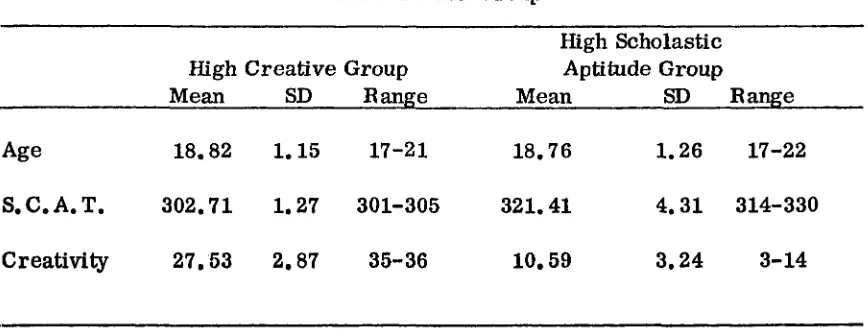
T ab le 1 in clu d es the m e an , s ta n d a rd deviation and ran g e fo r ag e,
23 Table 1
M ean, SD and Range fo r A ge, S. C. A. T. and C re ativ ity S co res fo r E ach Group
High S cholastic High C re a tiv e G roup A ptitude G roup
M ean SD R ange________M ean________ SD R ange
Age 18.82 1.15 17-21 18.76 1.26 17-22
S .C .A .T . 302.71 1.27 301-305 321.41 4 .3 1 314-330
C re a tiv ity 2 7 .5 3 2.87 35-36 10.59 3 .2 4 3-14
th e SD of S. C . A. T . s c o r e s fo r the two g ro u p s can be explained by noting two
fa c to rs . F i r s t , the c u t-o ff p o in ts fo r th e c r ite r io n of sele c tio n v a ry in such a
way a s to influence th e SD. Since th e c u t-o ff point fo r th e sc h o la stic aptitude
gro u p i s th e top 40% w hile fo r th e c re a tiv ity group i t is th e lo w est 30% a w id er
ra n g e e x is ts fo r the fo rm e r group. T h is fa c to r would account fo r so m e of the
d ifferen c e. T he rem ain in g d ifferen c e is p o ssib ly due to the s e le c tiv e sy ste m
em ployed in g ran tin g coU ege e n tra n c e to th e stu d en ts co n cern ed . T he o rig in a l
d istrib u tio n included a m uch l a r g e r sam p le. The lo w est s c o re fo r accep tan ce
to coUege would th u s co m e in th e lo w er m iddle ra n g e of th e o rig in a l d istrib u tio n .
T h is could account fo r th e hom ogeneity of th e S .C .A .T . s c o r e s fo r th e c re a tiv e
group and not th e sch o la stic aptitude group.
P ro c e d u re
T he C a tte ll 16 P . F . F o rm A (see appendix) w as a d m in iste re d to each
of th e su b je c ts in th e two e x p e rim e n ta l g ro u p s, th e raw s c o r e s being co n v erted
1957). The v a lid ity , re lia b ility and fa c to ria l s tru c tu re of th is te s t h as been
adequately d e m o n strated in p rev io u s r e s e a r c h , p re se n te d by C. J . Adcock in
B u ro s M ental M ea su rem en ts Y earbook (1959, p. 198) a s follow s:
T h is te s t h a s 16 o r 17 s c o r e s . . . . Split h alf r e lia b ilitie s (n=450) ra n g e fro m .7 1 to . 93, ten c o efficien ts being above . 80. T h is i s q u ite good; but even m o re pleasin g i s the fa c t th a t v a lid itie s (based on fa c to r loadings) ran g e fro m .7 3 to .9 6 w ith eleven c o efficien ts exceeding .8 0 .
F o r a m u lti-d im e n sio n a l te s t of th is kind one could not hope fo r m uch m o re . E vidently, d esp ite th e rep u ta tio n of q u e stio n n aire m ethods as u n re lia b le , th is te s t d oes su cceed . I t should be noted, h ow ever, th a t the s tru c tu re of th e te s t d oes no t re q u ire th a t th e q u e stio n s be taken a t th e ir face v alu e. They a r e c o n sid e re d a s stim u lu s v a ria b le s , and a v a ria b le i s assig n ed to a fa c to r m e a s u re no t b ecau se of its m eaning but b ecau se of the u s u a l m ode of re sp o n se to it. Of c o u rs e , any q u e stio n n aire i s su b jec t to d e lib e ra te d isto rtio n and som e check on th is i s d e s ira b le .
The above e s tim a te s fo r th e re lia b ility and v alid ity of the C a tte ll 16 P . F . a r e
fo r F o rm s A and B taken to g eth er a s one te s t. Only one fo rm of th e 16 P . F .
(F o rm A) w as u se d in th is in v e stig atio n , h ow ever, and th is involved a red u ctio n
in th e num ber of ite m s availab le in m e asu rin g th e sam e 16 fa c to rs of th e p e r
sonality in v en to ry . In the C a tte ll M anual the re lia b ility e s tim a te s fo r F o rm A
u se d alone a r e said to be v e ry c lo se to th o se of F o rm s A and B tak en to g e th e r
on a ll 16 fa c to rs . The v alid ity e stim a te fo r a single fo rm i s not given in the
M anual, but i t i s sug g ested a s being slig h tly lo w er than fo r F o rm s A and B
to g e th e r.
A naly sis
T he H ypothesis T ested :
25
d iffe rs significantly fro m a group c h a ra c te riz e d by high sc h o la stic aptitude (a v erag e c re a tiv e ability) w ith r e s p e c t to p e rso n a lity a s m e a s u re d by th e ir p e rfo rm an c e on th e C a tte ll 16 P . F . .
U sing th e a n a ly sis of v a ria n c e technique (W iner, 1962, p. 302) th e null
hypothesis th a t th e re i s no sig n ifican t d ifferen c e between the two g ro u p s w as
te s te d .
PRESENTATION AND ANALYSIS OF RESULTS
M ain S ta tis tic a l A n aly sis
The 16 P . F . m ean sten s c o r e s of the high c re a tiv ity and high sc h o la stic
aptitude g ro u p s a r e lis te d in T ab le 2. A g rap h ic re p re se n ta tio n of th e se r e s u lts
In th e fo rm of a p ro file i s given in F ig u re s 2 and 3.
T able 2
M ean Sten S c o re s fo r Both G roups
High C re a tiv ity Group
High S cholastic A ptitude G roup
F a c to r A 5.88 5 .1 2
B 5.47 6.47
C 5 .8 8 4 .9 4
E 5 .82 4 .6 5
F 7 .12 5 .0 6
G 4 .4 1 5.18
H 5 .4 1 5 .1 2
I 4. 65 5 .7 1
L 6 .5 9 6 .0 6
M 6 .5 3 6.29
N 5 .9 4 5.59
O 5.82 6 .0 6
Q l 4 .7 1 6. 06
Q2 5 .2 9 7 .3 5
Q3 4. 53 5 .2 9
Q4 6 .4 1 6 .2 4
27
The c o rresp o n d in g p ro file of th e m ean sten s c o re s fo r fa c to rs A -I can
be found in F ig u re 2.
STANDARD TEN SCORE (STEN)
1 2 3 4 5 6 7 8 9 10 LOW SCORE ___
DESCRIPTION
A) Aloof, Cold (Schizothym ia)
B) D ull, Low C apacity (Low "g")
C) E m otional, U nstable (Low Ego Strength)
E) Subm issive, M ild (S ubm issive n e ss)
F) G lum , Silent (D esurgency)
G) C asu a l, Unde pendable (Low Super Ego Strength
H) T im id , Shy (T h rectia)
I) Tough, R e a listic (H arria)
High C re a tiv e Group High S cholastic A ptitude Group ■
HIGH SCORE DESCRIPTION
W arm , Sociable (Cyclothym ia)
B rig h t, In te llig e n t (High "g")
M a tu re , C alm (High Ego Strength)
D om inant, A g g re ssiv e (Dominance)
E n th u sia stic , T alk ative (Surgency)
C o n scien tio u s, P e r s is te n t (High Super Ego Strength)
A dventurous, "T h ick Skinned" (P arm ia)
S en sitiv e, E ffem inate (P re m sia )
The co rresp o n d in g p ro file of th e m ean sten s c o re s fo r fa c to rs L-Q 4
can be found in F ig u re 3.
LOW SCORE ___ DESCRIPTION
L) T ru stfu l, A daptable (Inner R elaxation)
M) C onventional, P r a c tic a l
(P ra x e rn ia )
N) Sim ple, Awkward (Naivete)
O) C onfident, U nshakable (Confidence)
Q l) C o n serv ativ e A ccepting
(C onservativism )
Q2) D ependent, Im ita tiv e (Group Dependence)
Q3) Lax, U n su re (Low In te g ra tio n
Q 4 )P hleg m atic, (Low E rg ic Tension)
STANDARD TEN SCORE (STEN) _______ 1 2 3 4 5 6 7 8 9 10___
High C re a tiv e G roup High S cholastic A ptitude G
roup-HIGH SCORE DESCRIPTION
Suspecting, Je a lo u s (P ro tensio n )
B ohem ian U nconcerned (Autia)
S ophisticated, P o lish e d (Shrew dness)
In s e c u re , Anxious (T im idity)
E x p erim en tin g , C ritic a l
R ad icalism )
S elf-S ufficient, R eso u rc e fu l (Self-Sufficiency)
C o n tro lled , E x act (Self Sentim ent C ontrol)
T e n se , E x citab le (High E rg ic Tension)
29
T he m ean sten s c o re d ifferen c es of the high c re a tiv ity and high
sch o la stic aptitude g ro u p s w e re then analyzed by the a n aly sis of v a ria n c e tech
nique (W iner, 1962, p. 302), The r e s u lts of th is a n a ly sis a r e shown in T able
3. The d istrib u tio n of c re a tiv ity s c o r e s (F ig u re 4) shows a slig h t p o sitiv e
skew but th is would no t be su fficien t to in v alid ate th e assu m p tio n s und erly in g
the a n a ly sis of v a ria n c e technique.
T ab le 3
A n aly sis of V a ria n ce F o r N u m e ric al T able
Source of V a ria tio n SS df MS F
Between Subiects 149.9338 33 4.5434
G
(Betw een groups) .2647 1 .2647
W ithin Subiects
149.6691
2209.1250
32
510
4.6672
4.3316 F
(betw een fa c to rs) 146.0588 15 9.7372 2.44*
GF
(groups and fa c to rs 144.9706 15 9.6647 2.42*
in teractio n )
1918.0956 480 3.9960
*P . 01 = 2 .0 4
The a n a ly sis in d ic a tes th at sig n ifican t F v alu es a t th e . 01 pro b ab ility
F
R
E
Q
U
E
N
C
IE
S
36
---34
32
30
28
26
22
20
18
16
14
12 r—■
10 ____
8 —
6
4 __
2 —
°
I 1 1 I
M I I I I 1 1 r i i i
3 5 7 9 11 13 15 17 19 21 23 25 27 29 31 33 35 37 CREATIVITY SCORES
31
fa c to rs in te ra c tio n 1. On the b a s is of th e se r e s u lts , a d e tailed a n a ly sis w as then
m ad e of th e sim ple m ain effects fo r group d iffe re n c e s on each of th e C a tte ll
p e rso n a lity fa c to rs (W iner, 1962, p. 310). T ab le 4 p re s e n ts the r e s u lts of
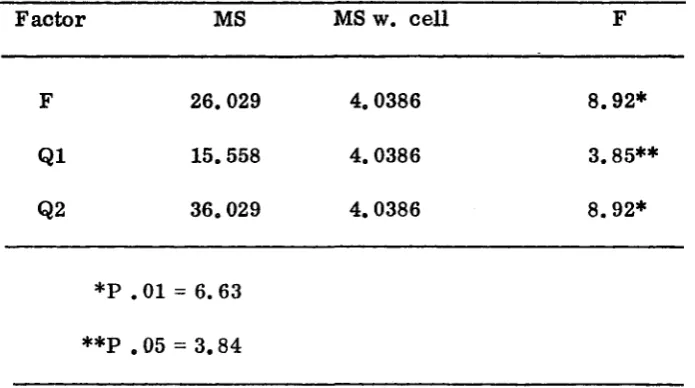
th is a n a ly sis. S ta tistic a lly sig n ifican t d iffe re n c e s w e re found fo r fa c to rs F , Q1
and Q2 a t the p ro b ab ility le v e l . 05. At the . 05 le v e l of p ro b ab ility i t i s p o ssib le
th a t one out of tw enty a n a ly se s w ill v a ry sig n ifican tly by chan ce. T h e re fo re ,
sin c e six teen te s ts w e re m a d e, one of th e se findings could p o ssib ly be a ttrib u te d
to chance and would n eed co n firm a tio n by subsequent re s e a r c h .
T able 4
A n aly sis of V a ria n c e Sim ple M ain E ffects
F a c to r MS M S w . c e ll F
F 26.029 4.0386 8.92*
Q1 15.558 4.0386 3.85**
Q2 36.029 4.0386 8.92*
*P .0 1
**P . 05
- 6 .6 3