
ISSN(Online): 2320-9801
ISSN (Print): 2320-9798
I
nternational
J
ournal of
I
nnovative
R
esearch in
C
omputer
and
C
ommunication
E
ngineering
(An ISO 3297: 2007 Certified Organization) Website:www.ijircce.com
Vol. 5, Issue 1, January 2017
Copyright to IJIRCCE DOI: 10.15680/IJIRCCE.2017. 0501016 114
Study on Requirement Engineering and
Traceability Techniques in Software Artefacts
Swathine. K, Dr. N. Sumathi
Research Scholar, Department of Computer Science, S.N.R SONS College (Autonomous), Coimbatore,
Tamil Nadu, India
Associate Professor and Head, Department of Information Technology, S.N.R SONS College (Autonomous),
Coimbatore, Tamil Nadu, India
ABSTRACT: Software have many artefacts all are built to getcomplete working software system by prototype way.
Multiple versions of artefacts are existing. All these versions are combining together to make a complete working product. Artefacts of the software are requirements specifications, design specification, source code, test case for verification and validation of the system, among all source code is high priority artefact. All these artefacts are by product of the software. Artefacts are continuously changing and updating regularly, which need proper management in order to software work properly. An artefact inconsistency is a major problem managing them is a challenging one. Maintaining traceability links between all artefacts and updating those artefacts are solution to inconsistency and changing requirements. Traceability links provide good understanding relationships between artefacts. The effective way of doing traceability links between requirements is with their priority. Traceability links are represented by traceability matrix. This article summarizes requirements engineering task, requirement management process, types of traceability and review on traceability.
KEYWORDS: Artefacts, Traceability links, Requirements Engineering, Requirements Managements.
I. INTRODUCTION
Requirements are put together processed to custom artefacts. Requirements are categorized into three types of user:user requirements, system requirements, and software specifications. They are always incomplete and inconsistent due to lack of knowledge.
Requirements are input to the system. Key characteristics are unambiguous, complete, modified, traceable, verifiable, consistent, correct, necessary, prioritized, and feasible.
Requirements give sense through consistent, traceable, and modifiable. They are valid and worth pursuing.
New requirements occur during the development of software, change occurs in business needs and for better understanding of the system.
Requirement change is caused by business change, technology change, environment change, stakeholder change; care should be taken for better understanding of the problem in order to get best solution. Requirements engineering is set of action concerned with identifying and communicating the purpose of software system and its use. Conflicts in requirements based on customer from business perspective. During development of software, business and technical environment get changed.
ISSN(Online): 2320-9801
ISSN (Print): 2320-9798
I
nternational
J
ournal of
I
nnovative
R
esearch in
C
omputer
and
C
ommunication
E
ngineering
(An ISO 3297: 2007 Certified Organization) Website:www.ijircce.com
Vol. 5, Issue 1, January 2017
Copyright to IJIRCCE DOI: 10.15680/IJIRCCE.2017. 0501016 115 requirements, finally transforming the requirements into operational system. Requirement engineering task are: listed below and also shown in fig: 1
Inception: Specifying the beginning of the software project.Establish the basic understanding of the project.
Elicitation: Requirements are discovered.It’sa difficult taskbecause of difficulty in understanding the problem,
communication between customer and project team, volatility of requirements, sometimes customer keep changing the requirements.
Elaboration: Information about the requirements are expanded and refined. Functions, features and constraints are
proposed.
Negotiation: Customer may demand for more. Project teamnegotiate the reasonable solution.
Specification: Requirements are represented in writtendocument, mathematical or graphical model. Developing
software requirements specification for requirements.
Validation: Requirements are analyzed, ensuring thatthey are unambiguously. Requirements validation mechanism is
Formal Technical Review (FTR). Validation means are we building right product.
Requirements Management: It is the process of managingchanging requirements during the requirements engineering
process and system development. It identifies, control, track requirements and make changes to the requirements as the project proceeds. The main goal of requirement management is to measure, handle inconsistency, and manage software development process, give traceability links and CASE tool supports. CASE tool support is required for requirement storage, change management and traceability management as shown in Fig: 2. Requirement management uses CASE Tool, it manages project requirements clearly, reduces risk, improves and develops software development process, helps to prioritize the requirements, trace relationship between requirements, and capture change history. Requirement management tool that meets customer needs, complete within a time, within a budget [14]. Refer fig: 3 for change management process.
Traceability deals with relationship among requirements, their source and system design. Bi-directional traceability, which deals with various associated requirements enables user to find origin of requirements and track every changes that are made to the requirements. For this, every change should be documented. Traceability information is represented by a data structure or requirement traceability matrix. In row-column cell, one requirement dependent on another requirement is denoted by D and weak relationship denoted by R.
Types of traceability
1. Source traceability: These are basically the linksform requirements to customer, stakeholder, who propose
these requirements.
2. Requirement traceability: Links betweenrequirements to another requirement, between dependent
requirements.
3. Design traceability: Links from requirements todesign and software architecture.
Types of Traceability tables
1. Source traceability table: Identifies source of eachrequirements.
2. Dependency traceability table: Shows dependentrelationship between requirements
ISSN(Online): 2320-9801
ISSN (Print): 2320-9798
I
nternational
J
ournal of
I
nnovative
R
esearch in
C
omputer
and
C
ommunication
E
ngineering
(An ISO 3297: 2007 Certified Organization) Website:www.ijircce.com
Vol. 5, Issue 1, January 2017
Copyright to IJIRCCE DOI: 10.15680/IJIRCCE.2017. 0501016 116 that they govern.
4.Interface traceability table: Shows howrequirements communicate to internal and external system.
Requirements Traceability: Capability to show, followthe life and expiry of the requirements in both forward and
backward direction. Capture all levels of requirement from customer for project, to meet cent percent expectation and satisfaction. It is backbone of software development process and helps in effective, accurate delivery to the customer.
Uses of Requirements Traceability
Requirements traceability means tracking all requirements in Software Requirements Specification (SRS). It helps to confirm that all requirements are properly designed and well tested. Requirements support work product, so testing is very important.
II. LITERATURE REVIEW
Requirement Engineering is foremost phase of Software development process and it is most essential one. Because in this phase all basic and essential requirements are gathered through iterative, co-operative process on analyzing problem and customer needs. Requirement describes how software should work when it interact to the customer (clients). Requirement should be clear and give knowledge about domain and constraints of software. Wrong Requirement leads wastage of resource. Gathering requirement is a not easy task.
ISSN(Online): 2320-9801
ISSN (Print): 2320-9798
I
nternational
J
ournal of
I
nnovative
R
esearch in
C
omputer
and
C
ommunication
E
ngineering
(An ISO 3297: 2007 Certified Organization) Website:www.ijircce.com
Vol. 5, Issue 1, January 2017
Copyright to IJIRCCE DOI: 10.15680/IJIRCCE.2017. 0501016 117 by project team to understand the problem; it shows how data are processed to output from input given by customer. It also represents data flow from input to output, process, externalentity and data storage. Multiple level of DFD gives information in detail. ER diagram shows how system works by describing the logical structure. Entity is the information required from attributes that contains data. It shows relationships between entities. Use-case diagram shows boundary, external view of the system and how user interacts to the system. Mainly it is used to gather functional requirements. STD shows behavior of the system. It eliminates redundancy. Software Requirements Specification (SRS) describes internal and external behavior of the system that specifies both functional and non-functional requirements written by user or developer [1]. Managing those requirements is essential after requirement engineering which is handled by requirement management phase. Inconsistency occurs between requirements which are handled by traceability links among requirements.
Requirement management defines the success of the Software. Fail to manage requirements decrease the chance to meet user satisfaction and expectation. Common problem in requirement management is we cannot track changing requirement, it is difficult for the analyst to note down the requirements described by user. Project team failed to organize the requirements. Skills needed for requirement management are analyzing the problem,understand the purpose, need and cause of software to be built. Understand stakeholder needs requirements have many source they are customers, partners, end users, and domain experts are some high priority sources of requirements. Management, project team members, business policies, and regulatory agencies said as medium priority sources. We have to understand the customer needs on all perspectives. Define the system translating the requirements into meaningful form such as system architecture, design, specification and source code. The scope of the system software, should meet user expectation to fit according to the availability of time, people and money which are main resources for success. Refine the system definition includes developing and testing the software effectively and efficiently in any environment [2].
Tips for effective requirements management are prioritize requirement, prepare your requirement package, organize requirement review sessions, baseline your requirement, conduct impact analysis, trace your requirement, store requirement attributes, requirement versioning matters, requirement management tools help, maintain your requirement [5].For successful requirement management People, Process and Technology are three considerations to keep in mind.
Processes guide through the development cycle. People need skills in technique and to know when, where andhow to
apply. Technology enables system to work. This relationship is shown in fig 4.
To manage changing requirements, some changes in requirement are desirable. Activities involved are establishing the baseline, learning and following history of requirement, determining dependent requirement, tracing the relationship between requirements, maintaining version control. These skills are workflow of Requirement Management [2].
ISSN(Online): 2320-9801
ISSN (Print): 2320-9798
I
nternational
J
ournal of
I
nnovative
R
esearch in
C
omputer
and
C
ommunication
E
ngineering
(An ISO 3297: 2007 Certified Organization) Website:www.ijircce.com
Vol. 5, Issue 1, January 2017
Copyright to IJIRCCE DOI: 10.15680/IJIRCCE.2017. 0501016 118 Continuous and frequently changing requirements need proper requirements change management, so traceability is essential. Scope, Coverage, and Analysis is basis term fortraceability. Scope defines boundary for traceability, system boundary incorporates software and software requirements that derived from requirements. Coverage defines directional traceability. Four types of coverage are in traceability: They are 1) Origin-Requirements Traceability: defines source of the requirements 2) Requirements-Requirements Traceability: Includes four types of traceability i) Functional- Functional ii) Functional – Functional iii) Functional - Functional iv) Functional - Non-Functional 3) Requirements-Other Artefacts Traceability: Traceability between different form of requirements that is requirement specification, design, implementation, test cases. 4) Other Artefacts - Other Artefacts Traceability: Provides links and dependencies in between artefacts other than requirements. Not all requirements satisfy these essential term [7].
Traceability links which are established by semi-automatic way, need visualization tool for proper requirements management in an incremental software development. Model driven development is used to produce artefacts, traceability links are defined manually which is labor-intensive and error-prone. For modelling and storing these artefacts relationship graph database approach is used. Treemap and hierarchical tree visualization techniques integrates overall overview of traceability. But hierarchical structure is not well communicated and not scalable. For evaluation process, tool processed against expected functionality of semi-automatic artefacts consistency management. Precision and recall describes the accuracy of traceability. It is more generic platform for artifacts without enforcing special methodologies [8].
Neo4j is a graph database that represents the link by node, node properties and edges, which translate original artefacts into XML format. Complete prototype will support all aspects of consistency management [9]. Visualizing the traceability is very important. Matrices, lists and trees are old visualization techniques. Sunburst visualization is a graph which nodes are in a radial layout, links are made through edges. Visualization is a radial space filling techniques for displaying tree like structure. In sunburst nodes are drawn on adjacent rings representing a tree structure. Sunburst shows overview of specification. Netmap visualization is segments of exactly one ring. Treemap is a space constrained visualization of hierarchical structure; it’s very effective in showing attributes of leaf nodes using size and color coding [10].
Steven introduced CLIME tool that works incrementally which is responsible for detecting inconsistency without imposing particular methodology. CLIME designed to tell the developer when artefacts became unsynchronized, CLIME is constraint model, works only for build in constraints for visualizing the link[11]. Visualizing the links between software artefacts helps developer to recover, maintain and browse relationship effectively and efficiently. Treemap and hierarchical tree visualization techniques combine together to give graph based visualization techniques which reduces visual clutter, highly scalable and interactive. Graph based visualization represents artefacts as nodes and traceability links between artefacts as edges to form a graph. It shows overall overview of relationship [12]. Automated traceability facilities generate links between software artefacts without any error. However result contains both false and true links which are evaluated by an analyst [13].
ISSN(Online): 2320-9801
ISSN (Print): 2320-9798
I
nternational
J
ournal of
I
nnovative
R
esearch in
C
omputer
and
C
ommunication
E
ngineering
(An ISO 3297: 2007 Certified Organization) Website:www.ijircce.com
Vol. 5, Issue 1, January 2017
Copyright to IJIRCCE DOI: 10.15680/IJIRCCE.2017. 0501016 119 characteristics and developed algorithm called Individual Functional Requirements Priority Ranking (IFRPR) which give priority to the requirements based on their type, role, time and frequency [24].
Richard R. Maiti focused on both functional requirements(FR) and non-functional requirements (NFR) because success of a system depends on both. He developed CEPP (Capturing, Eliciting, Predicting and Prioritizing) model for NFRs metadata.FRs state what system should do, describes input, behavior and output of the system.NFRs state how the system is supposed to achieve the behavior, NFRs is nothing but features of the system. Neglecting NFRs has negative impact on system. Requirements prioritization plays an important rolein requirements negotiation. Integrating NFRs in the early phase of software development can lead to high customer satisfaction and profit maximization [25].
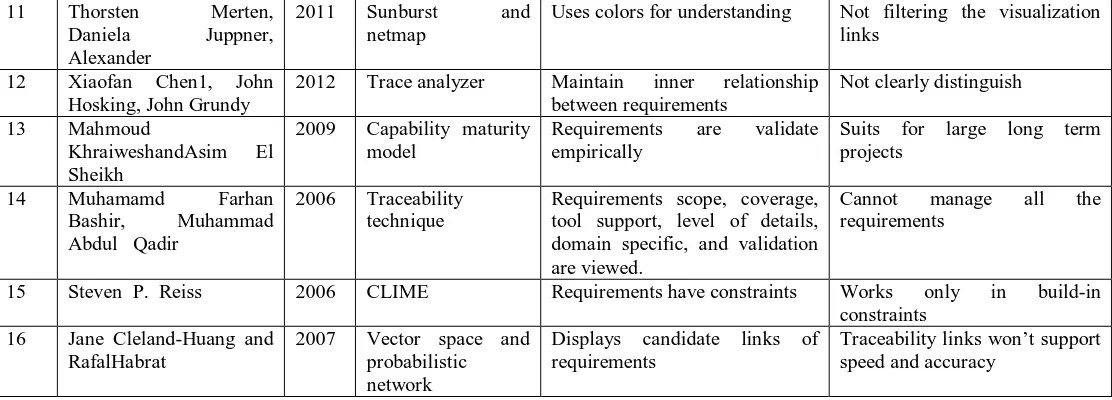
Falak said success of software is based on selection of well prioritized requirements. Requirements prioritization plays an important role in requirements negotiation. During Requirements prioritization various factors influenced business and technical aspects they are risk, cost, customer expectations, complexity, time, dependencies, scalability, resources, speed, value, effort, type, role, size[26]. Consolidated result of literature survey is shown in table 1.
S.No Authours Year Algorithm Advantage Disadvantage
1 Dhirendra Pandey &Vandana, Pandey
2012 Formal Requirement Engineering Process
Easily understandable Making perfect SRS is impossible
2
Jace Browning, Robert Adams
2014 Lightweight developer friendly interface
Tight interaction with source code
Hesitate to use due to formats
3 Saeed Namber and Mehdi Mirakhorli
2015 Strategic
traceability patterns
Both forward and backward links for requirements
Redundancy occur in links
4 Paul Ralph and Rahul Mohanan
2015 Dichotomous
Effects of
Requirements Engineering
Reviewing the system is easy Decoupling of requirements
5 K. Kamalabalan, T. Uruththirakodeeswaran, G. Thiyagalingam, D. B.
2015 Levenshtein distance
Handles inconsistency of requirements
More generic platform, Distribution development environment is minimal. 6 Ildiko Pete and
DhariniBalasubramaniam
2015 Holistic framework Graph based approach for visualization links
Lack of complete prototype support
7 Richard R. Maiti, Frank J.Mitropoulos
2015 Risk driven algorithm
Links for both functional and non-functional requirements
Not all NFR are gathered
8 Wentao Wang, Nan Niu, Hui Liu† and Yuting Wu
2015 Information
retrieval and select trace algorithm
Color representation of links Hard to retrieve the trace links
9 Falak Sher, Dayang N.A. Jawawi, Radziah Mohamad,
Muhammad Imran Babar
2014 Review protocol Concern about of aspects of the system
Results not are generalized
10 G. Spanoudakis, A. d’AvilaGarcez, A. Zisman
2014 Machine learning algorithm
Fellows rules for traceability links
ISSN(Online): 2320-9801
ISSN (Print): 2320-9798
I
nternational
J
ournal of
I
nnovative
R
esearch in
C
omputer
and
C
ommunication
E
ngineering
(An ISO 3297: 2007 Certified Organization) Website:www.ijircce.com
Vol. 5, Issue 1, January 2017
Copyright to IJIRCCE DOI: 10.15680/IJIRCCE.2017. 0501016 120 Table 1: Literature survey
III. CONCLUSION
In this literature survey paper, we have discussed requirement engineering task, reasons for requirements inconsistency. For above mentioned problem author recommend requirements traceability matrix is developed with priority. Various authors’ contribution towards Requirements inconsistency is also reviewed in literature review.
REFERENCES
[1] Dhirendra Pandey &Vandana, Pandey “Importance Of Requirement Management A Requirement Engineering Concern”, International Journal of Research and Development a management review (IJRDMR), vol-1, pp no-66-69,2012.
[2] “Applying Requirements Management with Use Case”,2000.
[3] Jace Browning, Robert Adams, “Doorstop: Text Based Requirements Management Using Version Control”, Journal of Software Engineering
and Applications, 2014, 7, 187-194, vol-7, pp no-187-194, 2014.
[4] Mahmoud KhraiweshandAsim El Sheikh“Empirical Validation of RequirementsManagement Measures”, The International Arab Journal of
Information Technology, vol-6, pp no 196-202, 2009.
[5] “10 Tips for Effective Requirement Management- Business Analyst”
[6] “Requirement Management Practice: the essence”, 2004.
[7] Muhamamd Farhan Bashir, Muhammad Abdul Qadir,“Traceability Techniques: A Critical Study”, IEEE, pp no- 265-267, 2006.
[8] K. Kamalabalan, T. Uruththirakodeeswaran, G. Thiyagalingam,D. B. Wijesinghe, I. Perera,D. Meedeniya, “Tool Support for Traceability of
Software Artefacts”, IEEE, pp no- 318-323, 2015.
[9] Ildiko Pete and DhariniBalasubramaniam, “Handling theDifferential Evolution of Software Artefacts: A Framework forConsistency
Management” IEEE, pp no- 599-600,2015.
[10] Thorsten Merten, Daniela Juppner, Alexander, “ImprovedRepresentation of Traceability Links in Requirements Engineering Knowledge
Using Sunburst and NetmapVisualization”, ResearchGate 2011
[11] Steven P. Reiss, “Incremental Maintenance of Software Artifacts”, IEEE computer society, pp no- 682-696 , Vol-32,2006.
[12] Xiaofan Chen1, John Hosking, John Grundy, “Visualizing Traceability Links between Source Code and Documentation”,
IEEE Symposium, pp no-119-125,2012.
[13] Jane Cleland-Huang and RafalHabrat, “Visual Support In Automated Tracing”, Second International Workshop onRequirements Engineering
Visualization (REV 2007) IEEE Computer Society, 2007.
[14] Dr. Jean-Claude Franchitti, “Software EngineeringG22.2440-001 Session 1 – Sub-Topic 1 Requirements Definition & Management
Processes and Tools”.
[15] Saeed Namber and Mehdi Mirakhorli, “Towards Actionable Architecture Traceability”, 8th International Symposium on Software and System
Traceability, pp no-36-42, 2015.
[16] Paul Ralph and Rahul Mohanani, “Is requirements Engineering Inherently Counterproductive?” IEEE/ACM 5th International workshop on the
Twin Peaks of Requirements and Architecture, pp no-20-23, 2015
[17] Hatem Herchi and Wahiba Ben Abdessalem, “From user requirements to UML class diagram”
11 Thorsten Merten, Daniela Juppner, Alexander
2011 Sunburst and netmap
Uses colors for understanding Not filtering the visualization links
12 Xiaofan Chen1, John Hosking, John Grundy
2012 Trace analyzer Maintain inner relationship between requirements
Not clearly distinguish
13 Mahmoud
KhraiweshandAsim El Sheikh
2009 Capability maturity model
Requirements are validate empirically
Suits for large long term projects
14 Muhamamd Farhan Bashir, Muhammad Abdul Qadir
2006 Traceability technique
Requirements scope, coverage, tool support, level of details, domain specific, and validation are viewed.
Cannot manage all the requirements
15 Steven P. Reiss 2006 CLIME Requirements have constraints Works only in build-in constraints
16 Jane Cleland-Huang and RafalHabrat
2007 Vector space and probabilistic network
Displays candidate links of requirements
ISSN(Online): 2320-9801
ISSN (Print): 2320-9798
I
nternational
J
ournal of
I
nnovative
R
esearch in
C
omputer
and
C
ommunication
E
ngineering
(An ISO 3297: 2007 Certified Organization) Website:www.ijircce.com
Vol. 5, Issue 1, January 2017
Copyright to IJIRCCE DOI: 10.15680/IJIRCCE.2017. 0501016 121
[18] Swathine.k and J.KomalaLakshmi, “A Survey of Requirement Engineering Practices in Software Development”, International Journal of
Engineering And Computer Science, Vol 3,2014, pp no:8690-8694,2014.
[19] Steven P.Reiss,”Incremental Maintenance of Software Artifacts”, 21stIEEE International Conference on Software Maintenance,2005.
[20] Swathine.k and J.KomalaLakshmi,“Requirement Elicitation for Requirement in Software Engineering”, International Journal Of Engineering Sciences & Research Technology, pp no- 354-357,2014.
[21] Swathine.k and J.KomalaLakshmi “A Survey of Defect Prediction on Software Leads to Quality Product”, International Journal of ComputerScience & Engineering Technology,pp no-1038-1040, Vol-5,2014.
[22] Falaksher, Dayang N.A, Jawawi, Radziah Mohamad, Muhammad Imran Babar, “Multi-aspects Based Requirements Prioritization
Techniques for Value-Based Software Development”, IEEE,2014.
[23] “Ten steps to effective Requirements Management”, IBM Omar Badreddin, Omar Badreddin, Timothy C.
Lethbridge,”RequirementsTraceability: A model driven approach”, pp no-87-91,IEEE,2014. [24] Software, Requirements definition and management, 2013.
[25] Dunhui Yu, Keqing He, Jian Wang, “An algorithm for priority ranking of individualized functional requirements in networked software”, IEEE,2008.
[26] Richard R. Maiti, Frank J.Mitropoulos, “Capturing, Eliciting, Predicting and Prioritizing (CEPP) Non-Functional Requirements Metadata during the Early Stages of Agile software Development”,IEEE,2015.
[27] Falak Sher, Dayang N.A.Jawawi, Radziah Mohamad, Muhammad Imran Babar, “Requirements Prioritization Techniques and different Aspects for Prioritization”, IEEE, 2014.
[28] Ritu , Dr. Nasib Singh Gill,” A Comparison among Various Techniques to Prioritize the Requirements”, PP no-601-607,ol no-12,2012. [29] G. Spanoudakis, A. d’AvilaGarcez, A. Zisman,” Revising Rules to Capture Requirements Traceability Relations: A Machine
Learning Approach”, IEEE, 2014.
![arxiv: v2 [physics.ins-det] 27 Jul 2010 The CMS Collaboration](data:image/gif;base64,R0lGODlhAQABAIAAAP///wAAACH5BAEAAAAALAAAAAABAAEAAAICRAEAOw==)