A Large Scale Ranker-Based System
for Search Query Spelling Correction
Jianfeng Gao
Microsoft Research, RedmondXiaolong Li
Microsoft CorporationDaniel Micol Microsoft Corporation
Chris Quirk
Microsoft Research, Redmond
Xu Sun
University of TokyoAbstract
This paper makes three significant extensions to a noisy channel speller designed for standard writ-ten text to target the challenging domain of search queries. First, the noisy channel model is sub-sumed by a more general ranker, which allows a variety of features to be easily incorporated. Se-cond, a distributed infrastructure is proposed for training and applying Web scale n-gram language models. Third, a new phrase-based error model is presented. This model places a probability distri-bution over transformations between multi-word phrases, and is estimated using large amounts of query-correction pairs derived from search logs. Experiments show that each of these extensions leads to significant improvements over the state-of-the-art baseline methods.
1
Introduction
Search queries present a particular challenge for traditional spelling correction methods. New search queries emerge constantly. As a result, many queries contain valid search terms, such as proper nouns and names, which are not well es-tablished in the language. Therefore, recent re-search has focused on the use of Web corpora and search logs, rather than human-compiled lex-icons, to infer knowledge about spellings and word usages in search queries (e.g., Whitelaw et al., 2009; Cucerzan and Brill, 2004).
The spelling correction problem is typically formulated under the framework of the noisy channel model. Given an input query
, we want to find the best spelling correc-tion among all candidates:
(1)
Applying Bayes' Rule, we have
(2)
where the error model models the trans-formation probability from C to Q, and the lan-guage model (LM) models the likelihood that C is a correctly spelled query.
This paper extends a noisy channel speller de-signed for regular text to search queries in three ways: using a ranker (Section 3), using Web scale LMs (Section 4), and using phrase-based error models (Section 5).
First of all, we propose a ranker-based speller that covers the noisy channel model as a special case. Given an input query, the system first gen-erates a short list of candidate corrections using the noisy channel model. Then a feature vector is computed for each query and candidate correc-tion pair. Finally, a ranker maps the feature vec-tor to a real-valued score, indicating the likeli-hood that this candidate is a desirable correction. We will demonstrate that ranking provides a flex-ible modeling framework for incorporating a wide variety of features that would be difficult to model under the noisy channel framework.
Second, we explore the use of Web scale LMs for query spelling correction. While traditional LM research focuses on how to make the model “smarter” via how to better estimate the probabil-ity of unseen words (Chen and Goodman, 1999); and how to model the grammatical structure of language (e.g., Charniak, 2001), recent studies show that significant improvements can be achieved using “stupid” n-gram models trained on very large corpora (e.g., Brants et al., 2007). We adopt the latter strategy in this study. We pre-sent a distributed infrastructure to efficiently train and apply Web scale LMs. In addition, we ob-serve that search queries are composed in a lan-guage style different from that of regular text. We thus train multiple LMs using different texts as-sociated with Web corpora and search queries.
multi-term phrase into another multi-term phrase. Compared to traditional error models that account for transformation probabilities between single characters or substrings (e.g., Kernighan et al., 1990; Brill and Moore, 2000), the phrase-based error model is more effective in that it captures inter-term dependencies crucial for correcting real-word errors, prevalent in search queries. We also present a novel method of extracting large amounts of query-correction pairs from search logs. These pairs, implicitly judged by millions of users, are used for training the error models.
Experiments show that each of the extensions leads to significant improvements over its base-line methods that were state-of-the-art until this work, and that the combined method yields a sys-tem which outperforms the noisy channel speller by a large margin: a 6.3% increase in accuracy on a human-labeled query set.
2
Related Work
Prior research on spelling correction for regular text can be grouped into two categories: correct-ing non-word errors and real-word errors. The former focuses on the development of error mod-els based on different edit distance functions (e.g., Kucich, 1992; Kernighan et al., 1990; Brill and Moore, 2000; Toutanova and Moore, 2002). Brill and Moore’s substring-based error model, con-sidered to be state-of-the-art among these models, acts as the baseline against which we compare our models. On the other hand, real-word spelling correction tries to detect incorrect usages of a valid word based on its context, such as "peace" and "piece" in the context "a _ of cake". N-gram LMs and naïve Bayes classifiers are commonly used models (e.g., Golding and Roth, 1996; Mangu and Brill, 1997; Church et al., 2007).
While almost all of the spellers mentioned above are based on a pre-defined dictionary (ei-ther a lexicon against which the edit distance is computed, or a set of real-word confusion pairs), recent research on query spelling correction fo-cuses on exploiting noisy Web corpora and query logs to infer knowledge about spellings and word usag in queries (Cucerzan and Brill 2004; Ahmad and Kondrak, 2005; Li et al., 2006; Whitelaw et al., 2009). Like those spellers designed for regu-lar text, most of these query spelling systems are also based on the noisy channel framework.
3
A Ranker-Based Speller
The noisy channel model of Equation (2) does not have the flexibility to incorporate a wide va-riety of features useful for spelling correction, e.g., whether a candidate appears as a Wikipedia document title. We thus generalize the speller to a ranker-based system. Let f be a feature vector of a query and candidate correction pair (Q, C). The ranker maps f to a real value y that indicates how likely C is a desired correction. For example, a linear ranker maps f to y with a weight vector w such as , where w is optimized for accu-racy on human-labeled pairs. Since the logarithms of the LM and error model probabili-ties can be included as features, the ranker covers the noisy channel model as a special case.
For efficiency, our speller operates in two dis-tinct stages: candidate generation and re-ranking. In candidate generation, an input query is first tokenized into a sequence of terms. For each term q, we consult a lexicon to identify a list of spelling suggestions c whose edit distance from q is lower than some threshold. Our lexicon con-tains around 430,000 high frequency query uni-gram and biuni-grams collected from 1 year of query logs. These suggestions are stored in a lattice.
We then use a decoder to identify the 20-best candidates from the lattice according to Equation (2), where the LM is a backoff bigram model trained on 1 year of query logs, and the error model is approximated by weighted edit distance:
(3)
The decoder uses a standard two-pass algorithm. The first pass uses the Viterbi algorithm to find the best C according to the model of Equations (2) and (3). The second pass uses the A-star al-gorithm to find the 20-best corrections, using the Viterbi scores computed at each state in the first pass as heuristics.
The core component in the second stage is a ranker, which re-ranks the 20-best candidate cor-rections using a set of features extracted from
. If the top C after re-ranking is different from Q, C is proposed as the correction. We use 96 features in this study. In addition to the two features derived from the noisy channel model, the rest of the features can be grouped into the following 5 categories.
e.g., whether C is transformed from Q by adding an apostrophe, or by adding a stop word at the beginning or end of Q.
2. Phonetic-form similarity features, which check whether the edit distance between the met-aphones (Philips, 1990) of a query term and its correction candidate is below some thresholds.
3. Entity features, which check whether the original query is likely to be a proper noun based on an in-house named entity recognizer.
4. Dictionary features, which check whether a query term or a candidate correction are in one or more human-compiled dictionaries, such as the extracted Wiki, MSDN, and ODP dictionaries.
5. Frequency features, which check whether the frequency of a query term or a candidate cor-rection is above certain thresholds in different datasets, such as query logs and Web documents.
4
Web Scale Language Models
An n-gram LM assigns a probability to a word string according to
∏ ( | )
∏ ( | )
(4)
where the approximation is based on a Markov assumption that each word depends only upon the immediately preceding n-1 words. In a speller, the log of n-gram LM probabilities of an original query and its candidate corrections are used as features in the ranker.
While recent research reports the benefits of large LMs trained on Web corpora on a variety of applications (e.g. Zhang et al., 2006; Brants et al., 2007), it is also clear that search queries are com-posed in a language style different from that of the body or title of a Web document. Thus, in this study we developed a set of large LMs from dif-ferent text streams of Web documents and query logs. Below, we first describe the n-gram LM collection used in this study, and then present a distributed n-gram LM platform based on which these LMs are built and served for the speller.
4.1 Web Scale Language Models
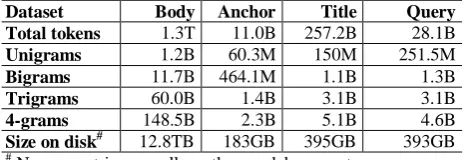
Table 1 summarizes the data sets and Web scale n-gram LMs used in this study. The collection is built from high quality English Web documents containing trillions of tokens, served by a popular commercial search engine. The collection
con-sists of several data sets built from different Web sources, including the different text fields from the Web documents (i.e., body, title, and anchor texts) and search query logs. The raw texts ex-tracted from these different sources were pre- processed in the following manner: texts are to-kenized based on white-space and upper case let-ters are converted to lower case. Numbers are retained, and no stemming/inflection is per-formed. The n-gram LMs are word-based backoff models, where the n-gram probabilities are esti-mated using Maximum Likelihood Estimation with smoothing. Specifically, for a trigram mod-el, the smoothed probability is computed as
(5)
{
( )
where is the count of the n-gram in the train-ing corpus and is a normalization factor. is a discount function for smoothing. We use modified absolute discounting (Gao et al., 2001), whose parameters can be efficiently estimated and performance converges to that of more elabo-rate state-of-the-art techniques like Kneser-Ney smoothing in large data (Nguyen et al. 2007).
4.2 Distributed N-gram LM Platform
The platform is developed on a distributed com-puting system designed for storing and analyzing massive data sets, running on large clusters sisting of hundreds of commodity servers con-nected via high-bandwidth network.
We use the SCOPE (Structured Computations Optimized for Parallel Execution) programming model (Chaiken et al., 2008) to train the Web scale n-gram LMs shown in Table 1. The SCOPE scripting language resembles SQL which many programmers are familiar with. It also supports
Dataset Body Anchor Title Query
Total tokens 1.3T 11.0B 257.2B 28.1B
Unigrams 1.2B 60.3M 150M 251.5M
Bigrams 11.7B 464.1M 1.1B 1.3B
Trigrams 60.0B 1.4B 3.1B 3.1B
4-grams 148.5B 2.3B 5.1B 4.6B
Size on disk# 12.8TB 183GB 395GB 393GB
#
N-gram entries as well as other model parameters are stored.
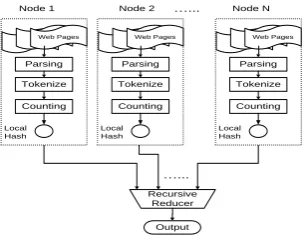
C# expressions so that users can easily plug-in customized C# classes. SCOPE supports writing a program using a series of simple data transfor-mations so that users can simply write a script to process data in a serial manner without wonder-ing how to achieve parallelism while the SCOPE compiler and optimizer are responsible for trans-lating the script into an efficient, parallel execu-tion plan. We illustrate the usage of SCOPE for building LMs using the following example of counting 5-grams from the body text of English Web pages. The flowchart is shown in Figure 1.
The program is written in SCOPE as a step-by- step of computation, where a command takes the output of the previous command as its input.
ParsedDoc=SELECT docId, TokenizedDoc
FROM @”/shares/…/EN_Body.txt”
USING DefaultTextExtractor;
NGram=PROCESS ParsedDoc
PRODUCE NGram, NGcount
USING NGramCountProcessor(-stream
TokenizedDoc -order 5 –bufferSize 20000000);
NGramCount=REDUCE NGram
ON NGram
PRODUCE NGram, NGcount
USING NGramCountReducer;
OUTPUT TO @”Body-5-gram-count.txt”;
The first SCOPE command is a SELECT statement that extracts parsed Wed body text. The second command uses a build-in Processor (NGramCountProcessor) to map the parsed doc-uments into separate n-grams together with their counts. It generates a local hash at each node (i.e., a core in a multi-core server) to store the (n -gram, count) pairs. The third command (RE-DUCE) aggregates counts from different nodes according to the key (n-gram string). The final command (OUTPUT) writes out the resulting to a data file.
The smoothing method can be implemented similarly by the customized smoothing Proces-sor/Reducer. They can be imported from the ex-isting C# codes (e.g., developed for building LMs in a single machine) with minor changes.
It is straightforward to apply the built LMs for the ranker in the speller. The n-gram platform provides a DLL for n-gram batch lookup. In the server, an n-gram LM is stored in the form of multiple lists of key-value pairs, where the key is the hash of an n-gram string and the value is ei-ther the n-gram probability or backoff parameter.
5
Phrase-Based Error Models
The goal of an error model is to transform a cor-rectly spelled query C into a misspelled query Q. Rather than replacing single words in isolation, the phrase-based error model replaces sequences of words with sequences of words, thus incorpo-rating contextual information. The training pro-cedure closely follows Sun et al. (2010). For in-stance, we might learn that “theme part” can be replaced by “theme park” with relatively high probability, even though “part” is not a mis-spelled word. We use this generative story: first the correctly spelled query C is broken into K non-empty word sequences c1, …, ck, then each is
replaced with a new non-empty word sequence q1, …, qk, finally these phrases are permuted and
concatenated to form the misspelled Q. Here, c and q denote consecutive sequences of words.
To formalize this generative process, let S de-note the segmentation of C into K phrases c1…cK,
and let T denote the K replacement phrases q1…qK – we refer to these (ci, qi) pairs as
bi-phrases. Finally, let M denote a permutation of K elements representing the final reordering step. Figure 2 demonstrates the generative procedure.
Next let us place a probability distribution over rewrite pairs. Let B(C, Q) denote the set of S, T, M triples that transform C into Q. Assuming a uniform probability over segmentations, the phrase-based probability can be defined as:
Recursive Reducer
Node 1 Node 2 …... Node N
…...
Output
Web Pages
Parsing
Counting
Local Hash
Tokenize
Web Pages
Parsing
Counting
Local Hash
Tokenize
Web Pages
Parsing
Counting
Local Hash
Tokenize
Figure 1. Distributed 5-gram counting.
C: “disney theme park” correct query S: [“disney”, “theme park”] segmentation T: [“disnee”, “theme part”] translation M: (1 2, 2 1) permutation Q: “theme part disnee” misspelled query
∑
(6)
As is common practice in SMT, we use the max-imum approximation to the sum:
(7)
5.1 Forced Alignments
Although we have defined a generative model for transforming queries, our goal is not to propose new queries, but rather to provide scores over existing Q and C pairs that will act as features for the ranker. Furthermore, the word-level align-ments between Q and C can most often be identi-fied with little ambiguity. Thus we restrict our attention to those phrase transformations con-sistent with a good word-level alignment.
Let J be the length of Q, L be the length of C, and A = a1…aJ be a hidden variable representing
the word alignment between them. Each ai takes on a value ranging from 1 to L indicating its cor-responding word position in C, or 0 if the ith word in Q is unaligned. The cost of assigning k to ai is equal to the Levenshtein edit distance (Levenshtein, 1966) between the ith word in Q and the kth word in C, and the cost of assigning 0 to ai is equal to the length of the ith word in Q. The least cost alignment A* between Q and C is computed efficiently using the A-star algorithm.
When scoring a given candidate pair, we fur-ther restrict our attention to those S, T, M triples that are consistent with the word alignment, which we denote as B(C, Q, A*). Here, consisten-cy requires that if two words are aligned in A*, then they must appear in the same bi-phrase (ci, qi). Once the word alignment is fixed, the final permutation is uniquely determined, so we can safely discard that factor. Thus we have:
(8)
For the sole remaining factor P(T|C, S), we make the assumption that a segmented query T = q1… qK is generated from left to right by trans-forming each phrase c1…cK independently:
∏ , (9)
where is a phrase transformation prob-ability, the estimation of which will be described in Section 5.2.
To find the maximum probability assignment efficiently, we use a dynamic programming ap-proach, similar to the monotone decoding algo-rithm described in Och (2002).
5.2 Training the Error Model
Given a set of (Q, C) pairs as training data, we follow a method commonly used in SMT (Och and Ney, 2004) to extract bi- phrases and esti-mate their replacement probabilities. A detailed description is discussed in Sun et al. (2010).
We now describe how (Q, C) pairs are gener-ated automatically from massive query reformu-lation sessions of a commercial Web browser.
A query reformulation session contains a list of URLs that record user behaviors that relate to the query reformulation functions, provided by a Web search engine. For example, most commer-cial search engines offer the "did you mean" function, suggesting a possible alternate interpre-tation or spelling of a user-issued query. Figure 3 shows a sample of the query reformulation ses-sions that record the "did you mean" sesses-sions from three of the most popular search engines. These sessions encode the same user behavior: A user first queries for "harrypotter sheme part",
Google:
http://www.google.com/search? hl=en&source=hp&
q=harrypotter+sheme+part&aq=f&oq=&aqi=
http://www.google.com/search? hl=en&ei=rnNAS8-oKsWe_AaB2eHlCA& sa=X&oi=spell&resnum=0&ct= result&cd=1&ved=0CA4QBSgA&
q=harry+potter+theme+park&spell=1
Yahoo:
http://search.yahoo.com/search; _ylt=A0geu6ywckBL_XIBSDtXNyoA? p=harrypotter+sheme+part& fr2=sb-top&fr=yfp-t-701&sao=1
http://search.yahoo.com/search? ei=UTF-8&fr=yfp-t-701&
p=harry+potter+theme+park
&SpellState=n-2672070758_q-tsI55N6srhZa. qORA0MuawAAAA%40%40&fr2=sp-top
Bing:
http://www.bing.com/search?
q=harrypotter+sheme+part&form=QBRE&qs=n
http://www.bing.com/search?
q=harry+potter+theme+park&FORM=SSRE
and then clicks on the resulting spelling sugges-tion "harry potter theme park". We can "reverse-engineer" the parameters from the URLs of these sessions, and deduce how each search engine en-codes both a query and the fact that a user arrived at a URL by clicking on the spelling suggestion of the query – an strong indication that the spelling suggestion is desired. In this study, from 1 year of sessions, we extracted ~120 million pairs. We found the data set very clean because these spelling corrections are actually clicked, and thus judged implicitly, by many users.
In addition to the "did you mean" functionali-ty, recently some search engines have introduced two new spelling suggestion functions. One is the "auto-correction" function, where the search en-gine is confident enough to automatically apply the spelling correction to the query and execute it to produce search results. The other is the "split pane" result page, where one half portion of the search results are produced using the original query, while the other half, usually visually sepa-rate portion of results, are produced using the auto-corrected query.
In neither of these functions does the user ever receive an opportunity to approve or disapprove of the correction. Since our extraction approach focuses on user-approved spelling suggestions, we ignore the query reformulation sessions re-cording either of the two functions. Although by doing so we could miss some basic, obvious spelling corrections, our experiments show that the negative impact on error model training is negligible. One possible reason is that our base-line system, which does not use any error model learned from the session data, is already able to correct these basic, obvious spelling mistakes. Thus, including these data for training is unlikely to bring any further improvement.
We found that the error models trained using the data directly extracted from the query refor-mulation sessions suffer from the problem of un-derestimating the self-transformation probability of a query P(Q2=Q1|Q1), because we only includ-ed in the training data the pairs where the query is different from the correction. To deal with this problem, we augmented the training data by in-cluding correctly spelled queries, i.e., the pairs (Q1, Q2) where Q1 = Q2. First, we extracted a set of queries from the sessions where no spell sug-gestion is presented or clicked on. Second, we
removed from the set those queries that were rec-ognized as being auto-corrected by a search en-gine. We do so by running a sanity check of the queries against our baseline noisy channel speller, which will be described in Section 6. If the system consider a query misspelled, we as-sumed it an obvious misspelling, and removed it. The remaining queries were assumed to be cor-rectly spelled and were added to the training data.
6
Experiments
We perform the evaluation using a manually an-notated data set containing 24,172 queries sam-pled from one year’s query logs from a commer-cial search engine. The spelling of each query is manually corrected by four independent annota-tors. The average length of queries in the data sets is 2.7 words. We divided the data set into non-overlapped training and test data sets. The training data contain 8,515 pairs, among which 1,743 queries are misspelled (i.e. ). The test data contain 15,657 pairs, among which 2,960 queries are misspelled.
The speller systems we developed in this study are evaluated using the following metrics.
Accuracy: The number of correct outputs generated by the system divided by the total number of queries in the test set.
Precision: The number of correct spelling corrections for misspelled queries generated by the system divided by the total number of corrections generated by the system.
Recall: The number of correct spelling cor-rections for misspelled queries generated by the system divided by the total number of misspelled queries in the test set.
We also perform a significance test, a t-test with a significance level of 0.05.
In our experiments, all the speller systems are ranker-based. Unless otherwise stated, the ranker is a two-layer neural net with 5 hidden nodes. The free parameters of the neural net are trained to optimize accuracy on the training data using the back propagation algorithm (Burges et al., 2005) .
6.1 System Results
and (3) is used. The error model is based on the weighted edit distance function and the LM is a backoff bigram model trained on 1 year of query logs, with count cutoff 30. Row 2 is the speller using a linear ranker to incorporate all ranking features described in Section 3. The weights of the linear ranker are optimized using the Aver-aged Perceptron algorithm (Freund and Schapire, 1999). Row 3 is the speller where a nonlinear ranker (i.e., 2-layer neural net) is trained atop the features. Rows 4, 5 and 6 are systems that incor-porate the additional features derived from the phrase-based error model (PBEM) described in Section 5 and the four Web scale LMs (WLMs) listed in Table 1.
The results show that (1) the ranker is a very flexible modeling framework where a variety of fine-grained features can be easily incorporated, and a ranker-based speller outperforms signifi-cantly (p < 0.01) the traditional system based on the noisy channel model (Row 2 vs. Row 1); (2) the speller accuracy can be further improved by using more sophisticated rankers and learning algorithms (Row 3 vs. Row 2); (3) both WLMs and PBEM bring significant improvements (Rows 4 and 5 vs. Row 3); and (4) interestingly, the gains from WLMs and PBEM are additive and the combined leads to a significantly better speller (Row 6 vs. Rows 4 and 5) than that of using either of them individually.
In what follows, we investigate in detail how the WLMs and PBEM trained on massive Web content and search logs improve the accuracy of the speller system. We will compare our models with the state-of-the-art models proposed previ-ously. From now on, the system listed in Row 3 of Table 1 will be used as baseline.
6.2 Language Models
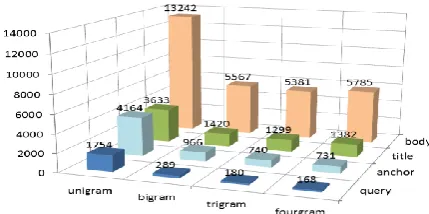
The quality of n-gram LMs depends on the order of the model, the size of the training data, and how well the training data match the test data. Figure 4 illustrates the perplexity results of the
four LMs trained on different data sources tested on a random sample of 733,147 queries. The re-sults show that (1) higher order LMs produce lower perplexities, especially when moving be-yond unigram models; (2) as expected, the query LMs are most predictive for the test queries, though they are from independent query log snapshots; (3) although the body LMs are trained on much larger amounts of data than the title and anchor LMs, the former lead to much higher per-plexity values, indicating that both title and an-chor texts are quantitatively much more similar to queries than body texts.
Table 2 summarizes the spelling results using different LMs. For comparison, we also built a 4-gram LM using the Google 1T web 5-4-gram cor-pus (Brants and Franz, 2006). This model is re-ferred to as the G1T model, and is trained using the “stupid backoff” smoothing method (Brants et al., 2007). Due to the high count cutoff applied by the Google corpus (i.e., n-grams must appear at least 40 times to be included in the corpus), we found the G1T model results to a higher OOV rate (i.e., 6.5%) on our test data than that of the 4 Web scale LMs (i.e., less than 1%).
The results in Table 2 are more or less con-sistent with the perplexity results: the query LM is the best performer; there is no significant dif-ference among the body, title and anchor LMs though the body LM is trained on a much larger amount of data; and all the 4 Web scale LMs out-perform the G1T model substantially due to the significantly lower OOV rates.
6.3 Error Models
This section compares the phrase-based error model (PBEM) described in Section 5, with one of the state-of-the-art error models, proposed by Brill and Moore (2000), henceforth referred to as
# System Accuracy Precision Recall 1 Noisy channel 85.3 72.1 35.9 2 Linear ranker 88.0 74.0 42.8 3 Nonlinear ranker 89.0 74.1 49.6 4 3 + PBEM 90.7 78.7 58.2 5 3 + WLMs 90.4 75.1 58.7 6 3 + PBEM + WLMs 91.6 79.1 63.9
Table 1. Summary of spelling correction results.
Figure 4. Perplexity results on test queries, using n
the B&M model. B&M is a substring error mod-el. It estimates as
∏
(10)
where R is a partitioning of correction term c into adjacent substrings, and T is a partitioning of query term q, such that |T|=|R|. The partitions are thus in one-to-one alignment. To train the B&M model, we extracted 1 billion term-correction pairs from the set of 120 million query-correction pairs , derived from the search logs as described in Section 5.2.
Table 3 summarizes the comparison results. Rows 1 and 2 are our ranker-based baseline sys-tems with and without the error model (EM) fea-ture. The error model is based on weighted edit distance of Eq. (3), where the weights are learned on some manually annotated word-correction pairs (which is not used in this study). Rows 3 and 4 are the B&M models using different maxi-mum substring lengths, specified by L. L=1 re-duces B&M to the weighted edit distance model in Row 2. Rows 5 and 6 are PBEMs with differ-ent maximum phrase lengths. L=1 reduces PBEM to a word-based error model. The results show the benefits of capturing context information in error models. In particular, the significant im-provements resulting from PBEM demonstrate that the dependencies between words are far more effective than that between characters (within a word) for spelling correction. This is largely due to the fact that there are many real-word spelling errors in search queries. We also notice that PBEM is a more powerful model than
# # of word pairs Accuracy Precision Recall 1 Baseline w/o EM 88.55 71.95 46.97 2 1M 89.15 73.71 50.74 3 10M 89.22 74.11 50.92 4 100M 89.20 73.60 51.06 5 1B 89.21 73.72 50.99
Table 4. The performance of B&M error model (L=3) as a function of the size of training data (# of word pairs).
# # of (Q, C) pairs Accuracy Precision Recall 1 Baseline w/o EM 88.55 71.95 46.97 2 5M 89.59 77.01 52.34 3 15M 90.23 77.87 56.67 4 45M 90.45 78.56 57.02 5 120M 90.70 78.49 58.12
Table 5. The performance of PBEM (L=3) as a function of the size of training data (# of (Q, C) pairs).
B&M in that it can benefit more from increasing-ly larger training data. As shown in Tables 4 and 5, whilst the performance of B&M saturates quickly with the increase of training data, the per-formance of PBEM does not appear to have peaked – further improvements are likely given a larger data set.
7
Conclusions and Future Work
This paper explores the use of massive Web cor-pora and search logs for improving a ranker- based search query speller. We show significant improvements over a noisy channel speller using fine-grained features, Web scale LMs, and a phrase-based error model that captures intern- word dependencies. There are several techniques we are exploring to make further improvements. First, since a query speller is developed for im-proving the Web search results, it is natural to use features from search results in ranking, as studied in Chen et al. (2007). The challenge is efficiency. Second, in addition to query reformulation ses-sions, we are exploring other search logs from which we might extract more pairs for er-ror model training. One promising data source is clickthrough data (e.g., Agichtein et al, 2006; Gao et al., 2009). For instance, we might try to learn a transformation from the title or anchor text of a document to the query that led to a click on that document. Finally, the phrase-based error model is inspired by phrase-based SMT systems. We are introducing more SMT techniques such as alignment and translation rule exaction. In a broad sense, spelling correction can be viewed as a monolingual MT problem where we translate bad English queries into good ones.
# System Accuracy Precision Recall 1 Baseline 89.0 74.1 49.6 2 1+ query 4-gram 90.1 75.6 56.3 3 1 + body 4-gram 89.9 75.7 54.4 4 1 + title 4-gram 89.8 75.4 54.7 5 1 + anchor 4-gram 89.9 75.1 55.6 6 1 + G1T 4-gram 89.4 75.1 51.5
Table 2. Spelling correction results using different LMs trained on different data sources.
# System Accuracy Precision Recall 1 Baseline w/o EM 88.6 72.0 47.0 2 Baseline 89.0 74.1 49.6 3 1 + B&M, L=1 89.0 73.3 50.1 4 1 + B&M, L=3 89.2 73.7 51.0 5 1 + PBEM, L=1 90.1 76.7 55.6 6 1 + PBEM, L=3 90.7 78.5 58.1
Acknowledgments
The authors would like to thank Andreas Bode, Mei Li, Chenyu Yan and Kuansan Wang for the very helpful discussions and collaboration. The work was done when Xu Sun was visiting Mi-crosoft Research Redmond.
References
Agichtein, E., Brill, E. and Dumais, S. 2006. Improv-ing web search rankImprov-ing by incorporatImprov-ing user be-havior information. In SIGIR, pp. 19-26.
Ahmad, F., and Kondrak, G. 2005. Learning a spelling error model from search query logs. In HLT-EMNLP, pp. 955-962.
Brants, T., and Franz, A. 2006. Web 1T 5-gram corpus version 1.1. Technical report, Google Research. Brants, T., Popat, A. C., Xu, P., Och, F. J., and Dean, J.
2007. Large language models in machine translation. In EMNLP-CoNLL, pp. 858 - 867.
Brill, E., and Moore, R. C. 2000. An improved error model for noisy channel spelling correction. In ACL, pp. 286-293.
Burges, C., Shaked, T., Renshaw, E., Lazier, A., Deeds, M., Hamilton, and Hullender, G. 2005. Learning to rank using gradient descent. In ICML,
pp. 89-96.
Chaiken, R., Jenkins, B., Larson, P., Ramsey, B., Shakib, D., Weaver, S., and Zhou, J. 2008. SCOPE: easy and efficient parallel processing f massive data sets. In Proceedings of the VLDB Endowment, pp. 1265-1276.
Charniak, E. 2001. Immediate-head parsing for lan-guage models. In ACL/EACL, pp. 124-131. Chen, S. F., and Goodman, J. 1999. An empirical
study of smoothing techniques for language model-ing. Computer Speech and Language, 13(10):359-394.
Chen, Q., Li, M., and Zhou, M. 2007. Improving que-ry spelling correction using web search results. In
EMNLP-CoNLL, pp. 181-189.
Church, K., Hard, T., and Gao, J. 2007. Compressing trigram language models with Golomb coding. In
EMNLP-CoNLL, pp. 199-207.
Cucerzan, S., and Brill, E. 2004. Spelling correction as an iterative process that exploits the collective knowledge of web users. In EMNLP, pp. 293-300. Freund, Y. and Schapire, R. E. 1999. Large margin
classification using the perceptron algorithm. In
Machine Learning, 37(3): 277-296.
Gao, J., Goodman, J., and Miao, J. 2001. The use of clustering techniques for language modeling -application to Asian languages. Computational
Lin-guistics and Chinese Language Processing, 6(1):27–60, 2001.
Gao, J., Yuan, W., Li, X., Deng, K., and Nie, J-Y. 2009. Smoothing clickthrough data for web search ranking. In SIGIR, pp. 355-362.
Golding, A. R., and Roth, D. 1996. Applying winnow to context-sensitive spelling correction. In ICML, pp. 182-190.
Joachims, T. 2002. Optimizing search engines using clickthrough data. In SIGKDD, pp. 133-142. Kernighan, M. D., Church, K. W., and Gale, W. A.
1990. A spelling correction program based on a noisy channel model. In COLING, pp. 205-210. Koehn, P., Och, F., and Marcu, D. 2003. Statistical
phrase-based translation. In HLT/NAACL, pp. 127-133.
Kucich, K. 1992. Techniques for automatically correcting words in text. ACM Computing Surveys, 24(4):377-439.
Levenshtein, V. I. 1966. Binary codes capable of cor-recting deletions, insertions and reversals. Soviet Physics Doklady, 10(8):707-710.
Li, M., Zhu, M., Zhang, Y., and Zhou, M. 2006. Ex-ploring distributional similarity based models for query spelling correction. In ACL, pp. 1025-1032. Mangu, L., and Brill, E. 1997. Automatic rule
acquisi-tion for spelling correcacquisi-tion. In ICML, pp. 187-194. Microsoft Microsoft web n-gram services. 2010.
http://research.microsoft.com/web-ngram
Nguyen, P., Gao, J., and Mahajan, M. 2007. MSRLM: a scalable language modeling toolkit. Technical re-port TR-2007-144, Microsoft Research.
Och, F. 2002. Statistical machine translation: from single-word models to alignment templates. PhD thesis, RWTH Aachen.
Och, F., and Ney, H. 2004. The alignment template approach to statistical machine translation.
Computational Linguistics, 30(4): 417-449. Philips, L. 1990. Hanging on the metaphone.
Comput-er Language Magazine, 7(12):38-44. Sun, X., Gao, J., Micol, D., and Quirk, C. 2010.
Learning phrase-based spelling error models from clickthrough data. In ACL.
Toutanova, K., and Moore, R. 2002. Pronunciation modeling for improved spelling correction. In ACL, pp. 144-151.
Whitelaw, C., Hutchinson, B., Chung, G. Y., and Ellis, G. 2009. Using the web for language independent spellchecking and autocorrection. In EMNLP, pp. 890-899.