i
FLEXURAL BEHAVIOR OF STEEL REINFORCED BRICK BEAM
UTILIZING INTERLOCKING BRICK SYSTEM
EMAD HOSSEINPOUR
A project report submitted in partial fulfillment of the requirements for the award of the degree of
Master of Engineering (Civil-Structure)
Faculty of Civil Engineering Universiti Teknologi Malaysia
JANUARY 2013
3
ACKNOWLEDGEMENT
I would like to thank all my friends specially B.Eng. Mohamad Idzwan Latiff who have given the cooperation to me in laboratory for doing of this project. I am sincerely grateful to my supervisor; Prof.Ir. Dr. Mahmood Md Tahir. for his continues support and guidance to set a high standard for the conduct of this study and his valuable suggestions confer to complete this project report. My sincere appreciation also extends to all my beloved family members.
ABSTRACT
The Interlocking Hollow Brick System (IHBS) was recently used in the construction of load bearing beam and walls. The concepts behind an IHBS include the elimination of the mortar layer. The interlocking brick system investigated in this study was a load bearing brick system relied on U-shaped hollow bricks in the bed
5
ABSTRAK
Sistem bata saling Hollow (IHBS) baru-baru ini digunakan dalam pembinaan rasuk dan dinding galas beban. Konsep sebalik sebuah IHBS termasuk penghapusan lapisan mortar. Sistem bata saling disiasat dalam kajian ini adalah bata galas beban sistem bergantung pada bata berongga berbentuk-U di barisan katil dan lompang kosong dalam rasuk yang membenarkan penambahan pengukuh grout konkrit bertetulang dalam arah menegak dan mendatar untuk meningkatkan kestabilan dan integriti rasuk. Kedua-dua Konkrit Biasa (NC) dan Konkrit Membuka Diri (SCC) dan konkrit, grout, dan mortar yang digunakan sebagai bahan pengisi. Secara umumnya, dalam kajian ini, dua belas spesimen disediakan untuk ujian skala penuh dengan parameter yang berbeza. Saiz bata berongga adalah 250mm x 1250 x100 dan bilangan rebar adalah 12 mm. Dimensi rasuk membuat dengan bata berongga dan rebar mendatar dan menegak adalah 3000mm panjang, 125 mm lebar, dan ketinggian 300mm. Ia telah mendapati bahawa penambahan super plasticizer dalam rasuk dengan SCC prestasi yang lebih baik di bawah pembebanan lenturan daripada NC. Tingkah laku ini juga membolehkan konkrit untuk mempunyai campuran lebih homogen, disebabkan ikatan yang lebih baik antara bata, grout dan tetulang keluli. Susunan yang berbeza bata berongga saling berturut-turut tidur menyebabkan tingkah laku yang sangat mulur kerana tetulang melintang dikelilingi oleh konkrit antara dua lapisan bata berongga yang ia mempunyai interaksi yang lebih baik di kalangan rebar, bata dan grout.
TABLE OF CONTENTS
CHAPTER TITLE PAGE
TITLE i
DECLARATION ii
DEDICATION iii
ACKNOWLEDGEMENT iv
ABSTRACT v
ABSTRAK vi
TABLE OF CONTENTS vii
LIST OF TABLES x
LIST OF FIGURES xi
1 INTRODUCTION 1
1.1. General 1
1.2. Properties of hollow brick masonry 4
1.2.1. Strength 4
1.2.2. Compressive strength of unites 5
7
1.3.1. Mortar bedding 6
1.3.2. Reinforcement 6
1.3.3. Elastic module 8
1.4. Hollow brick specification and sizes 9
1.4.1. Grade Error! Bookmark not defined. 1.4.2. Type 9
1.4.3. Class 9
1.4.4. Hollow spaces (voids) 10
1.4.5. Sizes and shapes 11
1.5. Problem statement 11
1.6. Objectives of study 12
1.7. Scope of study 12
1.8. Significance of the study 13
2 LITERATURE REVIEW 14
2.1. General 14
2.1.1. Summary of the invention 16
2.1.2. Description of the drawings 17
2.1.3. Description of the prepared embodiment 18 2.2. Conception of clay units 18
2.2.1. Selection of raw materials 19
2.2.2. Geometry 19
2.5.2. Behavior of masonry walls 31
3 RESEARCH METHODOLOGY 34
3.1. Introduction 34
3.2. Test preparation 35
3.3. Specimens description 35
3.4. Loading and support 36
3.5. Expected Findings 38
3.6. Details of each sample 39
3.7. Constituent Materials and mixture proportion 42
3.7.1. Cement 43
3.7.2. Fly ash 44
3.8. Cube test 4
4 TEST RESULTS AND DISCUSION 47
4.1. Introduction 47
4.2. Compressive strength test result 48
4.3. Flexural strength 49
4.4. Results of sample 1 with NC and SCC infill grout 50 4.5. Results of sample 2 with NC and SCC infill grout 53 4.6. Comparison of sample 1and sample 2 with NC infill 55 4.7 Comparison of sample 1and sample 2 with SCC infill 57 4.8. Results of sample 1and 2 with mortar infill 59
4.9. Comparison of sample 1and 2 with mortar infill 60
4.10. Results of sample 1and 2 with mortar infill 62
4.11. Comparison of sample 1and 2 with concrete infill 64
4.12. Results of sample 1and 2 with grout infill 66
9
4.14. Results of sample 1and 2 with mortar infill 68
4.15. Cracking pattern 69
5 CONCLUSION AND RECOMMENDATION 75
5.1. Introduction 75
5.2. Conclusion 76
5.3. Recommendations 77
REFERENCES 78
LIST OF TABLES
TABLE NO TITLE PAGE
1.1 Characteristic tensile yield strength of reinforcing steel, fy 7
1.2 ASTM C652 Hollow Brick Cross-Sectional Requirements 10
2.1 Summary of the mechanical parameters of the clay past 24
2.2 Mechanical parameters of masonry in compression 38
3.1 Chemical composition of cement 43
3.2 Chemical composition of Fly ash 44
3.3 Material mixture proportion 44
4.1 Compressive strength for NC and SCC 48
11
LIST OF FIGURES
FIGURE NO TITLE PAGE
1.1 Hollow brick configuration 4
1.2 Short-term design stress-strain curve for reinforcement 8
2.1 Perspective view of one of the bricks used in the wall 17
2.2 Perspective view of the interlocking member 17
2.3 Finite element mesh defined for the clay units 22
2.4 Constitutive model adopted for the clay 23
2.5 Stress–strain diagrams in three main load directions 23
2.6 Typical stress–strain diagrams of clay units 26
2.7 Distribution of principal tensile stresses 26
2.8 Typical failure modes of clay masonry under compression 29
2.9 Typical stress–strain diagrams of clay brick masonry 30
2.10 The walls’ mode of failure in specimens 32
3.1 Specimen properties and testing 38
3.2 Characteristic of sample 1 (S1) 39
3.3 Characteristic of sample 2 (S2) 40
3.4 Four point flexural test 41
3.5 Details of testing 41
3.7 Hollow interlocking brick characteristic 45
3.8 Compressive tests of cubes 46
4.1 Compressive strength developments of SCC and NC 49
4.2 Load-Strain response of sample 1 with NC 51
4.3 Load-deflection response of S1 (a) 51
4.4 Load-deflection response of S1 (b) 52
4.5 Load-Strain response of sample 2 with NC 53
4.6 Load-deflection response of S2 (a) 54
4.7 Load-deflection response of S2 (b) 55
4.8 Comparison of load-deflection responses of samples with NC infill 57
4.9 Comparison of load-deflection responses of samples with SCC infill 59
4.10 Load-deflection responses of sample 1 with mortar infill 60
4.11 Load-deflection responses of sample 2 with mortar infill 60
4.12 Comparison of load-deflection responses of samples with mortar infill 79
4.13 Load-deflection responses of sample 1 with concrete infill 63
4.14 Load-deflection responses of sample 2 with concrete infill 64
4.15 Comparison of Load-deflection responses of samples with concrete infill 65
4.16 Load-deflection responses of sample 1 with grout infill 66
4.17 Load-deflection responses of sample 2 with grout infill 66
4.18
Comparison of load-deflection responses of samples with grout infill 68
4.19
Load-deflection responses of sample 1 with mortar infill 69
13
4.21 Crack patterns of samples with mortar infill 72
CHAPTER1
INTRODUCTION
1.1 General
Originally, brick was formed by placing moist clay in a mold by hand. As modern industrial methods were implemented in the brick manufacturing process, the majority of production was changed from a molded process to an extrusion process. Extrusion more easily accommodates the inclusion of holes in a brick unit, which in turn can make the manufacture and use of brick more cost-effective and material-efficient. Traditionally, the size and number of holes in a brick unit have varied based on manufacturer capabilities, type of clay being extruded, type of firing process, and intended use of the product. As part of the evolution of brick unit manufacture and classification, these various hole patterns were categorized into two basic designations: solid brick and hollow brick. Solid brick are defined as having holes (or voids) not greater than 25 percent of the unit’s bed area. Hollow brick are defined as having greater than 25 percent and at most 60 percent void areas. Hollow brick are further classified into those with a void area not greater than 40 percent and those with greater than 40 percent voids. [1]
2
range in size from 4 to 8 in. (102 to 203 mm) in nominal thickness with void areas in the range of 35 to 60 percent. Typical single-Wythe applications of hollow brick include commercial, retail and residential buildings; hotels; schools; noise barrier walls; and retaining walls. The second application of hollow brick is as veneer units. These brick are generally 3 to 4 in. (76 to 102 mm) in nominal thickness with void areas in the range between 26 and35 percent.
Masonry consists of a variety of materials. Raw materials are made of masonry units of different sizes and shapes, each having specific physical and mechanical properties. Both raw materials and method of manufacture affect masonry unit properties. One of the oldest building products in the world, brick remains a popular and durable wall covering. However, its use has taken on new meaning as design professionals specify and incorporate environmentally responsible construction that considers appropriate use of natural resources. Due to rapid development in the world, there is a need to build different categories of houses within a limited time to meet the increasing demand in the housing sector. Hence, a number of building systems have been developed in the world by different overseas companies. A technology using reinforced hollow concrete brick has been developed all over the world since a while. Its principle is to reinforce the masonry by grouting a concrete into the holes of the blocks where stands a steel rod at the critical locations (Corners, ends, near openings, etc,). Horizontal reinforcements are also cast in blocks with a U shape.
Interlocking Hollow Brick system (IHBS) is recently used in the construction of non-load bearing walls and load bearing walls. The main concepts of IHBS are the elimination of the mortar layers and instead the bricks are interconnected through providing key connection (protrusion and groove). The elimination of the mortar layers in the IHBS will speed up the construction and reduce the number of skilled and unskilled workers required to construct similar mortar bricks constructions.
The stresses developed in the wall due to the applied loads resisted by the connected parts of the bricks. The complex interaction between different parts of the brick under different types of stresses requires more comprehensive investigation in order to provide the designer a clear picture on the mechanism of load transfer. Most of the published researches focus on testing the Interlocking Hollow Brick systems experimentally, Published data are available on the theoretical analysis on normal masonry but no published data are available on the theoretical analysis and design procedures of IHBS. [2]
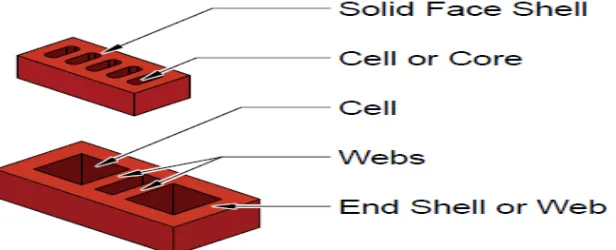
Figure 1.1 presents the three typical configurations of hollow brick units. Actual coring patterns vary by manufacturer and may depend on raw materials, extrusion equipment, firing methods or other factors. Note that as used in Figure 1.1 and throughout this definition, a “core” is a void having a cross sectional area of 1.5 in.² (968 mm²) or smaller, and a “cell” is a void larger than a core.
4
Figure.1.1 Hollow brick configuration
1.2 Properties of hollow brick masonry
1.2.1 Strength
stresses can be different for hollow brick masonry than for solid brick masonry. The following sections highlight some of the specific requirements for hollow brick units.
1.2.2 Compressive strength of unites
Compressive strength of hollow brick can be reported on either a gross or net cross-sectional area basis, depending on how the value is to be used. The gross area compressive strength is used to determine compliance with ASTM C652, Standard Specification for Hollow Brick (Hollow Masonry Units Made from Clay or Shale) [2] for purposes of durability and empirical design requirements. The net area compressive strength is needed for structural computations in structural applications using rational design of masonry.
6
1.3 Design and detailing
1.3.1 Mortar bedding
Requirements for brickwork constructed of hollow brick depending on the intended use of the brickwork. For larger hollow brick units used in structural (non-veneer) walls, mortar should be applied to the full thickness of the face shell (face-shell bedding). For smaller hollow brick units that are used in veneer applications, mortar should be applied to the full width of the brick veneer (full bedding) to maintain proper anchor embedment and cover.
1.3.2 Reinforcement
Table 1.1 Characteristic tensile yield strength of reinforcing steel, fy
Designation Grade Nominal size
Tensile yield strength fy (Mpa)
Steel reinforcement , conforming to BS 4449
500 All 500
Steel wire reinforcement ,
conforming to BS 4482 250
≤ 12mm 250
Steel wire reinforcement ,
conforming to BS 4482 500
≤ 12mm 500
Steel wire reinforcement , conforming to BS 4483
500 All 500
Plain dowel bars, conforming to BS EN 10025-2
250 > 12mm 235
Plain stainless steel bars, conforming to BS 6744
200 All 200
Ribbed stainless steel bars, conforming to BS 6744
8
Figure.1.2 Short-term design stress-strain curve for reinforcement
1.3.3 Elastic module
Where elastic methods of analysis are adopted, the following elastic module may be used in the absence of relevant test data:
a) Elastic modulus for reinforced clay masonry including calcium silicate with infill material is following, Em = 0.9 fk kN/mm2;
1.4 Hollow brick specification and sizes
1.4.1 Type
Four types of hollow brick are defined by ASTM C652: Types HBS, HBX, HBA and HBB. Each of these types relates to the appearance requirements for the brick. Dimensional variation, chip page, war page and other imperfections are qualifying conditions of type. The most common, type HBS, is considered to be standard and is specified for most applications. When the type is not specified, ASTM C652 stipulates that the requirements of type HBS. Type HBX brick are specified where a higher degree of precision is required. Type HBA brick are unique units that are specified for no uniformity in size or texture. Where a particular color, texture or uniformity is not required, type HBB brick can be specified (these applications are typically unexposed locations).
1.4.2 Class
10
1.4.3 Hollow spaces (voids)
Hollow spaces may be cores, cells, deep frogs or combinations of these. In ASTM C652, a core is defined as a void having an area equal to or less than 1½ in.² (968 mm²), while cells are voids larger than a core. A deep frog is an indentation in the bed surface of the brick that is deeper than ⅜ in. (9.5 mm). The thickness of face
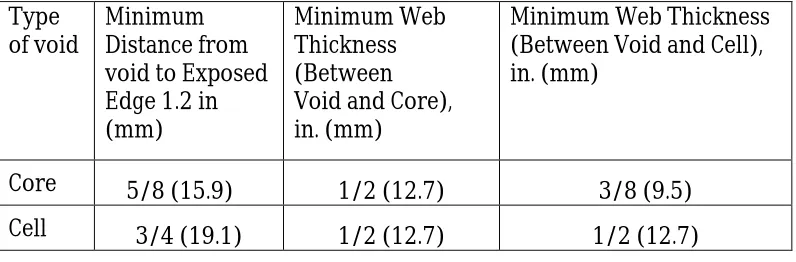
shells and webs are limited by ASTM C652. Figure 1.1 and Table 1.2 define the nomenclature associated with hollow brick units and the minimum required thickness of face shells and cross webs.
Table 1.2 ASTM C652 Hollow Brick Cross-Sectional Requirements
Type of void
Minimum Distance from void to Exposed Edge 1.2 in (mm)
Minimum Web Thickness (Between Void and Core), in. (mm)
Minimum Web Thickness (Between Void and Cell), in. (mm)
Core 5/8 (15.9) 1/2 (12.7) 3/8 (9.5) Cell 3/4 (19.1) 1/2 (12.7) 1/2 (12.7)
1.4.4 Sizes and shapes
Hollow brick are commonly available in a variety of sizes. Hollow brick are also made in a variety of special shapes. Special shapes include radial, bull nose, interior and exterior angled corner units and others. Bond beam units are often used where horizontal reinforcing is required. They may be specially made at the plant or cut on site. The brick manufacturer should be consulted for the availability of special shapes.
1.5 Problem statement
Currently there is limited standard available for the design of interlocking hollow brick system. Most of the published researches focus on testing the IHBS experimentally; Published data are available on the theoretical analysis on normal masonry but no published data are available.
The structural behavior and design parameters for this system are expected to be different than the conventional load bearing beam and wall system. This research is mainly focused on the structural behavior of interlocking hollow brick beams with infill Normal Compacting Concrete (NC) and Self Compacting Concrete (SCC) under effect of mid-span vertical load on beams with simply support.
12
1.6 Objectives of study
The main objectives of this study are:
1. To investigate the structural response of the interlocking hollow brick designed as composite beam subjected to mid-span loading conditions.
2. To investigate the structural behavior of IHBS to based on ductility or deflection between the bricks through the interlocking keys.
3. To study the structural behavior of tested with two different NC and SCC infill grout.
1.7 Scope of study
The main scopes of this study include:
1. Study on interlocking hollow brick system with different infill grout based on two main different reinforced and unreinforced composite beams.
2. Study on different interlocking composite beams of different row bed arrangement of brick.
4. Analysis on the effect of vertical load rating on the overall flexural response of the beams.
5. To investigate the cracking mode of interlocking hollow brick beams.
1.8 Significance of the study
In the absence of any theoretical analysis to provide sufficient technical information about the IHBS, this study provides the properties which affect the structural behavior of different IHBS. The interlocking mechanism plays a significant role in the distribution of the stresses developed in the brick due to the applied load.
79
REFERENCES
[1] Building Code Requirements for Masonry Structures (ACI 530-05/ASCE 5-05/TMS 402-05), The Masonry Society, Boulder, CO, 2005.
[2] Annual Book of Standards, Vol. 04.12, ASTM International, West Conshohocken, PA, 2007: C216 “Standard Specification for Facing Brick (Solid Masonry Units Made From Clay or Shale)” C652 “Standard Specification for Hollow Brick (Hollow Masonry Units Made From Clay or Shale)”
[3] Sanders, J.P., and Brosnan, D.A., “The Effect of Void Area on Brick Masonry Performance,” Journal of ASTM International, Volume 4, Issue 1, ASTM International, West Conshohocken, PA, 2007.
[4] Cerioni R, Doinda G. A finite element model for the nonlinear analysis of reinforced and prestressed masonry wall. Computer and Structures 1994; 53:1291– 306.
[5] Vecchio F. Finite element modelling of concrete expansion and confinement. Journal of Structural Engineering, ASCE 1992;118: 2390–405.
[6] Kupfer H, Gerstle K. Behaviour of concrete under biaxial stresses. Journal of Engineering Mechanics Division, ASCE 1973;99:853–67.
[8] Mosele F, da Porto F, Modena C, di Fusco A, di Cesare G, Vasconcelos G. et al. Developing innovative systems for reinforced masonry walls. In: Proceedings of 7th international masonry conference, London, UK, CD-ROM; 2006. 6 pp.
[9] EN 1996-1-1, Eurocode 6: design of masonry structures – part 1-1: rules for reinforced and unreinforced masonry; 2005.
[10] EN 1998-1-1, Eurocode 8: design of structures for earthquake resistance – part1: general rules, seismic actions and rules for buildings; 2004.
[11] Directive 2002/91/CE – Energy performance building directive.
[12] Del Coz Diaz JJ, Neto PJG, Sierra JLS, Biempica CB. Nonlinear thermal optimization of external light concrete multi-holed brick walls by finite element method. Int J Heat Mass Transfer 2008;51:1530–41.
[13] Li LP, Wu ZY, He YL, Tao WQ. Numerical thermal optimization of the configuration of multi-holed clay bricks used for constructing building walls by the finite volume method. Int J Heat Mass Transfer 2008;51:3669–82.
[14] Dias A, Ferraz E, Sousa H, Sousa L, Sousa R, Lourenco PB, et al. Development of an eco-efficient ceramic brick for sustainable construction, C25 –sustainability integrated approach to life-time structural engineering, July, Dresden, Germany; 2008.
81
[16] Lourenco PB, Almeida JC, Barros JA. Experimental investigation of bricks under un-axial tensile testing. Masonry Int 2005;18(1):11–20.
[17] EN 772-1, Methods of tests for masonry units – part 1: determination of compressive strength; 2000.
[18] EN 1052-1, Methods of test for masonry – part 1: determination of compressive strength; 1999.
[19] EN 1015-11, Methods of tests for mortar for masonry – part 11: determination of flexure and compressive strength of hardened mortar; 1999.
[20] EN 1015-3, Methods of test for mortar for masonry: part 3: determination of consistence of fresh mortar (by flow table); 1999.
[21] Page AW, Shrive NG. A critical assessment of compression tests for hollow brick masonry. Masonry Int 1988;5(2):64–70.
[22] Gihad M, Lourenco PB. Mechanics of hollow concrete brick masonry prisms under compression: review and prospects. Cement Concrete Compos2007;29(3):181
–92.
[23] Khalaf FM, Hendry AW, Fairbairn DR. Study of the compressive strength of brickwork masonry. ACI Struct J 1994;91(4):367–74.
[25] Vasconcelos G, Lourenco PB. In-plane experimental behaviour of stone masonry walls under cyclic loading. ASCE, J Struct Eng 2009;135(10):1269–77. [26] Haach VG, Vasconcelos G, Lourenco PB. Experimental analysis of reinforced concrete brick masonry walls subjected to in-plane cyclic loads. ASCE, J Struct Eng 2010;136(4):452–62.
[27] Tomazˇevicˇ M. Earthquake-resistant design of masonry buildings. London: Imperial College Press; 1999. ISBN: 1-86094-066-8.
[28] Tomazˇevicˇ M, Lutman M, Bosiljkov V. Robustness of hollow clay masonry units and seismic behavior of masonry walls. Constr Build Mater 2006;20(10): 1028–39.
[29] Magenes G, Calvi GM. In-plane seismic response of brick masonry walls. Earthq Eng Struct Dyn 1997;26:1091–112.
[30] Calderini C, Serena C, Lagomarsino S. In-plane strength of unreinforced piers. Earthq Eng Struct Dyn 2009;38:243–67.
[31] Tomazˇevicˇ M. Shear resistance of masonry walls and Eurocode 6: shear versus tensile strength of masonry. Mater Struct 2009;42:889–907.