DE GRUYTER
Journal of Intelligent Systems 2014; aopAli M . Ahm ad, Ghazali Sulong, Am jad R ehm an*, M oham m ed Hazim Alkaw az and
Tanzila Saba
Data Hiding Based on Improved Exploiting
Modification Direction Method and Huffman
Coding
Abstract: The rapid growth o f covert activities via communications network brought about an increasing
need to provide an efficient method for data hiding to protect secret information from malicious attacks.
One o f the options is to combine two approaches, namely steganography and compression. However, its per
formance heavily relies on three major factors, payload, imperceptibility, and robustness, which are always
in trade-offs. Thus, this study aims to hide a large amount o f secret message inside a grayscale host image
without sacrificing its quality and robustness. To realize the goal, a new two-tier data hiding technique is
proposed that integrates an improved exploiting modification direction (EMD) method and Huffman coding.
First, a secret message o f an arbitrary plain text o f characters is compressed and transformed into streams of
bits; each character is compressed into a maximum o f 5 bits per stream. The stream is then divided into two
parts o f different sizes o f 3 and 2 bits. Subsequently, each part is transformed into its decimal value, which
serves as a secret code. Second, a cover image is partitioned into groups o f 5 pixels based on the original EMD
method. Then, an enhancement is introduced by dividing the group into two parts, namely k1 and k2, which
consist o f 3 and 2 pixels, respectively. Furthermore, several groups are randomly selected for embedding pur
poses to increase the security. Then, for each selected group, each part is embedded with its corresponding
secret code by modifying one grayscale value at most to hide the code in a (2ki + l)-ary notational system. The
process is repeated until a stego-image is eventually produced. Finally, the x 2 test, which is considered one
o f the most severe attacks, is applied against the stego-image to evaluate the performance o f the proposed
method in terms o f its robustness. The test revealed that the proposed method is more robust than both
least significant bit embedding and the original EMD. Additionally, in terms o f imperceptibility and capac
ity, the experimental results have also shown that the proposed method outperformed both the well-known
methods, namely original EMD and optimized EMD, with a peak signal-to-noise ratio o f 55.92 dB and payload
o f 52,428 bytes.
Keywords: Information security, steganography, Huffman coding, data hiding, direction evaluation.
DOI 10.1515/jisys-2014-0007 Received January 28, 2014.
1 Introduction
The need for methods that provide efficient work on the protection o f data and private property o f individu
als has become very vital because o f the huge growth o f multimedia applications on networks. It is therefore
Corresponding author: Amjad Rehman, Management Information Systems Department, College of Business Administration, Salman bin Abdul Aziz University, Alkharj, KSA, e-mail: [email protected]
Ali M. Ahmad and Mohammed Hazim Alkawaz: Faculty of Computing, Universiti Teknologi Malaysia, Johor Bahru, Malaysia; and Faculty of Computer Sciences and Mathematics, University of Mosul, Mosul, Iraq
2
--- A.M. Ahmad et al.: Data Hiding Based on EMD and Huffman CodingDE GRUYTER
important to create methods that provide security for the media from thieves and hackers to prevent them
from tampering and misrepresenting the data [8, 9].
Data protection consists o f two techniques: cryptography and data hiding. Cryptography means the provi
sion o f protection for data storage and data transfer while using a secret key. Encryption is still a successful
way to protect stored and transmitted data over a network. However, with the growing use o f networks to send
and receive data on the global information network, it has become very difficult to maintain these data [12, 14].
Data hiding has two main approaches: steganography and digital watermarking. These two approaches
have many techniques [3, 15, 16], one o f them is least significant bit (LSB) embedding steganography that
alters a document to embed a secret message to reveal the actual ownership [13, 18].
The steganography system consists o f two components, the embedder and a detector, and is used to
protect secret information by embedding secret messages in the host media (cover image), for instance, text,
images, audio, or video.
2 Related Work
The LSB is considered one o f the most common methods [1, 2]. This approach deals directly with a cover
image, after hiding a secret image within it. In general, bit-mapped images are commonly used. Every image
consists o f a set o f pixels, and every pixel represents one color. The values o f a grayscale image range from 0
to 255. If the value o f the pixel is equal to 0, it signifies darkness, and when is equal to 255, it indicates light
ness. Therefore, a gray-level image can be adjusted by adjusting these values. At least 8 bits are required to
represent these values, and the binary system stores them from bits a , a2, ..., a . The LSB substitution changes
the last bit (a 1) to make imperceptible modification that cannot be detected by the human vision system. For
instance, if the value o f a pixel is 100, and we want to embed a 1, the pixel value becomes 101. Human vision
cannot recognize this difference. However, the LSB can easily embed secret data into an image with an impal
pable effect on the image. The pixel values after embedding can be computed using Eq. (1):
x 'i = xi - xi mod 2k + mi, (1)
where xi, and x 'i refer to the pixel before and after embedding, respectively; k refers to the number o f bits that
are going to be embedded; and mi refers to the value o f the secret message.
Other researchers used intermediate significant bit planes [4, 5, 7, 10, 17, 19] to overcome the LSB draw
backs. Here, a higher bit plane is selected to embed the secret messages. Thus, it reduces stego-image quality
but increases robustness. The higher the bit plane is chosen, the better robustness w ould be, but the poorer
image quality would become and vice versa [11].
Reference [6] proposed the exploiting modification direction (EMD) to reduce distortion. EMD made use
o f n pixels as a group to embed secret digits in a (2n + 1)-ary notational system. During the embedding stage, it
requires to increase or decrease one from the value o f a particular pixel within the group using Eqs. (2) and (3):
n
f ( g 1, g 2, ■■■, gn) = K gi *i )m od(2*n + 1 ), (2) i = 1
s = ( d - f )m od (2n + 1 ), (3)
where n indicates the number o f pixels; g 1, g 2, ..., g n represent values o f pixels within each group; s refers to
the index o f the image; and d indicates the value o f the secret digit.
Iff = d, no change is needed; iff * d and s < n, g (s) is increased by 1. Iff * d and s > n, g (2n+1 _s) is decreased
by 1. For example, let n = 4, d = 3, and the original pixel group be [99, 110, 120, 130]. Then, f = (99*1 + 110*2
+ 120*3 + 130*4) mod 9 = 2, s = (d - f ) mod 9 = 1, which is less than n. Thus, g (s) = g (1) + 1 = 100. Second
example: let d = 9 and the same pixel group is employed. Then, s = (d - f ) mod 9 = 7, which is bigger than n;
thus, g (2n+1 _ s) = g (2) - 1 = 109. The embedded data can be extracted using the follow ing extraction function o f
DE GRUYTER
A.M. Ahmad et al.: Data Hiding Based on EMD and Huffman Coding ---3
d = f ( g 1, g 2, gn) = £ ( gi* i)m od(2*n +1). (4) i = 1
Ref. [6] proposes the relationship between the value o f n and amount o f payload that minimizes cover-image
distortion. Here, the value o f n is computed before embedding using Eq. (5):
where J means the total number o f pixels o f the cover image, n indicates the amount o f pixels for each group,
and p represents the payload to be embedded.
The basic proposed idea is to compress the secret message using Huffman coding. Then, the cover image is
partitioned into groups, with each group divided into two parts, k1 and k2. Also, each secret code is divided
into two digits, d1 and d2; the first digit ( d ) contains 3 bits and is embedded in the first part (k^ o f the group,
whereas the second digit (d2) contains 2 bits and is embedded in the second part (k2) o f the group.
3.1 Huffman Coding
Initially, secret data are compressed and transformed to bits stream and these bits are transferred into secret
digits using the Huffman dictionary table. The Huffman coding can compress each character to a maximum
o f 5 bits per stream. The stream is divided into two parts, d1 and d2, which are 3 and 2 bits, respectively.
Huffman coding algorithm
Step 1: Construct a table containing individual letters and their frequency numbers.
Step 2: Sort the letters in an ascending order according to their frequency numbers.
Step 3: Add the first two frequency numbers and then rearrange the table again.
Step 4: Repeat step 3 until a single frequency number is achieved.
Step 5: Construct a Huffman tree by assigning each pair o f branches with (0,1) for all branches o f the tree.
Step 6: Rewrite the letters according to the Huffman tree.
Step 7: Construct the final table containing the entire secret letters with their codes.
3.2 An Improved EMD Method
The cover image is partitioned into groups o f 5 pixels such that each group is divided into two parts, k1 and
k2. The first secret digit (d1) is embedded in the first part (k1) and the second secret digit (d2) is embedded in
the second part (k2) o f the selected group by modifying one gray-scale value at most to hide the secret digit in
(2k + 1)-ary notational system. In this case, each character can be embedded in one group.
The secret data w ill be transformed into (2k + 1)-ary notational system. Eq. (6) is used to transform each
k-pixel part in the group into a reference value f:
(5)
3 Proposed Method
f ( p 1, p 2, ..., pk j) = £ ( pi* i) mod( 2 *k. +1), (6) i = 1
where k indicates the value o f pixels in each part, and p 1, p 2, ..., p kj represent the values o f the pixels within
4
--- A.M. Ahmad et al.: Data Hiding Based on EMD and Huffman CodingDE GRUYTER
s = ( dj - f )m od(2*k. + 1 ), (7)
where s refers to the index o f the image; d indicates the value o f the secret digit. Eq. (7) is used to determine
which pixel w ill be changed.
Here, the value o f f is collected and compared with the secret digit dj. If f = dj, no change is needed;
if f * dj and s < 5, g s is increased by 1. If f * dj and s > 5, g(2kj + 1 _ s) is decreased by 1.
The selection o f the groups is done at random depending on the secret key known by the sender and
receiver. Through the secret key and the random function, a set o f random numbers can be generated that
indicates the sequence o f the groups in the cover image and the same set o f the random numbers refer to the
same sequence o f the groups in the stego-image.
An improved EMD algorithm
Input: cover image o f size M *N, array o f codes from Huffman encoding d [i]
Output: stego-image
Step 1: Set n = 5, n is the number o f pixels for each group Step 2: Set row=size o f the cover image divide by n
Step 3: Set k=length o f secret message and i= 1
Step 4: Set p = 3 and p 2= 2
Step 5: Construct array g[row][n]
Step 6: while i< k
Divide d[i] to d1 with 3 bits and d2 with 2 bits
r=random number between 1 and row
For j= 1: Pj
f= (sum (g[r][/]*j)) mod (2*^+1)
End o f loop j
If f* d j then s=d2- f mod (2*Pj+1)
If s < p , then increase g[r][s] by 1
If s>p 1, then decrease g[r][2*Pj+1- s] by 1
Set index=1 and z = 4
For j= 1: p2
f = (sum (g[r ]*index)) mod (2*p2+1)
index=index+1, z=z+1
End o f loop j
If fe d 2 then s= (d2- f ) mod (2*p2+1)
If s>p2 then decrease g[r][2*p2+1- s] by 1
Increase i by 1
End o f loop i
3.3 Inversion of an Improved EMD
Once the stego-image is received by the recipient, the inversion o f an improved EMD is applied to extract
the codes. At first, the stego-image is partitioned into groups o f 5 pixels and each group is divided into two
parts, k1 and k2, that consist o f 3 and 2 pixels, respectively. Second, random numbers are generated to select
the groups. Subsequently, the first secret digit (d1) is extracted from the first part and the second secret digit
(d2) is extracted from the second part o f the selected group using Eq. (8). Next, the secret digits are converted
into binary numbers and they are combined to create a new stream o f the binary, then converted again to
the decimal number to obtain the secret code. Finally, the secret codes are decompressed using the Huffman
DE GRUYTER
A.M. Ahmad et al.: Data Hiding Based on EMD and Huffman Coding ---5
ki
di = f ( p [ , P 2, ■ ■■,P k ) = £ ( P '* i) m o d (2 *k + 1 ), (8)
i = 1
where p [ , p'2, p'u mean the pixels o f the stego-image; k indicates the amount o f pixels for each part in the
group; and dt is a secret code.
Inversion o f an improved EMD algorithm
Input: Stego-image
Output: array o f the secret digits
Step 1: set row= size o f the stego-image divided by n
Step 2: segment the stego-image into row*n groups, by constructing g'[row][n]
Step 3: set L = 1, length=size o f the secret message Step 4: set kx=3 and k2= 2
Step 5: while i< length
r=random number between 1 and row
For j= 1: k
d = (sum (g'[r][J]*j)) mod (2*^+1)
End o f loop j
Convert d1 to binary
Index=1
Start=4
Last=5
For j= start: last
d2= (sum (g '[r] [ j]*index)) mod (2*k2+1)
Index=index+1
End o f loop j
Convert d2 to binary
d=combine between (d1 and d2)
Increase L by 1
If L> length
Then go to step 6
Else
Z[L]= convert d to the decimal
Increase i by 1
End if
End o f loop i
Step 6: print the secret codes Z[]
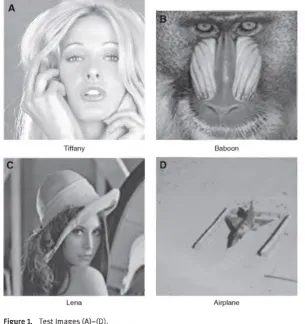
An experiment is conducted using four standard gray-scale images o f 512 x 512 pixels as cover images shown
in Figure 1, namely, Baboon, Airplane, Lena, and Tiffany. Furthermore, an arbitrary plain text that contains
all letters o f the alphabet is used as the secret message. To evaluate the quality o f the stego-image, the follow
ing peak signal-to-noise ratio (PSNR) is employed:
4 Experimental Results
6
— A.M. Ahmad et al.: Data Hiding Based on EMD and Huffman CodingDE GRUYTER
Lena Airplane
Figure 1. Test Images (A)-(D).
where MSE refers to the mean square error between two pixels.
^ _ j ([ cover(i, j ) - stego(i, j ) ] ) 2
MSE _ ^ z L J z l --- , (10)
r x c
where r and c refer to the number of rows and columns, respectively, for the cover image and stego-image.
4.1 Imperceptibility
For the purpose of a validation test between the proposed technique and various well-known methods,
namely EMD and optimized EMD, same sizes o f payload are used.
As shown in Table 1, the experimental results are divided into four parts in different sizes of payload that
are computed by bit per pixel. The embedding rate starts from the first part that utilizes full payload where
the embedding rate equals 1.599 bits per pixel (bpp) (52,400 bytes) and ends with the fourth part with 0.5
bpp (16,384 bytes). The results of the first part showed that the proposed method is superior to the rest of the
techniques in terms of both PSNR and payload viz. 55.93 dB and 1.599 bpp, respectively. However, this ratio
(1.599 bpp) is overflow for both the original EMD and optimized EMD because the maximum payload that can
be embedded for these two methods is 1.5 bpp. As shown for the second, third, and fourth part o f the results,
it is obvious that the performance of the proposed method is maintained better in terms of PSNR with the
same embedding rate, where the difference of PSNR is quite significant between the proposed method and
the second best method, which is around 4 dB when the embedding rate equals 1.5 bpp (49,152 bytes), and the
difference of PSNR is 3 and 5 dB when the embedding rate equals 1.0 bpp (32,768 bytes) and 0.5 bpp (16,384
bytes), respectively. As a result, the proposed method produces high performance capable of embedding
DE GRUYTER
A.M. Ahmad et al.: Data Hiding Based on EMD and Huffman Coding ---7
Table 1. Performance of the Proposed Method against both EMD and Optimized EMD.
Bpp
|H
Method Lena Airplane Tiffany Baboon AVG1.599 Proposed method n = 5 Opt EMD n = 2 EMD n = 2
55.92 Overflow Overflow
55.95 55.94 55.92 55.92
1.5 Proposed method n = 5 56.21 56.25 56.19 56.22 56.21
Opt EMD n = 2 52.11 52.10 52.11 52.11 52.11
EMD n = 2 52.11 52.10 52.11 52.11 52.11
1.0 Proposed method n = 5 57.99 57.02 57.98 57.99 57.99
Opt EMD n = 4 54.67 54.67 54.66 54.66 54.66
EMD n = 2 53.86 53.87 53.86 53.87 53.87
0.5 Proposed method n = 5 60.97 60.98 61.06 61.05 61.01
Opt EMD n = 9 58.37 58.36 58.36 58.38 58.37
EMD n = 2 56.88 56.89 56.88 56.89 58.89
4.2 Robustness
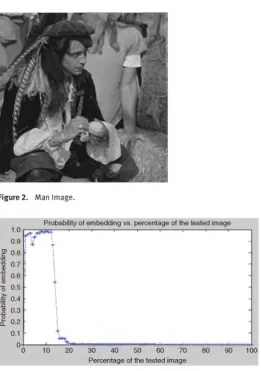
The evaluation o f robustness is done by applying the %2 attack in Figure 2. To prove that the proposed method
provides high robustness, the results should be compared with another method in the same payload and
image. Therefore, Figures 3-6 are employed to benchmark the results o f robustness.
8
--- A.M. Ahmad et al.: Data Hiding Based on EMD and Huffman CodingDE GRUYTER
Figure 4. Results for %2 Attack on Man Stego-image That Has Been Embedded by the Proposed Method Using 5-Pixel Group and Tested on 100,000 Bits of the Secret Message.
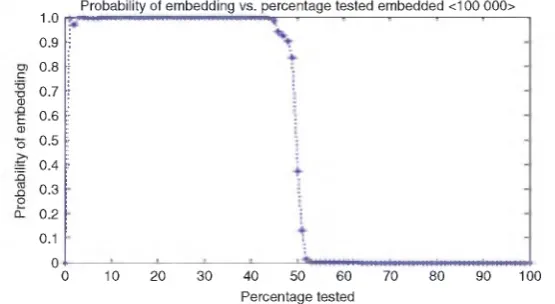
Figure 5. Results for %2 Attack on Man Stego-image That Has Been Embedded by the Original EMD Method Using 2-Pixel Group and Tested on 100,000 Bits of the Secret Message.
1.0 0.9 0.8 0.7 0.6 0.5 0.4 0.3 0.2 0.1 0
Probability of embedding vs. percentage tested embedded <100 000>
10 20 30 40 50 60 70 80 90 100 Percentage tested
Figure 6. Results for %2 Attack on Man Stego-image That Has Been Embedded by Simple LSB Method and Tested on 100,000 Bits of the Secret Message.
The proposed method is compared with the original EMD and LSB method using the same cover image
and payload. As shown in Figures 4-6, the probability of containing a hidden message in the proposed
method as well as in original EMD are almost zero except for the first 15% of the test where the probability
varies between 1 and 0.8; during this 15%, the results revealed that the proposed method is similar to the
original image (Figure 3) rather than to the original EMD. From this fact, it can be deduced that the proposed
DE GRUYTER
A.M. Ahmad et al.: Data Hiding Based on EMD and Huffman Coding ---9
method is a successful method for embedding secret messages because it does not leave clear-cut effective
when a hidden message is embedded inside the stego-image. Furthermore, the probability o f the LSB method
is almost continuously 1 until 50% o f the tested image, and this result is very different from the original image
in Figure 3; therefore, the attacker can easily detect that the image contains hidden information. Thus, as
can be clearly seen, the proposed method in Figure 4 and the original EMD in Figure 5 outperformed the LSB
method in Figure 6.
5 Conclusion
In this article, an improved EMD method and Huffman coding is proposed. The secret messages are encrypted,
compressed, and embedded in random groups inside cover images, with high secrecy but without compro
mising the quality o f the stego-images. Experimental results have revealed that the proposed method has
successfully outweighed the well-known methods in PSNR, payload, and robustness.
Bibliography
[1] E. Adelson, Digital signal encoding and decoding apparatus, United States Patent, 4 (939, 515), pp. 1-13, 1990. [2] W. Bender, D. Gruhl, M. Morimoto and A. Lu, Techniques for data hiding, IBM Systems Journal 35 (1996), 313-336. [3] M. Elarbi-Boudihir, A Rehman and T Saba, Video motion perception using optimized Gabor filter, International Journal of
Physical Sciences 6 (2011), 2799-2806.
[4] M. Emami and G. B. Sulong, A statistical method based on L2Norm technique for EISB information watermarking scheme, in: Proc. of International Conference on Future Information Technology IPCSIT, vol. 13, pp. 139-143, 2011.
[5] A. Habes, Information hiding in BMP image implementation, analysis and evaluation, Information Transmissions in Com
puter Networks 6 (2006), 1-10.
[6] L. Kai Yung, H. Wien, J. Chen, C. Tung Shou and C. Wen Chin, Data hiding by exploiting modification direction technique using optimal pixel grouping, in: Proceedings of the 2010 Education Technology and Computer (ICETC), 2010 2nd Interna tional Conference on 22-24 June 2010, V3-121-V123-123.
[7] B. A. Mehemed, T. E. A. El-Tobely, M. M. Fahmy, M. E. L. Said Nasr and M. H. A. El-Aziz, Robust digital watermarking based falling-off boundary in corners board-MSB-6 gray scale images, International Journal of Computer Science and Network
Security 9 (2009), 227-240.
[8] Z. F. Muhsin, A. Rehman, A. Altameem, T. Saba and M. Uddin, Improved quadtree image segmentation approach to region information, The Imaging Science Journal 62 (2014), 56-62.
[9] K. Neamah, D. Mohamad, T. Saba and A. Rehman, Discriminative features mining for offline handwritten signature verifica tion, 3D Research 5 (2014), DOI 10.1007/s13319-013-0002-3.
[10] S. M. Perumal and V. V. Kumar, A wavelet based digital watermarking method using thresholds on intermediate bit values,
International Journal of Computer Applications 15 (2011), 29-36.
[11] K. Rabah, Steganography: the art of hiding data, Information Technology Journal 3 (2004), 245-269.
[12] A. Rehman and T. Saba. Neural network for document image preprocessing: state of the art, Artificial Intelligence Review (2012), DOI: 10.1007/s10462-012-9337-z.
[13] A. Rehman and T. Saba, Features extraction for soccer video semantic analysis: current achievements and remaining issues, Artificial Intelligence Review 41 (2014), 451-461, DOI: 10.1007/s10462-012-9319-1.
[14] A. Rehman, S. Alqahtani, A. Altameem and T. Saba, Virtual machine security challenges: case studies, International Journal
of Machine Learning and Cybernetics (2013), DOI 10.1007/s13042-013-0166-4.
[15] T. Saba and A. Rehman, Effects of artificially intelligent tools on pattern recognition, International Journal of Machine
Learning and Cybernetics 4 (2012), 155-162, DOI: 10.1007/s13042-012-0082-z.
[16] Z. Xinpeng and W. Shuozhong, Efficient steganographic embedding by exploiting modification direction, Communications
Letters, IEEE 10 (2006), 781-783.
[17] D. Yan, R. Yang, Y. Yu and H. Xin, Blind digital image watermarking technique based on intermediate significant bit and discrete wavelet transform, in: Proceedings of the 2009 Computational Intelligence and Software Engineering, 2009, CISE 2009, International Conference on 11-13 December 2009, pp. 1-4.
[18] A. A. Zaidan, B. B. Zaidan, Y. A. Taqa, M. K. Sami, G. M. Alam and A. H. Jalab, Novel multi-cover steganography using remote sensing image and general recursion neural cryptosystem, International Journal of Physical Sciences 5 (2010), 1776-1786. [19] A. M. Zeki and A. A. Manaf, A novel digital watermarking technique based on ISB (intermediate significant bit), Interna