USING ROBOTICS IN EDUCATION : LESSONS LEARNED AND
LEARNING EXPERIENCES
Henry Goh, 1Baharuddin Aris
SMK Bahang / Bahagian Teknologi Pendidikan 89507 Penampang, Sabah
Department of Educational Multimedia,Faculty of Education, Universiti Teknologi Malaysia,
81310 Skudai, Johor [email protected]
ABSTRACT
This paper investigates the use of robotics as a vehicle for guiding secondary school students toward an effective understanding of programming and engineering principles. The students built their robots using RCX LEGO MindStorms for a competition in the Robot Transporter Event. The paper describes the lessons learned in terms of designing the robots and learning that has emerged from the students’ experiences in building and programming robots. It observes some considerations contributing to an efficient design of the robots and how students find robotics as interesting, fun, “cool”, stimulating and motivating. These conclusions arise from the observations and interviews conducted with six participating students.
INTRODUCTION
To transform the educational system will entail changing the culture and practices of Malaysia’s primary and secondary schools, moving away from memory-based learning designed for the average student to an education that stimulates thinking, creativity, and caring in all students, caters to individual abilities and learning styles, and is based on more equitable access. It will require students to exercise greater responsibility for their own education, while seeking more active participation by parents and the wider community (MOE, 1997).
In this millennium, students and teachers need to keep abreast with advancement in ICT as well as being competitive and relevant (Noraini, 2006). As mentioned in the Smart School Conceptual Blueprint (MOE, 1997), technology is used as a tool and should be integrated into the curriculum rather than be taught separately as an end in itself. It is best learned within the context of meaningful tasks. Motivation matters. Jacobsen & Jadud (2005) believe students should have fun exploring authentic tasks in constructive ways.
According to the Minister of Education, Datuk Seri Hishammuddin Hussein,
“We want our human capital to be knowledgeable, have skills that are relevant to the times and be able to compete in a globalised world. We want people with new ideas, who are critical and creative, adept at problem-solving, able to create new opportunities and adaptable to changes.
We do not want human capital that is self-centred and lacking in values. They need to be principled, respectful of differences in others, and be good and effective leaders”
(The New Straits Times, 7/1/2007)
The National Education Blueprint (Pelan Induk Pembangunan Pendidikan) 2006-2010 outlined six strategic thrusts to strengthen the national education system (Bahagian Perancangan dan Penyelidikan Dasar Pendidikan, 2006). The blueprint contains six strategic thrusts as follows:
* Developing Human Capital (Membangunkan Modal Insan)
* Strengthening National Schools (Memperkasakan Sekolah kebangsaan) * Bridging the Education Gap (Merapatkan Jurang Pendidikan)
* Enhancing the Teaching Profession (MemartabatkanProfesion Keguruan)
* Accelerating Excellence of Educational Institutions. (Melonjakkan Kecemerlangan Institusi Pendidikan)
Under the thrust - Developing Human Capital, the ministry will give attention to value systems, disciplinary aspects, character, morals and resilience of students. This is to produce students who are competent in Science and Technology, innovative and creative and marketable. Greater efforts would be made to nurture creativity and innovativeness among students; enhance learning culture; develop a science and technology culture through the development and integration of ICT; encourage lifelong learning; provide for an efficient, effective, and world-class quality education system; and promote Malaysia as a centre of educational excellence. In the 9th Malaysia Plan, the Education Ministry has introduced the F1 Technology Challenge Program and Robotic to make learning more interesting, motivating, stimulating and meaningful.
Technology opens the door to a whole new way of teched-out living (Jones, 2007). In the past decade, there has been an overwhelming surge of technology that is significantly influencing daily life (e.g. cell phones, personal computers, the Internet, i-pod ) (Beals & Bers, 2006). Children are becoming more exposed to technology - many secondary school students now carry cell phones and i-pods. It would be cool to have teched-out gadgets and robots like in the movie “The Transformers”.
Motivating and engaging students in active learning is challenging even for the most experienced teachers due to students’ different learning styles, cultural and ethnic backgrounds. Prescriptions of either a “one-size-fits-all” approach or the “cookie-cutter” approach do not necessarily gear them towards achieving high standards (Education Technology Division, 2006). Therefore, the primary role of teaching is not to lecture, explain, or otherwise attempt to “transfer” knowledge, but to create situations for students that will enable mental constructions.
BACKGROUND OF THE STUDY
The Lego Mindstorms for Schools series’ vision is to provide a powerful learning platform to enable students to cope with skills that are essential for success in the 21st century while its mission is to strengthen important problem-solving and social skills that are critical for success in further studies and further careers. These skills include problem solving, creative thinking, interpersonal communication and collaborative teamwork skills.
Robotics is a popular and effective way for teachers as a teaching tool for introducing students to important areas of Science, Technology, Engineering and Maths curricula (Johnson, 2003 & Perteet, 2005). Children can learn more about the real world by working with robots (Nalajala, 2003). Learning through designing, building and operating robots can lead to the acquisition of knowledge and skills in high-tech electrical, mechanical, and computer engineering areas that are in high demand in industry. It can promote development of systems thinking, problem solving, self-study, and teamwork skills. Involvement of students in a robot contest can offer additional educational benefits (Johnson, 2003 & Verner & Ahlgren, 2004).
The Lego Mindstorms for Schools series is tailor-made for classroom and after-school club use. It includes construction sets, programming tools and activity packs. It covers the following curriculum areas :
• Science : investigating energy, forces and speed
• Technology : programming and controlling input and output devices
• Engineering : developing solutions, selecting, building, testing and evaluating
The LEGO Mindstorms robot is truly a plug-and-play robot. Students do not have to design circuits, or even solder components to the robots. With Lego Mindstorms for schools, students get to grips with techniques that are used in the real world of science, engineering and design. They design, build and program fully functional models. Robot competitions present numerous successful examples of robot systems developed by students (Verner & Ahlgren, 2004). The purpose of the robotic program is not necessary to teach students to become extraordinary robotics expert but rather to engage and compel them to learn, among other things about values, communication, teamwork, science, mathematics and engineering, to behave as young scientists, carrying out simple investigations, calculating and measuring behaviours, and recording and presenting their results.
PROBLEM STATEMENT
The problem addressed in this study was whether students’ participation in the eight-week challenge of the robotics competition had an effect on secondary school students’ interest in science, mathematics, engineering, and technology and motivation towards learning in science, mathematics, engineering, and technology. This study was conducted to determine whether students’ participation in the robotics competition had an effect on their social skills and teamwork.
OBJECTIVES OF THE STUDY
The objective of this study is to examine and review the learning journey, through designing robots in the competition framework required, focusing on two aspects :
• Lessons learned in engineering knowledge and skills in designing robots
• Learning motivation and experiences while facing the challenges of the robot contest.
PROJECT IMPLEMENTATION The Hardware
The Mindstorms Robotics Invention System (RIS) manufactured by Lego in Denmark was developed and released in the late 1990s (Chiou, 2004). The contents of the kit are an assortment of approximately 700 pieces of building blocks, gears, wheels, tyres, pins, racks, brackets, electric motors, sensors, microswitches, electrical cables and other parts necessary to build a fully functional educational robot. At the heart of the RIS set is the RCX, a programmable ‘smart brick’ package in a similar look-a-like design to Lego’s familiar building blocks. The RCX Brick as shown in Figure 1 has an embedded Hitachi H8 microcontroller.
Figure 1 : The RCX Brick
The Software
Figure 2 : The RoboLab Software
The Rules
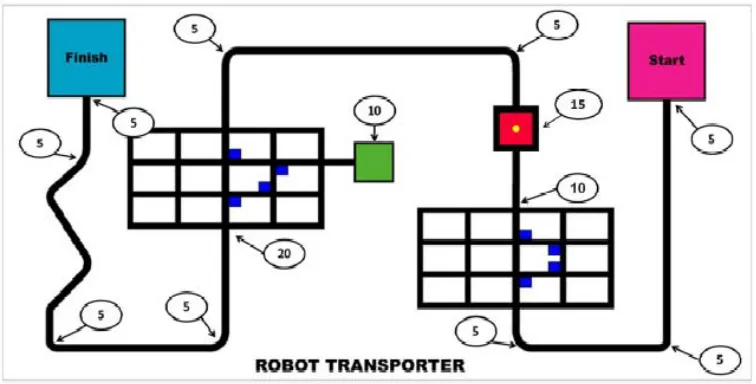
Robot competitions present numerous successful examples of robot systems developed by students. The students participated in the RCX category for Upper Secondary School in the Robot Transporter Event. The students design and build autonomous robots and program them to perform assignments defined by contest rules, while the scoring is based on robot performance. The objective of the game is to design an autonomous robot that can follow the track line from the Start Box, turn or cross at the intersection according to the traffic lights represented by the colour patches, pick-up a can in the loading area, and then unload it in the unloading area before arriving at the Finish Box. If the mission is completed within the time limit, the team that is the fastest (with the shortest time taken) is the winner. The Competition Field with Check-Points for Robot Transporter Event is shown in Figure 3.
The Students
This study included six students from SMK Bahang, Penampang, Sabah. These students were chosen based on their performance in their classroom, particularly in Mathematics and Physics. During the eight-week period of the study, prior to participating in the Lego Mindstorms Competition 2007, students were involved in designing, developing, and producing robots in groups.
Figure 3 : The Competition Field with Check-Points for Robot Transporter event
FINDINGS
a) Lessons Learned
i) The Design
• The many analog components in a robot, such as sensors and motors;
• The batteries driving a robot, and their level of charge; and
• The mechanical design of the robot
The following are some considerations that can cause problem of unpredictable robots:
• Bigger wheels should be avoided as they generate more friction and adversely affect turning and motion, especially as the batteries discharge.
• Three-wheel design should be avoided, especially with a swivel wheel, as it makes turning unpredictable and may even caused the robot to be declared as “miss-tracking”. Two wheels and a stub should also be avoided, as the stub generates additional friction as it drags the playing field and may slow down the robot. A four-wheel design was favoured as it was more stable and reliable.
• The load/weight of the robot should also be balanced on the front and rear wheels to avoid skateboard effect. Apart from that, a heavier weight would obviously effect the time taken to complete the course.
• Light sensors should be mounted as close to the ground as possible. The sensor should always be calibrated and adjusted according to light intensity.
• Gears used should be compromised between lower and higher gears. b) Learning Experiences
i) Self-directed and initiative
From the very first day after being given an introductory course by the trainers from the company, all of the students stayed extra hours and held additional meetings in the laboratory beyond the time formally assigned for project guidance. On their own initiative, the students even worked through the school holidays with minimal supervision. An analysis of transcripts revealed some important threads. Students perceived many advantages and strengths of using robots. Words like “interesting”, “fun”, challenging”, “relevant” kept recurring in the discussion.
ii) Curiosity and motivation in inquiring about project-related subjects
During the project, the students managed informal consultations with their teachers of physics (in robot design) and mathematics (sensor calibration). They conducted extensive Web searches on robot navigation algorithms, sensors, and mobile robots. A few online resources which were visited were :
http://www.sasbadi.com/legoindex.htm http://www.lego.com
http://www.extremenxt.com/lego.htm
One particular student even viewed blogs covering development and information related to the Mindstorms robotics platform and downloaded movies on robots from the popular video-sharing site “You-Tube”. In addition to viewing these video clips students become naturally motivated to analyze design of opponents, and reflect these design to improve their own design.
iii) Concentrating on solving project-related problems and working together
From the observations and interview, the students reported learning from building robots. On the whole, students were deeply involved in the robotics problems and continually discussed them during the project. It was observed that a number of discussions in the work areas were undertaken in which children shared and compared programming codes, explained techniques, and showed each other useful representations, and working out actions associated with different sensor inputs and different robot designs to obtain an optimized kinematic scheme.
iv) Attitudes toward technology
It was observed that a lot of patience and discipline was needed in building a good robot. Students’ attitude towards technology changed after students participating in the robot education program. The students who participated in the program did not have a strong technological background initially other than the lessons they learnt in Physics. After completion, students were confident and interested in the engineering field and profession in technology and became more interested in learning more about operating technological systems. One student said, “ I feel confident now and very interested to choose engineering as a profession in future”.
v) Feelings of empathy toward the robot
Some studies (Sterling & Gaertner in Tapus & Mataric, 2007) have shown a positive correlation between empathy and physiological in-dices (e.g., heart rate accelaration, palm sweating). These physiological responses can also be used by the robot as a significant source of sensory information for real time interaction and emphatic response. An adaptive, reliable, user-friendly and empathic hands-off therapist robot can establish a complex and productive human-robot relationship that provides an engaging and motivating customized therapy protocol to participants in laboratory, clinic, and ultimately, home environments (Tapus & Mataric, 2007). Empathic interaction with synthetic characters enables users to build and maintain an emotional involvement that can result in stimulating novel interactions (Hall & Woods, 2005).
During the observations, it was found that students often performed character conversations with the robots, feeling happy, sad and angry towards the robots and categorizing the robots with gender by its outward appearance. For example, one of the students mentioned : "The robot is too tired today.", when the robot was not performing to expectations.
SUGGESTIONS
Robots have great potential for sound pedagogic reasons within education at all levels. They provide particular opportunities for making accessible, for a wide range of disabled students, practical elements of the curriculum. However, the available technology is largely under exploited except by teacher enthusiasts in isolated pioneering centres (Cooper et al. 1999). There are several possible directions that can be explored :
• To make available low cost robots and associated software in as many schools as possible
• To raise awareness within the teaching professions as to the potential of robot technology
• Incorporating robotics in vocational and academic education. If robotics is to fulfill its education potential, is essential that it be explicitly integrated with the national curriculum.
CONCLUSION
The problem of building an autonomous robot also engages the issues of real-world problem solving, multidisciplinary teamwork, and creative and critical thinking. Building an actual robot, rather than programming a simulation, requires students to immediately confront the non-ideality of real-world devices, and provides immediate feedback about the success or failure of their ideas. By having students work in teams, the course encourages them to pool their individual expertise, allows them to specialize on specific subtasks, and gives them experience in developing the interpersonal skills to articulate and defend their views, but ultimately reach a consensus that is best for the group as a whole.
project-based learning, can draw students into learning underlying principles. Project-based learning is seen as holistic in nature and incorporates the principles of providing challenging and complex work, interdisciplinary and encourages cooperative learning (Education Technology Division, 2006).
Acknowledgements
Special thanks to the principal of SMK Bahang, Penampang, Sabah, Pn. A. Junaidah Yusuppu, for this work would of course not be possible without her gracious support and motivation. We also thank the mentors of the teams, Lee Lee Khen, Ong Joo Lian & Lester Wen Lundoh for running this program with such great dedication and perseverance. Gratitude also to all the six students who participated in the program, Ashwin, Dennie, Edwin, James, Jeffrey and Simon.
“LEGO Mindstorms” and “RCX” are trademarks of the LEGO Group, which does not sponsor, authorize, or endorse any of the third-party work cited in this article. The authors of this article do not have any financial relationship with the LEGO Group.
Any opinions, findings, and conclusions or recommendations expressed in this material are those of the authors and do not necessarily reflect the views of any organization, institution or body.
REFERENCES
Ahlgren, D.J. (2001). Fire-Fighting Robots and First-Year Engineering Design: Trinity College Experience. Proceedings : ASEE / IEEE Frontiers in Education Conference, Oct 10-13, Reno, NY.
Bahagian Perancangan dan Penyelidikan Dasar Pendidikan. (2006). Rancangan Malaysia Ke-9 : Pelan Induk Pembangunan Pendidikan, 2006-2010. Putrajaya, Malaysia : Kementerian Pelajaran Malaysia.
Beals, L. & Bers, M. (2006). Robotic Technologies : When Parents Put Their Learning Ahead of Their Child’s. Journal of Interactive Learning Research. 17 (4), 341- 366.
Beer, R.D., Chiel, H.J. & Drushel, R.F. (1999). Autonomous Robotics to Teach Science and Engineering. Communications of The ACM, 42 (6), 85-92.
Chiou, A.(2004). Teaching Technology Using Educational Robotics. UniServe Science Scholarly Inquiry Symposium Proceedings. 9-14 , 'Scholarly Inquiry into Science Teaching and Learning'
Cooper, M., Keating,D., Harwin, W. & Dautenhahn, K. (1999). Robots in the Classroom – Tools for Accessible Education. Proc. AAATE Conference , The 5th European Conference for the Advancement of Assistive Technology, Düsseldorf/Germany. Retrieved 15 August 2007 from
http://www.andrew.cmu.edu/user/fduvalle/robo_ed/robots_accessible_education.pdf. Education Technology Division (2006). Project-Based Learning Handbook. Putrajaya,
Malaysia : Ministry of Education.
Halls,L. & Woods, S. (2005). Empathic Interaction with Synthetic Characters: The Importance of Similarity. Retrieved 16 August 2007 from
http://www.macs.hw.ac.uk/EcircusWeb/Publications/Cross/hall_woods_encychci.pdf. Jacobsen, C. L. & Jadud, M.C. (2005). Towards Concrete Concurrency : occam-pi on the
LEGO Mindstorms. SIGSE,
Johnson, J. (2003). Children, Robotics and Education. Artif Life Robotics.,7, 16-21 Jones, K. (2007). Ideas for Integrating Technology Education into Everyday Learning
Technology and Children. 11 (4).19-20
Mataric, M.J. (2004). Robotics Education for All Ages. Proceedings, AAAI Spring Symposium on Accessible, Hands-on AI and Robotics Education, Palo Alto, CA, Mar 22-24, 2004. Ministry of Education. (1997). Smart School Flagship Application : The Malaysian Smart
School : A Conceptual Blueprint. Kuala Lumpur : Government of Malaysia.
Nalajala, T.D. (2003). Internet Telerobotic System. Unpublished Master’s Thesis, University of Nevada, Reno.
Perteet, B. (2005). A Multi-Vehicle Framework for the Development of Robotic Games : The Marco Polo Case. Unpublished Master’s Thesis, Oklahoma State University, Stillwater.
Tapus, A. & Mataric, M.J.(2007). Emulating Empathy in Socially Assistive Robotics. American Association for Artificial Intelligence. Online
http://cres.usc.edu/pubdb_html/files_upload/533.pdf. Access on 16 August 2007. The New Straits Times (2007).7/1/2007