AN APPLICATION OF THE SSHAC LEVEL 3 PROCESS TO THE
PROBABILISTIC SEISMIC HAZARD ANALYSIS FOR NUCLEAR
FACILITIES AT THE HANFORD SITE, EASTERN WASHINGTON, USA
Kevin J Coppersmith1, Julian J Bommer2, Robert W. Bryce3, Stephen McDuffie4, and Greg A. Lisle5
1 President, Coppersmith Consulting Inc., Walnut Creek, CA, USA
2 Professor, Dept. of Civil Engineering, Imperial College London, SW7 2AZ, UK 3 Project Manager, Pacific Northwest National Laboratory, Richland, WA
4 Office of the Chief of Nuclear Safety, US Department of Energy, Richland, WA 5 Energy Northwest, Richland, WA
ABSTRACT
Under the sponsorship of the US Department of Energy (DOE) and the electric utility Energy Northwest (owner of Columbia Generating Station, CGS), the Pacific Northwest National Laboratory (PNNL) is conducting a PSHA within the framework of a SSHAC Level 3 procedure. Specifically, the project is being conducted following the guidelines and requirements specified in NUREG-2117 (USNRC, 2012b) and the American Nuclear Standard ANSI/ANS-2.29-2008 Probabilistic Seismic Hazard Analysis. The collaboration is spawned by the needs of both organizations for an accepted PSHA with high levels of regulatory assurance that can be used for the design and safety evaluation of nuclear facilities. DOE committed to this study after performing a ten-year review of the existing PSHA, as required by DOE Order 420.1C. The study will also be used by Energy Northwest as a basis for fulfilling the NRC’s 10CFR50.54(f) requirement that the western US nuclear power plants conduct PSHAs in conformance with SSHAC Level 3 procedures. The study was planned and is being carried out in conjunction with a project Work Plan, which identifies the purpose of the study, the roles and responsibilities of all participants, tasks and their associated schedules, Quality Assurance (QA) requirements, and project deliverables. New data collection and analysis activities are being conducted as a means of reducing the uncertainties in key inputs to the PSHA. It is anticipated that the results of the study will provide inputs to the site response analyses at multiple nuclear facility sites within the Hanford Site and at CGS.
INTRODUCTION
The Hanford probabilistic seismic hazard analysis (PSHA) represents an unusual collaboration between public and private sector sponsors with common needs: a high-quality site-specific PSHA conducted using SSHAC Level 3 (Senior Seismic Hazard Analysis Committee; Budnitz at et al., 1997) processes that can be used to evaluate the seismic safety of existing nuclear facilities and to develop seismic design bases for new facilities. The Hanford Site is a large site covering 1,518 km2 that includes
Figure 1. Map showing the Hanford DOE Site (yellow boundary) and the facility sites (red dots) where the seismic hazard will be calculated. The WTP lies near Site A and Site C is the location of the
Columbia Generating Station.
DOE Order 420.1C, Chapter IV (3)(d)(1-2) provides Review and Upgrade Requirements for Existing DOE Facilities: “(1) Existing facility or site NPH assessments must be reviewed at least every 10 years for any significant changes in data, criteria, and assessment methods that would warrant updating the assessments. Section 9.2 of DOE-STD-1020-2012 contains criteria and guidance for performing these reviews.” The applicable section of DOE-STD-1020-2012 provides the specification of the criteria for evaluating whether or not an existing hazard study is worthy of continued use: “9.2.4 In the case of seismic hazard assessments, a determination of whether an existing assessment remains adequate for future use should consider the criteria in Section 4.1 of ANSI/ANS-2.29-2008 for the suitability of existing studies. Additional guidance on the bases for updating existing seismic assessments can be obtained from NUREG-2117, Practical Implementation Guidelines for SSHAC Level 3 and 4 Hazard Studies.”
Energy Northwest’s Columbia Generating Station (CGS) lies within the Hanford Site (Figure 1). Site characterization and evaluation of seismic hazard was conducted in association with licensing of the plant in the early 1980s. Along with the other three nuclear power plants in the western US, the CGS plant is required to conduct a SSHAC Level 3 PSHA as part of the NRC’s 50.54(f) Recommendation 2.1: Seismic letter in response to the Near-Term Task Force review of insights from the Fukushima Daiichi accident. With the decision to conduct the Hanford SSHAC Level 3 PSHA made and the initial planning already completed, Energy Northwest reached agreement with DOE to co-sponsor the study. Adjustments were made to the Work Plan to ensure that all applicable NRC-related guidance would be addressed and that the schedule would specifically accommodate the need for the development of site-specific ground motions at the CGS site (i.e., providing sufficient time for site characterization and site response analyses following completion of the PSHA) to meet the requirement for a submittal to the NRC by March 2015.
Figure 2. Faults of the Yakima Fold Belt in the Hanford Site region.
and low velocity layers.
The Yakima Fold Belt (Figure 2) includes the western and central parts of the Columbia Basin and consists of a series of anticlinal ridges and synclinal valleys with northwest to southeast structural trends. Much of the deformation associated with these structures occurred during the deposition of the CRBG basalts, but the seismogenic potential of the structures in the Yakima Fold Belt is a matter of continuing debate.PROJECT WORK PLAN
A key part of the planning process for the Hanford PSHA was the development of a project Work Plan, which began more than two years prior to the initiation of the project to assist DOE management in programmatic and financial planning. As the project kick-off approached and again just following project initiation, the Work Plan was revised and updated to reflect the detailed activities and schedules for the project. The purpose of the Work Plan is to provide every participant in the project, as well as any observers of the project, a single point of reference that identifies the overall framework for the execution of the project. The activities in the Work Plan are consistent with the essential steps in a SSHAC Level 3 project given in the latest guidance in NUREG-2117 (USNRC, 2012b). The Work Plan for the Hanford PSHA includes the overall scope of the project within the framework of a SSHAC Level 3 process, definition of the roles and responsibilities of all participants, descriptions of the key tasks to be executed, the overall project schedule, summary of the technical deliverables, description of technical risks associated with the project and planned mitigation efforts, and the detailed project schedule. Some topics of the Work Plan are summarized here to illustrate important elements of the study.
Scope of the Hanford PSHA Project
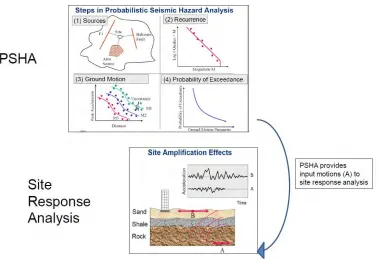
The Hanford PSHA is exclusively focused on the hazard associated with vibratory ground motions for reference site conditions at facility sites within the Hanford Site, including the CGS plant site. The products of a PSHA include seismic hazard curves, uniform hazard spectra, and other products that serve as the input to site-specific ground motion site response analyses at a particular facility site. The relationship between PSHA, such as that being conducted for this study, and site response analyses is shown diagrammatically in Figure 3. A PSHA includes an SSC model that defines the locations, magnitudes, and recurrence rates of future earthquakes; and a GMC model that expresses the variation in ground motion amplitude as a function of distance, magnitude, and other factors. A fundamental outcome of a PSHA is a distribution of seismic hazard curves that express the annual frequency of exceeding different levels of ground motion. Seismic hazard is given at particular locations for a given reference site condition (e.g., reference rock location and average shear-wave velocity). In order for the hazard results to be used for purposes of design or safety review of a particular engineered structure, the site-specific properties of the rock/soil directly beneath the facility must be assessed and site response analyses conducted. The site response analyses use the ground motions from the PSHA as input at the location of the reference rock and the motions are modified as they move through the site profile.
hazard results for these reference conditions can then be input to the site response model developed for each facility site to obtain design ground motions at the surface.
Figure 3. Simplified diagram illustrating the important components of a PSHA and of site response analysis. The Hanford PSHA will perform a PSHA and will result in seismic hazard curves and other deliverables at identified sites. For application at particular facility sites for design or safety review purposes, site characterization and site response analysis will be required in order to arrive at site-specific
ground motions.
Project Roles and Responsibilities
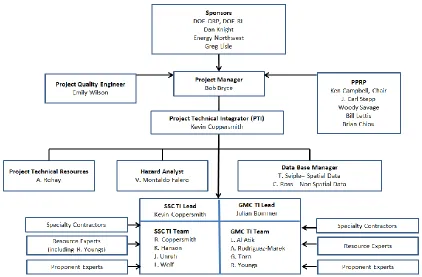
The roles and responsibilities of the different participants in the Hanford PSHA project are defined in the Work Plan, illustrating how their contributions fit into the overall process. Figure 4 presents the organizational structure for the Hanford PSHA Project. The Work Plan describes the nature and timing of the project participant interactions. Where appropriate, the necessary attributes of individuals assigned to certain roles are specified, since these define the criteria used to select the project participants. The descriptions of roles and responsibilities are consistent with those defined in the SSHAC implementation guidance (USNRC, 2012b). As a result, reference can then be made to this section of the Work Plan to identify the responsibilities and duties that correspond to each SSHAC-specific role, which can then be identified in each participant’s contract.
As shown in the diagram in Bommer and Coppersmith (2013; Figure 3), the different participant groups are identified and the duration of their participation is indicated. Some of the participants are engaged throughout the entire project, such as the Technical Integration (TI) Teams and the Participatory Peer Review Panel (PPRP), whereas others only participate during the earlier phases of the project or, in the case of Proponent Experts and some Resource Experts, at a single workshop.
Energy Northwest. However, the above quote from the SSHAC Guidelines refers to intellectual ownership, which in this context means taking responsibility for the technical evaluations, and providing defense and justification of the technical bases for these evaluations, and the integrated distribution that is finally used as input to the hazard calculations. This ownership resides exclusively with the Project Technical Integrator (PTI), TI Team Leads, and the TI Teams.
Figure 4. Organizational structure for the Hanford PSHA Project.
Project Schedule
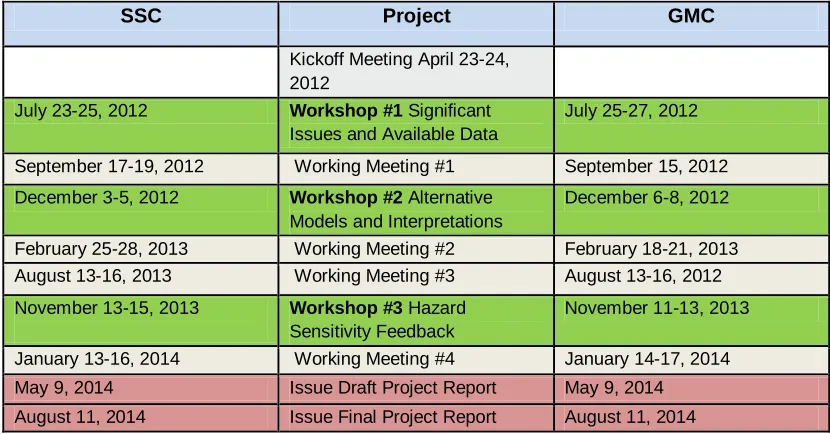
The tasks and activities given in the Hanford PSHA Work Plan are consistent with the NRC guidance, including thedescription of the essential steps given in NUREG-2117 (USNRC, 2012b). The tasks follow the SSHAC Level 3 logic flow described in Bommer and Coppersmith (2013) and a detailed work breakdown and schedule for the project is provided in the Work Plan, including technical subtasks and supplementary administrative tasks.
Table 1. Schedule for the Hanford PSHA Project.
SSC Project GMC
Kickoff Meeting April 23-24, 2012
July 23-25, 2012 Workshop #1 Significant Issues and Available Data
July 25-27, 2012
September 17-19, 2012 Working Meeting #1 September 15, 2012
December 3-5, 2012 Workshop #2 Alternative Models and Interpretations
December 6-8, 2012
February 25-28, 2013 Working Meeting #2 February 18-21, 2013 August 13-16, 2013 Working Meeting #3 August 13-16, 2012
November 13-15, 2013 Workshop #3 Hazard Sensitivity Feedback
November 11-13, 2013
January 13-16, 2014 Working Meeting #4 January 14-17, 2014
May 9, 2014 Issue Draft Project Report May 9, 2014
August 11, 2014 Issue Final Project Report August 11, 2014
Project Quality Assurance
Analyses and processes that are used for the design or safety assessment of nuclear facilities are typically governed by QA programs. The Hanford SSHAC Level 3 PSHA coupled with the site response analysis will be used to evaluate the seismic design basis ground motions at existing facility sites and may be used to develop design basis ground motions for future facilities within the DOE Site. Accordingly, the study is being conducted for the DOE nuclear facility sites according to a Project Quality Assurance Plan (PQAP) that is designed to meet the requirements of ANSI/ASME NQA-1-2008 Quality Assurance Requirements for Nuclear Facility Applications. The PQAP includes the scope, client, authorizing document, QA requirement specifications, QA program/organization, and requirements. The implementing procedures for the PQAP includes procedures developed by PNNL, augmented by project-specific procedures, as required. PNNL procedures include the procedure for computer code qualification, which is being applied to the seismic hazard code. Project-specific procedures include one to implement a SSHAC Study Level 3 process, which is consistent with the American Nuclear Standard ANSI/ANS-2.29-2008 Probabilistic Seismic Hazard Analysis. That Standard was developed to be consistent with NQA-1 and refers specifically to the SSHAC process as being acceptable for obtaining seismic design inputs. The PQAP was approved by DOE prior to the conduct of any quality-affecting work on the Hanford PSHA and, as necessary, will be updated during the course of the project to address any changes in the project Work Plan. For the CGS site, the work is being conducted according to the NRC guidance given in NUREG-2117, Section 5.17 Quality Assurance.
Compilation and Evaluation of Available Data
Compiling and evaluating existing data both for SSC and GMC is an important activity during the
agencies, and other hazard studies. This can include geologic, geophysical, and geotechnical data related to site conditions throughout the Hanford site. It is assumed that as a “site-wide” PSHA, the results can be used as a basis for subsequent site-specific application at selected facility locations. It should be noted that the database development activity continues throughout the preliminary SSC and GMC model-building integration phase of the project. As part of the data evaluation activity, Resource Experts with detailed knowledge of specific datasets and Proponent Experts for particular models presented their points of view at Workshops #1 and #2. As the project progresses and the model-building process proceeds, the database development activity will include preparation of derivative maps and products that are directly applicable to the PSHA (e.g., seismicity maps). Additional analyses may also be necessary to provide the information that the TI Teams need for their evaluations.
Documentation of the evaluation process is important and is being conducted differently by the SSC and the GMC TI Teams in the Hanford PSHA. The SSC Team has adopted the use of Data Evaluation and Data Summary tables, which were first brought into general use as part of the Central and Eastern U.S. Seismic Source Characterization project (NUREG-2115, USNRC, 2012a). The Data Summary tables include every data source that is evaluated and, at a minimum, provide a summary of the contents of the source and its potential relevance to seismic source characterization. Those data sources that are used directly in the development of the SSC model are included in Data Evaluation tables that describe the elements of the SSC model to which the data have been applied, the quality of the data, its relevance, and the degree of reliance that has been placed on each dataset. The GMC Team has chosen to document their evaluation process using a series of “white papers,” as was done during the course of the Thyspunt SSHAC Level 3 PSHA (Bommer et al., 2013). Each white paper is focused on a particular GMC issue (e.g., single-station sigma) and includes a complete technical description of the issue, the potential implications to the GMC model, the alternative points of view and models that have been proposed in the community, and the proposed approach that the Team will use to address the issue and incorporate the associated uncertainties. In the same way that the data tables provide an inventory of the data, models, and methods that were considered, the white papers do this as well along with documentation of all data sources considered.
FOCUSED DATA COLLECTION AND ANALYSIS ACTIVITIES
A key part of the SSHAC Level 3 process is the early identification of technical issues that have the most significance to the hazard at the site. This information can then be used to identify the available data that can best address the most significant technical issues. The information can also be used to identify new data collection and analysis activities that have the potential to reduce uncertainties in key inputs to the PSHA. Several new data collection and analysis activities were identified by the TI Teams by virtue of their value in reducing uncertainties in key inputs to the PSHA. The activities were identified as a result of issues and data discussed at Workshop #1including sensitivity analysis designed to identify hazard-significant issues, and were prioritized according to their uncertainty-reduction potential versus their associated costs and duration. The focused data collection activities are limited in duration and they are being conducted to provide timely inputs to support the development of the SSC and GMC models. Activities identified to supplement existing data include the following:
SSC-Related Activities
Field mapping, geomorphic analyses, and structural geologic analysis to support the interpretations of the geometry and timing of deformation within the Yakima Fold Belt. Particular emphasis is being given to the analyses for Rattlesnake Mountain, which is the largest and closest fold to the Hanford facility sites. These analyses provide a screening of the folds for subsequent analyses in the Quaternary geologic studies.
associated with each fold. The QGS includes field mapping to identify key geomorphic surfaces and deposits, tectonic geomorphic analyses using LiDAR and high-resolution digital elevation models, and other geologic analyses to assess the locations, timing, and rates of post-Columbia River Basalt deformation. Structural analyses will also provide information related to the down-dip geometry of faults.
High-resolution reprocessing of seismicity data to assess three-dimensional earthquake locations, focal mechanisms, and other characteristics. This task involves identifying the highest-quality, best-resolved earthquakes in the catalog and reprocessing the records using multiple relocation and tomographic techniques.
GMC-Related Activities
Development of Vs profiles for Hanford based on Spectral Analysis of Surface Waves
measurements at HAWA (a seismograph located on basalt on the flank of Rattlesnake Mt.) and other recording sites at Hanford. These data will be used to develop Vs-kappa
adjustments to the ground-motion prediction equations to properly account for the conditions at the Hanford Site.
Analysis of available strong-motion and seismograph recordings on the Hanford site to better constrain kappa values to be used in the GMC evaluations.
Investigation of possible basin effects on ground motions using the modeling approach developed by the U.S. Geological Survey. The possible effects of both the Tertiary sedimentary basin lying beneath the Columbia River Basalts as well as the near-surface sediments lying above the basalts will be evaluated.
Assessment of the presence of deep and shallow basin effects based on an analysis of displacement traces of ground-motion recordings from the Pasco basin (this task complements the basin modeling listed above).
CONCLUSION AND PATH FORWARD
At the time of writing this paper, the Hanford SSHAC Level 3 PSHA is well underway and on track for successful completion in August 2014. From the beginning, the planning for the project has been controlled by a project Work Plan that ensures compliance with applicable NRC guidance and ANS standards for the conduct of SSHAC Level 3 projects, makes clear the roles and responsibilities of all participants, specifies the project tasks and their associated schedules, identifies the PQAP that governs both the PSHA activities as well as new data collection and analysis activities, and defines the project deliverables. Following the SSHAC Level 3 process, Workshops #1 and #2 assisted in the identification and evaluation of data, models, and methods that have been proposed by the larger technical community. Resource and Proponent Experts at those workshops provided their specific knowledge and viewpoints regarding key technical issues. Working Meetings #1 and #2 were conducted with the specific purpose of identifying applicable data to address hazard-significant issues, and defining strategies and approaches to address the key SSC and GMC issues within the context of preliminary models for the PSHA. Following a participatory peer review process, the PPRP has closely followed the project and has provided their written review comments following the first two workshops. Their comments provide valuable independent perspectives to the TI Leads, which results in continual improvement of the project as it evolves. A series of new data collection and analysis activities has been initiated, whose specific purpose is to reduce uncertainties in key SSC and GMC inputs. The results of those studies will be made available during the next several months and will provide information to inform the construction of the preliminary SSC and GMC models prior to Workshop #3 and the subsequent finalization of the models.
probability of faults, constraints on deformation rates derived from paleoseismic constraints, single-station sigma, selection and characterization of reference rock horizon for development of GMC models) for discussion amongst the team members. New data collection efforts will continue and the results of those studies will inform the model-building process (e.g., evidence for Quaternary deformation and fault slip rates, high-resolution earthquake hypocenter locations and focal mechanisms, constraints on kappa values and the Vs-kappa adjustments to ground-motion prediction equations, evidence for ground motion
amplification from basin effects). In association with Working Meeting #3, the TI Teams will develop preliminary SSC and GMC models in ample time for hazard calculations to be conducted prior to Workshop #3. That workshop will focus on feedback; both the feedback from the hazard calculations, which will provide insights into the relative significance of various elements of the SSC and GMC models, as well as feedback from the PPRP, who will be free to ask questions about the preliminary models and their technical bases. In light of that feedback, the TI Teams will finalize the SSC and GMC models during Working Meeting #4, and the models will be used for final hazard calculations. The documentation phase of the project will then proceed, which will include the written review by the PPRP of the Draft Report, and culminating in delivery of the Final Project Report to the sponsors on August 11, 2014.
ACKNOWLEDGMENTS
The ongoing success of the Hanford PSHA is the result of the hard work and dedication of a large number of people. As representatives of the sponsors, project management team, and technical leadership, the authors thank the numerous Resource and Proponent experts who provided their insights at Workshops #1 and #2. Alan Rohay at PNNL has provided invaluable data and insights from three decades of work on the seismicity and strong motion data at Hanford. Charla Saranovich from PNNL devoted countless hours to organizing the workshops and solving all logistical issues. Ryan Coppersmith developed Figure 2. As we move into the hazard calculation and documentation phases of the project, we will undoubtedly expand the list of individuals to acknowledge and to whom this paper is dedicated.
REFERENCES
Bommer, J.J. and Coppersmith, K.J. (2013). “Lessons learned from applications of the NUREG-2117 guidelines for SSHAC Level 3 probabilistic seismic hazard studies for nuclear sites”, Proc., 22nd Structural Mechanics in Reactor Technology (SMiRT-22) Conference, San Francisco, this volume. Bommer, J.J., Coppersmith, K.J., Hattingh, E. and Nel, A.P. (2013). “An application of the SSHAC Level
3 process to the probabilistic seismic hazard assessment for the Thyspunt nuclear site in South Africa”, Proc., 22nd Structural Mechanics in Reactor Technology (SMiRT-22) Conference, San
Francisco, this volume.
Budnitz, R.J., Apostolakis, G., Boore, D.M., Cluff, L.S., Coppersmith, K.J., Cornell, C.A. and Morris, P.A. (1997). “Recommendations for Probabilistic Seismic Hazard Analysis: Guidance on Uncertainty and the Use of Experts”, NUREG/CR-6372, US Nuclear Regulatory Commission, Washington D.C., USA.
DOE ORDER 420.1C, Subject: Facility Safety; U.S. Department of Energy, Washington, D.C., approved 12-4-2012.
DOE-STD-1020-2012. “Natural Phenomena Hazards Analysis and Design Criteria for DOE Facilities.” U.S. Department of Energy, Washington, D.C., December 2012.
Tallman A.M. (1996). “Probabilistic Seismic Hazard Analysis, DOE Hanford Site, Washington.” WHC-SD-W236A-TI-002, Rev. 1. Westinghouse Hanford Company, Richland, WA.
USNRC (2012a). “Central and Eastern United States Seismic Source Characterization for Nuclear Facilities”, NUREG-2115, US Nuclear Regulatory Commission, Washington D.C., USA.
USNRC (2012b). “Practical Implementation Guidelines for SSHAC Level 3 and 4 Hazard Studies”,