Interaction between Structural Changes in Machine
Translation
Satoshi KINOSHITA, John PHILLIPS, Jun-ichi TSUJII
C e n t r e f o r C o m p u t a t i o n a l L i n g u i s t i c s
U n i v e r s i t y o f M a n c h e s t e r I n s t i t u t e o f S c i e n c e a n d T e c h n o l o g y
PO Box 88, Manchester M60 1QD, United Kingdom
A B S T R A C T
This paper discusses complex structural changes dur- ing transfer within a non-destructive transfer framework. Though the description of each individual structural change is not difficult, special provision must be made when they are combined, because interaction between them sometimes causes unexpected problems. Transfer of coordinate struc- tures is also discussed as this often necessitates a structural change and interacts with other structural changes in a prob- lematic way.
1. I n t r o d u c t i o n
Several focal issues have emerged in machine translation (MT) research as the result of recent intensive studies in the field. T h a t is,
• Declarative Frameworks for expressing Bi-lingual Knowledge
• Integration of Knowledge-based Processing and Contextual Processing with the Translation Process
• Effective Exploitation of D o m a i n / T e x t T y p e Speci- ficity (or Sublanguageness) in M T and Discovery Processes for such Specificities
T h o u g h new frameworks of M T such as Statistics-based M T (SBMT), E x a m p l e - b a s e d M T ( E B M T ) , Analogy- based M T (ABMT), Knowledge-based M T ( K B M T ) etc. look radically different from conventional linguistic- based M T (LBMT) such as Transfer-based, they address one or two of the above focal issues and ignore the rest [7] [9]. In particular, the new p a r a d i g m s of M T tend to ignore the first issue ie. declarative representation of bi-lingual knowledge and the complexities involved n the process of combining units of bi-lingual knowledge.
It is our contention t h a t any M T system, whichever p a r a d i g m it belongs to, has to store a set of translation- equivalent units for a pair of languages and combine these to produce larger units of translation. In E B M T , for example, a set of translation examples has to be stored and several of t h e m have to be combined prop- erly to produce translation. Because of the declarative
nature of translation examples, E B M T inevitably en- counters the same complexities of combining translation units in declarative representation as L B M T does.
Research in L B M T [1] [2] [31 [10] [12] has revealed t h a t difficulties in the declarative representation of bi-lingual knowledge s t e m m a i n l y f r o m the t r e a t m e n t of idiosyn- cratic structural changes caused by lexical items, and in- teractions of such idiosyncratic structural changes when they co-exist in single sentences. These types of struc- tural changes also cause problems when they are com- bined with general or ordinary linguistic p h e n o m e n a such as coordination. A formal framework to cope with these m a t t e r s is essential in other approaches, such as E B M T , as in L B M T , if the translation is produced in a compositional way.
In this paper, we discuss problems caused by such in- teraction, and give solutions in our logic-based transfer framework [8]. Our transfer model views the transfer process as deduction; it produces the target linguistic de- scription without changing the source description. This gives a clear contrast to the conventional tree-transducer model, which gradually transforms the source descrip- tion, and is therefore hard to control.
Because of the logic oriented nature of out framework, it can also be extended to cope with the other focal is- sue of M T such as the integration of knowledge-based processing with translation[4].
2. F o r m a l i s m
We use a simple formalism, representing a sentence as a network of semantic dependencies. T h e basic units of the formalism are
indices, properties,
andrelations. A
logical form consists of an unordered set ofterms;
each t e r m is either a p r o p e r t y predicated of an index, or a rela- tion between two indices. T h e written notation depicts properties and relations as unary and binary functors, respectively, and indices as their arguments, i.e. within brackets. A logical f o r m representing ' J o h n saw M a r y ' might besubj(e,j) & obj(e,m)
This representation is simplified particularly in that the relation tense here stands for what should be a com- plex representation of tense, aspect, and aktionsart, re- lated anaphorically to the preceding discourse. It can be seen that the representation includes the n a m e s of the concepts, both objects and events, which are mentioned in the sentence, and the semantic relationships between them. Each of the three indices, j, m and e, is a unique label given to a node in the dependency network. T h e root node of the network is specified at the beginning of the representation, in this case e, the node representing the seeing event. A s long as the toot node of the net-
work is specified, it is possible to convert a logical form mechanistically into a structured representation such as a dependency graph or a feature structure. T h e par- ticular characteristics of the formalism -- the types of relations and predicates used and the m a n n e r of their use - - are justified elsewhere[11].
3. T r a n s f e r
We follow the s t a n d a r d division of a machine transla- tion system into stages of analysis, transfer, and gener- ation. It is a requirement for the transfer description t h a t it should state all and only the equivalence rela- tionships between expressions of a pair of languages. It should contain no general linguistic information, either universal or specific to any single language: these types of information belong in the formalism and content, re- spectively, of the descriptions of individual languages. In fact m o s t of our transfer descriptions consist of direct equivalences between predicates or groups of predicates of the language pair.
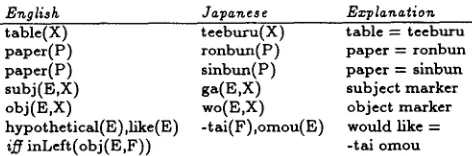
A transfer rule shows a particular translation equivalence between two languages. It consists of three parts: a pair of logical forms, one for each language, representing the equivalence, and a third logical form giving the condi- tions under which the equivalence is applicable. We call these the equivalence pair and the condition respectively. T w o ~ logical forms form an equivalence pair if the natu- ral language expressions they represent have overlapping denotations. T h e rule can therefore be used for trans- lating in either direction: the two logical forms of the equivalence pair are always translationally equivalent if the condition is satisfied. T h e logical forms of the equiv- alence pair will be indistinguishable from logical forms of the respective languages, using the same predicates and relations. T h e logical forms of the condition use m e t a - predicates which allow reference to to the logical form of the current local translation unit (sentence or clause) and to the linguistic context. In practice, most transfer rules have no condition; they consist just of an equiva- lence pair. Some examples of rules follow:
English Japanese Explanation
t a b l e ( X ) t e e b u r u ( X ) t a b l e --- t e e b u r u paper(P) r o n b ~ ( P ) paper = r o n b ~
paper(P) sinbun(P) paper = sinbun subj(E,X) ga(E,X) subject marker obj(E,X) wo(Z,X) object marker hypothetical(E),like(E) -tai(F),omou(E) would like =
i.l~ i n L e f t ( o b j ( E , F ) ) - t a i o m o u
T h e following is the basic definition of transfer between two texts (sentences, clauses, or whatever):
A source logical form and a target logical form are correctly transferred if the terms of each can be divided into non-overlapping subsets such that the source subsets can be placed into one-to-one cor- respondence with the target subsets by each corre- sponding pair being 'unified' with the two halves of the equivalence pair of a transfer rule, and if the ac- cumulated conditions of the transfer rules used are satisfied. ('Unification' in this definition is rather similar to graph unification).
4. ' C o m p l e x ' T r a n s f e r
4.1. T y p e s of C o m p l e x T r a n s f e r
Lindop & Tsujii (1991) list and discuss a variety of exam- ples t h a t are always p r o b l e m a t i c for machine translation systems. We suggest t h a t what makes these examples difficult is t h a t different dependency structures are as- sociated with otherwise s y n o n y m o u s lexical items. We break the p r o b l e m down into four subparts.
* i)
Argument-swiiching
as in the translation of the G e r m a n Der Wagen gef~llt m i r - - I like the carT h e c a r p l e a s e s m e
gefallen(E) & n o m ( O ) & dat(S) , , like(E) & subj(S)
& obj(O)
In argument-switching, the relations between the lexical i t e m and its dependents are not translated standardly. Although the G e r m a n n o m i n a t i v e n o r m a l l y corresponds to an English subject, it m u s t in this e x a m p l e be trans- lated as a dative.
* ii)
Head-switching
as in the translation of G e r m a n Hans s c h w i m m t gern - - J o h n likes s w i m m i n gJ o h n s w i m s g l a d l y
like(L) ~ oDj(L,S), , g e m ( L ) ~ subj(L,S) iffshift(L,S)
[image:2.612.322.558.45.123.2]* iii) Decomposition as in the translation of the Japanese John-ga zisatusita - - John committed suicide
zisatusuru(E) , , commit(E) & suicide(S) & obj(E,S)
Here the single Japanese word zisatusuru is translated as the English phrase to commit suicide. Some types of decomposition can give rise to special problems when there are modifiers or dependents involved. These are discussed in detail by Tsujii et al. (1992). Shortage of space and the variety and complexity of examples pre- vents their discussion here.
* iv) Raising as in the translation of the Welsh Fe ddigwydd fod Si6n y m a
h a p p e n s be John here
John happens to be here
digwydd(E1) & subj(E1,E2) & subj(E2,X) , , hap- pen(E1) & subj(E1,X) & obj(E1,E2)
In the English, the subject of happen is John, but in the Welsh, the subject of digwydd ('happen') is the situation of John's being here.
The predicate shift is introduced to define a transla- tion equivalence where certain dependencies are differ- ently arranged in the target language, as compared to the source language. It can be understood in terms of semantic type-shifting - - the types are differently dis- tributed in the source- and target-language logical forms. Shift(H,E) means that in any instance of subj(H,X} or P(X,H) (where P stands for any relation) in the logical form representing the English text, the H corresponds to an E in the logical form representing the other language. The following example shows how the example under (ii) above would work in practice.
Ich weiB Hans schwimmt g e r n - I know John likes swim- ming
ich(i) me(i) me(i)
wissen(w) know(w) know(w)
subj(w,i) subj(w,i) subj(w,i)
obj(w,s) obj(w,s) obj(w,g)
Hans(j) John(j) John(j)
schwimmen(s) swim(s) swim(s) subj(s,j) subj(s,j) subj(g,j) gern(g)
subj(g,s)
like(g) obj(g,s) {shift (s,g)}
like(g) obj(g,s)
The columns of the table show the German source logical form, the English logical form as it would be without shift, and the actual English target logical form. The
horizontal divisions of the table represent the fields of operation of separate transfer rules.
4 . 2 . I n t e r a c t i o n b e t w e e n t y p e s o f c o m p l e x t r a n s f e r
When several of these syntactic changes are combined in one example, the logical form resulting from transfer tend to be incoherent. The following examples are types on which most, if not all, existing machine translation systems will fail, as will the mechanism proposed here so far.
English - Welsh; raising with argument-switching: John happens to like swimming
fe ddigwydd fod yn dda gan John nofio
h a p p e n s be nice by J o h n swim
(swimraing-being-rdce-i~-John's-olairdon occurs)
Dutch - English; verb - head-switching twice: Jan zwemt graag toevallig
John swims gladly happeningly
John happens to like swimming (also 'John likes happening to swim 3
There are two separate causes of difficulty in these ex- amples. Firstly, the long-distance movement caused by raising causes problems n the transfer of structures which have been the target of raising. The simplest way to get round the problem is to require syntactically-deleted ar- guments to be marked explicitly on all the verbs of which they are logical arguments, treating the phenomenon syntactically as an example of lexically-triggered extrac- tion, on a par with the extractions of syntactic objects in a man I know and an easy man to please. Transfer rules which introduce raising predicates will then have to bring in the new subject explicitly. For instance, the rule for happen and digwydd, (iv) in §4.1, will be re-written
as
digwydd(E1) & subj(E1,E2) , , happen(E1) & subj(E1,X) & obj(E1,E2) iffsubj(E2,X)
not transferred by the transfer rule which introduced the
shift(tiT, E).
Together, these two stipulations enable the transfer of examples involving head-switching, argument-switching, raising, and m o s t types of decomposition.
5. ' I Y a n s f e r o f C o o r d i n a t e S t r u c t u r e s
5 . 1 . P r o b l e m s i n t r a n s f e r o f c o o r d i n a t e s t r u c t u r e s
T h o u g h transfer of coordinated structures often inter- acts with transfer of other translation units to produce miserable results in translation, few a t t e m p t s have been reported to formalize this problem. We here divide the problem into two categories:
• Divergence in semantic constraints
• C o m b i n a t i o n of complex transfers
A typical e x a m p l e of the first type is shown in the fol- lowing.
Japanese.
( l a ) She wears a hat and shoes.
( l b ) kanojo-ga boushi-wo kaburi, kutsu-wo she-subj hat-obj wear shoe-obj haku.
w e a r
As is understood from its translation, "wear" is trans- lated "kaburu" or "haku" in Japanese, depending on whether its object is something worn on the head or on the foot(or leg). This means that, in this example, coordination of objects in English should be altered to t h a t of verb phrases in Japanese.
This type of knowledge for lexical choice is very com- m o n in a transfer or bi-lingual dictionary, and plays an essential role in lexical transfer of m o s t current transfer- based M T systems. T h e problem arises because neither a transfer p r o g r a m or a transfer-rule writer expects such an awkward p r o b l e m ot be caused by coordination. To translate "wear" into "kaburu" in the above example, a rule writer m a y usually write the following rule in our notation1:
1 In this section, we consider translation whose source and target logical forms are on the left and right sides of a transfer rule. For the sake of simplicity, transfer rules hereafter are described as uni- directional ones.
wear(X) , k a b u r u ( X ) i f f o b j ( X , Y ) & H A T ( Y )
But the condition p a r t of this rule is implicitly expected to be interpreted as follows.
wear(X) , kaburu(X) iff V Y o b j ( X , Y ) & H A T ( Y )
T h e precise definition m a y change depending on how the coordinate structure is represented. But the point is t h a t "wear" m a y be translated "kaburu" only if all the objects have a feature of being a " H A T " .
A simple transfer algorithm, for example, m a y choose the target word when it finds the first applicable transfer rule for a source word: this a l g o r i t h m m a y produce "boushi- to kutsu-wo kaburu" for the sentence ( l a ) , which means t h a t the semantic relation between "wear" and "shoes" is ignored.
T h e second type of p r o b l e m s occurs when one of the coordinated objects triggers a complex transfer which is described in §3. This t y p e of p r o b l e m can be seen in the following translation.
He c o m m i t t e d murder then suicide.
kare-ga satsujin-wo okashi, jisatsu-shita. he-subj murder-obj commit commlt-ed suicide
This p r o b l e m is m o r e complicated t h a n the previous one because complex transfer, in this e x a m p l e " m a n y - t o - o n e transfer", causes a structural change.
There are several possible solutions to this problem. The simplest one is t h a t a transfer-rule writer writes all the transfer rules which explicitly describe every possible sub-structure with coordination. This is of course unre- alistic. Another solution is to m a k e a transfer p r o g r a m which modifies the transfer result d y n a m i c a l l y when, for example, a source word is given two different tar- get words. But such a d y n a m i c modification of the re- sult during transfer is against our policy of logic-based transfer, because this m e a n s gradual t r a n s f o r m a t i o n of the source structure and therefore transfer cannot be for- malized as logical inference.
5 . 2 . T r a n s f e r w i t h C o o r d i n a t e E x p a n s i o n
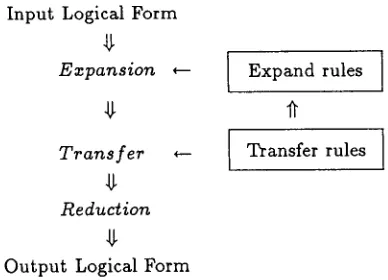
Input Logical Form
E z p a n s i o n ~--
T r a n s f e r ~--
It
Reduction
O u t p u t Logical Form
Expand rules
I Transfer rules
]
Figure h Transfer with Coordinate Expansion
basic requirement in logic-based transfer is that coordi- nation of objects should be reorganized to that of verb phrases or sentences, which is not supposed to cause problems in transfer. We call this reorganization "co- ordinate expansion". The following is a part of logical form for (la), which involves a coordinate structure.
wear(w)&obj
(w,o)&coord(o,ol)&hat
(ol)&
coord(o,o2)&shoe(o2)
In this form, o is a linguistic object, and a predicate
coord represents a relation between the linguistic object and its constituents. The following is a result of expan- sion.
coord(w,wl)&wear(wl)&obj (wl
,ol)&hat(ol)&
coord(w,w2)&wear(w2)~:obj
(w2,o2)~shoe(o2)
The most naive and simplest strategy using this expan- sion is to expand every coordination within a sentence and represent it in sentence coordination before trans- fer. This transfer result will be reorganized again into an appropriate representation of coordination in the tar- get language. But this solution seems inefficient from the computational point of view because caseswhere ex- pansion is necessary are rare . Unnecessary expansion and reorganization of coordinate structures should be avoided. The strategy we propose executes coordination expansion only if it is necessary[5] (See Fig. 1).
Transfer is divided into three phases; in the first phase, logical forms are expanded if expand rules (explained below) find the necessity of coordinate expansion. This process continues as long as the necessity remains. In the second phase, transfer described in previous sections is executed. Finally, in the third phase, coordination is reorganized if the target language has a more appropriate
structure for coordination than the second phase result. (Consider the translation of ( l b ) . W i t h o u t reorganizing coordination, the transfer result will contain two "wear"s .)
The following is an expand rule which detects the neces- sity of expansion concerned with translation of "wearing a hat".
wear(X)&obj
(X,Y)&coord(Y,Yi)&HAT(Yi)&
coord(Y,Y2)&Yl
#Y2&-~HAT(Y2)
expand(Y,X)
In the rule, e z p a n d ( Y , X ) means that coordination of the level Y should be expanded to t h a t of X. This rule sug- gests that coordinate expansion is necessary if the object of "wear" is a coordinate structure, and one constituent is a H A T while another isn't.
We assume that expand rules are produced automati- cally from transfer rules before the actual transfer oper- ation. The simplest way of extracting such a rule refers only one transfer rule at one time. This means that the necessity of expansion can be detected not by creating expand rules but by referring transfer rules in actual transfer phase. But the former approach seems essential if we wish to optimize expansion detection.
O t h e r e x a m p l e s E x p a n d rules from a transfer rule which involves a structural change are a little different in forms to the previous case. The following are a transfer rule for translating "commit suicide" into Japanese and its expand rule.
commit (X)&obj (X,Y) &suicide(Y)
, jisatsu_suru(X)
commit(X)&obj (X,Y)&coord(Y,Y1)&suicide(Y1)&
coord(Y,Y2)
8zYl
#Y2&-~suicide(Y2)
, expand(Y,X)
Another example is the translation of the English "HU- MAN have ADJ NOUN" construction into Japanese. The sentence (2E) is translated (2J) using the rule (3).
(2E) She has beautiful eyes.
(2J) kanojo-no me-ga utsukushii. she-poss eye-subj beautiful
(3) have(H)&subj (H,S)&obj ( H , X ) a m o d ( X , M ) poss(X,S)&subj(M,X)
[image:5.612.56.250.52.192.2]This case is more complicated t h a n the previous ones because the transfer rule refers to two semantic features. Therefore we will get two expand rules, one of which is the following rule.
have(X)&subj
(X,Y)&coord(Y,Y1)&HUMAN(Yi)&
c o o r H ( Y , Y 2 ) & Y i # Y 2 & ~ H U M A N ( Y 2 ) & obj(X,Z) & mod(Z,_) & PART_OF_BODY(Z)
, e x p a n d ( Y , X )
In addition, we need another expand rule which checks another type of coordinate construction. This rule will apply when the system translates "she has long hair and beautiful eyes".
have(X) & subj(X,S) &
HUMAN(S) & obj(X,Y) & -~mod(Y,_) & coord(Y,Y1) & rood(Y1,_) & PART_OF_BODY(Y1)
, e x p a n d ( Y , X )
D i s c u s s i o n Our coordinate expansion detection works even if a coordinate structure has more t h a n two con- stituents. W h a t we have to consider is an appropri- ate expansion algorithm. For example, in translating (4a), an a p p r o p r i a t e expansion should keep coordination of "shoes" and "stockings", as shown in (45), because b o t h satisfy a semantic constraint on which the system chooses "haku" as the translation of "wear". Otherwise reorganizing a coordination in the generation phase is inevitable.
(4a) She wears a hat, stockings and shoes.
(4b) She wears a hat and wears stockings and shoes.
Reorganization of a coordination in the target language does not only occur as outlined in the above case. Since the coordinate expansion is completely separate f r o m the actual transfer process, transfer rules which do not cause problems might be used.
There is still an open p r o b l e m to be solved with regard to the transfer of coordination with "expansion"; expan- sion is not always straightforward. There is often a case where coordinate expansion is impossible without deep understanding of the sentences, or it is impossible in t h a t it m a y change their semantic structures. For example, the sentence (55) cannot be the expansion of (ha) though it seems so at first glance.
(ha) I saw a group of men and women.
(55) I saw a group of m e n and I saw a group of women.
6 . C o n c l u s i o n a n d f u t u r e w o r k
In this paper, we showed how complex structural changes in transfer are treated within our logic-based transfer model, in which the target linguistic description is ob- tained f r o m the source description in a non-destructive manner. These types of structural changes cause a prob- lem when they co-occur and their transfer rules are in- teracted. We also discussed a p r o b l e m in transferring coordinate structures and presented an extended trans- fer model with coordinate expansion.
One of our current concerns is to i m p l e m e n t our transfer model in a parallel processing framework. Our current algorithm for transfer and its i m p l e m e n t a t i o n have a pro- cedural aspect of operation. T h a t is, the sense of "logic" in the n a m e of our model has not been fully achieved. We think t h a t the search for parallel i m p l e m e n t a t i o n will lead to "logic-based transfer" in the true sense.
R e f e r e n c e s
1. H.Alshawi, D.Carter and M.Rayner: 'Translation by Quasi Logical Form Transfer', in Proc. o]2gth A C L Con- ference, Berkeley, 1991.
2. C.Copeland, et.al.: 'The Eurotra Linguistic Specifica- tion', in Studies in Machine Translation and Natural Language Processing Vol. 1, Office for Official Pubhca- tion of the EC, 1991
3. R.Kaplan,K.Netter, et.al.: 'Translations by Structural Correspondences', in Proc. of 4th E-ACL Conference,
Manchester, 1989.
4. S.Kinoshita and J.Tsujii: 'Framework for Incorporating Knowledge into Machine Translation', in Proc. off Work- shop on FGNLP, Kyoto, 1991.
5. S.Kinoshita: Transffer off Coordinate Structures, CCL Report 91/13, 1991.
6. J.Lindop and J.Tsujii: Complex Transffer in MT: A Sur- vey off Examples, CCL/UMIST Report 91/5, 1991. 7. S.Nirenburg: Machine Translation, Cambridge Univer-
sity Press, 1987.
8. J.D.Phfllips, et.al.: 'Linguistic Context for Machine Translation', in Proc. of S I C O N L P '90, Seoul, 1990. 9. S.Sato and M.Nagao: 'Memory-based Translation', in
Proc. of COLING 90, Helsinld, 1990.
10. J.Tsujii et.al.: 'Lexical Transfer based on Bilingual Signs: Towards interaction during transfer', in Proc. off 5th E-ACL Conference, 1991.
11. ].Tsujii, et.al.: A n Architecture for Machine Transla- tion, CCL/UMIST Report 92/1, 1992.
12. G.van Noord, et.al.: 'The MiMo2 Research System', in Proc. of the 3rd International Confference on TMI,
Austin, 1990.
13. H. Watanabe: 'A Model of a Transfer Process Using Combinations of Transfer Rules', in Proc. off P R I C A I