CUSTOMER RELATIONSHIP MANAGEMENT IMPLEMENTATION IN IRAN AUTOMOBILE INDUSTRY
KAMYAR KAVOSH
CUSTOMER RELATIONSHIP MANAGEMENT IMPLEMENTATION IN IRAN AUTOMOBILE INDUSTRY
KAMYAR KAVOSH
A thesis submitted in fulfillment of the requirements for the award of the degree of
Doctor of Philosophy (Management)
Faculty of Management & Human Resource Development Universiti Teknologi Malaysia
DEDICATION
TO ALLAH THE ALMIGHTY
iv
ACKNOWLEDGEMENTS
So many things have helped me fulfill my dream of earning a PhD. This research would never have come to fruition the aid and support of God, my many mentors, colleagues, teachers, friends, wife, supervisors, and family.
Primarily, I would like to sincerely thank ALLAH the Almighty, the most merciful and the most gracious‖ who has blessed me with the understanding, determination and guidance during my graduate studies
Secondly, I would like to thank all those who have contributed so many ways to complete this thesis. I would like to sincerely express my gratitude and appreciations to my supervisor Prof. Dr. Abu Bakar Abdual Hamid, for his year‘s valuable of guidance, wisdom, encouragement and support during my entire academic career at UTM. The completion of this thesis would not possible without his assistance and encouragement. In addition, I would like to thank the chairperson and member of my committee. I am thankful for their valuable comments and suggestions on my thesis.
I am particularly thankful to my Wife, dear son, father, mother, in laws, brothers and sisters for their continuous prayers, support, encouragement, patient, unlimited support, and bringing happiness to my life. Their support and encouragement has helped me a great deal, and has played a vital part in helping me to achieve my goals and dream.
ABSTRACT
vi
ABSTRAK
TABLE OF CONTENTS
CHAPTER TITLE PAGE
DECLARATION vi
DEDICATION iii
ACKNOWLEDGEMENTS iv
ABSTRACT v
ABSTRAK vi
TABLE OF CONTENTS viii
LIST OF TABLES xiii
LIST OF FIGURES xiv
LIST OF ABBREVIATIONS xv
LIST OF APPENDICES xv
1 INTRODUCTION 1
1.1 An overview to Islamic Republic of Iran 1
1.2 ManufacturingIndustry 2
1.3 Background of the Study 3
1.4 Statement of the Problem 5
1.5 Scope of the Research 8
1.6 SignificanceoftheResearch 8
1.7 Limitations of the Research 9
1.8 Guides to the Thesis 9
2 LITERATURE REVIEW 10
2.1 Introduction 10
2.2 Different Views of CRM 16
2.2.1 CRM as Philosophy 16
ix
2.2.3 CRM as a Strategy 18
2.2.4 CRM as a Process 19
2.3 Customer Relationship Management Components 21 2.3.1 Chen and Popovich model 21
2.3.2 Business Process 21
2.3.3 Technology 23
2.3.4 People 26
2.4 Model Introduced by Sin 28
2.4.1 Customer Centric 28
2.4.2 CRM Organization 29
2.4.3 Knowledge Management 30
2.4.4 Technology Based- CRM 30
2.5 Model Introduced by Shum 32
2.5.2 Organizational Culture 33
2.5.3 Facilitative Leadership 34
2.5.4 Communication 36
2.5.5 Training 37
2.6 Customer Relationship Management Implementation 37 2.7 Major CRM Implementation Barriers 40
2.8 CRM Critical Success Factors 46
2.9 The Conceptual Framework of the Study 48
2.10 Conclusion 50
3 RESEARCH METHODOLOGY 51
3.1 Introduction 51
3.2 Research Design 54
3.3 Case Studies 54
3.4 Exploratory Study 57
3.5 Qualitative Method 57
3.6 Inductive and Deductive Approaches 58
3.7 Sampling Design 58
3.8 Data Collection Methods 60
3.8.1 Interview 60
3.9 Validity and Reliability 63
3.10 Data Analysis 64
3.11 Conclusion 65
4 FINDINGS 66
4.1 Introduction 66
4.2 Within-case Analysis: Company A 66
4.2.1 Profile of Company A 66
4.2.2 Products of Company A 67
4.2.3 Future Plans of Company A 67
4.2.4 CRM in Company A 68
4.3 CRM Training in Company A 68
4.4 Within- Case Analysis: Company B 69
4.4.1 Profile of Company B 69
4.4.2 CRM in Company B 70
4.5 Within-case Analysis: Company C 71
4.5.1 Profile of Company C 71
4.5.2 CRM in Company C 71
4.6 Within- case Analysis: Company D 73
4.6.1 Profile of Company D 73
4.6.2 CRM in Company D 73
4.7 Within-case Analysis: Company E 75
4.7.1 Profile of Company E 75
4.7.2 CRM in Company E 75
4.8 Within-case Analysis: Company F 77
4.8.1 Profile of Company F 77
4.8.2 CRM in Company F 77
4.9 Within-case Analysis: Company G 78
4.9.1 Profile of Company G 78
4.10 CRM in Company G 79
4.11 Within-case analysis: Company H 79
4.11.1 Profile of Company H 79
4.11.2 CRM in Company H 80
xi
4.12.1 Profile of Company I 81
4.12.2 CRM in Company I 81
4.13 Cross-case Analysis 82
4.13.1 Training 82
4.13.2 Organizational Culture 89
4.13.3 Facilitative Leadership 93
4.14 Technology 99
4.14.1 Facsimile 99
4.14.2 Internet and Email 101
4.14.3 Call Center 104
4.14.4 Customer Database 106
4.14.5 CRM Software 109
4.15 Process 110
4.15.1 Customer Centric 110
4.15.2 Cross-Functional Integration 114
4.15.3 Communication 116
4.16 Barriers 121
4.17 Success Factors 125
4.18 Conclusions 128
5 CONCLUSION 129
5.1 Introduction 129
5.2 To explore CRMI in Iran Automobile Industry 129 5.3 To Define the Barriers of CRM 131
5.4 To Identify the CSF of CRM 133
5.5 To Analyze Critically the Implementation of CRM 135
5.5.1 Training 135
5.5.2 Organizational Culture 136
5.5.3 Facilitative Leadership 137
5.5.4 Technology 137
5.5.5 Customer Centric 139
5.5.6 Cross Functional Integration 139
5.5.7 Communication 140
5.7 The implications 141 5.7.1 Implications for Management 141
5.8 Contribution of the Study 143
5.9 Research Findings 143
5.10 Further Research 146
REFERENCES 147
xiii
LIST OF TABLES
TABLE NO. TITLE PAGE
2.1 Summary of CRM Definitions and
explanations
14
2.2 Barriers of CRM in the investigated companies 43
2.3 Summary of the barriers of CRM
implementation
45
3.1 Different types of source in case study 56
3.2 Target population of the research 60
3.3 Strengths and weaknesses of interview 61
LIST OF FIGURES
FIGURE NO TITLE PAGE
1.1 Map of IRAN 1
2.1 Components of CRM 21
2.2 Dimensions of CRM 28
2.3 Role of employees' in CRM implementation 32
2.4 Conceptual framework of the study 49
3.1 Units of analysis 52
3.2 Units of analysis 53
xv
LIST OF ABBREVIATIONS
ROI - Return On Investment
KM - Knowledge Management
CEO - Chief Executive Officer CSF - Critical Success Factors IT - Information Technology ERP - Enterprise Resource Planning CRM - Customer Relationship Management
E_CRM - Electronic Customer Relationship Management
LIST OF APPENDICES
APPENDIX TITLE PAGE
A CRM specifications of company A 172
B CRM specifications of company B 173
C CRM specifications of company C 174
D CRM specifications of company D 175
E CRM specifications of company E 176
F CRM specifications of company F 177
G CRM specifications of company G 178
CHAPTER 1
INTRODUCTION
1.1 An overview to Islamic Republic of Iran
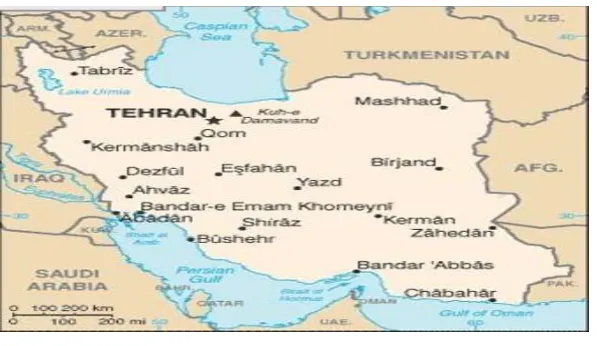
Figure 1.1 Map of IRAN
Source: Atiehbahar (2004, P.1)
Iran is between the Caspian Sea and the Persian Gulf. The country neighbor‘s are Armenia, Azerbaijan and Turkmenistan Afghanistan and Pakistan and Turkey and Iraq. Iran has one of the largest areas in Middle East, which is 1,648,000 square kilometers. North of Iran where the Caspian Sea is located is the largest lake in the world (Atiehbahar, 2008).
Iran has huge resources of oil and gas. The production of oil and gas are 135 billion barrels and natural gas 25 trillion cubic meters. Mineral resources currently exploited include bauxite, chromium, coal, copper, gold, iron ore, red oxide, salt, strontium, sulfur, turquoise, and uranium (Library of Congress, 2008).
Iran‘s economy is highly impacted by oil resources that are totally under the control of the government. Generally, the economy of Iran is divided into three different sectors that are state, cooperative, and private. The state or governmental sector focuses upon all strategic industries such as international trade, most important minerals, banking, power generation, dams and large-scale irrigation networks, radio and television, post, telegraph and telephone services, aviation, shipping, roads, railroads and the like; all these are controlled by the government. Regarding the cooperative section, we can refer to companies that are responsible for distribution and production in the country.
The last sector is private, which concentrates on activities such as agriculture, animal husbandry, industry, trade, and services that helps the economic activities of the government and other sectors (Atiehbahar, 2008).The goal of economic development plan of Iran has focused on increasing international and global trades and also on underutilized resources and more investment in private sectors.(Amirahmadi, 1996).
To be successful in the above plan the country has to increase its exports and having duty free and international zones can be helpful. Other than these, controlling the domestic market, maintaining a well-functioning supply of basic commodities as well as reasonable prices for necessities and services, and increasing foreign investment are the rest of Iran‘s economic development plan(Karshenas and Pesaran, 1995).
1.2 Manufacturing Industry
3 had impacted positively the growth of the industry. In the 1990s, Iran‘s economy did not improve and the investment in private section was low, but the high world oil prices helped the government in public investment especially in petrochemicals industry. The petrochemicals industry, which has been controlled by the government, has improved remarkably. According to the economic development plan, the government tries to increase petrochemical output and due to this, the above industry has received many attentions for foreign investment.
The steel industry in Iran is improving quickly in three cities namely Ahvaz, Esfahan, and Mobarakeh. According to the plan of the government in 2004, 8.5 million tons must be produced and the goal was attained. Regarding car makers it should be pointed out due to those contracts with foreign car makers they benefited greatly. For example, Iran national car manufacturer could manufacture 260,000 units in 2002. Planting and growing of agricultural products is also a strategic and critical industry in Iran, and controlled by private sector. Two other major industries in Iran are related to grain processing and textile industry. The two said industries have created many job opportunities for Iranians (Library of Congress 2008).
1.3 Background of the Study
that has caused improvement in marketing since it links individuals and businesses of all types to one another. Firms, companies, and business organizations are using the internet to have closer relationship with customers.
Marketing activities have changed radically(Brown et al., 1995, Brodie et al., 1997) and it no longer involves producing and selling as what it was in the past. New marketing emphasizes on satisfying customer needs and wants (Fournier, 1998, Batra, 1999, Gummesson, 2004). Kotler, (2003) has defined marketing as "a social and managerial process by which individuals and groups obtain what they need and
want through creating and exchanging products and values with others.” It seems
that the most important concept of marketing refers to customer needs.
Relationship marketing is another important concept of today's marketing that is affected positively by improvement of technology such as internet(Anderson, 1995, Aulakh et al., 1996, Blois, 1996, Bruhn, 2003, Egan, 2008).Since 1990s, relationship marketing has been accorded much attention especially in business to business marketing(Sharma, 2003). Nowadays, managers try to understand their customers so that they can best meet their customers' needs, and thus, by doing this, consequently, the customers avoid switching to other companies (Gallagher, 1998, Fickel, 1999, Dibb and Meadows, 2001).
5 Firms produce according to the customers‘ expectations and due to these changes it is preferred that companies concentrate on small customer segments. Hence, close relationship with customers increased (Chatham et al., 2002)since they are not same in their wants and expectations. According to the techniques of customer relationship management, relationship marketing focuses on individual customers.
The firm must also be customer centric rather than product focused. Companies that focus upon customers try to serve them in the best manner to satisfy them. It can be done by integrating marketing activities and the business process of the company. They also adopt themselves with changes; hence, they will be more flexible to respond to changes in customers‘ needs (Field and Shutler, 1990, Bowen and Hedges, 1993, Conlon, 1999, Prabhaker, 2001, Flint et al., 2002, Bigné et al., 2004).
1.4 Statement of the Problem
Nowadays many firms invest in customer relationship management. However, some of them fail to meet management expectations on return on investment (Corner and Hinton, 2002, Åkerlund, 2005, Caldeira et al., 2008). The reason is that firms apply the technology with the absence of a coherent business strategy focused on the customers. Another problem in customer relationship management is the technology implementation. In some firms, because the focus was given to controlling the customers rather than rendering better services to them, it means trying to retain the customers affects the organization rather than aiming to give better service to the customers(Stone et al., 2000).
However, Hackney(2000) Botwinik(2001) Elmuti(2009)and Goodhue(2002) explained that there were convincing reasons to implement CRM in business organizations and companies even though there was no 100 percent guarantee that it would be successful. On the other hand, CRM software vendors talk about a successful CRM in a way that can solve all the problems in the business. Schweigert(2000) and Boulding(2005) claimed that there were some risks such as failure in the project, inadequate return on investment, unsatisfied employees, and customers that should be considered.
In one example Patton(2001) explained that, "a large telecommunications company rolled out a major CRM application to more than 1,000 sales
representatives in late 1999, at a cost of $10,000 per user, only to find a year later
that fewer than 100 were using the system.” Other surveys have also shown that the
average investment in customer relationship management implementation is $2.2 million dollars and the failure rate is 65 percent (Apicella, 1999).
It is becoming increasingly clear that failing in customer relationship management projects are the results of companies misunderstanding of customer relationship management properly (Chen and Popovich, 2003, Cicmil et al., 2006,
Foss et al., 2008, Alamgir et al., 2011). Furthermore, they have pointed to other
issues. The first issue is that companies try to implement CRM but they do not design and redesign the processes properly. To get better results from CRM, companies have to focus upon the process of sales; they also have to find the ways to convince, serve, and satisfy customers better, and then identify the steps to changes in the plan software or process.
Another issue is that companies are focusing too much on new technologies and processes rather than focusing on people who are responsible to implement CRM. It means that companies need employees who can offer better services to customers, also employees who can be sure that they will have a better situation and environment than what they now have after CRM has been implemented(Alexander and Turner, 2001).
7 outsource them (MacSweeney, 2000). If customers become satisfied about the value that is offered and meet their expectations the benefit will be generated for the company(Bateson, 2002). Besides all these issues, pitfalls and difficulties regarding CRM implementation, it should be considered that today we have the concept of CRM that leads to improve customer retention and satisfaction, increase competitiveness, higher revenues, lower operational costs and customize products (Jackson Jr, 1994, Reichheld et al., 1996, Bultema, 2000, Bose, 2002, Roh et al., 2005).
Due to the issues and difficulties in CRM implementation, some companies are reluctant to implement it (Bard, 2005). By searching through databases and Iran annual reports, the researcher has realized that customer satisfaction is remarkably low regarding the products and services of car manufacturing companies in Iran. It has also been found that customer relationship management is not implemented properly. It seems that because of the current problems, the customer relationship management technology has been disregarded in Iran automobile industry.
The problem of the research revolves around the implementation of customer relationship management technology in Iran automobile industry. This study is conducted in automobile industry since it is one of the most known and crucial industries in Iran.
1.5 Objectives of the Study
Considering the importance of automobile industry in Iran, this study attempts to achieve the following objectives:
1. To explore the current implementation of customer relationship management in the automobile industry.
3. To identify the success factors of customer relationship management with regard to automobile industry.
4. To analyze critically the implementation of customer relationship management in the automobile industry.
1.6 Scope of the Research
This study designed to provide an overview on customer relationship management implementation in Iran automobile industry within the vicinity of the capital Tehran, and two other cities Ahwaz, and Boroujerd. These cities are selected because Tehran and Ahwaz have large population, are industrialized cities and Boroujerd is selected since one of the investigated car manufacturing companies is located there.
1.7 Significance of the Research
First, based on the previous study this is the first attempt of exploring CRM implementation in Iran automobile industry. Hence it will be helpful for this industry specially car manufacturers.
Second, customer relationship management implementation has been tested, but the majorities were done in the developed countries or they were not about automobile industry(Nguyen et al., 2007).
9
1.8 Limitations of the Research
The research has some limitations. First, it is done merely in automotive industry therefore results and findings cannot be generalized in other sectors. Second limitation refers to the data collection. As some of the respondents were busy, making appointment with them was difficult. Third limitation refers to number of cities that will be covered, because difficulties in traveling and long distances between the cities only three cities Tehran, Ahwaz, and Boroujerd were covered for this study.
1.9 Guides to the Thesis
This study is organized into five chapters, as follows. The first chapter presents a general introduction and discusses the statement of the problem, objectives of the study as well as significance and limitations of the research.
REFERENCES
Abbott, J., Stone, M. & Buttle, F. (2001). Customer relationship management in practice A qualitative study. The Journal of Database Marketing, 9, 24-34. Agar, M. (1996). Language shock: Understanding the culture of conversation,
Harper Paperbacks.
Agarwal, A., Harding, D. P. & Schumacher, J. R. (2004). Organizing for CRM.
McKinsey Quarterly, 3, 80-91.
Ahlemann, F. (2009). Towards a conceptual reference model for project management information systems. International Journal of Project Management, 27, 19-30. Ahn, J. Y., Kim, S. K. & Han, K. S. (2003). On the design concepts for CRM system.
Industrial Management & Data Systems, 103, 324-331.
Ak in, O. Z. & Harker, P. T. (2001). Modeling a phone center: Analysis of a multichannel, multiresource processor shared loss system. Management Science, 324-336.
Åkerlund, H. (2005). Fading customer relationships in professional services.
Managing Service Quality, 15, 156-171.
Alamgir, M., Nasir, T. & Shamsuddoha, M. (2011). Determinants of customer relationship management (CRM): A conceptual analysis. Annals of the Stefan cel Mare University of Suceava-Faculty of Economics and Public Administration,
10, 95-101.
Alexander, D. & Turner, C. (2001). The CRM pocketbook, Pocketbooks.
Ali, I. (2007). Customer relationship managment: A qualitative cross-case analysis
148 Alvesson, M. (2002). Understanding organizational culture, Sage Publications Ltd. Amirahmadi, H. (1996). Iran's development: evaluation and challenges. Third World
Quarterly, 17, 123-147.
Amrit, T. (2001). The Essential Guide to Knowledge Management: E-Business and CRM Application. Prentice Hall.
Anderson, J. C. (1995). Relationships in business markets: exchange episodes, value creation, and their empirical assessment. Journal of the Academy of Marketing
Science, 23, 346-350.
Anderson, J. C., Håkansson, H. & Johanson, J. (1994). Dyadic business relationships within a business network context. The Journal of Marketing, 58, 1-15.
Ang, L. & Buttle, F. (2006). Customer retention management processes: A quantitative study. European Journal of Marketing, 40, 83-99.
Apicella, M., Mitchell, K, Et. Al. (1999). Customer Relationship Management: Ramping up sales service", InfoWorld, Vol. 21, No. 33, pp.68-80. 21, 68-80. Apostolou, D. & Mentzas, G. (2003). Experiences from knowledge management
implementations in companies of the software sector. Business Process
Management Journal, 9, 354-381.
Armenakis, A. A. & Bedeian, A. G. (1999). Organizational change: A review of theory and research in the 1990s. Journal of Management, 25, 293.
Atiehbahar. (2008). Iran Country Profile and Business Guide [Online]. Available: www.Atiehbahar.com [Accessed].
Aulakh, P. S., Kotabe, M. & Sahay, A. (1996). Trust and performance in cross-border marketing partnerships: A behavioral approach. Journal of international
business studies, 1005-1032.
Bain, P., Et.Al, . (2001). "Taylorism, targets and the dichotomy in call centers".
Paper Presented at the 19th international Labour Process Conference.
Bakar, A., . . ,. ., , . (2003). "A Critical Analysis of Policy Initiatives Involving small
and Medium Enterprises in Malaysia". Thesis for PhD, Unpublished, University
of Derby.
Bard, E. A. (2005). Evaluation of top enterprise CRM software vendors across 177
criteria, Forrester Research Inc.
Bateson, E. G. J., Hoffman, D.K., . (2002). Essentials of service marketing:
concepts, strategies and cases, Orlando, Harout College.
Batra, R. (1999). The new direct marketing: how to implement a profit-driven
database marketing strategy, McGraw-Hill Professional.
Becker, J. U., Greve, G. & Albers, S. (2009). The impact of technological and organizational implementation of CRM on customer acquisition, maintenance, and retention. International Journal of Research in Marketing, 26, 207-215. Beldi, A., Cheffi, W. & Dey, P. K. (2010). Managing customer relationship
management projects: The case of a large French telecommunications company.
International Journal of Project Management, 28, 339-351.
Benjamin, R. I. & Levinson, E. (1993). A framework for managing IT-enabled change. Sloan Management Review, 34, 23–33.
Berry, L. L. (1995). Relationship marketing of services—growing interest, emerging perspectives. Journal of the Academy of Marketing Science, 23, 236-245.
Berry, L. L. (2004). Marketing services: Competing through quality, Free Press. Berry, M. J. & Linoff, G. S. (2011). Data mining techniques: for marketing, sales,
and customer relationship management, * Wiley Computer Publishing.
Beugré, C. D. (1998). Implementing Business Process Reengineering. The Journal of
Applied Behavioral Science, 34, 347.
Bigné, J. E., Blesa, A., Küster, I. & Andreu, L. (2004). Market orientation: an antecedent to the industrial manufacturer's power. European Journal of
150 Bin-Xing, L. (2005). Adoption of Customer Relationship Management (CRM) in
China: a Case Study of Inse Lighting Utensils co Ltd.
Birjandi, P., Mosallanejad, P. , (2005). Research Methods and Principle, Mahdavi Publications.
Bitner, M. J., Brown, S. W. & Meuter, M. L. (2000). Technology infusion in service encounters. Journal of the Academy of Marketing Science, 28, 138.
Black, S. E. & Lynch, L. M. (2001). How to compete: the impact of workplace practices and information technology on productivity. Review of Economics and statistics, 83, 434-445.
Blattberg, R. C. & Deighton, J. (1996). Manage marketing by the customer equity test. Harvard Business Review, 74, 136.
Blois, K. J. (1996). Relationship marketing in organizational markets: when is it appropriate? Journal of Marketing Management, 12, 161-173.
Bohling, T., Bowman, D., Lavalle, S., Mittal, V., Narayandas, D., Ramani, G. & Varadarajan, R. (2006). CRM Implementation. Journal of Service Research, 9, 184.
Bolton, M. (2004). Customer centric business processing. International Journal of
Productivity and Performance Management, 53, 44-51.
Bonoma, T. V. (1985). Case research in marketing: opportunities, problems, and a process. Journal of Marketing Research, 22, 199-208.
Bose, R. (2002). Customer relationship management: key components for IT success.
Industrial Management & Data Systems, 102, 89-97.
Bose, R. & Sugumaran, V. (2003). Application of knowledge management technology in customer relationship management. Knowledge and Process
Management, 10, 3-17.
Boudreau, M. C., Gefen, D. & Straub, D. W. (2001). Validation in information systems research: A state-of-the-art assessment. MIS Quarterly, 1-16.
Boulding, W., Staelin, R., Ehret, M. & Johnston, W. J. (2005). A customer relationship management roadmap: What is known, potential pitfalls, and where to go. The Journal of Marketing, 69, 155-166.
Bowen, J. & Hedges, R. (1993). Increasing service quality in retail banking. Journal
of Retail Banking, 15, 21-21.
Boyle, M. J. (2004). Using CRM software effectively. The CPA Journal, 74.
Bradshaw, D. & Brash, C. (2001). Managing customer relationships in the e-business world: how to personalise computer relationships for increased profitability.
International Journal of Retail & Distribution Management, 29, 520-530.
Brendler, W. (2001). The human dimension of CRM: the key to success or failure.
The Customer Relationship Primer.
Broadbent, M. & Weill, P. (1997). Management by maxim: how business and IT managers can create IT infrastructures. Sloan Management Review, 38, 77-92. Brodie, R. J., Coviello, N. E., Brookes, R. W. & Little, V. (1997). Towards a
paradigm shift in marketing? An examination of current marketing practices.
Journal of Marketing Management, 13, 383-406.
Brown, J. R., Johnson, J. L. & Koenig, H. F. (1995). Measuring the sources of marketing channel power: A comparison of alternative approaches* 1.
International Journal of Research in Marketing, 12, 333-354.
Bruhn, M. (2003). Relationship marketing: Management of customer relationships, Pearson Education.
Bultema, P. (Year). Getting the big picture on operational CRM. In, 2000. 27-29. Burgers, A., De Ruyter, K., Keen, C. & Streukens, S. (2000). Customer expectation
dimensions of voice-to-voice service encounters: a scale-development study.
152 Burgess, R. G. (1984). In the field: An introduction to field research, Psychology
Press.
Bush, A., Moore, J. & Rocco, R. (2005). Antecedents and consequences of CRM technology acceptance in the sales force. Industrial Marketing Management, 34, 369–380.
Buttle, F. (1996). Relationship marketing: theory and practice, Sage Publications Ltd.
Bygstad, B. (2003). The implementation puzzle of CRM systems in knowledge based organizations. Information Resources Management Journal, 16, 33-45.
Caldeira, M., Pedron, C., Dhillon, G. & Lee, J. (Year). Applying EA Perspective to CRM: Developing a Competency Framework. In, 2008. IEEE, 1029-1034.
Caldeira, M. M. & Ward, J. M. (2002). Understanding the successful adoption and use of IS/IT in SMEs: an explanation from Portuguese manufacturing industries.
Information Systems Journal, 12, 121-152.
Caldwell, S. D., Herold, D. M. & Fedor, D. B. (2004). Toward an Understanding of the Relationships Among Organizational Change, Individual Differences, and Changes in Person-Environment Fit: A Cross-Level Study. Journal of Applied
Psychology, 89, 868.
Cameron, K. S. & Quinn, R. E. (2006). Diagnosing and changing organizational
culture: Based on the competing values framework, Jossey-Bass Inc Pub.
Campbell, A. J. (2003). Creating customer knowledge competence: managing customer relationship management programs strategically. Industrial Marketing
Management, 32, 375-383.
Capella, M., Arnold, R., and Mitchell, M. & . (1994). The Marketing Concept: otential Implementation Problems for Non-For-Profit Organizations. Journal of
Marketing Theory and Practice, pp 17-28.
Chen, I. J. (2001). Planning for ERP systems: analysis and future trend. Business
Process Management Journal, 7, 374-386.
Chen, I. J. & Popovich, K. (2003). Understanding customer relationship management (CRM): People, process and technology. Business Process Management Journal,
9, 672-688.
Chen, L., Sakaguchi, T. & Frolick, M. N. (2000). Data mining methods, applications, and tools. Information systems management, 17, 1-6.
Cho, Y., Im, I., Fjermestad, J. & Hiltz, S. R. (2003). The impact of product category on customer dissatisfaction in cyberspace. Business Process Management
Journal, 9, 635-651.
Chonko, L. B., Jones, E., Roberts, J. A. & Dubinsky, A. J. (2002). The role of environmental turbulence, readiness for change, and salesperson learning in the success of sales force change. Journal of Personal Selling and Sales
Management, 22, 227-246.
Chou, D. C. & Lin, B. (2002). Development of web-based knowledge management systems. Human Systems Management, 21, 153-158.
Churchill, G. A. (1979). A paradigm for developing better measures of marketing constructs. Journal of Marketing Research, 16, 64-73.
Churchill, G. A. (2001). Basic marketing research, South-Western Pub.
Cicmil, S., Williams, T., Thomas, J. & Hodgson, D. (2006). Rethinking project management: researching the actuality of projects. International Journal of
Project Management, 24, 675-686.
154 Conlon, G., ―, (1999). Growing sales from existing customers‖. Sales and
Marketing Management
Vol. 15, pp. 135.
Coombs, R., Hull, R., Economic, Council, S. R., Centre, S. R. C. B. P. R. & Centre, U. O. W. I. M. (1998). The wider research context of business process analysis. ESRC Business Processes Resource Centre.
Corner, I. & Hinton, M. (2002). Customer relationship management systems: implementation risks and relationship dynamics. Qualitative Market Research:
An International Journal, 5, 239-251.
Corner, I. & Rogers, B. (2005). Monitoring qualitative aspects of CRM implementation: The essential dimension of mangement responsibility for employee involvement and acceptance. Journal of Targeting, Measurement and
Analysis for Marketing, 13, 267-274.
Crane, A. (1995). ―Rhetoric and reality in the greening of organizational culture.
Greener Management International,, pp. 49–62.
Creswell, J. W. (2009). Research design: Qualitative, quantitative, and mixed
methods approaches, Sage Publications, Inc.
Crosby, L. A. & Johnson, S. L. (2001). Technology: friend or foe to customer relationships? Marketing Management, 10, 10-11.
Croteau, A. M. & Li, P. (2003). Critical success factors of CRM technological initiatives. Canadian Journal of Administrative Sciences/Revue Canadienne des
Sciences de l'Administration, 20, 21-34.
Cunningham, C. E., Woodward, C. A., Shannon, H. S., Macintosh, J., Lendrum, B., Rosenbloom, D. & Brown, J. (2002). Readiness for organizational change: A longitudinal study of workplace, psychological and behavioural correlates.
Journal of Occupational and Organizational Psychology, 75, 377-392.
Davenport, T. & Prusak, L. (1998). Working knowledge Harvard business school press Boston. Mass.
Davenport, T. & Short, J. (1990). ªThe new industrial engineering: information technology and business process designº. Sloan Management Review, 31, 11-27. Davenport, T. H. & Beers, M. C. (1995). Managing information about processes.
Journal of Management Information Systems, 12, 57-80.
David, M. & Sutton, C. D. (2004). Social research: The basics, Sage Publications Ltd.
Day, G. S. (1994). The capabilities of market-driven organizations. The Journal of
Marketing, 58, 37-52.
De Chernatony, L. (2001). Succeeding with brands on the Internet. The Journal of
Brand Management, 8, 186-195.
Deighton, J. (2005). Privacy and Customer Management. CUSTOMER
MANAGEMENT, 17–19.
Denzin, N. K. (1978). The research act New York. McGraw-Hill. INSTITUTIONAL
THEORY & ADMINISTRATIVE REFORM, 353, 41-62.
Dey, I. (1993). Qualitative data analysis: A user-friendly guide for social scientists, Routledge.
Dibb, S. & Meadows, M. (2001). The application of a relationship marketing perspective in retail banking. The Service Industries Journal, 21, 169-194.
Difonzo, N. & Bordia, P. (1998). A tale of two corporations: Managing uncertainty during organizational change. Human Resource Management, 37, 295-303. Drucker, P. F. (1995). The information executives truly need. Harvard Business
Review, 73.
156 Durgee, J. F. (1986). Depth-interview techniques for creative advertising. Journal of
Advertising Research, 26, 29-37.
Dussart, C. (2001). Transformative power of e-business over consumer brands.
European Management Journal, 19, 629-637.
Dyche, J. (2002). The CRM handbook: a business guide to customer relationship
management, Addison-Wesley.
Dyer, N. (1998). ``What's in a relationship (other than relations)?''. Insurance
Brokers Monthly & Insurance Adviser, 48, 16-17.
Dyer, N. G., Hanges, P. J. & Hall, R. J. (2005). Applying multilevel confirmatory factor analysis techniques to the study of leadership. The Leadership Quarterly,
16, 149-167.
Easterby-Smith, M., Thorpe, R. & Lowe, A. (2002). Management research: An
introduction, Sage Publications Ltd.
Ebner, M., Hu, A., Levitt, D. & Mccrory, J. (2002). How to rescue CRM. The
McKinsey Quarterly, 4, 2002.
Eckerson, W. & Watson, H. (2001). Harnessing customer information for strategic advantage: technical challenges and business solutions. Industry study, 200, 6. Egan, J. (2008). Relationship marketing: exploring relational strategies in
marketing, Pearson education.
Eisenhardt, K. M. (1989). Building theories from case study research. The Academy
of Management Review, 14, 532-550.
Elmuti, D., Jia, H. & Gray, D. (2009). Customer relationship management strategic application and organizational effectiveness: an empirical investigation. Journal
of Strategic Marketing, 17, 75-96.
Elving, W. J. L. (2005). The role of communication in organisational change.
Essex, P. A., Magal, S. R. & Masteller, D. E. (1998). Determinants of information center success. Journal of Management Information Systems, 15, 95-117.
Evans, P. & Wurster, T. (1997a). Strategy and the economics of information.
Harvard Business Review, 2.
Evans, P. B. & Wurster, T. S. (1997b). Strategy and the new economics of information. Harvard Business Review, 75, 70.
Fahey, L. & Prusak, L. (1998). The eleven deadliest sins of knowledge management.
California Management Review, 40, 265.
Fedor, D. B., Caldwell, S. & Herold, D. M. (2006). The effects of organizational changes on employee commitment: A multilevel investigation. Personnel
Psychology, 59, 1-29.
Feinberg, R. A., Kadam, R., Hokama, L. & Kim, I. (2002). The state of electronic customer relationship management in retailing. International Journal of Retail &
Distribution Management, 30, 470-481.
Ferguson, T., Lin, B. & Chen, J. C. H. (2004). Leveraging the work force using information technology: a financial service case study. International Journal of
Management and Enterprise Development, 1, 316-332.
Fickel, L. (1999). Know your customer. CIO Magazine, 12, 62-72.
Field, E. & Shutler, M. (1990). Service with a smile--The public face of public sector industries. European journal of operational research, 45, 356-367.
Filiatrault, P. & Lapierre, J. (1997). Managing business-to-business marketing relationships in consulting engineering firms. Industrial Marketing Management,
26, 213-222.
Fjermestad, J. & Romano Jr, N. C. (2003). Electronic customer relationship management: revisiting the general principles of usability and resistance–an integrative implementation framework. Business Process Management Journal,
158 Flint, D. J., Woodruff, R. B. & Gardial, S. F. (2002). Exploring the phenomenon of customers' desired value change in a business-to-business context. The Journal of
Marketing, 66, 102-117.
Folger, R. & Skarlicki, D. P. (1999). Unfairness and resistance to change: hardship as mistreatment. Journal of Organizational Change Management, 12, 35-50.
Ford, J. D. & Ford, L. W. (1995). The role of conversations in producing intentional change in organizations. The Academy of Management Review, 20, 541-570. Ford, J. D., Ford, L. W. & D'amelio, A. (2008). Resistance to change: The rest of the
story. The Academy of Management Review (AMR), 33, 362-377.
Foss, B., Stone, M. & Ekinci, Y. (2008). What makes for CRM system success—Or failure? Journal of Database Marketing & Customer Strategy Management, 15, 68-78.
Fournier, S. (1998). Consumers and their brands: Developing relationship theory in consumer research. Journal of consumer research, 343-373.
Galbreath, J. & Rogers, T. (1999). Customer relationship leadership: a leadership and motivation model for the twenty-first century business. The TQM Magazine, 11, 161-171.
Gallagher, R. (1998). Returning To Your Customers. Customer Value Management,
New Zealand Ltd., http://www. cvm. co. nz.
Gebert, H., Geib, M., Kolbe, L. & Brenner, W. (2003). Knowledge-enabled customer relationship management: integrating customer relationship management and knowledge management concepts [1]. Journal of Knowledge Management, 7, 107-123.
Gefen, D. & Ridings, C. M. (2002). Implementation team responsiveness and user evaluation of customer relationship management: A quasi-experimental design study of social exchange theory. Journal of Management Information Systems,
Gersick, C. J. G. (1988). Time and transition in work teams: Toward a new model of group development. Academy of Management Journal, 9-41.
Glesne, C. & Peshkin, A. (1992). Becoming qualitative researchers: an introduction (White Plains, NY, Longman).
Goldenberg, B. (2000). What is an e-customer? Why you need them now? . paper
presented at conference on Customer Relationship Management. Boston, USA:
Shared insights.
Goldenberg, B. J. (2002). CRM automation, Prentice Hall.
Goodhue, D. L., Wixom, B. H. & Watson, H. J. (2002). Realizing business benefits through CRM: hitting the right target in the right way. MIS Quarterly Executive,
1, 79-94.
Grant, R. (1991). A resource-based perspective of competitive advantage. California
Management Review, 33, 114-135.
Gravetter, F. J. & Forzano, L. A. B. (2006). Research methods for the behavioral
sciences, Recording for the Blind & Dyslexic.
Gray, P., Byun, J. (2001). "Customer Relationship Management". Center for Research on Information Technology and Organizations, IT in business.
Greenberg, P. (2001). CRM at the speed of light: Capturing and keeping customers
in Internet real time, McGraw-Hill Professional.
Grönroos, C. (2000). Service management and marketing: a customer relationship
management approach, John Wiley & Sons Inc.
Guba, E. G. & Lincoln, Y. S. (1985). Naturalistic inquiry. Beverly Hills. CA: Sage Publications.
Guenzi, P. & Pelloni, O. (2004). The impact of interpersonal relationships on customer satisfaction and loyalty to the service provider. International Journal of
160 Gummesson, E. (2002a). Practical value of adequate marketing management theory.
European Journal of Marketing, 36, 325-349.
Gummesson, E. (2002b). Relationship marketing in the new economy. Journal of
Relationship Marketing, 1, 37-57.
Gummesson, E. (2004). Return on relationships (ROR): the value of relationship marketing and CRM in business-to-business contexts. Journal of Business &
Industrial Marketing, 19, 136-148.
Gupta, S., Lehmann, D. & Stuart, J. (2004). A (2004): Valuing Customers. JMR, 41, 7-18.
Hackney, D., . . (2000). ―Business intelligence technology and tools for CRM‖.
Paper presented at conference on Customer Relationship Management. Boston.
Hallén, L., Johanson, J. & Mohamed, N. S. (1987). Relationship strength and
stability in international and domestic industrial marketing, Företagsekonomiska
institutionen vid Uppsala universitet.
Hammer, M. (1997). Beyond reengineering: How the process-centered organization
is changing our work and our lives, Harper Paperbacks.
Hammer, M. & Champy, J. (1993). Reengineering the corporation: A manifesto for business revolution.
Harris, L. C. & Ogbonna, E. (2001). Leadership style and market orientation: an empirical study. European Journal of Marketing, 35, 744-764.
Hart, C. W. L. (1995). Mass customization: conceptual underpinnings, opportunities and limits. International Journal of Service Industry Management, 6, 36-45. Harvey Élisabeth, J. & Lefebvre, L. A. (1993). Technology and the creation of value
in services: a conceptual model. Technovation, 13, 481-495.
Hogan, J. & Holland, B. (2003). Using theory to evaluate personality and job-performance relations: A socioanalytic perspective. Journal of Applied
Psychology, 88, 100.
Holland, C. P. & Naudé, P. (2004). The metamorphosis of marketing into an information-handling problem. Journal of Business & Industrial Marketing, 19, 167-177.
Homburg, C., Workman, J. P. & Jensen, O. (2000). Fundamental changes in marketing organization: The movement toward a customer-focused organizational structure. Journal of the Academy of Marketing Science, 28, 459-478.
Horn, D., Feinberg, R. & Salvendy, G. (2005). Determinant elements of customer relationship management in e-business. Behaviour & Information Technology,
24, 101-109.
Huy, Q. N. (2002). Emotional balancing of organizational continuity and radical change: The contribution of middle managers. Administrative Science Quarterly,
47, 31-69.
Ikujiro, N. & Takeuchi, H. (1991). The knowledge-creating company. Harvard
Business Review, 6, 96-104.
Jackson Jr, D. (1994). Relationship selling: the personalization of relationship marketing. Asia-Australia Marketing Journal, 2, 45–54.
Jarnagin, C. & Slocum, J. W. (2007). Creating corporate cultures through mythopoetic leadership. Organizational Dynamics, 36, 288-302.
Jassawalla, A. R. & Sashittal, H. C. (1999). Building collaborative cross-functional new product teams. The Academy of Management Executive (1993-2005), 50-63. Jayachandran, S., Sharma, S., Kaufman, P. & Raman, P. (2005). The role of
162 Jones, R. A., Jimmieson, N. L. & Griffiths, A. (2005). The impact of organizational culture and reshaping capabilities on change implementation success: The mediating role of readiness for change. Journal of Management Studies, 42, 361-386.
Karakostas, B., Kardaras, D. & Papathanassiou, E. (2005). The state of CRM adoption by the financial services in the UK: an empirical investigation.
Information & Management, 42, 853-863.
Karimi, J., Somers, T. M. & Gupta, Y. P. (2001). Impact of information technology management practices on customer service. Journal of Management Information
Systems, 17, 125-158.
Karshenas, M. & Pesaran, M. H. (1995). Economic reform and the reconstruction of the Iranian economy. Middle East Journal, 49, 89-111.
Kassanoff, B. (Year). Build loyalty into your e-business. In, 2000. 27-29.
Kerlinger, F. N. (1986). Foundations of behavioral research . Fort Worth, TX: Holt, Rinehart and Winston. Inc.
Khalifa, M. & Liu, V. (2002). Satisfaction with Internet-based services: The role of expectations and desires. International Journal of Electronic Commerce, 7, 31-49.
Kim, H., Lee, T. H., Lee, S. & Chun, J. (Year). Automated data warehousing for rule-based CRM systems. In, 2003. Australian Computer Society, Inc., 67-73. King, S. F. & Burgess, T. F. (2008). Understanding success and failure in customer
relationship management. Industrial Marketing Management, 37, 421-431. Kohli, R., Piontek, F., Ellington, T., Vanosdol, T., Shepard, M. & Brazel, G. (2001).
Managing customer relationships through E-business decision support applications: a case of hospital-physician collaboration. Decision Support
Systems, 32, 171-187.
Kozlowski, S. W. J., Gully, S. M., Salas, E. & Cannon-Bowers, J. A. (1996). Team leadership and development: Theory, principles, and guidelines for training leaders and teams.
Kracklauer, A., Passenheim, O. & Seifert, D. (2001). Mutual customer approach: how industry and trade are executing collaborative customer relationship management. International Journal of Retail & Distribution Management, 29, 515-519.
Kraemer, K. L., Dedrick, J. & Jarman, S. (1994). Supporting the free market: Information technology policy in Hong Kong. The Information Society, 10, 223-246.
Kumar, R. (2005). Research methodology. A step by step guide for beginners, Sage publications.
Langerak, F. & Verhoef, P. C. (2003). Strategically embedding CRM. Business
Strategy Review, 14, 73-80.
Laplaca, P. J. (2004). Special issue on customer relationship management. Industrial
Marketing Management, 33, 463-464.
Law, M., Lau, T. & Wong, Y. (2003). From customer relationship management to customer-managed relationship: unraveling the paradox with a co-creative perspective. Marketing Intelligence & Planning, 21, 51-60.
Ledingham, D. & Rigby, D. K. (2004). CRM done right. Harvard Business Review,
82, 118-128.
Lemon, K. N., White, T. B. & Winer, R. S. (2002). Dynamic customer relationship management: Incorporating future considerations into the service retention decision. Journal of marketing, 66, 1-14.
164 Lewis, L. K. (2006). Employee perspectives on implementation communication as predictors of perceptions of success and resistance. Western Journal of
Communication, 70, 23-46.
Library of Congress (2008). Country profile of Iran [Online]. [Accessed]. Library of Congress , , . ((2008)). Country profile of Iran [Online]. [Accessed]. Light, B. (Year). A review of the issues associated with customer relationship
management systems. In, 2001. Citeseer, 1232-1241.
Lindgreen, A. (2004). The design, implementation and monitoring of a CRM programme: a case study. Marketing Intelligence & Planning, 22, 160-186. Lord, C. (1993). The practicalities of developing a successful e-business strategy.
Journal of Business Strategy, 21, 40-43.
Macsweeney, G. (2000). Hitting the CRM bullseye. Insurance and Technology, 25, 28.
Mankoff, S. (2001). Ten Critical Success Factors for CRM. Siebel System, White
Paper.
Martin, J. (1992). Cultures in organizations: Three perspectives, Oxford University Press.
Massey, A. P., Montoya-Weiss, M. M. & Holcom, K. (2001). Re-engineering the customer relationship: leveraging knowledge assets at IBM. Decision Support
Systems, 32, 155-170.
Mcknight W. , W. D. C. (2001). The CRM-Ready Data Ware-house,Online
[Online]. [Accessed].
Mendoza, L. E., Marius, A., Pérez, M. & Grimán, A. C. (2007). Critical success factors for a customer relationship management strategy. Information and
Software Technology, 49, 913-945.
Meredith, J., Mantel, S.J . (2000). Project Management: A Managerial Approach,
Miles, M., Huberman, Am (1994). An expanded source book: Qualitative data
analysis . Beverly Hills.
Mintzberg, H. & Mchugh, A. (1985). Strategy formation in an adhocracy.
Administrative Science Quarterly, 30, 160-197.
Montes, F. J. L., Jover, A. V. & Fernandez, L. M. M. (2003). Factors affecting the relationship between total quality management and organizational performance.
International Journal of Quality & Reliability Management, 20, 189-209.
Neslin, S. A., Grewal, D., Leghorn, R., Shankar, V., Teerling, M. L., Thomas, J. S. & Verhoef, P. C. (2006). Challenges and opportunities in multichannel customer management. Journal of Service Research, 9, 95.
Neubert, M. J. & Cady, S. H. (2001). PROGRAM COMMITMENT: A MULTI STUDY LONGITUDINAL FIELD INVESTIGATION OF ITS IMPACT AND ANTECEDENTS. Personnel Psychology, 54, 421-448.
Newell, F. (2003). Why CRM doesn't work: how to win by letting customers manage
the relationship, Bloomberg Pr.
Nguyen, T. U. H., Sherif, J. S. & Newby, M. (2007). Strategies for successful CRM implementation. Information Management & Computer Security, 15, 102-115. Nonaka, I., , . Harvard & (1991). "The knowledge creating company". Business
Review, Vol. 69, pp.96-104.
Osarenkhoe, A. & Bennani, A. E. (2007). An exploratory study of implementation of customer relationship management strategy. Business Process Management
Journal, 13, 139-164.
Ouchi, W. G., & Price, R. L. (1993). ―Hierarchies, clans, and theory Z: A new perspective on organization development". Organizational Dynamics, Vol. 21, pp. 62.
166 Parasuraman, A. (2000). Technology readiness index (TRI). Journal of Service
Research, 2, 307.
Pardey, D. (2007). Coaching: learning made simple, Butterworth-Heinemann.
Pardey, D. (2009). Leadership in turbulent times: Effective leadership during times of organizational change. Strategic HR Review, 6, 16-19.
Patton, S. (2001). The truth about CRM. CIO, 14, 76.
Peppard, J. (2000). Customer relationship management (CRM) in financial services.
European Management Journal, 18, 312-327.
Peppers, D., Rogers, M., (1999). The One To One Manager: Real-world Lessons In
Customer Relationship Management, Doubleday, New York, NY.
Perry, C. (1998). Processes of a case study methodology for postgraduate research in marketing. European Journal of Marketing, 32, 785-802.
Perry, D. C., Taylor, M. & Doerfel, M. L. (2003). Internet-based communication in crisis management. Management Communication Quarterly, 17, 206.
Peterson, A. H. (2001). Planning for CRM. Credit Union Magazine, 67.
Pettigrew, A. M. (1990). Longitudinal field research on change: theory and practice.
Organization science, 1, 267-292.
Piccoli, G., Capaccioli, C, Et. Al. . , (2003). Customer relationship management: A driver for change in the structure of the U.S. lodging industry. Cornell Hotel and
Restaurant Administration Quarterly, pp.61-73.
Porter, M. E. (2001). Strategy and the Internet. Harvard Business Review, 79, 62-79. Prabhaker, P. (2001). Integrated marketing-manufacturing strategies. Journal of
Business & Industrial Marketing, 16, 113-128.
Quinn, J. B., Mintzberg, H. & James, R. M. (1988). The strategy process: concepts,
Reichheld, F. F., Teal, T. & Smith, D. K. (1996). The loyalty effect, Harvard Business School Press Boston.
Renner, D. (2000). Customer relationship management: a new weapon in your competitive arsenal. Siebel Magazine, 1.
Ribbers, P. M. A. & Schoo, K. C. (2002). Program management and complexity of ERP implementations. Engineering Management Journal, 14, 45-52.
Robertson, S. & Williams, T. (2006). Understanding project failure: Using cognitive mapping in an insurance project. Project Management Journal, 37, 55-71.
Robey, D., Ross, J. W. & Boudreau, M. C. (2002). Learning to implement enterprise systems: An exploratory study of the dialectics of change. Journal of
Management Information Systems, 19, 17-46.
Robson, C. (1993). Real world research: a resource for social scientists and practitioner researchers. Blackwell. Oxford.
Roh, T. H., Ahn, C. K. & Han, I. (2005). The priority factor model for customer relationship management system success. Expert systems with applications, 28, 641-654.
Romano, A. C. J., . (2000). ―Customer relations management in information systems research‖. Proceedings of the Americas Conference in Information Systems (AMCIS).
Romano, C. A. (1989). Research strategies for small business: a case study approach.
International Small Business Journal, 7, 35.
Ruane, J. M. (2005). Essentials of Research Methods, UK, Blackwell Publishing Company.
Rubin, A. & Babbie, E. R. (2008). Research methods for social work, Brooks/Cole Pub Co.
168 Ryals, L. & Knox, S. (2001). Cross-functional issues in the implementation of relationship marketing through customer relationship management. European
Management Journal, 19, 534-542.
Ryan, C., . . (1995). Researching Tourist Satisfaction: Issues, Concepts, problems,
London, Rutledge.
Sanjari, A., R., (2009). Methods of Research in management, Ayed publications. Sarantakos, S. (1998). Social research, Macmillan, Basingstoke.
Saunders, M., Lewis, P. & Thornhill, A. (2009). Research methods for business
students, Prentice Hall.
Scannell, T. (1999). CRM looms on the horizon. Computer Reseller News, 850, 59-60.
Schein, E. (2004). 2004: Organizational culture and leadership. San Francisco: Jossey-Bass.
Schiffman, L. G., Kanuk, L.L., . (2004). Consumer Behavior, Pearson Prentice Hall Publications,U.S.A.
Schulz, M. (2001). ―The uncertain relevance of newness: organizational learning and knowledge flows‖. Academy of Management Journal,, Vol. 44, pp. 661-81. Schweigert, D., . . (2000). "Balancing idealistic Vs Realistic Processes". Paper at
conference on CRM. Boston.
Sekaran, U. (2000). Research Methods for Business; A skill business approach. John Wiley and Sons, New York.
Shahnam, L. (2003). What‘s really CRM. accessed September, 19, 2003.
Sharma, A., Pillali, K.G., (2003). The impact of transactional and relational strategies in business market: An agenda for inquiry. Journal of Industrial
Shaw, R., . , . (2003). European Centre for Customer Strategies: Customer Concepts [Online]. [Accessed].
Shehab, E., Sharp, M., Supramaniam, L. & Spedding, T. A. (2004). Enterprise resource planning: An integrative review. Business Process Management
Journal, 10, 359-386.
Shepard, D. E. A. (1998). The New Direct Marketing, New York, NY, McGraw Hill. Sheth, J. N. & Sisodia, R. S. (2002). Marketing productivity: issues and analysis.
Journal of Business Research, 55, 349-362.
Sheth, J. N., Sisodia, R. S. & Sharma, A. (2000). The antecedents and consequences of customer-centric marketing. Journal of the Academy of Marketing Science, 28, 55.
Shum, P., Bove, L. & Auh, S. (2008). Employees' affective commitment to change: the key to successful CRM implementation. European Journal of Marketing, 42, 1346-1371.
Sillince, J. A. A. (1999). The organizational setting, use and institutionalization of argumentation repertoires. Journal of Management Studies, 36, 795-830.
Sin, L. Y. M., Tse, A. C. B. & Yim, F. H. K. (2005). CRM: conceptualization and scale development. European Journal of Marketing, 39, 1264-1290.
Smith, A. K. & Bolton, R. N. (1998). An experimental investigation of customer reactions to service failure and recovery encounters. Journal of Service Research,
1, 65.
Solomon, M. (2000). Like ERP, CRM systems can be a struggle to launch.
Computerworld, 34, 26-51.
170 Stefanou, C. J., Sarmaniotis, C. & Stafyla, A. (2003). CRM and customer-centric knowledge management: an empirical research. Business Process Management
Journal, 9, 617-634.
Stone, M., Woodcock, N. & Machtynger, L. (2000). Customer relationship
marketing: get to know your customers and win their loyalty, Kogan Page Ltd.
Swift, R. S. (2000). Accelerating customer relationships: Using CRM and
relationship technologies, Prentice Hall.
Teece, D. J., Pisano, G. & Shuen, A. (1997). Dynamic capabilities and strategic management. Strategic management journal, 18, 509-533.
Thomas, J. S., Reinartz, W. & Kumar, V. (2004). Getting the most out of all your customers. Harvard Business Review, 82, 116-123.
Tiwana, A., . (2001). The Essential Guide to Knowledge Management: E-business
and CRM Applications, NJ, Prentice-Hall, Upper Saddle River.
Turnbull, P., Ford, D. & Cunningham, M. (1996). Interaction, relationships and networks in business markets: an evolving perspective. Journal of Business &
Industrial Marketing, 11, 44-62.
Uit Beijerse, R. P. (1999). Questions in knowledge management: defining and conceptualising a phenomenon. Journal of Knowledge Management, 3, 94-110. Versleijen-Pradham. (2000). European CRM Services Forecast and Analysis, 2000–
2006 [Online]. [Accessed].
Waddington, D. (1994). Participation observation in Caseell, C. and Symon, G.(Eds).Qualitative methods in organizational research: a practical guide,
London, Sage.
Wells, J. D., Fuerst, W. L. & Choobineh, J. (1999). Managing information technology (IT) for one-to-one customer interaction. Information & Management,
Wilson, H., Daniel, E. & Mcdonald, M. (2002). Factors for success in customer relationship management (CRM) systems. Journal of Marketing Management,
18, 193-219.
Woodside, A. G. & Wilson, E. J. (2003). Case study research methods for theory building. Journal of Business & Industrial Marketing, 18, 493-508.
Wu, J. (Year). Customer relationship management in practice: A case study of hi-tech company from China. In, 2008. IEEE, 1-6.
Wyner, G., (1999). Customer Relationship Management. Journal of Marketing
Research, Vol, 11, pp. 39-41.
Xu, Y., Yen, D. C., Lin, B. & Chou, D. C. (2002). Adopting customer relationship management technology. Industrial Management & Data Systems, 102, 442-452. Yin, R. K. (1984). Case study: design and methods. Revised edition. Applied Social
Research Methods.
Yin, R. K. (2002). Case Study Research: Design and Methods, Applied Social Research Methods Series, Vol 5.
Yin, R. K. (2003). Applications of case study research, Sage Publications, Inc. Yin, R. K. (2006). Case study methods. Handbook of complementary methods in
education research, 111-122.
Zablah, A. R., Bellenger, D. N. & Johnston, W. J. (2004). An evaluation of divergent perspectives on customer relationship management: Towards a common understanding of an emerging phenomenon. Industrial Marketing Management,
33, 475-489.
Zaccaro, S. J., Rittman, A. L. & Marks, M. A. (2001). Team leadership. The
Leadership Quarterly, 12, 451-483.