ABSTRACT
YANG, YI. Architectural Support and Compiler Optimization for Many-Core Architectures.
(Under the direction of Dr. Huiyang Zhou).
Many-core architectures, such as general purpose computation on graphics processing units
(GPGPU) and Intel Many Integrated Core (MIC), have been exploited to achieve teraflops
computation capability on a single chip. This dissertation proposes both architectural
improvement and compiler optimization for many-core architectures.
First, in order to fully utilize the power of GPGPUs, application developers have to consider
the platform-specific optimization very carefully. To relieve the workload from application
developer, we develop a source to source compiler, which takes a fine-grain GPGPU
program as the input and generates an optimized GPGPU program by applying a set of
optimization techniques.
Secondly, Intel MIC employs directive-based programming model, aiming at simplifying the
program development. However when adapting the legacy programs to Intel MIC, several
issues need to be addressed: 1) how to identify the profitable and parallelizable code sections
for Intel MIC; 2) how to automatically generate the MIC program; 3) how to minimizing the
memory transfer between the CPU and the MIC. We develop one compiler framework,
called Apricot, to facilitate the program development by addressing these issues.
Architectural Support and Compiler Optimization for Many-Core Architectures
by
Yi Yang
A dissertation submitted to the Graduate Faculty of
North Carolina State University
in partial fulfillment of the
requirements for the degree of
Doctor of Philosophy
Computer Engineering
Raleigh, North Carolina
2013
APPROVED BY:
_______________________________
______________________________
Huiyang Zhou
Rainer Mueller
Committee Chair
DEDICATION
BIOGRAPHY
ACKNOWLEDGMENTS
I would like to thank my Ph.D. advisor, Dr. Huiyang Zhou, who has been the most important
people for my graduate research. I want to show my appreciation to Dr. Huiyang Zhou, Dr.
Frank Mueller, Dr. Yan Solihin, and Dr. James Tuck for serving on my dissertation
committee. I gratefully thank Mike Mantor, Norman Rubin, Chris Reeve, Nishkam Ravi,
Srimat Chakradhar, Qunfeng Dong for their valuable advice. In addition, I would like to
thank my M.S. advisor Dr. Xiaofang Zhao, who helped me build the background knowledge
for my Ph.D. study.
Many thanks go to my colleagues including Ping Xiang, Saurabh Gupta, Zhaoshi Zheng,
Jingfei Kong, Martin Dimitrov and Lei Wu for their helps during my Ph.D. study.
TABLE OF CONTENTS
LIST OF TABLES ... viii
LIST OF FIGURES ... ix
Chapter 1 Introduction... 1
1.1 Introduction ... 1
1.2 Contributions ... 3
1.3 Outlines ... 4
Chapter 2 Background ... 5
2.1 GPGPU Architecture ... 5
2.2 Intel MIC ... 10
2.3 CPU-GPU Fused Architecture ... 11
2.4 Related Work ... 11
Chapter 3 A GPGPU Compiler for Memory Optimization and Parallelism Management
... 13
3.1 Introduction ... 13
3.2 Background ... 15
3.3 An Optimizing GPGPU Compiler ... 16
3.3.1 Vectorization of Memory Accesses ... 18
3.3.2 Checking Memory Coalescing ... 19
3.3.3 Converting Non-Coalesced Accesses into Coalesced Ones ... 21
3.3.4 Data Dependencies and Data Sharing ... 23
3.3.5 Thread/Thread-Block Merge to Enhance Memory Reuse ... 25
3.3.5.1 Thread-block merge ... 26
3.3.5.2 Thread merge ... 26
3.3.5.3 Selection between thread merge and thread-block merge ... 28
3.3.6 Data Prefetching ... 28
3.3.7 Eliminating Partition Camping ... 29
3.4 Design Space Exploration ... 31
3.4.1 The Number of Threads in A Thread Block ... 31
3.4.2 Hardware Specification ... 32
3.5 Case Study: Matrix Multiplication ... 32
3.6 Experiments ... 34
3.6.1 Experimental Methodology ... 34
3.6.2 Experimental Results ... 35
3.7 Limitations ... 39
3.8 Related Work ... 40
3.9 Conclusions ... 41
Chapter 4 Apricot: An Optimizing Compiler and Productivity Tool for x86-compatible
Many-core Coprocessors ... 42
4.1 Introduction ... 42
4.2.1 Programming model ... 45
4.3 Apricot Overview ... 48
4.4 Apricot Design ... 50
4.4.1 Phase I ... 50
4.4.1.1 Liveness Analysis ... 51
4.4.1.2 Array Bound Analysis ... 52
4.4.2 Phase II ... 53
4.4.2.1 Conditional Offload Insertion ... 54
4.4.2.2 Lowering #pragma conditional-offload ... 54
4.4.3 Phase III ... 55
4.4.3.1 Offload Hoisting ... 57
4.4.3.2 Data Declaration Optimization ... 57
4.4.3.3 Malloc-to-memalign Conversion ... 59
4.4.3.4 Data Reuse Optimization ... 59
4.4.4 Phase IV ... 61
4.4.4.1 Inspection for Cost-benefit Analysis ... 61
4.5 Evaluation ... 61
4.6 Related work ... 64
4.7 Conclusion and Future Work ... 65
Chapter 5 Shared Memory Multiplexing: A Novel Way to Improve GPGPU
Performance ... 67
5.1 Introduction ... 67
5.2 Background ... 68
5.3 Characterization of Shared Memory Usage ... 69
5.4 Shared Memory Multiplexing: Software approaches ... 72
5.4.1 Virtual Thread Block (VTB) ... 73
5.4.2 Pipelined Virtual Thread Block (VTB_PIPE) ... 76
5.4.3 Collaborative Virtual Thread Block (CO_VTB) ... 77
5.5 Shared memory Multiplexing: A Hardware Solution ... 80
5.6 Experimental Methodology ... 84
5.7 Experimental Results ... 86
5.7.1 Evaluation of Software-Based Shared Memory Multiplexing... 86
5.7.2 Evaluation of Hardware-Supported Shared Memory Multiplexing ... 88
5.8 Related Work ... 90
5.9 Conclusion ... 90
Chapter 6 CPU-Assisted GPGPU on Fused CPU-GPU Architecture... 92
6.1 Introduction ... 92
6.2 Background ... 94
6.2.1 Fused CPU-GPU architectures ... 94
6.3 Architectural Modeling and Experimental Methodology ... 95
6.4 CPU-Assisted GPGPU ... 97
6.4.1 Generating the CPU Pre-Execution Code from LWST GPU Kernels ... 97
6.4.2 Mechanisms to Control How Far the CPU Code Can Run Ahead of GPU Threads ... 101
6.4.3 Generating the CPU Pre-Execution Code from HWST GPU Kernels ... 104
6.5.1 Performance of CPU-Assisted GPGPU ... 108
6.5.2 The Efficacy of Data Prefetching using CPU Pre-execution ... 109
6.5.3 Understanding the Impact of GPU Architectures ... 111
6.5.4 Sensitivity of the Parameters in CPU Pre-Execution Program ... 114
6.5.5 Using CPU to Execute GPU Threads ... 115
6.6 Related work ... 115
6.7 Chapter Conclusion... 116
Chapter 7 Conclusion ... 118
LIST OF TABLES
Table 3.1. A list of the algorithms optimized with our compiler. ... 34
Table 4.1. Main LEO keywords– Programming Language Extensions for MIC ... 46
Table 5.1. Benchmarks for shared memory multiplexing ... 70
LIST OF FIGURES
Figure 2.1. Overview of GPGPU architecture ... 5
Figure 2.2. The detailed structure of each SM ... 7
Figure 2.3. The performances of GPU programs after removing the share memory usage ... 8
Figure 2.4. CUDA code example ... 9
Figure 2.5 Code example for Intel MIC ... 10
Figure 5.1. The portion of the execution time, during which the allocated shared memory
is actually utilized, of a thread block for GPGPU applications. ... 71
Figure 5.2. The pseudo code of a 1k-point FFT implementation, which uses 8736-Byte
shared memory per thread block and there are 64 threads per thread block. ... 72
Figure 5.3. The pseudo code of a 1k-point FFT implementation using VTB. Each thread
block uses 8736-Byte shared memory and there are 128 threads in each thread block. ... 73
Figure 5.4. A comparison of execution time of the baseline to our proposed software
approaches: (a) the baseline, (b) VTB, (c) VTB_pipe, and (d) CO-VTB. ... 75
Figure 5.5. The pseudo code of a 1k-point FFT implementation using VTB_pipe. Each
thread block uses 8736-Byte shared memory and there are 128 threads in each thread
block. ... 77
Figure 5.6. The simplified pseudo code of MarchingCubes, (a) the baseline kernel code;
(b) the code after we apply CO-VTB. ... 79
Figure 5.7. A shared memory management (SMM) table. ... 81
Figure 5.8. The pseudo code for 1k-point FFT kernel using the hardware supported
dynamic shared memory management. Each TB allocates and de-allocates 8376-byte
shared memory and contains 64 threads. ... 81
Figure 5.9. Two TBs running concurrently on an SM using dynamic shared memory
management. ... 82
Chapter 1
Introduction
1.1 Introduction
Many-core architectures have been exploited to reach teraflops computation capability in a single chip. Such examples including NVIDIA and AMD general purpose computation on graphics processor units (GPGPUs), and Intel Xeon Phi [33], all employ in-order pipeline and contain hundreds of ALU units in one chip running at lower frequency compared with central processing units (CPUs). In order to take the advantage of the large number of ALU units, single program multiple data (SPMD) languages, such as Compute Unified Device Architecture (CUDA) and Open Computing Language (OpenCL), are proposed. Recently directive based languages including OpenACC and Intel Language Extensions for Offload (LEO), are targeted at further simplifying the program development. In this dissertation, we revisit the architecture of many-core processes, identify the performance bottleneck of many-core programs and then develop compile solutions as well as the architectural improvements to address these issues so as to fully utilize the hardware platforms, primarily focusing on GPGPUs. We also discuss the challenges and opportunities on the heterogeneous architectures, on which CPUs and GPUs are integrated into same chip.
thread blocks. In addition, the compiler also supports data prefetching to overlap the long off-chip memory latency. Last, the compiler applies partition camping elimination to further improve the off-chip memory bandwidth. The experiment results on NVIDIA GPUs show that the GPU programs generated by our compiler can achieve up to 128 times speedup over naïve version, and even outperform the fine-tuned library. The compiler is further extended to support OpenCL on AMD GPUs [84].
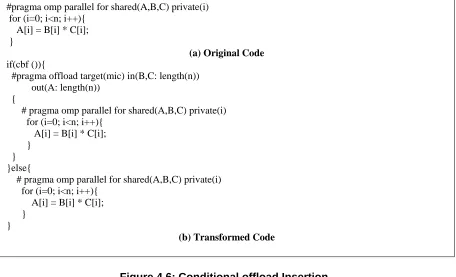
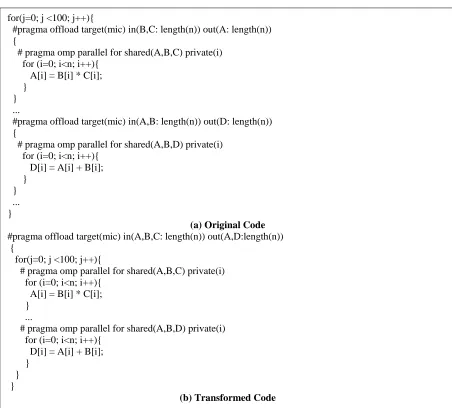
Secondly, similar to GPGPUs, Intel Many Integrated Core (MIC) is attached to the CPU through PCIE slot. Since the memory bandwidth of PCIE is far less than the memory bandwidth inside of Intel MIC, the memory transfer between CPU and MIC can be critical to the performances of MIC programs. We develop one source to source compiler framework, called Apricot [62], to optimize memory transfer between CPU and MIC, therefore improving the performances of MIC programs. To further reduce the workload of application developers, our compiler can also identify profitable code sections using a cost model and automatically insert Language Extensions for Offload (LEO) clauses for these parallel code sections. We evaluate the benchmarks from SpecOMP and NAS parallel suits, and the experiment results show up to 24 times speedup on first MIC prototype Knights Ferry.
Finally, the trend toward to energy efficiency has led to the fused architectures, in which CPUs and GPUs are integrated onto the same chip. In the fused architecture, CPUs and GPUs share the off-chip memory and eliminate the memory transfer between CPUs and GPUs. We model such architecture by integrating a GPU simulator and a CPU simulator with shared L3 cache and off-chip memory. Then we propose a novel way to collaboratively utilize the CPU and GPU resources, called CPU-assisted GPGPU [85]. When a GPU kernel is launched on the GPU, we also start one pre-execution program on the CPU, which is generated using the GPU kernel. Since the CPU pre-execution executes only memory instructions and skips some workload, it can run ahead of the GPU program and fetch the data required by the GPU program in the L3 cache. As a result, the shared L3 cache is warmed up for the GPU program. Our performance results based on the simulation show up to 2.26 times speedup and on average 1.21 times speedup. Furthermore, we discuss other opportunities in the heterogeneous architectures.
1.2 Contributions
This dissertation makes several important contributions to many-core architectures. First, we present one compiler framework to improve the performances of naïve GPGPU programs by applying a set of optimization techniques. Our compiler takes one naïve GPGPU program as the inputs and generates optimized GPGPU programs. A set of scientific and media processing algorithms is used in the experiment. The experiment results show that our compiler can effectively improve the GPGPU programs without the effort of application developers.
Secondly, we develop one source to source compiler to automatically identify parallelizable code regions, insert LEO clauses, and optimize memory transfer between CPU and MIC, therefore improving the overall performances of MIC programs. The experiments with SpecOMP and NAS Parallel benchmarks demonstrate the effectiveness of our compiler.
Finally, using prefetching as one example, we demonstrate that on fused heterogeneous architecture, on which the CPU and GPU are integrated into same chip with shared last level cache, the CPU prefetcher can significantly improve the throughput of GPU programs.
1.3 Outlines
Chapter 2
Background
In this chapter, we first give a brief introduction about the architecture of GPGPU as one example of many-core architecture in Section 2.1. Section 2.2 discusses another many-core prototype Intel MIC. Section 2.3 presents the CPU-GPU fused architecture. We briefly discuss the related work in Section 2.4.
2.1 GPGPU Architecture
Figure 2.1. Overview of GPGPU architecture
GPGPU
SM
Global memory
Constant memory
Texture memory
Local memory
SM
SM
SM
SM
SM
SM
SM
…...
CPU
PCIE
The discrete GPGPUs work as coprocessors attached to CPUs through PCI Express bus as shown in Figure 2.1. Instead of operating on the system memory directly, each GPGPU has own off-chip memory system. If the GPGPU needs to access the data in the system memory, the data has to been first transferred from system memory to GPGPU memory, and vice versa. In order to accommodate both general purpose applications and graphics applications, the GPGPU off-chip memory is partitioned into different memory regions including global memory, constant memory, texture memory and local memory. Each memory region can be accessed by GPGPU cores through different cache hierarchies. Since the global memory is both readable and writeable, and supports large memory space, it is studied mostly in this dissertation. To access the off-chip memory efficiently, both memory latency and memory bandwidth have to been considered carefully. To achieve the high off-chip memory bandwidth, the vectorization as well as memory coalescing are two important techniques for GPUs. To hide the long latency off-chip memory, each GPU can support thousands of threads running concurrently. These threads running on a GPU follow the single-program multiple-data (SPMD) program execution model and are also organized in a hierarchical manner. Multiple threads are firstly grouped into a thread block, and then multiple thread blocks are grouped into a grid. Therefore a GPU kernel is launched to a GPU with a grid of thread blocks (TBs) using the NVIDIA CUDA terminology, which are called workgroups in OpenCL.
critical to the application development. To relieve the workload of application developers, we develop one source to source compiler which can automatically apply a set of optimization techniques based on the aforementioned hardware structure. As a result, the application developers only need to focus on identifying fine-grain thread-level parallelism without proficient understanding of GPU architecture. This work is presented in Chapter 3.
Figure 2.2. The detailed structure of each SM
Current GPUs highly rely on TLP [80] to overcome the data dependency, control hazard and the off-chip memory latency. However the number of concurrent threads (i.e. TLP) can be limited by the aggressive usage of chip resources, such as the register file and shared memory. Among the on-chip resources, the shared memory works as a software-managed cache and plays an important role in optimizing performance of the applications. Application developers use shared memory mainly in three ways: 1) data communication among threads in a thread block as used in the Fast Fourier transform (FFT) [4]; 2) memory coalescing and data cache as used in Matrix Multiplication [56]; 3) array access as used in MarchingCubes [56]. If we ignore the performance impact, all three types of shared memory usage can be replaced with either global memory usage or local memory usage. For example, first the data communication can be implemented through the global memory with correct barrier instructions. Secondly, the un-coalesced memory access doesn’t affect the correctness of the
Streaming Multiprocessor (SM)
Shared memory
L1 cache
Register file
SP
SP
SP
……
SP
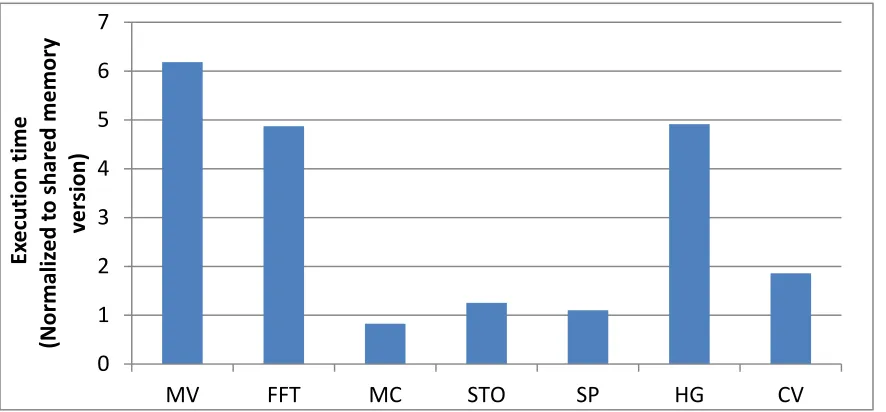
program. Therefore the shared memory usage for coalesced memory access can be removed by using un-coalesced memory access. Thirdly, as the alternative to shared memory, either local memory or global memory can be accessed as one array using array index. As off-chip memories, local memory and global memory, have long access latency. But they can be cached using the hardware-managed L1 cache to improve the performance. To investigate the benefit of the shared memory, we remove the shared memory usage from seven benchmarks and report the execution time of each benchmark in Figure 2.3. The detailed methodology and benchmark descriptions can be found in Section 5.3. Since the execution time in Figure 2.3 is normalized to the original execution time of each benchmark using shared memory, we can see that the shared memory is effective for almost all the benchmarks except MC. In Chapter 5, we will further characterize the share memory usage of each benchmark and discuss how we can improve the performance of the GPU program, which uses the shared memory intensively and therefore has the limited TLP.
Figure 2.3. The performances of GPU programs after removing the share memory usage
0
1
2
3
4
5
6
7
MV
FFT
MC
STO
SP
HG
CV
Ex
ecu
tion
ti
me
(N
or
ma
liz
ed
to s
ha
red
memor
y
ver
si
on
In order to accommodate the GPGPU architecture, the CUDA programming model is proposed to release the capability of GPGPUs to application developers. Next, we use one code example to illustrate the CUDA programming model as shown in Figure 2.4. First each GPU program consists of two parts: the host program running on a CPU and the device function, also called kernel function running on a GPU. Since a GPU works as a coprocessor, i.e. a GPU program cannot run standalone, we need to setup the GPU program using a CPU program. In the Figure 2.4a, the CPU program first allocates three memory arrays on the GPU using the first three lines. Then in the line 4 and 5, the data in the array A and B that are allocated in CPU memory, will be transferred to d_A and d_B in GPU memory, respectively. In line 6 of Figure 2.4a, the GPU kernel function is called with thread block configurations and function. Finally, the result of GPU computing is transferred back to CPU memory in line 7. We also show the kernel function in Figure 2.4b, in which each thread first computes it thread id in line 3 and performs the addition operation in line 4.
Figure 2.4. CUDA code example
(b) Device function of Vector-Add (a) Host code of Vector-Add 1. cudaMalloc((void**)&d_A, size);
2. cudaMalloc((void**)&d_B, size); 3. cudaMalloc((void**)&d_C, size);
4. cudaMemcpy(d_A, A, size, cudaMemcpyHostToDevice); 5. cudaMemcpy(d_B, B, size, cudaMemcpyHostToDevice); 6. VecAdd<<<n/256, 256>>>(d_A, d_B, d_C);
7. cudaMemcpy(h_C, C, size, cudaMemcpyDeviceToHost)
1. __global__ void VecAdd(const float* A, const float* B, float* C) 2. {
3. int i = blockDim.x * blockIdx.x + threadIdx.x; 4. C[i] = A[i] + B[i];
2.2 Intel MIC
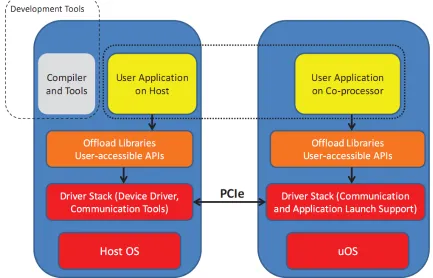
Many Integrated Core Architecture (MIC), officially named as Xeon Phi, is released as the successor of Intel Larrabee and targeted at the supercomputing market. As a competitor of GPGPUs, Intel MIC is also capable of teraflops computation power and hundreds of gigabytes memory bandwidth by employing the many-core architecture. Similar to GPGPUs, Intel MIC has own device memory, and it is also connected to the CPU through the PCIE bus, therefore requiring explicit memory transfer between a CPU and a MIC. The microarchitecture of Intel MIC, however, is more close to the traditional CPUs rather than GPUs, even though each MIC device has many in-order cores as GPGPUs. The core of a MIC is very different from the SM of a GPU. First, each MIC core has been deployed a Vector Processing Unit (VPU) and 32 512-bit vector registers. New 512-bit wide SIMD vector instructions are supported to utilize the VPU, while GPUs explore the warp/wavefront level execution to deliver multiple flops in each cycle. Secondly, each SM of a GPU can support thousands of threads, and high level TLP is preferred to achieve high performance. But a MIC core can support only four hardware threads, and therefore single thread optimization is more critical. Thirdly, Intel MIC relies on the large shared L2 cache (up to 32M bytes) for the efficient utilization of off-chip memory bandwidth, while GPUs have smaller L2 cache (768K bytes on NVIDIA GTX 480) and employ techniques including data vectorization and memory coalescing, to achieve high memory bandwidth.
Figure 2.5 Code example for Intel MIC
Next we briefly introduce the programming model of Intel MIC also using Vector-Add as shown in Figure 2.5. Compared with the openmp program, the difference of the code in Figure 2.5 is the
#pragma offload target(mic) in(A,B:length(n)) out(C:length(n)) {
#pragma omp parallel for shared(A,B,C) private(i) for (i=0; i<n; i++){
C[i] = B[i] + A[i]; }
pragma started with “#pragma offload”. Such pragma indicates that the code section will be executed in the MIC. The in clause in the pragma means the array A and B need to be copied to MIC device, and the size of data to be transferred is specified by length keyword. In contrast, the out clause is used to copy data from MIC device to CPU memory. The parallelization of the MIC program relies on the openmp programming model so as to minimize the change of legacy code. In order to adapt legacy programs to the MIC and utilize the MIC efficiently, we need to answer following questions: 1) which code section should be selected to be executed on MIC device; 2) how can we generate the offload pragma automatically; 3) how we optimize the memory transfer between the CPU and the MIC. As will be seen in Chapter 4, we address these issues by developing our compiler framework.
2.3 CPU-GPU Fused Architecture
In order to achieve the energy efficiency, instead of building high performance GPGPUs, another trend is to integrate a GPU and a CPU into single chip. In such fused architectures including AMD accelerated processing unit (APU) and Intel Sandy Bridge, a CPU and a GPU share the same off-chip memory, and therefore the memory transfer between the CPU and the GPU can be eliminated. In AMD APU architecture, the GPU has the same microarchitecture of discrete GPGPUs, but has reduced number of Computer Units (CUs) running at the lower frequency to save area and energy consumption. Intel Sandy Bridge provides a unified last level L3 cache, which is not available in AMD APU. But current GPU of Intel Sandy Bridge doesn’t support either CUDA or OpenCL languages for general purpose computation. In Chapter 6, we propose CPU-assisted GPGPU based on our modeled fused CPU-GPU architecture, in which the CPU and GPU share both last level cache and off-chip memory.
2.4 Related Work
Chapter 3
A GPGPU Compiler for Memory
Optimization and Parallelism
Management
3.1 Introduction
The high computational power and affordability of state-of-art graphics processing units (GPU) have made them the first widely accessible parallel computers with teraflops capability. To fully realize the power of general purpose computation on graphics processing units (GPGPU), two key issues need to be considered carefully: (1) how to parallelize an application into concurrent work items and distribute the workloads in a hierarchy of thread blocks and threads; and (2) how to efficiently utilize the GPU memory hierarchy, given its dominant impact on performance. As these two issues usually coupled together and finding an optimal tradeoff between different levels of parallelism and memory optimizations requires detailed understanding of GPU hardware, developing high performance GPGPU programs remains challenging for application developers. Furthermore, GPU hardware architectures are evolving rapidly, which makes the code developed and tuned for one generation (e.g., NVIDIA GTX 8800) less optimal for the next one (e.g., NVIDIA GTX280). Our envisioned solution to these problems is to let application developers identify fine-grain thread-level parallelism and/or data-level parallelism and to use an optimizing compiler to perform memory and parallelism optimizations. This way, we leverage the algorithm-level expertise of application developers and at the same time relieve them of low-level hardware-specific performance optimizations.
fine-grain work item is the computation of a single data element in the output domain. The compiler analyzes the naïve kernel, checks the off-chip memory access patterns, and optimizes the memory accesses through vectorization and coalescing to achieve high data access bandwidth. Then the compiler analyzes data dependencies and identifies possible data sharing across threads and thread blocks. Based on data sharing patterns, the compiler intelligently merges threads and/or thread-blocks to improve memory reuse through the register file and the on-chip shared memory. These merges provide a novel way to achieve loop tiling and unrolling by aggregating fine-grain work items into threads and thread blocks. Additionally, the compiler schedules the code to enable data prefetching so as to overlap computation with memory access latencies. To avoid partition camping [67] (i.e., to distribute memory traffic evenly across memory partitions), thread blocks are checked for their memory accesses and depending on the thread block dimensions, either an address offset is inserted or the block identifiers (ids) are remapped, if necessary. The compiler also performs hardware-specific tuning based on hardware parameters such as the register file size, the shared memory size, and the number of cores in the target GPU.
Besides the aggressive compiler optimizations, another distinguishing feature of our compiler is that the optimized code is reason-ably understandable compared to the code generated using algebraic frameworks such as polyhedral models [61]. As a result, it is relatively easy to reason about the optimized code generated by our compiler, which facilitates algorithm-level exploration.
In our experiments, we used the compiler to optimize 10 scientific and image processing functions. The experimental results on NVIDIA 8800 GTX and NVIDIA GTX 280 GPUs show that our optimized code can achieve very high performance, either superior or very close to the NVIDIA CUBLAS 2.2 library and up to 128X over the naïve implementation.
The remainder of the chapter is organized as follows. In Section 3.2, we present a brief background on the NVIDIA CUDA programming model [51] and highlight key requirements for high performance GPU computation. In Section 3.3, we present our pro-posed optimizing compiler in detail. Section 3.4 explores the design space of our propose optimizations. A case study of matrix multiplication is presented in the Section 3.5 to illustrate the compilation process. The experimental methodology and results are presented in the Section 3.6. In Section 3.7, we highlight the limitations of the proposed compiler. Related work is discussed in Section 3.8. Finally, Section 3.9 concludes our chapter and discusses future work.
3.2 Background
In this section, based on the GPGPU background introduced in Chapter 2, we summarize the key aspects for high performance GPGPU code as they are the main focus of our proposed compiler optimizations.
1. Off-chip memory access bandwidth. To utilize the off-chip memory bandwidth efficiently, memory accesses need to be coalesced and each data item may need to be a vector type, depending on specific GPU hardware. Memory coalescing refers to the requirement that the accesses from 16 consecutive threads in a warp (i.e., a half warp) can be coalesced into a single contiguous, aligned memory access [51]. In this chapter, we refer to such a coalesced contiguous, aligned region as a coalesced segment. If each memory access is of the type ‘float’, each segment starts from an address which is a multiple of 64 bytes, and has the size of 64 bytes. The memory bandwidth utilization may be significantly improved when each of coalesced memory accesses is of a vector data type, such as float2 (a vector of two float numbers) and float4 (a vector of four float numbers). For ATI/AMD HD 5870, the sustained bandwidth reaches 71GB/s, 98GB/s, and 101GB/s when accessing 128MB data using the float, float2, and float4 data types, respectively. In comparison, for the same data transmission on NVIDIA GTX 280, the sustained bandwidth is 98GB/s, 101GB/s, and 79GB/s using the float, float2, and float4 data types, respectively.
3. Balanced resource usage. As multiple threads in the same thread block and multiple thread blocks compete for limited resources in an SM, including the register file, the shared memory, and the number of the thread contexts being supported in hardware, we need to carefully balance parallelism and memory optimizations.
4. Off-chip memory partitions. In current GPUs, off-chip memory is divided into multiple partitions. There are 6 and 8 partitions in GTX8800 and GTX280, respectively, and the partition width is 256 bytes. To use the partitions effectively, the memory traffic should be evenly distributed among all the partitions. Otherwise, the requests may be queued up at some partitions while others are idle. This is referred to as partition camping [67] or partition conflicts, which are similar to bank conflicts at shared memory but incur much higher performance penalties. Since concurrent memory requests are issued on a per half-warp basis from all active thread blocks, partition conflicts happen across different thread blocks.
Note that the key performance issues listed above are not unique to current GPUs. Future many-core architectures will probably use similar approaches to achieve high memory bandwidth (i.e., coalescing, multiple memory partitions) and to reduce memory access latency (i.e., on-chip software managed cache or shared memory). So, the proposed compiler optimizations are expected to be relevant beyond the scope of GPGPU.
3.3 An Optimizing GPGPU Compiler
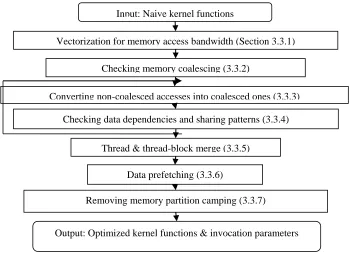
Our proposed compiler framework is shown in Figure 3.1. The input to our compiler is a naïve GPU kernel function, which is functionally correct, but does not include any device-specific performance optimizations. For many scientific computing and media processing functions, the naïve version is simply the code to compute one element/pixel in the output matrix/image. Typically such code is straightforward to extract from the sequential CPU code. One common example is the loop body from a heavily executed loop. In Figures 3.2a and 3.2b, we show the sample naïve kernel functions for the matrix multiplication (mm) and matrix-vector multiplication (mv) algorithms, respectively. Each computes one element at the position (idx, idy).
In comparison, the CUDA predefined ‘threadIdx.x’ and ‘threadIdx.y’ are the relative thread position/coordinate within a thread block and we refer to them as ‘tidx’ and ‘tidy’ for short. Both tidx and tidy are independent of the thread block ids.
As can be seen from the two examples, the naïve kernel functions don't have any shared memory usage and do not require thread block partition. In other words, we may simply assume every block only has one thread. All the arrays are initially in the off-chip global memory.
For applications which require synchronization among computing different output pixels, e.g., reduction operations, a global sync function is supported in the naïve kernel.
Figure 3.1. The framework of the proposed compiler
To facilitate compiler optimizations, the following (optional) information can be conveyed using the ‘#pragma’ interface: the size of the input and output dimensions, and the output variable names. The
Input: Naive kernel functions
Checking memory coalescing (3.3.2)
Converting non-coalesced accesses into coalesced ones (3.3.3)
Checking data dependencies and sharing patterns (3.3.4)
Thread & thread-block merge (3.3.5)
Data prefetching (3.3.6)
Output: Optimized kernel functions & invocation parameters Vectorization for memory access bandwidth (Section 3.3.1)
latter can be used to eliminate global memory writes to temporary variables when they are moved to shared memory.
Given the naïve kernel function, the compiler takes the following steps to generate the optimized kernel code. First, depending on the targeted GPUs, the compiler attempts to group memory accesses into vector data accesses. Secondly, the off-chip memory accesses are checked to see whether they satisfy the requirements for memory coalescing. If not, the code will be converted to coalesced memory accesses using shared memory as temporary storage. Thirdly, the compiler analyzes data dependencies and sharing patterns to determine how the data are shared among the neighboring thread blocks. Based on data sharing patterns, the compiler merges both threads (i.e., combining several threads in different thread blocks into one) to enable the data reuse through registers and thread blocks (i.e., combining several blocks into one) to increase data reuse through shared memory. The data reuse information is also used to disable certain memory coalescing transformations when there is little or no data reuse. After thread/thread-block merge, the compiler schedules the code to perform data prefetching. Then, the compiler checks the memory accesses from different thread blocks for partition camping and either inserts address offsets or remaps thread block ids, if necessary. Finally, the compiler generates the optimized kernel and the parameters (i.e., the thread grid & block dimensions) to invoke the kernel function.
The optimization process described above can also be used as a generic methodology to guide manual optimizations of GPGPU programs. As a result, our optimized code is reasonably understandable, as will be seen in the remainder of Section 3.3.
3.3.1 Vectorization of Memory Accesses
replaces the original array accesses with f2.x and f2.y. This rule is essentially designed for applications using complex numbers when the real part is stored next to the imaginary part of each data element. Note that this vectorization of data accesses is simpler than classical vectorization. For AMD/ATI GPUs, due to the much more profound impact on bandwidth, the compiler is more aggressive and also groups data accesses from neighboring threads along the X direction into float2/float4 data types. The tradeoff of vectorization of data accesses is that if the vector data accesses are not coalesced (Section 3.3.2) and the compiler converts them into coalesced ones (Section 3.3.3) through shared memory, there may be bank conflicts. For AMD/ATI GPUs, the benefits of vectorization far overweigh the penalties of shared memory bank conflicts. For NVIDIA GPUs, however, the benefits from vectorization are limited. Therefore, the compiler skips these additional steps to vectorize data accesses.
Figure 3.2. Examples of naive kernel functions.
3.3.2 Checking Memory Coalescing
As discussed in Chapter 2, GPGPU employs the SPMD model and the threads in a single warp execute the kernel function in the SIMD mode. Therefore, in order to determine whether off-chip memory accesses can be coalesced, we need to compute the addresses of each memory access in the kernel function for different threads. As arrays are the most common data structure in scientific and media processing, we consider four types of array indices and affine transformations of these indices: 1. Constant index: the constant value is used in an array index, for example, the constant integer ‘5’
in ‘a[idy][i+5]’.
(b) A naïve kernel for matrix-vector (a) A naïve kernel for matrix
float sum = 0;
for (int i=0; i<w; i++)
sum+=a[idy][i]*b[i][idx]; c[idy][idx] = sum;
float sum = 0;
2. Predefined index: the predefined numbers, such as absolute thread ids, idx, idy, and relative thread ids, tidx (i.e., threadIdx.x), tidy (i.e., threadIdx.y), are used as an array index. For example, ‘idy’ in ‘a[idy][i+5]’.
3. Loop index: a loop iterator variable is used as an array index, for example, ‘i’ in ‘b[i][idx]’ in Figure 3.2a.
4. Unresolved index: an array index is used, which is not one of the first three types. For example, an indirect access ‘a[x]’ where ‘x’ is a value loaded from memory. As our compiler cannot determine the addresses of such indices, we simply skip them without checking whether they can be coalesced.
Among the four types of indices, the addresses corresponding to the first two are fixed for a given thread. For the third, however, we need to check different values of the loop iterator. Assuming that a loop index starts from S with increment Incr, then we need to check the index addresses from the first 16 iterations: S, S+Incr, S+2*Incr, to S+15*Incr. The reason is that the same behavior repeats for remaining iterations in terms of whether the access can be coalesced as the difference in addresses is a multiple of 16.
After determining the types of array indices in the kernel function, for each memory access instruction, the compiler computes the addresses from the 16 consecutive threads in the same warp (i.e., a half warp) to see whether they can be coalesced. As discussed in Section 3.2, if we assume the array type of ‘float’, the coalesced accesses will form a coalesced segment, which starts from an address, whose value is a multiple of 64, and has the size of 64 bytes. Among the addresses from the 16 threads, we refer to the smallest one as the ‘base address’. The differences between the base address and the addresses from the subsequent 15 threads are referred to as ‘offsets’. To satisfy the coalescing requirement, the base address needs to be a multiple of 64 and offsets need to be 1 to 15 words. The following two rules are used to handle common array accesses.
When a loop index is used in the kernel function, the compiler computes the base address and the offsets for each possible value of the loop iterator. For example, for the address ‘a[idy][i]’ in Figure 3.2a, the base address is ‘&a[idy][0]’ when the iterator ‘i’ is 0; ‘&a[idy][1]’ when ‘i’ is 1, etc. The offsets are all zeros as the addresses do not change for different threads in the same half warp. As both the base addresses and the offsets do not meet the condition, the array access ‘a[idy][i]’ is not coalesced. For the array access ‘b[i][idx]’ in Figure 3.2a, the base address is ‘&b[0][0]’ when ‘i’ is 0; ‘&b[1][0]’ when ‘i’ is 1, etc.. The offsets are from 1 word to 15 words. Thus, the array access ‘b[i][idx]’ is coalesced as long as each row of array b is aligned to the multiple of 16 words. For the array access ‘b[idx+i]’, although the offsets satisfy the condition for every possible ‘i’, it is not a coalesced access since the base address is not always a multiple of 16 words, e.g., ‘b[1]’ when ‘i’ is 1.
3.3.3 Converting Non-Coalesced Accesses into Coalesced Ones
After the compiler analyzes every array access in the kernel code, the compiler converts the non-coalesced accesses into non-coalesced ones through shared memory. The observation here is that for each non-coalesced memory access instruction, the compiler can determine the coalesced segments that contain the data required by the non-coalesced memory accesses from the half warp. The compiler then introduces shared-memory array variables, inserts statements (coalesced memory accesses) to initialize the shared memory variables, and replaces the original global memory accesses with shared memory accesses. The thread block size is also set to 16 so that each thread block contains one half warp. The ‘syncthreads’ function is also inserted to ensure the proper access order.
determine whether this transformation is beneficial or not. If it is not, the compiler will skip coalescing transformation on this access. In the special case where an array access involves both ‘idx’ and ‘idy’, such as ‘A[idx][idy]’, the compiler analyzes the feasibility to exchange ‘idx’ and ‘idy’ to make it coalesced. This transformation is equivalent to loop interchange on the CPU code.
Figure 3.3. Coalesced kernels generated by the compiler.
For array accesses using a loop index, ‘A[m*i+n]’, where ‘i’ is the loop iterator and m and n are constants, the compiler unrolls the loop for 16/(GCD(m,16)) times if m is less than or equal to 8. If m is greater than 8, the coalesced access has little benefit due to limited reuse across different iterations. Then, the compiler groups the accesses from unrolled loops into coalesced ones. For example, for the array access ‘A[idy][i]’ where ‘i’ is the loop iterator, the segment ‘A[idy][0:15]’ contains all the required data for the first 16 iterations. The compiler unrolls the loop for 16 times, introduces shared memory variable sA[0:15] which are initialized with A[idy][tidx+i] (coalesced as the increment of ‘i’ is 16 after unrolling), and replaces ‘A[idy][i]’ with ‘sA[i]’.
(b) The coalesced mv kernel (a) The coalesced mm kernel
(S0)for (i=0; i<w; i=(i+16)) { (S1) __shared__ float shared0[16];
(S2) shared0[(0+tidx)]=a[idy][((i+tidx)+0)]; (S3) __syncthreads();
(S4) for (int k=0; k<16; k=(k+1)) {
(S5) sum+=shared0[(0+k)]*b[(i+k)][idx]); (S6) }
(S7) __syncthreads(); (S8)}
(S9)c[idy][idx] = sum;
(S0) for (i=0; i<w; i=(i+16)) { (S1) __shared__ float shared2[16]; (S2) __shared__ float shared1[16][17]; (S3) shared2[(0+tidx)]=b[i+tidx]; (S4) for (l=0; l<16; l=(l+1)) (S5) shared1[(0+l)][tidx]= a[((idx-tidx)+l)][(i+tidx)]; (S6) __syncthreads();
(S7) for (int k=0; k<16; k=(k+1)){
(S8) sum+=(shared1[tidx][k]*shared2[k]); (S9) }
(S10) __syncthreads(); (S11) }
For the naïve kernels in Figure 3.2, the coalesced versions are shown in Figure 3.3. The inner loop with the iterator ‘k’ is a result of unrolling the outer loop with the iterator ‘i’. In the naïve kernel in Figure 3.2a, the access ‘a[idy][i]’ is not coalesced, which results in loop unrolling as described above. ‘b[i][idx]’ is coalesced and it transforms to ‘b[(i+k)][idx]’ due to unrolling for ‘a[idy][i]’. In the mv kernel in Figure 3.2b, both accesses ‘a[idx][i]’ and ‘b[i]’ are not coalesced. Converting the access ‘b[i]’ into coalesced accesses involves a loop unrolling of 16 (=16/GCD(1,16)) times and it becomes ‘b[i+tidx]’ in Figure 3.3b. For the access ‘a[idx][i]’ the loop with the iterator ‘l’ is introduced and the access is transformed to ‘a[(idx-tidx)+l][i+tidx]’. In addition, the compiler may add padding to the shared memory arrays to avoid bank conflicts and padding to input data arrays to ensure that the row size of each array is a multiple of 16 words so as to meet the requirement of memory coalescing. After memory coalescing, the kernel code generated by our compiler has the following characteristics: 1. Each thread block has 16 consecutive threads (i.e., only a half warp) along the X direction, because 16 threads are needed by hardware to coalesce memory accesses and they communicate with each other through shared memory. The number of threads in each thread block will be expanded during the next optimization phase (Section 3.3.5) to make sure there are enough threads in each thread block.
2. There are two types of global memory load statements: (a) Global memory to shared memory (G2S): the statements read data from global memory and store them into the shared memory, such as (S2) in Figure 3.3a. (b) Global memory to register (G2R): the statements read data from global memory and save them to registers. For example, in (S5) in Figure 3.3a, the global memory access ‘b[(i+k)[idx]’ loads the data into registers.
3.3.4 Data Dependencies and Data Sharing
compiler implementation mainly focuses on checking data sharing among neighboring thread blocks and also the thread blocks with a fixed stride along the X or Y direction.
Figure 3.4. Improve memory reuse by merging neighboring thread blocks.
Figure 3.5. The kernel function for matrix multiplication, after merging blocks along the X direction.
Shared Data
Segment
Thread
Thread block after thread-block merge
…
…
…
…
Thread block before merge
Thread block before merge
int i = 0; float sum = 0;
for (i=0; i<w; i=(i+16)) { __shared__ float shared0[16];
if (tidx<16) { /*inserted due to block merge to remove redundant loads */ shared0[(0+tidx)]=a[idy][((i+tidx)+0)];
}
__syncthreads(); int k;
for (k=0; k<16; k=(k+1)) {
sum+=shared0[(0+k)]*b[(i+k)][idx]); }
__syncthreads(); }
The data sharing/reuse information is also used to determine whether the code conversion for memory coalescing is beneficial. As described in Section 3.3.3, shared memory is used as temporary storage to achieve memory coalescing. The data in the shared memory, however, may not be useful as they are simply loaded from off-chip memory to satisfy the coalescing requirement. For example, the compiler loads A[idy][0:15] in order to convert the access A[idy][0] into a coalesced one. Currently, our complier employs a simple rule to check whether an access needs to be converted: if the loaded data in shared memory have no reuse, it is not converted. A more crafted heuristic may further rank code conversions for different accesses by comparing their shared memory usage and number of data reuses, and then select the most beneficial ones if shared memory is used up. We left such investigation as our future work to refine our compiler framework.
3.3.5 Thread/Thread-Block Merge to Enhance Memory Reuse
Figure 3.6. Improve memory reuse by merging threads from neighboring thread blocks.
After detecting that there exists data sharing among thread blocks (mainly neighboring blocks), we propose two new techniques to enhance data sharing so as to reduce the number of global memory
Thread Thread block before merge
Thread block after thread merge
Thread block before merge
Shared Register Shared Data Segment
…
accesses: merging thread blocks and merging threads. Thread-block merge determines the workload for each thread block while thread merge decides the workload for each thread. These two techniques combined are essentially a way to achieve loop tiling and unrolling by aggregating the fine-grain work items into threads and thread blocks. We first present the two techniques and then discuss how compiler prioritizes one over the other.
3.3.5.1 Thread-block merge
When our compiler determines that multiple thread blocks share some common data, it may choose to merge them into one thread block, as shown in Figure 3.4.
To illustrate the procedure to merge thread blocks, we show how our compiler combines two neighboring blocks along the X direction into one. First, the compiler re-computes the thread id information within the thread block (i.e., tid). As two thread blocks along the X direction are merged, idx, idy and tidy remain the same while tidx is re-computed as (idx%(N*blockDim.x)), where N is 2 for Figure 3.4. Secondly, for the statements that result in data sharing, we add control flow to ensure that the global memory data are loaded only once. For the matrix multiplication example in Figure 3.3a, the statement S2 in threads from two neighboring thread blocks accesses the same segment. Therefore, we add an ‘if (tidx < blockDim.x)’ statement to eliminate redundant global memory accesses, as shown in Figure 3.5. Thirdly, the thread block dimension is resized (blockDim.x = 2*blockDim.x).
As thread-block merge determines the workload for each thread block and all threads in the same thread block reuse data in shared memory, it essentially achieves loop tiling for locality and parallelism optimizations.
3.3.5.2 Thread merge
effects of loop unrolling. Note that thread merge also combines multiple thread blocks into one but it does not increase the number of threads in each thread block.
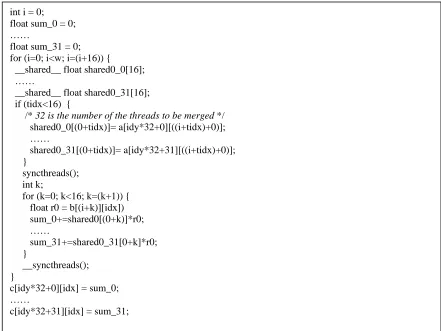
Figure 3.7. The matrix multiplication kernel after merging 32 threads in 32 adjacent blocks along the Y direction.
To illustrate the procedure to merge threads, we show how our compiler combines N neighboring blocks along the Y direction into one. First, the compiler re-computes the thread id information. As we merge threads from two thread blocks along the Y direction, the absolute thread ID along the X direction ‘idx’ remains the same while the thread ID along the Y direction ‘idy’ will be changed to
int i = 0; float sum_0 = 0; ……
float sum_31 = 0; for (i=0; i<w; i=(i+16)) { __shared__ float shared0_0[16]; ……
__shared__ float shared0_31[16]; if (tidx<16) {
/* 32 is the number of the threads to be merged */ shared0_0[(0+tidx)]= a[idy*32+0][((i+tidx)+0)]; ……
shared0_31[(0+tidx)]= a[idy*32+31][((i+tidx)+0)]; }
syncthreads(); int k;
for (k=0; k<16; k=(k+1)) { float r0 = b[(i+k)][idx]) sum_0+=shared0[(0+k)]*r0; ……
sum_31+=shared0_31[0+k]*r0; }
__syncthreads(); }
c[idy*32+0][idx] = sum_0; ……
idy*N, idy*N+1, idy*N+2…, idy*N+(N-1) for the N replicated statements. The thread id information within a thread block remains the same. Secondly, for the statement that results in data sharing, we need only one copy. Thirdly, for the control flow statement such as loops, we also only need one copy. Fourth, for the remaining statements including data declaration, ALU computation statement and other memory access statements, we replicate them for N times. For the matrix multiplication example in Figure 3.5, the array access ‘b[(i+k)][idx]’ results in the shared data among the thread blocks along the Y direction (as the access address is not dependent on ‘idy’). The compiler merges 32 neighboring blocks along the Y direction using thread merge, as shown in Figure 3.7.
3.3.5.3 Selection between thread merge and thread-block merge
As discussed in Section 3.3.3, the code generated by the compiler after memory coalescing has two types of global memory accesses: global to shared memory (G2S) and global to register (G2R). If data sharing among neighboring blocks is due to a G2S access, the compiler prefers thread-block merge to better utilize the shared memory. When data sharing is from a G2R access, the compiler prefers to merge threads from neighboring blocks due to the reuse of registers. If there are many G2R accesses, which lead to data sharing among different thread blocks, the register file is not large enough to hold all of the reused data. In this case, thread block merge is used and shared memory variables are introduced to hold the shared data. In addition, if a block does not have enough threads, thread-block merge instead of thread merge is also used to increase the number of threads in a block even if there is no data sharing.
3.3.6 Data Prefetching
Data prefetching is a well-known technique to overlap memory access latency with computation. To do so, the compiler analyzes the memory accesses in a loop and uses a temporary variable to prefetch data for the next iteration before the computation in the current loop. The process is illustrated in Figure 3.8. The code before insertion of prefetching is in Figure 3.8a and Figure 3.8b shows the code after insertion. Besides the temporary variable, additional checking is added to ensure that the prefetching access does not generate unnecessary memory accesses.
Figure 3.8. A code example to illustrate data prefetching.
3.3.7 Eliminating Partition Camping
In this step, the compiler reuses the address access patterns obtained for thread/thread-block merge to see whether they lead to partition camping. As neighboring thread blocks along the X direction are likely to be active at the same time, the compiler focuses on the addresses that involve blockIdx.x or bidx in short. Those accesses without involving bidx either access the same line in the same partition (e.g., A[0]) or access the same partition at different times (e.g., A[bidy][0] based on the assumption that thread blocks with different bidy will execute at different times). The following rules are followed by our compiler.
Partition Camping Detection: If an array access involves bidx, the compiler checks the address stride between the two accesses from the two neighboring blocks (i.e., one with block id bidx and the other with bidx+1). The compiler detects partition camping if the stride is a multiple of (partition size * number of partitions). For example, for an array access A[idx], it is equivalent to A[bidx*blockDimx+tidx]. The stride between two neighboring blocks is blockDimx, whose value then decides whether there are partition conflicts (i.e., two concurrent accesses to the same partition).
(b) After inserting perfetching (a) Before inserting perfetching
for (i=0; i<w; i=(i+16)){ __shared__ float shared0[16];
shared0[(0+tidx)]=a[idy][((i+tidx)+0)]; __syncthreads();
int k;
for (k=0; k<16; k=(k+1)) {
sum+=(shared0[(0+k)]*b[(i+k)][idx]); }
__syncthreads(); }
/* temp variable */
float tmp = a[idy][((0+tidx)+0)]; for (i=0; i<w; i=(i+16)) { __shared__ float shared0[16]; shared0[(0+tidx)]=tmp; __syncthreads();
if (i+16<w) //bound check
tmp = a[idy][(((i+16)+tidx)+0)]; int k;
for (k=0; k<16; k=(k+1)) {
sum+=(shared0[(0+k)]*b[(i+k)][idx]); }
Partition Camping Elimination: If an access results in partition conflicts, depending on how thread blocks are organized, we use two ways to eliminate partition conflicts:
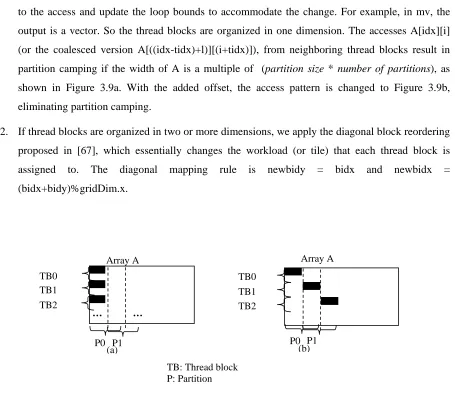
1. If thread blocks are arranged in one dimension, we add a fixed offset, (the partition width * bidx), to the access and update the loop bounds to accommodate the change. For example, in mv, the output is a vector. So the thread blocks are organized in one dimension. The accesses A[idx][i] (or the coalesced version A[((idx-tidx)+l)][(i+tidx)]), from neighboring thread blocks result in partition camping if the width of A is a multiple of (partition size * number of partitions), as shown in Figure 3.9a. With the added offset, the access pattern is changed to Figure 3.9b, eliminating partition camping.
2. If thread blocks are organized in two or more dimensions, we apply the diagonal block reordering proposed in [67], which essentially changes the workload (or tile) that each thread block is assigned to. The diagonal mapping rule is newbidy = bidx and newbidx = (bidx+bidy)%gridDim.x.
Figure 3.9. Eliminating partition camping. (a) Accesses to array A resulting in conflicts at partition 0. (b) Adding an offset as (partition size * bidx) eliminates the conflicts. The dark regions represent the memory footprint of A[idx][0] from different
thread blocks.
TB0 TB1 TB2
Array A
P0 P1 P0 P1
… …
(a) (b)
TB0 TB1 TB2
TB: Thread block P: Partition
3.4 Design Space Exploration
3.4.1 The Number of Threads in A Thread Block
Figure 3.10. The performance impact (GTX 280) of the number of merged threads/thread blocks. ‘xN_yM’ means that N thread blocks merged along the X
direction and M threads merged along the Y direction.
3.4.2 Hardware Specification
GPU hardware is evolving rapidly. Although different generations of GPU hardware may share similar architecture, e.g., NVIDIA GTX8800 and GTX280, there are significant changes, e.g., the register file size, which may have a strong impact on performance. When there are more registers, more threads can be put into one block or one thread can use more registers for temporary data. As a result, an optimized code tuned for one GPU generation may not be optimal for the next. To solve this problem, our compiler generates different versions of optimized code based on different machine descriptions so that they can be deployed on different GPU platforms.
3.5 Case Study: Matrix Multiplication
Matrix multiplication (mm) is a commonly used algorithm and there has been continuing effort to improve its performance [77]. The fine-tuned implementation in NVIDIA CUBLAS 1.0 has a throughput of 110 GFLOPS when computing the product of two 2kx2k matrices on GTX 8800. In CUBLAS 2.2, a more optimized version is implemented based on the work of Vasily et. al. [77],
0 50 100 150 200 250 300 350 400
1kx1k 2kx2k 3kx3k 4kx4k
Pe
rfor
ma
nce
(G
flop
s)
Input matrix size
Matrix multiplication on GTX280
GFLOPS. In this section, we use matrix multiplication as an example to illustrate our compilation process.
The naïve kernel, i.e., the input to our compiler, is shown in Figure 3.2a. In the kernel, there are two input arrays, a and b, from the global memory. The compiler converts the accesses to array a into coalesced ones, as shown in Figure 3.3a. Based on detected data sharing, the compiler determines that neighboring thread blocks along the X direction can be merged to improve reuse of array a and neighboring thread blocks along the Y direction can be merged to improve memory reuse of array b. As the access to array a is a R2S (read-to-shared memory), the compiler chooses to perform thread-block merge. As the access to array b is R2R (read-to-register), the compiler chooses thread merge as discussed in Section 3.3.5. The next question is then how many thread blocks should be merged along either direction? As discussed in Section 3.4, the heuristic is to put at least 128 threads in each thread block and to generate different versions of kernel functions depending on the number of threads/thread blocks to be merged. Figure 3.10 shows the performance effect on GTX 280 of the number of merged threads/thread blocks in either direction. It can be seen that the optimal performance for different sizes of input matrices is achieved with merging 16 thread blocks along the X direction and 16 threads along the Y direction.
Figure 3.11. The speedups of the optimized kernels over the naive ones. (the input to reduction is a vector of 16M floats).
1 2 4 8 16 32 64 128
Input: 4kx4k matrices or 4k vectors
Speedups over naïve kernels
3.6 Experiments
3.6.1 Experimental Methodology
We implemented the proposed compiler framework in Cetus, a source-to-source compiler infrastructure for C programs [44]. The CUDA language support in Cetus is ported from MCUDA [74]. The compiler optimizes the naïve kernel functions of the algorithms listed in Table 3.1, all of which compute a single element at the position (idx, idy). The numbers of lines of code (LOC) of these naïve kernel functions are included in Table 3.1 to illustrate their programming complexity/simplicity. Among the kernels, ‘#pragma’ is used in the reduction kernel to convey the information of input vector length and the actual output to the compiler. The output of our compiler, i.e., the optimized kernel, is compiled by the CUDA compiler, nvcc, to generate the GPU executable file. In our experiments, we used both NVIDIA GTX8800 and NVIDIA GTX280 GPUs with CUDA SDK 2.2 and a 32-bit CentOS 5.2 operating system. Our compiler code, the naïve kernels, and the optimized kernels are available at [31]. The implementation detail of the compiler is introduced in [88].
Table 3.1. A list of the algorithms optimized with our compiler.
Algorithm The size of input matrices/vectors Num. of LOC in the
naïve kernel transpose matrix vector multiplication
(tmv)
1kx1k to 4kx4k (1k to 4k vec.) 11
matrix mul. (mm) 1kx1k to 4kx4k 10
matrix-vector mul. (mv) 1kx1k to 4kx4k 11
vector-vector mul. (vv) 1k to 4k 3
reduction (rd) 1-16 million 9
matrix equation solver (strsm) 1kx1k to4kx4k 18
convolution (conv) 4kx4k image, 32x32 kernel 12
matrix transpose (tp) 1kx1k to 8kx8k 11
Reconstruct image (demosaicing) 1kx1k to 4kx4k 27
find the regional maxima (imregionmax)
3.6.2 Experimental Results
In our first experiment, we examine the effectiveness of our compiler optimizations. Figure 3.11 shows the kernel speedups of the optimized kernels over the naïve ones running on both GTX8800 and GTX 280 GPUs. From the figure, it can be seen that the compiler significantly improves the performance using the proposed optimizations (15.1 times and 7.9 times on average using the geometric mean).
Figure 3.12. Performance improvement along the compilation process.
Figure 3.13. Performance improvement of our optimized kernels over CUBLAS 2.2 implementations on GTX280.
Among the algorithms in Table 3.1, six are implemented in the CUDA CUBLAS library. In the next experiment, we compare our optimized kernel with the highly tuned CUBLAS v2.2 on GTX 280. Figure 3.13 shows the performance comparison of the algorithms with different input sizes. From Figure 3.13, we can see that the kernel optimized by our compiler achieves consistently better performance than CUBLAS 2.2 for transpose matrix vector multiplication (tmv), matrix vector multiplication (mv), vector vector multiplication (vv), and matrix equation solver (strsm) for different
0 2 4 6 8 10 12 14 16
gtx8800 gtx280
Speedups over naïve kernels (4kx4k matrix/vector inputs)
coalescing
thread/thread-block merge
prefetching
partition camping elimination
0.91
1.1 1.2 1.3 1.4 1.5 1.6 1.7 1.8
1.92
1k X 1k 2k X 2kInput matrix size 3k X 3k 4k X 4k
Speedups over CUBLAS2.2
input sizes. For matrix multiplication (mm) and reduction (rd), the performance of our optimized code is very close to CUBLAS 2.2 (within 2% difference). On average (based on the geometric mean), our performance improvement over CUBLAS varies from 26% to 33% for different input sizes.
To study the effect of data vectorization, we chose the reduction (rd) algorithm since rd is the only algorithm in our study that has a corresponding version for complex numbers (CublasScasum) in CUBLAS. We changed the naïve kernel of rd to process complex numbers by using two float-type variables to read the real (A[2*idx]) and imaginary (A[2*idx+1]) parts of a complex number instead of a single float2 variable. Then, we optimized this naïve kernel with and without the data vectorization step. For different input sizes, we compared the performance of the two optimized kernels (labeled ‘optimized_wo_vec’ and ‘optimized’, respectively) and the results are show in Figure 3.14.
Figure 3.14. The effect of data vectorization on reduction with complex number inputs.
0 5 10 15 20 25
1M 2M 3M 4M
Pe
rfor
ma
nce
(G
FL
OPS
)
Input : 1 million to 4 million complex numbers
Reduction on GTX280
Figure 3.15. Performance comparison between CUDA SDK and our optimized kernel on matrix transpose.
From Figure 3.14, we can see that data vectorization significantly improves the performance. One reason is the improved memory bandwidth due to the use of float2 data types as discussed in Section 3.2. Another reason is the side effect of memory coalescing. Without data vectorization, the compiler recognized that the array accesses to both real and imaginary parts (A[2*idx] and A[2*idx+1]) are not coalesced. So, it uses shared memory as temporary storage to generate coalesced memory accesses as discussed in Section 3.3.3. In comparison, the accesses in the kernel after data vectorization, A[idx], is coalesced. As a result, the data are directly loaded into registers for computation. Although the compiler uses the shared memory to improve memory reuse for both vectorized and un-vectorized versions, there are more shared memory accesses in the un-vectorized kernel ‘optimized_wo_vec’ due to code transformation for coalescing. These extra shared memory accesses contribute to the performance differences between the ‘optimized_wo_vec’ and ‘optimized’ kernels.
Among all the kernels, transpose (tp) and matrix-vector multiplications (mv) exhibit the partition camping problem. Ruetsch and Micikevicius [67] proposed diagonal block reordering to address the issue with transpose and their implementation is included in the latest CUDA SDK. In Figure 3.15, we compare the performance of our optimized kernel (labeled ‘optimized’) with theirs (labeled ‘SDK new’) and we also include the previous CUDA SDK version for reference (labeled ‘SDK prev’). Since tp does not have any floating point operations, the effective bandwidth is used. From Figure 3.15, it can be seen that although our compiler uses the same approach to eliminate partition camping, the remaining optimizations taken by our compiler result in better performance than the version in the latest SDK. 0 10 20 30 40 50 60 70 80 90
2kx2k 4kx4k 6kx6k 8kx8k
Ef fec tive ba nd w id th (G B/ s) Matrix Size
Matrix transpose on GTX280
In mv, the thread blocks are in one dimension. Therefore, diagonal block reordering cannot be applied. Our compiler uses the address offset approach described in Section 3.3.7 and the results are shown in Figure 3.16. It can be seen that for different input sizes, even without partition camping elimination, our optimized kernel (labeled ‘Opti_PC’) already achieves better performance than CUBLAS and eliminating partition camping (labeled ‘optimized’) further improves the performance.
In summary, our experimental results show that our optimizing compiler generates very high quality code and often achieves superior performance even compared to the manually optimized code in CUDA CUBLAS and SDK.
Figure 3.16. Performance of mv using the naïve kernel, the optimized kernel without partition camping elimination (labeled ‘Opti_PC’), the optimized kernel, and CUBLAS.
3.7 Limitations
Although the proposed compiler can dramatically improve the performance over naïve kernel functions, the fundamental limitation is that it cannot change the algorithm structure. Instead, our compiler can be used to facilitate algorithm-level exploration. The reasons are two-fold. First, developers can leverage our aggressive compiler optimizations so that they do not need to optimize their implementations of each candidate algorithm. Secondly, the relatively good understandability of our optimized code may give a hint of what algorithms are better suited. Taking 1D fast Fourier transform (FFT) as an example, when the naïve kernel (50 lines of code) simply uses 2-point FFT in
0 10 20 30 40 50
2kx2k 2kx4k 2kx8k 2kx16k 2kx32k 2kx64k 4kx4k 3kx3k
GFLO
PS
Matrix size
Matrix vector multiplication on GTX 280
each step of the Cooley–Tukey algorithm [19], the throughput is 24 GLOPS for computing the FFT of 220 complex numbers on GTX280. Our compiler optimizes the naïve kernel by merging threads and the resulting kernel computes 8-point FFT in each step, which delivers a throughput of 41 GFLOPS, significantly better than CUFFT 2.2 (26GFLOPS). The compiler generated 8-point FFT version, however, is not as good as a naïve implementation of 8-point FFT (113 lines of code with a throughput of 44 GFLOPS). The reason is that the compiler generated version uses multiple 2-point FFT calculations for an 8-point FFT. On the other hand, as our compiler generated code is reasonably understandable, it serves as a good guideline for algorithm exploration: changing the naïve kernel from 2-point FFT to 8-point FFT, for which the compiler can further optimize the performance to achieve 59 GFLOPS. More elaborate algorithm-level development by Govindaraju et. al. [25] as well as the one used in CUFFT2.3 achieves even higher performance (89 GFLOPS), indicating that our compiler facilitates but cannot replace intelli