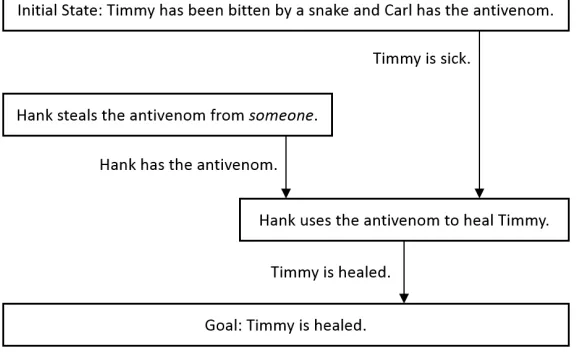
Abstract
WARE, STEPHEN G. A Plan-Based Model of Conflict for Narrative Reasoning and Generation. (Under the direction of R. Michael Young.)
Narrative is one of the fundamental cognitive tools that we use to understand the world around us. When interacting with other humans we rely on a shared knowledge of narrative structure, but in order to enable this kind of communication with digital artifacts we must first formalize these narrative conventions. Narratology, computer science, and cognitive science have formed a symbiotic relationship around this endeavor to create computational models of narrative. These models provide us a deeper understanding of story structure and will enable us to create a fundamentally new kind of interactive narrative experience in which the author, the audience, and the machine all participate in the story composition process.
This document presents a computational model of narrative conflict, its empirical evalua-tion, and its deployment in an interactive narrative experience. Narratologists have described conflict in terms of the difficulties that an intelligent agent encounters while executing a plan to achieve a goal [33, 34]. This definition is inherently plan-based, and has been integrated into an existing model of narrative based on the data structures and algorithms of artificial intelligence planning—the process of constructing a sequence of actions to achieve a goal. The Conflict Partial Order Causal Link (or CPOCL) model of narrative represents the events of a story along with their causal structure and temporal constraints. It extends previous models by representing non-executed actions which describe how an agent intended to complete its plans even if those plans failed, thus enabling an explicit representation of thwarted plans and con-flict. The model also includes seven dimensions which can distinguish one conflict from another and provide authors with greater control over story generation: participants, topic, duration,
balance,directness,intensity, and resolution.
One valuable aspect of plan-based models is that they can be generated and modified au-tomatically. Two story creation methods are discussed: the plan-space CPOCL algorithm that works directly with the rich CPOCL knowledge representation and the state-space Glaive algo-rithm which is significantly faster. Glaive achieves its speedup by incorporating research from fast forward-chaining state-space heuristic search planning and by using the constraints that a valid narrative plan must obey to calculate a more accurate heuristic. Glaive is fast enough to solve certain non-trivial narrative planning problems in real time.
validates the four continuous dimensions—balance, directness, intensity, and resolution—by showing that a human audience ranks static text stories in the same order defined by the formulas for those dimensions.
The final experiment is an evaluation of an interactive narrative video game calledThe Best Laid Plans, which uses Glaive to generate a story at run time from atomic actions and without recourse to pre-scripted behaviors or story fragments. In this game, the player first acts out a plan to achieve a goal and then Glaive coordinates all the non-player characters in the game to thwart the player’s plan. The game is evaluated relative to two other versions: a control in which the other characters do nothing and a scripted version in which the other characters are controlled by programs written by a human author. Players recognize intentionality and conflict in the stories Glaive produces more so than in the control and comparably to the human scripted version.
© Copyright 2014 by Stephen G. Ware
A Plan-Based Model of Conflict for Narrative Reasoning and Generation
by
Stephen G. Ware
A dissertation submitted to the Graduate Faculty of North Carolina State University
in partial fulfillment of the requirements for the Degree of
Doctor of Philosophy
Computer Science
Raleigh, North Carolina
2014
APPROVED BY:
David L. Roberts Mark O. Riedl
James Lester Robert St. Amant
Dedication
Biography
Acknowledgements
I wish to thank the many people without whom this work could never have happened. Brent Harrison and David L. Roberts, thank you for your assistance in designing the experiments in Chapter 4 and for your help analyzing the data. Christian Stith and Phillip Wright, thank you for your help in the development of The Best Laid Plans game used in Chapter 6. To the United States National Science Foundation, thank you for your financial support through the Human-Centered Computing Program, Grant IIS-0915598: Plan-Based Models of Narrative Structure for Virtual Environments.
To my parents, Steve and Helen Ware, you sacrificed so much to give me the financial and educational opportunities to get to graduate school. More importantly, you taught me to work hard, to think hard, to never give up, and to believe in my own self-worth. You taught me the really important things that get me out of bed in the morning and so much more than you give yourselves credit for.
The person who made the greatest impact on my scientific career is Dr. R. Michael Young, my advisor and mentor. Michael, you taught me to be a scientist and how to thrive in academia through your advice and your example. Most importantly, you taught me to pursue with great passion the problems that interest me and to pursue them because they are interesting and because of what they can tell us about the human mind. In the day to day grind, it is easy to forget the long term goals or to settle for those results which are easy to obtain. You inspired me never to lose sight of the noble purpose of scientific research.
I also wish to thank my committee for their support and guidance. Dr. David L. Roberts, you taught me experimental design and honored me by making me feel like a colleague. Dr. Mark O. Riedl, you paved the way for this work through your own research and your encourage-ment when I was just beginning. Dr. James Lester, you lent me your encyclopedic knowledge of our field and showed me by example a truly exemplary scientific career. Dr. Robert St. Amant, you taught me to love artificial intelligence, and you showed me that a planner can be both sophisticated and elegant.
All my teachers have played a part in my success, but some stand out in my memory. Ann Stevens and Lyla Marinelli, you were the first to make me love science. Katie King, you taught me to keep working on something until I’m happy with the result. Dr. David Brooks, you taught me most of what I know about pedagogy. Dr. William T. Cotton, you whet my appetite for graduate-level research. Dr. Carla Savage and Dr. Nagiza Samatova, you initiated me into the central mysteries of computer science.
me love philosophy and the human mind in the long debates that made our college nights so memorable. Brent Harrison, you single-handedly taught me more about computer science and experimental design than anyone else. I would not have survived my first year of graduate school without you. Rogelio E. Cardona Rivera, you continuously inspire me with the scope of your knowledge and your passion for research. Justus Robertson, you were the other half of many of the most interesting conversations I had in graduate school. You have all impacted me with your knowledge, but more importantly you have been the best friends I have ever had the privilege to know. I am also deeply indebted and forever grateful to all the member of the Liquid Narrative Group, past and present.
Table of Contents
List of Tables . . . .viii
List of Figures . . . ix
Chapter 1 Introduction . . . 1
1.1 Plan-Based Models of Narrative . . . 2
1.2 Thesis . . . 2
1.3 Roadmap . . . 3
Chapter 2 Related Work . . . 5
2.1 Conflict in Fiction . . . 5
2.2 Conflict in Interactive Narrative and Story Generation . . . 7
2.3 Story Metrics . . . 9
2.4 AI Planning . . . 9
2.5 Context of this Work . . . 12
Chapter 3 The CPOCL Model of Conflict . . . 14
3.1 Example Story World . . . 16
3.2 Representing Conflict in Partial Order Causal Link Plans . . . 20
3.2.1 The Classical POCL Model . . . 20
3.2.2 The Intentional Plan Model . . . 23
3.2.3 The Conflict Plan Model . . . 26
3.3 The Expressivity of Conflict Plans . . . 30
3.4 Seven Dimensions of Narrative Conflict . . . 34
3.4.1 Participants . . . 36
3.4.2 Topic . . . 36
3.4.3 Duration . . . 37
3.4.4 Balance . . . 38
3.4.5 Directness . . . 39
3.4.6 Intensity . . . 39
3.4.7 Resolution . . . 40
Chapter 4 Evaluation of the CPOCL Model . . . 43
4.1 Validating Participants, Topic, and Duration . . . 44
4.1.1 Inter-Subject Agreement . . . 46
4.1.2 Subject Agreement with CPOCL . . . 50
4.1.3 Discussion . . . 53
4.2 Validating Balance, Directness, Intensity, and Resolution . . . 55
4.2.1 Analysis . . . 61
4.2.2 Inter-Subject Agreement . . . 62
4.2.3 Subject Agreement with CPOCL . . . 64
4.2.4 Discussion . . . 64
Chapter 5 Planning Algorithms Supporting Conflict . . . 67
5.1 The CPOCL Algorithm . . . 68
5.1.1 CPOCL Flaws and How They Are Repaired . . . 70
5.1.2 Example . . . 71
5.1.3 Differences Between IPOCL and CPOCL . . . 74
5.2 The Glaive Planner . . . 75
5.2.1 Intentional State-Space Planning . . . 75
5.2.2 The Glaive Heuristic . . . 78
5.2.3 Possible Worlds and Conflict . . . 85
5.2.4 Example . . . 88
Chapter 6 Evaluation of the Glaive Planner . . . 91
6.1 Computational Efficiency . . . 92
6.1.1 Benchmark Problems . . . 92
6.1.2 Results . . . 94
6.2 Narrative Generation inThe Best Laid Plans . . . 96
6.2.1 Game Design . . . 96
6.2.2 Experimental Design . . . 103
6.2.3 Results . . . 105
6.2.4 Discussion . . . 107
Chapter 7 Conclusion . . . .110
7.1 Summary . . . 110
7.2 Limitations and Future Work . . . 111
7.3 Closing Remarks . . . 113
References. . . .114
Appendix . . . .120
Appendix A Planning Domains and Problems . . . 121
A.1 Aladdin . . . 121
A.2 Heist . . . 125
A.3 Western . . . 133
A.4 Fantasy . . . 137
A.5 Space . . . 141
A.6 Raiders . . . 145
List of Tables
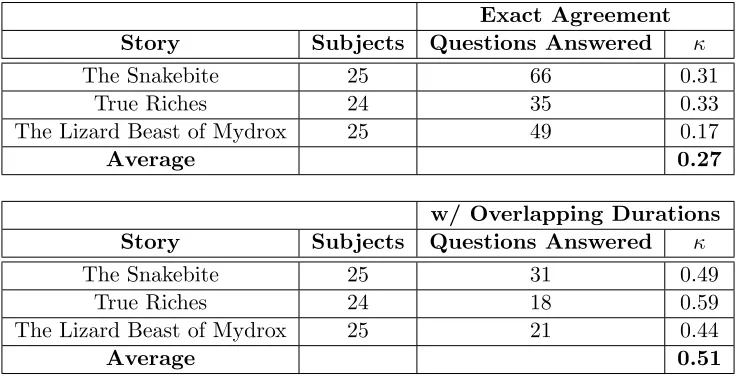
Table 4.1 Inter-subject agreement for the experiment in Section 4.1 . . . 49
Table 4.2 Threshold values for each story . . . 50
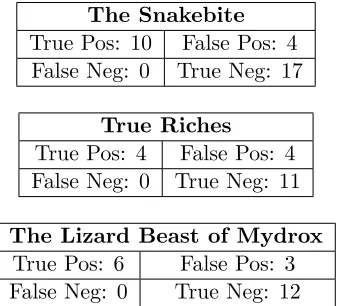
Table 4.3 CPOCL’s confusion matrices for the first task in Section 4.1 . . . 51
Table 4.4 CPOCL’s summary statistics for the experiment in Section 4.1 . . . 52
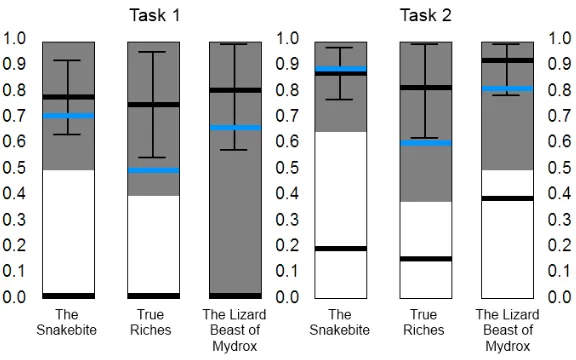
Table 4.5 CPOCL’s performance vs. the baseline for the second task in Section 4.1 . . . 53
Table 4.6 Bhattacharyya distances between ideal and observed distributions in the ex-periment in Section 4.2 . . . 64
Table 4.7 Most popular orderings of the stories used in the experiment in Section 4.2 . . 64
Table 6.1 Glaive vs. Narrative Fast-Forward on 8 benchmark problems . . . 95
List of Figures
Figure 2.1 An example Partial Order Causal Link plan . . . 10
Figure 3.1 A narrative planning domain for stories in the old American West . . . 17
Figure 3.2 A narrative planning problem for the Western domain in Figure 3.1 . . . 18
Figure 3.3 Seven example solution plans to the Western problem in Figure 3.2 . . . 18
Figure 3.4 A POCL plan for Plan D in Figure 3.3. . . 24
Figure 3.5 An IPOCL plan for Plan D in Figure 3.3 . . . 27
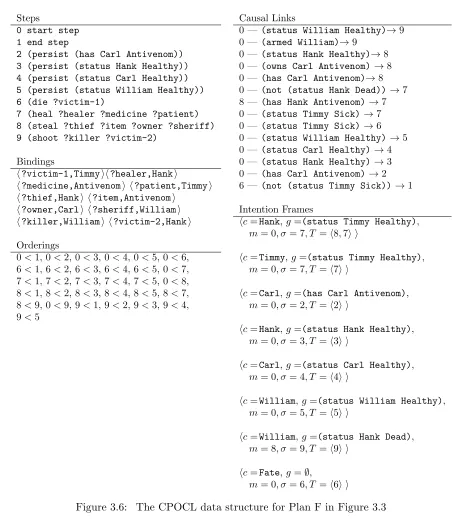
Figure 3.6 The CPOCL data structure for Plan F in Figure 3.3 . . . 31
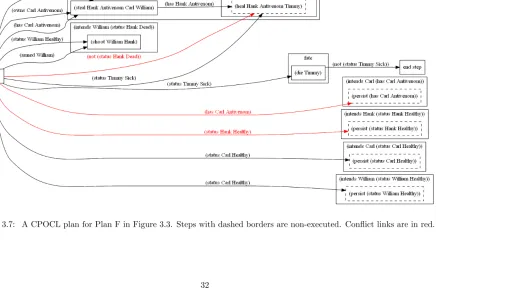
Figure 3.7 A CPOCL plan for Plan F in Figure 3.3 . . . 32
Figure 4.1 Example story “The Snakebite” . . . 45
Figure 4.2 Example story “True Riches” . . . 46
Figure 4.3 Example story “The Lizard Beast of Mydrox” . . . 47
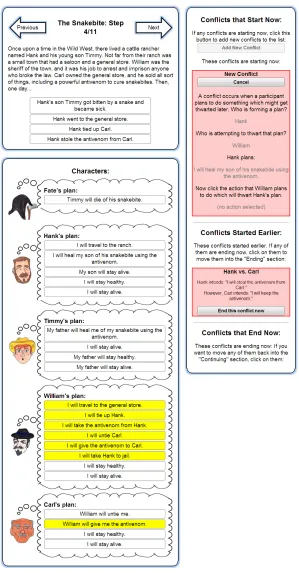
Figure 4.4 The interface for the experiment in Section 4.1 . . . 48
Figure 4.5 CPOCL’s precision vs. the baseline and average subject for the experiment in Section 4.1 . . . 52
Figure 4.6 Visualization of CPOCL’s performance on the second task in Section 4.1 . . . 54
Figure 4.7 The four stories used in the experiment in Section 4.2 . . . 56
Figure 4.8 The Interface for the experiment in Section 4.2 . . . 57
Figure 4.9 The descriptions of dimensions given to human subjects when sorting stories in the experiment described in Section 4.2. . . 59
Figure 4.10 Distributions representing agreement and disagreement for the experiment in Section 4.2 . . . 66
Figure 4.11 Observed distributions for the experiment in Section 4.2 . . . 66
Figure 5.1 One goal graph for the example problem in Figure 3.2 . . . 80
Figure 5.2 A plan graph for the example problem in Figure 3.2 . . . 81
Figure 5.3 Possible worlds for the example problem in Figure 3.2 . . . 86
Figure 6.1 Map of locations inThe Best Laid Plans . . . 97
Figure 6.2 Actions available to the player in The Best Laid Plans . . . 98
Figure 6.3 A screenshot demonstrating the interface of The Best Laid Plans . . . 99
Figure 6.4 The client / server architecture ofThe Best Laid Plans . . . 100
Figure 6.5 Example transcript between The Best Laid Plans client and server . . . 101
Figure 6.6 Responses to two questions designed to measure perception of intentionality and conflict . . . 106
Chapter 1
Introduction
Narrative is one of the fundamental cognitive tools that we use to understand the world around us. We choose the content and structure of the narratives we tell to others based on our communicative goals, and in turn we have expectations about the content and structure of the narratives we are told. When interacting with other humans we rely on a shared knowledge of these protocols, but in order to enable this kind of communication with digital artifacts we must first formalize these narrative conventions.
Narratology, computer science, and cognitive science have formed a symbiotic relationship around this endeavor to create computational models of narrative. Narratology observes nor-mative features of human storytelling which can be formalized and implemented by computer science and used by cognitive science to investigate the role those norms play in human thought. This process is not a pipeline but a cycle—each part making contributions to and prompting further investigation by the others—by which we slowly illuminate the complex mental machin-ery of human storytelling. The process is inherently valuable because of what we learn about our minds, our stories, and our cultures. It is also valuable because it allows us to construct complex artificial machinery which can communicate with a human audience using the language of narrative.
ex-periencing. This provides the audience a tailored, context-sensitive experience and expands the expressive capabilities of the author. It is also a more intimate kind of communication. Rather than sharing a single narrative, the author shares a part of his mind, a part that embodies thousands of years of collected knowledge on human storytelling. So the end goal of research in computational models of narrative is not to replace the author with a machine, as some have claimed, but to magnify the participation of the the author, the audience, and the machine in a collaborative and fundamentally human storytelling process.
1.1
Plan-Based Models of Narrative
Narratives are often described as a sequence of causally and temporally related events con-structed by an author for some communicative purpose. It is no surprise, then, that the artifi-cial intelligence paradigm of planning is a popular source of data structures and algorithms for reasoning about stories. Planning is the computational process of constructing a sequence of actions which can be taken by one or more agents to achieve a goal. Plans and the associated planners which produce them provide a computational foundation on which models of narrative can be built and evaluated.
Plans have proven useful for representing both the fabula and syuzhet of a narrative. The
fabula is the complete chronology of events in the story world seen from a god’s eye view, where plans represent the actions each agent takes to achieve its goals. The syuzhet is the telling of the story, a selection of information from the fabula, where plans represent communicative acts taken by the author for some rhetorical purpose. It is often difficult to separate these two layers because they mutually constrain one another, but many computational models focus primarily on one or the other.
Another benefit of plan-based models is that they are generative—that is, they can be used not only to represent and analyze a sequence of events but also to create such a sequence. When evaluating a generative model, it is important to consider both the richness of the knowledge representation and the speed of the algorithms used to construct it. Both are important if the model is to be used in an interactive context, but many plan-based models of narrative have focused on one at the expense of the other.
1.2
Thesis
experiences while carrying out a plan to achieve a goal. This model is inherently plan-based. It reasons about possible worlds where an agent’s plan succeeds or fails and how that plan can be thwarted by other agents or the environment. Specifically, I say that conflict occurs when a character forms a plan that is thwarted by another event in the story, or would have been thwarted if the event had succeeded. The thwarting event can be part of another character’s plan (external conflict), part of the same character’s plan for a different goal (internal conflict), or an accident or force of nature (environmental conflict).
The thesis I advance in this document is as follows: An operationalization of narrative conflict as thwarted plans can be incorporated into a computational model of story fabula which is representationally rich enough that a human audience will perceive conflict just when the model defines it to exist; this model can be generated and adapted by an algorithm which is efficient enough to create stories with recognizable conflicts at run time in an interactive virtual environment.
1.3
Roadmap
This document presents the development of this computational model of narrative conflict. Chapter 2 begins with a narratological discussion of why conflict is an essential element of stories. It also surveys how other computational systems have dealt with conflict and presents background on the planning systems used to create this model.
Chapter 3 describes the knowledge representation in formal detail. It presents the Partial Order Causal Link planning framework on which the model is built, and describes how that framework was extended first by Riedl and Young [62] to include intentionality and then by me to include conflict by representing actions which an agent intended to take but failed to execute. The chapter concludes with a discussion of how the Conflict Partial Order Causal Link (or CPOCL) representation constrains the expressiveness of plans to be more consistent with the narrative expectations of a human audience. Chapter 4 presents an evaluation of the CPOCL representation through two human subjects experiments. These experiments demonstrate that the CPOCL model can be used to predict how humans reason about conflict in static textual narratives.
Glaive has been used to control the plot of an interactive narrative adventure game calledThe Best Laid Plans while the game is being played. A final human subjects experiment demon-strates that players recognize thwarted plans in the plots generated by Glaive more so than in a control and comparably to plots specified by a human author at design time. Chapter 7 concludes the document and discusses the ample opportunities for further development.
Chapter 2
Related Work
This work is inherently interdisciplinary, so relevant material from several fields is surveyed below. This chapter begins with a narratological and psychological discussion of why conflict is important to narrative and what rhetorical purpose it serves. I then discuss how previous narrative generation systems have dealt with conflict and describe other systems which have used quantifiable metrics to evaluate the quality of their stories. I also survey relevant technol-ogy from the classical AI planning community and how it is related to my work. I conclude by situating this work in the field of computational models of narrative.
2.1
Conflict in Fiction
Conflict is a key component of interesting stories. The Routledge Encyclopedia of Narrative Theory[34],A Dictionary of Narratology[59], and theThe Cambridge Introduction to Narrative
[1] provide subtly different definitions, but they all agree that it is essential. Abbott notes that it “is so often the life of the narrative” [1]. Herman goes so far as to declare it a “minimal condition for narrative” [34], while Brooks and Warren even tell us that “story means conflict” [13].
Other scholars analyzing computational storytelling have come to similar conclusions about the centrality of conflict [51, 65, 70, 67, 22, 19, 6, 50]. Szilas, creator of the IDtension narrative system, declares that “the notion of conflict is the core of the drama” [71]. Crawford argues that a narrative game is impossible without a thorough analysis of conflict [22]. Screenwriting handbooks also highlight the importance of a story’s central struggle [24, 78, 36, 17, 74].
even to antiquity:
To me, the amazing thing about [Aristotle’s] Poetics is that for all the aspects of good screenwriting the Poetics addresses, it does not address everything directly. For example, take conflict. Everybody knows conflict is important, and its probably the dominant mode of action. Greek tragedy was loaded with conflict, so it’s safe to say Aristotle assumed (as we can about movie storytelling) that conflict is a given. [74]
Narrative conflict seems to be so ingrained in our social and historical consciousness that critics do not bother to explain it. Unfortunately, machines have no such consciousness to fall back on, so a formal model needs to be distilled. Developing one such formal model is the first step for my work, and the next is to integrate that model into the story generation process.
Conflict serves at least three important purposes in a story. Firstly, it structures the dis-course into a rising action that culminates in a climax (the resolution of a story’s central conflict) and ends with falling action [34]. Chapters and scenes are often organized around a conflict so that its resolution (or lack of resolution) creates a meaningful segmentation of the discourse [1]. Secondly, conflict motivates the action. Stories are commonly described as beginning in a state of equilibrium which is destroyed by some conflict [75]. The characters in the story are motivated by this distrubance to form a plan—that is, to plot—a way of restoring that equi-librium. Thirdly, psychologists studying narrative claim that conflict engages the audience. It causes the audience to ask questions and form expectations about the outcome, which propels them forward through the plot [28, 1]. Readers also experienceanomalous suspense, which is a form of engagement that occurs despite knowing the outcome of the story [28, 17, 1].
Many narratological definitions of conflict focus on the central role of actions, plans, and the thwarting of plans [1, 24, 23, 34]. One such plan-based definition of conflict is given by Herman:
Yet a minimal condition for narrative can be defined as the thwarting of intended actions by unplanned, sometimes unplannable, events, which may or may not be the effect of other participants’ intended actions. This is another way of expressing the intuition that stories prototypically involve conflict. [33]
definition I have chosen to operationalize is this: Conflict occurs when a character forms a plan that is thwarted by another event in the story, or would have been thwarted if the event had succeeded. The thwarting event can be part of another character’s plan (external conflict), part of the same character’s plan for a different goal (internal conflict), or an accident or force of nature (environmental conflict).
2.2
Conflict in Interactive Narrative and Story Generation
Non-interactive narratives, such as oral tradition, books, and films, rely on a human author (or authors) to design story conflicts appropriately for the genre and audience. Interactive narratives must somehow accommodate the intervention of the audience while still maintaining certain narrative properties that are important to the author. Riedl and Bulitko [63] present a framework for classifying interactive narrative systems based on design philosophy, and I will use this framework for a brief survey of how different kinds of systems have handled the problem of conflict.
Most interactive stories designed for commercial systems, such as Choose Your Own Ad-venture books and most narrative-focused video games, are classified as Manually Authored Stories. All possible branches of the story are created by human authors at design time to en-sure that the author’s vision is maintained no matter how the narrative is experienced. These systems rely on the author’s understanding of conflict and story structure. They have the largest authorial burden and are least able to adapt a story to an individual audience.
Hybrid Systems use a combination of human authorship and an experience manager to create an interactive story. The human author generally provides story content in the form of chapters or scenes along with a story graph that formalizes how the audience may move from one plot element to the next. These systems reduce authorial burden and allow a wider variety of stories to arise, but the experience manager is responsible for maintaining the author’s vision, and thus it needs some computational model of the narrative phenomena that the author wishes to create. Roberts and Isbell provide a survey of experience management techniques [64]. Notable systems that explicitly address the problem of conflict include Universe [41] and Mexica [57]. These systems combine pre-scripted plot fragments according to plot grammars to produce whole stories. Both of these systems rely on a human author to encode short-term conflicts into the individual scenes that make up the plot graph [41] and long-term conflicts (e.g. a plot resembling Freytag’s Triangle) into the story graph [57]. These systems have many interesting design features, but they still rely on a human author to create conflict, so the general problem of building plot fragments that contain conflict from atomic actions remains unsolved.
or story world actions. The information provided by the author is more general—usually a domain theory that describes when actions may occur and how they change the world. These systems can produce the widest range of stories, but their experience managers must assume more responsibility for the story’s quality. More general computational models of narrative are needed to ensure that the story generated meets the author’s requirements. The computational model of conflict I describe in this document is intended for use in these kinds of systems. Gerv´as [29] provides a survey of automatic story generators as creative systems. Below I will describe some of the notable systems which have explicitly addressed conflict.
Carbonell [15] described a rule-based system in which agents with conflicting goals reason about how they can interfere with and overcome the plans of their competitors. This kind of reasoning and counter-planning is of interest to narrative generation, but Carbonell’s model is described at a high level of abstraction and he does not present a formal algorithm for generating conflicting plans.
Smith [68] generated conflict in stories using an adversarial game-playing algorithm. This approach oversimplifies the antagonist; which is not simply a malevolent force to make trouble for the protagonist, but a character with its own goals that should thwart the protagonist only when it is properly motivated.
Barber and Kudenko [6] create dramatic tension in their GADIN system with dilemmas— decisions the user must make which will negatively affect at least one character. When the player feels invested in those characters, these conflicts will engage the audience. GADIN detects when these dilemmas are applicable to the story, applies them immediately, and then elicits a resolution from the player. GADIN does not attempt to reason about the role of conflict in the future of the story, making it difficult to model the thematic and extended conflicts that provide important macro-structural narrative features.
Teaching conflict resolution strategies is a central element of the Fearnot! [2] and SIREN [20] narrative systems. Their model of conflict is based on organizational psychology research, as opposed to my narratology-inspired model, so they tend to emphasize different aspects. For example, conflict resolution games designed to teach real-world skills tend to focus on cooperation and compromise, whereas fictional conflicts are more often resolved by competition or trickery.
but also in the planning process to produce those models. Secondly, my work has a specific narrative generation focus and is validated in a narrative context.
2.3
Story Metrics
Many researchers have explored the use of quantifiable metrics to describe properties of stories. Yannakakis [83] provides a survey that measures human perceptions like fun and flow in the context of video games. Peinado and Gervs [55] collected four metrics from human readers evaluating the quality of stories produced by their ProtoPropp system: linguistic quality, co-herence, interest, and originality. My approach to the seven dimensions of narrative conflict differs from these because I attempt to measure story properties apart from their effects on the reader. The dimensions of conflict answer who? what? when? and how? questions and are designed so that readers can agree on their values even when they disagree on more subjective aspects such as how fun or interesting a conflict is.
At least four story systems have reasoned about conflict quantitatively. IDtension [71] assigns each action a “conflict value” for the degree to which a character is forced to act against its moral principles. MEXICA [57] measures the tension a reader perceives at each world state, allowing the system to craft a pattern of rising and falling action. Zambetta, Nash, and Smith [87] specify the ideal amount of conflict in a story as a system of differential equations that simulate an arms race scenario. These approaches are helpful as high-level control for the pace of a story, but do not reason about the individual motivations of the participants.
The AI Director of the game seriesLeft 4 Dead [10] moderates the intensity of conflicts by controlling the number and frequency of enemies, distribution of power-ups, and geography of levels. The director monitors metrics like the player’s health and accuracy to measure stress level and create a series of peaks and valleys in intensity that are similar to popular narratives in its domain. We hope to provide a model which can generalize to many domains, but we plan to use our metrics similarly to these systems, which produce rising and falling story arcs.
2.4
AI Planning
Figure 2.1: An example of an incomplete Partial Order Causal Link plan. Edges represent causal links that describe how the effect of an earlier step satisfies the precondition of a later step. During the plan construction process, this plan would be annotated with a set of flaws that indicate how it is incomplete. These flaws would be fixed one by one until a flawless plan is produced.
what state that world is in initially and specifies a goal that the world should be by the end. The purpose of a planning algorithm, or planner for short, is to solve a planning problem by finding a sequence of actions which achieves the goal. These actions are drawn from the domain but must be fully ground, e.g. “Hank stole the medicine from Carl.” Story generation is the process of findings a sequence of actions involving characters, props, and locations, so planning-based methods have proven a popular foundation for many narrative systems (selected examples include [3, 18, 43, 58, 61, 62, 85, 86]).
narrative teaching environment [72], and the salience of past actions in a story discourse [16]. Many early planning systems, including POCL planners, contained some model of conflict and could reason about these conflicts specifically to remove them from plans. In contrast, my work leverages this representation toretain certain conflicts without sacrificing the plan’s soundness. POCL planning is a kind of refinement search through the space of plans [37]. A partial plan is constructed and annotated with flaws describing how it is incomplete. Search proceeds by iteratively choosing a flaw and repairing it until a flawless (and thus complete) plan is found. The least-commitment nature of POCL search allows the planner to express notions like “someone steals the medicine,” where the variablesomeone is not bound to an actual character until it is needed. Partially-ordered steps and least-commitment variable bindings allow the planner many degrees of freedom during composition, but story evaluation is often made more difficult as a result. The rhetorical effect of “someone steals the medicine” can vary widely depending on when that step occurs and whosomeone is.
Though POCL planning is widely used in narrative modeling because of its helpful knowl-edge representation, such planners are often too slow to generate stories of significant length, and thus their practicality is limited, especially for real time systems. The last two decades of classical planning research have been dominated by forward-chaining state-space heuristic search. The Heuristic Search Planner, or HSP [9], begins at the initial state and moves through the space of states toward a goal state by applying fully ground steps whose preconditions are satisfied by the current state. The HSP heuristic is a domain-independent way to estimate any state’s distance to a goal state. Variants of HSP with improved heuristics and other search enhancements have won the classical deterministic track at the biannual International Planning Competition every year since its inception in 1998, with one exception in 2002 [21]. Forward-chaining state-space planners construct totally ordered plans with no unbound variables. They lack the flexibility of POCL planners, but analyzing the quality of the unfinished story may be easier because all information is known about the story up to the current time (though the ending is still unknown, which can have a significant impact on the meaning of events at the beginning).
The state-space planning community has devoted much effort to the development of accurate heuristics which can be efficiently calculated—indeed, the names of many state-space planning systems are synonymous with the heuristics they use. Notable milestones include Bonet’s HSP [9], Hoffmann and Nebel’s Fast-Forward [35], and Helmert’s Fast-Downward [32] systems, each of which defined a more accurate heuristic that bears the same name as the planning system. In Chapter 5 I will discuss how the constraints of narrative planning problems—specifically the constraint that actions must appear to be goal directed for the characters who take them—can be leveraged to improve these heuristics and thus the search process.
Causal Link (or CPOCL) algorithm, which was developed as a means to generate stories with the rich knowledge representation of POCL plans. The second is a forward-chaining state-space planner named Glaive, which was developed to capitalize on the speed of state-space planners so that it could be used to control the narrative of a real-time interactive system. Both algorithms have different strengths and weaknesses, so both are presented to provide a more complete understanding of how a complex narrative phenomena such as conflict can be integrated into a plan-based model.
2.5
Context of this Work
I will now attempt to contextualize my work in the landscape of other computational models of narrative and narrative generation systems.
This work is founded primarily on narratology, meaning that it attempts to model narra-tive pheomena which have more or less universal applicability. This is opposed to systems (including many drama management systems [64]) which focus on modeling the prefer-ences of an individual user and tailoring a narrative to that user. Obviously this is not a black and white distinction, because one advantage of any generative model is its ability to adapt to an individual player and most drama management systems make use of some general storytelling guidelines. However, my model does not construct a detailed player model to detirmine what kind of story to build; rather it constructs stories according to general principles described by narratology.
I use planning techniques to construct stories from atomic actions. This sets my work apart from systems which rely on preauthored stories, story fragments (e.g. [41]), story grammars (e.g. [12]), and scripts (e.g. [66]). Building stories from atomic pieces allows a high degree of control over the details of the story but is very computationally expensive.
I focus on extensive reasoning about the future to create a whole story, which differentiates this work from reactive planning architectures (e.g. [47]), which wait for certain situations to arise and then respond with pre-programmed scripts.
My planners coordinate the resources in the story toward the author’s goals. This places my work primarily in what Mateas [46] and Riedl and Bulitko [63] call the strong story
Chapter 3
The CPOCL Model of Conflict
Most research in planning to date has been for the purposes of efficiently coordinating real world resources for a single agent or a set of cooperating agents that all pursue the same goal. As we adapt models of planning to represent stories, we must reframe the problem in terms that distinguish between the author’s goals and those of the individual agents, who sometimes cooperate and sometimes compete. Agents must be seen to pursue their own goals in order to seem believable, but the planner as a whole should still direct the story toward the author’s desired outcome [62]. Since conflict is an essential element of interesting stories, we also need a means of modeling failed and thwarted plans. We say that conflict occurs when a character forms a plan that is thwarted by another event in the story, or would have been thwarted if the event had succeeded. This requires counterfactual reasoning—some way of representing other possible worlds. It also requires an explicit representation of how and why a plan fails.
This chapter describes a representation for stories that embodies this thwarted plans def-inition of conflict. It begins with the Partial Order Causal Link (or POCL) representation of plans. The POCL model is a rich data structure for representing a sequence of actions taken to achieve a goal. The events are partially ordered with respect to one another, which means that there are potentially many valid orders that the events could occur in. Causal links explain how the facts established by earlier events satisfy the preconditions of later events. The structures of a POCL plan provide a way to ensure that a plan is valid—that is, guaranteed to achieve a goal.
POCL planning paradigm provides a formal definition for this, called a threatened causal link, specifically so that these violations can be avoided.
My Conflict Partial Order Causal Link (or CPOCL) model leverages this idea of threatened causal links to represent conflict. Key to the thwarted plans definition is the idea of a character forming a plan which fails because some obstacle has made it impossible. But before this defi-nition can be fully realized, the POCL model needs to be extended to include a representation of intentional actions.
Riedl and Young [62] describe a framework for intentional planning which organizes a POCL plan’s events into groups based on character goals. These groups are called intention frames and have four important parts: a character who forms a plan, the goal that character is trying to achieve, something which motivated the character to achieve that goal, and a set of actions taken by the character in service of the goal. An example in text may be helpful here: “When young Timmy was bitten by a snake, his father Hank was motivated to heal him. In order to heal Timmy, Hank robbed the general store to get some medicine and then used that medicine to heal Timmy.” Intentional POCL (or IPOCL) plans are one large plan that is organized into many smaller subplans for each characters that wants to achieve some goal.
This paradigm of intentional planning places additional constraints on which plans can be considered valid. Not only must the goal of the plan be achieved at the end, but all the actions taken by characters must be explained in terms of their personal goals. These constraints ensure that IPOCL plans more closely meet the expectations of the audience when told as a narrative. However, this representation has a significant limitation: every subplan must succeed. In other words, when a character adopts a goal, that character must either succeed in achieving that goal or never form a subplan at all.
The CPOCL model picks up where IPOCL left off. It allows some events in the story to be marked as non-executed events (and assumes that all others are executed). These non-executed events are actions which some character intended to take but failed to take because they were impossible for some reason. The uses of non-executed steps relaxes some of the constraints that IPOCL places on valid plans. In a CPOCL plan, it is acceptable for some causal links to be threatened as long as the later step is non-executed. Because a non-executed step never actually takes place, it does not matter if the causal links that explain the event are violated. Indeed, these threatened causal links allow the model to represent conflict as a data structure. Non-executed steps allow CPOCL to represent failed and partially executed subplans. It also allows a single plan to represent many possible worlds. A failed plan represents another way that the story might have gone—an alternate world. Reasoning about these alternate worlds gives the model additional reasoning power.
kinds of stories which are generated, I also operationalize seven dimensions of narrative conflict from narratology which can be used to distinguish one conflict from another. Three of these dimensions can be directly observed in a CPOCL plan: participants (who is in conflict),topic
(what fact they in conflict over), andduration (how long the conflict lasts). The other four are continuous values that require some additional domain information that is commonly available in narrative virtual environments. Given some way to measure a character’s utility and the likelihood of a plan’s success, I define balance (how closely matched the participants are),
directness (how close the participants are to one another), intensity (how much is at stake), and resolution (the result).
This section presents only the CPOCL model itself—that is, only the data structures used to represent stories. A discussion of the planning process is reserved for Chapter 5.
3.1
Example Story World
For the purposes of illustrating various narrative planning concepts, I have provided a small example domain (Figure 3.1) and problem (Figure 3.2). The syntax is an extension of the Planning Domain Definition Language, or PDDL, a standard in the classical planning commu-nity. This sample setting is intentionally very simple; it is designed to be just large enough to demonstrate each of the features discussed in this section. The story world is set in the old American West. It defines a space of short stories about how a young boy named Timmy is saved (or not saved) from a deadly snakebite. His father, Hank, can save him by stealing antivenom from Carl, the town shopkeeper, but this theft cause sheriff William to hunt down Hank and dispense frontier justice. A detailed explanation of how to read the domain and problem is given below.
Figure 3.1 is the planning domain, which describes all the possible actions that can take place. It begins with a list of :requirementsthat allows a planner to recognize whether or not it implements enough features to reason about this domain. The :typesdefine an ontology of things, withobjectbeing the default supertype of all things. This domain defines three high-level types: status,person, anditem. Asheriffis a specific type ofperson. Amedicineis a specific type of item. This domain defines three:constantswhich must be part of every story world. These three constants are the three kinds of status that a person can have: Healthy,
Sick, and Dead.
The list of :predicates defines which kind of relationships can exist in this story world. The statuspredicate indicates that a person has one of the three possible statuses. The has
(define (domain western)
(:requirements :strips :equality :negative-preconditions :typing :intentionality) (:types status - object
sheriff - person medicine - item)
(:constants Healthy Sick Dead - status)
(:predicates (status ?person - person ?status - status) (has ?person - person ?item - item) (owns ?person - person ?item - item) (armed ?person - person)
(parent ?parent - person ?child - person)) ;;; Action: A person gets bitten by a snake.
(:action snakebite
:parameters (?victim - person) :precondition (status ?victim Healthy)
:effect (and (not (status ?victim Healthy)) (status ?victim Sick)
(intends ?victim (status ?victim Healthy)))) ;;; Action: A sick person dies.
(:action die
:parameters (?victim - person) :precondition (status ?victim Sick)
:effect (and (not (status ?victim Sick)) (status ?victim Dead)))
;;; Action: One person steals an item from another, angering the sheriff. (:action steal
:parameters (?thief - person ?item - item ?owner - person ?sheriff - sheriff) :precondition (and (not (= ?thief ?owner))
(status ?thief Healthy) (owns ?owner ?item) (has ?owner ?item)) :effect (and (not (has ?owner ?item))
(has ?thief ?item)
(intends ?sheriff (status ?thief Dead))) :agents (?thief))
;;; Action: One person uses medicine to heal a sick person. (:action heal
:parameters (?healer - person ?medicine - medicine ?patient - person) :precondition (and (not (status ?healer Dead))
(has ?healer ?medicine) (status ?patient Sick)) :effect (and (not (status ?patient Sick))
(status ?patient Healthy) (not (has ?healer ?medicine))) :agents (?healer ?patient))
;;; Action: One person shoots and kills another. (:action shoot
:parameters (?killer - person ?victim - person) :precondition (and (status ?killer Healthy)
(armed ?killer))
:effect (and (not (status ?victim Healthy)) (not (status ?victim Sick)) (status ?victim Dead)) :agents (?killer)))
(define (problem save-timmy) (:domain western)
(:objects Timmy Hank Carl - person William - sheriff Antivenom - medicine)
(:init ;;; Timmy is dying and wants to get better.
(status Timmy Sick) (intends Timmy (status Timmy Healthy)) ;;; Hank is Timmy’s father. He is armed.
(parent Hank Timmy) (armed Hank) (status Hank Healthy) (intends Hank (status Hank Healthy)) ;;; Hank also wants his son to get better.
(intends Hank (status Timmy Healthy))
;;; Carl is the shopkeeper. He has antivenom which can save Timmy, but wants to keep it. (has Carl Antivenom) (owns Carl Antivenom) (intends Carl (has Carl Antivenom))
(status Carl Healthy) (intends Carl (status Carl Healthy)) ;;; William is the sheriff. He is also armed.
(armed William) (status William Healthy) (intends William (status William Healthy))) (:goal ;;; The author’s goal is for Timmy to be sick no longer.
(not (status Timmy Sick))))
Figure 3.2: A simple narrative planning problem for the Western domain in Figure 3.1 in PDDL (Planning Domain Definition Language) syntax.
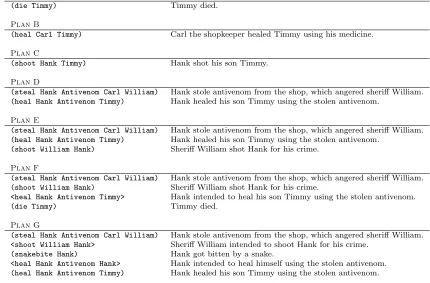
Plan A
(die Timmy) Timmy died.
Plan B
(heal Carl Timmy) Carl the shopkeeper healed Timmy using his medicine.
Plan C
(shoot Hank Timmy) Hank shot his son Timmy.
Plan D
(steal Hank Antivenom Carl William) Hank stole antivenom from the shop, which angered sheriff William.
(heal Hank Antivenom Timmy) Hank healed his son Timmy using the stolen antivenom.
Plan E
(steal Hank Antivenom Carl William) Hank stole antivenom from the shop, which angered sheriff William.
(heal Hank Antivenom Timmy) Hank healed his son Timmy using the stolen antivenom.
(shoot William Hank) Sheriff William shot Hank for his crime.
Plan F
(steal Hank Antivenom Carl William) Hank stole antivenom from the shop, which angered sheriff William.
(shoot William Hank) Sheriff William shot Hank for his crime.
<heal Hank Antivenom Timmy> Hank intended to heal his son Timmy using the stolen antivenom.
(die Timmy) Timmy died.
Plan G
(steal Hank Antivenom Carl William) Hank stole antivenom from the shop, which angered sheriff William.
<shoot William Hank> Sheriff William intended to shoot Hank for his crime.
(snakebite Hank) Hank got bitten by a snake.
<heal Hank Antivenom Hank> Hank intended to heal himself using the stolen antivenom.
(heal Hank Antivenom Timmy) Hank healed his son Timmy using the stolen antivenom.
predicate indicates that one person is the mother or father of another.
Having established a vocabulary, the domain then defines five kinds of actions. The first action describes a ?victim (which must be of type person) getting bitten by a snake. The
:precondition indicates that before this action can occur, the ?victim must be Healthy. After this action occurs, the:effect changes the world in three ways: the?victim’s status is no longerHealthy, the ?victim’s status is Sick and the?victim intends to become Healthy
again. The dieaction has a very similar structure. Before a ?victim can die, he or she must have a status of Sick. After a victim dies, he or she is no longerSick and instead is Dead.
The steal action describes how a ?thiefsteals an ?item from its ?ownerand angers the town ?sheriff. The precondition of this action indicates that the ?thief and the ?owner
may not be the same character. It also specifies that the?thiefmust beHealthy, the?owner
must be the rightful owner of the ?item, and that the ?owner must be in possession of the
?item. After this action, the ?owner no longer has possession of the ?item, the ?thief has possession of the ?item, and the ?sheriff intends that the ?thief be dead. The :agents
keyword indicates that the?thiefmust be an intelligent agent who takes this action for some purpose. In other words, any story which contains a steal action must provide an explanation for why the ?thiefwould want to steal something.
The heal action describes how a ?healer uses some ?medicine to heal a sick ?patient. The ?healer must not be Dead, the ?healer must be in possession of the ?medicine, and the patient must be Sick. After the action, the ?patient is no longer Sick, the ?patient is
Healthy, and the ?healerno longer has the ?medicine. Both the?healer and the?patient
must have a reason to take this action.
The final shoot action describes how a ?killer shoots and kills some ?victim. The
?killer must be Healthy and must be armed. After the action, the ?victim is no longer
Healthy orSick; the?victim isDead. The?killer must have a reason to take this action. The planning problem in Figure 3.2 describes all the people and items in the story world, as well as the initial state that the world is in. There are four people: Timmy,Hank,Carl, and
William. William is also the sheriff (which is a subtype of person). There is one item, the Antivenom which is a kind of medicine. Timmy is a young boy. Initially, he is Sick and he intends to be Healthy again. Hank is Timmy’s father. He is Healthy and armed, and he intends that his son be Healthy. Carl is the town shopkeeper. He is the rightful owner of the
Antivenom and he current has the Antivenom. William is the town sheriff and is also armed. The author’s goal for the story is that Timmyis no longerSick. This can be accomplished two ways: eitherTimmy is healed orTimmy dies.
model described here.
3.2
Representing Conflict in Partial Order Causal Link Plans
A plan is a sequence of steps that describes, in some formal language, how a world transitions from its beginning, or initial state, to its end, or goal state [53]. Classical planning generally uses the language of function-free ground predicate literals. Sometimes it also allows the use of other syntactic niceties such as boolean expressions, first order quantifiers, and conditional effects [81] (for simplicity, the example domain in Figure 3.1 does not use any of these). The various objects in the story world, such as characters, items, and places, are represented as logical constants. Relationships between these objects are described with predicates.
3.2.1 The Classical POCL Model
This section presents the definitions for classical partial order causal link planning on which intentional and conflict planning are built.
Definition 1(state). Astate is a single function-free ground predicate literal or a conjunction of such literals describing what is true and false in a hypothetical story world.
Definition 2 (goal). A goal is a literal or conjunction of literals which must be true in some state.
Definition 3 (planning problem). A planning problem is composed of an initial state, which describes the configuration of the story world before planning begins, and a goal, which must be true in the final state of the story world after the plan has been executed.
Actions that change the world are described using templates. This formalism was originally described by Fikes and Nilsson as STRIPS [26].
Definition 4(operator). Anoperatoris a template for an action which can occur in the world. It is defined as a two-tuple hP, Ei where P is a set of preconditions—literals which must be true before the action can be carried out—and E is a set of effects—literals which are made true after the action is carried out. In the original STRIPS formalism the effects of an operator were divided into an add list and a delete list, but this can be generalized as one set of effects which contains both positive literals (e.g. p) and negative literals (e.g. ¬p).
Definition 5 (parameters). The set of all variables used in an operators preconditions and effects are its parameters. To restrict the search space, a parameter can declare a type that limits which constants can legally be bound to that variable.In Figure 3.1, parameters are represented as tokens beginning with a?, and each parameter’s type appears after the dash.
Definition 6(planning domain). The set of all operators which can be used to solve a problem is that problem’s planning domain.
Definition 7 (step). A step is a ground instance of an operator, i.e. one in which all the operator’s parameters have been bound to constants. A step represents an actual event in the story. The example plans in Figure 3.3 are composed of steps.
Definition 8 (start step). A start step is a special kind of step with no preconditions and effects equal to the initial state of the planning problem. A problem’s start step can be thought of as the first step of every plan for that problem.
Definition 9 (end step). An end step is a special kind of step with preconditions equal to the goals of the planning problem and no effects. A problem’s end step can be through of as the last step of every plan for that problem.
Definition 10(plan). Aplanis an ordered sequence of steps meant to solve a planning problem.
POCL planning operates in a least commitment fashion. When a new step is added to a plan, its parameters are not yet bound to specific constants. This allows a partial POCL plan to express notions such as “Someone healed Timmy using the antivenom” by including an instance of theheal operator but leaving the?healerparameter unbound. During the process of constructing a complete POCL plan, all unbound parameters must eventually be given a binding.
Definition 11 (binding constraint). A binding constraint is a two-tuple hv, ti such that v is a variable corresponding to one parameter in a step, and t is either a constant or another parameter. When tis a constant, the binding constraint indicates that the value of parameter v is that constant. When t is another parameter, the binding constraint indicates that the parameters v and tmust be assigned the same value. Binding constraints are transitive.
In addition to a set of steps,S, POCL plans also have a set of binding constraints,B, which track the values of each step’s parameters. POCL planning also adopts a least commitment approach with regards to the order in which steps are taken.
POCL plans are said to be partially ordered because they contain a set of ordering con-straints, O, which strives to express the minimum number of restrictions on how steps are ordered. In story terms, this means imposing as few constraints as possible on the story’s dis-course. A partially ordered plan represents many possible totally ordered plans—one for each valid topological sort of it steps.
POCL plans also explicitly track how the preconditions of each step are made true by previous steps using causal links. If we imagine a POCL plan as a graph in which the nodes are steps, causal links are labeled edges.
Definition 13 (causal link). A causal link is an edge s−→p u whose tail is a steps with effect p and whose head is a step u with precondition p. A causal link s −→p u implies the ordering constraint s < u.
Adding a causal link to a plan often imposes binding constraints on the parameters of the tail and head steps. For example, say the plan contains an instance of stealsuch as (steal ?thief Antivenom Carl). This step would have the effect (has ?thief Antivenom). Say the plan also contains the step (heal Hank Antivenom Timmy), which had the precondition
(has Hank Antivenom). A causal link can be drawn from steal toheal with the label (has Hank Antivenom), but only if we impose the binding constraint h?thief,Hanki. This logical unification process is that of finding a most general unifier, orMGU, which is described in more detail by Weld [81].
POCL plans maintain a set of causal links, L, to explain how the preconditions of each step become satisfied. The ordering constraints implied by causal links, as well as any other ordering constraints imposed on the plan, make the set of steps into a directed acyclic graph.
Definition 14 (causal parents and children). If there exists a causal link s−→p u, then the step sis said to be the causal parent of stepu. Step uis said to be the causal child ofs.
Definition 15 (causal ancestors and descendents). A step’s causal ancestors are all steps in the the transitive closure of the causal parent relationship. A step’scausal descendents are all steps in the transitive closure of the causal child relationship.
Definition 16(POCL plan). Apartially ordered causal link plan, orPOCL plan, is a four-tuple hS, B, O, Li, such that S is a set of steps, B is a set of binding constraints on the parameters inS,O is a set of ordering constraints that defines a partial ordering of the steps in S, andL is a set of causal links between the steps in S.
Definition 17 (threatened causal link). A causal link s−→p u is a threatened causal link when there exists a step t with effect ¬p such that the ordering s < t and t < u are valid in some total ordering of the steps s, t, and u. In other words, step t could possibly undo the effect p of stepsbefore it is needed by step u.
Definition 18 (valid POCL plan). A POCL plan is said to be valid if (1) every parameter of every step is bound to a constant, (2) for every total ordering of its steps, each step’s preconditions are met immediately before it is taken, and (3) the goal is true after all steps have been taken.
Causal links and threatened causal links were originally designed to reason about what constraints has to be placed on a plan to ensure that it would succeed. Weld [81] provides sufficient conditions for the validity of a POCL plan in terms of causal links:
Theorem 19. A POCL plan is valid if (1) for every precondition p of every step u∈S, there exists a causal links−→p u from some steps, and (2) none of the causal links inLare threatened [81].
Note that a threatened causal link is something to be avoided or eliminated in a POCL plan. One of the key extensions I make to this representation is a way to preserve certain threatened causal links while still guaranteeing that the plan will achieve its goal.
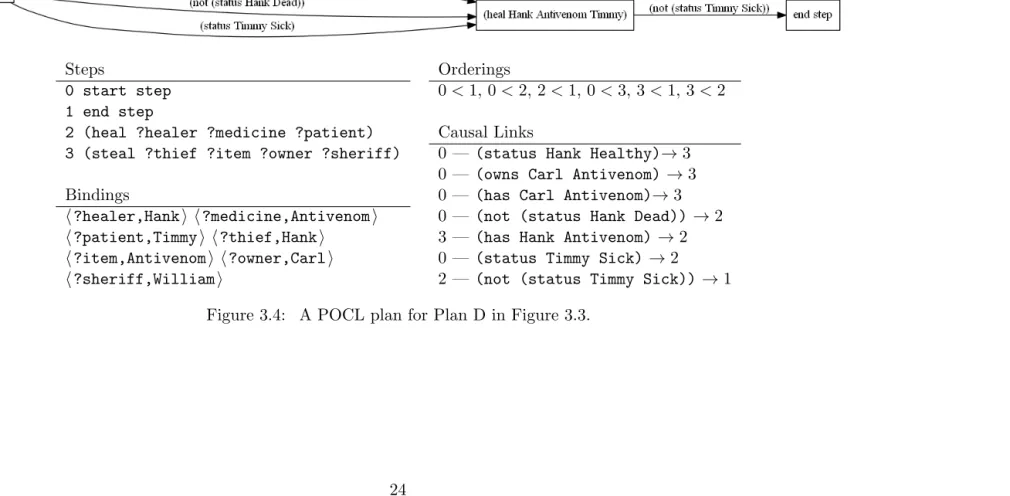
An example of a valid POCL plan is given in Figure 3.4. First, Hank steals the Antivenom from Carl, then Hank uses that Antivenom to heal Timmy. Note the causal link that runs from
stealtoheal. It explains how the earlierstealstep satisfies a precondition of the later heal
step, namely that Hank must have the Antivenom. Because a causal link implies an ordering constraint between its steps, the stealstep must occur before the heal step.
3.2.2 The Intentional Plan Model
Intentional planning augments the knowledge representation of classical planning to incorporate the goals of individual characters in order to increase the appearance of character believability [62].
Definition 20 (character). Some set of story world constants are designated as characters, intentional agents which should be seen to pursue their own goals.
Steps Orderings
0 start step 0<1, 0<2, 2<1, 0<3, 3<1, 3<2
1 end step
2 (heal ?healer ?medicine ?patient) Causal Links
3 (steal ?thief ?item ?owner ?sheriff) 0 —(status Hank Healthy)→3 0 —(owns Carl Antivenom) →3
Bindings 0 —(has Carl Antivenom)→3
h?healer,Hanki h?medicine,Antivenomi 0 —(not (status Hank Dead)) →2 h?patient,Timmyi h?thief,Hanki 3 —(has Hank Antivenom) →2 h?item,Antivenomi h?owner,Carli 0 —(status Timmy Sick) →2
h?sheriff,Williami 2 —(not (status Timmy Sick)) →1
Definition 22 (intentional step). An intentional step is a ground instance of an intentional operator.
Definition 23(happening). An intentional step for whichC =∅, i.e. a step with no consenting characters, is called ahappening. Happenings represent accidents and the forces of nature. Start steps and end steps are happenings.
Definition 24(motivation). Amotivationis a modal predicate of the form(intends ?character ?goal)where?characteris a character and?goalis a ground predicate literal that the char-acter wishes to make true. Motivations may appear in the effects of intentional operators (and thus also in the effects of intentional steps) and in a problem’s initial state (and thus also in the effects of start steps).
Definition 25(intentional parents and children). An earlier stepsis said to be theintentional parent of a later stepufor charactercif stepsis the causal parent ofu,c∈C fors, andc∈C for u. In other words, s is the causal parent of u and the steps share a consenting character. Stepu is said to be the intentional child of steps for characterc.
Definition 26 (intentional ancestors and descendents). A step’s intentional ancestors are all steps in the the transitive closure of the intentional parent relationship. A step’s intentional descendents are all steps in the transitive closure of the intentional child relationship.
Intentional planning defines structures calledintention frames that explain how a character adopts a goal, pursues that goal, and then eventually achieves it.
Definition 27(motivating step). Amotivating step for charactercand goalgis an intentional step whose effects contain the motivation (intends c g). A motivating step describes how a character came to adopt a goal.
Definition 28(satisfying step). Asatisfying stepfor a charactercand a goalgis an intentional step which requires the consent of c and whose effects contain g. A satisfying step describes how a character achieved a goal.
Definition 29 (subplan). A character c’s subplan to achieve some goal g is a set of steps T such thatT contains a satisfying stepσ for charactercand goal g, and every other step inT is an intentional ancestor of σ. Another equivalent way to express this definition is thatT must contain a satisfying step σ, every other step in T must be the causal parent of σ, and every step in T requires the consent of character c.
step for c and g, σ is a satisfying step for c and g, and T is a subplan for c and g such that σ∈T. All steps inT must be ordered after the motivating stepm. The steps inT are said to be members ofT’s intention frame.
Definition 31 (IPOCL plan). An intentional partial order causal link plan, or IPOCL plan, is a five-tuple hS, B, O, L, Ii such that S is a set of intentional steps, B is a set of binding constraints, O is a set of ordering constraints, L is a set of causal links, and I is a set of intention frames.
The process of intentional planning is that of organizing a plan’s steps into intention frames to ensure that every step can be explained in terms of the motivations of the characters who take them. When a step that requires the consent of some character is not a member of any intention frame for that character, the plan is incomplete.
Definition 32 (orphan). An intentional step is anorphan if it has cas a consenting character but is not a member of any intention frame for characterc.
Definition 33(valid IPOCL plan). An IPOCL plan isvalid if it is valid according to Definition 18 and it contains no orphans [62]. In other words, for every total ordering of intentional steps (1) every parameter of every step is bound to some constant (2) the preconditions of every step are satisfied before the step is taken, (3) the resulting state of the story world after all steps have been taken is a goal state, and (4) for every charactercwhich must consent to a steps,s is the intentional ancestor of some satisfying step for one ofc’s goals.
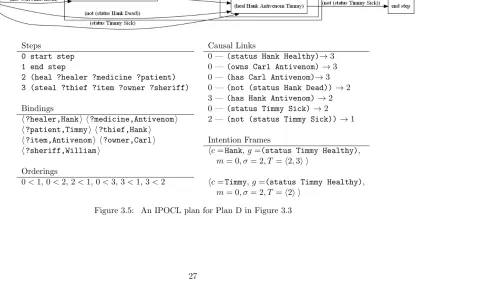
An example valid IPOCL plan is given in Figure 3.5. In terms of the steps it contains, this plan is identical to the POCL plan in Figure 3.4: First Hank steals the Antivenom and then he uses it to heal Timmy. Note the addition of the intention frames which make this an IPOCL plan. The first frame describes Hank’s subplan to heal his son. It is motivated by the start step (in other words, before the story starts). It is eventually satisfied by theheal step, which achieves Hank’s goal. The steal step is also part of this frame because it is the intentional ancestor of the satisfying step—in other words, there is a causal link running from steal to
heal that helps to explain how Hank was able to achieve his goal. Recall that the heal step requires the consent of two characters: the healer and the person being healed. That means that there must also exist a second intention frame to explain why Timmy allowed Hank to heal him. Timmy allowed that to happen because it was in service of his goal to be healthy again.
3.2.3 The Conflict Plan Model
Steps Causal Links
0 start step 0 — (status Hank Healthy)→3
1 end step 0 — (owns Carl Antivenom) →3
2 (heal ?healer ?medicine ?patient) 0 — (has Carl Antivenom)→3
3 (steal ?thief ?item ?owner ?sheriff) 0 — (not (status Hank Dead))→2 3 — (has Hank Antivenom)→2
Bindings 0 — (status Timmy Sick)→2
h?healer,Hanki h?medicine,Antivenomi 2 — (not (status Timmy Sick))→1 h?patient,Timmyi h?thief,Hanki
h?item,Antivenomi h?owner,Carli Intention Frames
h?sheriff,Williami hc=Hank,g=(status Timmy Healthy), m= 0, σ= 2, T =h2,3i i
Orderings
0<1, 0<2, 2<1, 0<3, 3<1, 3<2 hc=Timmy,g=(status Timmy Healthy), m= 0, σ= 2, T =h2i i
capture how the subplans of characters interfere with one another. One of the key extensions to the intentional representation is that steps in a plan can be marked as either executed or non-executed.
Definition 34 (executable step). An executable step is a ground instance of an intentional operator. It is a four-tuplehP, E, C, xiwhereP,E, andCare defined as for the step’s operator, and xis a boolean flag that is true if the step is an executed step and false if the step is a non-executed step.
Note that this definition overrides the previous definition of step (Definition 7) by adding the boolean flag that indicates whether or not the step is executed. This notion of executed and non-executed steps should not be confused with the notion of “steps already executed” and “steps not yet executed” when carrying out a plan. A non-executed step is one whichwill never be executed. Non-executed steps exist to track what a character intended to do but did not succeed in doing. Happenings (steps not intended by any character) require some special reasoning.
Definition 35 (executable happenings). For each happening h (including the start and end steps),hmust be an executed step, and there must exist an intention frame whose character is f ate, whose goal is∅, whose motivating step is the start step of the plan, whose satisfying step is h, and for whom T = {h}. In other words, each happening is assigned to its own intention frame intended byf ate.
This convention of assigning happenings to their own special intention frames forf ateexists to simplify the definition of conflict, which occurs between two intention frames. Otherwise, special cases would need to be defined any time a happening is involved in a conflict.
By allowing the subplans of some characters to contain non-executed steps, we can ensure that each character’s subplans are consistent while still allowing some subplans to fail. In addition to subplans that change the world, we also need a way to represent the desire that things remain the same. For example, all characters in the example problem begin alive and wish to remain alive. We can accomplish this using non-executed steps.
Definition 36 (persistence step). A persistence step is a non-executed step with a single precondition g, a single effect g, and a single consenting character c. All persistence steps are ordered to occur simultaneously with the plan’s end step.
remain true. These causal links (more specifically, threats to these causal links) can be used to represent conflict.
The introduction of non-executed steps into the model has implications for causal and intentional relationships. A non-executed step cannot be the causal parent of an executed step. This is because a non-executed step will never actually occur, therefore its effects cannot be used to satisfy the preconditions of events that will occur. This implies that a non-executed step cannot be the intentional parent of an executed step. Similar implications apply to the causal child, intentional child, causal ancestor, intentional ancestor, causal descendent, and intentional descendent relationships.
Definition 37 (conflict plan). A conflict plan is an intentional plan composed of executable steps.
Having laid out the role of executable steps, we can now define conflict as one intention frame interfering with another.
Definition 38 (conflict). A conflict is a four-tuple D
c1, c2, s
p
− →u, t
E
such that: c1 is a character such thatc16=f ate
c2 is any character, possiblyf ateand possibly the same asc1
s−→p u is a causal link between stepsand step u with labelp, henceforth aconflict link
tis a step with effect¬p that threatens the causal links−→p u
there exists an intention frame f1=hc1, g1, m1, σ1, T1i such thatu∈T1
there exists an intention frame f2=hc2, g2, m2, σ2, T2i such thatt∈T2 and f16=f2
eithert oru (or both) are non-executed steps
While this definition is long and cumbersome, it corresponds to a very simple idea: one character intends to take a step u, but some step potentially prevents u from being taken. Either the character will succeed in taking stepu, in which case the thwarting event must fail, or the character will fail to take stepu, in which case the thwarting event may succeed. It is also possible that both the character and the thwarting event will fail. The thwarting event might be in the subplan of another character (narratologists call this external conflict), a subplan of the same character for a different goal (called internal conflict), or it might be a step intended by fate (called conflict with the environment).
Definition 40(valid CPOCL plan). A CPOCL plan is said to bevalid if it adheres to Definition 33 and all executed steps have only executed steps as causal ancestors. In other words, a CPOCL plan is valid if (1) it is a valid IPOCL plan, (2) no causal link runs from a non-execut