EFFECT OF PROCUREMENT SYSTEMS ON THE PERFORMANCE OF
CONSTRUCTION PROJECTS
Rosli Abdul Rashid, Ismail Mat Taib , Wan Basiron Wan Ahmad, Md. Asrul Nasid, Wan Nordiana Wan Ali & Zainab Mohd Zainordin
Department of Quantity Surveying Faculty of Built Environment Universiti Teknologi Malaysia
Abstract: Project procurement has been described as an organized methods or process and procedure for clients to obtain or acquire construction products. Apart from the traditional approach, there are now other “fast-tracking” or innovative procurement systems used by the construction industry world wide. The different procurement systems differ from each other in term of allocation of responsibilities, activities sequencing, process and procedure and organizational approach in project delivery. These differences have invariably affected the project performance. Project performance has been defined as “the degree of achievement of certain effort or undertaking” which relates to the prescribed goals or objectives that form the project parameters. There are many other elements that determine project success, but the focus of this paper is on the three critical parameters or project performance i.e. time, cost and quality. The aim of this paper is to look into the effect of the different procurement systems on the project performance. Since there are many different project procurement systems, it is appropriate for the purpose of this presentation to limit to the common ones i.e. traditional system, design and build and management contracting.
Keyword: Project procurement, performance, time, cost and quality
INTRODUCTION
The procurement of construction project is vast in scope because it involves the gathering and
organizing of myriads of separate individuals, firms and companies to design, manage and build
construction products such as houses, office buildings, shopping complex, roads, bridges etc. for
specific clients or “customers”. Procurement comes the word procure which literally means “to
obtain by care or effort”; “to bring about” and “to acquire”. System is about “organized method,
approach, technique, process or procedure”. In this context, project procurement is very much
concerned with the organized methods or process and procedure of obtaining or acquiring a
construction product such as a house, shopping complex or road and jetty. It also involves
arranging and coordinating people to achieve prescribed goals or objectives. The Aqua Group
(1999) described procurement as the process of obtaining or acquiring goods and services from
another for some consideration. Masterman (1996) described project procurement as the
organizational structure needed to design and build construction projects for a specific client. It is
in a sense very true because the process of “obtaining” a building by a client involves a group of
people who are brought together and organized systematically in term of their roles, duties,
Today, there are several types or variations of project procurement systems being widely used in
the construction industry. They range from the traditional system to the many variations of
“fast-tracking” systems such as turnkey, design and build, build-operate-transfer, management
contracting, cost-plus contracting etc. The introduction of many variations of project procurement
system was induced by the quest for more efficient and speedier project delivery system and
better project performance. They are innovations to the traditional delivery method aimed at
meeting the changing demand of clients or customers. The different procurement systems present
have brought changes not only to the process and procedure of project delivery but also the
aspects of management and organization.
Performance has been described as “the degree of achievement of certain effort or undertaking”. It relates to the prescribed goals or objectives which form the project parameters (Chitkara, 2005).
From project management perspective, it is all about meeting or exceeding stake holders’ needs
and expectations from a project. It invariably involves placing consideration on three major
project elements i.e. time, cost and quality. (Project Management Institute, 2004). It has been
pointed out that, in today’s highly competitive and uncertain business environment, the client who
is the major stakeholder, want speedier delivery of their project with early start of construction
work, certainty of performance in term of cost, quality and time, value for money for their
investment, minimal exposure to risk and early confirmation of design and price or cost (Centre
for Construction Strategic Studies, 1998). Although many tend to focus on the elements of cost,
quality and time, all others are also important parameters of project performance.
THE ISSUES
As mentioned earlier, the introduction of different “fast-tracking” project procurement systems is
the attempt by the industry to provide better deal to its clients or customers, who are increasingly
insisting for “better value for money” from their projects in term of cost, time and quality. The
different project procurement systems present different methods, process and procedure of
designing and construction of projects for the client. These different systems also prescribe the
variation of the organizational structure of the project teams in term of role, responsibility and
authority. So how do the different procurement systems affect the project performance given that
the method, process, procedure and organization vary according to the systems? This paper looks
at the different procurement systems and their attributes and how each of them affects the project
performance.
There are many procurement systems, as will be highlighted later, being used in the construction
used in Malaysia now days i.e. traditional system; design and build method, management
contracting method and professional construction management method. The parameters for the
measurement of project performance are many, but in this case consideration is given to only
three elements – time, including speed of delivery, cost and quality
CONSTRUCTION PROJECT PROCUREMENT SYSTEMS
Before discussing the effect of the different procurement systems on project performance, it is
most appropriate to familiarize ourselves with the concept and operation of the different project
procurement systems.
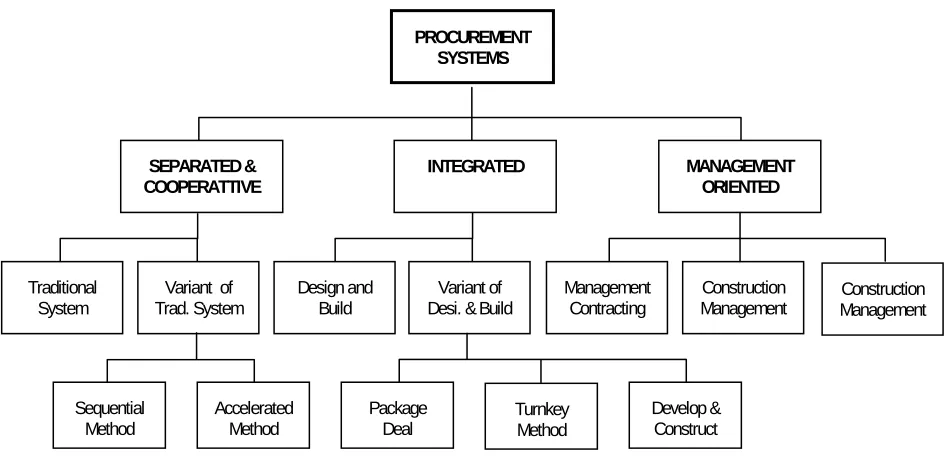
Mastermann (1994) classify project procurement systems into several categories based on the
relationship and critical interaction between design and construction responsibilities. The
categorization of the various procurement systems are as follows (refer Figure 1.0):
1) separated and Cooperative System
2) Integrated System
3) Management Oriented System
The different category and sub-classification of construction project procurement systems can be
shown in Figure 1.0 below:
a) Separated and Cooperative Procurement Systems SEPARATED &
COOPERATTIVE INTEGRATED
MANAGEMENT ORIENTED
Traditional System
Variant of Trad. System Sequential Method Accelerated Method Design and Build Variant of Desi. & Build
Management Contracting
Construction Management
Package
Deal Turnkey Method
Develop & Construct
Construction Management
Figure 1.0 – CATEGORY OF BUILDING PROCUREMENT SYSTEMS Source: Masterman J W E (1996) Building Procurement Systems: An Introduction
Under this system, the responsibilities of designing and construction of the project are
separated and are carried out by different independent organizations namely the designers
and contractors. It is sometimes called linear or sequential contracting system or multiple
responsibilities contracting approach. It is a system where the project development activities
that start from feasibility study, preliminary design, documentation to construction and hand
over, are carried out sequentially one after another. Traditionally, the complete working
drawings or design has to be prepared by the designers before tender and construction
activities can take place. It is sub-divided into 2 sub-categories – Traditional System and
Variants of the Traditional Systems. The Variant System is further sub-divided into (i)
Sequential Method, and (ii) Accelerated Method.
Under the sequential method or a single stage tendering approach, the building owner will
appoint a team of consultants to act on his behalf to produce construction drawings,
specification and tender document and to administer the tendering processes to select a
contractor. Once selected and awarded the contract, the contractor will carry out based on
the drawings and specification prepared by the client’s consultants.
The accelerated method, can be considered as an innovative approach to speed up the
selection of contractor and the commencement of construction. The method can be divided
into 2 sub-categories i.e. two-stage and negotiated tendering methods. Both methods
involve preliminary discussion with selected few contractors, submission of fixed tender
and/or cost negotiation.
b) Integrated Procurement Systems
This system, as the name implies, integrates or combines the responsibilities of design and
construction of the project (Ashworth, 2001). Both responsibilities are contracted out to a
single contracting organisation. It is also called a parallel or single responsibility
procurement system whereby the client will only need to deal with a single organisation for
both the designing and constructing the proposed project. In this case, the contractor will
have to engage and be responsible for design and construction teams. Design and build
system falls under this category of project procurement system. Under this system, the client
together with is/her consultants will prepare a tender or bidding document that include the
project brief and client’s requirements and invite a number of contractors to bid. For the
purpose of submitting tenders, the invited contractors will produce their own design,
construction and cost proposal. Very often the successful contractor will into a contract
The variation or innovation to this mode of project delivery systems includes (1) Package
deal (2) Turnkey (3) Develop and construct. These systems that entail the contractor to be
responsible for both the design and construction of the project, allow for the early start of
construction through the reduction of the pre-tender activities as such they reduce process
time.
Package deal or commonly called the “all in” contracting is a type of procurement method
where a contractor is given the responsibility for everything that is required and necessary
for the design, construction and delivery of the project. Under this system, the services of
the contractor will include the preparation of project brief, sketch and final working
drawings, getting all the approval from authorities, project financing, construction,
furnishing and commissioning of all equipments and accessories and handing over the
project to the client.
Turnkey contract is an American term for “all in” or package contract. Under this
arrangement, a contractor is commissioned to undertake the responsibilities for everything
necessary and required for the construction, completion, commissioning and hand over the
project. The word “turnkey” means that, upon completion, the client is given the key and he
can then enter the project by “turning the key”. The contractor will have to do everything
from preparing project brief, getting approval, designing, financing, construction, furnishing
and decorating to commissioning and handing over completed, cleaned and ready for use
project (Allen, 2001).
Develop and construct is another of the integrated procurement approach which is very
much similar to design and build. In this case, the contractor is still given the responsibility
for both the design and construction of the project. The difference is that, under this method
the client’s design consultants prepare the concept sketches or designs and passed them to
the contractor who will develop them and produced the detailed working drawings. The
contractor will then construct and complete the project based on what it has developed and
produced.
c) Management Oriented Procurement Systems
It is a system that gives greater emphasis on the management and integration of the design
and construction of projects. Under this system, the management of the design and
construction a project is contracted out to a contractor who acts as a management consultant
sub-contractors who enter into contract with either the management contractor or the client. This
procurement approach that was introduced based on the conception that a builder or
contractor has more expertise to manage the design and construction of a project. As
management consultant, the appointed contractor does not itself, carry out the design or
construction of the project. Its main responsibility is to manage the design and construction
by the design consultants and the many specialist contractors, respectively.
There are three types of procurement method that fall under the category of Management
Oriented Procurement Systems, they are:
1) Management contracting
2) Construction management
3) Design and manage
Management contracting and construction management contracting are forms of
“fast-tracking” procurement approach whereby a contractor is contracted and paid a fee to
manage, procure and supervise the construction of a project rather than to build the project.
The actual construction works are contracted out to many package or specialist contractors.
Under this arrangement the management contractor is employed as a construction
consultant to be part of the client’s team. The main difference between contract
management and construction management contracting is that in the former, the package
contractors are in contract with the management contractor. In the latter, the package
contractors (specialist sub-contractors) are in contract with the client or building owner.
Under the design and managesystem, a single organization or firm is commissioned to be responsible for designing the project and managing its construction. The firm is does carry
out the work itself, but it is contracted out to a number of specialist sub-contractors or
package contractors, who enter into contract with the client. A design and manage firm or
company is engaged as a consultant for the client and become a member of the project
team.
THE PROCESS OF THE VARIOUS PROCUREMENT SYSTEMS
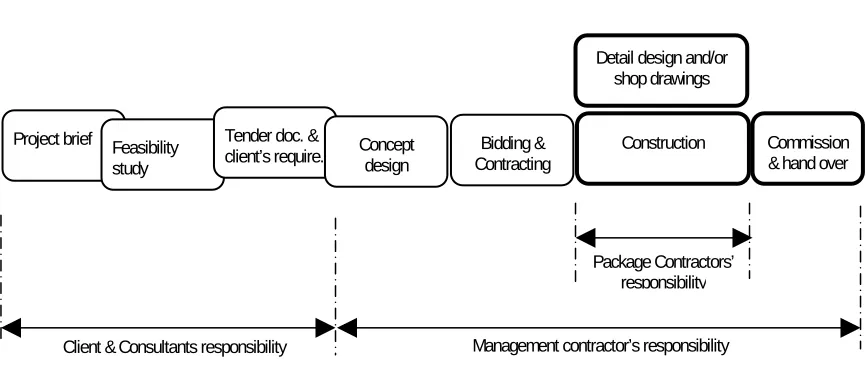
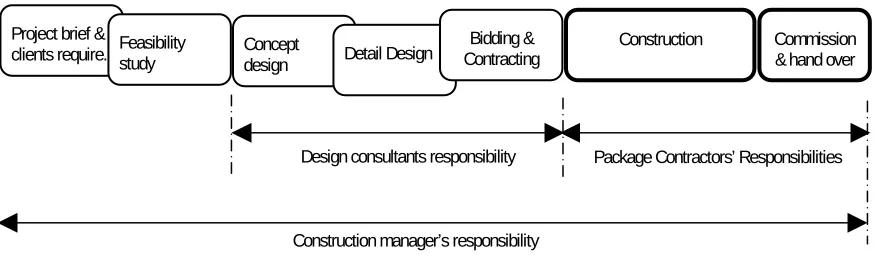
It is appropriate at this juncture to view the process or flow of activities of the different
procurement systems. They have, to a certain extent, indicated the effect of the different
procurement system on the project performance, specifically on the duration of the project
and responsibilities between the client, design and construction consultants and contractor/s. For
comparison purposes, please refer Figure 1.1, 1.2, 1.3 and 1.4 in this and next page.
Project brief Feasibility
study Concept design Detail design Tender & contract Construction
Contractor’s responsibility Client & Consultants responsibility
Commission & handover
Figure 1.1 – The Linear or Sequential Process of the Traditional Procurement System
Project brief Feasibility study
Detail design Tender and
contracting
Construction Commission & hand over Tender
documentation Concept design
Client & Consultants responsibility Contractor’s responsibility
Figure 1.2 – The Integrated Process of Project Designing and Construction in the Design and Build Procurement System
Project brief Feasibility study
Detail design and/or shop drawings
Bidding & Contracting
Construction Commission & hand over Tender doc. &
client’s require. Concept design
Client & Consultants responsibility Management contractor’s responsibility
Figure 1.3 – The Process of Project Designing and Construction in the Management Contracting & Professional Construction Management Procurement System
Project brief &
clients require. Feasibility study Concept design Construction Commission & hand over
Construction manager’s responsibility
Design consultants responsibility Package Contractors’ Responsibilities Detail Design Contracting Bidding &
Figure 1.4 – The Process of Project Designing and Construction in the Design and Manage Procurement System
THE EFFECT OF THE DIFFERENT PROCUREMENT SYSTEMS ON PROJECT PERFORMANCE
After having considered the concept and the working process and procedure of the different
project procurement systems, let us now look into the general effect of the different system on
project performance. As highlighted earlier, the focus of this paper in on three procurement
systems (1) Traditional system (2) Design and Build and Turnkey Procurement Systems (3)
Management contracting and Professional Construction Management Systems. The discussion is
limited to the main project performance parameters – time, cost and quality.
1) Traditional Procurement System
Time
Due to its linear or sequential approach, the traditional procurement system has been
identified as the slowest project delivery approach. However, this approach is more
preferable because it provides clear accountability and better design and construction
control by the client. Since the pre-contract stage of this system is longer, more time is
available for the client and the project team to scrutinize and review the design before
construction.
Cost
This system provides more price certainty to the client at the very early stage of the project.
complete working drawings have been fully developed and detailed out prior to tendering. It
eliminates any design or construction ambiguity or uncertainty which often causes the
contractors to unnecessarily inflate the price. In the case where bill of quantities is used, the
bidding tend to be more fair as such the project cost is also lower. The system also better
cost control as such cost increase due to variations is minimized, but works were often
disrupted when there are too many variations (due to unforeseeable problems) and it tend to
cause the cost to inflate. (Masterman, 1996)
Quality
The traditional procurement system also provides a high degree of quality certainty and
functional standards. It is also a system that provides an opportunity for the building owner
to combine the best design, management and construction expertise between consultants
and contractor. It also provide more time for client and consultants to review and fully
develop the design and specification thus allowing better documentation preparation.
However, this system does not provide opportunities for contractor to contribute his
construction technology and management expertise because they only come into the scene
after the design has been fully developed and approved.
2) Design and Build and Turnkey Procurement Systems
Time
Design and build and turnkey project procurement system are called “fast-tracking” or
“build-it-fast” project delivery system where the design and construction are integrated. The
design free pre-tender process allow for earlier construction date. It also allows the process
of detail design and construction to run almost in parallel and concurrently to each other,
thus reducing the overall project development period considerably. As a single entity
responsible for both the design and construction, the contractor is able to control not only
the construction time but also the time reserved for the design of the project, thus reducing
the overall contract duration. In this type of procurement system, the contractor has always
been selected based on its vast experience, knowledge and competency in construction, as
such by giving it the design responsibility, the contractor very often able to reduce
construction time. This is done by him rationalizing the design and construction process and
Cost
Although the cost is fixed at the tender stage and is subject to design changes, it is often
higher than the traditional contracting system. Apart from the fact that very limited
contractors are invited to submit tenders, the lack of design and specification detailing
during tender, has made the contractors to jack up the price to allow for many uncertainties.
This is because once accepted, the tender price will be the final contract sum. It is not
subject to change, unless there are variations required or instructed by the client. Such
additional cost cannot be avoided because under this procurement system the contractor will
to take much of the financial risk.
However, as many have claimed, the significant cost saving in this type of procurement
system is made through the reduction of the overall development period. The cost of
contractor’s uncertainty can be set-off by the reduction in loan interest and early financial
return or benefits.
Cost saving may also be made when the contractor applies his construction knowledge and
experience to simplify design and work. At the same further cost saving can be made when
the client offer the contractor some form of incentive if he is able to save a significant
amount of cost.
Quality
The integration of design and construction allows the contractor to utilize his knowledge
and experience to develop much compacted and coherent work program and to develop
more efficient design and project control programme. At the same time it allows the
contractor to be innovative to further improve the construction process and techniques thus
allowing for better work and process quality.
However, it is more often found that the quality of work under this contracting system tend
to be questionable. The assigning of the designing and construction to a contractor has
caused the client to loose control of the design and supervision of the work. This is
especially so when the client does have his own team of consultants. As far the contractor is
concerned, they tend to cut corners in order to maximize their profit, especially when they
3) Management Contracting and Professional Construction Management Systems
(Both systems operate almost on the same concept, except that in Management Contracting, the package contractors enter into contract with the management contractor. In Construction Management System, the Package Contractors enter into contract with the client))
Time
As mentioned earlier, the essence of these two methods of project procurement is that a
contractor has the knowledge, experience and competency to better manage the design and
construction of a project. It is a factor that allows for more efficient and effective
coordination of works, materials, manpower and plants, thus making construction time
shorter compared to other procurement systems. This is especially so, given the fact that the
same management contractor is able to manage and contribute towards the development of
the design. It allows the management contractor to improve buildability or constructability.
At the same, the system also allow for early start of construction compared to the traditional
approach. The preparation of simple or basic tender (bidding) document and the shift of the
process of schematic and detail design to construction phase, allow for an early start of
construction. As pointed earlier, under these two systems, the detail design (shop drawings)
is carried out (either by the consultant or package contractors) during the construction stage.
All these factors brought about a considerable reduction of the overall project time
compared to the traditional or even design and build contracting systems.
Cost
The cost of the project procured using this system tends to be lower than those using other
procurement approach. This is because the cost of the project is actually the sum of prices
quoted by the package contractors. With the management contractor being the consultant,
no extra cost is being added up for main contractor’s profit margin. The only additional cost
is the consultant fee that the client has to pay to the management contractor or to the
construction management consultant.
Quality
As an agent responsible for the construction, the management contractor or the professional
construction manager tend to be more serious with the standard and quality of the work
done by the package contractors. Their experience as contractor or construction manager
knowledge and experience also made them more adept in selecting materials and
components of the right type and quality. These factors have contributed to a better standard
and quality of the completed construction products.
CONCLUSION
Cost, time and quality are the three most important parameters of project performance. It has been
stressed that in today’s highly competitive and uncertain business environment, clients are
demanding for better value from their investment. They want their project to be completed on
time, within the estimated cost and with the right quality. The use of the various project
procurement systems shows that the construction industry is now trying to meet the clients’ needs.
This is because the different procurement method will have different effect on the cost, time and
quality of the project. Each project procurement system has its own peculiarity in term of the
pre-tender and post pre-tender activities and processes, division of risks between client and contractors,
and the effectiveness of project monitoring and control.
It is very important at the very outset of the project to carefully consider all factors when selecting
the most appropriate procurement approach for a construction project. This is because each
system has its own feature and peculiarity that will have effect on the cost, time and quality of the
project i.e. the project performance.
REFERENCES
1. Akintoye, A and Fitzgerald E (1995) – Design and Build: A Survey of Architects’ Views, Engineering, Construction and Architectural management
2. Ashworth A (2001) Contractual Procedures in the Construction Industry, UNITEC, New Zealand
3. Chitkara K K (2005): Project Management - Planning, Scheduling and Controlling – Tata McGraw Hill, New Delhi
4. Kwakye A A (1997) Construction Project Administration In Practice – Longman, London 5. Lam, E W M, Albert P C and Chan D W M (2003) Is Design and Build the Preferred
Option to Procure all Projects? Research Fellow, Department of Building and Real estate,
The Hong Kong Polytechnic University
7. Murdoch J and Hughes W ( 2000) Construction Contract: Law and Management: 3rd Edition E&FN Spon, London
8. Rowlinson, S (1987) Design and Build – Its development and Present Status, Ascot – CIOB
9. Songer A D and Molenaar K R (1996) : Selecting Design and Build – Public and Private
Sector Owner Attitudess, Journal of Management in Engineering, ASCE.