Tightly-Secure Authenticated Key Exchange
1Christoph Bader*, Dennis Hofheinz†, Tibor Jager*, Eike Kiltz*, and Yong Li*
*Horst G¨ortz Institute, Ruhr-University Bochum,
{christoph.bader,tibor.jager,eike.kiltz,yong.li}@rub.de †Karlsruhe Institute of Technology,
Abstract
We construct the first Authenticated Key Exchange (AKE) protocol whose security does not degrade with an increasing number of users or sessions. We describe a three-message protocol and prove security in an enhanced version of the classical Bellare-Rogaway security model.
Our construction is modular, and can be instantiated efficiently from standard assumptions (such as the SXDH or DLIN assumptions in pairing-friendly groups). For instance, we provide an SXDH-based protocol whose communication complexity is only 14 group elements and 4 exponents (plus some bookkeeping information).
Along the way we develop new, stronger security definitions for digital signatures and key encapsulation mechanisms. For instance, we introduce a security model for digital signatures that provides existential unforgeability under chosen-message attacks in amulti-user settingwith
adaptive corruptions of secret keys. We show how to construct efficient schemes that satisfy the new definitions withtight security proofs under standard assumptions.
1
Introduction
Authenticated Key Exchange (AKE) protocols allow two parties to establish a cryptographic key over an insecure channel. Secure AKE protects against strong active attackers that may for instance read, alter, drop, replay, or inject messages, and adaptively corrupt parties to reveal their long-term or session keys. This makes such protocols much stronger (and thus harder to construct) than simpler passively secure key exchange protocols like e.g. [DH76].
The most prominent example of an AKE protocol is the TLS Handshake [DA99, DR06, DR08], which is widely used for key establishment and authentication on the Internet. The widespread use of TLS makes AKE protocols one of the most widely-used cryptographic primitives. For example, the social network Facebook.com reports 802 million daily active users on average in September 2013. This makes more than 229 executions of the TLS Handshake protocolper day only on this single web site.2 The wide application of AKE protocols makes it necessary and interesting to study their security in large-scale settings with many millions of users.
Provably-secure AKE and tight reductions. A reduction-based security proof describes an algorithm, thereduction, which turns an efficient attacker on the protocol into an efficient algorithm solving an assumed-to-be-hard computational problem. The quality of such a reduction can be measured by its efficiency: the running time and success probability of the reduction running the
1
A public version of this paper has been posted to the ePrint Archive athttp://eprint.iacr.org/2014/.
2
attacker as a subroutine, relative to the running time and success probability of the attacker alone. Ideally the reduction adds only a minor amount of computation and has about the same success probability as the attacker. In this case the reduction is said to be tight.
The existence of tight security proofs has been studied for many cryptographic primitives, like digital signatures [Ber08, Sch11, KK12], public-key encryption [BBM00, HJ12a, LJYP14], or identity-based encryption [CW13, BKP14]. However, there is no example of an authenticated key exchange protocol that comes with tight security proof under a standard assumption, not even in the Random Oracle Model [BR93b].
Known provably secure AKE protocols come with a reduction which loses a factor that depends on the numberµ of users and the number `of sessions per user. The loss of the reduction ranges typically between 1/(µ·`) (if the reduction has to guess only one party participating in a particular session) and 1/(µ·`)2 (if the reduction has to guess both parties participating in a particular ses-sion). This may become significant in large-scale applications. We also consider tight reductions as theoretically interesting in their own right, because it is challenging to develop new proof strategies that avoid guessing. We will elaborate on the difficulty of constructing tightly secure AKE ini the next paragraph.
The difficulty of Tightly-Secure AKE. There are two main difficulties with proving tight security of an AKE protocol, which we would like to explain with concrete examples.
To illustrate the first, let us think of an AKE protocol where the long-term key pair (pki, ski) is
a key pair for a digital signature scheme. Clearly, at some point in the security proof the security of the signature scheme must be used as an argument for the security of the AKE protocol, by giving a reduction from forging a signature to breaking the AKE protocol. Note that the attacker may use the Corrupt-query to learn the long-term secret of all parties, except for communication partnerPj of the Test-oracle. The index j might be chosen at random by the attacker.
A standard approach in security proofs for AKE protocols is to let the reduction, which im-plements the challenger in order to take advantage of the attacker, guess the index j of party Pj.
The reduction generates all key pairs (pki, ski) with i6=j on its own, and thus is able to answer
Corrupt-queries to party Pi for all i6= j. In order to use the security of the signature scheme as
an argument, a challenge public-key pk∗ from the security experiment of the signature scheme is embedded aspkj :=pk∗.
Note that this strategy works only if the reduction guesses the index i ∈ [`] correctly, which leads to a loss factor of 1/` in the success probability of the reduction. It is not immediately clear how to avoid this guessing: a reduction that avoids it would be required to be able to reveal all long-term secret key at any time in the security experiment, while simultaneously it needs to use the security of the signature scheme as an argument for the security of the AKE protocol. It turns out that we can resolve this seeming paradox by combining two copies of a signature scheme with a non-interactive proof system in a way somewhat related to the Naor-Yung paradigm [NY90] for public-key encryption.
To explain the second main difficulty, let us consider signed-DH protocol as an example. Let us first sketch this protocol. We stress that we leave out many details for simplicity, to keep the discussion on an intuitive level. In the sequel let G be a cyclic group of order p with generator g. Two parties Pi, Pj exchange a key as follows.
1. Pi chooses x←$ Zp at random. It computesgx and a digital signature σi overgx, and sends
(gx, σ
2. If Pj receives (gx, σi). It verifies σi, chooses y $
← Zp at random, computesgy and a digital signatureσj overgy, and sends (gy, σj) to Pi. Moreover,Pj computes the key as K = (gx)y.
3. IfPi receives (gy, σj), andσj is a valid signature, then Pi computes the key asK = (gy)x.
The security of this protocol can be proved [CK01] based on the (assumed) security of the signature scheme and the hardness of the decisional Diffie-Hellman problem, which asks for a given a vector (g, gx, gy, gw) ∈ G to determine whether w =xy or w is random. However, even though the DDH problem is randomly self-reducible [BBM00], it seems impossible to avoid guessing at least one oracle participating in theTest-session.
To explain this, consider an attacker in the AKE security model from Section 4.1. Assume that the attacker asks Send(i, s,(>, j)) to an (uncorrupted) oracle πsi. According to the protocol specification, the oracle has to respond with (gx, σi). At some point in the security proof the
security of the protocol is reduced to the hardness of the DDH problem, thus, the challenger of the AKE security experiment has to decide whether it embeds (a part of) the given DDH-instance in
gx. Essentially, there are two options:
• The challenger decides that it embeds (a part of) the given DDH-instance ingx. In this case, there exists an attacker which makes the simulation fail (with probability 1) if oracleπis does not participate in theTest-session. This attacker proceeds as follows.
1. It corrupts some unrelated party Pj to learn skj.
2. It computesgyfory←$ Zpalong with a signatureσjunderskj, and asksSend(i, s,(gy, σj))
to send (gy, σj) toπsi.
3. Finally it asksReveal(i, s) to learn the session keykiscomputed byπsi, and checks whether
kis= (gx)y.
A challenger interacting with this attacker faces the problem that it needs to be able to compute kis = (gy)x, knowing neither x or y. Note that the challenger can not answer with an incorrectksi, because the attacker knowsy and thus is able check whetherkis is computed correctly.
• The challenger decides that it does not embed (a part of) the given DDH-instance in gx. If now the attacker asks Test(i, s), then the challenger is not able to take advantage of the attacker, because the DDH-challenge is not embedded in the Test-session.
The only way we see to circumvent this technical issue is to let the challenger guess in advance (at least) one oracle that participates in the Test-session, which however leads to a loss of 1/(µ`) in the reduction.
The challenge with describing a tightly-secure AKE protocol is therefore to come up with a proof strategy that that avoids guessing. This requires to apply a strategy where essentially an instance of a hard computational problem is embedded intoany protocol session, while at the same time the AKE-challenger is always able to compute the same keys as the attacker.
Our contribution. We construct the first AKE protocols whose security does not degrade in the number of users and instances. Following [BR93a] we consider a very strong security model, which allows adaptive corruptions of long-term secrets, adaptive reveals of session keys, and multiple adaptiveTest queries.
Our model provides perfect forward secrecy [BWJM97, Kra05]: the corruption of a long-term secret does not foil the security of previously established session keys. Furthermore, we prevent
key-compromise impersonation attacks [BWM98, GBN09]: in our security model, an attacker may
states or intermediate results of computations, as considered in the (extended) Canetti-Krawczyk model [CK01, LLM07]. The existence of a tightly secure construction in such a model is an interesting open problem.
While our approach is generic and modular, we give efficient instantiations from standard as-sumptions (such as the SXDH or DLIN asas-sumptions in pairing-friendly groups). Specifically, we propose an SXDH-based AKE protocol with a communication complexity of only 14 group elements and 4 exponents (plus some bookkeeping information). The security reduction to SXDH loses a fac-tor ofκ(the security parameter), but does not depend on the number of users or instances. (Using different building blocks, this reduction loss can even be made constant, however at a significant expense of communication complexity.)
Our approach. At a very high level, our AKE protocol follows a well-known paradigm: we use a public-key encryption scheme to transport shared keys, and a digital signature scheme to authenticate exchanged messages. Besides, we use one-time signature scheme to provide a session-specific authentication, and thus to guarantee a technical “matching conversations” property.3 The combination of these building blocks in itself is fairly standard; the difficulty in our case is to construct suitable buildings blocks that aretightly and adaptively secure.
More specifically, we require, e.g., a signature scheme that is tightly secure in face of adaptive corruptions. Specifically, it should be hard for an adversary A to forge a new signature in the name of any so far uncorrupted party in the system, even though A may corrupt arbitrary other parties adaptively. While regular signature security implies adaptive security in this sense, this involves a (non-tight) guessing argument. In fact, currently, no adaptively tightly secure signature scheme is known: while, e.g., [HJ12a] describe a tightly secure signature scheme, their analysis does not consider adaptive corruptions, and in particular no release whatsoever of signing keys. (The situation is similar for the encryption scheme used for key transport.)
How we construct adaptively secure signatures. Hence, while we cannot directly use exist-ing buildexist-ing blocks, we can use the (non-adaptively) tightly secure signature scheme of [HJ12a] as a basis to construct adaptively and tightly secure components. In a nutshell, our first (less efficient but easier-to-describe) scheme adapts the “double encryption” technique of Naor and Yung [NY90] to the signature setting. A little more concretely, our scheme uses two copies of an underlying signature scheme SIG (that has to be tightly secure, but not necessarily against adaptive corrup-tions). A public key in our scheme consists of two public keys pk1,sk2 of SIG; however, our secret key consists only of one (randomly chosen) secret key skb of SIG. Signatures are (non-interactive,
witness-indistinguishable) proofs of knowledge ofone signatureσi under oneski.
During the security proof, the simulation will know one valid secret key skb for each scheme
instance.4 This allows to plausibly reveal secret keys upon corruptions. However, the witness-indistinguishability of the employed proof system will hide which of the two possible keys ski are
known for each user until that user is corrupted. Hence, an adversaryAwho forges a signature for
3Intuitively, the matching conversations property, introduced by Bellare and Rogaway [BR93a] establishes the
notion of a “session” between two communication partners (essentially as the transcript of exchanged messages itself). Such a notion is essential in a model without explicit session identifiers (such as the one of Canetti and Krawczyk [CK01, CK02]) that separate different protocol instances.
4
an uncorrupted user will (with probability about 1/2) forge a signature under a secret key which is unknown to the simulation. Hence, the simulation will lose only about a factor of 2 relative to the success probability ofA.
Of course, this requires using a suitable underlying signature scheme and proof system. For instance, the tightly secure (without corruptions) signature scheme from [HJ12a, ADK+13] and the Groth-Sahai non-interactive proof system [GS08] will be suitable DLIN-based building blocks.
Efficient adaptively secure signatures. The signature scheme arising from the generic ap-proach above is not overly efficient. Hence, we also construct a very optimized scheme that is not as modularly structured as the scheme above, but has extremely compact ciphertexts (of only 3 group elements). In a nutshell, this compact scheme uses the signature scheme that arises out of the recent almost-tightly secure MAC of [BKP14] as a basis. Instead of Groth-Sahai proofs, we use a more implicit consistency proof reminiscent of hash proof systems. Security can be based on a number of computational assumptions (including SXDH and DLIN), and the security reduction loses a factor of κ (the security parameter), independently of the number of users or generated signatures. We believe that this signature scheme can be of independent interest.
Adaptively secure PKE and AKE schemes. A similar (generic) proof strategy allows to construct adaptively (chosen-plaintext) secure public-key encryption schemes using a variation of the Naor-Yung double encryption strategy [NY90]. (In this case, the simulation will know one out of two possible decryption keys. Furthermore, because we only require chosen-plaintext security, no consistency proof will be necessary.) Combining these tightly and adaptively secure building blocks with the tightly secure one-time signature scheme from [HJ12a] finally enables the construction of a tightly secure AKE protocol. As already sketched, our signature scheme ensures authenticated channels, while our encryption scheme is used to exchange session keys. (However, to achieve perfect forward secrecy – i.e., the secrecy of finished sessions upon corruption –, we generate PKE instances freshly for each new session.)
Notation. The symbol ∅ denotes the empty set. Let [n] := {1,2, . . . , n} ⊂ N and let [n]0 := [n]∪ {0}. If A is a set, then a ←$ A denotes the action of sampling a uniformly random element from A. IfA is a probabilistic algorithm, then we denote by a←$ A that ais output by A using fresh random coins. If an algorithm A has black-box access to an algorithmO, we will write AO.
2
Digital Signatures in the Multi-User Setting with Corruptions
In this section we define digital signature schemes and their security in the multi-user setting. Our strongest definition will be existential unforgeability under adaptive chosen-message attacks in the multi-user setting with adaptive corruptions. We show how to construct a signature scheme with tight security proof, based on a combination of a non-interactive witness indistinguishable proof of knowledge with a signature scheme with weaker security properties.
2.1 Basic Definitions
• Π ←$ SIG.Setup(1κ): The parameter generation algorithm on input a security parameter 1κ returns public parameters Π, defining the message spaceM, signature spaceS, and key space
VK × SK.
• SIG.Gen(Π): On input Π the key generation algorithm ouputs a pair (vk, sk)∈ VK × SK.
• SIG.Sign(sk, m): On input a private key sk and a message m ∈ M, the signing algorithm outputs a signature σ.
• SIG.Vfy(vk, m, σ): On input a verification keyvk, a messagem, and a purported signatureσ, the verification algorithm returns b∈ {0,1}.
We note that our security definition below assumes a trusted setup of public parameters (us-ing SIG.Setup). Moreover, throughout the paper, we will assume signature schemes with message space {0,1}∗ for simplicity. It is well-known that such a scheme can be constructed from a sig-nature scheme with arbitrary message space M by applying a collision-resistant hash function
H:{0,1}∗→ Mto the message before signing.
Security Definitions. The standard security notion for signature schemes in the single user setting isexistential unforgeability under chosen-message attacks, as proposed by Goldwasser, Micali and Rivest [GMR88]. We consider natural extensions of this notion to the multi-user setting with or without adaptive corruptions.
Consider the following game between a challenger Cand an adversaryA, which is parametrized by the number of public keysµ.
1. For each i ∈ [µ], C runs (vk(i), sk(i)) ← SIG.Gen(Π), where Π are public parameters. Fur-thermore, the challenger initializes a set Scorr to keep track of corrupted keys, and µ sets
S1, . . . ,Sµ, to keep track of chosen-message queries. All sets are initially empty. Then it
outputs (vk(1), . . . , vk(µ)) to A.
2. A may now issue two different types of queries. When A outputs an index i ∈ [µ], thenC
updatesScorr :=Scorr∪ {i}and returnssk
i. WhenAoutputs a tuple (m, i), thenC computes
σ:=SIG.Sign(ski, m), adds (m, σ) to Si, and responds withσ.
3. Eventually Aoutputs a triple (i∗, m∗, σ∗).
Now we can derive various security definitions from this generic experiment. We start with existential unforgeability under chosen-message attacks in the multi-user setting with corruptions.
Definition 2. Let A be an algorithm that runs in time t. We say that A (t, , µ)-breaks the MU-EUF-CMACorr-security ofSIG, if in the above game it holds that
Pr
h
(m∗, i∗, σ∗)← AC :i∗6∈ Scorr∧(m∗,·)6∈ Si∗∧SIG.Vfy(vk(i ∗)
, m∗, σ∗) = 1
i ≥
In order to construct an MU-EUF-CMACorr-secure signature scheme, we will also need the following weaker definition of EUF-CMA security in the multi-user setting without corruptions. We note that this definition was also considered in [MS04].
Definition 3. Let A be an algorithm that runs in time t. We say that A (t, , µ)-breaks the MU-EUF-CMA-security ofSIG, if in the above game it holds that
Pr
h
(m∗, i∗, σ∗)← AC:Scorr=∅ ∧(m∗,·)6∈ Si∗∧SIG.Vfy(vk(i ∗)
, m∗, σ∗) = 1
Note that both MU-EUF-CMACorrand MU-EUF-CMA security notions are polynomially equiv-alent to the standard (single user) EUF-CMA security notion for digital signatures. However, the reduction is not tight.
Finally, we need strong existential unforgeability in the multi-user setting without corruptions forone-time signatures.
Definition 4. Let A be an algorithm that runs in time t. We say that A (t, , µ)-breaks the MU-sEUF-1-CMA-security of SIG, if in the above game it holds that
Prh(m∗, i∗, σ∗)← AC :Scorr =∅ ∧ |S
i| ≤1,∀i∧(m∗, σ∗)6∈ Si∗∧SIG.Vfy(vk(i ∗)
, m∗, σ∗) = 1i≥
2.2 MU-EUF-CMACorr-Secure Signatures from General Assumptions
In this section we give a generic construction of a MU-EUF-CMACorr-secure signature scheme, based on a MU-EUF-CMA-signature scheme and a non-interactive witness-indistinguishable proof of knowledge that allows a tight security proof. The main purpose of this construction is to resolve the “paradox” explained in the introduction.
2.2.1 NIWI Proofs of Knowledge
Let R be a binary relation. If (x, w) ∈ R, then we call x the statement and w the witness.
R defines a language LR := {x : ∃w : (x, w) ∈ R}. A non-interactive proof system NIPS =
(NIPS.Gen,NIPS.Prove,NIPS.Vfy) for R consists of the following algorithms.
• Algorithm NIPS.Gentakes as input the security parameter and ouputs a common reference string CRS←$ NIPS.Gen(1κ).
• AlgorithmNIPS.Prove takes as input theCRS, a statementxand a witnessw, and outputs a proof π←$ NIPS.Prove(CRS, x, w).
• The verification algorithm NIPS.Vfy(CRS, x, π)∈ {0,1} takes as input the CRS, a statement
x, and a purported proofπ. It outputs 1 if the proof is accepted, and 0 otherwise.
Definition 5. We call NIPS a witness indistinguishable proof of knowledge (NIWI-PoK) for R, if the following conditions are satisfied:
Perfect completeness. For all (x, w) ∈R, κ ∈N, CRS ←$ NIPS.Gen(1κ), and all proofs π com-puted asπ ←$ NIPS.Prove(CRS, x, w) holds that
Pr [NIPS.Vfy(CRS, x, π) = 1] = 1
Perfect Witness Indistinguishability. For all CRS ←$ NIPS.Gen(1κ), for all (x, w0, w1) such that (x, w0)∈R and (x, w1)∈R, and all algorithms Ait holds that
Pr [A(π0) = 1] = Pr [A(π1) = 1] (1)
whereπ0←$ NIPS.Prove(CRS, x, w0) andπ1←$ NIPS.Prove(CRS, x, w1).
Simulated CRS. There exists an algorithm E0, which takes as inputκ and outputs a simulated
Perfect Knowledge Extraction on Simulated CRS. There exists an algorithmsE1 such that for all (CRSsim, τ)
$
← E0(1κ) and all (π, x)← Asuch thatNIPS.Vfy(CRS
sim, x, π) = 1
Prhw← E$ 1(CRSsim, π, x, τ) : (x, w)∈R
i
= 1
Security Definition for NIWI-PoK. An algorithm (t, CRS)-breaks the security of a NIWI-PoK
if it runs in time t and for all κ ∈ N, CRSreal $
← NIPS.Gen(1κ), all (CRSsim, τ) $
← E0(1κ), it holds that
Pr
h
A(CRSreal) = 1)
i −Pr
h
A(CRSsim) = 1
i
≥CRS
We note that perfect witness indistinguishability is preserved if the algorithm A sees more than one proof. That is, let Oqb(x, w0, w1) denote an oracle which takes as input (x, w0, w1) with (x, w0)∈R and (x, w1)∈R, and outputs NIPS.Prove(CRS, x, wb) for random b∈ {0,1}. Consider
an algorithm A which asks Oqb at most q times. We observe the following (see Appendix A for a proof):
Lemma 1. Equation 1 implies for allq ∈N:
PrhAO1q = 1 :CRS←$ NIPS.Gen(1κ)
i
= PrhAO0q = 1 :CRS←$ NIPS.Gen(1κ)
i
(2)
2.2.2 Generic Construction
In this section we show how to construct a MU-EUF-CMACorr-secure (Definition 2) signature scheme
SIGMU from an MU-EUF-CMA-secure (Definition 3) schemeSIGand a NIWI-PoK.
In the sequel letNIPS= (NIPS.Gen,NIPS.Prove,NIPS.Vfy) denote a NIWI-PoK for relation
R:={((vk0,vk1, m),(σ0, σ1)) :SIG.Vfy(vk0, m, σ0) = 1∨SIG.Vfy(vk1, m, σ1) = 1}.
That is,R consists of statements of the form (vk0,vk1, m), where (vk0,vk1) are verification keys for
signature scheme SIG, and m is a message. Witnesses are tuples (σ0, σ1) such that either σ0 is a
valid signature for munder vk0, orσ1 is a valid signature for m undervk1, or both.
The new signature schemeSIGMU= (SIG.SetupMU,SIG.GenMU,SIG.SignMU,SIG.VfyMU) works as
follows:
• ΠSIGMU
$
← SIG.SetupMU(1κ): The parameter generation algorithm SIG.SetupMU runs ΠSIG $
←
SIG.Setup(1κ) andCRS←$ NIPS.Gen(1κ). It outputs ΠSIGMU := (ΠSIG,CRS).
• SIG.GenMU(ΠSIGMU): The key generation algorithm generates two key pairs by running the
key generation algorithm ofSIGtwice: (vki,ski) $
←SIG.Gen(ΠSIG),fori∈ {0,1}. Then it flips
a random coin δ ← {$ 0,1} and returns (vk, sk) = (vk0,vk1),(skδ, δ)
. Observe that sk1−δ is
discarded.
• SIG.SignMU(sk, m): The signing algorithm generates a SIG-signature σδ $
← SIG.Sign(skδ, m).
Then it defines a witness was
w:=
(
(σδ,⊥), ifδ= 0,
(⊥, σδ), ifδ= 1,
where⊥ is an arbitrary constant (e.g., a fixed element from the signature space). Note that ((vk0,vk1, m), w)∈R. Finally it runs π
$
← NIPS.Prove CRS,(vk0,vk1, m), w
• SIG.VfyMU(vk, m, σ): The verification algorithm parsesvk as (vk0,vk1) and returns whatever NIPS.Vfy CRS,(vk0,vk1, m), σ
returns.
Theorem 1. From any attacker ASIGMU that (t, , µ)-breaks the MU-EUF-CMACorr-security (with corruptions) ofSIGMU, we can construct algorithmsBNIPSandBSIGsuch that eitherBNIPS(tCRS, CRS
)-breaks the security of NIWI-PoK orBSIG (tSIG, SIG, µ)-breaks the MU-EUF-CMA-security (without
corruptions) ofSIG, where
<2·SIG+CRS
We have tCRS = t+t0CRS and tSIG = t+t0SIG, where t0CRS and t0SIG correspond to the respective
runtimes required to provide ASIGMU with the simulated experiment as described below.
Proof. We proceed in a sequence of games. The first game is the real game that is played between
an attackerAand a challengerC, as described in Section 2.1. We denote byχithe event thatASIGMU outputs (m∗, i∗, σ∗) such thatSIG.Vfy(vk(i∗), m∗, σ∗)∧i∗∈ S/ corr∧(m∗,·)∈ S/
i∗ in Game i.
Game 0. This is the real game that is played betweenA and C. We set
Pr[χ0] =.
Game 1. In this game we change the way keys are generated and chosen-message queries are
answered by the challenger.
When generating a key pair by running SIG.GenMU, the challenger does not discardsk1−δ but
keeps it. However, corruption queries by the attacker are still answered by responding only with
skδ. Therefore this change is completely oblivious to A.
To explain the second change, recall that aSIGMU-signature in Game 0 consists of a proofπ $
← NIPS.Prove CRS,(vk0,vk1, m), w
, where eitherw= (σδ,⊥) orw= (⊥, σδ) forσδ $
←SIG.Sign(skδ, m).
In Game 1 the challenger now defines w as follows. It first computes two signatures σ0
$
← SIG.Sign(sk0, m) and σ1
$
←SIG.Sign(sk1, m), and setsw:= (σ0, σ1). Then it proceeds as before, by
computing π asπ ←$ NIPS.Prove CRS,(vk0,vk1, m), w. Thus, in Game 1 two valid signatures are used as witnesses. Due to the perfect witness indistinguishability property ofNIPSwe have:
Pr[χ0] = Pr[χ1]
Game 2. This game is very similar to the previous game, except that we change the way theCRS
is generated. Now, we run (CRSsim, τ) $
← E0 and all proofs are generated with respect to CRSsim.
Since the contrary would allowBNIPS to break the (t, CRS)-security ofNIPSwe have
Pr[χ1]−Pr[χ2]
< CRS
Game 3. This game is similar to Game 2 except for the following. We abort the game (and
A loses) if the forgery (i∗, m∗, σ∗) returned by A satisfies SIG.VfyMU vk(i∗), m∗, σ∗
= 1, but the extractorE1is not able to extract a witness (s0, s1) fromσ∗. Due to theperfectknowledge extraction
property of NIPSon a simulatedCRS we have:
Game 4. In this game we raise event abortδ(i∗) and abort (and A loses) if A outputs a forgery
(i∗, m∗, σ∗) such that the following holds.
Given (i∗, m∗, σ∗), the challenger first runs the extractor (s0, s1) ← E$ 1(τ, σ∗). Then it checks
whether
SIG.Vfyvk(1−i∗)
δ(i∗), m
∗, s 1−δ(i∗)
= 0.
Recall here thatδ(i∗)denotes the random bit chosen by the challenger for the generation of the long-term secret of useri∗. If this condition is satisfied, then the game is aborted. Putting it differently, the challenger aborts, if the witness s1−δ(i∗) isnot a valid signature for m∗ under vk
(i∗) 1−δ(i∗).
Since A is not allowed to corrupt the secret key of user i∗, and the adversary sees only proofs which usetwovalid signatures (s0, s1) as witnesses (cf. Game 1), the random bitδ(i
∗)
is information-theoretically perfectly hidden fromA. Therefore, we have Pr[abortδ(i∗)]≤1/2 and
Pr[χ3]≤2·Pr[χ4]
Claim 1. For any attacker ASIGMU that breaks the (t,Pr[χ4], µ)-MU-EUF-CMACorr-security of SIGMUin Game 4 there exists an attackerBSIG that breaks the(tSIG, SIG, µ)-MU-EUF-CMA-security
of SIG withtSIG≈tand SIG≥Pr[χ4].
Given the above claim, we can conclude the proof of Theorem 1. In summary we have ≤
CRS+ 2·SIG..
Proof of Claim 1. Attacker BSIG simulates the challenger for an adversary ASIGMU in Game 4. We show that any successful forgery that is output by ASIGMU can be used by BSIG to win theSIG
security game.
BSIG receives µ public verification keys vk(i), i ∈ [µ], and public parameters ΠSIG from the
SIG challenger. Next, it samples µ key pairs (vk(i),sk(i)) ←$ SIG.Gen(ΠSIG), i ∈ {µ+ 1, . . . ,2µ}.
Moreover, it chooses a random vectorδ= (δ(1), . . . , δ(µ))∈ {0,1}µ. It sets
(vk(i), sk(i))←vk(δ(i)µ+i),vk((1−δ(i))µ+i),skµ+i,1−δ(i).
Note that now eachSIGMU-verification key contains oneSIG-verification key thatASIGhas obtained
from its challenger, and one that was generated by BSIG. We note further that, given vk(i),sk(i) is distributed correctly and may be returned byBSIG when ASIGMU issues a corrupt query (since it is generated byBSIG itself).
Over that BSIG generates a “simulated” CRS for the NIWI-PoK along with a trapdoor by running (CRSsim, τ)
$
← E0. ASIGMU receives as input {vk
(i):i∈[µ]}, Π
SIG and CRS.
Now, when asked to sign a message m under public key vk(i), ASIG proceeds as follows. Let
δ(i) = 0 without loss of generality. Then it computes σ1 = SIG.Sign(sk(µ+i), m). Moreover it
requests a signature for public key vk(i) and message m from its SIG-challenger. Let σ0 be the response. ASIG computes the signature formusing both signaturesw= (σ0, σ1) as witnesses. Note that this is a perfect simulation of Game 4.
2.2.3 (Somewhat Inefficient) Instantiation From Existing Building Blocks
The generic construction SIGMU above can be instantiated conveniently from existing building
blocks:
• Suitable tightly secure MU-EUF-CMA-secure signature schemes can be found in [HJ12b, ADK+13] (based on the DLIN assumption in pairing-friendly groups).
• Similarly, a suitable tightly MU-sEUF-1-CMA-secure one-time signature scheme is described in [HJ12b, Section 4.2]. Its security is based on the discrete logarithm assumption.
• Finally, a compatible NIWI-PoK is given by Groth-Sahai proofs [GS08]. (In a Groth-Sahai proof system, there exist “hiding” and “binding” CRSs. These correspond to our honestly generated, resp. simulated CRSs.) The security of Groth-Sahai proofs can be based on a number of assumptions, including the DLIN assumption in pairing-friendly groups.
When used in our generic construction, this yields a signature scheme whose MU-EUF-CMACorr security can be tightly (i.e., with a small constant loss) reduced to the DLIN assumption in pairing-friendly groups. However, we note that the resulting scheme is not overly efficient. In particular, the scheme suffers from public keys and signatures that contain a linear – in the security parameter – number of group elements.
Thus, in the next section, we offer an optimized, significantly more efficient MU-EUF-CMACorr -secure signature scheme.
2.3 Efficient and Almost Tightly MU-EUF-CMACorr-Secure Signatures
In this section, we present a very efficient signature scheme whose MU-EUF-CMACorr security can
be almost tightly (i.e., with a reduction loss that is linear in the security parameter) reduced to a number of standard assumptions in cyclic groups. In fact, we prove security under any matrix
assumption [EHK+13], which encompasses, e.g., the SXDH, DLIN, andk-Linear assumptions. The
following definitions are taken from [BKP14].
Pairing Groups and Matrix Diffie-Hellman Assumption. LetGGenbe a probabilistic poly-nomial time (PPT) algorithm that on input 1κ returns a description G = (G1,G2,GT, q, g1, g2, e)
of asymmetric pairing groups where G1, G2, GT are cyclic groups of order q for a κ-bit prime q,
g1 and g2 are generators of G1 and G2, respectively, and e:G1×G2 is an efficiently computable
(non-degenerated) bilinear map. DefinegT :=e(g1, g2), which is a generator inGT.
We use implicit representation of exponents by group elements as introduced in [EHK+13]. For
s ∈ {1,2, T} and a ∈ Zq define [a]s = gsa ∈ Gs as the implicit representation of a in Gs. More
generally, for a matrix A= (aij)∈Zqn×m we define [A]s as the implicit representation ofA inGs:
[A]s:=
ga11s ... ga1m
s
gan1
s ... gsanm
∈Gn ×m s
We will always use this implicit notation of elements inGs, i.e., we let [a]s ∈Gsbe an element in
Gs. Note that under the discrete logarithm assumption inGsit is hard to computeafrom [a]s∈Gs
Further, from [b]T ∈GT it is hard to compute the value [b]1 ∈G1 and [b]2 ∈G2 (pairing inversion
problem). Obviously, given [a]s ∈Gs and a scalar x∈Zq, one can efficiently compute [ax]s∈Gs.
Further, given [a]1,[a]2 one can efficiently compute [ab]T using the pairinge. For a,b∈Zkq define
We recall the definition of the Matrix Diffie-Hellman (MDDH) assumption [EHK+13].
Definition 6 (Matrix Distribution). Let k ∈ N. We call Dk a matrix distribution if it outputs matrices in Z(qk+1)×k of full rankkin polynomial time.
For B ∈Z(qk+1)×n, we define B∈Zqk×n as the first krows of B and B ∈Zq1×n as the last row
vector ofB. Without loss of generality, we assume the firstkrows AofA← D$ kform an invertible
matrix.
The Dk-Matrix Diffie-Hellman problem is to distinguish the two distributions ([A],[Aw]) and ([A],[u]) where A← D$ k,w←$ Zk
q and u $
←Zk+1
q .
Definition 7 (Dk-Matrix Diffie-Hellman Assumption Dk-MDDH). Let Dk be a matrix distribu-tion and s ∈ {1,2, T}. We say that A (, t)-breaks the Dk-Matrix Diffie-Hellman (Dk-MDDH)
Assumption relative to GGenin groupGs if it runs in time at mostt and
Pr[A(G,[A]s,[Aw]s) = 1]−Pr[A(G,[A]s,[u]s) = 1]| ≤,
where the probability is taken over G ← GGen(1λ), A← Dk,w←$ Zk q,u
$
← Zk+1
q and the random
coins of A.
For each k ≥1, [EHK+13] specifies distributions SCk, Ck, ILk, Lk such that the correspond-ing Dk-MDDHassumption is the k-Linear assumption, the k-Cascade, the k-Symmetric Cascade,
and the Incremental k-Linear Assumption, respectively. All assumptions are generically secure in bilinear groups and form a hierarchy of increasingly weaker assumptions. The distributions are exemplified for k= 2, wherea, a1, a2 ←$ Zq.
SC2 :A=
a 0
1 a
0 1
C2:A=
a1 0
1 a2
0 1
IL2 :A=
a 0 0 a+ 1
1 1
L2 :A=
a1 0
0 a2
1 1
It was also shown in [EHK+13] thatUk-MDDH(whereUkis the uniform distribution overZ(qk+1)×k)
is implied by all other Dk-MDDH assumptions. If A is chosen from SCk, then [A]s can be
repre-sented with 1 group element; if A is chosen from Lk or Ck, then [A]s can be represented with k
group elements; IfAis chosen fromUk, then [A]scan be represented with (k+ 1)kgroup elements.
Hence, SCk-MDDH and ILk-MDDH offer the same security guarantees as k-Linear, while having the advantage of a more compact representation.
2.3.1 The Construction and its Security
Let GGen be a pairing group generator and let Dk be a matrix distribution. The new signature
scheme SIGC = (SIG.SetupC,SIG.GenC,SIG.SignC,SIG.VfyC) for message m ∈ {0,1}` is based on a
tightly-secure signature scheme from [BKP14]. Whereas [BKP14] obtained their signature scheme from a tightly-secure single-user algebraic MAC, we implicitly construct a tightly-secure multi-user algebraic MAC. More precisely, the signatures consist of the algebraic MAC part (elements [r]2,[u]2) plus a NIZK proof [v]2 showing that the MAC is correct with respect to the committed
MAC secret key [c]1.
• Π ←$ SIG.SetupC(1κ): The parameter generation algorithm SIG.SetupC runs G ←$ GGen,
A,A0 ← D$ k and defines B := A0 ∈ Zkq×k, the k × k matrix consisting of the k top
rows of A0. For 0 ≤ i ≤ `,0 ≤ b ≤ 1 it picks xi,b $
← Zk q, Yi,b
$
← Zk×k
q , and defines
Zi,b = (Y>i,b||xi,b)·A∈Zkq×k. It outputs
Π := G,[A]1,[B]2,([Zi,b]1,[x>i,bB]2,[Yi,bB]2)1≤i≤`,0≤b≤1
.
For a message m= (m1, . . . , m`)∈ {0,1}`, define the following functions
x(m) :=
`
X
i=1
x>i,mi ∈Z1×q k, Y(m) :=
`
X
i=1
Yi,mi ∈Z
k×k q ,
Z(m) :=
`
X
i=1
Zi,mi = (Y(m)
>||x(m)>)·A∈
Zkq×k. (3)
• SIG.GenC(Π): The key generation algorithm picks a $
← Zq, b $
← Zkq, and defines c> =
(b>||a)·A∈Z1×q k. It returns (vk,sk) = [c]1,([a]2,[b]2)
∈Gk1×Gk2+1.
• SIG.SignC(Π,sk, m): The signing algorithm parses sk as sk = ([a]2,[b]2). Next, it picks r0←$ Zk
q and defines
r:=B·r0 ∈Zkq, u=a+x(m)·r∈Zq, v=b+Y(m)·r∈Zkq. (4)
The signature for message m is σ := ([r]2,[u]2,[v]2) ∈ G22k+1. Note that [u]2,[v]2 can be
computed fromr0 and Π.
• SIG.VfyC(Π,vk= [c]1, m, σ = ([r]2,[u]2,[v]2)): The verification algorithm picks s
$
← Zkq and
returns 1 iff the equation
e([c>·s]1,[1]2) =e([A·s]1,
v u
2
)·e([Z(m)·s]1,[r]2)−1 (5)
holds, where e([z]1,[z0]2) := [z>·z0]T.
Instantiated under the SXDH assumption (i.e., k = 1 and DDH in G1 and G2) we obtain a
signature scheme with |vk|= 1×G1 and |σ|= 3×G2. Instantiated under the k-Lin assumption, we obtain a signature scheme with vk|=k×G1 and |σ|= (2k+ 1)×G2. In both cases the public parameters contain`k2 group elements.
Theorem 2. For any attacker Athat(t, , µ)-breaks theMU-EUF-CMACorr-security ofSIGC, there
exists an algorithmB= (B1,B2) such thatB1 (t1, 1)-breaks theDk-MDDHassumption in G1, and B2 (t2, 2)-breaks theDk-MDDHassumption in G2 where < 1+ 2`2+ 2/q. We have t1 =t+t01
and t2 = t+t2, where t10 and t02 correspond to the respective runtimes required to provide ASIGMU
with the simulated experiment as described below.
Proof. We proceed in a sequence of games. The first game is the real MU-EUF-CMACorr-security
game that is played between an attacker A and a challenger C, as described in Section 2.1. We denote by χi the event that ASIGMU outputs (m
∗, i∗, σ∗) such that SIG.Vfy(vk(i∗), m∗, σ∗)∧i∗ ∈/
Scorr∧(m∗,·)∈ S/
Game 0. This is the real game that is played betweenAandC. We use (vki,ski) = [ci]1,([ai]2,[bi]2)
to denote the verification/signing key of thei-th user. We have
Pr[χ0] =.
Game 1. In this game we change the way the experiment treats the final forgery σ∗ =
([r∗]2,[u∗]2,[v∗]2) for useri∗ on messagem∗. The experiment pickss∗
$
←Zk
q and definest∗=A·s∗.
Next, it changes verification equation (5) and returns 1 iff equation
e([(b>i∗||ai∗)·t∗]1,[1]2) =e([t∗]1,
v∗ u∗
2
)·e([(Y>(m∗)||x(m∗)>)·t∗]1,[r∗]2)−1 (6)
holds. By equation (3) and by the definition of c>i∗ = (b>i∗||ai∗)·A, equations (5) and (6) are equivalent. Hence,
Pr[χ1] = Pr[χ0].
Game 2. In this game, we again change the way the experiment treats the final forgery. Instead
of defining t∗ = A·s∗, we pick t∗ ←$ Zk+1
q . Clearly, there exists an adversary B1 such that B1
(t1, 1)-breaks the Dk-MDDHassumption inG1 witht≈t1 and
Pr[χ2]−Pr[χ1] =1.
Game 3. In this game, we make a change of variables by substituting all Yi,b and bi using the
formulas
Y>i,b= (Zi,b−xi,b·A)A−1, b>i = (c>i −ai·A)A−1, (7)
respectively. The concrete changes are as follows. First, the public parameters Π are computed by picking Zi,b and xi,b at random and then defining Yi,b using (7). Second, the verification keys vki
for user iare computed by picking ci andai at random and then definingbi using (7).
Third, on a signing query (m, i), the valuesrand uare computed as before, but the valuev is computed as
v>= (r>Z(m) +ci>−u·A)·A−1. (8)
Fourth, the verification query for message m∗ and user i∗ is answered by picking h∗ ←$ Zq and
t∗ ←$ Zk
q, defining t∗=h∗+AA−1t∗ and changing equation (6) to
e([c>i∗·A−1t∗+ai∗·h∗]1,[1]2) =e([t∗]1,
v∗ u∗
2
)·e([Z(m∗)A−1t∗+x(m∗)h∗]1,[r∗]2)−1 (9)
By the substitution formulas for Yi,b and bi and be the definition of h and t∗, equations (4) and
(8) and equations (6) and (9) are equivalent. Hence,
Pr[χ3] = Pr[χ2].
Game 4. In this game, the answer σ = ([r]2,[u]2,[v]2) to a signing query (m, i) is computed
differently. Concretely, the values r and v are computed as before, but the value u is chosen as
The remaining argument is purely information-theoretic. Note that in Game 4, the value ai∗ from ski∗ only leaks through vki∗ via c>
i∗ = (b>i∗||ai∗)·A. As the uniform t∗ 6∈ span(A) (except with probability 1/q) the value (b>i∗||ai∗)·t∗ from (6) (which is equivalent to (9)) is uniform and independent fromA’s view. Hence,
Pr[χ4] = 2/q.
The following lemma completes the proof of the Theorem. It follows [BKP14, CW13] and essentially proves that the underlying message authentication code is tightly secure in a multi-user setting with corruptions.
Lemma 2. There exists an adversaryB2 such that B2 (t2, 2)-breaks theDk-MDDHassumption in
G2 witht≈t1 and
Pr[χ4]−Pr[χ3]≤2`2.
To prove the lemma, we define the following hybrid games Hj, 0 ≤ j ≤ ` that are played
with an adversary C. All variables are distributed as in Game 4. For m ∈ {0,1}∗, define m|j
as the j-th prefix of m. (By definition, m|0 is the empty string ε.) Let RFi,j : {0,1}j → Zq be
independent random functions. (For concreteness, one may think ofRFi,0(ε) :=ai, the MAC secret
key skMAC of the i-th user. In each hybrid Hj, we will double the number of secret-keys used in
answering the queries until each query uses an independent secret key.) In Hybrid Hj, adversary
C first obtains the values [B]2 and ([x>i,bB]2)i,b, which can be seen as the public MAC parameters
ΠMAC. Next, adversary C can make an arbitrary number of tagging and corruption queries, plus
one forgery query. On a tagging query called with (m, i), hybrid Hj picks a random r ∈ Zkq,
computes u = RFi,j(m|j) +x(m)·r and returns ([r]2,[u]2) (the MAC tag) to adversary C. Note
that the valuevis not provided by the oracle. On a Corrupt query called withi, hybridHj returns
[ai]2= [RFi,j(m(i)|j)]2 toC, wherem(i) is the first message for which the tagging oracle was called
for with respect to user i. (We make one dummy query if m(i) is undefined.) Further, user i is added to the list of corrupted users. The adversary is also allowed to make one single forgery query (i∗, m∗) for an uncorrupted user i∗ which is answered with ([h∗]1,[h∗·RFi∗,j(m∗
|j)]1,[h
∗·x(m∗)] 1),
forh∗ ←$ Zq. Finally, hybridHj outputs whatever adversaryC outputs.
Note that Game 3 can be perfectly simulated using the oracles provided by hybrid H0. The reduction picks A ← D$ k, inputs [B]2 and ([xi,bB]2)i,b from the hybrid game H0, picks Zi,b at
random, and computes [Yi,bB]2 via (7). The public verification keys vki = [ci]1 are picked at
random, without knowing ski = ([ai]2,[bi]2). To simulate a signing query on (m, i), the reduction
queries the tagging oracle to obtain ([r]2,[u]2) and computes the value [v]2 as in Game 3 via
(8). Forgery and Corrupt queries can be simulated the same way by defining RFi,0(ε) =: ai.
Hence Pr[χ3] = Pr[H0 = 1]. Similarly, Pr[χ4] = Pr[H` = 1] as in hybrid H` are values u =
RFi,`(m) +x(m)·rare uniform.
We make the following claim:
Claim 2. |Pr[Hj−1 = 1]−Pr[Hj = 1]| ≤22, for a suitable adversary B2.
The proof of this claim essentially follows verbatim from Lemma B.3 of [BKP14]. The reduction uses the fact that the Dk-MDDH assumption is random self-reducible. There is a multiplicative loss of 2 since the reduction has to guess m∗j, thej-th bit of the forgerym∗.
Fix 0 ≤ j ≤ `−1. Let Q be the maximal number of tagging queries. Adversary B2 inputs a Q-fold Dk-MDDH challenge ([A0]2,[H]2)∈G(2k+1)×k×G
(k+1)×Q
for W ∈ Zkq×Q from H $
← Z(qk+1)×Q. The Q-fold Dk-MDDHassumption has been proved tightly
equivalent to the Dk-MDDHassumption in [EHK+13].
Adversary B2 defines B := A0 and picks a random bit α which is a guess for m∗j, the j-th bit
of m∗. We assume that this guess is correct, which happens with probability 1/2. For each user i, define the random function RFi,j(·) via
RFi,j(m|j) :=
(
RFi,j−1(m|j−1) mj =α
RFi,j−1(m|j−1) +Ri,m|j mj = 1−α
, (10)
where Ri,m|j
$
← Zq. Let πi,j :{0,1}j →Q be arbitrary injective functions. Next, for i= 1, . . . , `,
b = 0,1 with (i, b) 6= (j,1−α), B2 picks xi,b $
← Zk
q and implicitly defines x>j,1−αB := x0>A0 for
x0 ←$ Zk+1
q . Note thatxj,1−α is not known toB2, only [x>j,1−αB]2. AdversaryB2 returns the values
ΠMAC = ([B]2,([x>i,bB]2)i,b).
A signing query on (i, m) is simulated as follows. We distinguish two cases. Case 1, if mj =α,
then pick random r∈Zkq and define u =RFi,j−1(m|j−1) +x(m)·r. By (10), the value u has the
same distribution inHj−1andHj. Case 2, ifmj 6=α(i.e., only [x>j,mjB]2 is known,xj,mj not), then pick randomr0 ∈Zk
q, definer:=Br0+Hβ andu:=RFi,j−1(m|j−1)+ P
l6=jx
>
l,ml·r+x
0>(A0r0+H
β).
Here Hβ is the β-th column ofHand β =πi,j(m|j). LetHβ =A0Wβ+Rβ, whereRβ = 0 or Rβ
is uniform. Thenr=A0(r0+Wβ) +Rβ and
x0>(A0r0+Hβ) =x0>A0(r0+Wβ) +x0>Rβ =x>j,mjB(r
0+W
β) +x0>Rβ =x>j,mjr+x
0>R
β
such that u =RFi,j−1(m|j−1) +Plx>l,ml·r+x
0>R
β. Hence, if H comes from the Q-fold MDDH
distribution, thenRβ = 0 anduis distributed as inHj−1; ifHcomes from the uniform distribution,
thenu is distributed as in Hj withRi,m|j :=x
0>R
β.
A verification query on (i∗, m∗, σ∗) is answered with ([h∗]1,[h∗·RFi∗,j(m∗
|j)]1,[h
∗·x(m∗)] 1), for
uniformh∗. Note that x(m∗) can be computed as allxl,m∗
l are known toB2.
Finally, a Corrupt query for useriis answered with [ai]2 = [RFi,j(m(i)|j)]2. Note that [RFi,j(m|j)]2
can be computed for allm.
3
KEMs in the Multi-User Setting with Corruptions
In this section we will describe a generic construction of a key encapsulation mechanism (KEM) with tight MU-IND-CPACorr-security proof, based on any public-key encryption scheme with tight security proof in the multi-user setting without corruptions. Encryption schemes with the latter property were described in [BBM00, HJ12a]. In particular, a tight security proof for the DLIN-based scheme from [BBS04] is given in [HJ12a]. A similar scheme was generalized to hold under any MDDH-assumption [EHK+13].
Before we proceed let us first recall public key encryption and key encapsulation mechanisms.
3.1 Public-Key Encryption
• Π←$ PKE.Setup(1κ): The algorithmPKE.Setup, on input the security parameter 1κ, outputs a set, Π, of system parameters. Π determines the message spaceM, the ciphertext spaceC, the randomness spaceR, and the key spacePK × SK.
• (sk, pk)←$ PKE.KGen(Π): This algorithm takes as input Π and outputs a key pair (sk, pk)∈ SK × PK.
• c←$ PKE.Enc(pk, m): This probabilistic algorithm takes as input a public key and a message
m∈ M, and outputs a ciphertextc∈ C.
• m = PKE.Dec(sk, c): This deterministic algorithm takes as input a secret key sk and a ciphertext c, and outputs a plaintextm∈ M or an error symbol,⊥.
Security. The standard security notions for public key encryption in the multi-user setting (with-out corruptions) go back to Bellare, Boldyreva and Micali [BBM00]. Security is formalized by a game that is played between an attackerA and a challengerC.
1. C runs Π←$ PKE.Setup(1κ), generates µ·` key pairs (sksi, pksi) ←$ PKE.KGen(Π) for (i, s) ∈
[µ]×[`], and chooses b← {$ 0,1} uniformly at random.
2. Areceives Π andpk11, . . . , pkµ`, and may now adaptively query an oracleOEncrypt, which takes
as input (pksi, m0, m1), computes c←$ PKE.Enc(pksi, mb), and responds withc.
3. Eventually Aouputs a bit b0.
Definition 8. We say that A (t, , µ, `)-breaks the MU-IND-CPA security of PKE, if it runs in timet in the above security game and
Pr[b0 =b]≥1/2 +
3.2 Key Encapsulation Mechanisms
Definition 9. A key encapsulation mechanism consists of four probabilistic algorithms:
• Π←$ KEM.Setup(1κ): The algorithmKEM.Setup, on input the security parameter 1κ, outputs public parameters Π, which determine the session key space K, the ciphertext space C, the randomness spaceR, and key spaceSK × PK.
• (sk, pk)←$ KEM.Gen(Π): This algorithm takes as input parameters Π and outputs a key pair (sk, pk)∈ SK × PK.
• (K, C) ←$ KEM.Encap(pk) takes as input a public key pk, and outputs a ciphertext C ∈ C
along with a keyK ∈ K.
• K =KEM.Decap(sk, C) takes as input a secret keyskand a ciphertextC, and outputs a key
K ∈ Kor an error symbol ⊥.
We require the usual correctness properties.
Multi User Security of KEMs. We extend the standard indistinguishability under chosen-plaintext attacks (IND-CPA) security for KEMs to a multi-user setting withµ≥1 public keys and adaptive corruptions of secret keys. We will refer to this new notion as MU-IND-CPACorr-security.
Consider the following game played between a challenger C and an attacker A.
bsi ← {$ 0,1}. Finally, the challenger initializes a setScorr :=∅to keep track of corrupted keys.
The attacker receives as input (pk11, . . . , pkµ`).
2. Now the attacker may adaptively query two oracles. OCorrupt takes as input a public key
pksi. It appends (i, s) toScorr and responds with sks
i. Oracle OEncap takes as input a public
key pkis. It generates a ciphertext-key-pair as (Cis, Ki,s1) ←$ KEM.Encap(pksi) and chooses a random keyKi,s0. It responds with (Cis, Ki,bs s
i). 3. Finally, the attacker outputs a pair (i, s, b).
Definition 10 (MU-IND-CPACorr-security). AlgorithmA (t, , µ, `)-breaks the MU-IND-CPACorr -security of the KEM, if it runs in time at most tand it holds that
Pr [bsi =b∧(i, s)6∈ Scorr]≥1/2 +
Remark 1. It is easy to see that security in the sense of Definition 10 can efficiently be reduced to standard IND-CPA security. However, the reduction incurs a loss of 1/(µ·`). We will describe a KEM with tight security proof.
3.3 Generic KEM Construction
Our KEMKEMMU is based on a PKE-scheme PKE= (PKE.Setup,PKE.KGen,PKE.Enc,PKE.Dec).
It works as follows:
• Π←$ KEM.SetupMU(1κ): The parameter generation algorithmKEM.SetupMU on inputκ runs ΠPKE
$
←PKE.Setup(1κ). The session key spaceK is set toM, the message space ofPKEthat is determined by ΠPKE.
• (sk, pk)←$ KEM.SetupMU(Π): The key generation algorithm generates two keys of the PKE scheme by running (ski,pki)
$
← PKE.KGen(Π) for i ∈ {0,1}. It furthermore flips a random coinδ ← {$ 0,1}and returns (sk, pk) = (skδ, δ),(pk0,pk1)
.
• (K, C)←$ KEM.EncapMU(pk): On inputpk= (pk0,pk1) the encapsulation algorithm samples a random key K ← K$ , computes two ciphertexts (C0, C1) as Ci
$
← PKE.Enc(pki, K) for
i∈ {0,1}, setsC:= (C0, C1), and outputs (K, C).
• K ← KEM.DecapMU(sk, C): The decapsulation algorithm parses sk = (skδ, δ) and C =
(C0, C1). It computes K←PKE.Dec(skδ, Cδ) and returnsK.
Theorem 3. For each attacker AKEM that (
kem, tkem, µ, `)-breaks the MU-IND-CPACorr-security
of KEMMU there exists an attacker APKE that (pke, tpke, µ, `)-breaks the MU-IND-CPA-security of
PKE with tkem = tpke+t0kem and kem ≤pke. Here t0kem is the runtime required to provide AKEM
with the simulation described below.
Proof. Proof. Again we proceed in a sequence of games. Letχidenote the event thatAoutputs
(i, s, b) withbsi =b∧(i, s)6∈ Scorr in Game i.
Game 0. This is the real game that is played betweenA andC. Thus we have
Game 1. This game is identical to Game 0, except that now C changes the way how challenge
ciphertexts are generated. For the moment let C = (C0, C1) denote an arbitrary challenge
KEM-ciphertext, which consists of two PKE-ciphertexts (C0, C1). Let K1 denote the “real” key encap-sulated in C and letK0 be the corresponding independent random key chosen by the challenger.
Letsk = (skδ, δ) be the secret.
Recall that in Game 0, both ciphertexts (C0, C1) encrypt the “real” key K1. In Game 1 we change this. Now Cδ will be an encryption of the “real” key K1, while C1−δ will encrypt
the “random” key K0. More precisely, the challenge ciphertext C = (C0, C1) is computed as Cδ
$
← PKE.Enc(pkδ, K1) and C1−δ $
← PKE.Enc(pk1−δ, K0). Except for this modification, Game 1
proceeds exactly like Game 0. In particular, note that since C still has knowledge of skδ, C can
respond to corruption queries.
Claim 3. |Pr[χ1]−Pr[χ0]| ≤PKE.
Before we prove this claim, let us finish the proof of Theorem 3 Note that since A is not allowed to corruptpki∗, the choice of δ(i
∗)
is perfectly hidden fromA. ThereforeAreceives no information (in an information-theoretic sense) about the bitbi∗ chosen by the challenger in Game 1. This implies that we have Pr[χ1] = 1/2. Tracing through the sequence
of games, we thus see thatkem= Pr[χ0]≤ 12 +PKE.
Proof of Claim 3. Attacker APKE = AOEncrypt
PKE acts as a challenger for an adversary AKEM =
AOEncap,OCorrupt
KEM . The idea behind the proof is thatAPKEdefines the KEM-public keys such that each
key consists of one PKE-public-key thatAPKEgenerated on its own (which enablesAPKEto answer
corrupt-queries of AKEM), and one PKE-public-key that APKE has received from its challenger (which allows to reduce the KEM-security to the PKE-security).
For clarity let us in the sequel denote with (pksi,KEM, ski,KEMs ) key pairs of the KEM, and with (pki,PKEs , sksi,PKE) of the PKE-scheme. Moreover, we denote with Ci,KEMs ciphertexts of the KEM-scheme, and with Ci,PKEs ciphertexts of the PKE-scheme.
APKE receives as inputµ·`public keys pksi,PKE, (i, s) ∈[µ]×[`], of the PKE scheme from the
PKE challenger. It generates µ·` additional key pairs ( ˆpksi,PKE,skˆsi,PKE) ←$ PKE.KGen(ΠPKE) for
(i, s)∈[µ]×[`], chooses a random vectorδ = (δ11, . . . , δµ`)∈ {0,1}µ·`, and sets
(pksi,KEM, ski,KEMs )←
ˆ
pksi,PKE, pksi,PKE,( ˆski,PKEs , δis), ifδis= 0
pki,PKEs ,pkˆsi,PKE
,( ˆsksi,PKE, δis)
, ifδis= 1.
Note that now each KEM public key consists of one PKE public key obtained from the PKE-challenger and one PKE public key generated byAPKE, their order depends onδ.
In the sequel let us assume δsi = 0, the case δis = 1 is analogous. Each time AKEM asks
OEncap(pki,KEMs ),APKEchooses two keysK0, K1at random. It computes ˆCPKE $
←PKE.Enc( ˆpksi,PKE, Ki,0)
and CPKE = OEncrypt(pksi,PKE, K0, K1), and reponds with CKEM = ( ˆCPKE, CPKE). If AKEM issues a
When AKEM terminates, then APKE outputs whatever AKEM returns. Observe that if b = 0,
then the view of AKEM is identical to the view in Game 0 from the proof of Theorem 3, while if
b= 1 then it is identical to Game 1. The claim follows.
4
A Tightly-Secure AKE Protocol
4.1 Secure Authenticated Key-Exchange
In this section we present a formal security model for authenticated key-exchange (AKE) protocols. We follow the approach of Bellare and Rogaway [BR93a] and use oracles to model concurrent and multiple protocol executions within a party and the concept of matching conversations to define partnership between oracles.
Essentially our model is a strenghtened version of the AKE-security model of [JKSS12], which allows an additional RegisterCorrupt-query. Moreover, we let the adversary issue more than one
Test-query, in order to achieve tightness also in this dimension.
Execution Environment. In our security model, we considerµ parties P1, . . . , Pµ. In order to
formalize several sequential and parallel executions of anAKEprotocol, each partyPiis represented
by a set of`oracles,{π1i, . . . , πi`}, where`∈Nis the maximum number of protocol executions per party.
Each oracle πsi has access to the long-term key pair (sk(i), pk(i)) of party Pi and to the public
keys of all other parties. LetKbe the session key space. Each oracleπismaintains a list of internal state variables that are described in the following:
• Pidsi stores the identity of the intended communication partner.
• Ψsi ∈ {accept,reject}is a boolean variable indicating wether oracleπsi succesfully completed the protocol execution.
• kis∈ K is used to store the session key that is computed byπsi.
• Γsi is a variable that stores all messages sent and received by πsi in the order of appearance. We call Γsi the transcript.
For each oracle πis these variables are initialized as (Pidsi,Ψsi, kis,Γsi) = (∅,∅,∅,∅), where ∅
denotes the empty string. The computed session key is assigned to the variablekisif and only ifπsi
reaches theacceptstate, i.e., if Ψsi =accept.
Adversarial Model. The attacker A interacts with these oracles through oracle queries. We consider an active attacker that has full control over the communication network, i.e., A can schedule all sessions between the parties, delay, drop, change or replay messages at will and inject own generated messages of its choice. This is modeled by theSend-query defined below.
To model further real world capabilites of A, such as break-ins, we provide further types of queries. TheCorrupt-query allows the adversary to compromise the long-term key of a party. The
Reveal-query may be used to obtain the session key that was computed in a previous protocol instance. The RegisterCorrupt enables the attacker to register maliciously-generated public keys. Note that we do not require the adversary to know the corresponding secret key. The Test-query does not correspond to a real world capability of A, but it is used to evaluate the advantage ofA
More formally, the attacker may ask the following queries:
• Send(i, s, m): A can use this query to send any message m of its choice to oracle πs i. The
oracle will respond according to the protocol specification and depending on its internal state. Ifm= (>, j) is sent to πis, then πis will send the first protocol message toPj.
If Send(i, s, m) is the τ-th query asked by A, and oracle πsi sets variable Ψsi =accept after this query, then we say that πis hasτ-accepted.
• Corrupt(i): This query returns the long-term secret key ski of party Pi.
If the τ-th query of A is Corrupt(Pi), then we call Pi τ-corrupted. If Corrupt(Pi) has never
been issued by A, then we say that partyi is∞-corrupted.
• RegisterCorrupt(Pi, pk(i)): This query allowsAto register a new party Pi,i > µ, with public
key pk(i). If the same party Pi is already registered (either via RegisterCorrupt-query or
i∈[µ]), a failure symbol ⊥is returned to A. Otherwise, Pi is registered, the pair (Pi, pk(i))
is distributed to all other parties, and the symbol>is returned. Parties registered by this query are called adversarially-controlled. All adversarially-controlled parties are defined to be 0-corrupted.
• Reveal(i, s): In response to this query πis returns the contents of kis. Recall that we have
kis6=∅ if and only if Ψsi =accept.
If Reveal(i, s) is the τ-th query issued by A, we call πis τ-revealed. If Reveal(i, s) has never been issued by A, then we say that partyi is∞-revealed.
• Test(i, s): If Ψsi =6 accept, then a failure symbol⊥is returned. Otherwiseπis flips a fair coin
bsi, samplesk0 ← K$ at random, setsk1 =kis, and returnskbs i.
If Test(i, s) is the τ-th query issued by A, we call πsi τ-tested. If Test(i, s) has never been issued byA, then we say that party iis∞-tested.
The attacker may ask many Test-queries to different oracles, but only once to each oracle.
Security Definitions. We recall the concept of matching conversations here that was first in-troduced by Bellare and Rogaway [BR93a]. We adopt the refinement from [JKSS12].
Recall that Γsi be the transcript of oracleπsi. By|Γsi|we denote the number of the messages in Γsi. Assume that there are two transcripts, Γsi and Γtj, where |Γis|=w and |Γtj|=n. We say that Γs
i is aprefix of Γtj if 0< w≤n and the firstw messages in transcripts Γsi and Γtj are identical.
Definition 11 (Matching conversations). We say that πsi has a matching conversation to oracle
πjt, if
• πis has sent all protocol messages and Γtj is a prefix of Γsi, or
• πjt has sent all protocol messages and Γsi = Γtj.
We say that two oracles, πis and πjt, have matching conversations if πis has a matching conver-sation to processπtj and vice versa.
Definition 12 (Correctness). We say that a two-party AKE protocol, Σ, iscorrect, if for any two oracles, πsi and πtj, that have matching conversations it holds that Ψsi = Ψtj = accept, Pidsi = j
and Pidtj =iand kis=ktj.
Security Game. Consider the following game that is played between an adversary, A, and a challenger,C, and that is parametrized by two numbers,µ(the number of honest identities) and `
1. At the beginning of the game,Cgenerates system parameters that are specified by the protocol and µ long-term key pairs (sk(i), pk(i)), i ∈ [µ]. Then C implements a collection of oracles {πis:i∈[µ], s∈[`]}. It passes toAall public keys,pk(1), . . . , pk(µ), and the public parameters. 2. Then the adversary may adaptively issue Send, Corrupt, Reveal, RegisterCorrupt and Test
queries toC.
3. At the end of the game, Aterminates with outputting a tuple (i, s, b0) where πsi is an oracle and b0 is its guess for bsi.
For a given protocol Σ byGΣ(µ, `) we denote the security game that is carried out with parameters µ, `as described above and where the oracles implement protocol Σ.
Definition 13 (Freshness). Oracle πs
i is said to be τ-fresh if the following requirements satisfied:
• πis has ˜τ-accepted, where ˜τ ≤τ.
• πis is ˆτ-revealed, where ˆτ > τ.
• If there is an oracle, πt
j, that has matching conversation to πsi, then πtj is ∞-revealed and
∞-tested.
• IfPidsi =j thenPj is τ(j)-corrupted with τ(j)> τ 5.
Definition 14 (AKE Security). We say that an attacker (t, µ, `, )-breaks the security of a two-party AKE protocol, Σ, if it runs in timetin the above security game GΣ(µ, `) and it holds that:
1. Let Q denote the event that there exists a τ and aτ-fresh oracle πs
i and there is no unique
oracleπtj such thatπis and πjt have matching conversations. Then P r[Q]≥, or
2. WhenAreturns (i, s, b0) such thatTest(πis) wasAsτ-th query andπisis aτ-fresh oracle that is ∞-revealed throughout the security game then the probability that b0 equals bs
i is upper
bounded by
Pr[bsi =b0]−1/2 ≥.
Remark 2. We note that, according to Definition 13, aτ-fresh oracleπisor its partner oracleπjtmay be corrupted later on. This allows us to model perfect forward secrecy [CK01]. Strictly speaking, we do not even require a τ-fresh oracle πis not to be ˆτ-corrupted, where ˆτ < τ. I.e., πsi may be
τ-fresh, even if there exists a ˆτ < τ such that party i is ˆτ-corrupted. This allows us to model key compromise impersonation attacks [JV96]. Since we do not require the adversary to supply a proof of knowledge of a matching secret key when issuing a RegisterCorrupt-query, we model also PKI-related attacks, e.g., PKI-related unknown key share attacks. Such attacks can have serious security effects [BWM99]. We note further that the adversary may issue more than oneTest-query throughout the security game and, over that, that it may issue a Reveal-query,Reveal(i, s), even if
πis is tested.
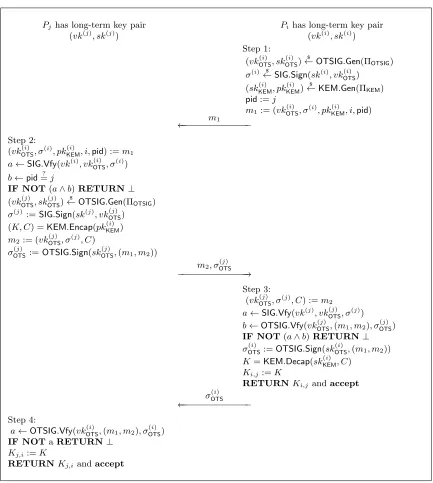
4.2 Our Tightly Secure AKE Protocol
Here, we construct an AKE-protocolAKE, which is based on three building blocks: a key encapsu-lation mechanism, a signature scheme, and a one-time signature scheme.
The protocol is a key transport protocol that needs three messages to authenticate both partici-pants and to establish a shared session key between both parties. Informally, the key encapsulation mechanism guarantees that session keys are indistinguishable from random keys. The signature
5 We note that for any P