Digital Democracy in Malaysia: Towards
Enhancing Citizen Participation
Nor Mazny Abdul Majid
A thesis submitted in fulfilment of the requirements for the degree of
Doctor of Philosophy
School of Law
Faculty of Business and Law
Victoria University
Melbourne, Australia
II
Digital Democracy in Malaysia: Towards Enhancing Citizen Participation
This thesis investigates the relevance of digital democracy in enhancing citizen participation in policy making within the Malaysian civil service. A qualitative research method is applied through an empirical, in-depth interview based, data collection exercise of a sample of civil servants and commentators on government and technology in Malaysia. It assesses, from a broad perspective, the possible
contribution of Information Communications Technology (ICT) in strengthening citizen participation in the democratic processes of government. In these contexts it offers a perspective on how the legal, political and social interpenetrates. The literature reviewed covers: the concept of democracy and assumed influences of ICT on democratic processes; Malaysia’s history with a focus on nation building, the civil service and also its government’s ICT agendas; and, laws structuring citizen
participation in government in Malaysia, framed within autopoietic theory. This, as a metaphor, offers a flexible perspective of law’s affect on its environment and vice versa, and, further illustrates and emphasises the importance of context. The findings suggest that civil servants agree that there are numerous opportunities for policy making to benefit from digital democracy practices based on ICT. However there is a gap between their appreciation of this potential as a concept and their confidence in its implementation in policy making within the civil service. Civil servants are not ready to hand over the role of defining the process and content of policy making to citizens. Civil servants are generally uncertain about the actual value or weight they are willing to afford to inputs from digital democracy practices and what its influence on policy making will be. The thesis is significant because it describes, from viewpoints within the civil service, the role of ICT in enhancing citizen participation in democratic processes within a context of issues, benefits, enablers and barriers to citizen
participation in policy making. This description is placed against a background of the history, culture and law which situates Malaysian civil servants’ understanding of the concept of digital democracy and how they frame its relevance to policy making. The research informs the formulation of policy for the use of digital democracy practices in Malaysia. More generally, it contributes to the debate over the factors, including historic democratic practices, which affect the capacity for ICT to enhance
III III
“I, Nor Mazny Abdul Majid, declare that the PhD thesis entitled Digital Democracy in
Malaysia: Towards Enhancing Citizen Participation is no more than 100,000 words in
length including quotes and exclusive of tables, figures, appendices, bibliography,
references and footnotes. This thesis contains no material that has been submitted
previously, in whole or in part, for the award of any other degree or diploma. Except
where otherwise indicated, this thesis is my own work.”
IV IV
I thank God for it is only with His blessings that this PhD journey has reached a
rewarding destination.
It has been an exceptional journey for which I am forever indebted to many. First and
foremost, I would like to express my deepest appreciation to my supervisor, Professor
Neil Andrews. As much as his constructive criticism and comments have been
invaluable, it is his patience, compassion and enthusiasm which is inspirational. Much
appreciation is also due to my co-supervisor, Dr Scott Beattie for his valuable inputs
and comments. I would also like to thank the wonderful people at the Faculty of
Business and Law. A special thank you to Tina Jeggo, from whose dedication I
benefited enormously. My heartfelt appreciation to my respondents, for their generous
assistance, time and contributions.
Thank you to friends, Wan, Zul, Ju, Aida, Zainah, Nikki, Effy, Annie and others who
shared the postgraduate office. Their continued support, warmth and humour were
critical to the overall enjoyment of my time at Victoria University and will forever be
cherished.
Thank you to my family for their emotional support and endless prayers. To my
mother, Che Pora Abdul Hamid for her unquestioning love and devotion. To my
children Adam and Afaf, my love for them makes me strive to improve. The
motivation and drive to start this journey came from my husband, Abdul Gapar Abu
Bakar. I am truly fortunate to have his love, support and understanding. My late
father, Abdul Majid Salleh, always believed in his girl. I dedicate this work to his
V V
Preface
This thesis records a qualitative research project which aims to assess the role of ICT
in enhancing citizen participation in democratic processes. It addresses the following
primary and subsidiary research questions:
• Primary question: How relevant is digital democracy towards enhancing
citizen participation in policy making within the Malaysian civil service?
• Subsidiary question 1: Will the potential of technology in disseminating
information, facilitating interaction and conducting political transactions
through digital democracy practices be used to increase the transparency,
efficiency, flexibility, cost-effectiveness, and inclusiveness of policy making
in the Malaysian civil service?
• Subsidiary question 2: To what extent will digital democracy practices be
integrated in the practices of Malaysian civil service institutions and how will
they affect actual policy making processes?
• Subsidiary question 3: Will the potential of digital democracy be used
optimally in integrating the basic elements of the entire policy making process
in the Malaysian civil service?
• Subsidiary question 4: Will digital democracy practices for policy making in
the Malaysian civil service be such that people involved may influence issues
of interest?
Points of Departure
This thesis emerged from my personal experience as a civil servant with a background
in legal studies, and a growing personal interest in the field of information and
communication technologies (ICT). Informed by fifteen years of experience in the
management and diplomatic scheme, within the Malaysian civil service, I am aware
that civil servants have a predominant voice in policy making. I also appreciate that
first and foremost, civil servants are individuals with outlooks or attitudes based on
VI VI
views on ICT processes and new policy styles, as well as their views on citizen
participation in policy making, will influence the inclusion or exclusion of digital
democracy practices in policy making within the civil service. Being both an insider
(by virtue of being a civil servant), and a researcher, makes me a “familiar stranger”.1
I feel that my proximity to the environment that I am researching increases my ability
to better evaluate opinions and information, and to interpret them. In essence, this
thesis, which is exploratory in nature, is written from the point of view of a civil
servant, with the purpose of making sense of, and offering insights into the
complexities of the Malaysian civil service.
Moving beyond the personal, to begin with, there is growing interests in the assumed
influences of ICT particularly of the internet on democratic processes. The potential
ICT holds for distribution of and access to information, as well as reinforcing
interactivity between citizens and governments, has led to it being hailed as a changer
of political lives. In the wake of this development, lies the concept of digital
democracy, defined by Hacker and Dijk as “… a collection of attempts to practise
democracy without the limits of time, space and other physical conditions, using ICT
or CMC [Computer Mediated Communication] instead, as an addition, not a
replacement for traditional ‘analogue’ political practices … .”2
The qualifications in this definition, that the concept is “a collection of attempts” and
“an addition, not a replacement”, suggest some holding back by the authors. A review
of the literature revealed that among scholars, some view the social and political
identities of a society and its existential base in relation to citizen participation as
being formed in specific cultural and institutional contexts. Such views posit that
states have their own conceptions and variants of democracy and continue to be
differently democratic, and that ICT does, and will, not necessarily enhance
democracy by increasing citizen participation or citizen power. These views, which
express hesitations and restraints, suggested the importance of taking a step back to
1 A concept first introduced by Stanley Milgram, to depict an individual who is recognised from regular activities, but with whom one does not interact.
2 Hacker and Dijk, What is Digital Democracy, In Hacker and Dijk (eds.),
Digital Democracy Issues of
analyse and understand the context of citizen participation in Malaysia, in order to
assess digital democracy’s relevance for policy making within its civil service.
Among the important elements which emerge from the review of literature as I
attempted to define and structure this research were; that there is no comprehensive
universal model of democracy and that the ideals of democracy do not automatically
link to human development; that it is the specific forces of law, culture and the
technological architecture which work jointly to regulate speech and structure online
deliberation; that the pursuit of applying ICT’s capacity to enhance democratic
processes will be affected by pre-existing democratic practices, pre-existing
governance practices and the general political environment of a country; and, that
civil servants have expertise and influence in policy making and play a vital role in
including or excluding democratic practices in the administrative processes of policy
development. A discussion of these premises in considering the added value of ICT in
enhancing citizen participation in democratic processes, suggested a critical basis for
the research, namely: that further development of the digital democracy concept is
dependant on how citizens and governments struggle with the fundamental question
of what social values are important to them, and how they decide to live.
In many ways, this thesis looks into how the legal, the political and the social
interpenetrate each other. It has a broad ranging literature review which covers the
concept of democracy and assumed influences of ICT on democratic processes
(chapter 1), Malaysia’s history, nation building, its civil service and also its ICT
agendas (chapter 2), and laws forming the context of citizen participation in Malaysia
framed within the theory of legal autopoiesis (chapter 3). As a metaphor, autopoiesis
offers a flexible outlook on law’s effect on its environment and vice versa, which
further illustrates and emphasises the importance of context.
This thesis is significant because it describes the added value of ICT in enhancing
citizen participation in democratic processes within a context of actual issues,
benefits, enablers and barriers to citizen participation for policy making within the
Malaysian civil service. A discussion of history, culture and law forms a background
VIII VIII
to the analysis of how Malaysian civil servants understand the concept of digital
democracy and how they frame its relevance to policy making. The research informs
the formulation of policy for digital democracy practices in Malaysia and generally
contributes to the debate that ICT’s capacity to promote participatory democracy does
IX IX
Table of Contents
ABSTRACT ... II
STUDENT DECLARATION... III
ACKNOWLEDGEMENT ... IV
PREFACE ... V
TABLE OF CONTENTS ... V
LIST OF FIGURES ... XVI
LIST OF TABLES... XVII
LIST OF ABBREVIATIONS ... XVIII
CHAPTER 1 ... 1
DEMOCRACY AND ICT ... 1
CONCEPTIONS OF DEMOCRACY ... 2
Non Existence of a Comprehensive Universal Model of Democracy... 2
Deliberative Democracy Theory ... 3
Concept of Citizen Participation ... 7
ASSUMED INFLUENCES OF THE INTERNET ON DEMOCRATIC PROCESS ... 9
ICT Facilitating Better Access to Information and Communication... 9
Policies and Laws as Forces which Structure Online Deliberations... 10
IMPACT OF ICT ON DEMOCRATIC PRACTICES: THE IMPORTANCE OF NATIONAL CONTEXT ... 13
Implementation of Digital Democracy within National Contexts ... 13
Civil Servants’ Role in Determining the Extent of Democratic Practices in Policy Making ... 16
RESEARCH DESIGN ... 19
Research Questions ... 19
Characterising Online Participation in Policy Making: A Contextual Approach.... 20
X
Anttiroiko: Framework for Assessing Contextual Role of ICT as Part of Digital
Democratic Practices ... 25
Macintosh: Analytical Framework for Electronic Participation... 27
METHODOLOGY ... 31
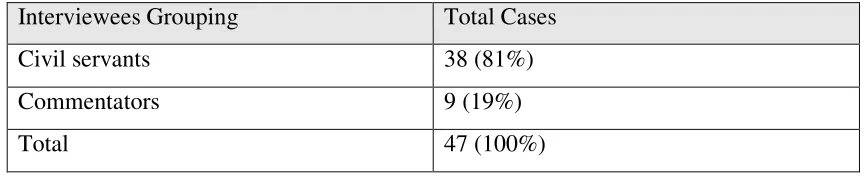
Interviewee Selection and Demographics... 32
Commentators ... 33
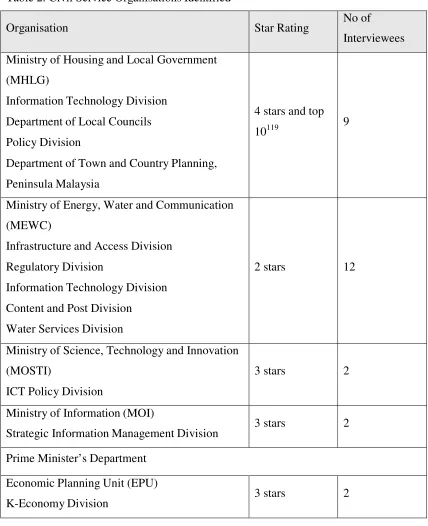
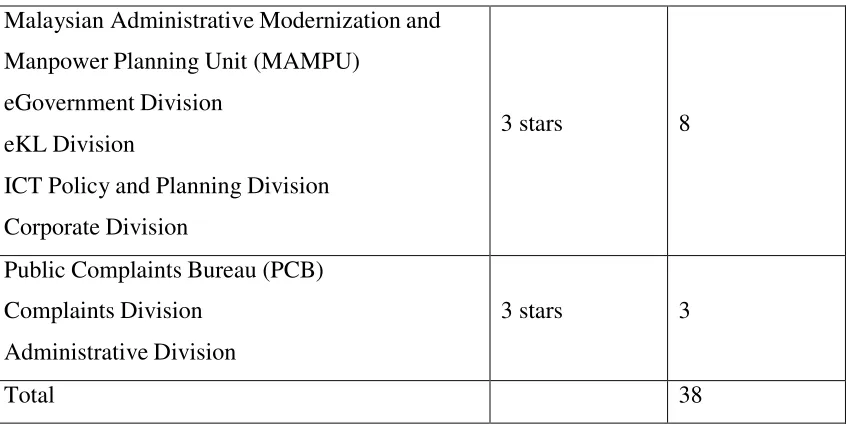
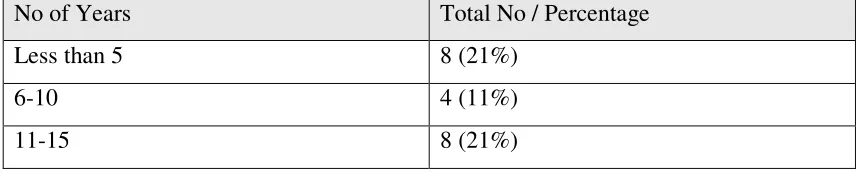
Civil Servants ... 35
The Interviews ... 42
Transcribing the interviews ... 46
Data Analysis ... 48
Data Analysis with QSR NVivo... 48
STRUCTURE OF THESIS ... 54
CHAPTER 2 ... 55
THE MALAYSIAN CONTEXT... 55
THE HISTORICAL DIMENSION ... 57
Colonialism and Post War Malaysia... 62
Federalism and the Significance of Rulers ... 62
RACE, RELIGION AND NATION BUILDING ... 65
The Briggs Plan... 69
The Malayan Union ... 69
The Ethnic Bargain, Social Contract and the Constitution ... 72
THE MALAYSIAN CIVIL SERVICE... 79
Development and Transition ... 79
Malayanisation Program ... 81
The Bureaucratic Elite: Pattern of Beliefs... 83
The Institutional and Administrative Legacy ... 87
Representativeness of the Civil Service ... 89
NATIONAL ICT AGENDAS ... 95
XI
National Information Technology Agenda (NITA). ... 96
MSC Malaysia ... 98
The Malaysian Communications and Multimedia Act 1998 (Act 588) ... 101
Malaysian Communications and Multimedia Commission (MCMC) ... 103
The Communications and Multimedia Content Forum of Malaysia (CMCF) ... 104
CHAPTER 3 ... 107
FRAMING THE GENERAL OUTLOOK FOR PARTICIPATION: LAW AS A CONTRIBUTING FACTOR ... 107
‘SELF-REFERENTIAL’ SYSTEMS ... 108
WHAT IS AUTOPOIESIS? ... 111
Functionally Differentiated Society... 111
Law as an Autopoietic System of Communication ... 112
THE LEGAL SYSTEM AND ITS “META-META STORIES” ... 113
FROM CONFLICT TO PARADOXES... 116
WORLD SOCIETY: TAKING CONFLICT TO THE NEXT LEVEL ... 118
THE CONTEXT OF HUMAN RIGHTS AND FREEDOM OF SPEECH IN CONTEMPORARY MALAYSIA ... 120
Human Rights ... 120
Civil Society Organisations ... 124
Consumer organisations ... 124
Human rights organisations ... 125
Environmental and Heritage Organisations... 125
Freedom of Speech ... 126
The Basic Constitutional Framework ... 127
Traditional Elements of the Malaysian Federal Constitution ... 128
The Sultanate or Rulership ... 129
Islamic Religion ... 131
Malay Language ... 132
Malay Privileges... 133
Article 10(2) (a)... 135
Article 10(4) ... 135
Article 63(4) ... 136
Articles 149 and 150... 136
A REFLECTION ON CONTENTIONS ... 138
Judicial Review of Executive Actions... 142
Judicial Reticence... 142
Media Regulation ... 147
Printing Presses and Publications Act 1984 (PPPA) ... 151
PARADOXES IN THE PARTICIPATION AND POWER EQUATION, IS AUTOPOIETIC LAW REDUCED TO NORMATIVITY? ... 153
CHAPTER 4 ... 158
ICT’S IMPACT ON CIVIL SOCIETY AND CIVIL SERVANTS’ ORIENTATION TOWARDS PARTICIPATIVE POLICY MAKING ... 158
COMMENTATORS: AN ASSESSMENT ... 158
DIGITAL DEMOCRACY: THE INCLUSION OF A WIDER COMMUNITY... 158
ICT as a Medium ... 160
Supports development of a stronger civil society... 160
Support group actions... 161
Facilitates cross discussions ... 162
Digital Divide ... 163
The Critical Factor Is People ... 166
It Is Inevitable, It Is There, Why Not Capitalise On It... 167
Fear of the Unknown ... 169
THE QUESTION OF CONTROL AND CONTEXT; WHAT ARE THE PARAMETERS?... 172
Is There any Real Danger of National Disintegration? ... 173
THE CIVIL SERVICE: ITS HIERARCHIES AND ITS LOCATION IN THE POWER STRUCTURE ... 178
The Bottom Line Is, “Will It Change Anything”? ... 180
XIII XIII
Acculturation ... 182
NO EASY ROUTE TO SUCCESS... 185
DIGITAL DEMOCRACY IS CERTAINLY NOT A DISTANT CONCEPT ... 189
CHAPTER 5 ... 194
INTERACTION ... 194
THE ADDED VALUE OF TECHNOLOGY... 194
ICT Facilitating Service Delivery and Automating Administrative Functions ... 194
Provision of Equitable Access to ICT Infrastructure ... 196
Access to Information and Communication with the Government... 197
Facilitating Participation in Policy Making ... 199
SIGNIFICANCE OF PUBLIC COMPLAINTS... 200
RECEPTIVENESS TO THE CONCEPT ... 202
An Enhancement rather than a Replacement... 203
Liberalising Access to Information ... 204
Facilitating Individual Participation... 204
Assist in Development of More Acceptable Policies ... 205
SIGNIFICANCE OF PUBLIC INPUTS ... 206
ETHNICITY AND ITS RELEVANCY TO THE PARTICIPATIVE POLICY MAKING PROCESS: A MEASURE OF CONFIDENCE ... 207
Ethnic Diversity and Control of Information on the Internet ... 210
On the Question of Tolerance: Where Do They Fall?... 213
RULES OF ENGAGEMENT... 215
Requiring Registration for Participation... 216
Anonymous Participation... 220
DIGITAL DEMOCRACY ENHANCING INTERACTION: BEYOND A DICHOTOMOUS DISCOURSE ... 221
CHAPTER 6 ... 224
XIV XIV
CONSTRUCTION OF INCLUSIVENESS ... 224
COPING WITH PRACTICES OF INFORMATION SOCIETY ... 226
THE QUESTION OF PARTICIPATION AND DECISIONAL BURDENS ... 227
FAITH IN PEOPLE ... 230
MANAGING WITH THE FLOW OF INFORMATION ... 232
Data Culture... 232
Awareness and Adapting... 233
Leadership... 236
Cynicism towards Politics... 238
The Acceptance of Technology... 240
Engaging Trust and Value ... 242
Strong Hierarchies ... 243
Inter Agency Coordination... 244
Information Sharing within the Service ... 245
BELIEFS ABOUT THE LIMITS OF FREEDOMS ... 246
A POSITIVE ATTACHMENT TO LAW... 248
AN APPRECIATION OF A PROVISIONAL CHARACTER ... 250
CHAPTER 7 ... 253
INTEGRATION AND INFLUENCE ... 253
Agenda Setting... 253
Analysis ... 255
Evaluation ... 257
Implementation at Various Stages... 257
A PREFERENCE FOR POLICY BASED FORUMS ... 258
INFLUENCE ... 259
Do Blogs Matter? ... 259
Validity of Information... 260
Portraying No Conviction ... 261
XV XV
What Limits Their Value? ... 264
Groups as Opposed to Individuals ... 265
Collective opinion ... 266
More manageable and practical... 266
Preference for Individual Participation ... 269
Open to All ... 270
A PROMISE TO TAKE NOTE... 271
CHAPTER 8 ... 274
CONCLUSION ... 274
REFLECTIONS ON THE STUDY ... 274
REVISITING THE RESEARCH QUESTIONS ... 277
Primary Research Question ... 277
Subsidiary Question 1 ... 279
Subsidiary Question 2 ... 280
Subsidiary Question 3 ... 282
Subsidiary Question 4 ... 283
LIMITATIONS OF THE THESIS AND FUTURE RESEARCH... 284
XVI XVI
List of Figures
Figure 1: Linking memos to nodes and texts ... 49
Figure 2: Creating nodes with links to texts ... 50
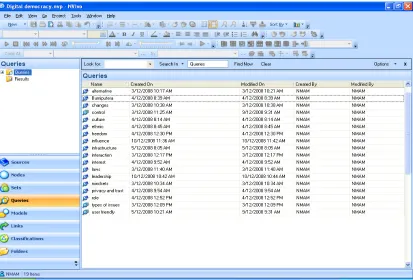
Figure 3: Running text search queries ... 50
Figure 4: Storing result of queries... 51
XVII
List of Tables
Table 1: Group ... 33
Table 2: Civil Service Organisations Identified... 36
Table 3: Sample Civil Servants by Ethnic Group ... 37
Table 4: Sample Civil Servants by Gender... 37
Table 5: Sample Civil Servants by Age Group... 37
Table 6: Sample Civil Servants by Scheme of Service ... 38
Table 7: Sample Civil Servants by Grade ... 38
Table 8: Sample Civil Servants by Years in Service ... 38
Table 9: Participants Interviewees Code-Commentators ... 39
Table 10: Participants Inventory Code-Civil Servants... 40
Table 11: Interview Guide ... 43
Table 12: Detailed Ethnic Group Classification, Malaysia, 2000 ... 55
Table 13: Respondents with Similar Education Background in Areas Relating to ICT . 195 Table 14: Sources of Complaints Lodged with the PCB in 2005 and 2006 ... 202
Table 15: Group (i)- Self censorship and Net Etiquettes ... 214
Table 16: Group (ii)- Censorship and Control ... 214
Table 17: Preference by Age Group... 271
XVIII XVIII
List of Abbreviations
BERNAMA Malaysian National News Agency CMA Communications and Multimedia Act
CMCF Communications and Multimedia Content Forum of Malaysia DAI Digital Access Index
EPU Economic Planning Unit
ICT Information and Communication Technology IAP International Advisory Panel
ITU International Telecommunication Union ISA Internal Security Act
KMM Kesatuan Melayu Muda MAS Malay Administrative Service
MPAJA Malayan People’s Anti Japanese Army MIC Malayan Indian Congress
MCS Malayan Civil Service
MCA Malayan Chinese Association MCP Malayan Communist Party
MAMPU Malaysian Administrative Modernization and Manpower Planning Unit MCMC Malaysian Communications and Multimedia Commission
MyCert Malaysian Computer Emergency Response Team MIMOS Malaysian Institute of Microelectronic Systems MEWC Ministry of Energy, Water and Communication MHLG Ministry of Housing and Local Government MOI Ministry of Information
METP Ministry of Energy, Telecommunications and Post MOSTI Ministry of Science, Technology and Innovation MDeC Multimedia Development Corporation Malaysia NEP New Economic Policy
XIX XIX
NITA National Information Technology Agenda NGO Non Government Organisation
NTP National Telecommunications Policy
OECD Organisation for Economic Co-operation and Development OIC Organisation of the Islamic Conference
PKMM Partai Kebangsaan Melayu Raya PAS Pan-Malayan Islamic Party
PPPA Printing Presses and Publications Act 1984 PTD Perkhidmatan Tadbir dan Diplomatik PCB Public Complaints Bureau
PCPC Permanent Committee on Public Complaints PSB Public Service Broadcasting
PSTN Public Switch Telephony Network RTM Radio Televisyen Malaysia
UMNO United Malays National Organisation UN United Nations
UDHR Universal Declaration of Human Rights USP Universal Service Provision
CHAPTER 1
DEMOCRACY AND ICT
This chapter deals with underlying theories, concepts and themes related to digital democracy which emerge in the literature and inform the research questions. The chapter begins with an overview of the diverse conceptions of democracy. An emphasis is placed on those concepts of democracy which relate to the provision of equal and effective opportunities for citizens to participate in processes of collective policy making or, more precisely, for policy making by government. It considers the role of information and communication technology (ICT) mediated communications which entail citizen inclusion in formal policy making processes by civil servants. However, the literature reviewed also includes direct attempts to influence policy making, such as citizen activism, and the use of the media to form opinions. Another focal point is the literature that insists on a more contextual approach to the understanding of digital democracy.
While the literature reviewed on digital democracy is informed by different perspectives, it serves to shape an understanding of the concept of digital democracy and provides a basis for defining and structuring this research. In examining the underlying arguments in the literature on digital democracy, the chapter is organised around three related premises:
• that digital democracy should be considered in the context of the root concepts of democracy;
• that there is a need to analyse the assumed influences of the internet on democratic processes; and
• that digital democracy is multifaceted and highly contextualised.
CONCEPTIONS OF DEMOCRACY
Non Existence of a Comprehensive Universal Model of Democracy
The concept of democracy defies a single universal definition. One variant of its meaning refers to a method of group decision making characterised by a kind of equality of input among participants.3 Another holds that democracy refers to the opportunity that is given to people to accept or reject those who rule them.4 Blaug likens attempts at defining
democracy to reaching into a black plastic bag to touch an object with an extremely
complex shape. Jutting out in one direction, he says, is a decision-making method identified by a set of political institutions embodying varying degrees of basic principles. Going in another direction is the resurgence of the notion of ethical ideals on what is good for all.5 In the endless discussions of its meaning, however, attempts at defining democracy cannot stray too far from its basic Athenian construction, namely that it is a form of government involving rule by the people.6
In spite of the extensive debate on the meaning of democracy, what remains important is the consensus that the legitimacy of the basic idea remains unchallenged. Democracy, identified by deliberation and consensus based on political equity, is still justified as the desirable form of government even though it may not be the best form of government.7 Bishop concluded:
3
Christiano, Neil and Paul, Democracy: Normative Theory, International Encyclopedia of the Social & Behavioral Sciences, (Oxford 2001) 3413.
4
Coleman, Blogs and the New Politics of Listening, The Political Quarterly, vol. 76, (2005) 272-280. 5
Blaug, Engineering Democracy, Political Studies Association, vol. 50, (2002) 104. 6
For discussions on the theory of democracy, refer Dahl, Neil and Paul, Democracy, International Encyclopedia of the Social & Behavioral Sciences, (Oxford 2001) 3405-3408, Christiano, Neil and Paul, Democracy: Normative Theory, International Encyclopedia of the Social & Behavioral Sciences, (Oxford 2001) 3413-3419, Coleman, Blogs and the New Politics of Listening, The Political Quarterly, vol. 76, (2005) 273-280 and Fishkin, Neil and Paul, Democratic Theory, International Encyclopedia of the Social &
Behavioral Sciences, (Oxford 2001) 3422-3425. 7
I see it as an invention that by its very nature, seems more in tune with equivocal support- not claiming to be the best, but offering a reasonable track record at keeping the worst at bay.8
Deliberative Democracy Theory
In the discussions of democracy, it is accepted that the ideals of democracy do not
automatically support the equal opportunity of all citizens to participate. When small elite groups dominate a country’s economy and politics, the association between democracy and what it offers in terms of equality and equity can be broken. However, even in this
situation, the concept can still be salvaged and be based on the rational choice of citizens. Theorists from Rousseau9 to Dewey have pointed out that:
to be legitimately democratic, political decisions must be based upon consent [which is] not merely the aggregate of personal preferences, but the result of reasoned public discussion of political questions.10
This emphasis on reasoned debate links directly to discussions of the theory of deliberative democracy, which is one of three major schools into which democracy is divided, the other two being liberal individualism and communitarianism.11
The deliberative theory of democracy is distinguished by the view that democracy does not only require equality of votes, but effective opportunity to participate in processes of collective decision making. It deals with the ideal that the distribution of power by democratic institutions is not purely represented through the casting of votes. The theory
8
Bishop, Papers on Parliament No. 39-December 2002-Democratic Equivocations: Who Wants What, When and How?, (2002), accessed online at http://www.aph.gov.au/SEnate/pubs/pops/pop39/c03.pdf on 8 October 2008.
9
According to Dijk, “Rousseau’s notion of the will of the people is not based upon the measurement of the views of individual citizens. Its purpose is the development of citizenship by means of collective discussion and education. Educating citizens as active members of the community is the primary aim of this model … . For Rousseau, the people’s will was not a sum of individual wills but some kind of totality revealing the sovereignty of the people as a collective … . A necessary condition of this model of democracy is the presence of informed citizens.” In Dijk, Models of Democracy and Concept of Communication, In Hacker and Dijk (eds.), Digital Democracy Issues of Theory and Practice, (London 2000) 43-44, emphasis in original.
10
Noveck, Designing Deliberative Democracy in Cyberspace: The Role of the Cyber-Lawyer, Journal of Science and Technology Law, vol. 9, (2003) 7.
11
distributes equal importance between the power to make decisions and equal participation in decision making. It stresses that the definitive idea of deliberative democracy is the act of deliberation itself which can involve elements such as communicating, arguing,
challenging, demonstrating and bargaining.12
Rawls’s13 idea of public reason takes constitutional democracy to also mean deliberative democracy. He defines three essential elements in deliberative democracy:
• the idea of public reason;
• a framework of constitutional and democratic institutions that specifies the settings for deliberative legislative bodies; and
• the knowledge and desire on the part of citizens generally to observe public reason and to realise its ideals in their political conduct.
Rawls maintains that when citizens deliberate on public political questions, they exchange views and debate their supporting justifications. During these deliberations, they
understand that their opinions may be revised by discussions with other citizens, in which the idea of public reason is important. This idea recognises that crucial political and social decisions can only result from having citizens educated in the basic aspects of
constitutional democratic government. It also would not achieve its ideals if citizens were misinformed on the issues at hand.
From the standpoint of legal theory, Habermas reflects that “the central element of the democratic process resides in the procedure of deliberative politics”14 and that:
the democratic procedure is institutionalized in discourses and bargaining processes by employing forms of communication that promise that all outcomes reached in conformity with the procedure are reasonable.15
12
Dahlberg, Democracy via Cyberspace, New Media and Society, vol. 3, (2001)157 and Warren, Deliberative Democracy, In Carter and Stokes (eds.), Democratic Theory Today, (2002) 173-202.
13
Rawls, The Idea of Public Reason Revisited, The University of Chicago Law Review, vol. 64, (1997) 765- 807.
14
Habermas, Between Facts and Norms: Contributions to a Discourse Theory of Law and Democracy, (Cambridge 1996) 296.
15
Habermas places his discourse theory in between the liberal and republican conceptions of the state. In the liberal concept, democratic processes are achieved only when there is a compromise among interests which is justifiable in terms of upholding basic liberal rights. The republican concept relies on substantive support in an established background of consensus by the citizenry upon which the republic is founded. The discourse theory, in its intermediate position, integrates elements from both these concepts into one of an ideal procedure for deliberation and decision making. Instead of viewing “the citizenry as a collective actor, that reflects the whole and acts for it,”16 discourse theory argues that:
[i]ndividual actors function as dependent variables in power processes - processes that operate blindly because beyond individual choice there can be at most aggregated, but not consciously formed and executed, collective decisions.17
Habermas’s discourse theory maintains civil society as the social basis of autonomous public spheres. From the theory’s standpoint, solidarity through widely diversified and autonomous public spheres, as well as procedures for the formation of democratic opinion and actions institutionalised within a constitutional framework, is able to hold its own against two other mechanisms of social integration, namely, money and administrative power.18
Drawing on various theoretical works on deliberative democracy, including that of
Habermas’s, Bottomley19 uses the concept of deliberative decision making to highlight the process of deliberation as a necessary prelude to decision making in a corporate context. Deliberative decision making requires that in considering an issue, there should as far as possible be a prior process which is open and genuine to be able to result in a decision which represents a collective judgement. He places emphasis on process as much as outcome and reason rather than authority and stresses that the legitimacy of a decision is determined from the preceding deliberation, making it more important than personal preferences. He maintains that by way of exposing individual interests to competing perspectives and debates, a decision becomes a collective judgment, even in instances
16
Ibid.(299). 17
Ibid.(299). 18
Ibid.(299). 19
where there are no significant differences to begin with. An important point which emerges from his discussion of the deliberative theory of democracy is that, presenting citizens with opportunities to present their arguments will make them feel that they have been listened to and that they have had a hand in the decision. This he argues is likely to increase their acceptance of the decision, even if it goes against them.
The theoretical writings of Rousseau, Dewey and Rawls, as well as Habermas, from which Bottomley draws, highlight deliberation as an essential process leading to collective decision making. They point towards the importance of the theory of deliberative democracy, the central idea around the theory being the facilitation of rational-critical discourse and the development of public opinion.20 However, being realistic about deliberation, Bottomley, albeit in the context of corporate decision making, cautions that:
[c]learly there are practical limits to the number and range of inputs that a decision-making process can sustain, and deliberative structures and processes must allow for this. There are also limitations imposed by the constitutional framework within which deliberation occurs. Not just anything can go onto the agenda of a general meeting or a board meeting, and not just anything can be decided about the agenda items.21
Where such limits are drawn in political decision making may lead citizens to accept or reject the legitimacy of the process. Related to this are issues about balance in deliberative decision making or the extent to which citizens can actively contribute to governance as well as passively benefit from government systems and processes. The idea of participation generates contrasting values and expectations between those who control deliberative activities and those who respond to them.
Participation, according to Blaug,22 is the key to understanding how conceptions of democracy are divided into “incumbent” and “critical”:
20
Rawls, The Idea of Public Reason Revisited, The University of Chicago Law Review, vol. 64, (1997) 765- 807. Other works on deliberative democracy theory include Baum and Neil, Citizen Participation,
International Encyclopedia of the Social & Behavioral Sciences, (Oxford 2001) 1840-1846 and Carson, Building Sustainable Democracies, NewMatilda.com, (2005) accessed 12 October 2007.
21
Bottomley, The Constitutional Corporation: Rethinking Corporate Governance, (Hampshire 2007) 120. 22
Incumbent democracy is primarily motivated to preserve existing institutions by
maximizing and managing orderly participation. Critical democracy seeks, instead, to resist such management and to empower excluded voices in such a way as to directly challenge existing institutions. Incumbent democrats assume that effectiveness is only achieved through institutions, and that participation requires institutionalization in order to be compatible with the central representative structures of the democratic state. Critical democracy upholds a rather different assumption: that effectiveness can arise out of a collective adherence to common concerns. Here, the institutionalization of participation is seen as an attempt to tame radical energy.23
Blaug maintains that, it is around participation that the apparent consensus on democratic values breaks down. The struggle he says, has always been over “location in the structure of power”.24 To those who hold power and those who do not, participation results in entirely different experiences. These contrasting values and expectations lead to conflict in determining what makes for good deliberation. In light of these conflicts, the challenge, is the task of finding the answer to the question of what can and should be done to deepen democracy so that it:
works for people, links citizens to public decision-making concerning policies and public programmes, fosters and sustains transparency and accountability; and produces outcomes that are equitable ... . 25
Concept of Citizen Participation
In 1969, Sherry Arnstein defined citizen participation as:
a categorical term for citizen power. It is the redistribution of power that enables the have- not citizens, presently excluded from the political and economic processes, to be
deliberately included in the future.26
Arnstein introduced a typology of eight levels of participation represented by eight rungs of a ladder. Participation in the ladder is framed in terms of citizen power. The bottom rung of the ladder is manipulation, where the purpose of a participation process is for those in power to remain in power by eliciting public support through distributing information and advertising approaches. Further up the ladder are levels which represent various degrees of
23
Blaug, Engineering Democracy, Political Studies Association, vol. 50, (2002) 107. 24
Ibid.(108), emphasis in original. 25
United Nations, People Matter: Civic Engagement in Public Governance, World Public Sector Report 2008, (New York 2008) 41-42.
26
Geographical Information and Participatory Approaches Using Geographic Information, (Spoleto 2001) 2.
consultation. At the higher levels are partnerships between citizens and state. The highest is the “possibly impractical utopia of complete citizen control over all issues”.27 Rungs are also grouped into three subsections, representing different degrees of participation including: nonparticipation; tokenism; and, citizen power.28 Arnstein’s concept seems unusual as it emphasises a transformative participation rather than participation as a static concept.
Arnstein considered the extent to which ideas such as consultation and participation are mainly about allowing those in power to claim that all points of view were considered while acting in ways that only benefited a few. In many citizen participation processes, she maintains, a group of the public which she terms “have nots” are lied to during the whole process. The progression up Arnstein’s ladder of citizen participation is by how much control the citizens are allowed. It describes the “transferral of political power from traditional power-holders having power over citizens, to citizens having the power to achieve their own requirements”.29 It begs the question of which rung of the ladder marks the optimal balance of power between citizens’ control and delegated leaders’ control?
Although it is a simplification, Arnstein’s ladder allows us to see that participation and consultation are considerably varied in their scope and effect. Consultations may not
always end in agreements but the reciprocity embedded in them require, as a minimum, that justifications and explanations are offered for taking decisions that do not accord with the views of those consulted. Beyond this minimum, a properly deliberative decision making has to share:
a commitment to fairness and inclusion that characterises a properly democratic approach where the process of decision-making is given priority over the pursuit of any particular outcome from that process. This deliberative democracy perspective is concerned about the
27
Fagan, Newman, McCusker and Murray, E-consultation: Evaluating Appropriate Technologies and Processes for Citizens Participation in Public Policy, (2006) 37.
28
Schlossberg and Shuford, Delineating "Public" and "Participation" in PPGIS, URISA Journal, vol. Vol. 16 No.2, (2005) 17.
29
ongoing relationships between citizens, civil society and the state rather than the efficiency of a single consultation.30
The examples discussed by Arnstein involve citizen participants with similar objectives, such as urban redevelopment. This raises the question of the extent to which the different rungs of the ladder are useful for understanding situations that involve consultations and deliberations on issues where participants have more contrasting objectives. However, the typology of the ladder is very relevant to the need for a government to be mindful of where on the ladder it wishes to place itself and how it wishes to respond to citizens’ demands for a more inclusive democracy. The rungs shift in different contexts and different
administrative cultures. A government may privilege participation in some debates, but not in others. The discussion of ICT’s impact on Malaysian civil society and its civil servant’s orientation towards participative policy making in chapter 4, will further illuminate this issue in the Malaysian context.
ASSUMED INFLUENCES OF THE INTERNET ON DEMOCRATIC
PROCESS
ICT Facilitating Better Access to Information and Communication
New ICT tools provide a formidable potential for distributing and accessing information. They open up opportunities for accelerating connectivity, leading to the emergence of network information societies. This development changes not only social and economic life but also opens up greater possibilities towards changes in political life. By the nature of its rapid pace of innovation and its ability to undermine geographic borders, ICT poses a challenge to governments. ICT’s capacities subject state authority and control and national legal policies and laws to new uncertainties. State power has always, to a certain extent, depended on control of access to information and communication. However, as much as ICT is said to be the technology of freedom, individual empowerment may not lead to objective results or outcomes. The power to know is not the same as the power to act. The power remains latent unless armed by purposeful authority and an institutional setting. It is
30
not technology but policy that potentially threatens contemporary personal jurisdiction theory,31 which is said to rest on the twin pillars of state sovereignty and legal processes.32 That this technology acts to structure our choices and preferences, but not in a wholly determinist way, is stressed by Street’s proclamation:
[T]here are three mistaken claims about technology; that it is neutral, that it is autonomous and that it can be selected freely.33
Policies and Laws as Forces which Structure Online Deliberations
Langdon Winner likens the internet to a Hollywood film in that they both mirror and inform the fantasies of their audience. The internet, he maintains, is contributing to a culture which, although widely shared, is full of highly commercialised symbols and meanings. Significantly, Winner also points out that social science studies suggest that in using the internet, people tend to customise the sources of information according to their interests. This contrasts he says, with the fact that one element that contributes to a truly democratic setting is the diversity of participants engaged in different arguments. This prompts questions of whether the mobilisation of people’s attention and activity is effective when it comes to matters of power and policy, and, whether the internet can actually
improve the quantity and quality of citizen participation. In Winner’s view, the internet into which hierarchies have supposedly vanished, cannot be seen in isolation. At the end of the day, it still occupies the same political space of what used to be and remains the focus of power, namely, statecraft and political parties.34
31
Modern personal jurisdiction theory states that, “[a] nonresident’s “minimum contacts” with a forum state are treated as the equivalent of her territorial presence in the state and hence justify a state’s exercise of sovereignty over her. At the same time, the nonresident’s “purposeful availment” of opportunities within the state is seen as implying her agreement to that state’s jurisdiction in exchange for the protection of its laws. This theory presumes that a non resident directs voice communications to known places by dialling a telephone number’s area code”. This theory is now challenged by the advent of Voice over Internet Protocol (VoIP) and its applications, which make area codes no longer correspond to known locations. In Citron, Minimum Contacts in a Borderless World: Voice over Internet Protocol and the Coming Implosion of Personal Jurisdiction Theory, University of California Davis Law Review vol. 39, (2006) 481. 32
For discussions related to ICT and citizen empowerment refer Ibid.(1481-1453), Breton, On the Meaning of Empowerment and Empowerment-0riented Social Work Practice, Social Work with Groups, vol. 17, (1994) 23-37 and Hartford, Who Owns Informationization?, vol. 2007, (Boston ) available online at
http://web.mit.edu/chinapolicy/www/conference1/hartford.pdf , accessed 5 October 2007. 33
Street, Remote Control? Politics, Technology and `Electronic Democracy', European Journal of Communication, vol. 12, (1997) 27.
34
In line with Winner’s arguments, Darin Barney argues that in most cases, new technologies strengthen priorities which are already in place. In an interview, while discussing access and the digital divide he says:
Contemporary technological discourse traps us with the assumption that access, or even access with skill, necessarily constitutes empowerment and liberation. I think this is a dubious proposition given the history of technological systems, almost all of which have served to reinforce, rather than democratize existing distributions of political and economic power. Still, our public culture confirms this equation, and so we will continue to press for equal access to technology when what democracy really requires is equal access to political and economic power. Equal access to a technology of disempowerment, or a technology configured to disempower, can undermine democracy instead of contributing to it.35 Conceptual frameworks of policies and laws play very significant roles in the architecture of rights and capabilities in cyberspace. An important point to be made here is that, amidst the overwhelming capacity of ICT, governments still possess the ability to privilege different types of value choices. It is these choices made by governments and expressed through policies and laws that will determine whether, and how, ICT will lead to greater citizen participation. The regulation of electronic communication, according to Winner, is not entailed in its technology but is a reaction to it. He maintains that social relations, with or without ICT, are more impacted by policies and legal rules than technologies because of their power of enforcement.36
Bringing aspects of this discussion closer to the realms of digital democracy is Noveck’s37 argument that the flourishing of human communication brought about by a technical revolution, such as ICT, does not guarantee a concomitant growth in democracy. Online activities such as web chatting, or what she terms as “unregulated talkativeness”, does not
Macintosh, Davenport, Malina and Whyte, Technology to Support Participatory Democracy, In Gronlund (ed.), Electronic Government:Design, Applications and Management, (London 2002) 226-248.
35
Jay, Technology, Democracy and Liberation: An Interview with Darin Barney, Monkeyfist.com, vol. 2008, (2003) <http://monkeyfist.com/articles/837 >, accessed 13 March 2008.
36
Winner, Technological Euphoria and Contemporary Citizenship, Techne: Research in Philosophy and Technology, vol. 9, (2005) 124-133. For a philosophical approach to technology, see also Winner, The Whale and the Reactor: A Search for Limits in an Age of High Technology, (1986).
37
necessarily foster democratic participation. Although Noveck looks at the issue from a legal perspective, her arguments align with those of Winner and Barney as she points out that it is the specific forces of law, culture and technological architecture which work jointly to regulate speech and structure online deliberation. For ICT to function in democratic ways requires, Noveck argues, that there be construction of online public spaces to allow for communications which are subject to rules of what she terms “conversational
transparency”. She connects the metaphor of transparency, in the sense of legal
accountability, to the role of communication regulation in the development of democratic political culture or legal transparency. Noveck stresses that if, in the previous era, lawyers had only to be concerned with enacting appropriate laws to preserve democracy, now they also have to know how to bring the values of democracy into the world of technology.
IMPACT OF ICT ON DEMOCRATIC PRACTICES: THE
IMPORTANCE OF NATIONAL CONTEXT
Implementation of Digital Democracy within National Contexts
Meanings of democracy vary across cultures, states and economic boundaries. While functional relationships between ICT, specifically the internet and increased information access, have become more or less self evident, what is less revealed is the extent of its effect on national democratic processes. States have their own conceptions and variants of democracy and continue to be differently democratic. The pursuit of the application of ICT’s capacities to enhance democratic processes will only correspond with pre-existing democratic practices, pre-existing governance practices and the general political
environment of a country. These factors indicate another aspect of the discussion of democracy that needs to be considered, that it embraces culture as well as the history and specific circumstances of a country. The definition of digital democracy by Hacker and Dijk reflects this. They define it as:
a collection of attempts to practise democracy without the limits of time, space and other physical conditions, using ICT or CMC [Computer Mediated Communication] instead, as an addition, not a replacement for traditional ‘analogue’ political practices.38
Dijk further qualifies the definition by emphasising digital democracy as:
an attempt to change traditional age-old ways of operation and habits in politic. It is a matter of exploration and experiment.39
Proponents of digital democracy aim to deploy ICT to improve the effectiveness and efficiency of democracy. Perhaps the technology’s strongest appeal lies in its potential to reinforce interactivity between citizens and governments. However, as previously
discussed, institutional and cultural differences in each political system shape the forms and extent of the political uses of computer technology. The fact remains that ICT does not change political institutions and processes by virtue of its mere existence. Rather, it may amplify existing tendencies by virtue of its development being controlled by specific
38
Hacker and Dijk, What is Digital Democracy, In Hacker and Dijk (eds.), Digital Democracy Issues of Theory and Practice, (London 2000) 1, emphasis in original.
39
dominant interests. Because of this, the opportunities and risks attributed to digital
democracy are related to existing models of democracy and communication. This helps to explain the particular preferences in applying ICT in a political system.40 As calls for civic engagements derive their successes and shortcomings from:
historical factors and specific cultural and institutional contexts, transplanting or adopting models [of digital democracy] across cultures is often difficult, if not impossible.41
While the internet’s democratic capacity may be maximised in some states which fulfil certain conditions, other states may find that it poses challenges to existing practices, albeit to varying degrees. Understanding the role of the internet in democratic processes requires understanding how states have been governing themselves without the internet.42 In the words of Watson and Mundy,43 “whether in its traditional or digital form, democracy should be customised and implemented in context.” A major study by Heeks and Bhatnagar, of attempts to introduce new ICT while ignoring the realities of the governmental context concludes, “failure predominates”.44
Crouch45 argues that in a society sharply divided on ethnic lines, each major group will be compelled to establish its own predominance. When in power, a group will authoritatively consolidate its position. On the other hand, the presence of several major ethnic
40
Watson and Mundy, A Strategic Perspective of Electronic Democracy, Association for Computing Machinery. Communications of the ACM, vol. 44 (2001) 27-30, Hagen, Digital Democracy and Political Systems, In Hacker and Dijk (eds.), Digital Democracy Issues of Theory and Practice, (London 2000) 54-63 and Dijk, Models of Democracy and Concept of Communication, In Hacker and Dijk (eds.), Digital
Democracy Issues of Theory and Practice, (London 2000) 30-53. 41
United Nations, People Matter: Civic Engagement in Public Governance, World Public Sector Report 2008, (New York 2008) 72.
42
For related discussions refer Inoguchi, Newman and Keane, Introduction: The Changing Nature of
Democracy, In Inoguchi, Newman and Keane (eds.), The Changing Nature of Democracy, (Tokyo, New York 1998) 1-19, Rose, Governance and the Internet, Communications of the ACM, vol. 46, (2003) 338-364, Rose, A Global Diffusion Model of e-Governance, Journal of Public Policy, vol. 25, (2005) 5-27, Loo, e-
Democracy in Malaysia: Chasing the Winds of Change, In Banerjee (ed.), Rhetoric and Reality: The Internet Challenge for Democracy in Asia, (Singapore 2003) 179, Catinet and Vedel, Public Policies for Digital Democracy, In Hacker and Dijk (eds.), Digital Democracy: Issues of Theory and Practice, (London, Thousand Oaks, New Delhi 2000) 184-208 and United Nations, Human Development Report 2002: Deepening Democracy in a Fragmented World, (2002).
43
Watson and Mundy, A Strategic Perspective of Electronic Democracy, Association for Computing Machinery. Communications of the ACM, vol. 44 (2001) 27-30.
44
Heeks and Bhatnagar, Understanding Success and Failure in Information Age Reform, In Heeks (ed.),
Reinventing Government In The Information age, (London and New York 1999) 49. 45
communities may contribute to a balance of power, promoting responsiveness by the government to inter group bargaining and negotiation. Both arguments may apply to Malaysia. One ethnic group has established its predominance while simultaneously, the presence of other distinct ethnic communities, necessitates the juggling of continuing threats of ethnic conflict through representative measures of control. In turn, this has encouraged bargaining and the development of government responsiveness. This issue will be discussed further in chapter 2.
Lijphart maintains that, the “difficulty to achieve and maintain stable democratic government in a plural society46 is a well established proposition”.47 In the case of
Malaysia, ethnic diversity has had definite impacts upon nationalism and democratisation. It has continuously played a significant role in the shaping of the country’s contemporary societies and politics.48 Lijphart cites Malaysia as an example of a successful consociational democracy.49 However, there are others who view it as having antidemocratic laws and politics, with continuing restrictions on freedom of association and of communication where these may have adverse impact on the governing party. These views will also be discussed further in chapter 2.
Loo50 argues that, despite initial positive signs of the Malaysian government’s willingness to tolerate a free internet, obstacles to change may remain embedded in hierarchical
government bureaucracy, academia and social settings inclined to limit information sharing and knowledge generation. He feels that among civil servants, apprehension still prevails
46
Segmental cleavages in a plural society according to Lijphart, may be of a religious, ideological, linguistic, regional, cultural, racial or ethnic nature. See Neher, Asian Style Democracy, Asian Survey, vol. 34, (1994) 946-961.
47
Lijphart, Democracy in Plural Societies: A Comparative Exploration, (New Haven and London 1977) 1. 48
From Ghia Nodia’s review of Jack Snyder’s work entitled From Voting to Violence, on democratization and nationalist conflict, cited in Nodia, Nurturing Nationalism, Journal of Democracy, vol. 11, (2000) 171. 49
According to Lustick, “In a consociational democracy, the centrifugal tendencies inherent in a plural society are counteracted by the cooperative attitudes and behaviour of the leaders of the different segments of the population. Elite cooperation is the primary distinguishing feature of consociational democracy”. In Lustick, Lijphart, Lakatos, and Consociationalism, Journal of World Politics, vol. 50.0 (1997), (1997) 88-117. 50
over the engagement of policy discussions in the public sphere. Factors such as the convention of uncritical deference to authority, group conformity, the Malaysian family system, social and work environments, schools and government are said to place
constraints on advocating the application of ICT’s capacity to enhance democratic processes in Malaysia. Lim also argues that, although modernisation has opened new
possibilities and increased agency in Malaysia, adjustments of the practices of everyday life using new technology must still be subject to social control. For example, the application of ICT’s capacity to create new forums for political discussions may still require the use of the old controls over political discussions in the mass media if Malaysia were to benefit from it. However, the deeper level of transparency that ICT creates, may, on the other hand, necessitate redefining democratic processes, as well as roles including those of civil servants.
Civil Servants’ Role in Determining the Extent of Democratic Practices in
Policy Making
ICT already contributes to the decentralisation or spread of politics. While the political government remains dominant in theory, in practice the use of ICT has strengthened the civil service in relationship to the government that it is serving. The fact that civil servants have expertise and influence in policy making, which has a political impact, is sometimes ignored in current literature on democracy theory. Their role as professionals immersed in a specific sectoral context puts them in a vital representative position to include or exclude democratic practices in the development of policy. Their preference for ICT processes and new policy styles will help determine the potential aggregation of interests in digital democracy through their encouragement of ICT’s use to enhance citizen debates and participation in policy making. The democratic quality of online practices will largely depend on how ICT is applied, and consequently, on how public authorities are able to frame their usage.51 In the words of Castells, “[t]he public sector is at present the decisive actor to develop and shape network society.”52
51
Drawing on institutional economics, Pierson53 in his discussion of path dependence in politics, argues that it is the increasing returns for policy and institutional players that keep them bound to an initial path. He argues that policymakers involved at the time of an initial policy proposal will have already had a committed or sunk investment in the policy path. They have learnt to deal with the system in a certain way. They may find co-ordination to be easier as the behaviour of others becomes predictable under the previously agreed policy or institutional processes. However, factors apart from increasing returns are often at play in policy and institutional processes, leading to learning and adaptation. Sometimes reforms are accepted, even if their advantages are not clear cut. Small changes can build up and may, at a certain “tipping point”, provide the force driving further change.
However, amidst all the changes which have taken place in the last century, it remains strongly evident that the state bureaucracy is still based on the Weberian legacy of a:
clear hierarchical order, concentration of power among senior officials, formal structures with strict rules and regulations, limited channels of communication, confined openness to innovation and change, and non compliance with the option of being replaceable.54
These values are sharply opposed to those we associate with democracy, such as equality and participation. They may limit the active involvement of citizens in policy making processes, especially when they are perceived as interfering with administrative work or the need of administrators to govern. Moves towards new procedures and processes, such as introducing a transformation to the traditional method of policy making into a public organisation, will need consideration of a change in existing cultures and values within public organisations.55 As stated by Sanford and Rose, it may require “reorganization of
Science Computer Review, vol. 21, (2003) 55-72 and Catinet and Vedel, Public Policies for Digital Democracy, In Hacker and Dijk (eds.), Digital Democracy: Issues of Theory and Practice, (London, Thousand Oaks, New Delhi 2000) 184-208.
52
Castells, The Network Society: From Knowledge to Policy, In Castells and Cardoso (eds.), The Network Society: From Knowledge to Policy, (2006) 17.
53
Pierson, Increasing Returns, Path Dependence, and the Study of Politics, The American Political Science Review, vol. 94, (2000) 251-267.
54
Vigoda, From Responsiveness to Collaboration: Governance, Citizens, and the Next Generation of Public Administration, Public Administration Review, vol. 62, (2002) 529.
55
government – perhaps into flatter hierarchies of more creative and cooperative” 56 civil servants.
Democracy implies a limitation on state powers. It invokes a more bottom up process in which actions may be initiated by individuals or be determined by popular demand. However, as literature suggests, changes brought about by technology are ambivalent towards democratic values. The marketplace or individuals may not always be the best mechanism to ensure basic values associated with the notion of digital democracy. For example, a change brought about by ICT to the ways in which information is relayed
necessitates the adaptation of media and communications policies. These policies impact on freedom of information and freedom of communication. Public policies regarding the development of ICT’s hard and soft infrastructure are also important as they condition the possible uses of ICT and their impact on political systems. The interplay of social forces, including businesses and politics, cannot be ruled out. Left alone, the determination of the range of desirable democratic ICT applications may, for example, be based solely on profitability, on an individual’s personal wealth and education or developed only to suit particular political interests.57
Malaysia’s quest for strategic and competitive advantages through its development of ICT and its consciousness of adhering to international standards and values58 may come to drive
27, (2007) 406, Vigoda, From Responsiveness to Collaboration: Governance, Citizens, and the Next Generation of Public Administration, Public Administration Review, vol. 62, (2002) 527-540 and Fountain, Central Issues in the Political Development of a Virtual State, In Castells and Cardoso (eds.), The Network Society: From Knowledge to Policy, (2006) 150.
56
Sanford and Rose, Characterizing eParticipation, International Journal of Information Management, vol. 27, (2007) 406.
57
Catinet and Vedel, Public Policies for Digital Democracy, In Hacker and Dijk (eds.), Digital Democracy: Issues of Theory and Practice, (London, Thousand Oaks, New Delhi 2000) 185-207.
the implementation of digital democracy in policy making. However as the literature reveals, the determination of how ICT will impact state-citizen relationships should not be solely driven by technology. Conceptual frameworks of policies and laws play significant roles in the architecture of rights and capabilities in cyberspace that privilege different types of “value choices”.59 In the case of Malaysia, whether or not digital democracy will enhance democratic participation, will depend upon these “value choices”. This necessitates consideration of the prevailing characteristics of state-citizen relationships, policies and laws as determined by contextual challenges of history, ethnicity and politics. These factors, which relate closely to the development of the Malaysian civil service, its role in the process of nation building as well as the adoption of ICT, will be discussed further in chapters 2 and 3.
RESEARCH DESIGN
Research Questions
The review of the literature demonstrates that digital democracy research has been
dominated by the ideological discourses of a mixture of advocates and sceptics drawing on underlying ideas on democracy and the internet. Although in general the debate over how and how much ICT will shape democratic practices is likely to continue, for this particular study, the literature serves to provide an overview of theories and key concepts related to digital democracy. This was used to identify the critical basis of this research, namely that further development of the digital democracy concept will be greatly dependant on how citizens and governments struggle with more fundamental questions of what social values are important to them and how they should live. This examination of actors and their roles in the practice of Malaysian digital democracy, in the context of the literature, led to the emergence of the primary research question (PRQ):
Millenium Declaration. The declaration lists six fundamental values as essential to internatonal relations in the 21st century. The first is freedom which text spells out as follows: “Men and women have the right to live and raise their children in dignity, free from hunger and from the fear of violence, oppression or injustice. Democratic and participatory governance based on the will of the people best assures these rights.”,United Nations, General Assembly Resolution 55/2, (2000) , available online at http://www.undemocracy.com/A- RES-55-2.pdf accessed 14 November 2008.
59