Improved Linear Sieving Techniques with
Applications to Step-Reduced LED-64
Itai Dinur1,?, Orr Dunkelman2,4,??, Nathan Keller3,4,? ? ?, and Adi Shamir4
1 D´epartement d’Informatique, ´Ecole Normale Sup´erieure, Paris, France 2
Computer Science Department, University of Haifa, Israel
3 Department of Mathematics, Bar-Ilan University, Israel 4
Computer Science department, The Weizmann Institute, Rehovot, Israel
Abstract. In this paper, we describe new techniques in meet-in-the-middle attacks. Our basic technique is called alinear key sieve since it exploits as filtering conditions linear dependencies between key bits that are guessed from both sides of the attack. This should be contrasted with related previous attacks, which only exploited alinear state sieve (i.e., linear dependencies between state bits that are computed from both sides of the attack). We apply these techniques to the lightweight block cipher LED-64, and improve some of the best known attacks on step-reduced variants of this cipher in all attack models. As a first application of the linear key sieve, we describe a chosen plaintext attack on 2-step LED-64, which reduces the time complexity of the best previously published attack on this variant from 256to 248. Then, we present the first attack on 2-step LED-64 in theknown plaintext model. In this attack, we show for the first time that the splice-and-cut technique (which inherently requires chosen messages) can also be applied in the known plaintext model, and we use the linear key sieve in order to obtain an attack with the same time complexity as our chosen plaintext attack. Finally, we describe a related-key attack on 3-step LED-64 which improves the best previously published attack (presented at Asiacrypt 2012) in all the complexity parameters of time/data/memory from 260 to 249. As our
first two single-key attacks, the related-key attack is also based on the linear key sieve, but it uses additional techniques in differential meet-in-the-middle which are interesting in their own right.
Keywords: Cryptanalysis, LED, AES, Even-Mansour, Meet-in-the-middle at-tack, Splice-and-cut
?Some of the work presented in this paper was done while the first author was a
postdoctoral researcher at the Weizmann Institute, Israel.
?? The second author was supported in part by the German-Israeli Foundation for
Scientific Research and Development through grant No. 2282-2222.6/2011. ? ? ?
1
Introduction
Meet-in-the-middle (MITM) attacks on block ciphers were first introduced more than 30 years ago [12]. A block cipher was shown to be vulnerable to such attacks if it is possible to independently compute a variable of its inner state from the encryption and decryption sides without having to guess the full key. The value of this inner variable (or variables) is used to efficiently sieve the key suggestions obtained from both sides and mount an efficient attack. This motivated block cipher designers to incorporate relatively complex key schedule algorithms into the design, thus assuring very quick diffusion of the full key into the state and making the cipher resistant to MITM attacks. On the other hand, complex key schedule algorithms are difficult to implement in resource-constrained environments (such as RFID tags and wireless sensors). Thus, in recent years, with the rise of lightweight cryptography, designers have proposed many schemes with simplified key schedule algorithms. At the extreme end of the scale lie block ciphers such as LED-64 [9], Zorro [8] and PRINCE [3] which have no key schedule at all, and simply XOR the key to the internal state of the cipher several times during the encryption process.
Naturally, the tendency to simplify the key schedule of block ciphers was accompanied by the development of interesting new techniques in MITM attacks in order to break these schemes. Examples of these techniques include sieve-in-the-middle [5] and splice-and-cut [1, 14] which is one of the most notable techniques, initially applied to hash functions, but was quickly shown to be applicable to block ciphers as well. Splice-and-cut attacks are adaptations of Merkle and Hellman’s attack on 2K-3DES [12] to single encryption. The main idea is to obtain the encryptions of several chosen plaintexts in order to view the first and the last rounds of the cryptosystem as consecutive rounds. As a result, the adversary can split the cipher into two parts in an unconventional way, and mount an efficient MITM attack in cases where such an attack seems difficult otherwise.
Another important technique used in several MITM attacks exploits the abil-ity to independently and efficiently compute linear combinations of variables of the inner state (rather than the actual variables) of the cipher from the encryp-tion and decrypencryp-tion sides. This linear state sieving technique allows the adver-sary to apply a MITM attack through a linear layer of the block cipher, and was specifically exploited in [4, 10, 13] in order to mount such attacks through the linear MixColumns operation of AES-based constructions.
The lightweight block cipher LED was presented at CHES 2011 [9], and due to its elegant AES-based design, it has been the target of significant cryptanalytic effort in the past few years. In the single-key chosen plaintext model, the best previously known attack on 2 steps of LED-64 (reduced from the full 8) was presented in [10], and we reduce its time complexity from 256 to 248. Both the previous attack and our new attack apply the splice-and-cut technique in order to mount a MITM attack on the cipher. The main element that enables us to improve the previous attack of [10] is the linear key sieve, which we use in order to filter the key suggestions obtained during the attack in a more efficient way.
In addition to the chosen plaintext attack, we present the first attack on 2-step LED-64 in the known plaintext model. The main novelty of this attack is that it uses, for the first time, the splice-and-cut technique (which seems to require chosen messages in an inherent way) in the known plaintext model. Once again, in this attack we use the linear key sieve technique, and it enables our known plaintext attack to maintain the same running time as our chosen plaintext attack.
Finally, in the stronger related-key model, we analyze 3-step LED-64, on which the best previously known attack [11] used a classical differential method. In this model, we use a differential MITM attack (which is interesting in its own right), in addition to the linear key sieve, in order to mount a more efficient attack which improves the previous attack in all the complexity parameters of time/memory/data from 260to 249.
The paper is organized as follows: in Section 2, we describe LED-64 and summarize the previous attacks as well as our new attacks on this cipher. In Section 3, we describe the notations and conventions that are used in this paper. Our new chosen plaintext, known plaintext and related-key attacks are described in Sections 4, 5 and 6, respectively. Finally, we conclude in Section 7.
2
Description of LED-64
LED [9] is a 64-bit block cipher built using several public permutations, in-terleaved with round-key additions over GF(2) (i.e., XOR operations). This construction is generally known as iterated Even-Mansour (see Figure 1), which generalizes the original one-round construction [7]. In the case of LED, the public permutations are called steps, and each step is composed of 4 rounds. A round of LED uses an AES-like design, where given a 64-bit input X, it is treated as a concatenation of 16 four-bit nibblesX[0]kX[1]k. . .kX[15], which are (concep-tually) arranged in a 4×4 array:
X[0] X[1] X[2] X[3]
X[4] X[5] X[6] X[7]
X[8] X[9] X[10]X[11]
X[12]X[13]X[14]X[15]
proper-ties of these mappings (given below) are similar to those of the AES mappings AddRoundKey, SubBytes, ShiftRows and MixColumns, respectively, and these are the only properties which are exploited by our attacks. For the complete implementation details of the LED mappings, refer to [9].
1. AddConstants adds (over GF(2)) a round-dependant constant to each cell of the two first columns.
2. SubCells applies a 4-bit Sbox to every cell of the internal state. 3. ShiftRows rotates each cell located in row ibyi positions to the left. 4. MixColumnsSerial independently applies an MDS (Maximum Distance
Sep-arable) matrix to each column.
LED has two main variants, LED-64 and LED-128, which differ according to the key size. In this paper, we are mainly interested in the 64-bit version, which uses 32 rounds (or 8 steps). The key schedule of LED-64 simply adds the 64-bit key
K before rounds 4i+ 1 fori= 0,1, . . . ,7, and after the final round 32.
P L F1 L F2 L Fi L Fr L C
K1 K2 K3 Ki+1 Kr+1
Fig. 1.Iterated Even-Mansour
2.1 Summary of Our New Attacks and the Previous Attacks on Step-Reduced LED-64
Our new attacks on step-reduced LED-64 are summarized in table 1. In the single-key model, the previous best chosen plaintext attack on 2-step LED-64 is described in [10], and we improve its time complexity from 256 to 248. In addition, we present the first attack on 2-step LED-64 in the known plaintext model, which has the same time complexity as our best chosen plaintext attack (but requires more data and memory). We also mention the attack on 3-step LED-64 given in [6]. However, despite its theoretical significance, the attack is non-practical with respect to the memory complexity (which is 260) and it is only about 16 times faster than exhaustive search. On the other hand, our attacks on 2-step LED-64 are more than 250,000 times faster than exhaustive search and are more practical.
interesting, it is very marginal with respect to the time, memory and data com-plexities, which are all1 about 263.
Section Model Steps Time Data Memory
4.2 Single-key 2 248 216CP 217
5 Single-key 2 248 248 KP 248
6.2 Related-Key 3 249 249CP 249
The data complexity is given in chosen plaintexts (CP), or in known plaintexts (KP).
Table 1.Our New Attacks of Step-Reduced LED-64
3
Notations and Conventions
Notations We denote byRrthe public function of roundrof LED-64 (without
the key addition), i.e., given a 64-bit stateX,Rr(X),M CS(SR(SC(AC(X))).
We denote byFithe public function of stepi, i.e., given a 64-bit stateX,Fi(X),
R4i+4(R4i+3(R4i+2(R4i+1(X)))). The functionsR−r1andFi−1are defined as the
inverses of Rr andFi, respectively.
Given a plaintext-ciphertext pair (P, C), we denote the state after r en-cryption rounds by Xr (e.g., X0 = P and X1 is the state after one round of LED-64). In order to simplify our notation, we define ˆX4i =X4i⊕K, and so
Fi( ˆX4i) = X4(i+1). In some of our attacks, in addition to obtaining plaintext-ciphertext pairs, we independently evaluate the public step functionFi(for some
i) on some input states ˆY4i, and we defineFi( ˆY4i) =Y4(i+1)(i.e., ˆY4i =Y4i⊕Ki).
We denote thej’th column ofXi byXi,|j|, i.e.,Xi,|0|is composed of nibbles
{0,4,8,12}. Similarly, we denote byXi,|j,l|columnsj andlofXi. We define two
more column-related sets: the first is Xi,/j/ which is composed of the nibbles
in Xi corresponding to the places after the ShiftRows operation on column j,
e.g., Xi,/0/ is composed of nibbles 0,7,10,13. The second set is Xi,\j\ which is composed of the nibbles in the positions of column j after having applied the inverse ShiftRows operation.
Conventions Throughout this paper, we use the standard conventions and calculate the time complexity of our attacks in terms of evaluations of the full cipher, while calculating their memory complexity in terms of 64-bit words (since the block size of LED-64 is 64 bits). Some of the attacks presented in this paper
1 In fact, since the time complexity of exhaustive search given 2 related keys is 263,
involve basic linear algebra algorithm (such as solving a system of linear equa-tions with a few dozen variables2 over GF(2)). Since our attacks execute these basic linear algebra algorithms no more than a few times per evaluation of the full cipher, we can ignore them in our time complexity analysis.
4
An Improved Chosen Plaintext Single-Key Attack on
2-Step LED-64
In this section, we introduce the linear key sieve technique, and apply it (bined with splice-and-cut) to 2-step LED-64. Our attack improves the time com-plexity of the previously best known attack on 2-step LED-64 [10] (which is based on the techniques of [13]) from 256to 248.
To simplify the description of the technique, before presenting the full 2-step attack, we introduce the linear key sieve in a simple example of a basic MITM attack on 1-step LED-64.
4.1 A Meet-in-the-Middle Attack on 1-Step LED-64
We describe a basic MITM attack on 4-round (1-step) LED-64, using a single known plaintext-ciphertext pair (P =X0, C = ˆX4). The attack is based on a few simple and well-known observations on AES-based constructions:
1. The order of the linear operations ARK andM CS is interchangeable, i.e.,
M CS−1(ARK−1(C)) =ARK0−1(M CS−1(C)), whereARK0 adds the key
K0 ,M CS−1(K) to the state. As in many attacks on AES-based construc-tions, we can thus applyM CS−1 to the ciphertext C, and “peel-off” the last-roundM CS operation.
2. Given an inverse-shifted column Xr,\i\ (at the beginning of any round r), we can fully compute the shifted column of the state after the first 7 opera-tionsSR(SC(AC(M CS(SR(SC(AC(Xr)))))))/i/. Similarly, given a shifted
columnXr,/i/, we can fully compute the inverse-shifted column of the state
after the 7 inverse operations
AC−1(SC−1(SR−1(M CS−1(AC−1(SC−1(SR−1(X
r)))))))\i\. Such a per-mutation, mapping 4 nibbles to 4 nibbles of the state through a “round and a half” is called a “Super-Sbox” of LED.
3. Given knowledge of any b1 bits of the state X, we can compute the values ofb1 linear expressions (overGF(2)) on the stateM CS(X).
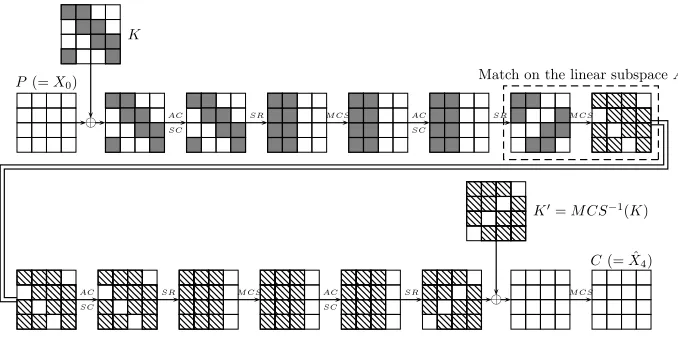
Observation 2 implies that given ˆX0,\i,j\ (for any two columns i andj) we can computeSR(SC(AC(X1)))/i,j/ =M CS−1(X2)/i,j/, as shown by the gray
nibbles in Figure 2. Combined with Observation 3, we can compute 16·2 = 32 linear expressions on the state X2, spanning a subspace of dimension 32.
2 In order to reduce the O(n3) bit operations required to solve a system ofn linear
Similarly, we can apply Observation 2 from the decryption side (with three columns), i.e.,M CS−1(ARK−1(C))
/l,m,n/ gives us the knowledge of 48 bits of
X2(namely,X2,\l,m,n\) as shown by the striped nibbles in Figure 2.
Since the full state contains 64 bits, the intersection of these two subspaces is a linear subspace of dimension332+48
−64 = 16. The basis of this subspace gives rise to 16 linearly independent expressions in the bits of the stateX2 (denoted by A, as shown in Figure 2) whose values are computable independently from the known 2 inverse-shifted columns (from the encryption side), and from the known 3 shifted columns (from the decryption side).
The computation of the |A| = 16 joint expressions, requires the knowledge of 16·2 = 32 bits ofK from one side and 16·3 = 48 bits ofK0=M CS−1(K) from the other side. For the correct guess of these bits, the values of the joint expressions in A match with probability 1, whereas for an arbitrary incorrect suggestion, based on standard randomness assumptions, the values of the expres-sions inAmatch with probability 2−|A|= 2−16. Therefore, incorrect suggestions in the MITM attack are discarded (as in the related attacks of [4, 10, 13]), and we refer to the expressions inAas alinear state sieve.
In standard MITM attacks, one treats the keys K and K0 as independent, and thus there are 232+48= 280 suggestions for the key from both sides. Given the 16 bits of the linear state sieve, we expect about 264suggestions to remain, which we need to further analyze. Thus, in its current form, this attack is not faster than exhaustive search.
⊕ AC
SC
SR M CS AC
SC
SR M CS
⊕ AC
SC
SR M CS AC
SC
SR M CS
K
K′=M CS−1(K)
P(=X0)
C(= ˆX4)
Match on the linear subspaceA
Fig. 2.A Meet-in-the-Middle Attack on 1-Step LED-64
3 In general, the dimension of the intersection can be bigger. However, in AES-based
The Linear Key Sieve A simple solution to the problem of insufficient filtering is to use an additional plaintext-ciphertext pair, which will offer an additional 16-bit filtering condition. However, we now introduce thelinear key sievewhich provides these 16 bit-conditions withno additional data, by exploiting the linear dependency of K and K0. This novel observation (which [10] did not use) is at the basis of our improved attack on 2-step LED-64 (described in the next section), and all the other attacks presented in the paper.
Recall that the MITM attack requires 32 bits of K and 48 bits of K0 =
M CS−1(K), which are linear expressions in the bits of K. Just as the state subspaces intersect (and allow us to obtain the linear state sieve), so do the two linear subspaces spanned by the expressions of K and K0 that we guess. The intersection is a linear subspace of dimension 32 + 48−64 = 16, giving rise to 16 linearly independent expressions in the bits of K (denoted by B3), whose values are computable independently from both sides. The expressions inB3are used in order to filter our wrong key guesses (for the right key they agree with probability 1, and for wrong key guesses they agree with probability 2−|B3|), and thus we call this set of expressions alinear key sieve.
LetB1 be additional 16 linear expressions of K needed for the attack4 (i.e,
B1andB3determine the partial encryption of two inverse-shifted columns), and let B2 be additional 32 linear expressions of K0 needed for the attack (i.e, B2 andB3 determine the partial decryption of three shifted columns). Our MITM attack is composed of an outer loop, iterating over the value of B3, where in each iteration, we independently iterate over the values ofB1andB2.5Thus, we force the key suggestions obtained from both sides of the attack to agree onB3 (rather than randomly achieving agreement). The resultant attack (described for two arbitrarily columnsi, jin the forward direction and three arbitrary columns
l, m, nin the backward direction) is as follows:
1. For each value of the 16 expressions ofB3: (a) For each value of the 16 expressions of B1:
i. ComputeK\i,j\, and use it to compute ˆX0,\i,j\.
ii. Compute the values of the 16 expressions ofA, and store them in a sorted listL, next to the value of the 16 expressions ofB1.
(b) For each value of the 32 expressions ofB2:
i. ComputeK/l,m,n/0 , and use it to computeM CS−1(ARK−1(C))
/l,m,n/.
ii. Compute the values of the 16 expressions ofA, and search for matches in the list L.
iii. For each match:
A. Obtain the value of the 16 expressions ofB1.
B. ComputeK using linear algebra, given the values ofB1,B2 and
B3.
4
There are many options for the basisB1, and we choose one arbitrarily.
5 We note that the approach of taking out shared bits to an outer loop is a very
C. Test K using a trial encryption, and if it succeeds, return the key.
The listL contains 216 values, and thus we expect a single match for each value of the 16 expressions ofAin Step 1.(b).ii. This implies that the expected time complexity of each iteration of Step 1 is about 232, and thus the expected time complexity of the whole attack is 248, which is faster than exhaustive search by a factor of 216. The memory complexity of the attack is about 216, which is required in order to store the listL. Note that the memory needed for storingL
in each iteration of Step 1 can be reused.
4.2 The Improved Chosen Plaintext Single-Key Attack on 2-Step LED-64
Our attack on 2-Step LED-64 follows the same general structure as the previous one of [10, 13]. We use the splice-and-cut technique in combination with a MITM attack on 4 rounds (1 step) of the cipher. The advantage of our attack comes from the linear key sieve (missing from [10]), i.e., using the linear relations between
K andK0=M CS−1(K).
In order to apply splice-and-cut to 2-step LED-64, we (as in the previous attack [10]) partition the indices of 64-bit state into two lexicographically ordered sets,S1andS2. The attack requires the encryptions of 2|S1|plaintextsP1, P2, . . . in which all the bits ofS2 are fixed to zero (or any arbitrary constant), and the bits ofS1range over all the possible values. Independently, we evaluate the first 4 key-less rounds of LED-64 (i.e., F1) on 2|S2| inputs ˆY01,Yˆ02, . . . in which the bits ofS1are fixed to zero (or any other constant), and the bits ofS2range over all the possible values, and obtain the corresponding outputsY1
4, Y42, . . .. In the splice-and-cut technique, we look for a plaintext Pi = Xi
0 and an internal state ˆY0j such that ˆX0i = X0i ⊕K = ˆY
j
0. This occurs if and only if
Pi andK “agree” on the bits of S1 and ˆY0j andK “agree” on the bits of S2, or formally Pi
|S1 =K|S1 and ˆY0j|S2 =K|S2 (whereW|S denotes the|S|-bit value of the wordW on the indices of the ordered setS.). In other words, each plaintext Pi is associated with a potential value of K
|S1, and each state ˆY0j is associated with a potential value ofK|S2. Using splice-and-cut, there is only one such correct pair, and we denote its plaintext by P, and its evaluated state by
ˆ
Y0=P⊕K. Thus, the knowledge of iand j is equivalent to the knowledge of the keyK.
Consider the correct pair (P,Yˆ0). ApplyingF1 to ˆY0 givesY4 = X4. Thus, if we consider all F1( ˆY0j) = Y
j
round 6. This knowledge gives rise to suggestions for the values of 48 linear ex-pressions ofY6. Independently, we try all possible values of 32 bits of two shifted columns ofK0, and partially decrypt all the ciphertexts to obtain suggestions of 32 bits ofX6.
Now, we can apply the 4-round attack (asY6=X6), obtaining a linear state sieve of 48+32−64 = 16 linear expressions on the state bits (each independently computed from a different side), denoted byA. To obtain more filtering condi-tions, we again use the linear key sieve: each ciphertext is associated with 16 bits ofK, and thus each suggestion for the 32 bits ofX6is associated with the values of 16 + 32 = 48 linear expressions on the bits of K. Since each suggestions for
Y6depends on 48 bits ofK, we have 48 + 48−64 = 32 expressions which we use as a linear key sieve (denoted byB3). Similarly to our basic MITM attack, we complement the 32 linear expressions of B3 to a basis of the subspace spanned by the 48 bits of S2 using 16 additional expressions, denoted by B2. Similarly, we complementB3 to a basis of the 48-dimensional subspace spanned by the 16 bits of S1 and the 32 bits of the 2 shifted columns of K0, using 16 additional expressions, denoted byB1.
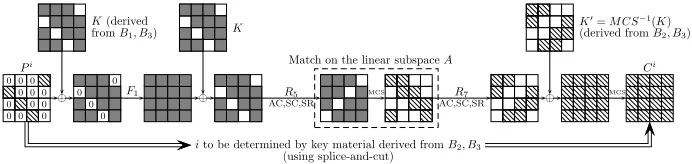
The attack proceeds as follows (see figure 3):
1. Request the encryptions of the 216plaintextsPisuch thatPi
\0,1,2\= 0, and store all plaintext-ciphertext pairs.
2. For each value of the 32 linear expressions of B3: (a) For each value of the 16 linear expressions ofB2:
i. Using the values ofB2 andB3, compute a suggestion forK\0,1,2\. ii. Let ˆY0j be the state such thatY
j
0,\3\= 0 and Y j
0,\0,1,2\=K\0,1,2\. iii. ComputeF1( ˆY0j) =Y
j
4, and use the partial knowledge ofK\0,1,2\ to obtain a suggestion for the values of the 16 linear expressions of A. Store the suggestion for the values of A in a sorted list L, next to the value of B2.
(b) For each value of the 16 linear expressions ofB1:
i. Using the values ofB1 andB3, compute a suggestion for K\3\ and
K/00,1/.
ii. Let (Pi, Ci) be the plaintext-ciphertext pair such thatPi
\3\=K\3\ (recall thatPi
\0,1,2\= 0).
iii. Compute a suggestion for the values of the 16 linear expressions of
A usingCi andK0 /0,1/.
iv. Search for the suggestion for the values ofAin the list L.
v. For each match, obtain the value ofB2, use it to obtain a suggestion for the keyKand test it using a trial encryption. If the trial succeeds, return the key.
Step 2 is equivalent to about 216 2-step LED-64 encryptions, and the total time complexity of the attack is about 248encryptions.
⊕ F1 ⊕ AC,SC,SRR5
MCS R7
AC,SC,SR ⊕
MCS
0 0
0 0
Match on the linear subspaceA K(derived
fromB1, B3) K K
′=M CS−1(K)
(derived fromB2, B3)
Pi Ci
ito be determined by key material derived fromB2, B3 (using splice-and-cut)
0 0 0 0 0 0 0 00
0 0 0
Fig. 3.Our Improved Chosen Plaintext Attack on 2-Step LED-64
5
A Known Plaintext Single-Key Attack on 2-Step
LED-64
In this section, we describe the first splice-and-cut attack (which was believed to be inherently a chosen message technique) in the known plaintext model. In particular, we devise the first known plaintext attack on 2-step LED-64. Due to the efficient sieving techniques, this attack has the same time complexity as our chosen plaintext attack, presented in the previous section.
One could expect the transformation of the splice-and-cut attack to the known plaintext model to be as follows: similarly to the chosen plaintext at-tack, collect 2|S2| inputs ˆY1
0,Yˆ02, . . . such that ˆY0i|S1 = 0 and ˆY0i|S2 range over all the possible values. Then, find a plaintextPisuch thatPi⊕K= ˆYj
0 for some (i, j), and repeat the same attack procedure. However, in the known plaintext model,P|S2 is not fixed, and thus we “lose” the association of an input ˆY0j to a potential value ofK|S2. Consequently, it is not clear how to continue the (par-tial) evaluation of ˆY0j beyond the 4’th (keyed) round of LED in order to obtain the suggestions for the values of the linear expression onY6. Thus, for each ˆY0j, we need to guess additional key bits in order to obtain these necessary filtering conditions.
Since an input ˆY0j is now associated with many key guesses, we are forced to evaluate fewer such inputs in order to obtain an efficient attack. Indeed, while in the chosen plaintext attack, we evaluated 248 such inputs, here we evaluate only 216 inputs, and for each one we guess the 32 bits of K
\0,1\ and obtain a suggestion for the values of 32 linear expressions onY6. According to the birthday paradox (assuming that the plaintexts are uniformly distributed6), in order to
6 In case that the plaintexts are not uniformly distributed, we can apply a similar
obtain a pair (Pi,Yˆj
0) such that Pi⊕K = ˆY
j
0 with good probability, we need 248 known plaintexts-ciphertext pairs (Pi, Ci) (i
∈ {1,2, . . . ,248
}). The values ˆ
Y1
0,Yˆ02, . . .which we evaluate are defined by the 16-dimensional linear subspace
{Yˆ0j|M CS−1( ˆYj
0)/1,2,3/= 0}. Thus, a plaintext Pi is implicitly associated with
a partial key valuePi
/1,2,3/=K/01,2,3/. This implies that we can partially decrypt
Ciin order to obtain the values of 48 bits ofXi
6without additional key guesses. Note that this is not the traditional way in which splice-and-cut is applied, as all previous attacks (including our previous chosen plaintext attack) directly partitioned the bits of the state into two groupsS1andS2. Instead, in this attack we work with linear subspaces constructed to exploit the linear dependency betweenKandK0in order to be able to partially decryptCi without additional
key guesses (whereas our previous chosen plaintext attack did not directly exploit this dependency).
As in the chosen plaintext attack, we have a linear state sieve of 32+48−64 = 16 expressions on the bits ofX6=Y6which are independently computable from each side, and we denote it byA1. Each value of the expressions ofA1, computed from an input ˆY0j, is associated with a suggestion forK\0,1\, and as a result, we can also computeY0j,\0,1\ = ˆY0j,\0,1\⊕K\0,1\. Since Pi =X0i, the 32-bit value ofY0j,\0,1\ can be directly matched with each plaintext, and we denote this sieve byA2. We note that since M CS−1( ˆY0j)/1,2,3/ = 0, then Yj (andY0j,\0,1\), can only attain 216values, and thus effectively, the 32 bits ofA
2 give only 16 bits of filtering.
From the decryption side, each value computed from (Pi, Ci) is associated with a suggestion for K0
/1,2,3/. Thus, we can identify 32 + 48−64 = 16 linear
expressions (i.e., a linear key sieve) which are independently computable from each side, and we denote this sieve byB. In total, we have 48 bits of filtering, as A1 gives us 16 bits,A2 (effectively) gives us 16 bits of filtering, and B gives us additional 16 bits.
The attack proceeds as follows:
1. For each of the 216 possible values of ˆYj
0 such thatM CS−1( ˆY
j
0)/1,2,3/= 0:
(a) Compute F1( ˆY0j) =Y
j
4
(b) For each of the 232values ofK
\0,1\:
i. Compute the values of the 16 linear expressions ofA1, the values of the bits ofA2, and the values of the 16 linear expressions ofB. Store these values in a sorted listL, next to the values ofK\0,1\.
2. For each plaintext-ciphertext pair (Pi, Ci):
(a) Assume that K/01,2,3/ = M CS−1(Pi)
/1,2,3/, compute the values of A1,
A2 andB, and search the listLfor matches.
(b) For each match, obtainK\0,1\, compute a suggestion for the full keyK, and test it using a trial encryption. If the trial succeeds return the key.
Since we evaluate 216inputs ˆY0j, we expect that after obtaining the encryp-tions of about 248 arbitrary plaintexts, we will have a pair (Pi,Yˆj
Pi
⊕K= ˆY0j, which will enable us to recover the correct key.7Thus, the expected data complexity of the attack is 248known plaintexts. Since the size ofLis 248, and (effectively) we have 48 bits of filtering conditions, we expect one match for each plaintext in Step 2.(a), and thus the time and memory complexities of the attack are 248 as well.
6
An Improved Related-Key Attack on 3-Step LED-64
In this section, we describe a related-key attack on 3-step LED-64 using two re-lated keys. The attack improves the previously best known attack on this scheme, described in [11], in all the complexities parameters of time/memory/data from 260 to 249. The 3-step attack uses the linear key sieve technique on top of a rather involved differential MITM attack. Before describing the full attack, we describe a simple differential MITM attack on 1-step LED-64 in the single-key model, which serves as background to our 3-step related-key attack. We note that in the case of 1-step LED-64, our simple attack is closely related to the attack on Pelican-MAC described in [4].
6.1 A Differential Single-Key Meet-in-the-Middle Attack on 1-Step LED-64
The simple differential MITM attack on 4-round (1-step) LED-64 requires 2 chosen plaintexts, and its memory and time complexities are slightly more than 216. In order to obtain an efficient attack, we compute and use the difference distribution tables for the LED Super-Sboxes (spanning the third round and part of the forth round). Namely, given an entry [δin, δout], specifying a 16-bit
input/output difference to the Super-Sbox, the table stores the actual pairs of values that conform to this entry. A single full table can be easily computed during preprocessing in 232 simple operations, and it requires about 232 words of memory. However, in this simple attack, the output difference δout to each
Super-Sbox is fixed by the ciphertexts, and thus we only need a single column in each table. Such a column is computed in the online phase (after obtaining the encryptions of the plaintexts) in 216time, using 216 storage.
The details of the attack are given below.
1. Obtain the encryptions ofP1andP2, chosen such that (P1⊕P2)
\0,1,2\= 0. Denote∆r=Xr1⊕Xr2, i.e.,∆r is the 64-bit state difference after roundr.
2. Compute 3 columns in the difference distribution tables of the LED Super-Sboxes, corresponding to the output differences specified by the three shifted columnsM CS−1(∆
4)/1,2,3/.
3. For each value of K/00/:
7
(a) Use C1 to compute X1
2,\0\ and C2 to compute X22,\0\, and calculate
∆2,\0\.
(b) Given ∆2,\0\, and the fact that M CS−1(∆2)/0,1,2/ = 0, calculate the
full∆2by solving a system of linear equations.
(c) Given the input difference ∆2 and M CS−1(∆4), use the Super-Sbox (partial) difference distribution tables to obtain the possible values for
ARK0(M CS−1(C1))
/1,2,3/, and use these values to obtain suggestions
for the fullK0, thus obtaining suggestions forK.
(d) Test each suggestion for K using a trial encryption, and if it succeeds return the key.
Since we expect, on average, a single suggestion forKin Step 3.(c), the time complexity of Step 3 is about 216, which is the time complexity of the full attack. The memory complexity is about 216, required in order to store the columns of the difference distribution tables for the Super-Sboxes.
We note that this attack is faster than the attack of Section 4.1 since the collision on the shifted columns ofP allows us to obtain a suggestion for the full key after guessing only 16 bits (enabling us to compute the full state difference
∆2). This observation will be further exploited in the next section.
6.2 The Improved Related-Key Attack on 3-Step LED-64
In this section, we describe the details of our related-key attack on 12-round (3-step) LED-64 which assumes that we can obtain the encryptions of plaintexts with keys K1 and K2, such that K1⊕K2 =∆ is known (in fact, as explained below, we need the ability to partially choose the value of∆). During the online phase of the attack, we request the encryptions of 248chosen plaintexts encrypted withK1and 248(different) chosen plaintexts encrypted withK2. The time and memory complexities of the attack are about 249.
Our attack uses the basic framework of [11] for related-key attacks on it-erated Even-Mansour schemes. Namely, we ask for the encryptions of pairs of plaintexts Pi,1 and Pi,2 =Pi,1
⊕∆, encrypted with K1 and K2, respectively. Considering the encryption process of these two plaintexts, the input difference to the publicF1 function is zero, which implies that the output difference ofF1 is zero, and after the second key addition, the input difference toF2 is ˆ∆4=∆ (namely, ˆX4i,1⊕Xˆ
i,2
4 = ˆ∆4 = ∆). At this point, our algorithm diverges from [11] (which assumes that the function F2has some high-probability differential characteristic).
is insufficient, as we were not able to find parameters for which the differential MITM algorithm yields an efficient attack, under the constraint that we store sufficiently many pairs of inputs to F2 (in order to obtain a collision with a processed plaintext pair). The problem is that we need to guess too many key bits before we can compute filtering conditions and eliminate some key guesses. In order to reduce the number of key guesses, we again exploit collisions on (inverse) shifted columns, but this time at the input ofF3. Namely, we require that the difference at the output ofF2on some (inverse) shifted columns cancels out after the key addition. More specifically, we preprocessF2, and find 231pairs of inputs to this function, ( ˆY4j,1 and ˆY
j,2 4 = ˆY
j,1
4 ⊕∆), such that their output difference is equal to∆in two inverse-shifted columns (i.e., (Y8j,1⊕Y8j,2)\0,1\=
∆\0,1\, implying that ( ˆY8j,1⊕Yˆ
j,2
8 )\0,1\ = 0). We expect that 231 such pairs indeed exist, since there are 263 unordered input pairs to F
1 with an input difference of ∆, and based on standard randomness assumptions, about 231 of them satisfy the 32-bit condition on the output difference (a slightly smaller number will only slightly increase the complexity of the attack). The trivial algorithm to find these pairs is to exhaustively enumerate all the 263input pairs, however, this is wasteful as it requires 264 time (and our model does not allow free precomputation). Instead, we use yet again a MITM approach, and devise an auxiliary preprocessing algorithm that finds the required pairs in about 248 time. In order to run efficiently, our algorithm requires that 48 specific bits of
∆ are zero, and thus we have to assume that we can partially choose the key difference8∆. The details of this preprocessing step are specified in Appendix A. The full preprocessing algorithm (which calls the algorithm of Appendix A) is given below.9In this attack, we assume that we have computed during prepro-cessing the full difference distribution tables for the LED Super-Sboxes, using about 232 simple operations and 232 memory.
1. Use the auxiliary preprocessing algorithm of Appendix A to obtain 231pairs ( ˆY4j,1,Yˆ
j,2 4 = ˆY
j,1
4 ⊕∆), such that (Y
j,1 8 ⊕Y
j,2
8 )\0,1\=∆\0,1\. 2. For each of the 231 pairs ( ˆYj,1
4 ,Yˆ
j,2 4 ): (a) For each value of (K1)\2\:
i. Compute (K2)\2\= (K1)\2\⊕∆\2\. Assume that ˆY4j,1is encrypted withK1and ˆY4j,2is encrypted withK2, and let∆r=Yrj,1⊕Yrj,2. Use
the LED Super-Sbox to computeM CS−1(∆
10)/2/=M CS−1(Y10j,1)/2/⊕
M CS−1(Yj,2 10 )/2/.
ii. Since M CS−1(∆
10)/0,1/ = 0 and M CS−1(∆10)/2/ is known, we
know 48 bits of M CS−1(∆
10). We now assume that ∆10,\0\ = 0, and compute the fullM CS−1(∆
10) using linear algebra (asM CS is a linear operation).
8
The related key attack of [11] required that we can choose the full 64 bits of∆, so our attack is slightly more generic.
9
iii. Use the difference distribution table for the LED Super-Sbox, and the knowledge of ˆ∆8, M CS−1(∆10) to compute suggestions for the actualM CS−1(Yj,1
10 )/3/,M CS−1(Y10j,2)/3/ and (K1)\3\.
iv. We now have suggestions for 32 bits ofK1, 32 bits ofM CS−1(Y10j,1) and 32 bits ofM CS−1(Yj,2
10 ). During the online phase, we will obtain suggestions for (specific) 48 bits ofK0
1, 48 bits ofX
i,1
10 and 48 bits of
X10i,2 (the encryption values of somePi,1 andPi,2 after 10 rounds). Thus, we can compute the values of a total of 48 linear expressions to serve as filtering bits: 16 expressions on the bits ofK1 (a linear key sieve), 16 expressions onY10j,1 and 16 expressions onY
j,2
10 . We store the values of these expressions in a sorted list L, next to (K1)\2,3\.
As described in Appendix A, the time complexity of Step 1 is about 248 evaluations of 1-step LED. On average, we expect a single suggestion for the values computed in Step 2.(a).iii (using the difference distribution table of the LED Super-Sbox). Thus, we perform only a few simple operations for each of the 231 pairs (computed in Step 1) and the 216 possible values of (K
1)\2\, im-plying that the total time complexity of the preprocessing algorithm is about 248evaluations of 1-step LED. In order to slightly reduce the data complexity of the online algorithm (at the expense of using slightly more memory), we repeat Step 2.(a) twice for each ordered pair, exchanging the roles of ˆY4j,1and ˆY
j,2 4 (i.e., by assuming that ˆY4j,1is encrypted with K2). Thus, the time complexity of the preprocessing algorithm is about 249evaluations of 1-step LED, and its memory complexity is about 249.
The online algorithm of the attack is given below.
1. For 248arbitrary values of the plaintextPi,1: (a) Ask for the encryption ofPi,1under the keyK
1, and for the encryption ofPi,2=Pi,1
⊕∆ under the keyK2=K1⊕∆. LetΛr=Xrj,1⊕Xrj,2.
(b) Compute C0i,1 = M CS−1(Ci,1) and C0i,2 = M CS−1(Ci,1). Check if (C0i,1⊕C0i,2)
/0/= 0, and if not, return to Step 1.
(c) For each value of (K0
1)/1/:
i. Compute (K20)/1/ = (K10)/1/ ⊕M CS−1(∆)/1/ and use the LED
Super-Sbox to computeΛ10,\1\=X10i,1,\1\⊕X i,2 10,\1\. ii. Assume that M CS−1(Λ
10)/0,1/ = 0, and compute Λ10 (using the fact thatΛ10,\0\= 0 andΛ10,\1\ is known).
iii. Use the difference distribution table for the LED Super-Sbox, and the knowledge ofΛ10and (C0j,1⊕C0j,2) to compute suggestions for
X10i,1,\2\,X10i,2,\2\ and (K10)/2/, and similarly compute suggestions for
X10i,1,\3\,X10i,2,\3\ and (K0
1)/3/.
iv. From the knowledge of 48 bits ofK0
1, 48 bits of X10i,1 and 48 bits of
X10i,2, compute the filtering values of the 48 linear expressions, and look for matches in the list L.
A pair ((Pi,1, Ci,1),(Pi,2, Ci,2)) passes the 16-bit filtering condition of Step 1.(b) with probability 2−16, and thus we expect to process about 248−16 = 232 pairs in Step 1.(c). As we store 232ordered input pairs of values forF
2 with an input difference of∆, and each of the processed 232 plaintext pairs has a difference of
∆ at the input to F2, we expect a collision between these two groups of pairs. For such a collision, the assumptions made during the online and preprocess-ing algorithms hold (∆10,\0\ = 0 is assumed in preprocessing Step 2.(a).ii, and
M CS−1(Λ
10)/0,1/ = 0 is assumed in online Step 1.(c).ii). Thus, this collision
will yield a match in Step 1.(c).iv, suggesting the correct value of K1.
Since we expect a single suggestion for the values computed in Step 1.(c).iii, we perform a few simple operations for each of the 232processed pairs in Step 1.(b) and the 216possible values of (K0
1)/1/, on which we iterate in Step 1.(c). Thus,
the total time complexity of the online algorithm is about 249 evaluations of 1-step LED. Including the preprocessing time, the total time complexity of the attack is about 249evaluations of 2-step LED (which is a bit less than 249 eval-uations of the full 3-step scheme). The data complexity of the attack is 249, and its memory complexity is 249, required in order to store the listL.
A Single-Key Attack on a Variant of 2-Step LED with Independent Keys Consider a variant of 8-round LED, where the three round keys K1,K2 and K3 are independent. We now show how to adapt the above attack to this scheme with about the same time/memory/data complexities. We note that this construction has a similar structure to the block cipher AES2 [2], which is composed of two key-less AES-128 permutations such that K1 and K2 are added before and after the first permutation and K3 is added after the second permutation. Since our techniques only exploit the AES structure of the LED step function, this attack can also be applied to AES2, reduced from 20 rounds to 8 rounds (with the complexity of the attack adjusted to the 128-bit cipher).
In this attack, we select∆ in a similar way to the related-key attack above. However, in the single-key attack we cannot inject a pair of different messages such that they have a zero difference at the input toF1. Thus, we now preprocess
F1 (instead of F2) and find 231 pairs of inputs to this function, ˆY0j,1,Yˆ
j,2 0 = ˆ
Y0j,1⊕∆, such that ( ˆY
j,1 4 ⊕Yˆ
j,2
4 )\0,1\= 0. Consequently, in the online algorithm, we request the encryptions of 248pairs of plaintexts with an input difference of
∆, and apply the differential MITM technique toF2.
Another difference between this attack and the previous related-key attack on LED-64, in that nowK1, K2 andK3 are independent, and thus we do not have any filtering conditions on the key when matching the suggestions during the MITM phase (i.e., we do not have a linear key sieve). This implies that if we use only one pair of plaintexts, the complexity of the attack will be at least 264. In order to speed up the attack, we use the same idea used in [6] in the attack on AES2: we choose an arbitrary non-zero difference∆0 6=∆, and ask for the encryption of another plaintext Pi,1⊕∆0 for each pairPi,1 and Pi,1⊕∆. Similarly, we attach another evaluation of ˆY0j,1⊕∆0 to each evaluated pair ˆY
the attack has similar time/memory/data complexities to the related-key attack. The full details of the filtering technique are found in [6].
7
Conclusions
In this paper, we introduced various techniques in MITM attacks including the linear key sieve technique, a known plaintext splice-and-cut attack, and new techniques for differential MITM. We applied these techniques to step-reduced LED-64 and obtained the best known results on this block cipher, both in the single-key and related-key models. Although our techniques are mainly applied to LED-64, we believe that they will be useful in the analysis of other cryptosys-tems, in particular AES-based cryptosystems and lightweight block ciphers.
References
1. Kazumaro Aoki and Yu Sasaki. Preimage Attacks on One-Block MD4, 63-Step MD5 and More. In Roberto Avanzi, Liam Keliher, and Francesco Sica, editors,
Selected Areas in Cryptography, volume 5381 ofLecture Notes in Computer Science, pages 103–119. Springer, 2008.
2. Andrey Bogdanov, Lars R. Knudsen, Gregor Leander, Fran¸cois-Xavier Standaert, John P. Steinberger, and Elmar Tischhauser. Key-Alternating Ciphers in a Prov-able Setting: Encryption Using a Small Number of Public Permutations - (Ex-tended Abstract). In David Pointcheval and Thomas Johansson, editors, EURO-CRYPT, volume 7237 ofLecture Notes in Computer Science, pages 45–62. Springer, 2012.
3. Julia Borghoff, Anne Canteaut, Tim G¨uneysu, Elif Bilge Kavun, Miroslav Kneze-vic, Lars R. Knudsen, Gregor Leander, Ventzislav Nikov, Christof Paar, Christian Rechberger, Peter Rombouts, Søren S. Thomsen, and Tolga Yal¸cin. PRINCE -A Low-Latency Block Cipher for Pervasive Computing -Applications - Extended Abstract. In Wang and Sako [15], pages 208–225.
4. Charles Bouillaguet, Patrick Derbez, and Pierre-Alain Fouque. Automatic Search of Attacks on Round-Reduced AES and Applications. In Phillip Rogaway, editor,
CRYPTO, volume 6841 of Lecture Notes in Computer Science, pages 169–187. Springer, 2011.
5. Anne Canteaut, Mar´ıa Naya-Plasencia, and Bastien Vayssi`ere. Sieve-in-the-Middle: Improved MITM Attacks. In Ran Canetti and Juan A. Garay, editors,CRYPTO (1), volume 8042 ofLecture Notes in Computer Science, pages 222–240. Springer, 2013.
6. Itai Dinur, Orr Dunkelman, Nathan Keller, and Adi Shamir. Key Recovery Attacks on 3-round Even-Mansour, 8-step LED-128, and Full AES2. IACR Cryptology ePrint Archive, 2013:391, 2013. Accepted to Asiacrypt 2013. To appear in Lecture Notes in Computer Science.
7. Shimon Even and Yishay Mansour. A Construction of a Cipher from a Single Pseudorandom Permutation. J. Cryptology, 10(3):151–162, 1997.
9. Jian Guo, Thomas Peyrin, Axel Poschmann, and Matthew J. B. Robshaw. The LED Block Cipher. In Bart Preneel and Tsuyoshi Takagi, editors,CHES, volume 6917 ofLecture Notes in Computer Science, pages 326–341. Springer, 2011. 10. Takanori Isobe and Kyoji Shibutani. Security Analysis of the Lightweight Block
Ciphers XTEA, LED and Piccolo. In Willy Susilo, Yi Mu, and Jennifer Seberry, editors,ACISP, volume 7372 ofLecture Notes in Computer Science, pages 71–86. Springer, 2012.
11. Florian Mendel, Vincent Rijmen, Deniz Toz, and Kerem Varici. Differential Anal-ysis of the LED Block Cipher. In Wang and Sako [15], pages 190–207.
12. Ralph C. Merkle and Martin E. Hellman. On the Security of Multiple Encryption.
Commun. ACM, 24(7):465–467, 1981.
13. Yu Sasaki. Meet-in-the-Middle Preimage Attacks on AES Hashing Modes and an Application to Whirlpool. In Antoine Joux, editor,FSE, volume 6733 ofLecture Notes in Computer Science, pages 378–396. Springer, 2011.
14. Yu Sasaki and Kazumaro Aoki. Preimage Attacks on Step-Reduced MD5. In Yi Mu, Willy Susilo, and Jennifer Seberry, editors,ACISP, volume 5107 ofLecture Notes in Computer Science, pages 282–296. Springer, 2008.
15. Xiaoyun Wang and Kazue Sako, editors. Advances in Cryptology - ASIACRYPT 2012 - 18th International Conference on the Theory and Application of Cryptol-ogy and Information Security, Beijing, China, December 2-6, 2012. Proceedings, volume 7658 ofLecture Notes in Computer Science. Springer, 2012.
A
The Auxiliary Preprocessing Algorithm of the
Related-Key Attack on 3-Step LED-64
Our goal in the auxiliary preprocessing algorithm is to find (about) 231 pairs ( ˆY4j,1,Yˆ4j,2= ˆY4j,1⊕∆), such that (Y8j,1⊕Y8j,2)\0,1\=∆\0,1\. In order to run in time of about 248 evaluations of 1-step LED, we assume that ∆
\0,1,2\ = 0, and the value of ∆\3\ is arbitrary (but non-zero).
Let∆r=Yrj,1⊕Yrj,2. The difference∆8 can obtain 232−1 non-zero values (since we require that∆8,\0,1\= (Y8j,1⊕Y
j,2
8 )\0,1\=∆\0,1\= 0), and in addition
M CS−1(∆
6) can obtain (at most) 216−1 non-zero values, implying that∆6can obtain 216−1 non-zero values. The algorithm is given below.
1. For each of the possible 216
−1 non-zero value of∆6: (a) For each non-zero value of ∆8 such that∆8,\0,1\= 0:
i. CalculateM CS−1(∆
8). Given∆6, use the difference distribution ta-bles for the LED Super-Sboxes to obtain the actual valuesY8j,1, Y8j,2. ii. Compute ˆY4j,1 = F2−1(Y
j,1
8 ) and ˆY
j,2
4 = F2−1(Y
j,2
8 ), and if ( ˆY
j,1 4 ⊕ ˆ
Y4j,2)\3\=∆\3\, store the pair.
Since we obtain an average of one value forY8j,1andY
j,2