PoTS—A Secure Proof of TEE-Stake
for Permissionless Blockchains
Sébastien Andreina, Jens-Matthias Bohli, Wenting Li, Ghassan O. Karame, Giorgia Azzurra Marson
NEC Laboratories Europe, Germany Email: [email protected]
Abstract — Proof-of-Stake (PoS) protocols have been actively researched for the past few years. PoS finds direct applicability in permissionless blockchain platforms and emerges as one of the strongest candidates to replace the largely inefficient Proof of Work mechanism that is currently plugged in the majority of existing permissionless blockchain systems. Although a number of PoS variants have been proposed, these protocols suffer from a number of security shortcomings. Namely, most existing PoS variants are either subject to the nothing at stake, the long range, or thestake grinding attacks which considerably degrade security in the blockchain. These shortcomings do not result from a lack of foresight when designing these protocols, but are inherently due to the ease of manipulating “stake” when compared to other more established variants, such as “work”. In this paper, we address these problems and propose a secure Proof of Stake protocol, PoTS, that leverages Trusted Execution Environments (TEEs), such as Intel SGX, to ensure that each miner can generate at most one block per “height” for strictly increasing heights—thus thwarting the problem of nothing at stake and a large class of long-range attacks. In combination with TEEs, PoTS additionally uses cryptographic techniques to also prevent grinding attacks and protect against posterior corruption. We show that our protocol is secure, in the sense of well-established cryptographic notions for blockchain protocols, down to realistic hardware assumptions on TEE and well-established cryptographic assumptions. Finally, we evaluate the performance of our proposal by means of implementation. Our evaluation results show that PoTS offers a strong tradeoff be-tween security of performance of the underlying PoS protocol.
I. INTRODUCTION
Blockchain technologies are gaining increasing attention nowadays motivated by the wide success of the Bitcoin cryptocurrency. To reach distributed agreement, blockchains rely on consensus protocols which ensure that all nodes in the network share a consistent view on a common distributed ledger. Most existing open blockchain systems rely on Bitcoin’s Proof of Work (PoW) to reach network consensus in permissionless systems that do not require the knowledge of nodes’ identities. However, PoW has been often criticized for its huge waste of energy. It is estimated that Bitcoin miners consume, by the end of 2018, as much electricity as Austria, or equivalently 0.5% of the world’s total consumption [1].
To remedy the limitations of PoW, the community has turned to Proof of Stake (PoS) protocols in the hope of offering
a more efficient and environment-friendly alternative. Unlike PoW, PoS leverages virtual and energy-friendly resources such as the “stake” of a node in the system in order to perform leader election and maintain consensus in the network.
Nevertheless, although many PoS variants have been pro-posed [2], [3], [4], [5], [6], [7], [8], PoS is still not widely deployed in existing blockchains. Namely, in spite of their effi-ciency, PoS-powered blockchains still account for less than 5% of the market capitalization of existing digital currencies. This is mostly due to the fact that most existing PoS protocols are vulnerable to a number of security threats, such asnothing at stake[9],long range[10], andstake grinding[11] attacks. The former attack allows the nodes to mine conflicting blocks with-out risking their stake, which increases the number of forks in the system as well as the time to reach consensus in the network. Long range attacks (commonly referred to as history attacks) aim at altering the entire history of the blockchain starting from early blocks (even from the genesis block). This can be achieved when, e.g., the attacker acquires the private keys of old accounts which no longer have any stake at the moment, but that have accrued majority stake at previous block heighth; the attacker can then construct a fork starting from block h leveraging these accounts. Finally, in stake grinding attacks, adversaries use their computational resources to increase their probabilities of being elected as leaders/miners of the upcoming blocks.
a block if they are able to increase their advantage over future blocks. These factors explain the reason why none of today’s large permissionless blockchain platforms rely solely on PoS protocols in their offerings—in spite of the plethora of PoS proposals that populate the literature [2], [5], [7], [8], [12], [13].
In this paper, we address the aforementioned problems, and propose a novel solution—Proof of TEE-Stake(PoTS)—which addresses the shortcomings of existing PoS protocols by leveraging functionality from Trusted Execution Environments (TEEs), such as Intel SGX. PoTS emerges as the first workable PoS protocol that protects against all the aforementioned attacks on PoS protocols without hampering the performance of the underlying consensus protocol.
The security of PoTS relies on TEEs to enforce validators to sign blocks on strictly increasing heights, fully preventing nothing at stake attacks and a large class of long-range attacks. Since the relevant operation of the leader election process are computed within the TEE, PoTS prevents an adaptive adversary from corrupting future leaders, as well as malicious validators from mounting grinding attacks. In doing so, we point out that PoTS tolerates possible compromise of TEEs (e.g., Spectre [14] or Foreshadow attacks [15]) as long as the adversary does not control a significant number of TEE devices. Our solution additionally deals with stake-bleeding attacks [16] and posterior-corruption attacks by adapting a cryptographic technique to achieve forward security—updating signing keys and deleting old ones—to the blockchain setting. In contrast to purely cryptographic solutions, our protocol leverages the ledger functionality of the blockchain itself to allow for an unlimited number of key updates. Finally, we point out that our protocol can tolerate compromised TEEs as long as the adversary does not control a significant number of TEE devices. We argue that PoTS is technically and economically viable. Indeed, TEEs are nowadays pervasive on mobile platforms, PCs, and servers [17]. While the main barriers of wide adoption of PoS lie in the lack of security given their high efficiency, PoTS bridges these gaps and establishes a strong trade-off between the efficiency and the security of PoS. More importantly, although our solution relies on TEEs, it does not tax ordinary users (that are not miners) from transacting in the system with such a requirement. Namely, PoTS does not require the presence of TEEs for issuing transactions, and validating the correctness of exchanged transactions/blocks.
This paper extends our previous work in [18]. Here, we additionally provide a security model, specifying formal properties for proof-of-stake protocols in the style of recent work from the cryptographic literature [19], [20], and considerably revisit the TEE-based protocol from [18] to meet these properties. Finally, we evaluate an improved implementation of the proposed scheme, and compare its performance with state-of-the-art PoS protocols.
We summarize our additional contributions as follows:
Security Model. We present a security model for blockchain protocols and specify the relevant properties that these protocols are expected to meet. Our model builds on
well-established results from the cryptographic literature and addresses several security risks for PoS simultaneously.
Concrete instantiation. We present a secure Proof of Stake protocol, PoTS, which is resistant against nothing at stake, long range, and grinding attacks, and analyse its security in the presented model. Our solution relies on realistic hardware assumptions for TEEs and on standard network and cryptographic assumptions.
Prototype Implementation. We implement and evaluate a prototype based on our instantiation using Intel SGX, and we show that our solution does not incur any meaningful overhead compared to Nxt’s protocol, while offering comparable security to the (slower) Ouroboros Praos protocol. Our implementation results also show that PoTS only moderately increments the TCB by approximately 250 Lines of Code (LoC).
The remainder of this paper is organized as follows. In Section II, we overview existing PoS protocols and discuss relevant attacks against these protocols. In Section III, we present a novel security model for (Proof of Stake) blockchain protocols. We then introduce PoTS in Section IV, and in Section V we analyse its security based on the model outlined in SectionIII. In SectionVI, we describe a prototype implementation and evaluation of our proposal, and we compare its performance to the PoS schemes Nxt [7] and Ouroboros Praos [21]. In Section VII, we overview related work in the area, and we conclude the paper in SectionVIII.
II. NOTATION& BACKGROUND
In this section, we introduce the notation that we will use throughout the paper, recall some background concepts, and discuss relevant attacks on proof of stake protocols.
A. General notation
Fora,b∈N, we use the shortcut[a..b]to denote the set{x∈ N:a≤x≤b}. We writeX←xfor assigning valuexto vari-ableX. We use=instead for the equality operator. An expres-sion X=xevaluatesTRUEif the values of variables X andx coincide, otherwiseFALSE. For a tupleX= (x1,...,xn), we
denote the number of its components (i.e., its length) by|X|=n. We denote by kthe concatenation operator, and writeX←k x for the operation of appending axto a string/listX. IfX is a list, we also denote its length by|X|, and we refer to its last element byLast(X). Ifn=|X|, for1≤i≤j≤nwe denote by X[i..j]the sublist ofX containing from thei-th element up to thej-th element. We writeXY to indicate thatX is a prefix ofY, meaning that X=Y[1..n]for some 1≤n≤ |Y| using the above notation. For0≤k≤n=|X| we writeX[1..−k]to denote the prefix ofX obtained by chopping the lastkelements (conventionally X[1..−0] =X andX[1..−n] =∅). Within an algorithm specification: when writingParse(X)we mean the operation that labels the components x1,...,xn of a tupleX,
B. Blockchain protocols
At a high level, the goal of a blockchain protocol is to allow mutually untrusted parties to agree on a growing number of transactions, i.e., to instantiate a distributed ledger. In a permissionless (a.k.a. open) blockchain, anybody can join the blockchain network, at any time, without the need of authenticating to a trusted entity. We correspondingly assume a dynamic set of N∈N mutually untrusted protocol partys, where ‘dynamic’ means that the set of parties may change over time (in particular:N is variable) and that each party may be online to contribute to the protocol execution, or be offline as it pleases them. Throughout the paper, we refer to each party, or blockchain node, with a (unique) handle Pi fori∈[1..N].
Parties interact with each other by exchanging messages over a peer-to-peer network in a broadcast fashion. We assume two abstract subroutines, BCAST and FETCH, providing application interfaces to send messages over, respectively, to retrieve incoming messages from the network.
Each node may simply use the ledger functionality by issuing transactions, or they may actively contribute in the system by verifying the validity of these transactions—the latter parties we namevalidators. To confirm transactions and assign them an order in the ledger, validators regularly broadcast blocks, containing a list of verified transactions, which build on top of each others—hence the term “blockchain”. Apart from the initial block (dubbed “genesis block”), which is fixed upfront and emulates a core root of trust, all other blocks are proposed and agreed upon by the various validators. More concretely, validators also have to verify blocks, where a block is deemed as valid if (recursively) it builds on a valid blockchain and it contains valid transactions. Since all validators may propose blocks, a selection mechanism is put in place to indicate who will have the right to generate the next block.
Initialization.To join the system, a new partyPiruns an
initial-ization procedure to create an account and retrieve the current blockchain. Upon initialization, the party’s local state, that we denote bystatei, encodes all information necessary to run the
protocol. We assume a minimal setup shared by all blockchain protocols: the state records the account key pair(pki,ski)and
a copyBCof (the party’s view on) the current blockchain.
Chain extension, Validation, and Fork Resolution. For the sake of abstraction, we describe the execution of the protocol through asynchronous rounds, where each round rcorresponds to the creation of block Br. Throughout the paper, we
conventionally refer to the length of a given blockchain (i.e., the number of blocks it contains) also with the term height; thus, we may use the expressions “block of round r” and “block at height r” interchangeably. In each round, all (online) parties compete to produce the next block, and a leader-election procedure resolves this competition by indicating who has the “right” to generate the block for that round. Depending on the protocol type, this prerogative may be assigned based on various resources (such as computing power in proof-of-work.) More precisely, the protocol Πthat parties execute to maintain
the blockchain consists of three phases: firstly, after retrieving new blocks and transactions from the network, parties (are expected to) verify the validity of transactions as well as of possible alternative chains they received. In the sequel, we denote the chain-validation procedure byValidate. Should a party receive multiple valid chains, they run a fork-resolution algorithmResolveto establish which one among these chains should be selected as ‘the current’ one to built upon. Notice that the possibility of having more than one eligible party per round is inherent ineventual consensusprotocols, which favors liveness over safety (cf. Section III-A). Finally, the party attempts to extend the updated chain by generating the next block; this procedure we nameExtend.
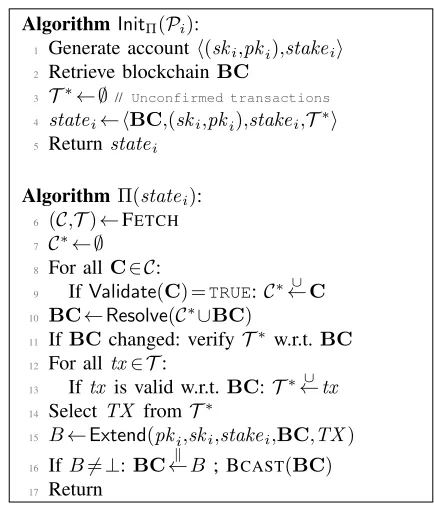
For completeness, we provide an abstract specification of a generic (eventual-consensus) blockchain protocol in Figure1.
Algorithm InitΠ(Pi):
1 Generate accounth(ski,pki),stakeii 2 Retrieve blockchainBC
3 T∗← ∅ // Unconfirmed transactions
4 statei← hBC,(ski,pki),stakei,T∗i
5 Returnstatei
Algorithm Π(statei):
6 (C,T)←FETCH
7 C∗← ∅
8 For allC∈ C:
9 IfValidate(C) =TRUE:C∗ ∪←C
10 BC←Resolve(C∗∪BC)
11 IfBCchanged: verifyT∗ w.r.t.BC 12 For alltx∈ T:
13 Iftx is valid w.r.t.BC:T∗ ∪←tx 14 SelectTX fromT∗
15 B←Extend(pki,ski,stakei,BC,TX)
16 IfB6=⊥:BC
k
←B ; BCAST(BC)
17 Return
Fig. 1: Abstract specification of a blockchain protocol for eventual consensus. We denote byC andT (resp. C∗ and T∗) the sets of received chains and transactions (resp. valid ones). We are deliberately vague about how transactions are verified (because it is a protocol-specific detail that does not play a role in our treatment). State variables (within hi) are understood as global ones, i.e., any modification is permanent.
C. Proof-of-stake protocols
Proof-of-Stake (PoS) is an emerging blockchain consensus protocol that appoints block leaders depending on some properties of the stake they own. Here, “stake” is a virtual resource that is tied to a validator in a publicly verifiable manner. The idea behind PoS security is that as long as the majority of stake is held by honest parties, the protocol works correctly, i.e., honest parties do agree on a common ledger.
Formally, each partyPi is associated with the stakestakei
as stakeholders. We assume an initial stake distribution S0= (stake1,...,stakeN), where N=n0is the initial number
of participants, to be encoded in the genesis blockB0; we also assume the latter to be distributed in a trustworthy manner.
A blockchainBC= (B0,...,BR)induces a stake distribution
SBC= (stake1,...,stakeN)where stakei is the stake balance
of Pi w.r.t. blockchain BC(in this notation,S0 is a special case ofSBCforBC= (B0)). Throughout the paper, we denote
by stakei(BC)the stake of partyPi w.r.t. blockchain BC.
The community currently features a number of PoS variants. Peercoin [2], Cloakcoin [3], and Novacoin [6] use “coin age”, i.e., the accumulated time a node holds their stake before generating a new block, as mining resource. Since hoarding the coins increases one’s chance to generate a block, relying on coin age discourages nodes from actively participating in the consensus process. VeriCoin [4] uses a similar mining resource, so-called “stake-time”, which also takes into account coin age but it also incentivizes participation: if a validator does not generate any block for a long time, their stake-time starts to degrade. The consensus protocols of Blackcoin [5] and Nxt [7] rely on the amount of stake owned by validators. BitShares [8] proposes a so-called “delegated PoS”, where validators vote for a group of delegates who are in charge of generating blocks in round-robin fashion, and each validator has voting power proportional to their stake. Slasher [12] and Casper the Friendly Finality Gadget (Casper FFG) [13], both proposed by Ethereum, are instances of deposit-based PoS, meaning that they require nodes to deposit their stake in order to become validators.
All of the above protocols are not supported by a thorough security analysis in a precisely specified model. The following protocols, instead, come with a cryptographic (reductionist) proof. Ouroboros [22] employs a multi-party computation protocol to generate unbiased randomness for the leader election process. This approach requires coordination among the valida-tors in the network. Algorand [23], [24] is a PoS variant based on a Byzantine Agreement protocol [25]. In contrast to the blockchain protocols discussed earlier, which achieve eventual consensus, Algorand favors safety over liveness and makes final decisions. Thus, it prevents forks (with high probability) by design. Snow White [26] is specifically designed to offer protection in the presence of posterior corruption, meaning that security holds as long as the majority of the active stake is not controlled by the adversary. Here, “active” stake refers to the stake owned at the present by validators who are online. Neither Algorand nor Ouroboros are secure against posterior corruption, while Ouroboros Praos [21] improves Ouroboros by additionally offering this kind of protection. In SectionVII, we discuss in greater detail the security guarantees provided by these protocol and the assumptions made to prove their security.
D. Attacks against PoS protocols
In what follows, we describe in greater details the nothing at stake, grinding, and long range attacks, and discuss existing countermeasures.
Nothing at stake attack. In most existing PoS protocols, validators have an incentive to work on multiple forks since generating a block in PoS is no more than generating one signature. In other words, in order to maximize their benefits, validators could generate conflicting blocks on all possible forks with nothing at stake. This behavior, referred to as the nothing at stakeattack [9], slows down the consensus process and, thus degrades performance. Moreover, it leads to frequent forks, making the system more vulnerable to double spending attacks. In terms of countermeasures, Ouroboros [22] introduces a reward mechanism that specifically incentivizes validators not to maintain incompatible chains. However, it only discourages opportunistic adversaries and cannot prevent targeted attacks, such as double-spending, that would benefit from (temporarily) forked blockchain. Slasher [12] proposes a punishment mechanism to discourage dishonest behavior. Specifically, it requires validators to provide a deposit which is then locked for a given period; should a validator generate conflicting blocks at the same height, they will lose the deposit. BitShares [8] adopts a similar approach to Slasher: any misbehaving validator loses the ability to generate blocks in the future.
A major drawback of deposit-based countermeasures is that they freeze a considerable amount of stake in the network. In addition, they do not prevent targeted double-spending attacks involving transactions carrying more than the deposit.
Long range attack. Long range attacks [10] refer to the ability of an attacker to rewrite the blockchain history starting from a block generated far in the past. Since this attack requires the majority of voting power, it is inherently resolved in a proof of work setting under the honest majority assumption of computing power. In a proof-of-stake setting, however, long range attacks can be mounted by controlling accounts that have no stake at the moment, but used to have a large amount of stake at some point in the past. That is, an attacker can create forks from past blocks and overtake the current chain by leveraging “past majority of stake”. It could do so, for instance, by compromising the private keys of nodes which no longer have stake at the moment, but were wealthy and jointly accrued majority of stake in the past.
joined the network (or re-joins after a long offline period) has no way to distinguish honest chains from malicious ones.
Stake grinding attack.Blockchain consensus protocols select the leader for each round proportionally to some mining resources, depending on the protocol type (e.g., computing power in the case of proof of work). In the ideal case—if parties do follow the protocol faithfully—the probability of being elected leader is proportional to the resource defining the protocol type, and independent of any other resource.
In some proof of stake protocols, an attacker can leverage computational resources to increase their chance to generate a block, violating the above-mentioned principle. This is commonly referred to as a stake grinding attack [11]. For instance, consider an eligibility function which depends only on a validator’s stake, the previous block, and some input variable that can be (partially) chosen by the validator. Then, an attacker could, once elected leader, compute multiple candidate blocks (one for each value of the input variable) until they find one that lets them become leader again in the subsequent round. In this way, the attacker could in principle monopolize the leader election process. While, strictly speaking, this is not an attack on the consensus protocol, it may give an unfair advantage to greedy validators.
Nxt [7] attempts to mitigate stake grinding using a determin-istic algorithm for the leader election process. This measure leads to a different issue, referred to as “transparent forging”: here, anybody can predict which validators will become leaders in the future. Transparent forging opens an additional attack vector by allowing adversaries to selectively nit-pick the next leader to compromise. Even worse, an adversary can still perform stake grinding by skipping opportunities to create a block in order to increase their advantage over future blocks [27]. Blackcoin [5] also relies on a deterministic election process, but aims at mitigating the transparent forging problem using a “stake modifier”, which periodically introduces entropy to the leader selection process. This technique, however, only limits the period in which leaders are predictable, namely between any two subsequent updates of the stake modifier.
Ouroboros [22] uses multi-party computation to generate unbiased randomness for the leader election process, and provably prevents the attack—however, at the expense of higher communication/synchrony requirements. Stake grinding attacks do not apply to Bitshares [8] and Casper FFG [13] PoS protocols. In Bitshares, leaders are not chosen randomly but selected in a round-robin fashion from a set of delegates. Casper FFG instead relies on proof-of-work for the leader election, and uses a PoS layer only to finalize the blocks generated within a certain time interval.
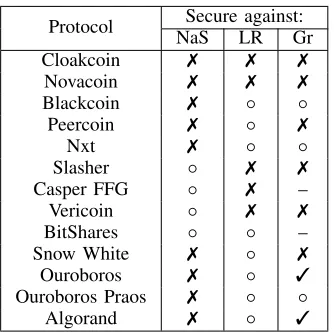
Table Isummarizes the security of existing PoS protocols against the nothing at stake, long range, and stake grinding attacks. As one can see, none of these protocols offers full protection against all of the attacks.
Secure against: Protocol
NaS LR Gr
Cloakcoin 7 7 7
Novacoin 7 7 7
Blackcoin 7 ◦ ◦
Peercoin 7 ◦ 7
Nxt 7 ◦ ◦
Slasher ◦ 7 7
Casper FFG ◦ 7 –
Vericoin ◦ 7 7
BitShares ◦ ◦ –
Snow White 7 ◦ 7
Ouroboros 7 ◦ 3
Ouroboros Praos 7 ◦ ◦
Algorand 7 ◦ 3
TABLE I: Resilience of existing PoS protocols against nothing at stake (NaS), long range (LR), and grinding attacks (Gr). The symbol ‘◦’ indicates that security is only partially achieved, while ‘–’ means that the attack does not apply to the considered protocol.
III. SECURITY MODEL
In this section, we present a formal model for the security of blockchain protocols, describing the major properties that a blockchain consensus protocol should target according to established works in the domain of provable security and pinpointing how these properties capture the aforementioned attacks (among others).
A. Blockchain security
Functionality and security properties targeted by blockchain protocols are typically specified in terms ofsafety(a.k.a. con-sistency) and liveness. Conforming with analogous notions for consensus, safety means that honest parties—who faithfully fol-low the protocol—agree on the same sequence of transactions, perhaps with the exception of a few “most recent” ones, while liveness guarantees that transactions are confirmed relatively quickly (i.e., progress happens). Both properties are expected to hold despite limited Byzantine failures and the network being asynchronous for potentially long periods1, as we expand next. Following the modeling approach of Davidet al.[21], we assume that time is divided in discrete units calledslots, and that the protocol participants have loosely synchronized clocks that indicate the current slot; in what follows we use the terms slot and time interchangeably. Our model assumes apartially synchronousnetwork [29]: messages may be delayed, but for at most∆ slots (otherwise, a participant who does not receive messages within ∆ slots should be considered offline). We assume that protocol participants have loosely synchronized clocks and, for the sake of abstraction, we also assume any potential drift to be insignificant compared to the length of a
time slot. Thus, without loss of generality, all clocks agree on the current slot. We consider an adversary Awho controls the network and may adaptively corrupt any party of their choosing, meaning thatAobtains the entire state of that party and hence may fully control them. The number of corruptions is limited, however, such that the majority of (online) stake remains in hon-est hands, otherwise the adversary can take over the blockchain and generate all the blocks, and the corruption model is “mildly adaptive” (as in [22], [26]), meaning that it takes a short while for A’s corruption requests to become effective.
We assume that the adversary may obtain all network messages, delay and modify them, subject to the assumed cryptographic constraints, i.e., A may not modify integrity-protected fields generated by uncorrupted participants, find hash collisions etc, and delivery guarantees, i.e., Amay not delay messages forever.
In the cryptographic literature, consistency/safety and liveness for blockchain-based distributed ledgers are formalized in terms of the three properties described below (that we borrow from [19], [30], [31] and adapt to our syntax). For a secure blockchain protocol, we require the properties below to hold in the adversarial model just described, particularly under the assumption thatAdoes not control the majority of active/online stake. For ease of presentation, we use the following notation: ifBCdenotes the local blockchain maintained by partyPi, we
writeBCtfor the view ofPi on the blockchain at time-slott.
The first property, common prefix, is closely related to consistency and states that the blockchains of honest parties share a large common prefix, i.e., they may differ only in (few) trailing blocks.
Definition 1 (Common prefix). Let BCi and BCj be the blockchains of honest partiesPiandPj, fori,j∈[1..N]. Then,
for all slots tand t0, witht≤t0, it holdsBCti[0..−s]BCtj0, where sis called the stability parameter.
The second property, chain growth, guarantees that the blockchains maintained by (honest) parties are extended rela-tively quickly, depending on the synchronicity of the network.
Definition 2 (Chain growth). Let BC be the blockchain of some honest party and`∈Na security parameter. Then, for every slot t and every T > `it holds |BCt+T−BCt| ≥g·T, where g is called the growth parameter.
The third property, called chain quality, establishes that if one observes the evolution of a honest blockchain for sufficiently many rounds, among all the newly added blocks a relatively large fraction has been contributed by honest parties.
Definition 3 (Chain quality & fairness). Let BC be the blockchain of some honest party and`∈Na security parameter. Then for every round r and every T > `, the number of honestly produced blocks in the subchainBC[r..r+T] is at leastq·T, whereqis called the quality parameter. In the ideal case, every party (or coalition of parties) holding a fractionρ of the overall stake should generate roughly a fraction ρof the blocks (ideal chain quality, or fairness).
The common prefix, chain growth, and chain quality properties of a blockchain protocol imply safety and liveness of the associated distributed ledger [19], [30]. Specifically, common prefix implies safety, while chain growth and chain quality together imply liveness. The chain quality property also loosely expresses the fairness of a blockchain protocol, in the sense of guaranteeing that each validator becomes block leader (and hence obtains the reward associated to the block) with probability proportional to the owned stake. Given this, a fair PoS protocol is one achieving an ideal chain quality, meaning that the fraction of generated blocks is the same as the fraction of the held relative stake.
We finally note that the above properties capture (the absence of) nothing at stake, grinding, and long range attacks in the aforementioned adversarial model. Namely, a long range attack causes honest parties to revert their blockchains starting from a block far in the past, hence violating the common prefix property and, more generally, the safety of the underlying ledger. A grinding attack allows a dishonest party to generate more blocks than they should, thus violating the chain quality property; this attack also has an impact on the liveness of the associated ledger, because having dishonest parties generating most blocks may slow down the process of including transactions into the blockchain. Perhaps surprisingly, the nothing at stake attack is not captured by the above properties as it does not violate them directly. However, a large number of parties mounting the attack may have a negative impact on the liveness as it significantly slows down the consensus process.
IV. POTS: ASECUREPOSPROTOCOL
In this section, we present PoTS—Proof of TEE–Stake—a novel proof-of-stake protocol that binds voting power to stake andTrusted Execution Environment (TEE) devices, and meets security in the strong adversarial model described in the previous section.
A. PoTS in a nutshell
The core component of PoTS is the use of trusted execution environments (TEEs) to enforce “sufficiently honest” behavior of validators, as proposed in [18]. Following this principle, a strawman solution would be to execute the protocol as a whole within the trusted application, which is sufficient for disallowing validators to deviate from the protocol instructions. This strawman approach, however, suffers from a number of shortcomings:
Need for trusted hardware: Ordinary users (who do not wish to become validators) might not be necessarily equipped with TEE platforms. Embedding the entire PoS protocol within a TEE would prevent a proper deployment of the protocol in realistic settings.
TCB size: Special care should be taken when deploying complex applications within TEEs, as exploits and vulner-abilities of an application itself cannot be prevented by the trusted hardware. Therefore, one should specifically cater for a minimal TCB size where only the critical functions of an application are implemented within TEEs (i.e., so that the trusted application can be formally verified). Security in the presence of compromised TEEs:Recent news
reveal that TEEs might as well be compromised [33], [34], [35], [36], [37], [38]. Should even a single TEE be compromised, the aforementioned straw-man solution can no longer offer security. Namely, the strawman solution would no longer offer protection against posterior-corruption attacks. This is the case since an adversary can easily acquire stake majority in the past by transferring the stake of posterior-TEE-corrupt users.
Security against stake-bleeding attacks: Finally, we note that using TEEs does not suffice to prevent a minority coalition of dishonest validators to maintain a private blockchain, which may eventually take over the honest one. In a PoS setting, this problem can lead to stake-bleeding vulnerabilities.
In this paper, we designed our PoS protocol to specifically address these challenges. In contrast to the strawman solution mentioned above, PoTS employs TEEs only for the critical operations of the mining protocol, namely eligibility and block signing. In doing so, PoTS ensures a small TCB size, resulting in about 250 LoC. This would be already sufficient to achieve a decent level of security, as we expand in Section V.
Our solution complements the trusted hardware component with a cryptographic technique that requires users to frequently update their account keys in order to prohibit the transfer of large amounts of stake (in the past) to compromised accounts, and ultimately prevents the adversary from rewriting the blockchain history. In particular, PoTS is robust against posterior-corruption attacks. We emphasize that the latter technique is also effective in the realistic case an adversary manages to compromise some TEE platforms and extract the corresponding cryptographic keys, provided that the stake associated to the compromised TEEs does not account for the majority of stake in the network. Furthermore, PoTS employs a technique that prevents dishonest validators from incorporating transactions to a privately maintained blockchain (i.e., to perform stake-bleeding attacks) by letting users add to each transaction a pointer linking to the most recent blockchain [39].
As a by-product, we stress that the operations computed within the TEE exclusively affect the mining protocol. Therefore, only validators need to be equipped with TEEs, which makes PoTS viable for ordinary users who do not wish to mine. Moreover, among the validators, only a few of them need to be registered with the TEE manufacturer. Namely, PoTS leverages a proxied remote-attestation protocol to distribute trust among all validators, letting the few designated validators (proxies) bootstrapping trust among the manufacturer and the other validators without compromising the security of the registration process.
B. Building blocks
In the following, we discuss the building blocks and corresponding assumptions that our protocol uses.
Cryptographic primitives. Similarly to other blockchain proposals, our protocol uses cryptographic primitives such as signature schemes and hash functions to protect the integrity of transactions and blocks and to link blocks to the intended chain. We assume a cryptographic hash functionH: {0,1}∗→ {0,1}`
and model it as a random oracle [40] in the sequel. For the signature scheme, our protocol uses the (Elliptic Curve) Digital Signature Algorithm (EC)DSA [41], however, its security relies generically on the unforgeability of the scheme [42]. For ease of presentation in the protocol specification as well as its analysis, we assume a generic signature scheme (KeyGen,Sign,Verify) that offers unforgeability under a chosen-message attack.
Trusted Execution Environments (TEEs). The mining protocol of PoTS relies on TEEs, which are pervasive nowadays and supported by many commodity platforms. For instance, Intel’s SGX is being deployed on PCs and servers, while mobile platforms are mostly supported by ARM’s Trustzone. TEEs provide an isolated environment running in parallel with the rich operating system. They provide standard cryptographic functionalities and restrict the memory access from the hosting OS—thus ensuring secure execution for the code running inside TEE. As a result, the data integrity and confidentiality of trusted applications deployed inside TEE are ensured. In the following, we describe the core properties of TEEs that we leverage for building a secure PoS protocol. Remote attestation: A TEE is able to provide publicly verifiable proofs of the integrity of the initial code and data of the trusted applications. Should a secure-hardware manufacturer be involved in the remote attestation process, we assume the manufacturer offers a trusted remote attestation service (RAS) such as the Intel Attestation Service. Throughout the paper, we refer to the attestation evidence that the TEE platform prepares for the RAS as a quote, denoted by RA_quote. A quote usually contains a measurement, performed by the TEE and signed with a dedicated attestation key provisioned by the manufacturer. Upon receiving RA_quote, the RAS validates the measurement and any other relevant data included into the quote, and returns a signed attestation resultRA_result, which can be then publicly verified. The RAS, however, should not be able to link any of the quotes and the TEE platforms that generated them, therefore preserving the users’anonymity.2
Trusted Monotonic Counters: To prevent replay attacks, the TEE platform provides tamper-resistant counters whose values cannot be reverted once incremented. Monotonic counters often rely on the non-volatile memory in the
TEE platform, which is usually implemented as flash memory and only supports a limited number of writes— resulting in a wear-out of those counters. Therefore, TEE implementations often throttle the increment operation of the monotonic counters [46], [47].
Isolation: Data within a TEE application resides in the protected memory which has guaranteed confidentiality and integrity; data and code used by the TEE application cannot be modified by any external processes.
Sealing:In case of lack of secure persistent storage, applica-tion data is encrypted and authenticated using platform-specific keys before being passed to the persistent storage of the untrusted system. The sealed data can only be decrypted if the integrity of the application and the data is assured.
The above properties can be assumed to hold as long as the TEE platform is not compromised (and its cryptographic keys cannot be accessed). Such assumption is not always realistic, as demonstrated by a series of attacks on TEEs [33], [34], [35], [36], [37], [38]. Thus, any security argument that relies on these properties can be in principle challenged in the presence of compromised TEEs which no longer offer the relevant guarantees. We anticipate, and later expand in the security analysis (cf. Section V), that PoTS retains its security even in such cases, provided that the adversary cannot compromise a large number of TEEs, namely not as many to control stake majority at any point in time.
C. PoTS: protocol specification
We proceed with presenting our PoS proposal in details.
Setup.We require all validators in the network to be equipped with secure hardware to run trusted code within the TEE. Since block mining employs a trusted application within the TEE, validators need to prove to the network that they are hosting legitimate hardware for block generation, and that corresponding private keys are hardware-protected and not accessible from the outside. This can be achieved by distributing the trusted application as part of the client wallet application when nodes first join the network. To this end, a new node initializes the trusted application for block generation and registers it to the blockchain network.
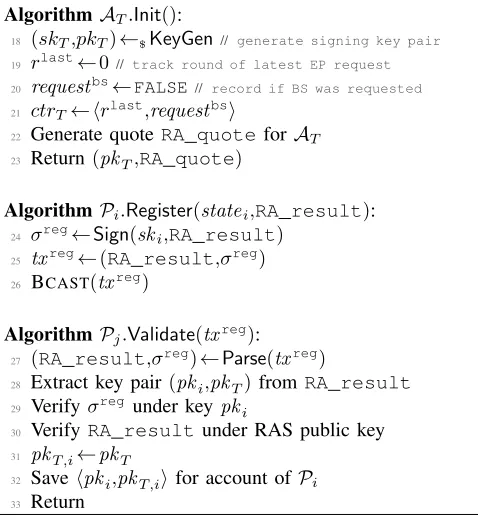
For ease of presentation, we consider each transaction as a pair tx= (m,σ), wheremis the payload of the transaction andσis a signature ofmunder the account key of the transac-tion issuer. We later discuss the detailed format of transactransac-tions in PoTS. The initialization and registration procedures are illustrated in Figure2, and described below. As previously men-tioned, the registration procedure assumes a scenario in which remote attestation requires the assistance of a trusted RAS.
In the rest of this section, we denote the trusted application byAT, and correspondingly writeAT.Procto indicate any
pro-cedure Procexecuted byAT within the TEE. More generally,
P.Procmeans that procedureProcis executed by a party P.
Algorithm AT.Init():
18 (skT,pkT)←$KeyGen// generate signing key pair
19 rlast←0 // track round of latest EP request
20 requestbs←FALSE // record if BS was requested 21 ctrT← hrlast,requestbsi
22 Generate quote RA_quoteforAT
23 Return(pkT,RA_quote)
Algorithm Pi.Register(statei,RA_result):
24 σreg←Sign(ski,RA_result)
25 txreg←(RA_result,σreg) 26 BCAST(txreg)
Algorithm Pj.Validate(txreg):
27 (RA_result,σreg)←Parse(txreg)
28 Extract key pair(pki,pkT)fromRA_result 29 Verify σregunder key pki
30 Verify RA_resultunder RAS public key 31 pkT ,i←pkT
32 Savehpki,pkT ,ii for account ofPi
33 Return
Fig. 2: Initialization and registration of the TEE trusted application for block generation.
TEE initialization and registration. Upon receiving an initialization request, AT generates a signing key
pair(skT,pkT)to be used for block generation. The trusted
application also initializes a variablectrT which record relevant
information about block signing requests, as we will see shortly. Hence,AT produces an attestation quoteRA_quote, which
includes: a hash valueH(pki,pkT)that binds the validator’s account keypki and the block verification keypkT generated
byAT, a description/identifier of the trusted application itself,
a measurement produced by TEE for the trusted application, and a signature of all these values under the attestation key provisioned on the TEE device. Finally,AT returns the public
key pkT along with the quote. The node can now send the
attestation quote to the RAS; the latter, upon verifying the quote, provides an attestation resultRA_resultstating that the application AT is running on a trusted TEE platform.
Finally, the attestation result is posted to the blockchain network by the node through a registration transactiontxreg.
Therefore, all peers can verify the RAS-signed attestation result and record the relevant data for the newly joint validator. Typically, a remote attestation service requires all users to be registered with that service, which may be not always desirable in an open network such as a blockchain network. Our solution, however, relaxes the latter requirement by relying on a few nodes registered with the RAS who function as proxies and forward the quotes of all other nodes to the RAS (the latter can be realized via mechanisms similar to [48]). The proxied attes-tation protocol works as follows: A new validatorPv initializes
implementation, and sends an attestation request to the trusted application. The attestation request in turns includes the service provider ID (SPID)3 of a selected proxy nodeP
p. Hence, the
trusted application generates a quote based on the given SPID, and validator Pv sends this quote to the proxy nodePp, who
further forwards the quote to the RAS through an authenticated and confidential channel. After verifying the quote, i.e., whether the attested trusted application is running on a legitimate TEE platform, the RAS signs the attestation result and sends it back toPp. The latter extracts the attestation result from the reply
of RAS and sends it toPv. The validator can now prepare the
registration transaction and broadcast it to the network. Once the registration process is completed, the validator can participate the mining process.
As we will see in Section V, the security of our protocol relies on each TEE device supporting at most one enclave at a time. The remote-attestation procedure of our solution guarantees this. More concretely, if the TEE is instantiated with Intel SGX or with TPM, the attestation quote includes an EPID [44], [45] or a DAA [43] pseudoname, respectively, which can be configured as linkable by specifically choosing the basename. Namely, using the linkable mode, all quotes produced by the same platform must use the same basename, hence multiple enclaves running on the same platform result in the same EPID/DAA signature authenticating the quotes.
Chain Extension. Akin to the concept of cryptographic sortition introduced by Micali [24], cf. Section VII), our protocol lets each individual validator check privately whether they are eligible to extend the blockchain in a given round and, if this is the case, produce a publicly verifiable proof to provide evidence of this.
The chain extension algorithm Extend consists of three main steps: (i) it checks whether the validator is eligible to become leader in the next round, and if so it proceeds with(ii) preparing the block header, and (iii)signing both the header and the proof. A blockBrconsists of validator’s identifierPir,
block header hdr, proof of eligibility πr, block signatureσr,
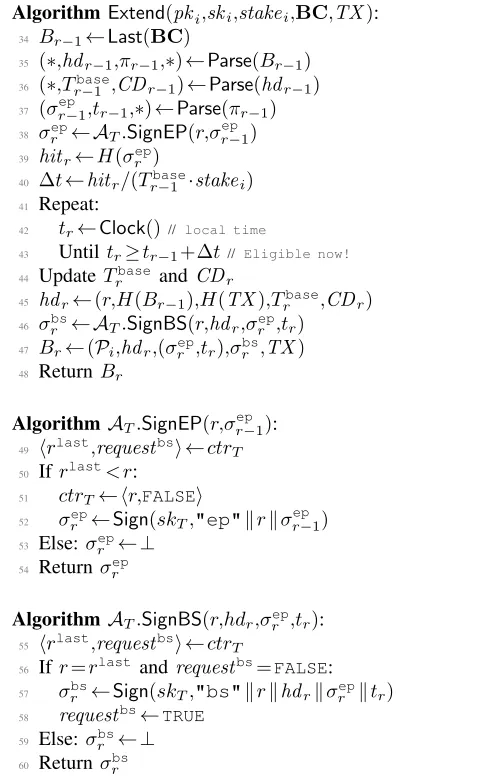
and a list of transactions TX. Both the eligibility proof and the block signature are computed with support of the TEE. We provide a full specification of the chain extension routine in Figure 3, and explain it in detail below.
To compute proof of eligibility and block signature, a valida-tor must issue corresponding requests to the trusted application. The eligibility proof consists of an “eligibility signature”σep,
which ensure public verifiability, and a timestamp to throttle the number of eligible validators. To generate the eligibility proof for round r, the validator submits a request toAT containing
the eligibility signature σep
r−1 for the previous block along with the current round valuer(cf. lines49–54in Figure3).
Each validator can only issue requests for strictly increasing block heights. To ensure this, the trusted application tracks the round information of each request using a pair of counters ctrT = (rlast,requestbs), where rlast records
3Registered parties by RAS is assigned a service provider ID and a correspondent certificate.
Algorithm Extend(pki,ski,stakei,BC,TX):
34 Br−1←Last(BC)
35 (∗,hdr−1,πr−1,∗)←Parse(Br−1)
36 (∗,Trbase−1 ,CDr−1)←Parse(hdr−1)
37 (σrep−1,tr−1,∗)←Parse(πr−1)
38 σepr ← AT.SignEP(r,σ
ep
r−1)
39 hitr←H(σrep)
40 ∆t←hitr/(Trbase−1 ·stakei)
41 Repeat:
42 tr←Clock()// local time
43 Untiltr≥tr−1+∆t // Eligible now! 44 UpdateTrbase andCDr
45 hdr←(r,H(Br−1),H(TX),Trbase,CDr)
46 σbsr ← AT.SignBS(r,hdr,σepr ,tr)
47 Br←(Pi,hdr,(σrep,tr),σrbs,TX)
48 ReturnBr
Algorithm AT.SignEP(r,σepr−1):
49 hrlast,requestbsi ←ctrT
50 Ifrlast< r: 51 ctrT← hr,FALSEi
52 σrep←Sign(skT,"ep"krkσepr−1)
53 Else:σepr ← ⊥ 54 Returnσrep
Algorithm AT.SignBS(r,hdr,σrep,tr):
55 hrlast,requestbsi ←ctrT
56 Ifr=rlast andrequestbs=FALSE: 57 σrbs←Sign(skT,"bs"krkhdrkσrepktr)
58 requestbs←TRUE 59 Else:σbsr ← ⊥ 60 Returnσrbs
Fig. 3: Chain extension routine of PoTS. It is executed by validators and requires a registered TEE.
the latest round for which an eligibility proof request has been submitted, and requestbs is a boolean flag indicating
whether a corresponding block signature in that round has been generated. Upon receiving an eligibility proof request, the trusted application checks whether the submitted round valueris strictly larger than the counterrlast and, if this is
the case, updatesrlast←randrequestbs←FALSE, computes
the new eligibility signatureσep
r by signing"ep"krkσ
ep
r−1, and returns the resultingσep
r ; otherwise, it rejects the request.
The eligibility signature effectively provides a “cryptographic ticket” for the sortition-based leader election step: the validator can now useσepto derive their so-calledhitfor roundr, namely
hitr=H(σrep). The hit provides a value in [0,2`−1], which is
unpredictable unlessσepis known. The validatorP
iis eligible
to generate a block for roundrif their hit is smaller than a given target, which in turns depends on the validator’s stakestakei,
a target-baseTbase
rate), and the elapsed time since the previous block has been generated. Note that any validator who waits long enough will eventually be eligible, and the time validator Pi needs to wait
is given by ∆t=hitr/(Trbase−1 ·stakei)(cf. line43).
Thus, once the local clock indicates time tr−1 + ∆t, where tr−1 is the timestamp recorded in the latest block, the validator can submit the block signature request to the TEE (cf. lines55–60).4 For the block signature request, the validator provides the prepared block headerhdr, the eligibility
signature σep
r , and its (local) timestamp tr (cf. line 46).
The trusted application extracts the round r from the block header hdr and checks it against the counters in ctrT: if
rlast=r (i.e., the rounds match) andrequestbs=
FALSE(i.e., no block signature has been requested for that round), AT
computes the block signatureσbs
r over"bs"krkhdrkσrepktr.
Upon successful completion of the above operations, the val-idator broadcasts the candidate blockBr= (Pi,hdr,πr,σr,TX),
whereπr= (σrep,tr)andσr=σbsr .
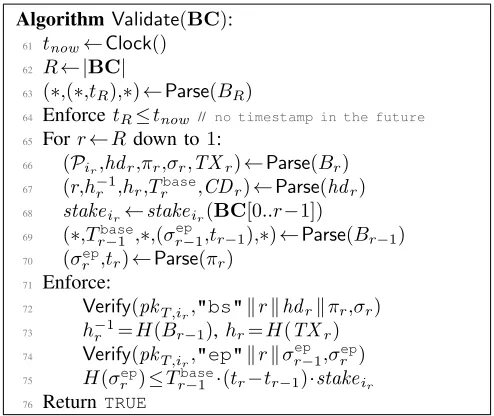
Chain validation and fork resolution. The validation algorithm Validate verifies that all blocks of the chain were generated “properly”, according to the protocol specification. Notice that proofs of eligibility are publicly verifiable since account public keys and stake information can be retrieved from the blockchain itself. In Figure4, we illustrate the details of the chain validation routine that we explain below.
AlgorithmValidate(BC):
61 tnow←Clock()
62 R← |BC|
63 (∗,(∗,tR),∗)←Parse(BR)
64 Enforce tR≤tnow // no timestamp in the future 65 Forr←Rdown to1:
66 (Pir,hdr,πr,σr,TXr)←Parse(Br) 67 (r,h−1r ,hr,Trbase,CDr)←Parse(hdr)
68 stakeir←stakeir(BC[0..r−1])
69 (∗,Trbase−1 ,∗,(σepr−1,tr−1),∗)←Parse(Br−1)
70 (σepr ,tr)←Parse(πr)
71 Enforce:
72 Verify(pkT ,i
r,"bs"krkhdrkπr,σr) 73 h−1r =H(Br−1),hr=H(TXr)
74 Verify(pkT ,i
r,"ep"krkσ ep
r−1,σrep)
75 H(σrep)≤Trbase−1 ·(tr−tr−1)·stakeir 76 ReturnTRUE
Fig. 4: Chain validation routine of PoTS. It can be executed by any initialized node (no TEE is necessary).
Upon retrieving a blockchain BC= (B0,...,BR), a node
verifies the validity of all blocks, going backwards from the most recent one. To ensure that block leaders were truly eligible, however, the node must also ensure that the timestamp tR
of the latest block is consistent with the current time tnow,
4However, someone else may have in the meantime generated therth
block (or more), thus being eligible does not necessarily translate to actually becoming the leader for that round.
namely that tR ≤ tnow, meaning otherwise that the last
validator faked the block timestamp (cf. line64in Figure 4).5
The block verification closely follows the operations of the chain extension routine, in reverse order. Namely, for each block Br, the node verifies the validity of the block
signatureσr under the TEE public keypkT ,ir of the alleged
block leaderPir (cf. line72), the hash valueshr=H(TXr)
andh−1r =H(Br−1)(cf. line73), the consistency of the block timestamp tr, the validity of the eligibility signature σep
(cf. line 74), and the validity of the eligibility proof w.r.t. the block leader’s stake when generating the block (cf. line75).
We emphasize that no trusted hardware is required for chain validation. That is, a TEE is necessary only for the mining process.
Should multiple valid chains be detected, the validator chooses the one with highest cumulative difficultyCDR (i.e.,
the cumulative difficulty of the latest blockBR). This process
is similar as the Nxt’s fork resolution [7].
Resuming application. All variables used within AT are
saved in the protected volatile memory of TEE, preventing the attacker from reading or manipulating their values. To allow AT resuming these variables after a restart, however,
they should also be saved onto the persistent storage of the untrusted system in a way that prevents replay attacks. Namely, AT should detect if it is ever resumed with a saved copy that
is obsolete. It should also prevent rollback attacks [49], e.g., that a user deliberately crashes the trusted application to reset the counter valuectrT to the last saved version. We achieve
this by using TEE monotonic counters and sealing function. More specifically, in the initialization phase (cf. Figure2)AT
additionally initializes a TEE monotonic counter to value 1. WheneverAT terminates normally, the value of the monotonic
counter is saved along with the other variables through the TEE sealing interface. Then, when the trusted application restarts and is given a copy of sealed data,AT unseals the data and obtains
the “last” counter value from the copy: If it equals to the reading of the current monotonic counter, the latter will be advanced; otherwise, AT terminates abnormally. As a result, in addition
to preventing replay attacks, it is guaranteed that an abnormal termination ofAT will make the application refuse to start until
it is re-initialized. Thus, any malicious validator who crashes the TEE in order to reset the round counters will have to register a new AT instance (effectively making the attack worthless).
Transacting in PoTS: key refreshing and chain linking.
Another crucial component of our protocol consists in generically tweaking the transaction format by introducing two additional fields to incorporate a key-refreshing mechanism and a method to link transactions to blockchain branches.
5To be precise,t
R> tnow implies thatsomeof the block timestamps
The first tweak consists in a novel mechanism to refresh the account keys of blockchain users which draws inspiration from forward-secure cryptography [50], i.e., is based on frequent key updates coupled with secure deletion of old keys. Forward security specifically aims at limiting the effect of key exposure, offering the guarantee that data protected in the past—prior to key exposure—remains secure. We adapt this concept to PoTS by letting users update their account key-pair upon issuing each transaction, so that corruption of a user’s account cannot be exploited to issue transactions far in the past.
The second modification of the transaction format consists in including to the transaction payload a pointer to the “current” blockchain (where the pointer could be the hash value of the last block of the chain), so that each given transaction is valid only w.r.t. the blockchain it points to. As discussed by Gazi et al. [39], this technique prevents transferring transactions to alternative chains maintained by malicious validators, and it particularly prevents stake-bleeding attacks.
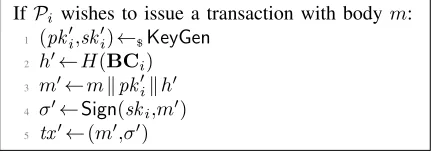
Key refreshing: Whenever a user Pi wishes to issue a
transaction with payload m, they also generate a fresh signing-key pair (sk0i,pk0i)6, include the public key pk0
i
in the payload obtaining m0 ←mkpk0i, sign m0 with the current signing key ski obtaining a signatureσ0, and
broadcast tx0= (m0,σ0) to the network. As soon as the transaction appears in a block, the other users register public key pk0i as the updated account key of Pi. The
issuer waits until the transaction is confirmed, i.e., until it appears in a “sufficiently deep” block of the blockchain (depending on the stability parameter from Definition1), hence it deletes the old signing keyski.
Our solution leverages the public-ledger functionality of the blockchain to make the key-update mechanism more efficient than traditional cryptographic techniques for forward security, which typically can only support a fixed numbers of key updates and require storage of relatively large keys. In particular, PoTS uses the blockchain itself a medium to communicate the key updates, and only requires storage of old signing keys for the transaction-confirmation time.
Chain linking: Whenever Pi wishes to issue a transaction
with payload m, they generate a pointer that links to the current blockchain, e.g., h0←H(BCi), derive an updated payloadm0←mkh0, and signm0 instead ofm. Both the key refreshing and the chain linking can be performed simultaneously as described in the generic method of Figure5.
V. SECURITY ANALYSIS
In this section, we analyze the security of our PoS proposal according to the security model presented in Section III. Specifically, we isolate the crucial security features offered by the various components of PoTS and argue that these features are sufficient to prevent nothing-at-stake, grinding, and long-range attacks.
6The next account key pair could also be generated in advance to improve performance.
IfPi wishes to issue a transaction with bodym:
1 (pk0i,sk0i)←$KeyGen
2 h0←H(BCi)
3 m0←mkpk0ikh0 4 σ0←Sign(ski,m0)
5 tx0←(m0,σ0)
Fig. 5: Key refreshing and chain linking of PoTS.
A. Basic protocol: PoTS-mini
For the sake of analysis, we present our protocol as being built in a modular way, starting from a basic PoS protocol that meets relevant blockchain properties in a weak adversarial model and then gradually enhancing such protocol to make it withstand an increasingly stronger adversary. For the resulting protocol, PoTS, the blockchain properties are also met in the “standard” (i.e., Byzantine) adversarial model.
The “basic” protocol, henceforth referred to as PoTS-mini, deterministically assigns the right to generate a block depending on public values, namely by comparing the current validator’s hit (cf. line 39 from Figure 3) with a specified target, both publicly computable. Chain validation and fork resolution rules of PoTS-mini are derived in the natural way, consistently with the leader-election process.
An instantiation of this protocol type is Nxt [7], for which the hit is derived recursively by hashing the previous hit concatenated with public, validator-specific information.
It is reasonable to assume that PoTS-mini offers minimal functionality and security, namely that under the clock synchro-nization and network assumptions specified in SectionIII, if all validators execute the protocol faithfully then the properties of common prefix,chain growth, andchain qualityare met.
Common prefix: Validators agree on the same (long prefix of the) blockchain since, in each round, either there is a unique leader or the most-difficult-chain rule resolves potential forks.
Chain growth: Since the target increases as time passes, in every round some active validator will eventually be eligible. By adjusting the value of Tbase, one can
regulate the block-generation rate, ensuring that the blockchains of active validators grow in a steady fashion.
Chain quality: The leader election rule weighs validators depending on their stake, so that each validator has a chance to become leader proportional to the owned stake. Thus, the relative number of blocks generated by a given validator over a sufficiently long period is related to the validator’s relative stake.
More-over, we stress that the synchronicity assumption on the network is necessary for the security of all existing blockchain protocols, which would otherwise be vulnerable to eclipse attacks [51].
Meeting security in the above mentioned adversarial model clearly is not sufficient to yield a secure PoS protocol: as it is, PoTS-mini offers no protection against Byzantine faults and corruptions of users. Indeed, an adversary may for instance adaptively corrupt validators who have a high chance to become leader in the near future, posterior-corrupt a former quorum of validators and rewrite the blockchain history, as well as mount more subtle attacks.
In the rest of the section we identify the components that enhance the security of PoTS-mini, turning it into PoTS, and argue that our solution retains all the blockchain properties in the strong adversarial model outlined in Section III.
B. Turning PoTS-mini into PoTS
We now show how to turn PoTS-mini into a full-fledged secure PoS protocol, PoTS, by (i) letting validators privately determine their eligibility in a private manner by computing an eligibility signature, (ii) computing both eligibility signature and block signature within the TEE, (iii) letting users update their account keys whenever they issue a new transaction, and (iv) linking transactions to a specific branch. In the rest of this section, we isolate the specific (security) properties offered by each of the above components, and indicate the corresponding attack strategies they can mitigate.
When designing a TEE-based blockchain protocol, special care must be taken to protect against rollback attacks [52], [53], [54]. These attacks aim to replace current application data—that has been sealed and saved onto untrusted storage to enable secure resumption of the application—with an older version of it. In the specific case of PoTS, an attacker could feed the trusted application with obsolete values, such as an outdated block height, to enable signing of blocks in the past. As we will see in the course of this section, PoTS prevents rollback attacks by employing monotonic counters, and to further avoid the memory wear out issue of the latter, it lets the trusted application verify that the unsealed data is up-to-date by letting the monotonic counter only track the restarts of the application (c.f. Section IV-C).
Further, it should be noted that any security arguments based on TEEs rely on the trusted hardware being tamper proof. However, side-channel attacks on popular TEE implementations such as Intel SGX [33], [34], [35] and ARM TrustZone [36], [37], [38], as well as the recent Spectre [55] and Foreshadow [15] vulnerabilities on TEE-enabled microprocessors, make this assumption hard to justify in practice. In the case of PoTS, a successful side-channel attack would allow a malicious validator to extract the TEE signing key so that they can work around the checks enforced by the TEE during the eligibility and signing process. Nevertheless, we argue that PoTS, in contrast to other TEE-based PoS proposals (cf. Section VII-B), offers a reasonable level of security even against an adversary that can compromise some TEE devices and obtain the corresponding private keys.
We proceed with incorporating the various security components to PoTS-mini for turning it into PoTS.
Dealing with adaptive corruptions.Since in PoTS-mini the eligibility of validators is determined from public values, everybody could predict who will become leader for any round in the future and, in particular, an adversary could choose the validators to corrupt according to that. To make future leaders unpredictable, PoTS uses an unforgeable signature scheme and lets validators derive their hit by hashing the eligibility signature, i.e.,hitr=H(σepr ).7 We formalize this intuition in
the following proposition.
Proposition 1 (Privately computable eligibility). If the signature scheme in use is unforgeable, the adversary cannot compute valid eligibility signatures for honest validators.
Proof sketch. Every adversary A, who can derive a valid eligibility proofσep
r for roundrand honest (i.e., non corrupt)
validatorPi, can be turned into a successful forger against the
signature scheme, violating the assumed unforgeability.
By Proposition1we have that, even ifAcan corrupt partici-pants at any time, eligible validators are not visible as such until they broadcast a new block. That is, the adversary cannot take advantage of adaptive corruptions for targeting the next leaders.
Dealing with nothing at stake and grinding attacks.Making leaders unpredictable is not sufficient, on its own, to yield a se-cure PoS protocol, as it does not discourage dishonest behavior of validators. In particular, determining validators’eligibility via signatures introduces a grinding vulnerability, since a malicious validator could precompute multiple eligibility signatures for the same block and then present the most profitable one. Moreover, dishonest validators could compute several eligibility or block signatures for different, inconsistent blocks in order to maintain alternative chains (nothing at stake). To overcome these issues, in PoTS eligibility and block signatures are computed within the TEE using a tamper-protected private key which is not known to the validator, in such a way that the TEE only allows one eligibility request, respectively, a block signature request, per round. Therefore, a malicious validator can neither precompute signatures on competing chains nor generate signatures on their own (without the TEE), and hence they have no way to compute the hits in advance on virtual branches for then adapting to the best chain. The following result formalizes the above intuition.
Proposition 2 (Restricting eligibility and block-signing requests). If the TEE supports remote attestation, isolation, sealing, and monotonic counter properties and the signature scheme is unforgeable, each validator can obtain at most one eligibility signature and corresponding block signature per block height, and only for strictly increasing heights.
Proof sketch. For the assumed unforgeability of the signature scheme and the isolation property of TEEs, the only way for a validator to compute an eligibility signatureσep
r for roundris
by issuing an eligibility-proof request to the trusted application. Due to the monotonic counter property of TEEs (cf. Sec-tion IV-B) and the design of PoTS’s block extension routine, the validator can issue at most one eligibility-proof request per round (specifically, this is guaranteed by the check in line 50 from Figure3). Further, any attempt to mount a rollback attack by powering down the processor or induce abrupt rebooting would not give any advantage to the validator: the sealing property of TEEs guarantees that round counters are saved in encrypted form in the persistent memory of the hosting system and correctly resumed by the trusted application upon restarting the TEE. Therefore, the trusted application recognizes incorrect resumption as suspicious and will force re-initialization of the device for mining, ultimately making the attack worthless.
By Proposition2 each validator, when issuing the eligibility signature request for round r, has to “commit” to a given chain, namely the one including eligibility signature σrep−1 in the latest block. In particular, validators can no longer attempt to extend multiple chains (of the same length) simultaneously, hence nothing at stake attacksare prevented.
Further, due to the eligibility signature being the only source of unpredictability in the leader election process, no validator can bias the randomness of the leader election in any predictable way: a malicious node can no longer create the conditions to bias the eligibility process in their favor, because they cannot establish what the favorable conditions are prior to obtaining the eligibility signature from the TEE (moreover, onceσep
r has been generated for a given roundr,
any other eligibility signature request for that round will be rejected). That is,grinding attacksare prevented, too.
Note that restricting eligibility and block-signature requests still allows validators to switch among chains, as long as the new chain is to be preferred. That is, the restriction does not harm functionality, and this is the case due to the fork-resolution rule which favors the most difficult chain: “natural” rollbacks always yield a more difficult chain, while making a block-signature request for an early round would yield an easier chain, meaning the validator is seeking for an illegitimate rollback.
We point out that Proposition 2crucially assumes that all TEE devices in the system are tamper proof. In fact, an adver-sary who manages to compromise a TEE and extract the cor-responding signing key could generate multiple eligibility and block signatures for every round. In particular, a compromised TEE allows a validator to maintain multiple, inconsistent chains. We argue that PoTS considerably hardens security against such attacks; namely, due to the complexity of side-channel attacks on TEEs, we can reasonably assume that compromised TEE devices under adversarial control only comprise a small share of the overall number of mining devices. Therefore, we can conclude that even in the presence of some compromised TEEs which are used to mine on inconsistent chains, the liveness of the protocol is not significantly threatened (cf. Section III-A).
Note also that obtaining a TEE’s private key allows an adversary to generate an unlimited number of valid signatures on any message of their choosing. In particular, the adversary could grind eligibility signatures. Again, such grinding vulnerability is limited to the compromised TEE devices, which we assume to be only a few. Therefore, exploitation of compromised devices can be detected using statistical methods, for instance by comparing the expected block-generation rate of each given validator with the actual number of blocks they did generate (e.g., as in [56], [57]). In this way, if a validator presents a significantly higher rate than expected, their blocks are eventually rejected by the network.
Dealing with posterior-corruptions and long-range attacks.
Enforcing that each validator can generate at most one block per round, and only for strictly increasing heights, can also make certain types of long-range attacks hard to mount. Namely, Proposition 2 implies that a malicious/corrupt validator cannot produce valid blocks in the past, prior to the latest block contributed by themselves. That is, each TEE device only allows to push the blockchain forward (and not moving backwards to cause a rollback). This means in particular that the adversary cannot posterior-corrupt a former quorum of validators and leverage their accounts to generate an alternative history, because none of their TEEs would allow to revert the blockchain to any earlier point than the latest round for which the TEE issued a block signature.
We point out that enforcing block signing within the TEE does not, however, prevent all types of posterior-corruption long-range attacks. Indeed, since any restriction on signing requests only applies to blocks previously signed using a given TEE, nothing prevents an adversary from exploiting adifferent TEE device to generate blocks in the past (for instance, using an idle TEE that did not yet mine). More precisely, a posterior-corruption attack against a former quorum of users/validators would allow the adversary to take over the majority of stake (in the past), transfer it to the adversary’s account associated to the idle TEE, and then leverage the acquired stake to cause an illegitimate rollback.
To also mitigate posterior-corruption attacks of this type, PoTS lets users frequently refresh their signing keys and delete expired ones. Namely, each user performs a key refresh whenever they issue a transaction (cf. Figure 5), and they delete the previous signing key as soon as the transaction is confirmed. Therefore, corruption of a user’s account may only give the adversary access to the most recently “confirmed” signing key, and to none of the older keys, and hence it limits the effect of posterior corruption.
Proposition 3(Preventing posterior-corruption stake transfer).
If users securely delete their old account signing keys, the adversary cannot issue transactions on behalf of corrupt users far in the past.