A Provably Secure Group Signature Scheme
from Code-Based Assumptions
Martianus Frederic Ezerman, Hyung Tae Lee, San Ling, Khoa Nguyen, and Huaxiong Wang
Division of Mathematical Sciences, School of Physical and Mathematical Sciences, Nanyang Technological University, Singapore.
{fredezerman,hyungtaelee,lingsan,khoantt,hxwang}@ntu.edu.sg
Abstract. We solve an open question in code-based cryptography by introducing the first provably secure group signature scheme from code-based assumptions. Specifically, the scheme satisfies theCPA-anonymity and traceability requirements in the random oracle model, assuming the hardness of the McEliece problem, the Learning Parity with Noise prob-lem, and a variant of the Syndrome Decoding problem. Our construction produces smaller key and signature sizes than the existing post-quantum group signature schemes from lattices, as long as the cardinality of the underlying group does not exceed the population of the Netherlands (≈224users). The feasibility of the scheme is supported by implementa-tion results. Addiimplementa-tionally, the techniques introduced in this work might be of independent interest: a new verifiable encryption protocol for the randomized McEliece encryption and a new approach to design formal security reductions from the Syndrome Decoding problem.
1
Introduction
1.1 Background and Motivation
Group signature [CvH91] is a fundamental cryptographic primitive with two in-triguing features: On the one hand, it allows users of a group to anonymously sign documents on behalf of the whole group (anonymity); On the other hand, there is a tracing authority that can tie a given signature to the signer’s identity should the need arise (traceability). These two properties make group signatures highly useful in various real-life scenarios such as controlled anonymous print-ing services, digital right management systems, e-biddprint-ing and e-votprint-ing schemes. Theoretically, designing secure and efficient group signature schemes is of deep interest since doing so typically requires a sophisticated combination of carefully chosen cryptographic ingredients. Numerous constructions of group signatures have been proposed, most of which are based on classical number-theoretic as-sumptions (e.g., [CS97,ACJT00,BBS04,BW06,LPY12]).
are based on computational assumptions from lattices. Despite their theoreti-cal interest, those schemes involve significantly large key and signature sizes, and no implementation result has been given. Our evaluation shows that the lattice-based schemes listed above are indeed very far from being practical (see Section 1.2). This somewhat unsatisfactory situation highlights two interesting challenges: First, making post-quantum group signatures one step closer to prac-tice; Second, bringing in more diversity with a scheme from another candidate for post-quantum cryptography (e.g., code-based, hash-based, multivariate-based). For instance, an easy-to-implement and competitively efficient code-based group signature scheme would be highly desirable.
A code-based group signature, in the strongest security model for static groups [BMW03], would typically require the following 3 cryptographic layers:
1. The first layer requires a secure (standard) signature scheme to sign messages1.
We observe that the existing code-based signatures fall into two categories. The “hash-and-sign” category consists of the CFS signature [CFS01] and its modified versions [Dal08,Fin10,MVR12]. The known security proofs for schemes in this category, however, should be viewed with skepticism: the assumption used in [Dal08] was invalidated by distinguishing attacks [FGUO+13], while the new
assumption proposed in [MVR12] lies on a rather fragile ground.
The “Fiat-Shamir” category consists of schemes derived from Stern’s identifica-tion protocol [Ste96] and its variant [V´er96,CVA10,MGS11] via the Fiat-Shamir transformation [FS86]. Although these schemes produce relatively large signa-tures (as the underlying protocol has to be repeated many times to make the soundness error negligibly small), their provable security (in the random oracle model) is well-understood.
2. The second layer demands a semantically secure encryption scheme to enable the tracing feature: the signer is constrained to encrypt its identifying infor-mation and to send the ciphertext as part of the group signature, so that the tracing authority can decrypt if and when necessary. This ingredient is also avail-able in code-based cryptography, thanks to variousCPA-secure andCCA-secure variants of the McEliece [McE78] and the Niederreiter [Nie86] cryptosystems (e.g., [NIKM08,DDMN12,Per12,MVVR12]).
3. The third layer, which is essentially bottleneck in realizing secure code-based group signatures, requires a zero-knowledge (ZK) protocol that connects the first two layers. Specifically, the protocol should demonstrate that a given sig-nature is generated by a certain certified group user who honestly encrypts its identifying information. Constructing such a protocol is quite challenging. There have been ZKprotocols involving the CFS and Stern’s signatures, which yield identity-based identification schemes [CGG07,ACM11,YTM+14] and threshold
ring signatures [MCG08,MCGL11]. There also have beenZKproofs of plaintext knowledge for the McEliece and the Niederreiter cryptosystems [HMT13]. Yet
we are not aware of any efficient ZKprotocol that simultaneously deals with both code-based signature and encryption schemes in the above sense.
Designing a provably secure group signature scheme, thus, is a long-standing open question in code-based cryptography (see, e.g., [CM10]).
1.2 Our Contributions
In this work, we construct a group signature scheme which is provably secure under code-based assumptions. Specifically, the scheme achieves the anonymity and traceability requirements ([BMW03,BBS04]) in the random oracle model, assuming the hardness of the McEliece problem, the Learning Parity with Noise problem, and a variant of the Syndrome Decoding problem.
Contributions to Code-Based Cryptography.By introducing the first
prov-ably secure code-based group signature scheme, we solve the open problem dis-cussed earlier. Along the way, we introduce two new techniques for code-based cryptography, which might be of independent interest:
1. We design aZKprotocol for the randomized McEliece encryption scheme, that allows the prover to convince the verifier that a given ciphertext is well-formed, and that the hidden plaintext satisfies an additional condition. Such protocols, called verifiable encryption protocols, are useful not only in constructing group signatures, but also in much broader contexts [CS03]. It is worth noting that, prior to our work, verifiable encryption protocols for code-based cryptosystems only exist in the very basic form [HMT13] (where the plaintext is publicly given), which seem to have restricted applications.
2. In our security proof of the traceability property, to obtain a reduction from the hardness of the Syndrome Decoding (SD) problem, we come up with an approach that, as far as we know, has not been considered in the literature before. Recall that the (average-case)SDproblem with parametersm, r, ωis as follows: given a uniformly random matrixHe ∈Fr×m2 and auniformly random
syndrome ˜y∈Fr
2, the problem asks to find a vectors∈Fm2 that has Hamming
weight ω (denoted by s∈B(m, ω)) such that He ·s> = ˜y>. In our scheme, the
key generation algorithm produces public key containing matrixH∈Fr×m2 and
syndromesyj ∈Fr2, while users are given secret keys of the formsj ∈B(m, ω)
such that H·s>j = y>j. In the security proof, since we would like to embed anSDchallenge instance (He,y˜) into the public key without being noticed with
non-negligible probability by the adversary, we have to require that Hand the
yj’s produced by the key generation are indistinguishable from uniform.
One method to generate these keys is to employ the “hash-and-sign” technique from the CFS signature [CFS01]. Unfortunately, while the syndromesyj’s could
be made uniformly random (as the outputs of the random oracle), the assump-tion that the CFS matrix H iscomputationally close to uniform (for practical parameters) is invalidated by distinguishing attacks [FGUO+13].
Another method, pioneered by Stern [Ste96], is to pickHand thesj’s uniformly
close to uniform if the parameters are set such thatωis slightly smaller than the valueω0 given by the Gilbert-Varshamov bound2, i.e.,ω0 such that ωm0
≈2r.
However, for these parameters, it is not guaranteed with high probability that a uniformly random SD instance (He,y˜) has solutions, which would affect the
success probability of the reduction algorithm.
In this work, we consider the case whenωis moderately larger thanω0, so that
two conditions hold: First, the uniform distribution over the set B(m, ω) has sufficient min-entropy to apply the left-over hash lemma [GKPV10]; Second, the SD problem with parameters (m, r, ω) admits solutions with high probability, yet remains intractable3 against the best known attacks [FS09,BJMM12]. This
gives us a new method to generate uniformly random vectors sj ∈ B(m, ω)
and matrix H ∈ Fr×m2 so that the syndromes yj’s corresponding to the sj’s
are statistically close to uniform. This approach, which somewhat resembles the technique used in [GPV08] for the Inhomogeneous Small Integer Solution problem, is helpful in our security proof (and generally, in designing formal security reductions from the SDproblem).
Contributions to Post-Quantum Group Signatures. Our construction
provides the first non-lattice-based alternative to provably secure post-quantum group signatures. The scheme features public key and signature sizes linear in the number of group usersN, which is asymptotically not as efficient as the recently published lattice-based counterparts ([LLLS13,LLNW14,LNW15,NZZ15]). How-ever, when instantiating with practical parameters, our scheme behaves much more efficiently than the scheme proposed in [NZZ15] (which is arguably the current most efficient lattice-based group signature in the asymptotic sense). In-deed, our estimation shows that our scheme gives public key and signature sizes that are 2300 times and 540 times smaller, respectively, for an average-size group of N = 28 users. As N grows, the advantage lessens, but our scheme remains
more efficient even for a huge group ofN = 224users (which is comparable to the whole population of the Netherlands). The details of our estimation are given in Table 1.
Furthermore, we give implementation results - the first ones for post-quantum group signatures - to support the feasibility of our scheme (see Section 5). Our results, while not yielding a truly practical scheme, would certainly help to bring post-quantum group signatures one step closer to practice.
1.3 Overview of Our Techniques
Letm, r, ω, n, k, tand`be positive integers. We consider a group of sizeN = 2`,
where each user is indexed by an integerj ∈[0, N−1]. The secret signing key of user j is a vector sj chosen uniformly at random from the set B(m, ω). A
uniformly random matrixH∈Fr×m2 andN syndromesy0, . . . ,yN−1∈Fr2, such
2
Table 1.Efficiency comparison between our scheme and [NZZ15].
N Public Key Size Signature Size∗
Our Scheme
28 5.13×106 bits ( 642 KB) 8.57×106 bits (1.07 MB) 216 4.10×107 bits (5.13 MB) 1.77×107 bits (2.21 MB) 224 9.23×109 bits (1.16 GB) 2.36×109 bits (294 MB) [NZZ15] ≤224 1.18×1010 bits (1.48 GB) 4.63×109 bits (579 MB) The parameters of our scheme are set as in Section 5. For the [NZZ15] scheme, we choose the commonly used lattice dimensionn= 28, and set parametersm= 29×150 andq= 2150so that the requirements given in [NZZ15, Section 5.1] are satisfied. Both schemes achieve theCPA-anonymity notion [BBS04] and soundness error 2−80.
∗
In our implementations presented in Section 5, the actual signature sizes could be reduced thanks to an additional technique.
thatH·s>j =y>j, for allj, are made public. Let us now explain the development of the 3 ingredients used in our scheme.
The Signature Layer.Userj can run Stern’sZKprotocol [Ste96] to prove the
possession of a vectors∈B(m, ω) such thatH·s>=y>j, where the constraints∈ B(m, ω) is proved inZKby randomly permuting the entries ofsand showing that the permuted vector belongs to B(m, ω). The protocol is then transformed into a Fiat-Shamir signature [FS86]. However, such a signature is publicly verifiable only if the indexj is given to the verifier.
The user can further hide its index j to achieve unconditional anonymity among allNusers (which yields aring signature[RST01] on the way, a la [BS13]), as follows. Let A =
y>0| · · · |y>j| · · · |y>N−1
∈ Fr×N2 and let x = δN
j - the N
-dimensional unit vector with entry 1 at thej-th position. Observe thatA·x>=
y>j , and thus, the equationH·s>=y>j can be written as
H·s>⊕A·x>=0, (1)
where⊕denotes addition modulo 2. Stern’s framework allows the user to prove in ZKthe possession of (s,x) satisfying this equation, where the conditionx=δN j
can be justified using a random permutation.
The Encryption Layer. To enable the tracing capability of the scheme, we
let user j encrypt the binary representation of j via the randomized McEliece encryption scheme [NIKM08]. Specifically, we represent j as vector I2B(j) = (j0, . . . , j`−1)∈ {0,1}`, wherePi`−=01ji2`−1−i=j. Given a public encrypting key G∈Fk×n2 , a ciphertext ofI2B(j) is of the form:
c= ukI2B(j)·G⊕e∈Fn2, (2)
where (u,e) is the encryption randomness, withu∈Fk−`2 , ande∈B(n, t) (i.e.,
eis a vector inFn
2, that has weight t).
Connecting the Signature and Encryption Layers. Userj must
prove that the vectorx=δN
j used in (1) and the plaintext hidden in (2) both
correspond to the same secretj ∈[0, N−1]. The crucial challenge is to estab-lish a connection (which is verifiable inZK) between the “index representation” δN
j and the binary representationI2B(j). This challenge is well-handled by the
following technique.
Instead of working withI2B(j) = (j0, . . . , j`−1), we consider an extension of
I2B(j), defined asEncode(j) = (1−j0, j0, . . . ,1−ji, ji, . . . ,1−j`−1, j`−1)∈F22`.
We then suitably insert`zero-rows into matrixGto obtain matrixGb ∈F
(k+`)×n
2
such that ukEncode(j)
·Gb = ukI2B(j)
·G. Let f = Encode(j), then equation (2) can be rewritten as:
c= ukf
·Gb ⊕e∈Fn2. (3)
Now, letB2I:{0,1}`→[0, N−1] be the inverse function ofI2B(·). For every b∈ {0,1}`, we carefully design two classes of permutations T
b:FN2 →FN2 and
T0
b:F
2`
2 →F22`, such that for anyj∈[0, N−1], the following hold:
x=δjN ⇐⇒Tb(x) =δB2IN (I2B(j)⊕b);
f =Encode(j)⇐⇒Tb0(f) =Encode(B2I(I2B(j)⊕b)).
Given these equivalences, in the protocol, the user samples a uniformly ran-dom vector b ∈ {0,1}`, and sends b
1 = I2B(j)⊕b. The verifier, seeing that
Tb(x) = δB2IN (b1) and T
0
b(f) = Encode(B2I(b1)), should be convinced that x
and f correspond to the same j ∈ [0, N −1], yet the value ofj is completely hidden from its view, because vectorbessentially acts as a “one-time pad”.
The technique extendingI2B(j) intoEncode(j) and then permutingEncode(j) in a “one-time pad” fashion is inspired by a method originally proposed by Langlois et al. [LLNW14] in a seemingly unrelated context, where the goal is to prove that the message being signed under the Bonsai tree signature [CHKP10] is of the formI2B(j), for somej∈[0, N−1]. Here, we adapt and develop their method tosimultaneously prove two facts: the plaintext being encrypted under the randomized McEliece encryption is of the formI2B(j), and the unit vector
x=δNj is used in the signature layer.
By embedding the above technique into Stern’s framework, we obtain an interactiveZKargument system, in which, given the public input (H,A,G), the user is able to prove the possession of a secret tuple (j,s,x,u,f,e) satisfying (1) and (3). The protocol is repeated many times to achieve negligible soundness error, and then made non-interactive, resulting in a non-interactiveZKargument of knowledge Π. The final group signature is of the form (c, Π), wherecis the ciphertext. In the random oracle model, the anonymity of the scheme relies on the zero-knowledge property of Π and theCPA-security of the randomized McEliece encryption scheme, while its traceability is based on the hardness of the variant of theSDproblem discussed earlier.
1.4 Related Works and Open Questions
con-current and independent work, Alam´elou et al. [ABCG15] also propose a code-based group signature scheme. These two works have yet to provide a provably secure group signature scheme basedsolely on code-based assumptions, which we achieve in the present paper.
Our work constitutes a foundational step in code-based group signatures. In the next steps, we will work towards improving the current construction in terms of efficiency (e.g., making the signature size less dependent on the number of group users), as well as functionality (e.g., achieving dynamic enrollment and efficient revocation of users). Another interesting open question is to construct a scheme achieving CCA-anonymity.
2
Preliminaries
Notations. We letλdenote the security parameter and negl(λ) denote a
neg-ligible function inλ. We denote by a←$ A ifa is chosen uniformly at random from the finite set A. The symmetric group of all permutations ofkelements is denoted by Sk. We use bold capital letters, (e.g.,A), to denote matrices, and
bold lowercase letters, (e.g., x), to denote row vectors. We use x> to denote the transpose ofxandwt(x) to denote the (Hamming) weight of x. We denote by B(m, ω) the set of all vectors x ∈ Fm2 such that wt(x) = ω. Throughout
the paper, we define a function I2Bwhich takes a non-negative integeraas an input, and outputs the binary representation (a0,· · · , a`−1)∈ {0,1}` of asuch
that a=P`−1
i=0ai2
`−1−i, and a functionB2Iwhich takes as an input the binary
representation (a0,· · · , a`−1)∈ {0,1}`ofa, and outputsa. All logarithms are of
base 2.
2.1 Background on Code-Based Cryptography
We first recall the Syndrome Decoding problem, which is well-known to be NP-complete [BMvT78], and is widely believed to be intractable in the average case for appropriate choice of parameters [Ste96,Meu13].
Definition 1 (The Syndrome Decoding problem). The SD(m, r, ω)
prob-lem is as follows: given a uniformly random matrix H∈Fr×m2 and a uniformly
random syndrome y∈Fr2, find a vector s∈B(m, ω)such that H·s>=y>.
Whenm=m(λ), r=r(λ), ω=ω(λ), we say that the SD(m, r, ω)problem is hard, if the success probability of any PPT algorithm in solving the problem is at mostnegl(λ).
In our security reduction, the following variant of the left-over hash lemma for matrix multiplication overF2is used.
Lemma 1 (Left-over hash lemma, adapted from [GKPV10]).LetDbe a
distribution overFm2 with min-entropye. For >0andr≤e−2 log(1/)−O(1),
and s ∈ Fm
2 is drawn from distribution D, and the uniform distribution over
Fr×m2 ×Fr2 is at most .
In particular, ifω < mis an integer such thatr≤log mω
−2λ− O(1)andD
is the uniform distribution overB(m, ω)(i.e.,D has min-entropylog mω), then the statistical distance between the distribution of (H,H·s>) and the uniform distribution overFr×m2 ×Fr2 is at most 2−λ.
The Randomized McEliece Encryption Scheme.We employ a randomized
variant of the McEliece [McE78] encryption scheme, suggested in [NIKM08], where a uniformly random vector is concatenated to the plaintext. The scheme is described as follows:
– ME.Setup(1λ): Select parameters n = n(λ), k = k(λ), t = t(λ) for a binary [n, k,2t+ 1] Goppa code. Choose integersk1,k2 such thatk=k1+k2. Set the
plaintext space as Fk22.
– ME.KeyGen(n, k, t): Perform the following steps: 1. Produce a generator matrixG0 ∈
Fk×n2 of a randomly selected [n, k,2t+ 1]
Goppa code. Choose a random invertible matrix S∈Fk×k2 and a random
permutation matrixP∈Fn×n2 . LetG=SG0P∈F
k×n
2 .
2. Output encrypting keypkME =Gand decrypting keyskME = (S,G0,P).
– ME.Enc(pkME,m): To encrypt a messagem ∈ Fk22, sample u $
←− Fk21 ande $
← B(n, t), then output the ciphertextc= (ukm)·G⊕e∈Fn
2.
– ME.Dec(skME,c): Perform the following steps:
1. Computec·P−1= ((ukm)·G⊕e)·P−1and thenm0·S=Decode
G0(c·P−1) whereDecode is an error-correcting algorithm with respect toG0. IfDecode
fails, then return⊥.
2. Computem0= (m0S)·S−1, parsem0 = (ukm), whereu∈
Fk21andm∈F
k2
2 ,
and returnm.
The scheme described above is CPA-secure in the standard model assuming the hardness of the DMcE(n, k, t) problem and the DLPN(k1, n,B(n, t))
prob-lem [NIKM08,D¨ot14]. We now recall these two problems.
Definition 2 (The Decisional McEliece problem).TheDMcE(n, k, t)
prob-lem is as follows: given a matrixG∈Fk×n2 , distinguish whetherGis a uniformly
random matrix overFk×n2 or it is generated by algorithmME.KeyGen(n, k, t) de-scribed above.
Whenn=n(λ), k=k(λ), t=t(λ), we say that theDMcE(n, k, t)problem is hard, if the success probability of anyPPTdistinguisher is at most1/2 +negl(λ).
Definition 3 (The Decisional Learning Parity with (fixed-weight) Noise problem). TheDLPN(k, n,B(n, t))problem is as follows: given a pair(A,v)∈ Fk×n2 ×Fn2, distinguish whether(A,v)is a uniformly random pair overF
k×n
2 ×Fn2
or it is obtained by choosing A ←$ Fk×n2 ,u $
← Fk2, e $
←B(n, t) and outputting
(A,u·A⊕e).
When k = k(λ), n = n(λ), t = t(λ), we say that the DLPN(k, n,B(n, t))
problem is hard, if the success probability of any PPT distinguisher is at most
2.2 Group Signatures
We follow the definition of group signatures provided in [BMW03] for the case of static groups.
Definition 4. A group signature GS =(KeyGen, Sign, Verify, Open) is a tuple
of four polynomial-time algorithms:
– KeyGen: This randomized algorithm takes as input (1λ,1N), whereN ∈
N is the number of group users, and outputs (gpk,gmsk,gsk), wheregpkis the group public key,gmskis the group manager’s secret key, andgsk={gsk[j]}j∈[0,N−1]
withgsk[j] being the secret key for the group user of indexj.
– Sign: This randomized algorithm takes as input a secret signing keygsk[j] for somej∈[0, N−1] and a messageM and returns a group signatureΣ onM.
– Verify: This deterministic algorithm takes as input the group public keygpk, a messageM, a signature ΣonM, and returns either 1(Accept)or 0(Reject).
– Open: This deterministic algorithm takes as input the group manager’s secret keygmsk, a messageM, a signatureΣonM, and returns an indexj ∈[0, N−1] associated with a particular user, or⊥, indicating failure.
Correctness. The correctness of a group signature scheme requires that for all λ, N ∈ N, all (gpk,gmsk,gsk) produced by KeyGen(1λ,1N), all j ∈ [0, N−1],
and all messagesM ∈ {0,1}∗,
Verify gpk, M,Sign(gsk[j], M)= 1; Open gmsk, M,Sign(gsk[j], M)=j.
Security Notions.A secure group signature scheme must satisfy two security
notions:
– Traceability requires that all signatures, even those produced by a coalition of group users and the group manager, can be traced back to a member of the coalition.
– Anonymity requires that, signatures generated by two distinct group users are computationally indistinguishable to an adversary who knows all the user secret keys. In Bellare et al.’s model [BMW03], the anonymity adversary is granted access to an opening oracle (CCA-anonymity). Boneh et al. [BBS04] later pro-posed a relaxed notion, where the adversary cannot query the opening oracle (CPA-anonymity).
Formal definitions of CPA-anonymity and traceability are as follows.
Definition 5. We say that a group signatureGS= (KeyGen,Sign,Verify,Open)
is CPA-anonymous if for all polynomial N(·) and any PPT adversaries A, the advantage of Ain the following experiment is negligible inλ:
1. Run(gpk,gmsk,gsk)←KeyGen(1λ,1N)and send (gpk,gsk)toA.
2. A outputs two identities j0, j1 ∈ [0, N −1] with a message M. Choose a
random bitb and giveSign(gsk[jb], M)toA. Then,Aoutputs a bit b0.
Asucceeds if b0=b, and the advantage ofAis defined to
Pr[Asucceeds]−1 2
Definition 6. We say that a group signatureGS= (KeyGen,Sign,Verify,Open)
is traceable if for all polynomial N(·) and any PPT adversaries A, the success probability of Ain the following experiment is negligible inλ:
1. Run(gpk,gmsk,gsk)←KeyGen(1λ,1N)and send (gpk,gmsk)toA. 2. Amay query the following oracles adaptively and in any order:
– AOCorrupt oracle that on input j∈[0, N−1], outputs gsk[j].
– AOSign oracle that on input j, a messageM, returnsSign(gsk[j], M).
LetCU be the set of identities queried to OCorrupt.
3. Finally, Aoutputs a message M∗ and a signatureΣ∗.
A succeeds if (1) Verify(gpk, M∗, Σ∗) = 1 and (2) Sign(gsk[j], M∗) was never queried for j /∈CU, yet (3)Open(gmsk, M∗, Σ∗)∈/ CU.
3
The Underlying Zero-Knowledge Argument System
Recall that a statistical zero-knowledge argument system is an interactive pro-tocol where the soundness property holds forcomputationally bounded cheating provers, while the zero-knowledge property holds against any cheating verifier. In this section we present a statistical zero-knowledge argument system which will serve as a building block in our group signature scheme in Section 4.
Before describing the protocol, we first introduce several supporting notations and techniques. Let`be a positive integer, and let N = 2`.
1. Forx= (x0, x1, . . . , xN−1)∈F2N and forj∈[0, N−1], we denote byx=δjN if
xj= 1 and xi= 0 for alli6=j.
2. We define an encoding function Encode: [0, N−1]→F2`
2 , that encodes integer
j ∈[0, N−1], whose binary representation isI2B(j) = (j0, . . . , j`−1), as vector:
Encode(j) = (1−j0, j0, . . . ,1−ji, ji, . . . ,1−j`−1, j`−1).
3. Given a vector b= (b0, . . . , b`−1)∈ {0,1}`, we define the following 2
permuta-tions:
(a) Tb : FN2 → FN2 that transforms x = (x0, . . . , xN−1) to (x00, . . . , x0N−1), where
for eachi∈[0, N−1], we havexi =x0i∗, wherei∗=B2I I2B(i)⊕b
. (b) Tb0 :F2`
2 →F22`that transformsf = (f0, f1, . . . , f2i, f2i+1, . . . , f2(`−1), f2(`−1)+1)
to (fb0, f1−b0, . . . , f2i+bi, f2i+(1−bi), . . . , f2(`−1)+b`−1, f2(`−1)+(1−b`−1)).
Observe that, for anyj∈[0, N−1] and anyb∈ {0,1}`, we have:
x=δjN ⇐⇒Tb(x) =δB2IN (I2B(j)⊕b); (4)
f =Encode(j)⇐⇒Tb0(f) =Encode(B2I(I2B(j)⊕b)). (5)
Example: Let N = 24. Let j = 6, then I2B(j) = (0,1,1,0) and Encode(j) =
(1,0,0,1,0,1,1,0). Ifb= (1,0,1,0), thenB2I(I2B(j)⊕b) =B2I(1,1,0,0) = 12, and we have:
Tb(δ166 ) =δ 16
3.1 The Interactive Protocol
We now present our interactive zero-knowledge argument of knowledge (ZKAoK). Letn, k, t, m, r, ω, `be positive integers, and N = 2`. The public input consists of matricesG∈Fk×n2 ,H∈F
r×m
2 ;N syndromesy0, . . . ,yN−1∈Fr2; and a vector
c∈ Fn2. The protocol allows prover P to simultaneously convince verifier V in
zero-knowledge thatP possesses a vectors∈B(m, ω) corresponding to certain syndrome yj ∈ {y0, . . . ,yN−1} with hidden index j, and that c is a correct
encryption of I2B(j) via the randomized McEliece encryption. Specifically, the secret witness ofP is a tuple (j,s,u,e)∈[0, N−1]×Fm
2 ×F
k−`
2 ×Fn2 satisfying:
(
H·s>=y>j ∧ s∈B(m, ω);
ukI2B(j)·G⊕e=c ∧ e∈B(n, t). (6)
LetA=
y>0| · · · |y>j| · · · |y>N−1
∈Fr×N2 andx=δN
j . We haveA·x>=yj>,
and thus, the equationH·s>=y>j can be written as H·s>⊕A·x>=0. LetGb ∈ F
(k+`)×n
2 be the matrix obtained from G∈ F
k×n
2 by replacing its
last`rowsgk−`+1,gk−`+2, . . . ,gk by 2`rows0n,gk−`+1,0n,gk−`+2, . . . ,0n,gk.
We then observe that ukI2B(j)
·G= ukEncode(j)
·Gb.
Letf =Encode(j), then (6) can be equivalently rewritten as:
(
H·s>⊕A·x> =0 ∧ x=δjN ∧ s∈B(m, ω);
ukf
·Gb ⊕e=c ∧ f =Encode(j) ∧ e∈B(n, t).
(7)
To obtain aZKAoKfor relation (7) in Stern’s framework [Ste96],P proceeds as follows:
– To prove that x = δN
j and f = Encode(j) while keeping j secret, prover P
samples a uniformly random vector b ∈ {0,1}`, sends b
1 = I2B(j)⊕b, and
shows that:
Tb(x) =δB2IN (b1) ∧ T
0
b(f) =Encode(B2I(b1)).
By the equivalences observed in (4) and (5), the verifier will be convinced about the facts to prove. Furthermore, since b essentially acts as a “one-time pad”, the secret j is perfectly hidden.
– To prove in zero-knowledge that s∈ B(m, ω), P samples a uniformly random permutation π ∈ Sm, and shows that π(s) ∈ B(m, ω). Similarly, to prove in
zero-knowledge that e ∈ B(n, t), a uniformly random permutation σ ∈ Sn is
employed.
– Finally, to prove the linear equations in zero-knowledge, P samples uniformly random “masking” vectors (rs,rx,ru,rf,re), and shows that:
(
H·(s⊕rs)> ⊕ A·(x⊕rx)> =H·r>s ⊕ A·r>x; u⊕rukf⊕rf
·Gb ⊕(e⊕re) ⊕c= rukrf
·Gb ⊕re.
(8)
Now let COM : {0,1}∗ → {0,1}λ be a collision-resistant hash function,
1. Commitment:P samples the following uniformly random objects: (
b← {0,$ 1}`
; π←$ Sm; σ←$ Sn; ρ1, ρ2, ρ3← {0,$ 1}λ ; rs
$
←Fm2; rx
$
←FN2; ru
$
←Fk2−`; rf
$
←F22`; re
$ ←Fn2. It then sends the commitmentCMT:= (c1, c2, c3) toV, where
c1= COM b, π, σ, H·r>s ⊕A·r
>
x, rukrf
·Gb ⊕ re; ρ1
, c2= COM π(rs), Tb(rx), Tb0(rf), σ(re); ρ2
,
c3= COM π(s⊕rs), Tb(x⊕rx), Tb0(f⊕rf), σ(e⊕re); ρ3
.
2. Challenge:ReceivingCMT,V sends a challenge Ch← {1,$ 2,3}toP. 3. Response:Presponds as follows:
– If Ch = 1: Revealc2 andc3. Letb1=I2B(j)⊕b, (
vs=π(rs),
ws=π(s),
vx=Tb(rx), vf=Tb0(rf), and
(
ve=σ(re),
we=σ(e).
SendRSP:= b1, vs, ws, vx,vf,ve, we; ρ2, ρ3toV.
– If Ch = 2: Revealc1 andc3. Let (
b2=b; π2=π; σ2=σ;
zs=s⊕rs; zx=x⊕rx; zu=u⊕ru; zf =f⊕rf; ze=e⊕re.
SendRSP:= b2, π2, σ2, zs,zx, zu, zf, ze; ρ1, ρ3
toV. – If Ch = 3: Revealc1 andc2. Let
b3=b; π3=π; σ3=σ; ys=rs; yx=rx; yu=ru; yf=rf; ye=re.
SendRSP:= b3, π3, σ3, ys, yx, yu, yf, ye; ρ1, ρ2
toV.
Verification:ReceivingRSP,Vproceeds as follows: – If Ch = 1: Letwx=δNB2I(b1) ∈F
N
2 andwf =Encode(B2I(b1))∈F22`. Check that ws∈B(m, ω), we∈B(n, t), and that:
(
c2= COM vs, vx, vf, ve; ρ2
,
c3= COM vs⊕ws, vx⊕wx, vf⊕wf, ve⊕we; ρ3
. – If Ch = 2: Check that
(
c1= COM b2, π2, σ2, H·z>s ⊕A·z>x, zukzf·Gb ⊕ze ⊕c; ρ1,
c3= COM π2(zs), Tb2(zx), T
0
b2(zf
, σ2(ze); ρ3
. – If Ch = 3: Check that
(
c1= COM b3, π3, σ3, H·y>s ⊕A·y
>
x, yukyf
·Gb ⊕ye; ρ1
, c2= COM π3(ys), Tb3(yx), T
0
b3(yf), σ3(ye); ρ2
.
In each case,Voutputs 1 if and only if all the conditions hold. Otherwise,Voutputs 0.
Fig. 1:The underlying zero-knowledge argument system of our group signature
3.2 Analysis of the Protocol
The properties of our protocol are summarized in the following theorem.
Theorem 1. The interactive protocol described in Section 3.1 has perfect
com-pleteness, and has communication cost bounded byβ= (N+3 logN)+m(logm+ 1) +n(logn+ 1) +k+ 5λ bits. If COM is modelled as a random oracle, then the protocol is statistical zero-knowledge. If COM is a collision-resistant hash function, then the protocol is an argument of knowledge.
Completeness. It can be seen that the given interactive protocol is perfectly
complete, i.e., ifP possesses a valid witness (j,s,u,e) and follows the protocol, then V always outputs 1. Indeed, given (j,s,u,e) satisfying (6), P can always obtain (j,s,x,u,f,e) satisfying (7). Then, as discussed above, the following are true:
(
∀π∈Sm: π(s)∈B(m, ω); ∀σ∈Sn: σ(e)∈B(n, t);
∀b∈ {0,1}`:T
b(x) =δB2IN (I2B(j)⊕b)=wx; Tb0(f) =Encode(B2I(I2B(j)⊕b)) =wf.
As a result, P should always pass V’s checks in the case Ch = 1. In the case Ch = 2, since the linear equations in (8) hold true, P should also pass the verification. Finally, in the case Ch = 3, it suffices to note thatV simply checks for honest computations of c1 andc2.
Communication Cost.The commitmentCMThas bit-size 3λ. If Ch = 1, then
the responseRSPhas bit-size 3`+N+ 2(m+n+λ). In each of the cases Ch = 2 and Ch = 3, RSPhas bit-size 2`+N+m(logm+ 1) +n(logn+ 1) +k+ 2λ. Therefore, the total communication cost (in bits) of the protocol is less than the boundβ specified in Theorem 1.
Zero-knowledge Property. The following lemma says that our interactive
protocol is statistically zero-knowledge if COM is modelled as a random oracle.
Lemma 2. In the random oracle model, there exists an efficient simulator S
interacting with a (possibly cheating) verifierVb, such that, given only the public input of the protocol,Soutputs with probability negligibly close to2/3a simulated transcript that is statistically close to the one produced by the honest prover in the real interaction.
The proof of Lemma 2, given in Appendix A.1, employs the standard simulation technique for Stern-type protocols (e.g., [Ste96,KTX08,LNSW13]).
Argument of Knowledge Property.The next lemma states that our protocol
satisfies the special soundness property of Σ-protocols, which implies that it is an argument of knowledge [Gro04].
Lemma 3. LetCOMbe a collision-resistant hash function. Given the public
in-put of the protocol, a commitmentCMTand3valid responsesRSP1,RSP2,RSP3
to all3possible values of the challengeCh, one can efficiently construct a knowl-edge extractorE that outputs a tuple(j0,s0,u0,e0)∈[0, N−1]×Fm2 ×F
k−`
such that:
(
H·s0>=y>j0 ∧ s0 ∈B(m, ω);
u0kI2B(j0)
·G⊕e0 =c ∧ e0 ∈B(n, t).
The proof of Lemma 3 is provided in Appendix A.2.
4
Our Code-Based Group Signature Scheme
4.1 Description of the Scheme
Our group signature scheme is described as follows:
KeyGen(1λ,1N): On input a security parameterλ and an expected number of
group users N = 2` ∈ poly(λ), for some positive integer `, this algorithm
first selects the following:
– Parameters n= n(λ), k =k(λ), t =t(λ) for a binary [n, k,2t+ 1] Goppa code.
– Parameters m = m(λ), r = r(λ), ω = ω(λ) for the Syndrome Decoding problem, such that
r≤log
m
w
−2λ− O(1). (9)
– Two collision-resistant hash functions, to be modelled as random oracles: 1. COM : {0,1}∗ → {0,1}λ, to be used for generating zero-knowledge
arguments.
2. H :{0,1}∗ → {1,2,3}κ (where κ=ω(logλ)), to be used in the
Fiat-Shamir transformation.
The algorithm then performs the following steps:
1. RunME.KeyGen(n, k, t) to obtain a key pair pkME =G∈Fk×n2 ; skME
for the randomized McEliece encryption scheme with respect to a binary [n, k,2t+ 1] Goppa code. The plaintext space isF`2.
2. Choose a matrixH←−$ Fr×m2 .
3. For each j ∈ [0, N−1], pick sj
$
←− B(m, ω), and let yj ∈ Fr2 be its
syndrome, i.e.,y>j =H·s>j .
Remark 1. We note that, for parametersm, r, ωsatisfying condition (9), the distribution of syndromeyj, for allj ∈[0, N−1], is statistically close
to the uniform distribution overFr2(by Lemma 1).
4. Output
gpk= (G,H,y0, . . . ,yN−1), gmsk=skME, gsk= (s0, . . . ,sN−1)
. (10)
Sign(gsk[j], M): To sign a message M ∈ {0,1}∗ under gpk, the group user of
1. Encrypt the binary representation ofj, i.e., vector I2B(j) ∈ F`
2, under
the randomized McEliece encrypting key G. This is done by sampling (u←−$ Fk−`2 ,e
$
←−B(n, t)) and outputting the ciphertext:
c= ukI2B(j)·G⊕e∈Fn2.
2. Generate aNIZKAoK Π to simultaneously prove in zero-knowledge the possession of a vector s ∈ B(m, ω) corresponding to a certain syn-dromeyj∈ {y0, . . . ,yN−1} with hidden indexj, and thatcis a correct
McEliece encryption ofI2B(j). This is done by employing the interactive argument system in Section 3 with public input (G,H,y0, . . . ,yN−1,c),
and prover’s witness (j,s,u,e) that satisfies:
(
H·s>=yj> ∧ s∈B(m, ω);
ukI2B(j)
·G⊕e=c ∧ e∈B(n, t). (11)
The protocol is repeatedκ=ω(logλ) times to achieve negligible sound-ness error, and then made non-interactive using the Fiat-Shamir heuris-tic. Namely, we have
Π= CMT(1), . . . ,CMT(κ); (Ch(1), . . . ,Ch(κ)); RSP(1), . . . ,RSP(κ)
,(12)
where (Ch(1), . . . ,Ch(κ)) =H M;CMT(1), . . . ,CMT(κ);gpk,c∈ {1,2,3}κ.
3. Output the group signatureΣ= (c, Π).
Verify(gpk, M, Σ): ParseΣ as (c, Π) and parse Π as in (12). Then proceed as
follows:
1. If (Ch(1), . . . ,Ch(κ))6=H M;CMT(1), . . . ,CMT(κ);gpk,c
, then return 0. 2. For i = 1 to κ, run the verification step of the interactive protocol in Section 3 with public input (G,H,y0, . . . ,yN−1,c) to check the validity
of RSP(i) with respect to CMT(i) and Ch(i). If any of the verification conditions does not hold, then return 0.
3. Return 1.
Open(gmsk, M, Σ): ParseΣas (c, Π) and runME.Dec(gmsk,c) to decryptc. If decryption fails, then return ⊥. If decryption outputs g ∈F`2, then return
j=B2I(g)∈[0, N−1].
The efficiency, correctness, and security aspects of the above group signature scheme are summarized in the following theorem.
Theorem 2. The given group signature scheme is correct. The public key has
sizenk+ (m+N)rbits, and signatures have bit-size bounded by (N+ 3 logN) + m(logm+ 1) +n(logn+ 1) +k+ 5λ
κ+n. Furthermore, in the random oracle model:
– If the Decisional McEliece problemDMcE(n, k, t)and the Decisional Learn-ing Parity with fixed-weight Noise problemDLPN(k−`, n,B(n, t))are hard, then the scheme isCPA-anonymous.
4.2 Efficiency and Correctness
Efficiency. It is clear from (10) that gpk has bit-size nk+ (m+N)r. The
length of theNIZKAoK Π is κtimes the communication cost of the underlying interactive protocol. Thus, by Theorem 1, Σ= (c, Π) has bit-size bounded by
(N+ 3 logN) +m(logm+ 1) +n(logn+ 1) +k+ 5λκ+n.
Correctness. To see that the given group signature scheme is correct, first
observe that the honest user with indexj, for anyj∈[0, N−1], can always obtain a tuple (j,s,u,e) satisfying (11). Then, since the underlying interactive protocol is perfectly complete, Π is a valid NIZKAoK and algorithm Verify(gpk, M, Σ) always outputs 1, for any messageM ∈ {0,1}∗.
Regarding the correctness of algorithmOpen, it suffices to note that, if the ciphertext c is of the form c= ukI2B(j)
·G⊕e, where e ∈ B(n, t), then, by the correctness of the randomized McEliece encryption scheme, algorithm ME.Dec(gmsk,c) will outputI2B(j).
4.3 Anonymity
LetAbe any PPT adversary attacking theCPA-anonymity of the scheme with advantage . We will prove that = negl(λ) based on the ZK property of the underlying argument system, and the assumed hardness of the DMcE(n, k, t) and theDLPN(k−`, n,B(n, t)) problems. Specifically, we consider the following sequence of hybrid experimentsG(0b), G(1b), G2(b), G(3b)andG4.
Experiment G(0b). This is the realCPA-anonymity game. The challenger runs KeyGen(1λ,1N) to obtain
gpk= (G,H,y0, . . . ,yN−1), gmsk=skME, gsk= (gsk[0], . . . ,gsk[N−1]),
and then givesgpkand{gsk[j]}j∈[0,N−1]toA. In the challenge phase,Aoutputs
a message M∗ together with two indices j0, j1 ∈ [0, N −1]. The challenger
sends back a challenge signature Σ∗ = (c∗, Π∗) ← Sign(gpk,gsk[jb]), where c∗= ukI2B(jb)
·G⊕e, withu←−$ Fk−`2 ande←−$ B(n, t). The adversary then outputsbwith probability 1/2 +.
ExperimentG(1b). In this experiment, we introduce the following modification in the challenge phase: instead of faithfully generating the NIZKAoK Π∗, the challenger simulates it as follows:
1. Computec∗∈Fn2 as in experiment G (b) 0 .
2. Run the simulator of the underlying interactive protocol in Section 3 t = ω(logλ) times on input (G,H,y0, . . . ,yN−1,c∗), and then program the
ran-dom oracleHaccordingly.
3. Output the simulatedNIZKAoKΠ∗.
Σ∗= c∗, Π∗
is statistically close to the one in experimentG(0b). It then follows that G(0b) andG(1b) are indistinguishable fromA’s view.
Experiment G(2b). In this experiment, we make the following change with re-spect toG(1b): the encrypting keyGobtained fromME.KeyGen(n, k, t) is replaced by a uniformly random matrix G←−$ Fk×n2 . We will demonstrate in Lemma 4 that experimentsG(1b) andG(2b)are computationally indistinguishable based on the assumed hardness of theDMcE(n, k, t) problem.
Lemma 4. IfAcan distinguish experimentsG(1b)andG(2b)with probability non-negligibly larger than1/2, then there exists an efficient distinguisher D1 solving
the DMcE(n, k, t)problem with the same probability.
Proof. An instance of theDMcE(n, k, t) problem is a matrixG∗ ∈Fk×n2 which
can either be uniformly random, or be generated byME.KeyGen(n, k, t). Distin-guisherD1 receives a challenge instanceG∗ and usesAto distinguish between
the two. It interacts withAas follows.
– Setup. Generate (H,y0, . . . ,yN−1) and (gsk[0], . . . ,gsk[N−1]) as in the real
scheme. Then, send the following toA:
gpk∗= (G∗,H,y0, . . . ,yN−1), gsk= (gsk[0], . . . ,gsk[N−1])
.
– Challenge.Receiving the challenge (M∗, j0, j1),D1 proceeds as follows:
1. Pickb ←− {0,$ 1}, and computec∗ = ukI2B(jb)
·G∗⊕e, where u←−$
Fk−`2 ande $
←−B(n, t).
2. Simulate theNIZKAoKΠ∗ on input (G∗,H,y0, . . . ,yN−1,c∗), and
out-putΣ∗= c∗, Π∗.
We observe that ifG∗is generated by ME.KeyGen(n, k, t) then the view ofAin the interaction withD1is statistically close to its view in experimentG
(b) 1 with
the challenger. On the other hand, if G∗ is uniformly random, then A’s view is statistically close to its view in experiment G(2b). Therefore, if A can guess whether it is interacting with the challenger in G(1b) or G(2b) with probability non-negligibly larger than 1/2, thenD1can useA’s guess to solve the challenge
instanceG∗ of theDMcE(n, k, t) problem, with the same probability.
ExperimentG(3b). Recall that in experimentG(2b), we have
c∗ = ukI2B(jb)·G⊕e= (u·G1⊕e)⊕I2B(jb)·G2,
where G1 ∈ F2(k−`)×n, G2 ∈ F`×n2 such that
h
G1
G2
i
=G; and u←−$ Fk−`2 , e $
←− B(n, t).
In experiment G(3b), the generation of c∗ is modified as follows: we instead letc∗ =v⊕I2B(jb)·G2, wherev
$
←−Fn
2. ExperimentsG (b) 2 andG
(b)
3 are
Lemma 5. IfAcan distinguish experimentsG(2b)andG(3b)with probability non-negligibly larger than1/2, then there exists an efficient distinguisher D2 solving
the DLPN(k−`, n,B(n, t))problem with the same probability.
Proof. An instance of the DLPN(k−`, n,B(n, t)) problem is a pair (B,v) ∈
F(2k−`)×n×F
n
2, whereBis uniformly random, andvis either uniformly random
or of the form v = u·B⊕e, for (u ←−$ Fk−`2 ;e $
←− B(n, t)). Distinguisher D2
receives a challenge instance (B,v) and usesAto distinguish between the two. It interacts with Aas follows.
– Setup. Pick G2 $
←− F`×n2 and let G∗ =
B
G2
. Generate (H,y0, . . . ,yN−1)
and (gsk[0], . . . ,gsk[N −1]) as in the real scheme, and send the following toA:
gpk∗= (G∗,H,y0, . . . ,yN−1), gsk= (gsk[0], . . . ,gsk[N−1])
.
– Challenge.Receiving the challenge (M∗, j0, j1),D2 proceeds as follows:
1. Pickb←− {0,$ 1}, and letc∗=v⊕I2B(jb)·G2, wherevcomes from the
challengeDLPNinstance.
2. Simulate theNIZKAoKΠ∗ on input (G∗,H,y
0, . . . ,yN−1,c∗), and
out-putΣ∗= c∗, Π∗
.
We observe that if D2’s input pair (B,v) is of the form (B,v = u·B⊕e),
whereu←−$ Fk−`2 ande $
←B(n, t), then the view ofAin the interaction withD2
is statistically close to its view in experimentG(2b) with the challenger. On the other hand, if the pair (B,v) is uniformly random, thenA’s view is statistically close to its view in experiment G(3b). Therefore, if A can guess whether it is interacting with the challenger in G(2b) or G(3b) with probability non-negligibly larger than 1/2, thenD2can useA’s guess to solve the challenge instance of the
DLPN(k−`,B(n, t)) problem with the same probability.
ExperimentG4. In this experiment, we employ the following modification with
respect to G(3b): the ciphertext c∗ is now set as c∗ = r ←−$ Fn2. Clearly, the
distributions ofc∗in experimentsG(3b)andG4are identical. As a result,G4and
G(3b) are statistically indistinguishable. We note that G4 no longer depends on
the challenger’s bitb, and thus,A’s advantage in this experiment is 0.
The above discussion shows that experiments G(0b), G(1b), G2(b), G(3b), G4 are
indistinguishable, and that AdvA(G4) = 0. It then follows that the advantage
ofAin attacking theCPA-anonymity of the scheme, i.e., in experimentG(0b), is negligible. This concludes the proof of theCPA-anonymity property.
4.4 Traceability
AlgorithmF receives a challenge SD(m, r, ω) instance, that is, a uniformly random matrix-syndrome pair (He,y˜)∈Fr×m2 ×Fr2. The goal ofF is to find a
vectors∈B(m, ω) such thatHe ·s> = ˜y>. It then proceeds as follows:
1. Pick a guess j∗←−$ [0, N−1] and setyj∗= ˜y.
2. Set H=He. For eachj ∈[0, N−1] such thatj 6=j∗, sample sj
$
←B(m, ω) and setyj∈Fr2be its syndrome, i.e., y>j =H·s>j.
3. RunME.KeyGen(n, k, t) to obtain a key pair pkME=G∈Fk×n2 ; skME
. 4. Sendgpk= G,H,y0, . . . ,yN−1
andgmsk=skME toA.
We note that, since the parametersm, r, ω were chosen such thatr≤log mw− 2λ−O(1), by Lemma 1, the distribution of syndromeyj, for allj6=j∗, is
statisti-cally close to the uniform distribution overFr2. In addition, the syndromeyj∗= ˜y is truly uniform over Fr2. It then follows that the distribution of (y0, . . . ,yN−1)
is statistically close to that in the real scheme (see Remark 1). As a result, the distribution of (gpk,gmsk) is statistically close to the distribution expected byA. The forgerF then initializes a setCU =∅ and handles the queries from A as follows:
– Queries to the random oracleHare handled by consistently returning uni-formly random values in{1,2,3}κ. Suppose thatAmakesQ
H queries, then
for eachη≤QH, we letrη denote the answer to the η-th query.
– OCorrupt(j), for any j ∈[0, N−1]: If j 6=j∗, thenF sets CU :=CU∪ {j}
and givessj to A; If j=j∗, then F aborts.
– OSign(j, M), for any j∈[0, N−1] and any messageM:
• Ifj 6=j∗, thenF honestly computes a signature, since it has the secret keysj.
• If j = j∗, then F returns a simulated signature Σ∗ computed as in Section 4.3 (see ExperimentG(1b) in the proof of anonymity).
At some point,Aoutputs a forged group signatureΣ∗on some messageM∗, where
Σ∗= c∗, CMT(1), . . . ,CMT(κ); Ch(1), . . . ,Ch(κ); RSP(1), . . . ,RSP(κ)
.
By the requirements of the traceability experiment, one hasVerify(gpk, M∗, Σ∗) = 1, and for allj∈CU, signatures of userjonM∗were never queried. NowFuses skME to openΣ∗, and aborts if the opening algorithm does not outputj∗. It can
be checked thatFaborts with probability at most (N−1)/N+ (2/3)κ, because the choice of j∗ ∈ [0, N −1] is completely hidden from A’s view, and A can
violate the soundness of the argument system with probability at most (2/3)κ.
Thus, with probability at least 1/N−(2/3)κ, it holds that
Suppose that (13) holds. AlgorithmFthen exploits the forgery as follows. Denote by∆the tuple M∗;CMT(1), . . . ,CMT(κ);G,H,y0, . . . ,yN−1,c∗. Observe that
ifAhas never queried the random oracleHon input∆, then
Pr
Ch(1), . . . ,Ch(κ)
=H(∆)
≤3−κ.
Therefore, with probability at least−3−κ, there exists certainη∗ ≤QH such
that∆ was the input of theη∗-th query. Next,F picksη∗ as the target forking point and replays A many times with the same random tape and input as in the original run. In each rerun, for the first η∗−1 queries,Ais given the same answers r1, . . . , rη∗−1 as in the initial run, but from the η∗-th query onwards, F replies with fresh random values r0η∗, . . . , r
0
qH
$
←− {1,2,3}κ. The Improved
Forking Lemma of Pointcheval and Vaudenay [PV97, Lemma 7] implies that, with probability larger than 1/2 and within less than 32·QH/(−3−κ) executions
ofA, algorithmFcan obtain a 3-fork involving the tuple∆. Now, let the answers ofF with respect to the 3-fork branches be
r1,η∗= (Ch(1)1 , . . . ,Ch1(κ)); r2,η∗= (Ch(1)2 , . . . ,Ch(2κ)); r3,κ∗= (Ch(1)3 , . . . ,Ch(3κ)).
Then, by a simple calculation, one has:
Pr∃i∈ {1, . . . , κ}: {Ch(1i),Ch2(i),Ch(3i)}={1,2,3}
= 1−(7/9)κ.
Conditioned on the existence of such indexi, one parses the 3 forgeries cor-responding to the fork branches to obtain RSP(1i),RSP2(i),RSP(3i). They turn out to be 3 valid responses with respect to 3 different challenges for the same commitmentCMT(i). Then, by using the knowledge extractor of the underlying interactive argument system (see Lemma 3), one can efficiently extract a tuple (j0,s0,u0,e0)∈[0, N−1]×
Fm2 ×Fk−`2 ×F
n
2 such that:
(
H·s0>=yj>0 ∧ s0∈B(m, ω);
u0kI2B(j0)·G⊕e0=c∗ ∧ e0∈B(n, t).
Since the given group signature scheme is correct, the equation u0kI2B(j0)
·
G⊕e0 = c∗ implies that Open(skME, M∗, Σ∗) = j0. On the other hand, we
have Open(skME, M∗, Σ∗) =j∗, which leads toj0 =j∗. Therefore, it holds that
e
H·s0>=H·s0>=yj>∗= ˜y>, and thats0∈B(m, ω). In other words,s0is a valid solution to the challengeSD(m, r, ω) instance (He,y˜).
Finally, the above analysis shows that, if A has success probability and running timeT in attacking the traceability of our group signature scheme, then F has success probability at least 1/2 1/N−(2/3)κ 1−(7/9)κ and running time at most 32·T·QH/(−3−κ) +poly(λ, N). This concludes the proof of the
traceability property.
5
Implementation Results
a modern PC running at 3.5 GHz CPU with 16 GB RAM. We employed the NTL library [NTL] and thegf2xlibrary [GF2] for efficient polynomial operations over a field of characteristic 2. To decode binary Goppa codes, the Paterson algorithm [Pat75] was used in our implementation of the McEliece encryption. We employed SHA-3 with various output sizes to realize several hash functions. To achieve 80-bit security, we chose the parameters as follows:
– The McEliece parameters were set to (n, k, t) = (211,1696,32), as in [BS08].
– The parameters for Syndrome Decoding were set to (m, r, ω) = (2756,550,121) so that the distribution ofy0, . . . ,yN−1is 2−80-close to the uniform distribution
over Fr2 (by Lemma 1), and that the SD(m, r, ω) problem is intractable with
respect to the best known attacks. In particular, these parameters ensure that: 1. The Information Set Decoding algorithm proposed in [BJMM12] has work
factor more than 280. (See also [Sen14, Slide 3] for an evaluation formula.)
2. The birthday attacks presented in [FS09] have work factors more than 280.
– The number of protocol repetitionsκwas set to 140 to obtain soundness 1−2−80.
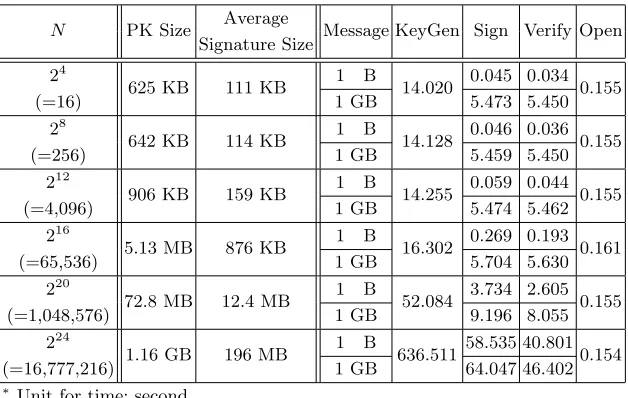
Table 2.Implementation results and sizes
N PK Size Average Message KeyGen Sign Verify Open Signature Size
24
625 KB 111 KB 1 B 14.020 0.045 0.034 0.155
(=16) 1 GB 5.473 5.450
28
642 KB 114 KB 1 B 14.128 0.046 0.036 0.155
(=256) 1 GB 5.459 5.450
212
906 KB 159 KB 1 B 14.255 0.059 0.044 0.155
(=4,096) 1 GB 5.474 5.462
216
5.13 MB 876 KB 1 B 16.302 0.269 0.193 0.161
(=65,536) 1 GB 5.704 5.630
220
72.8 MB 12.4 MB 1 B 52.084 3.734 2.605 0.155
(=1,048,576) 1 GB 9.196 8.055
224
1.16 GB 196 MB 1 B 636.511 58.535 40.8010.154
(=16,777,216) 1 GB 64.047 46.402
∗
Unit for time: second
Our implementation took about 0.27 and 0.20 seconds for 1 B message and about 5.70 and 5.60 seconds for 1 GB message, respectively, to sign a message and to verify a generated signature for a group of 65,536 users. In our experiments, it takes about 5.40 seconds to hash 1 GB message and it leads to the differences of signing and verifying times between 1 B and 1 GB messages.
As far as we know, the implementation results presented here are the first ones for post-quantum group signatures. Our results, while not yielding a truly practical scheme, would certainly help to bring post-quantum group signatures one step closer to practice.
Acknowledgements. The authors would like to thank Jean-Pierre Tillich,
Philippe Gaborit, Ayoub Otmani, Nicolas Sendrier, Nico D¨ottling, and anony-mous reviewers of ASIACRYPT 2015 for helpful comments and discussions. The research was supported by Research Grant TL-9014101684-01 and the Singapore Ministry of Education under Research Grant MOE2013-T2-1-041.
References
ABCG15. Q. Alam´elou, O. Blazy, S. Cauchie, and P. Gaborit. A Code-Based Group Signature Scheme. Presented at WCC, April, 2015.
ACJT00. G. Ateniese, J. Camenisch, M. Joye, and G. Tsudik. A Practical and Prov-ably Secure Coalition-Resistant Group Signature Scheme. In CRYPTO, volume 1880 ofLNCS, pages 255–270. Springer, 2000.
ACM11. S. M. E. Y. Alaoui, P.-L. Cayrel, and M. Meziani. Improved Identity-Based Identification and Signature Schemes Using Quasi-Dyadic Goppa Codes. InISA, pages 146–155, 2011.
BBS04. D. Boneh, X. Boyen, and H. Shacham. Short Group Signatures. In CRYPTO, volume 3152 ofLNCS, pages 41–55. Springer, 2004.
BJMM12. A. Becker, A. Joux, A. May, and A. Meurer. Decoding Random Binary Linear Codes in 2n/20: How 1 + 1 = 0 Improves Information Set Decoding. InEUROCRYPT, volume 7237 ofLNCS, pages 520–536. Springer, 2012. BMvT78. E. Berlekamp, R.J. McEliece, and H. C. A. van Tilborg. On the Inherent
Intractability of Certain Coding Problems. IEEE Trans. on Inf. Theory, 24(3):384–386, 1978.
BMW03. M. Bellare, D. Micciancio, and B. Warinschi. Foundations of Group Sig-natures: Formal Definitions, Simplified Requirements, and a Construction Based on General Assumptions. InEUROCRYPT, volume 2656 ofLNCS, pages 614–629. Springer, 2003.
BS08. B. Biswas and N. Sendrier. McEliece Cryptosystem Implementation: The-ory and Practice. In PQCrypto, volume 5299 of LNCS, pages 47–62. Springer, 2008.
BS13. S. Bettaieb and J. Schrek. Improved Lattice-Based Threshold Ring Signa-ture Scheme. InPQCrypto, volume 7932 ofLNCS, pages 34–51. Springer, 2013.
CFS01. N. Courtois, M. Finiasz, and N. Sendrier. How to Achieve a McEliece-Based Digital Signature Scheme. InASIACRYPT, volume 2248 ofLNCS, pages 157–174. Springer, 2001.
CGG07. P.-L. Cayrel, P. Gaborit, and M. Girault. Identity-Based Identification and Signature Schemes Using Correcting Codes. In WCC, pages 69–78, 2007.
CHKP10. D. Cash, D. Hofheinz, E. Kiltz, and C. Peikert. Bonsai Trees, or How to Delegate a Lattice Basis. InEUROCRYPT, volume 6110 ofLNCS, pages 523–552. Springer, 2010.
CM10. P.-L. Cayrel and M. Meziani. Post-quantum Cryptography: Code-Based Signatures. InAdvances in Computer Science and Information Technology, volume 6059 ofLNCS, pages 82–99. Springer, 2010.
CNR12. J. Camenisch, G. Neven, and M. R¨uckert. Fully Anonymous Attribute To-kens from Lattices. InSCN, volume 7485 ofLNCS, pages 57–75. Springer, 2012.
CS97. J. Camenisch and M. Stadler. Efficient Group Signature Schemes for Large Groups (Extended Abstract). InCRYPTO, volume 1294 ofLNCS, pages 410–424. Springer, 1997.
CS03. J. Camenisch and V. Shoup. Practical Verifiable Encryption and Decryp-tion of Discrete Logarithms. InCRYPTO, volume 2729 ofLNCS, pages 126–144. Springer, 2003.
CVA10. P.-L. Cayrel, P. V´eron, and S. M. E. Y. Alaoui. A Zero-Knowledge Identi-fication Scheme Based on theq-ary Syndrome Decoding Problem. InSAC, pages 171–186. Springer, 2010.
CvH91. D. Chaum and E. van Heyst. Group Signatures. InEUROCRYPT, volume 547 ofLNCS, pages 257–265. Springer, 1991.
Dal08. L. Dallot. Towards a Concrete Security Proof of Courtois, Finiasz and Sendrier Signature Scheme. InWEWoRC, volume 4945 ofLNCS, pages 65–77. Springer, 2008.
DDMN12. N. D¨ottling, R. Dowsley, J. M¨uller-Quade, and A. C. A. Nascimento. A CCA2 Secure Variant of the McEliece Cryptosystem.IEEE Trans. on Inf. Theory, 58(10):6672–6680, 2012.
D¨ot14. N. D¨ottling.Cryptography based on the Hardness of Decoding. PhD thesis, Karlsruhe Institute of Technology, 2014. Available at https://crypto. iti.kit.edu/fileadmin/User/Doettling/thesis.pdf.
FGUO+13. J.-C. Faugere, V. Gauthier-Umana, A. Otmani, L. Perret, and J.-P. Tillich. A Distinguisher for High-Rate McEliece Cryptosystems. IEEE Trans. on Inf. Theory, 59(10):6830–6844, 2013.
Fin10. M. Finiasz. Parallel-CFS - Strengthening the CFS McEliece-Based Sig-nature Scheme. InSAC, volume 6544 ofLNCS, pages 159–170. Springer, 2010.
FS86. A. Fiat and A. Shamir. How to Prove Yourself: Practical Solutions to Identification and Signature Problems. InCRYPTO, volume 263 ofLNCS, pages 186–194. Springer, 1986.
FS96. J.-B. Fischer and J. Stern. An Efficient Pseudo-Random Generator Prov-ably as Secure as Syndrome Decoding. InEUROCRYPT, volume 1070 of LNCS, pages 245–255. Springer, 1996.
GF2. gf2x library, ver. 1.1. Available athttps://gforge.inria.fr/projects/gf2x/. GKPV10. S. Goldwasser, Y. T. Kalai, C. Peikert, and V. Vaikuntanathan.
Robust-ness of the Learning with Errors Assumption. In ICS, pages 230–240. Tsinghua University Press, 2010.
GKV10. S. D. Gordon, J. Katz, and V. Vaikuntanathan. A Group Signature Scheme from Lattice Assumptions. InASIACRYPT, volume 6477 ofLNCS, pages 395–412. Springer, 2010.
GPV08. C. Gentry, C. Peikert, and V. Vaikuntanathan. Trapdoors for Hard Lat-tices and New Cryptographic Constructions. In STOC, pages 197–206. ACM, 2008.
Gro04. J. Groth. Evaluating Security of Voting Schemes in the Universal Com-posability Framework. In ACNS, volume 3089 of LNCS, pages 46–60. Springer, 2004.
HMT13. R. Hu, K. Morozov, and T. Takagi. Proof of Plaintext Knowledge for Code-Based Public-Key Encryption Revisited. InASIA CCS, pages 535– 540. ACM, 2013.
KTX08. A. Kawachi, K. Tanaka, and K. Xagawa. Concurrently Secure Identifica-tion Schemes Based on the Worst-Case Hardness of Lattice Problems. In ASIACRYPT, volume 5350 ofLNCS, pages 372–389. Springer, 2008. LLLS13. F. Laguillaumie, A. Langlois, B. Libert, and D. Stehl´e. Lattice-Based
Group Signatures with Logarithmic Signature Size. InASIACRYPT, vol-ume 8270 ofLNCS, pages 41–61. Springer, 2013.
LLNW14. A. Langlois, S. Ling, K. Nguyen, and H. Wang. Lattice-Based Group Signature Scheme with Verifier-Local Revocation. InPKC, volume 8383 ofLNCS, pages 345–361. Springer, 2014.
LNSW13. S. Ling, K. Nguyen, D. Stehl´e, and H. Wang. Improved Zero-Knowledge Proofs of Knowledge for the ISIS Problem, and Applications. In PKC, volume 7778 ofLNCS, pages 107–124. Springer, 2013.
LNW15. S. Ling, K. Nguyen, and H. Wang. Group Signatures from Lattices: Sim-pler, Tighter, Shorter, Ring-Based. InPKC, volume 9020 ofLNCS, pages 427–449. Springer, 2015.
LPY12. B. Libert, T. Peters, and M. Yung. Scalable Group Signatures with Revo-cation. InEUROCRYPT, volume 7237 ofLNCS, pages 609–627. Springer, 2012.
McE78. R. J. McEliece. A Public-key Cryptosystem based on Algebraic Coding Theory. Deep Space Network Progress Report, 44:114–116, 1978.
MCG08. C. A. Melchor, P.-L. Cayrel, and P. Gaborit. A New Efficient Threshold Ring Signature Scheme Based on Coding Theory. In PQCrypto, volume 5299 ofLNCS, pages 1–16. Springer, 2008.
MCGL11. C. A. Melchor, P.-L. Cayrel, P. Gaborit, and F. Laguillaumie. A New Ef-ficient Threshold Ring Signature Scheme Based on Coding Theory.IEEE Trans. on Inf. Theory, 57(7):4833–4842, 2011.
MCK01. J. F. Ma, T. C. Chiam, and A. C. Kot. A New Efficient Group Signature Scheme based on Linear Codes. InNetworks, pages 124–129. IEEE, 2001. Meu13. A. Meurer. A Coding-Theoretic Approach to Cryptanalysis. PhD thesis, Ruhr University Bochum, 2013. Available athttp://www.cits.rub.de/ imperia/md/content/diss.pdf.
MVR12. K. P. Mathew, S. Vasant, and C. Pandu Rangan. On Provably Secure Code-Based Signature and Signcryption Scheme.IACR Cryptology ePrint Archive, 2012:585, 2012.
MVVR12. K. P. Mathew, S. Vasant, S. Venkatesan, and C. Pandu Rangan. An Efficient IND-CCA2 Secure Variant of the Niederreiter Encryption Scheme in the Standard Model. InACISP, pages 166–179. Springer, 2012. Nie86. H. Niederreiter. Knapsack-type Cryptosystems and Algebraic Coding
The-ory. Problems of Control and Inf. Theory, pages 15(2):159–166, 1986. NIKM08. R. Nojima, H. Imai, K. Kobara, and K. Morozov. Semantic Security for
the McEliece Cryptosystem without Random Oracles. Des. Codes Cryp-tography, 49(1-3):289–305, 2008.
NTL. NTL: A library for doing number theory version 9.0.2. Available at http://www.shoup.net/ntl/.
NZZ15. P.Q. Nguyen, J. Zhang, and Z. Zhang. Simpler Efficient Group Signatures from Lattices. InPKC, volume 9020 ofLNCS, pages 401–426. Springer, 2015.
Pat75. N. J. Patterson. The Algebraic Decoding of Goppa Codes. IEEE Trans. on Inf. Theory, 21(2):203–207, 1975.
Per12. E. Persichetti. On a CCA2-Secure Variant of McEliece in the Standard Model. IACR Cryptology ePrint Archive, 2012:268, 2012.
PV97. D. Pointcheval and S. Vaudenay. On Provable Security for Digi-tal Signature Algorithms. Technical Report LIENS-96-17, Laboratoire d’Informatique de Ecole Normale Superieure, 1997.
RST01. R. L. Rivest, A. Shamir, and Y. Tauman. How to Leak a Secret. In ASIACRYPT, volume 2248 ofLNCS, pages 552–565. Springer, 2001. Sen14. N. Sendrier. QC-MDPC-McEliece: A Public-key Code-Based Encryption
Scheme Based on Quasi-Cyclic Moderate Density Parity Check Codes. InWorkshop “Post-Quantum Cryptography: Recent Results and Trends”, Fukuoka, Japan, November 2014.
Sho97. P. Shor. Polynomial-Time Algorithms for Prime Factorization and Discrete Logarithms on a Quantum Computer.SIAM J. Comput., 26(5):1484–1509, 1997.
Ste96. J. Stern. A New Paradigm for Public Key Identification. IEEE Trans. on Inf. Theory, 42(6):1757–1768, 1996.
V´er96. P. V´eron. Improved Identification Schemes based on Error-Correcting Codes. Appl. Algebra Eng. Commun. Comput., 8(1):57–69, 1996.
A
Supporting Proofs for the Underlying Zero-Knowledge
Argument of Knowledge
In the following, we will provide supporting proofs that the interactive protocol given in Section 3.1 is a statistical zero-knowledge argument of knowledge.
A.1 Proof of the Zero-Knowledge Property
The proof of Lemma 2 is as follows.
Proof. Simulator S, given the public input (H,A,Gb,c), begins by selecting a
random Ch∈ {1,2,3}. This is a prediction of the challenge value thatVbwillnot
choose.
Case Ch = 1:S proceeds as follows:
1. Computes0 ∈Fm2 andx0 ∈FN2such that H·s0>⊕A·x0> =0; andu0 ∈F
k−`
2 ,
f0∈F22`,e0 ∈Fn2 such that u0kf0
·Gb⊕e0 =c. This step can be done efficiently
using linear algebra.
2. Sample uniformly random objects, and send a commitment computed in the same manner as of the real prover. Namely,S samples:
(
b← {0,$ 1}`; π←$ S m; σ
$
←Sn; ρ1, ρ2, ρ3 $
← {0,1}λ;
rs
$
←Fm2; rx
$
←FN2; ru
$
←Fk−`2 ; rf
$
←F22`; re
$
←Fn2,
and sends the commitmentCMT:= (c01, c02, c03), where
c01= COM b, π, σ, H·r>s ⊕ A·r>x, rukrf
·Gb ⊕re; ρ1
,
c20 = COM π(rs), Tb(rx), Tb0(rf), σ(re); ρ2,
c03= COM π(s0⊕rs), Tb(x0⊕rx), Tb0(f 0⊕r
f), σ(e0⊕re); ρ3
.
(14)
Receiving a challenge Ch fromVb, the simulator responds as follows:
– If Ch = 1: Output⊥and abort.
– If Ch = 2: SendRSP= b, π, σ, s0⊕rs, x0⊕rx, u0⊕ru, f0⊕rf, e0⊕re; ρ1, ρ3.
– If Ch = 3: SendRSP= b, π, σ, rs, rx, ru, rf, re; ρ1, ρ2.
Case Ch = 2:S samples
j0←$ [0, N−1]; s0 ←$ B(m, ω); e0←$ B(n, t);
b← {0,$ 1}`; π←$ S m; σ
$
←Sn; ρ1, ρ2, ρ3 $
← {0,1}λ;
rs
$
←Fm2; rx
$
←FN2 ; ru
$
←Fk−`2 ; rf
$
←F22`; re
$
←Fn2,
and lets x0 = δN
j0 and f0 = Encode(j0). Then S sends the commitment CMT computed in the same manner as in (14).
– If Ch = 1: Send
RSP= I2B(j0)⊕b, π(rs), π(s0), Tb(rx), Tb0(rf), σ(re), σ(e0); ρ2, ρ3.
– If Ch = 2: Output⊥and abort.
– If Ch = 3: SendRSPcomputed as in the case (Ch = 1,Ch = 3).
Case Ch = 3: The simulator performs the preparation as in the case Ch = 2 above. Additionally, it samples u0 ←$ Fk−`2 . Then it sends the commitment
CMT:= (c01, c
0
2, c
0
3), wherec
0
2, c
0
3 are computed as in (14), while
c01= COM b, π, σ,H·(s0⊕rs)>⊕A·(x0⊕rx)>, u0⊕rukf0⊕rf
·Gb⊕ e0⊕re
⊕c;ρ1
.
Receiving a challenge Ch fromV, it responds as follows:b
– If Ch = 1: SendRSPcomputed as in the case (Ch = 2,Ch = 1).
– If Ch = 2: SendRSPcomputed as in the case (Ch = 1,Ch = 2).
– If Ch = 3: Output⊥and abort.
We observe that, in every case we have considered above, since the outputs of the random oracle COM are assumed to be uniformly random, the distribution of the commitment CMT and the distribution of the challenge Ch from Vb are
statistically close to those in the real interaction. Hence, the probability thatS outputs⊥is negligibly close to 1/3. Moreover, one can check that whenever the simulator does not abort, it will provide a successful transcript, the distribution of which is statistically close to that of the prover in the real interaction. In other words, we have constructed a simulator that can successfully impersonate
the honest prover, with probability 2/3.
A.2 Proof of the Argument of Knowledge Property
The proof of Lemma 3 is as follows.
Proof. Assume that we have a commitmentCMT= (c1, c2, c3) and 3 responses
RSP1= b1, vs, ws, vx, vf, ve, we; ρ2, ρ3
RSP2= b2, π2, σ2, zs, zx, zu, zf, ze; ρ1, ρ3
RSP3= b3, π3, σ3, ys, yx, yu, yf, ye; ρ1, ρ2
that satisfy all the verification conditions when Ch = 1, Ch = 2, and Ch = 3, respectively. In other words, we have the following relations:
ws∈B(m, ω), wx=δNB2I(b1), wf =Encode(B2I(b1)), we ∈B(n, t), c1= COM b2, π2, σ2, H·z>s ⊕A·z>x, zukzf
·Gb ⊕ze ⊕c; ρ1
, c1= COM b3, π3, σ3, H·y>s ⊕A·y>x, yukyf
·Gb ⊕ye; ρ1
,
c2= COM vs,vx,vf,ve;ρ2
= COM π3(ys), Tb3(yx), T
0
b3(yf), σ3(ye);ρ2
, c3= COM vs⊕ws, vx⊕wx, vf⊕wf, ve⊕we; ρ3
,
c3= COM π2(zs), Tb2(zx), T
0 b2(zf
, σ2(ze); ρ3
![Table 1. Efficiency comparison between our scheme and [NZZ15].](https://thumb-us.123doks.com/thumbv2/123dok_us/7935240.1317500/5.612.141.472.130.198/table-eciency-comparison-scheme-nzz.webp)