Practical Quantum-Safe Voting from Lattices
Rafaël del Pino
IBM Research – Zurich [email protected]
Vadim Lyubashevsky
IBM Research – Zurich [email protected]
Gregory Neven
IBM Research – Zurich [email protected]
Gregor Seiler
IBM Research – Zurich [email protected]
ABSTRACT
We propose a lattice-based electronic voting scheme, EVOLVE (Elec-tronic Voting from Lattices with Verification), which is conjectured to resist attacks by quantum computers. Our protocol involves a number of voting authorities so that vote privacy is maintained as long as at least one of the authorities is honest, while the integrity of the result is guaranteed even when all authorities collude. Fur-thermore, the result of the vote can be independently computed by any observer.
At the core of the protocol is the utilization of a homomorphic commitment scheme with strategically orchestrated zero-knowledge proofs: voters use approximate but efficient “Fiat-Shamir with Aborts” proofs to show the validity of their vote, while the au-thorities use amortized exact proofs to show that the commitments are well-formed. We also present a novel efficient zero-knowledge proof that one of two lattice-based statements is true (so-called OR proof ) and a new mechanism to control the size of the randomness when applying the homomorphism to commitments.
We give concrete parameter choices to securely instantiate and evaluate the efficiency of our scheme. Our prototype implementa-tion shows that the voters require 8 milliseconds to submit a vote of size about 20KBto each authority and it takes each authority 0.15 seconds per voter to create a proof that his vote was valid. The size of the vote share that each authority produces is approximately 15KBper voter, which we believe is well within the practical bounds for a large-scale election.
CCS CONCEPTS
•Security and privacy→Privacy-preserving protocols;
KEYWORDS
E-Voting, Lattices, Implementation, Zero-Knowledge, Post-Quantum
Permission to make digital or hard copies of all or part of this work for personal or classroom use is granted without fee provided that copies are not made or distributed for profit or commercial advantage and that copies bear this notice and the full citation on the first page. Copyrights for components of this work owned by others than the author(s) must be honored. Abstracting with credit is permitted. To copy otherwise, or republish, to post on servers or to redistribute to lists, requires prior specific permission and /or a fee. Request permissions from [email protected].
CCS’17, , Oct. 30–Nov. 3, 2017, Dallas, TX, USA.
© 2017 Copyright held by the owner/author(s). Publication rights licensed to Associa-tion for Computing Machinery.
ACM ISBN ISBN 978-1-4503-4946-8/17/10. . . $15.00 https://doi.org/https://doi.org/10.1145/3133956.3134101
1
INTRODUCTION
Given how information technology has penetrated almost every aspect of our world, one could be surprised at the primitive state of technology used in the process that most influences society: elections. Electronic voting machines, which required voters to physically turn up at polling stations to cast their ballots on dedi-cated machines, saw a brief rise in popularity until the early 2000s, but many countries have since then gone back to paper-and-pencil voting amidst worries about security and reliability.
These are definitely genuine concerns. Researchers discovered se-rious security flaws in several models of voting machines that were used in elections in the US, the Netherlands, and Germany [19, 22]. Recent news reports on massive security breaches and suspicions of foreign meddling in national elections have only aggravated those concerns.
Nevertheless, many countries are warming up to the idea of online voting, in which voters cast their ballots using their personal devices from the comfort of their couch. A handful of countries, including Estonia, Switzerland, and Australia, are already using online voting for local and national elections, and it is quite a common tool among private organizations to elect officers and board members.
There are of course many aspects to securing an online voting system, but the underlying cryptographic protocol is obviously an important ingredient. All of the currently deployed electronic voting systems (e.g., Helios [2], the Swiss voting system [31], and the Estonian one) are based on cryptographic primitives that rely on the hardness of factoring or discrete logarithms for their security. Both of these assumptions are well-known to succumb to attacks by quantum computers, meaning that, as soon as sufficiently powerful quantum computers become available, an adversary could use them to break the vote secrecy of a past election, or to tamper with the result of an ongoing one. The threat of foreign meddling in elections gives additional reason for concern: powerful nation states may very well be the first to build quantum computers, and they may not be particularly vocal about their achievement.
Voter Auth/Voter Total Size / Voter Time 8.5ms 0.15s
Size 78KB 18KB 150KB
Table 1: Time and space complexity of the voting scheme with 4 authorities.Using the parameters of Section 5, each voter ouputs one OR-Proof and four commitments (one per authority), while each au-thority outputs one proof per voter.
that they cast a valid ballot. Most lattice-based zero-knowledge proofs are either Fiat-Shamir proofs with single-bit challenges or Stern-type proofs [32] with soundness error 2/3, which have to be repeated many times to reduce the soundness error. Amortization techniques [6, 14, 18] exist when performing thousands of proofs in parallel, but these are not very useful when each voter must prove correctness of his own vote. Lyubashevsky’s “Fiat-Shamir with Aborts” technique [25] yields much more efficient proofs with large challenges, but only allows to prove correctness of the state-ment up to a small multiple of the witnesses, which could be quite detrimental in the context of voting, as it may allow an attacker to inflate the weight of this vote.
The only quantum-safe voting protocol that we are aware of [11] therefore shuns zero-knowledge proofs completely and uses fully-homomorphic encryption [21] instead. The paper doesn’t give any implementation details or concrete parameter choices, so it’s hard to make statements about efficiency, but due to the “heavy machinery” being utilized, chances are that the protocol is not efficient enough for medium to large-scale elections.
1.1
Our Contributions
In this paper, we present a new lattice-based electronic voting scheme thatdoesuse zero-knowledge proofs, but overcomes their inefficiencies by re-organizing the proofs so that the voting author-ities assist the voters by performing amortized proofs. Our protocol provably guarantees vote privacy as long as one of a number of voting authorities is honest, and guarantees consistency (i.e., that honest votes are correctly counted) even if all voting authorities are corrupt, all under standard lattice-based assumptions in the random-oracle model. We suggest concrete choices for the security parameters and implement a prototype of our protocol. Our exper-imental results (Table 1) show that voters need less than 10ms to cast a vote and a complete bulletin (including all commitments and votes) is of size 150KB, though the proof and verification time is higher for the authorities these computations can be done after the vote and are easily parallelizable, which we think is well within practical bounds for a large-scale election.
To better understand the technical hurdles to obtain this result, we briefly sketch a voting protocol by Cramer et al. [15] on which our protocol is based. Let’s say there areNV voters andNAvoting authorities that assist in a binary election, i.e., where each voter votes zero or one and the result is the sum of the votes. Let’s also say that there is a public bulletin board where voters can post their ballots. The authorities jointly compute the tally and post the result of the election, together with a proof of correctness. The goal is to obtain vote privacy, meaning that as long as one authority is
honest, the adversary does not learn anything more about the votes of honest voters than what is already implied by the result, as well as consistency and universal verifiability, meaning that anyone can check that all honest votes were counted correctly, even if all authorities collude to rig the election.
The protocol of Cramer et al. [15] begins by letting each voter secret-share his vote among theNAauthorities and commit to each of the shares. The voter sends the share and the opening infor-mation to each authority, and performs an OR-proof [13] to show that he secret-shared a zero-or-one vote by exploiting a homomor-phism in the commitment scheme. When the voting phase closes, all servers check the openings of the commitments they received. Each authority then publishes the sum of all the shares it received together with valid opening information, again using the homo-morphism in the commitments. The result of the election is the sum of all these partial sums.
There are a number of hurdles to overcome when translating this approach into lattice-based primitives. The first is that, as discussed above, lattice-based zero-knowledge proofs are either inefficient or approximate, while amortization doesn’t help for proofs by indi-vidual voters. The second is that commitments typically use short vectors as randomness (i.e., opening information), but applying homomorphisms accumulates the size of this randomness, which must be compensated for by choosing larger parameters, which comes at a big cost in efficiency. The third problem is that the typi-cal OR-proof technique [13] of XOR-ing challenge values doesn’t work for lattices, because challenges are polynomials with small coefficients in a ring, but do not form a group among them.
We address the first problem by strategically splitting up the burden of the proofs between voters and authorities. Namely, we let voters prove that they secret-shared a zero-or-one vote using approximate proofs, but we let the authorities prove that the com-mitment they received is well-formed, i.e., has short opening infor-mation. The authorities do so for all voters simultaneously, so they can use the more efficient amortized proofs [6, 14, 18].
The second problem we address by letting authorities re-commit to the sum of batches of votes, and by letting them prove in zero knowledge that the new commitment indeed contains the sum of all votes in the batch. By repetitively applying this technique, each authority can keep the randomness growth within bounds, so that it eventually ends up with a commitment to the sum of all received shares with short randomness.
are currently no known natural counter-examples of Fiat-Shamir zero-knowledge proofs (nor of commitment schemes) which are based on quantum-hard problems via classical reductions, but are broken by quantum adversaries. It therefore seems reasonable to assume that such Fiat-Shamir schemes are secure. If one would like to have a reduction that is in the QROM, one could instantiate the schemes as in [1] and then use the reduction in [34]. This would, however, lead to a noticeable increase in the size of the proofs and public keys.
1.2
Overview of the Cryptographic Tools
Commitment Scheme with “Unbounded” Messages Sizes.We re-view the lattice-based instantiation of a generic commitment scheme from [17] to lattices [7].
To commit to an integerx ∈Zq, we first interpret it as a polyno-mial inRqwhose constant coefficient isxand all others are 0, then pick a random vector of polynomialsrhaving small coefficients, and output
a
b
=A
B
r+
0
x
where the public commitment key
A B
is a matrix of uniformly
ran-dom polynomials. To open a commitment
a
b
one simply computes the inverse operation
0
x
=
a
b
−
A B
r
This commitment is binding if finding small solutions to the equa-tionAr=0 modqis hard (since opening a commitment to two dif-ferent values implies finding smallrandr′such thatAr=a=Ar′), this problem is called M-SIS (Module Short Integer Solution). The commitment is hiding if distinguishing
A B
rfrom uniform is hard, we will show that this problem can be reduced to the M-LWE prob-lem (Module Learning With Error). A useful property of this scheme is that it’s additively-homomorphic, i.e. the sum of two commit-ments is a commitment to the sum of the messages using the sum of the randomnesses, however one cannot sum an arbitrary number of commitments as finding a solution toAr=0 modq(and thus breaking the binding property) becomes easier as the coefficients ofrgrow.
Approximate Zero-Knowledge Proofs.Suppose thatAis a matrix overRk×ℓ andtis an element inRksuch that there exists ans with small coefficients satisfyingAs=t.1Then it is possible to very efficiently prove in zero-knowledge using the “Fiat-Shamir with Aborts” technique that there exist ¯sand ¯cthat satisfyA¯s=c¯t. The coefficients of ¯sare somewhat larger than those ofsand the coefficients of ¯c are very small. Notice that such proofs are not homomorphic. In other words giving giving a proof fort1andt2 does not give a proof fort1+t2because the ¯cicould be different. This is the main reason why the voters cannot simply use these types of proofs by themselves to commit to their votes.
1
The parameters that we will use in this paper will typically havek≈7 andℓ≈2k with the ring R beingZq[X]/(X256+1).
Amortized Exact Zero-Knowledge Proofs.If we would like to have proofs compose homomorphically, we would need to prove the knowledge of ¯ssuch thatA¯s=γtfor some fixedγ. While this is quite inefficient for one proof, it can be in fact made very efficient when needing to prove many such relations simultaneously [6, 14, 18]. If one has a very large number of relations, then one can have γ =1. It was shown in [18] that one could apply the improved zero-knowledge proof from [9] to efficiently prove these linear relations withγ =2 when having access to only around a few thousand relations for security parameter 256. In our voting scheme, this is the proof system that the authorities will use when proving that the randomness used by the voters’ commitment scheme contains small coefficients.
¯
f with very small coefficients such that
¯ f a b = A B ¯
r+f¯
0
x
, andx ∈ {0,1}.
1.3
Overview of the Construction
We will now explain how we utilize the above building blocks to build a voting scheme.
We will make the convention that the voters (and information pertaining to the voters) are numbered 1 throughNV using a sub-script, whereas the information pertaining to the authorities is numbered 1 throughNAand is labeled using a parenthesized super-script. In particular, for elementsx(j)
i , we will definexi =
NA Í
j=1 x(j)
i , x(j)=NÍV
i=1 x(j)
i , andx =
NV Í
i=1
NA Í
j=1 x(j)
i = NA
Í
j=1
NV Í
i=1 x(j)
i .
A voteriwho wishes to cast a votevi(which is 0 or 1), first splits vi intoNApartsvi(j)where the firstNA−1 of them are chosen uniformly random moduloqand the last sharev(iNA)is chosen such that
NA Í
j=1 v(j)
i =vi(modq). Eachv(j)
i is then interpreted as a polynomial in the ringRqwhose constant coefficient isv(j)
i and the other coefficients are 0. The voterithen uses the commitment scheme to commit to each sharev(j)
i as
A B
·r(ij)+
0 v(j)
i
=
"
a(ij)
b(j) i
#
. (1)
All the commitments are published to the bulletin board. Note that because the commitment scheme is additively homomorphic, we have
NA Õ
j=1 "
a(ij)
b(j) i # = ai bi = A B ·ri+
0
vi
,
which is a valid commitment tovi (but with slightly larger ran-domnessri). Voterinow creates a zero-knowledge OR-proof that he has knowledge of a vector ¯riwith small coefficients and a ring elementf¯i with very small coefficients such that
ai
bi
·f¯
i=
A B
·¯ri+
0
vi·f¯
i
, andvi ∈ {0,1}. (2)
This proofπiV also gets posted to the bulletin board.
Each voter now sends to authorityjthe encryption (under au-thorityj’s public key) of the sharev(j)
i and the randomness under which this share was committedr(ij)from (1) (one can alternatively think that the voters simply post this encryption to the bulletin board). Upon receiving all such encryptions from every voter, au-thorityjneeds to create a proof of knowledge that ther(ij)all have small coefficients. He uses the Amortized Exact Zero-Knowledge proof to create proofsπA
i,j that prove the knowledge of ˆr(j)
i that satisfy
A·ˆr(j)
i =2a(j)
i . (3)
If allNAauthorities provide proofs of the above statement, then using the additive homomorphism of the commitment scheme, we
obtain a proof of knowledge of an ˆrisuch that
2ai =
NA Õ
j=1 2a(j)
i = NA Õ
j=1
A·ˆr(j)
i =A·rˆi. (4)
Combining this with (2), implies thatA· (2¯ri −f¯irˆi)=0. Based on the hardness of the M-SIS problem, this implies that 2¯ri =f¯iˆri. One can then rewrite (2) as
2·
ai
bi
·f¯
i =
A B
·f¯
iˆri+
0
2vi·f¯i
,
and since we choose the challenge set such thatf¯i is invertible in Rq, we can divide byf¯ito finally obtain
2· ai bi = A B ·rˆi+
0
2mi
, andvi ∈ {0,1}. (5)
Because there is no longer the factorf¯i which could be distinct for every voter, the commitment in (5) is additively homomorphic. In particular, if we compute
2·
NV Õ
i=1 ai bi = A B ·ˆr+
0 2 NV Í
i=1 vi
, andvi ∈ {0,1}, (6)
and ˆris a vector with small coefficients, then the quantity
2·
NV Õ
i=1
ai
bi
is a commitment to twice the total number of 1-votes that have been cast. If there are many voters, then ˆr=Íir¯i is not small, but we show how to handle this issue later.
For universal verifiability, we therefore would like the value of ˆ
rto be publicly computable. For this to happen, each authority simply computes
NV Í
i=1
r(ij)=r(j)and reveals it by publishing it to the bulletin board. Any verifier can simply check that
A·r(j)=a(j). (7) We now claim that it must be that
r=
NA Õ
j=1
r(j)=2ˆr.
From (3), we know that
A·ˆr(j)=
NV Õ
i=1
A·ˆr(ij)=2a(j).
Combining this with (7) implies thatArˆ(j)=A· (2r(j)). Unless one can break the M-SIS problem, it must be that ˆr(j)=2r(j), and then we have
ˆ
r=
NA Õ
j=1 ˆ
r(j)=2
NA Õ
j=1
r(j)=2r.
Plugging the above into (6) and dividing by 2 implies that a b = NV Õ
i=1 ai bi = A B ·r+
0 NV Í
i=1 vi
Ifris small enough, then the above implies that
a
b
is a
commit-ment to the full vote tally
NV Í
i=1
vi, and one can obtain this tally by computingb−B·r. As long as there are fewer thanqvoters, we can exactly recover
NV Í
i=1
viover the integers.
1.3.1 Reducing the Randomness.An issue that we still need to deal with is how to make sure that the randomness, when summed over all the voters, does not grow too much. This is crucial in order for the final commitment in (6) to be meaningful. A trivial way to accomplish this is to simply set the parameters large enough so that a large set of voters can be accommodated. This is an extremely impractical solution that we would like to avoid.
The way that we can overcome this issue is by making the Au-thorities create votes of 0 using randomness that is close to the randomnesses used by the individual voters. For example, if voters 1, . . . ,lwhose commitments to Authorityjare
"
a(1j) b(j) 1
# , . . . ,
"
a(lj)
b(j) l
#
under randomnessesr(j) 1 , . . . ,r
(j)
l , then the Authority can create a vote of 0 using randomnessr′=r−Íir(j)
i , whereris a fresh ran-domness that comes from the same distribution as the commitment randomnesses. The Authority would then publish the “vote”
a′
b′
, prove that it’s a zero-vote by proving that there exists some ˆr′such that
A B
·ˆr′=2
a′
b′
, (9)
and also prove that there exists a small ˆrsuch that
A B
·ˆr=2·
a′
b′
+Õ
i
"
a(ij)
b(j) i
# !
(10)
The proof in (10) can be “amortized-in” with the proofsπA
i,jbecause the size of the randomness is the same. The proof of (9), however, contains larger randomness, and so such proofs should be amortized only among themselves.2
Notice that because the randomness of the sum of the com-mitments
a′
b′
+Í
i
"
a(ij)
b(j) i
#
=
A B
·ris as small as in one voter commitment, we have effectively reduced the size of the sum of the randomness inlvoter commitments to that of one commitment. If we do this for every block oflvoters, then we effectively reduced the sum of the randomness by a factor ofl.
It’s easy to see that this procedure is repeatable. Once everyl blocks of votes have small randomness, we can consider repeating this procedure by summing overlsuch blocks. This will effectively reduce the total sum of the randomnesses by another factor ofl. If we continue this procedure, then we will be effectively adding 2(NV/l+NV/l2+. . .) ≈2NV/(l−1)extra proofs. The advantage will be that we now only need to worry about the randomness
2
It is also possible to do these proofs in a non-amortized fashion and only get an approximate proof. In this case, depending on the value ofl, the parameters may have to be increased.
growing by a factorlfor the proof in (9). We set our parameters so thatl=30.
One can also think of the above procedure as the authority sum-ming up 30 votes, recommitting to the sum using fresh, small ran-domness, and then giving a proof that he correctly recommitted to the sum of the votes. In particular, proving that the difference between his new commitment and the sum of the 30 commitments is a commitment to 0.
2
PRELIMINARIES
2.1
Notations
We fixnandqto be integers throughout this paper, we denote byZq the integers modulo q, which we will represent between−
jq−1 2
k
and jq+1
2 k
. We will denote byRthe polynomial ringZ[X] /Xn+1, and byRqthe quotient ringR/qR. Elements inZ,R,R,orRqwill be written in lower case, vectors overZ,R,R,orRqwill be written in bold face lower case, and matrices will be in bold face upper case. The Euclidean norm is denoted as∥·∥, the infinity norm and l1norm are denoted respectively as∥·∥∞, and∥·∥1. All norms can be extended to a polynomialf =Ín−1
0 fiX
i by considering the vector(f0, . . . ,fn−1)of its coefficients (if said coefficients are in
Zqwe consider their representative that lies between− jq−1
2 k
and jq+1
2 k
). For a setSwe writes
$
← Sto denote thatswas sampled at random fromS, for a distributionχwe writes←χto denote thatswas sampled fromχ.
2.2
E-Voting Schemes
We base our syntax and security definitions of one-pass electronic voting schemes on that of Bernhard et al. [10], but there are some differences. First, we explicitly model a multi-authority setting where each authority independently generates its own keys. Second, ballot testing in our scheme must be performed by the authorities, who use their secret key in the process. Verification of the entire election can still be done publicly, though. As ballot testing, tallying, and verification do not require interaction with the voters, the authorities do not need to be online for the first part of the election and only need to run the ballot testing and tallying algorithms once all the ballots have been cast.
A multi-authority electronic voting schemeEVis a tuple(Setup,
ASetup,Vote,TestB,Tally,Verify)of algorithms and protocols that are used by authoritiesA1, . . . ,AN
A and voters with identities id ∈Ias follows. We consider binary elections (we consider the more general case of votes in{0,1}kfork≥1 in Appendix B), i.e., where each voterid ∈Icasts a votevid ∈ {0,1}and the result of the election isr=Íid∈
Ivid. We assume that all voters and authorities
have read access and authenticated append-only write access to a public bulletin boardBB, meaning that entries can only be appended to the board and entries are authenticated (e.g., signed) under the writer’s identity. Moreover, each voter can only write once to the bulletin board; authorities can write as often as they want.
• Setup(λ)generates trusted common parameterspar. • ASetup(par)is used by authorityAj to generate a public
• Vote(par,pk1, . . . ,pkNA,id,v)is used by voterid ∈ Ito cast his votev∈ {0,1}. It returns a ballotbthat the voter posts on the bulletin boardBB.
• TestB(par,pk1, . . . ,pkNA,skj,b) allows authorityAj to test whether ballotbis valid or not by returning 1 or 0, respectively. The ballot is only considered valid after all NAauthorities confirm its validity on the bulletin boardBB. This check can be performed as the votes come in, or only after the voting phase has ended. The tallying authorities therefore do not have to be online during the voting phase: rather than interacting directly with the voters, the tallying authorities can obtain the ballots from the bulletin board after voting has ended and discard invalid ballots if needed. • Tally(par,pk1, . . . ,pkNA,BB,skj)is an interactive proto-col run among the authoritiesAj,j =1, . . . ,NA, at the end of which they announce the tallyrand proofΠ. • Verify(par,pk1, . . . ,pkNA,BB,r,Π)can be run by anyone
to check the correctness of the election result.
Correctness.Correctness guarantees that, when all parties be-have honestly, all ballots are deemed valid and the result of the election is correct. Letid1, . . . ,idN
V ∈ Ibe voter identities and v1, . . . ,vNV be their respective votes. Letpar
$
←Setup(1λ); and (pkj,skj)←$ ASetup(par)forj=1, . . . ,NA. Fori=1, . . . ,NV and j =1, . . . ,NAletbi
$
←Vote(par,pk1, . . . ,pkNA,idi,vi),BB[i] ← bi, and let(r,Π)be the outcome of the protocol when each au-thorityAj runsTally(par,pk1, . . . ,pkN
A,BB,skj),j =1, . . . ,NA. The scheme is correct if for alli =1, . . . ,NV andj =1, . . . ,NA, the following conditions hold with overwhelming probability:r = ÍNV
i=1vi,TestB(par,pk1, . . . ,pkNA,skj,bi) = 1, andVerify(par, pk1, . . . ,pkNA,BB,r,Π)=1.
Privacy.Privacy requires that an adversary who corruptsNA−1 authorities and an arbitrary number of voters does not learn any-thing more about the votes of honest voters than what is revealed by the election result. The single-authority BPRIV notion of Bern-hard et al. [10] defines this by requiring that the adversary cannot tell a bulletin board for a first set of votes with the real election result and proof from a bulletin board for a second set of votes with the same result and a simulated proof. The BPRIV notion is not easily adapted to the multi-authority setting, because the corrupt authorities would have to be involved in computing the tally for both bulletin boards. We therefore adapt the notion to require that the adversary cannot distinguish between the bulletin boards of two different sets of votes, as long as both sets of votes yield the same election result, i.e., have the same total number of zero-votes and one-votes.
The advantage of an adversaryAin breaking the privacy of the electronic voting schemeEVis defined through the experiment
ExpprivA ,βbelow as
Advpriv A (λ) =
Pr[Exp
priv,0
A (λ)=1] −Pr[Exp priv,1 A (λ)=1]
,
whereAis given access to all oracles in the setO={OVote,OCast, OTally}as well as read and append-only write access to the bulletin boardBB. TheOVoteandOCastoracles can be queried as many times asAwants, but theOTallyoracle can only be queried once.
ExperimentExp priv,β A (λ): par←$ Setup(1λ); pk1
$
←ASetup(par); HV ← ∅ (pk2, . . . ,pkNA,st)← A(par,$ pk1)
β′ $
← AO,BB(st)
HV′← {(id,v0,v1,b) ∈HV :
∀j ∈ {1, . . . ,NA} : "Ajapprovesb"∈BB} V0←Í
(id,v0,v1,b)∈HV
′v0; V1←Í(id,v
0,v1,b)∈HV
′v1
IfV0,V1then return⊥else returnβ′ OracleOVote(id,v0,v1):
b $
←Vote(par,pk1, . . . ,pkNA,id,vβ) HV ←HV∪ {(id,v0,v1,b)} BB←BB∥"idcastsb" IfTestB(par,pk1, . . . ,pkN
A,sk1,b)=1 thenBB←BB∥"A1approvesb" elseBB←BB∥"A1rejectsb" OracleOCast(id,b):
If "idcastsb"∈BBandTestB(par,pk1, . . . ,pkN
A,sk1,b)=1 thenBB←BB∥"A1approvesb"
elseBB←BB∥"A1rejectsb" OracleOTally:
RunTally(par,pk1, . . . ,pkN
A,BB,sk1)withAto obtain(r,Π) Return(r,Π)
Consistency.Consistency requires that the election result is cor-rect with respect to the votes cast by voters. Bernhard et al.’s notion of strong consistency [10] requires that individual ballots can be extracted online. We relax this notion by requiring that, if an elec-tion finishes successfully, the result must be “realistic” with respect to the honestly cast votes. Meaning, the result must be at least the number of honest one-votes and at most the total number of votes cast minus the number of honest zero-votes. We strengthen the notion, however, by requiring that this property holds even against corrupt election authorities. Intuitively, our notion is similar to the quantitative verifiability goal of Cortier et al. [12]; a formal analysis and comparison would require further work.
Formally, the advantage of an adversaryAin breaking the con-sistency ofEV is defined through the consistency experiment
Expcons
A below as
Advcons
A (λ) = Pr[Exp cons A (λ)=1]. ExperimentExpcons
A (λ): par←$ Setup(1λ); HV ← ∅ (pk1, . . . ,pkNA,st)← A(par)$ (r,Π)← A$ OVote,BB(st) HV′← {(id,v,b) ∈HV :
∀j ∈ {1, . . . ,NA} : "Ajapprovesb"∈BB} h0← |{(id,0,b) ∈HV′}|; h1← |{(id,1,b) ∈HV′}| t← |{b : ∀j∈ {1, . . . ,NA} : "Ajapprovesb"∈BB}| IfVerify(par,pk1, . . . ,pkN
A,BB,r,Π)=1 and (r<h1orr>t−h0)
then return 1 else return 0 OracleOVote(id,v):
b $
HV ←HV∪ (id,v,b) BB←BB∥"idcastsb"
2.3
Homomorphic Commitments
Our first building block will be a commitment scheme, which will allow voters to commit to their vote. Additionally using an homo-morphic commitment scheme (i.e. one in which the sum of two commitments is a commitment to the sum of the associated mes-sages) will allow our voting protocol to use the sum of all of the voters’ commitments as a commitment to the result of the election. A commitment scheme is a triple (KeyGen,Com,Open) such that: • K←KeyGen(1λ)generates the public commitment key. • (c,d) ←ComK(m)generates the commitmentcand
open-ingdfor messagem
• m′ ← OpenK(c,d)opens the commitmentc using the openingd(potentiallym′=⊥ifdis not a valid opening of c)
We will ignore the subscriptKon the commitment and opening algorithm when the key is clear from the context and we will denote byc=Com(m;d)the commitment ofmwith openingd. We consider computationally binding/hiding commitment schemes, i.e. schemes with the following properties:
• Correctness :For any messagemOpenK(ComK(m))=m with overwhelming probability.
• Computational Hiding :A commitment hides the com-mited message. It is computationally hard for any PPT adversaryAto generate messagesm0,m1such thatAcan distinguish betweenComK(m0)andComK(m1).
• Computational Binding :A commitment cannot be opened to two messages. It is computationally hard for any PPT adversaryAto generate a triple(c,d,d′)such that(c,d) opens tomand(c,d′)opens tom′form,m′.
We will consider additively homomorphic commitment schemes, i.e. schemes such that ifOpenK(c,d)=mandOpenK(c′,d′)=m′, thenOpenK(c+c′,d+d′)=m+m′(this property will be restricted to openings with small enough norm, c.f Section 3.1).
2.4
Zero-Knowledge Proofs of Knowledge
Our second building block will be proofs of knowledge, they will be used to prove that the voters commited to correct votes. We will consider relaxed ZKPoK (Zero-Knowledge Proof of Knowledge) as defined in [9]. They differ from standardΣ-protocols in that the soundness extractor recovers a witness that lies in a somewhat larger language than the one used for the secret.
Definition 2.1. LetS=(P,V)be a two-party protocol, whereV is PPT, and letR,R′be binary relations such thatR⊂R′. Then S is called aΣ′-protocol forR,R′ with challenge setC, public inputyand private inputw, if and only if it satisfies the following conditions:
• Three-move form:The protocol is of the following form: The proverPcomputes a commitmenttand sends it toV. The verifier then draws a challengec
$
← Cand sends it toP. The prover sends a responsesto the verifier. Depending on the protocol transcript(t,c,s), the verifier finally accepts
or rejects the the proof. The protocol transcript(t,c,s)is called accepting if the verifier accepts.
• Completeness:Whenever(x,w) ∈R, the verifierV ac-cepts with probability at least 1−α.
• Soundness:There exists a PPT algorithmE(the knowl-edge extractor) such that, for any(x,w) ∈Rand determin-istic proverP∗(x)which succeeds in makingVaccept with probabilityp=1/|C |+εover the choice ofc
$
← C,Ecan extract(x,w′) ∈R′in expected timepoly(|x|)/ε
• Special honest-verifier zero-knowledge (HVZK):There exists a PPT algorithmSim(the simulator) takingx∈L(R) andc∈ Cas inputs, that outputsSim(x,c)=(t,s)so that the triple(t,c,s)is indistinguishable from an accepting protocol transcript generated by a real protocol run. We will use the non-interactive flavor of the ZKPoK by applying the Fiat-Shamir transform [20], i.e. the protocol can be made non-interactive in the random oracle model by replacing the challenge sampling ofVby a hash of(x,t).
2.5
Rejection Sampling and the Normal
Distribution
For a protocol to be zero-knowledge, the output of the prover needs to be independent of his secret. In certain situations achieving this independence requires rejection sampling to ensure a target distri-bution (e.g. [25]). We use discrete Gaussians when sampling errors in our proofs of knowledge as this allows for tighter parameters.
Definition 2.2 (Continuous Normal Distribution). The continuous Normal distribution overRr centered atvwith standard devia-tionσ is defined by the probability density functionρr
v,σ(x) =
1 √
2π σ2
r
e−∥x−v∥2
2σ2
Definition 2.3 (Discrete Normal Distribution). The discrete Nor-mal distribution overZr centered atvwith standard deviationσis defined by the probability mass functionDr
v,σ(x)=ρrv,σ(x)/ρrσ(Zr)
For a polynomialf ∈ Rwe will denote byf ← Dσnthe fact that the coefficients off come from the distributionDσ
Lemma 2.4 (Tail-Cut Bound [5]). Pr∥z∥ ≥2σ √
r;z← Dσr< 2−r
Theorem 2.5 (Rejection sampling [25] Theorem 4.6). LetV be a subset ofZrwith elements of norm less thanT, lethbe a distribution over V, letσ=11T. Consider the following algorithms:
Rej:
(1) v←h (2) z← Dr
v,σ
(3) Output(v,z)with probabilitymin Dσr(z)/(3Dr v,σ(z)),1
F:
(1) v←h (2) z← Drσ
(3) Output(v,z)with probability1/3
2.6
M-SIS and M-LWE
The M-SIS (Module Short Integer Solution) and M-LWE (Module Learning With Error) problems introduced in [24] are new variants of the Ring-SIS [26, 30] and Ring-LWE [27] problems often used in lattice-based constructions. Module problems are a generalization of their Ring counterparts in that instead of using operations over a large polynomial ring (e.g. of dimension 1024 or 2048) the module variants use operations on matrices of smaller polynomials (e.g. a matrix of size 4 or 8 containing polynomials of dimension 256), this allows for more modular implementations as the underlying ring does not need to be changed to accommodate new security parameters.
Definition 2.6 (M-SIS). We define M-SISq,n,d,m,βas follows: Given
A← R$ qd×m, findz∈ Rmsuch thatAz=0 modqand 0<∥z∥ ≤ β.
Remark that w.l.o.g the last block of sized×dofAcan be taken to be the identity matrix (simply by left multiplying by the inverse of this block which has non-zero determinant with high probability). Letψbe an error distribution overR, lets∈ Rdq. We defineAs,ψ to be the distribution overRdq× Robtained by choosing a vector
a ← R$ dq, ande ←ψ, and returning(a,⟨a,s⟩+e). We will use the normal form of the M-LWE problem in which the secret are sampled from the same distribution as the errors.
Definition 2.7 (Decision M-LWE). LetΨbe a family of distribu-tions overR, we define (the decision variant of ) M-LWEq,n,d,Ψ as follows: Letψ ∈ Ψ, lets ←ψd; the goal is to distinguish be-tween arbitrarily many independent samples fromA
s,ψ and the same number of independent samples fromU(Rqd,Rq).
2.7
Invertible polynomials
For extraction of witnesses in our zero knowledge protocols it will be useful that challenges (which will be polynomials of infinity norm equal to 1) and even differences of challenges are invertible inRq. For this we use the following lemma adapted from [28]:
Lemma 2.8 (Theorem 1.1 [28]). Ifqis prime,q=17 mod 32, andq>220then anyf ∈ Rqsuch that0<∥f∥∞≤2has an inverse in the ring.
3
CRYPTOGRAPHIC PRIMITIVES
3.1
Commitment
In this section we describe the lattice-based homomorphic com-mitment we will use, the security of this comcom-mitment scheme relies on the hardness of the M-LWE and M-SIS problems. Let d ∈ N, letσ ∈ R,Br be a positive real bound. We define a com-mitment with key spaceR(d+
1)×(2d+1)
q , message spaceRq, open-ing space
n
r∈ R2d+1, ∥
r∥ ≤Br
o
, and commitment space Rdq+1 (adapted from [7], which is a lattice-based instantiation of a generic commitment proposed in [17]):
Keygen(1λ): • LetA′
$
← Rdq×(d+1) • LetA= A′ Id ∈ Rd×(
2d+1)
q
• LetB
$
← R1q×(2d+1) • OutputC:=
A B
∈ Rq(d+1)×(2d+1)
Commit(m∈ Rq): • Letr← Dσn(2d+1) • OutputCom(m;r):=Cr+
0
m
∈ Rd+1
q
Open(c∈ Rd+1
q ,r∈ R2d+1
q ): • If:
– ∃m′∈ Rqs.tc−Cr=
0
m′
– ∥r∥ ≤Br • Then outputm′ • Else output⊥
Theorem 3.1. The commitment scheme described above is compu-tationally hiding under the M-LWE assumption and compucompu-tationally binding under the M-SIS assumption.
Proof. The proof is close to the one of [7] but we use M-LWE as a computational assumption rather than statistical security as it allows for better parameters.
Binding Property: Suppose an adversaryAgenerates a triple (c,r,r′)such thatOpen(c,r) =mandOpen(c,r′) = m′where m,m′
are valid messages andm ,m′. Using the opening algo-rithm we have thatB(r−r′)=m−m′,0, thusr−r′,0 and ∥r−r′∥ ≤2Br. AdditionallyA(r−r′)=0, i.e. we have a solution of norm less than 2Br for the M-SISq,n,d,2d+1,2B
r challenge defined byA.
Hiding Property: We show that an adversary that can distinguish a commitment from uniform can break the M-LWE problem (which clearly implies the computational hiding property given in Sec-tion 2.3). LetAgenerate a messagem, supposeAcan distinguish
Com(m)from the uniform distribution overRdq+1with non neg-ligible probability. LetC = X Y , withX ∈ R(d+
1)×d
q and
Y∈ R(d+1)×(d+1)
q , be the public commitment key. LetU=Y−1X, sinceXis sampled uniformly, so isU. Consider the function that mapsy ∈ Rdq+1 toY−1
y−
0
m , this function maps the uni-form distribution to itself and maps the distribution ofCom(m) to the M-LWEq,n,d,Dn
σ distribution for the matrixU. Indeed if
y=Cr+
0
m
thenY−1
y−
0
m =
U I
r.Ais thus a dis-tinguisher for M-LWEq,n,d,Dn
σ.
By using Theorem 2.4 it is clear that our commitment scheme will be correct with overwhelming probability as long asBr ≥ 2
p
n(2d+1)σ, however we will need a larger gap betweenσand Brto be able to use the homomorphic properties of the commitment scheme.
3.2
OR Proof for Homomorphic Commitments
fcopens to a message f mfor some small f ∈ Rq. For a fixed matrixC∈ R(d+
1)×(2d+1)
q , we first define the two binary relations for which we want to prove the disjunction:
R0= n
(c,r) ∈ Rd+1
q × R2d+1,c=Cr,∥r∥ ≤BOR
o
R1=
(c,r) ∈ Rd+1
q × R2d+1,c=Cr+
0
1
,∥r∥ ≤BOR
We also define the two relaxed binary relations from which the soundness extractor will be able to recover a witness.
R0′=
(c,r,f) ∈Rd+1
q × R2d+1× R,
fc=Cr,∥r∥ ≤BOR′ ,0<∥f∥ ≤2 √
60
R1′=
(c,r,f) ∈Rd+1
q × R2d+1 × R,
fc=Cr+f
0
1
,∥r∥ ≤B′OR,0<∥f∥ ≤2 √
60
LetCbe the set of all polynomials with coefficients in{−1,0,1} with exactly 60 nonzero coefficients, i.e.
C=
f ∈ R,∥f∥∞=1,∥f∥
1=60 .
Our OR-Proof will use the challenge spaceΠ=Perm(n) × {0,1}60 (where Perm(n)is the set of all permutations over the coefficients of vectors of dimension n). An elementπ =(s,b) ∈Πacts on a polynomial inCby permuting its coefficients according tosand changing the sign if theithnonzero coefficient ifbi =1. Remark that for anyf,д∈ C, forπ
$
←Πwe have Pr[π(f)=д]=1/|C |. LetσORbe a positive real parameter,BORbe a positive real bound, andH be a collision resistant hash function that maps arbitrary inputs to the uniform distribution overΠ. We can now define our OR-proof for homomorphic commitments:
ΠOR(c=Cr+
0
m
,r,m∈ {0,1}):
(1) r1−m← D
n(2d+1)
σO R
(2) f1−m
$
← C
(3) t1−m:=Cr1−m+f1−m
0
1−m
−f1−mc
(4) ρ← Dσn(2d+1) O R (5) tm:=Cρ (6) π :=H(c,t0,t1)
$
←Π
(7) fm=π2m−1(f1−m) (8) rm=ρ+fmr
(9) Abort with probability 1−min
Dn(2d+1)
σOR (rm) 3Dn(
2d+1)
fmr,σOR(rm) ,1
!
(10) Output(r0,r1,f0,f1)
VerifyOR(c,(r0,r1,f0,f1)):
(1) Lett0:=Cr0−f0c (2) Lett1:=Cr1+f1
0
1
−f1c
(3) Letπ =H(c,t0,t1) (4) Check∥r0∥ ≤B′
OR
(5) Check∥r1∥ ≤B′
OR
(6) Checkf0∈ C (7) Checkf1=π(f0)
Remark that we could, as in [29], use a challengef ∈ Cand compute f1−m =f −fm. But sinceCis not stable by difference this would leak information aboutmwhich would force us to use another rejection sampling and significantly increase the slack of the proof. UsingΠas the challenge space allows us to cleverly circumvent this issue and obtain much better parameters.
Theorem 3.2. IfσOR≥22∗ √
60BOR,B′
OR≥2 p
n(2d+1)σOR, thenΠORis a zero knowledge proof of knowledge for the language
R0∨R1, with soundness extractor inR
′
0∨R
′ 1.
Proof.
Correctness:Using Theorem 2.5 withσOR ≥22 √
60BOR ≥ ∥fmr∥ we have that the rejection step accepts with probability 1/3 and thus the proof outputs a result after an average of 3 runs. By construction of the proof the condition f1 = π(f0)is verified on an honest proof. Moreover using Lemma 2.4 we have forb ∈ {0,1},∥rb∥ ≤ 2pn(2d+1)σOR ≤B′
ORwith overwhelming probability.
Zero-knowledge: We construct a simulatorSim. For(c,r) ∈R0∨
R1andπ∈Π,Simdoes the following:
(1) f0
$
← C
(2) f1=π(f0)
(3) Forb∈ {0,1},rb← Dnσ(2d+1) O R
(4) Forb∈ {0,1},tb=Crb+fb
0
b
−fbc
(5) Abort with probability 2/3 (6) output(r0,r1,f0,f1)
Using Theorem 2.5 the distribution of the output of the simulator is identical to the one of an honest prover.
SoundnessLet(c,r) ∈R0∨R1, letP∗(c)be a deterministic prover, i.e.P∗(c)always queriesHon the same input and his probability of success only depends on the output ofH. Suppose thatP∗(c) succeeds with probabilityp=1/|C |+εover the randomness of the challengeπ. We construct a soundness extractorEwhich extracts
r′′,f′′, inpoly(|(c,r)|)/εcalls toH, such that(c,r′′,f′′) ∈R′
0∨R
′ 1. Efirst runsP∗(c)on fresh challengesπ
$
←ΠuntilP∗(c)outputs a valid proof(c,(r0,r1,f0,f1)), this takes expected timeO
1 1/ |C|+ε
. Ethen runsP∗(c)on random challenges until it outputs a valid proof(c,(r′
0,r ′ 1,f
′ 0,f
′
1))such that eitherf0,f ′
0orf1,f
′ 1. Suppose P∗(c)has produced both of these proofs, letb ∈ {0,1}be such thatfb,f′
b, let(c,t0,t1)be the hash query made byP∗(c), since both proofs output byP∗(c)verify correctly, we have bothtb =
Crb+fb
0
b
−fbcandtb =Cr′
b+fb′
0
b
−fb′c, which implies:
(fb−fb′)c=C(rb−rb′)+(fb−fb′)
0
b
Letr′′=rb−r′
b,f′′=fb−f′
b, then(c,r′′,f′′) ∈R′
0∨R
′ 1. We still need to prove thatP∗(c)outputs a proof such thatfb,f′
with probability at leastε. PrP∗(c)succeeds∧ (f0,f
′
0 ∨f1,f
′ 1)
=PrP∗(c)succeeds−PrP∗(c)succeeds∧ (f0=f′
0 ∧f1=f
′ 1)
=1/|C |+ε−PrP∗(c)succeeds∧ (f0=f′
0 ∧π(f0)=π
′(f0)
≥1/|C |+ε−Prπ(f0)=π′(f0)
=ε
3.3
Amortized Proof
In this section we want to give a proof of knowledge of a small preimage for a one-way function. This proof can be used to prove that a commitmentcopens to 0, by proving knowledge ofrsuch thatCr=c, or it can be used to simply prove knowledge of the value thatccommits to, by proving knowledge ofrsuch thatAr=a(with
athe top part ofc). The proof given in this section avoids the caveat of the OR-proof from the previous section where the extracted randomnessrwas such that there is a small polynomialf such that fc=Cr+
0
fx
, in this section we will always havef =2. This is particularly useful because it entails that proving knowledge for two commitments implies proving knowledge for their sum (with of course a larger extracted randomness), which was not true for the previous proof where summing the extracted values would give an opening off1c1+f2c2for some small polynomialsf1,f2; it is not clear how one would extract an opening forc1+c2from this. As explained in Section 1.2, there are no efficient constructions to prove knowledge of a single secret, however in the context of our E-voting scheme each authority will prove knowledge of many secrets at once (one per voter). We can thus use the construction of [14, 18] which achieves quasi-optimal slack and negligible soundness error when amortizing over enough secrets. We first define the binary relation for which we will prove knowledge of a witness, lett ∈N, letX ∈ Rtq×(2d+1)(in our scheme we will use eitherX = C ∈ Rq(d+1)×(2d+1)orX=A∈ Rd×(
2d+1)
q ), lets∈Nbe the number of secrets we amortize over, letBAmoandB′
Amobe two positive real bounds.
RAmo,X=
(xi,ri)i∈[s]∈Rtq× R2d+1
q
s ,
∀i∈ [s]:xi =Xri∧ ∥ri∥ ≤BAmo
The binary relation for the soundness extractor will be:
RAmo′ ,X=
(xi,ri)i∈[s]∈Rtq× R2d+1
q
s ,
∀i∈ [s]: 2xi =Xri∧ ∥ri∥ ≤B′
Amo
We use the amortized zero-knowledge scheme from [14, 18], which we will denote byΠAmo,X, as a black box algorithm (the descrip-tion of the algorithm is rather lengthy so we refer to the cited paper for the full scheme, we discuss our choice of parameters and its validity in Section 5). The algorithmΠAmo,Xtakes as in-put(xi,ri)i∈[s]∈RAmo,Xand outputs a proofP, the verification
algorithmVerifyAmo,
Xtakes as input(xi)i∈[s]and a proofPand accepts or rejects.
Theorem 3.3. IfB′
Amo ≥ 2684n √
2d+1BAmo, ands ≥ 2209, thenΠAmo,Xis a zero knowledge proof of knowledge for the language
RAmo,X, with soundness extractor inR′Amo,
X.
We now briefly discuss the parameter choices made for our amor-tized proof. We do not go into much detail as the description of the proof itself is rather cumbersome. An important point however is that the construction given in [18] depends on a parameterαwhich does not affect security nor the size of the proof (per voter) but dictates the efficiency of the proof as well as the number of voters needed to amortize. For anyα≥2 the number of voters needed for amortization3grows inO
1 log2α
and the time complexity of both the prover and the verifier grow inO(α). It is clear that increasing αpast a certain point will yield little advantage at a high cost in computation time, however simply settingα =2 means we would need to amortized over more than 10600 voters to have 128 bits of post quantum security. We setα =16, which means that a little more than 2800 voters are enough for amortization, at the cost of our proofs taking 8 times longer to compute than forα =2. This time cost is not much of an issue since the amortized proofs are computed by the authorities after all votes have been cast and are not an urgent matter.
We should point out that after the submission of this paper, Baum and Lyubashevsky [8] constructed a different amortized proof sys-tem that only requires approximately 500 proofs for the amortiza-tion advantages to fully kick-in. We can therefore use this latter proof system in our voting protocol when there is a small number of voters.
4
OUR E-VOTING SCHEME
4.1
The Scheme
We instantiate our voting scheme according to the definition given in Section 2.2. We split the tallying algorithm in two parts, this algo-rithm in our E-Voting definition is interactive between authorities A1, . . . ,ANA. In our instantiation there is no need for interaction, each authorityAjcan run an algorithmTallyj(par,pk1, . . . ,pkNV, BB,skj)and publish on the bulletin board its partial tallyt(j)and proofπA,(j), anyone can then runTally(par,pk1, . . . ,pkN
V,BB)to compute the total tally and final proof.
Setup(λ):
• generate parametersn,q,d,σ. • C:=
A B
←Keygen(1λ), withC∈ R(d+ 1)×(2d+1)
q .
• outputpar:=n,q,d,σ,C
Let
KGen(1λ),Enc,Decbe a CCA-Secure public key encryption scheme, which the authorities will use to obtain the shares of the randomness of each voter.
ASetupj(par):
• (pkj,skj) ←KGen(1λ)
3
The exact number of voters needed for amortization with k bits of post-quantum security isp2wherepis the first prime larger than4k
• Giveskj toAj • outputpkj
To cast a bulletin, voteriwill share his vote intoNAadditive shares and compute a commitmentc(j)
i for each of them. He proves that the sum of these commitments is a commitment to either 0 or 1 and then encrypts the randomnessri(j)under the public keypkj so that each authority can open one share of the vote. He finally posts his vote, proof, commitments, and encryptions on the bulletin board along with a signature.
Votei(par,pk1, . . . ,pkNA,idi,vi): • vi(j)←$ Zqs.t.vi =ÍNA
1 v
(j) i
• r(ij)← Dnσ(2d+1) • c(ij):=Com
v(j)
i ;r(j)
i
• ri :=ÍNA
1 r
(j) i
• ci :=ÍNA
1 c
(j) i
• πiV =ΠOR(ci,ri) • e(ij)=Enc(r(ij),pkj)
• bi=idi,πiV,(ci(j),e(ij))j∈[NA]
• Sign and publishbi on the bulletin board
Before tallying the votes each authorityAj will check whether the bulletins have been properly cast. i.e. for each bulletinbi,Aj checks the signature onbi, the proof thatvi ∈ {0,1}and that the encryption ofr(j)
i under his public key decrypts to a valid randomness.
TestBi,j(par,pk1, . . . ,pkNA,skj,bi): • idi,πiV,c(1)
i ,e(
1)
i , . . . ,c(iNA),e(iNA)
:=bi • Check thatbiwas signed by voteridi • Verify(πiV)
• r(ij):=Dec(e(j)
i ,skj)
• Check r
(j) i
≤2
p
n(2d+1)σ
Each authorityAjwill compute its sharet(j)of the total tally as well as a proof thatt(j)has been computed correctly. To do soAj first decryptsei(j)for each bulletinbi to recover randomnessri(j). He then proves that for each voteri,r(ij)is a valid opening ofci(j) and finally outputsr(j), the sum overiof allr(j)
i (the sharet(j)of the final tally can be obtained by openingc(j)the sum of thec(j)
i
using ther(j)output byAj) as well as the proofs he computed. Note that w.l.o.g we will consider in all the following algorithms that all the bulletins on the bulletin board were tested and accepted by all the authorities (otherwise we can just discard the rejected bulletins and adjustNV to the number of remaining bulletins).
Tallyj(par,pk1, . . . ,pkNA,BB,skj)
• idi,πiV,ci(1),e(i1), . . . ,ci(NA),e(iNA):=bi, For(bi)i∈N V ∈ BB
• ∀i, r(ij):=Dec(e(ij),skj) • πA,(j)=π1A, . . . ,πNA
V
=ΠAmo,A
a(1j), . . . ,a (j) NV,r
(j) 1 , . . . ,r
(j) NV
• r(j)=ÍNV
1 r
(j) i
• Sign and publishπA,(j),r(j)on the bulletin board To compute the total tally, anyone can simply recover the random-nessesr(j)published by each authorityAj, compute the corre-sponding commitmentc(j)=Íc(ij)and open it to the partial tally t(j). The total tally is then the sum of the partial tallies.
Tally(par,pk1, . . . ,pkNA,BB)
• For each authorityAj,j∈ [NA]recoverr(j)onBB • ∀j, c(j):=ÍNiV
=1c (j) i
• ∀j,
0
t(j)
:=c(j)−Cr(j) • t:=ÍNA
1 t
(j) • publisht
The verification algorithm can be run by anyone to check that the final tally is correct (i.e. the voting scheme is publicly verifiable). To do so one simply verifies all the proofs output by the voters and authorities and checks that the opening of the total tally has been done correctly (by computing it again).
Verify(par,pk1, . . . ,pkNA,BB,t)
• For eachi∈ [NV],j∈ [NA], recoverci(j),πiV,πiA,j onBB. • ∀i, verifyπV
i
• ∀i,j, verifyπiA,j • ∀j, c(j):=ÍNiV
=1c (j) i
• ∀j,
0
t(j)
:=c(j)−Cr(j) • Check thatt=ÍNA
1 t
(j)
For correctness we need all the proofs to verify correctly, which will be true with overwhelming probability for appropriate parameters (cf. Section 5), we also need the test on the norm ofr(j)
i to suc-ceed, which will be true with overwhelming probability by using Lemma 2.4, and we need for the commitment of the partial tallies to open correctly, i.e. we need
r
(j)
≤Br. We can fix the parameters so that this condition is verified, however the norm ofr(j)grows linearly with the number of voters which, as we discuss in the next section, heavily impacts the efficiency of this scheme.
Dealing with Misbehaving Authorities.A malicious authority could prevent a voter from casting his vote by claiming that the voter’s ballot is invalid. Since theTestBalgorithm requires the secret key of the authority, the authority’s claim cannot be publicly verified. This situation can be improved by letting voters store the randomness used in the encryption ofe(j)
i and, in case their ballot is incorrectly claimed to be invalid, revealr(j)
i and the randomness to show that the authority is at fault.
4.2
Improved Voting Scheme
Com(v1,2,r1,2)
Π(r1,2small)
Π(v1,2=v1,1+v2,1)
Com(v1,1,r1,1)
Π(r1,1small)
Π(v1,1=v1+v2)
Com(v1,r1)
Π(r1 small)
Com(v2,r2)
Π(r2small)
Com(v2,1,r2,1)
Π(r2,1small)
Π(v2,1=v3+v4)
Com(v3,r3)
Π(r3small)
Com(v4,r4)
Π(r4small)
Figure 1: Example of the improved tallying for an authority. At each levelsfresh randomnessesru,sare sampled and the authority com-mits to the sum of the votes of the previous level. The authority computes a proof that each new randomness is small and that it commits to the right value. Finally the authority publishes all the commitments and proofs as well as the opening, herer1,2, of the top level commitment which opens to the sum of the votes (i.e.v1,2=v1+v2+v3+v4).
voters. Increasing this bound heavily impacts the parameters of the scheme, e.g. if we fixn=256 andq≃231, then for∼100 bits of security we require a dimensiond=7 for 100 voters andd=12 for 100 000 voters. This nearly doubles the commitment size, proof size and communication cost per voter (another issue with the previous scheme is that privacy is nontrivial, indeed revealing the sum of the randomnesses used makes it so that the privacy cannot be easily proven). We avoid this problem by using the fact that the authorities know the shares of many commitments and can thus create new commitments for the sum of their associated messages (this is the solution discussed in Section 1.3.1). e.g. Imagine authorityAjhas re-ceived the commitments and openingsc(j)
i =Com(vi(j);r(j)
i ,)from voters 1 toNV,Aj can choosel <<NV and compute new com-mitmentsc(j)
1,1, . . . ,c (j) NV/l,1
, wherec(j)
i,1=Com( Íli
l(i−1)+1v (j) i ;r(j)
i,1) with fresh randomnessesr(j)
i,1
and publish these commitments on the bulletin board. Notice thatc(j)=ÍNV
1 c
(j)
i opens to the same message asc(j) ′=ÍNV/l
1 c
(j)
i,1(assuming both sums are valid com-mitments). However the randomness in the commitmentc(j) ′will be approximatelyltimes smaller than the one inc(j)which means thatc(j) ′can be a valid commitment even ifc(j)is not. By proving in zero knowledge that fori≤NV/lthe commitmentc(i,j)
1is valid and opens to the same value asÍli
l(i−1)+1c (j)
i we can ensure that the scheme remains secure even if parameters are only set so that
c(j) ′is valid and notc(j). This effectively allows us to reduceBr by a factor l. This process can be iterated by summing thec(j)
i,1by buckets of l and outputting new commitmentsc(j)
i,2to the sum of the corresponding messages with fresh randomnesses, once again accompanied by a proof that each commitment is valid and opens to the same value as a sum ofc(j)
i,1(an example of such summations with buckets of sizel=2 is given in Figure 1).
Each authority can repeat this process until there are less thanl commitments to be summed, resulting in a boundBr that grows linearly inl but remains independent of the number of voters. On the other hand this new protocol will output an overhead of
∼NV/(l−1)commitments (more preciselyNV/l+NV/l2+. . . ex-tra commitments) and 2 additional proofs (which can be amortized over) for each new commitment.
Tallyj(par,pk1, . . . ,pkNA,BB,skj)
• idi,πiV,c(1j),e (j) 1 , . . . ,c
(j) NV,e
(j) NV
:=bi, For(bi)i∈N V ∈BB
• ∀i, ri(,j0):=Dec(e(j)
i ,skj)
• ∀i, "
0
v(j) i,0 #
:=c(j)
i −Cr (j) i
• Fors∈ 1, . . . ,logl(NV):
– Foru∈ (1, . . . ,⌈NV/ls⌉): ∗ r(uj,)s ← Dnσ(2d+1) ∗ r(uj,)s
′
:=r(uj,)s−
ul
Í
x=(u−1)l+1
r(xj,)s−1
∗ vu(j,)s :=
ul
Í
x=(u−1)l+1 v(j)
x,s−1
∗ cu(j,)s :=Com
v(j) u,s;r(uj,)s
∗ c(uj,)s ′
:=c(uj,)s−
ul
Í
x=(u−1)l+1
c(xj,)s−1
∗ "
a(uj,)s
b(uj,)s
# :=cu(j,)s • πA,(j)=ΠAmo,Aau(j,)s,r(uj,)s
(
s∈ 0, . . . ,logl(NV) u∈ (1, . . . ,⌈NV/ls⌉) • πA,(j) ′=ΠAmo,Ac(uj,)s
′ ,r(uj,)s
′
(
s∈ 1, . . . ,logl(NV) u∈ (1, . . . ,⌈NV/ls⌉) • cT ot(j) =cu(j,)s(
s∈ 1, . . . ,logl(NV) u∈ (1, . . . ,⌈NV/ls⌉) • Sign and publishπA,(j),πA,(j) ′,c(j)
T ot,r(1j,)⌈log
l(NV)⌉on the bulletin board
To compute the total tally one only needs to open the commitments
c(1j,)⌈log
l(NV)⌉ for eachj ∈ NAas these are commitments to the partial tallies of each authority.
Tally(par,pk1, . . . ,pkNA,BB)
• Forj ∈ [NA]recoverc(j) 1,⌈logl(NV)⌉
andr(j) 1,⌈logl(NV)⌉
onBB • ∀j,
0
t(j)
:=c(j) 1,⌈logl(NV)⌉
−Cr(j)
1,⌈logl(NV)⌉ • t:=ÍNA
1 t
(j) • publisht
To verify the election one needs to verify the OR-Proof of each user, the proof of correct opening of eachcu(j,)s, and the proof thatc(uj,)s
′
opens to zero. The verifier can then recompute the tally and check that it has been done correctly.
Verify(par,pk1, . . . ,pkNA,BB,t)
• For eachi∈ [NV], recoverπiV onBB. • ∀i, verifyπV
i
• ∀j∈ [NA], ∀(s,u) ∈ 1, . . . ,logl(NV)×(1, . . . ,⌈NV/ls⌉) recoverπuA,,s(j)andπuA,,s(j)
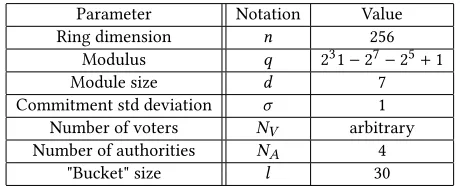
Parameter Notation Value
Ring dimension n 256
Modulus q 231−27−25+1
Module size d 7
Commitment std deviation σ 1
Number of voters NV arbitrary
Number of authorities NA 4
"Bucket" size l 30
Table 2: A possible set of parameters for our E-Voting scheme.These parameters achieve a post-quantum security of 119 bits in time and 93 bits in space for privacy, as well as 180 bits in time and 141 bits in space for consistency.
• ∀j,u,sverifyπuA,,s(j)andπuA,,s(j) ′
• Forj ∈ [NA]recoverc(j) 1,⌈logl(NV)⌉
andr(j) 1,⌈logl(NV)⌉
onBB • ∀j,
0
t(j)
:=c(j)
1,⌈logl(NV)⌉−Cr (j) 1,⌈logl(NV)⌉ • Check thatt=ÍNA
1 t
(j)
We prove privacy and consistency in Appendix A and we discuss how to set the parameters in Section 5.
5
PARAMETERS
In this section we review the bounds imposed on the parameters of our scheme by the correctness and security of the vote, and we propose concrete parameters in Table 2 as well as benchmarks from our implementation of the scheme.
The correctness and security of our scheme impose the following bounds on the parameters:
• Correctness ofπV:BOR ≥2NA p
n(2d+1)σ • Zero-knowledge ofπV:B′
OR≥44p60n(2d+1)BOR • Correctness ofπA:BAmo,1≥2pn(2d+1)σ • Zero-knowledge ofπA:B′
Amo,1≥2684n √
2d+1BAmo,1 • Correctness ofπA′:BAmo,2≥2(l+1)pn(2d+1)σ • Zero-knowledge ofπA
′ :B′
Amo,2≥2684n √
2d+1BAmo,2 • Consistency of the vote (equation(3)): 2B′
OR ≤Br
• Consistency of the vote (equation(4)): 2 √
60NAB′
Amo,1≤ Br
• Consistency of the vote (equation(7)):(l+1)B′
Amo,1≤Br • Consistency of the vote (equation(8)):B′
Amo,2≤Br Using the security analysis of [4] and [3] to assess the hardness of M-LWE and M-SIS, we set our parameters as in Table 2 (we arbitrarily fix the number of authorities to 4, anything larger than 2 is enough for security and this does not impact performance sig-nificantly). Due to the improved E-voting scheme of Section 4.2, the number of voters does not affect the security at all and can thus be taken arbitrarily large. Using these parameters and the cryptanalysis of [3, 4] we obtain a post-quantum security of 119 bits in time and 93 bits in space for the privacy of our scheme, as well as a post-quantum security of 180 bits in time and 141 bits in space for consistency. We have implemented the complete voting scheme in C. The main computational problems in the scheme are
Voter Authority per voter Verification per Voter total total sampling OWF total Time 8.5ms 0.15s 33.2% 62.9% 0.15s
Table 3: Timings for our implementation of the voting scheme simulating an election with11000voters.
the sampling of discrete Gaussian vectors and multiplication of polynomials inZq[X]/(Xn+1). For the sampling we have imple-mented a two-stage Knuth-Yao sampler. We have taken great care to ensure that the statistical distance between the sampled vectors and the exact discrete distribution is below 2−100. This required computing the probabilities and the lookup table for the sampler with a multiprecision library. We used pari [33] for this task. For the fastest possible multiplication in rings of the given form, one usu-ally chooses the primeqin such a way thatZqcontains a 2n-th root of unity. This then implies that the modulusXn+1 splits into linear factors overZqand allows for using an NT T-based multiplication algorithm. Unfortunately, the security requirements of our scheme preventqfrom being chosen in this way. Instead of completely re-sorting to a general algorithm that works for multiplication modulo arbitrary polynomials, we have exploited the fact that for our prime q,Xn+1 does in fact split into 16 factors. This allowed us to use a general multiplication algorithm only after 4 stages of NT T. We have used our own NT T implementation and the highly optimized FLINT library [23] for the base case multiplication. FLINT uses a variant of Kronecker substitution for this task.
Table 3 gives the results of an experiment conducted with 11000 Voters. In that instance each authority Aj will amortize proofs over 4000 commitments (we use 4000 commitments rather than the minimum of 2809 so that the data structures used in the amortized proofs are simpler to implement) and thus compute 3 amortized proof to obtainπA,(j)as well as 1 amortized proof to compute πA,(j) ′
. The total time per server is of 41min, we give times per voter in Table 3. We have used a laptop equipped with an Intel Skylake i7 CP U running at 2.6 GHz to perform all tests.
ACKNOWLEDGEMENTS
We thank the anonymous referees for numerous comments that
helped to improve this manuscript. This work is supported by the
SNSF ERC Transfer Grant CRETP2-166734 – FELICITY.
REFERENCES
[1] Michel Abdalla, Pierre-Alain Fouque, Vadim Lyubashevsky, and Mehdi Tibouchi. 2012. Tightly-Secure Signatures from Lossy Identification Schemes. In
EURO-CRYPT. 572–590.
[2] Ben Adida. 2008. Helios: Web-based Open-Audit Voting. InProceedings of the
17th USENIX Security Symposium, July 28-August 1, 2008, San Jose, CA, USA. 335–348.
[3] Martin R. Albrecht, Rachel Player, and Sam Scott. 2015. On the concrete
hardness of Learning with Errors. J. Mathematical Cryptology9, 3 (2015),
169–203. http://www.degruyter.com/view/j/jmc.2015.9.issue- 3/jmc- 2015- 0016/ jmc- 2015- 0016.xml
[4] Erdem Alkim, Léo Ducas, Thomas Pöppelmann, and Peter Schwabe. 2016.
Post-quantum Key Exchange - A New Hope. In25th USENIX Security Symposium,
USENIX Security 16, Austin, TX, USA, August 10-12, 2016.327–343. https://www. usenix.org/conference/usenixsecurity16/technical- sessions/presentation/alkim [5] Wojciech Banaszczyk. 1993. New bounds in some transference theorems in the