
One-Round Key Exchange with Strong Security:
An Efficient and Generic Construction
in the Standard Model
Florian Bergsma, Tibor Jager, and J¨org Schwenk
Horst G¨ortz Institute for IT Security Ruhr-University Bochum
Abstract. One-round authenticated key exchange (ORKE) is an es-tablished research area, with many prominent protocol constructions like HMQV (Krawczyk, CRYPTO 2005) and Naxos (La Macchia et al., ProvSec 2007), and many slightly different, strong security models. Most constructions combine ephemeral and static Diffie-Hellman Key Exchange (DHKE), in a manner often closely tied to the underlying se-curity model.
We give a generic construction of ORKE protocols from general assump-tions, with security in the standard model, and in a strong security model where the attacker is even allowed to learn the randomness or the long-term secret of either party in the target session. The only restriction is that the attacker must not learnboththe randomnessand the long-term secret of one party of the target session, since this would allow him to recompute all internal states of this party, including the session key. This is the first such construction that does not rely on random ora-cles. The construction is intuitive, relatively simple, and efficient. It uses only standard primitives, namely non-interactive key exchange, a digital signature scheme, and a pseudorandom function, with standard security properties, as building blocks.
Keywords:One-round key exchange, eCK security, provable security.
1
Introduction
Key Exchange Protocols and Their Security. Interactive key exchange protocols are fundamental cryptographic building blocks. Two-party protocols, where two parties A and B exchange messages in order to establish a com-mon secret kAB, are particularly important in practice. Popular examples are SSL/TLS [13], SSH [34], and IPSec IKE [22].
Following the seminal works of Bellare and Rogaway (BR) [1] and Canetti and Krawczyk [8], security for such protocols is usually defined with respect to
0 c
activeattackers [23, 25, 32], which may intercept, read, alter, replay, or drop any message transmitted between parties (see Section 3.3 for a precise definition). An attacker in such a security model interacts with a collection of oraclesπ1
1, . . . , π`d, where all oracles π1
i, . . . , πid share the same long-term public and secret keys of party Pi. An adversary breaks the security of the protocol, if she is able to distinguish the session key k shared between two oracles πs
i and πtj from a random value from the same distribution. To this end, the attacker may ask a Test(i, s)-query to oracleπs
i. Oracleπsi returns either the real keykor a random value, each with probability 1/2.
Typical security models also allow the attacker to corrupt selected parties, that is, to learn their long-term secret keys, or to reveal keys, that is, to learn the shared keys of sessions which are not related to the Test session. Stronger models [8, 23, 25, 32] allow the attacker furthermore to learn the randomness used by an oracle (which is easy to define clearly), or even internal computation states (which are difficult to define precisely).
One-Round Key Exchange. In this paper we consider one-round key
ex-change (ORKE) protocols, where two parties are able to establish a key in a single round. Such protocols are particularly interesting, due to their simplicity and their efficiency in terms of messages exchanged between parties.
In a (public-key, two-party) ORKE protocol, only two messages are ex-changed between two parties A and B. If (pkA,skA) is the public key pair of A, and (pkB,skB) that of B, key establishment proceeds as follows. Party
A chooses a random nonce rA, computes a message mA = f(skA, pkB, rA), and sends mA to B. B chooses a random nonce rB and responds with mes-sage mB = f(skB, pkA, rB) (cf. Section 3.2). Note that mB does not depend on mA, thus, messages mA and mB may be computed and sent
simultane-ously in one round. The key is computed by evaluating a function g with
g(skA, pkB, rA, mB) =g(skB, pkA, rB, mA).
Security Models. Some combinations of adversarial queries lead to trivial attacks, these trivial attacks must of course be excluded from the security defi-nition. For instance, in all models, the attacker is not allowed to simultaneously reveal the session key of an oracleπs
i, and then ask aTestquery to πis, as this would trivially allow the adversary to correctly answer theTestquery with prob-ability 1. Moreover, the attacker must also not learn both the long-lived secret key (Corrupt) and the randomness (RevealRand) of an oracle involved in the Test-session, because then the attacker would learn the entire internal state of this oracle, and thus would be able to re-compute everything the oracle is able to compute, including the secret session key.
of parties are of course only allowedafter the key has been established, as oth-erwise trivial man-in-the-middle attacks are possible.)Is it possible to construct an ORKE protocol that achieves security in such a strong model?
If a party is corrupted, the adversary can impersonate this partyin the future. In some cases, the adversary can also break the security of session keys that have been generatedin the past(e.g. if RSA key transport is used). The property that session keys computed before the corruption remain secure is known asperfect forward secrecy (PFS) [16, 14]. In reaction to a conjecture of Krawczyk that ORKE protocols could only achieve a weaker form of PFS [24], Cremers showed that full PFS is generally achievable for ORKE protocols [11]. However until now, none of the proposed ORKE protocols has this property.Can we construct an ORKE protocol that achieves perfect forward secrecy in such a strong model as eCK?
Contributions. In this paper, we make the following contributions:
– Novel generic construction.We give an intuitive, relatively simple and effi-cient construction of an ORKE protocol with provable security in a model that allowsall non-trivial combinations of corrupt- and reveal-queries, even against theTest-session.
– Non-DH ORKE instantiation.Instantiating our protocol with the factoring based NIKE protocol by Freireet al.[15], this yields an ORKE protocol based on the hardness of factoring large integers. This provides an alternative to known constructions based on (decisional) Diffie-Hellman.
– First ORKE with perfect forward security under standard assumptions.Our protocol is the first one-round AKE protocol which provides perfect forward security without random oracles.
– Well-established, general assumptions.The construction is based on general assumptions, namely the existence of secure non-interactive key exchange (NIKE) protocols [9, 15], (unique) digital signatures, and a pseudorandom function. For all building blocks we require standard security properties.
– Security in the Standard Model.The security analysis is completely in the standard model, that is, without resorting to the Random Oracle heuristic [2] and without relying on non-standard complexity assumptions.
The Advantages of Generic Constructions. From a theoretical point of view, generic constructions show relations and implications between different types of cryptographic primitives. From a practical point of view, a generic protocol construction based on abstract building blocks allows to instantiate the protocol with arbitrary concrete instantiations of these building blocks — provided that they meet the required security properties. For instance, in order to obtain a “post-quantum”-instantiation of our protocol, it suffices to construct a NIKE scheme, digital signatures, and a PRF with post-quantum security and plug these primitives into the generic construction.
with the NIKE schemes from [15], our protocol is already efficient enough to be deployed in practice. See Section 5 for an efficiency comparison to other ORKE protocols.
Practical Motivation of the Model. Most cryptographic protocols in-herently require “good” (i.e., independent and uniform) randomness to achieve their security goals. The availability of “good” random coins is simply assumed in the theoretical security analysis. However in practice, there are many famous examples where a flawed (i.e., low-entropy) generation of random numbers has led to serious security flaws. These include, for instance, the Debian OpenSSL bug,1the results of Lenstraet al.[28] and Heningeret al.[17] on the distribution
of public keys on the Internet, or the case of certified smart cards considered by Bernsteinet al. [3].
In our security model we allow the attacker to learn thefull randomness of each party. Thus, even if this randomness is completely predictable, the protocol still provides security — as long as the long-lived secret keys of all parties are generated with good, “secret” randomness.
2
Related Work
Authenticated Key Exchange. An important line of research on the field of authenticated key exchange protocols started with Bellare and Rogaway [1] (theBR model) and Canetti and Krawczyk [8] (theCK model). TheCK model is usually used to analyze one-round protocols, where authentication and key negotiation is performed very efficiently by two parties, only sending one message per party. Examples of such one-round protocols are MQV [27], KEA [30, 26], or NAXOS [25]. HMQV [23], SMQV [32] were proposed to meet stronger security definitions. A comparison of different variants of the CK model can be found in [10, 35]. Most constructions are proven secure in the Random Oracle Model (ROM) [2], with only a few exceptions [31, 5, 33].
PFS and KCI attacks. Perfect forward secrecy (PFS) is an important secu-rity goal for key-exchange protocols. Loosely speaking, PFS guarantees the se-crecy of older session keys, even when the parties long-term key is compromised. Krawczyk [24] conjectured that no one-round protocol with implicit authenti-cation can achieve full PFS in a CK-type model and introduced the notion of weak PFS (wPFS); this conjecture was refuted by Cremerset al.[11]. A protocol is wPFS secure, if the session key is indistinguishable from a random key and the parties long-term key is compromised if the adversary was passive during the session key negotiation [24, Section 3.2]. Similar to [11], we define rules for the security game to model and prove (full) PFS. In our security definition, the party corresponding to the tested oracle is allowed to be corrupted before the session completes. The only restriction to the corruption of parties in the test
session is that theintended partner of the tested oracle is uncorrupted until the tested oracle accepts.
Another security goal of AKE protocols is security againstkey-compromise impersonation(KCI) attacks [24]. In a KCI attack, an adversary corrupts a party
A and is able to authenticate herself toAas some uncorrupted partyB. Since in the eCK model the adversary is always allowed to corrupt some party and learn the session randomness of the matching session, security in theeCK model naturally brings security against KCI attacks.
eCK Models. The term “extended Canetti-Krawczyk model” (eCK) was first introduced in [25]. The main difference to the CK model is that the RevealState-query (which has to be specified for each protocol) is replaced with a different query, namely RevealEphemeralExponent(which is a meaningful definition only for DH-based protocols, or other protocols where ephemeral exponents appear). In subsequent publications, the eCK model was often slightly modified, such that it is difficult to speak of “the” eCK model.
The eCK-PFS Security model. In 2012 Cremers and Feltz introduced a variant of the extended Canetti-Krawczyk model to capture perfect forward security [11]. The major difference between the eCK and eCK-PFS security models is the definition of session identifiers. Cremers et al. introduced the notion of origin sessions, which solves technical problems with the session identifier definition from the originaleCK-model [12].
We slightly enhanced theeCK-PFS model in order to better model PFS, by introducing an explicit counter of adversarial interactions as done by Jager et al. [20] for the BR security model. Thus, we have a clear order of events and we can formally validate if a party was corruptedbefore or after a sessionaccepted
another party as a communication partner.
3
Preliminaries
In this paragraph we will define non-interactive key exchange (NIKE) and one-round key exchange (ORKE) protocols and their security.
3.1 Secure Non-Interactive Key Exchange
Definition 1. A non-interactive key exchange (NIKE) scheme consists of two deterministic algorithms (NIKEgen,NIKEkey).
NIKEgen(1λ, r) takes a security parameter λ and randomness r
∈ {0,1}λ. It
outputs a key pair(pk,sk). We write(pk,sk)←$ NIKEgen(1λ)to denote that NIKEgen(1λ, r) is executed with uniformly randomr $
← {0,1}λ.
NIKEkey(ski,pkj) is a deterministicalgorithm which takes as input a secret key
We say that a NIKE scheme is correct, if for all (pki,ski) $
←NIKEgen(1λ)and (pkj,skj)
$
←NIKEgen(1λ)holds that NIKEkey(sk
i,pkj) =NIKEkey(skj,pki). A NIKE scheme is used bydpartiesP1, . . . , Pdas follows. Each partyPi gen-erates a key pair (pki,ski)←NIKEgen(1λ) and publishespki. In order to com-pute the key shared byPi andPj, party Pi computeski,j =NIKEkey(ski,pkj). Similarly, partyPj computeskj,i=NIKEkey(skj,pki). Correctness of the NIKE scheme guarantees thatki,j=kj,i.
CKS-light security. The CKS-light security model for NIKE protocols is relatively simplistic and compact. We choose this model because other (more complex) NIKE security models like CKS, CKS-heavy and m-CKS-heavy are polynomial-time equivalent toCKS-light. See [15] for more details.
Security of a NIKE protocolNIKEis defined by a gameNIKEplayed between an adversary A and a challenger. The challenger takes a security parameter λ
and a random bitbas input and answers all queries ofAuntil she outputs a bit
b0. The challenger answers the following queries for
A:
– RegisterHonest(i). A supplies an index i. The challenger runs NIKEgen(1λ) to generate a key pair (pki, ski) and records the tuple (honest, pki, ski) for later and returnspki to A. This query may be askedat most twice byA.
– RegisterCorrupt(pki). With this queryAsupplies a public keypki. The chal-lenger records the tuple (corrupt, pki) for later.
– GetCorruptKey(i, j).Asupplies two indexesiandjwherepkiwas registered as corrupt and pkj as honest. The challenger runs k ← NIKEkey(skj, pki) and returnskto A.
– Test(i, j). The adversary supplies two indexesi and j that were registered honestly. Now the challenger uses bit b: if b = 0, then the challenger runs
ki,j ← NIKEkey(pki, skj) and returns the key ki,j. If b = 1, then the chal-lenger samples a random element from the key space, records it for later, and returns the key toA.
The game NIKEoutputs 1, denoted by NIKEANIKE(λ) = 1 if b=b0 and 0
otherwise. We sayAwins the game ifNIKEANIKE(λ) = 1.
Definition 2. For any adversary A playing the above NIKE game against a NIKE scheme NIKE, we define the advantage of winning the gameNIKEas
AdvCKS-lightNIKE (A) =PrhNIKEANIKE(λ) = 1i−1 2
3.2 One-Round Key Exchange Protocols
Definition 3. A one-round key exchange (ORKE) scheme consists of three de-terministic algorithms(ORKEgen,ORKEmsg,ORKEkey).
– ORKEgen(1λ, r) takes a security parameter λ and randomness r
∈ {0,1}λ.
It outputs a key pair(pk,sk). We write (pk,sk)←$ ORKEgen(1λ)to denote
thatORKEgenis executed with uniformly randomr← {$ 0,1}λ.
– ORKEmsg(ri,ski,pkj)takes as input randomnessri∈ {0,1}λ, secret key ski
and a public key pkj, and outputs a message mi.
– ORKEkey(ski,pkj, ri, mj) takes as input a secret key ski, a public key pkj,
randomnessri, and messagemj. It outputs a keyk.
We say that a ORKE scheme is correct, if for all (pki,ski) $
← ORKEgen(1λ)
and(pkj,skj) $
←ORKEgen(1λ), and for allr i, rj
$
← {0,1}λ holds that ORKEkey(ski,pkj, ri, mj) =ORKEkey(skj,pki, rj, mi),
wheremi :=ORKEmsg(ri,ski,pkj)andmj:=ORKEmsg(rj,skj,pki).
A ORKE scheme is used bydpartiesP1, . . . , Pdas follows. Each partyPi gen-erates a key pair (pki,ski)
$
←ORKEgen(1λ) and publishespk
i. Then, two parties
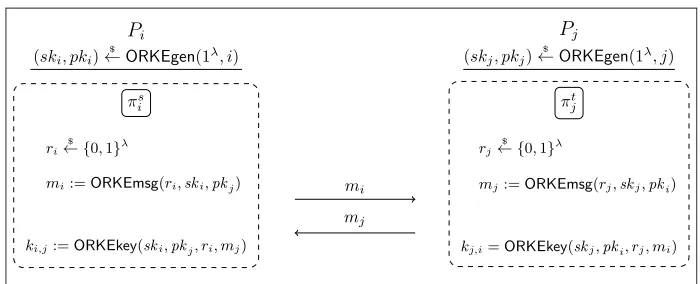
Pi,Pj can establish a shared key as follows (see Figure 1 for an illustration). 1. Pi choosesri
$
← {0,1}λ, computes m
i :=ORKEmsg(ri,ski,pkj), and sends
mi toPj. 2. Pj choosesrj
$
← {0,1}λ, computesm
j:=ORKEmsg(rj,skj,pki), and sends
mj toPi.
(Both messagesmiandmjmay be sent simultaneously, as this is aone-round protocol).
3. The shared key is computed by partyPiaski,j :=ORKEkey(ski,pkj, ri, mj). Similarly, party Pj computeskj,i = ORKEkey(skj,pki, rj, mi). Correctness of the ORKE scheme guarantees thatki,j =kj,i.
3.3 Secure One-Round Key Exchange
Security models for one-round key exchange have two major building blocks. The first defines theexecution environmentprovided to an attacker on the AKE protocol. The second defines the rules of the game and the winning condition for an attacker.
Pi Pj (ski, pki)
$
←ORKEgen(1λ, i) (sk j, pkj)
$
←ORKEgen(1λ, j)
πs i
ri $ ← {0,1}λ
mi:=ORKEmsg(ri,ski,pkj) mi
πt j
rj $ ← {0,1}λ
mj:=ORKEmsg(rj,skj,pki)
mj
ki,j:=ORKEkey(ski,pkj, ri, mj) kj,i=ORKEkey(skj,pki, rj, mi)
Fig. 1.Execution of an ORKE protocol
representing party Pi have access to the same long-term key pair (pki, ski) of
Pi and to all public keys pk1, . . . , pkd. Moreover, each oracle πis maintains as internal state the following variables:
– Acceptedsi ∈ N∪ {reject}. This variable indicates whether and when the oracle accepted. It is initialized toAcceptedsi =reject.
– Keysi ∈ K ∪ {∅}, where Kis the keyspace of the protocol and∅ is the empty string, initialized toKeysi =∅.
– Partnersi containing the intended communication partner. We assume that each partyPi is uniquely identified by its public keypki, and therefore use public keys as identities.2 The variable is initialized toPartners
i =∅.
– A variableMi,sout storing the message sent by an oracle and a variableMi,sin
storing the received protocol message. Both are initialized asMi,sin =M
i,s
out=
∅.
– A variableRandomnesssi, which contains a uniformly string from{0,1}κ. This string corresponds to the local randomness of an oracle. It is never changed or modified by an oracle.
– Variables RevealedKeysi,Corruptedi ∈ N, which will be used to determine if and when a RevealKey or Corrupt query was asked to this oracle or the corresponding party was corrupted (see below for details). These variables are initialized asRevealedKeysi =Corruptedi=∞.
We will assume (for simplicity) that
Keysi 6=∅ ⇐⇒ Accepted s i ∈N.
We assume the adversary controls the network. Thus she is able to generate, manipulate or delay messages. Furthermore, the adversary can learn session keys,
parties’ secret long term keys and even the session randomness in our model. Formally the adversary may interact with the execution environment by issuing the following queries.
– Send(i, s, m)→m0: The adversary sends message m to oracleπs
i. PartyPi processes message m according to the protocol specification and its inter-nal oracle state πs
i, updates its state3, and optionally outputs an outgoing messagem0.
There is a distinguished initialization messageiniwhich allows the adver-sary to activate the oracle with certain information. In particular, the ini-tialization message contains the identityPj of the intended partner of this oracle.
– RevealKey(i, s): if this is theτ-th query issued byA, then the challenger sets RevealedKeysi :=τ and responds with the contents of variable Key
s i. Recall thatKeysi 6=∅ iffAcceptedsi ∈N.
– RevealRand(i, s): the challenger responds with the contents ofRandomnesssi.
– Corrupt(i, pk∗): if this is theτ-th query issued by
A(in total), then the chal-lenger sets the oracle stateCorruptedi:=τand responds withski. Moreover, the public key pki is replaced (globally) with the adversarially-chosen key
pk∗.4
– Test(i, s): This query may be asked only once throughout the game, it is answered as follows. Let k1 := Keysi and k0
$
← K. If Acceptedsi ∈ N, the oracle flips a fair coinb← {$ 0,1} and returns kb. IfAcceptedsi =reject or ifPartnersi =j andPj is corrupted whenTestis issued, terminate the game and output a random bit.
eCK-PFS Security Definition In the following we give the security definition for one-round key-exchange protocols in the extended Canetti-Krawczyk model with perfect forward security. Firstly we introduce the partnering definitions from Cremers and Feltz. Secondly we define the rules by which an adversary has to play the AKE game in the eCK-PFS-model. Finally we define the security for one-round key-exchange protocols in the model.
Definition 4 (Origin session). Consider two parties Pi andPj with oracles
πs
i andπtj. We say πishas origin sessionπtj, ifM i,s
in =M
j,t
out, and denote this by πs
i
os ←−πt
j.
Alternatively we could sayπt
j is an origin sessionofπsi, ifM i,s
in =M
j,t
out.
Using the concept of origin sessions, we can define matching sessions as a symmetric relation of origin sessions: two sessions match, if they are origin ses-sions to each other. We capture this in the following definition.
3 In particular, ifπs
i accepts after theτ-th query, setAcceptedsi =τ.
Definition 5 (Matching session). Consider two partiesPi and Pj with
ora-clesπs
i andπtj. We say πsi has a matching sessiontoπtj (and vice versa), ifπsi
is an origin session ofπt
j andπtj is an origin session ofπsi.
The notions of origin and matching sessions will be used in Definition 6 to exclude trivial attacks from the security model: IfTest(i, s) is asked, restrictions are imposed on oracle πs
i itself, and on oracles and parties from which the test
oracle has received a message.On the other hand, sessions and parties to which a message was sent from the test session do not necessary play any role in Definition 6, for example if the test session has no matching session.
AKE Game. Consider the following security experimentAKEAΠ(λ) played be-tween a challengerC and an adversary A. The challenger receives the security parameterλas an input and sets up all protocol parameters (like long term keys generation etc.).C simulates the protocolΠ and keeps track of all variables of the execution environment. The adversary interacts by issuing any combination of the above mentioned queries. At some point of time during the game, she asks theTestsi query and gets a keykb, which is either the exchanged key or a random key as described in the previous section. She may continue asking queries and finally outputs a bitb0. The gameAKEoutputs 1, denoted byAKEA
Π(λ) = 1 ifb=b0 and 0 otherwise.
Definition 6 (eCK-PFS-rules). A plays theAKEgame by eCK-PFS-rules, if the following conditions hold simultaneously when she issues Test(i, s):
– Acceptedsi =τ withτ ∈N.
– Adid not ask bothCorrupt(i, pk∗)andRevealRand(i, s).
– Ifπs
i has an origin sessionπtj, then it does not hold that bothCorruptedj ≤τ
andAasked RevealRand(j, t).
– If πs
i has no origin session but intended partner Partner s
i =j, then it does
not hold thatCorruptedj≤τ.
When A terminates and outputs a bit b0, it also holds that A did not ask
RevealKey(i, s) and (ifπs
i has a matching session toπtj) RevealKey(j, t). We sayAwins the AKE game, ifAKEAΠ(λ) = 1.
Definition 7 (eCK-PFS-security). We define the advantage of A winning this game playing by eCK -PFS -rules as
AdveCK -PFSΠ (A) =PrhAKEAΠ(λ) = 1i−1 2.
Let λbe a security parameter, Π be an AKE protocol and A an adversary. We say Π is an eCK-secure AKE protocol, if it is correct and for all proba-bilistic polynomial-time adversaries A playing by eCK -PFS -rules, the function
AdveCK -PFSΠ (A)is a negligible function inλ.
3.4 Further Building Blocks
Digital signatures. A digital signature scheme consists of three polynomial-time algorithms SIG = (SIGgen,SIGsign,SIGvfy). The key generation algorithm (sk, pk) $
←SIGgen(1λ) generates a public verification keypkand a secret signing keysk on input of security parameterλ. Signing algorithmσ←$ SIGsign(sk, m) generates a signature for messagem. Verification algorithmSIGvfy(pk, σ, m) re-turns 1 ifσ is a valid signature formunder keypk, and 0 otherwise.
Definition 8. We say thatSIG is deterministic, if SIGsignis deterministic.
Consider the following security experiment played between a challenger C and an adversaryA.
1. The challenger generates a public/secret key pair (sk, pk)←$ SIGgen(1λ), the adversary receivespk as input.
2. The adversary may query arbitrary messagesmito the challenger. The chal-lenger replies to each query with a signatureσi =SIGsign(sk, mi). Here iis an index, ranging between 1≤i≤qfor some q∈N. Queries can be made adaptively.
3. Eventually, the adversary outputs a message/signature pair (m, σ).
Definition 9. We define the advantage on an adversaryA in this game as
AdvsEUF -CMASIG (A) :=Pr
(m, σ) $
← AC(λ)(pk) : SIGvfy(pk, m, σ) = 1,
(m, σ)6= (mi, σi)∀i
SIG is strongly secure against existential forgeries under adaptive chosen-message attacks (sEUF-CMA), if AdvsEUF -CMASIG (A) is a negligible function in λfor all probabilistic polynomial-time adversariesA.
Remark 2. Deterministic signatures with sEUF-CMA security can be construc-ted, for instance, from verifiable unpredictable or verifiable random functions with large input spaces [29, 18, 4, 19].
Pseudorandom functions. Apseudo-random function is an algorithmPRF. This algorithm implements a deterministic function z = PRF(k, x), taking as input a keyk∈ {0,1}λand some bit stringx, and returning a stringz
∈ {0,1}µ. Consider the following security experiment played between a challenger C and an adversaryA.
1. The challenger samplesk← {$ 0,1}λ uniformly random.
2. The adversary may query arbitrary values xi to the challenger. The chal-lenger replies to each query withzi=PRF(k, xi). Hereiis an index, ranging between 1≤i≤qfor someq∈N. Queries can be made adaptively.
3. Eventually, the adversary outputs value x and a special symbol >. The challenger setsz0=PRF(k, x) and samples z1
$
4. Finally, the adversary outputs a guessb0
∈ {0,1}.
The Adversary wins the game, if she outputsb0 such that b=b0.
Definition 10. We denote the advantage of an adversary A in winning this game as
AdvprfPRF(A) =Prhb=b0 forb0 $
← AC(λ)(1λ)i
−12
We say thatPRFis a securepseudo-random function, if for all probabilistic polynomial time adversaries AAdvprfPRF(A)is a negligible function inλ.
4
Generic Construction of eCK-Secure Key Exchange
LetSIG= (SIGgen,SIGsign,SIGvfy) be adeterministicsignature scheme,NIKE= (NIKEgen,NIKEkey) be a NIKE scheme, and letPRFbe a pseudo-random func-tion. Letsortbe an arbitrary function which takes as input two strings (mi, mj), and outputs them according to some order (e.g. lexicographically). That is,
sort(mi, mj) :=
(
(mi, mj), if mi≤mj, (mj, mi), if mi> mj,
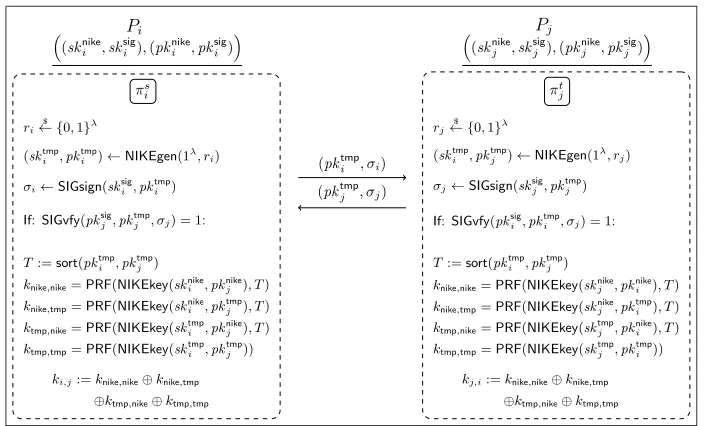
where ≤and>are defined with respect to some (arbitrary) ordering. We con-struct an ORKE protocolΠ = (ORKEgen,ORKEmsg,ORKEkey) as follows (see also Figure 2).
ORKEgen(1λ) computes key pairs for the NIKE and digital signature scheme, re-spectively, as (pknikei ,sknikei )
$
←NIKEgen(1λ) and (pksig
i ,sksigi ) $
←SIGgen(1λ), and outputs
(pki,ski) := ((pknikei ,pksigi ),(sknikei ,sksigi )) ORKEmsg(ri,ski,pkj) parses ski = (sknikei ,sksigi ). Then it samplesri
$
← {0,1}λ and runs the key generation algorithm (pktmpi ,sktmpi ) $
←NIKEgen(1λ, r i) to generate a key pair of the NIKE scheme. Then it computes a signature over pktmpi as σi
$
← SIGsign(sksigi ,pktmpi ) and outputs the message mi := (pktmpi , σi).
ORKEkey(ski,(pknikej ,pksigj ), ri, mj) first parses its input asmj = (pktmpj , σj) and
ski= (sknikei ,sksigi ). If
SIGvfy(pksigj ,pktmpj , σj)6= 1,
then it outputs ⊥. Otherwise it runs (pktmpi ,sktmpi ) $
← NIKEgen(1λ, r i) to re-computesktmpi fromri. Finally it derives the keykas follows.
2. Compute
knike,nike:=PRF(NIKEkey(sknikei ,pknikej ), T), (1)
knike,tmp:=PRF(NIKEkey(sknikei ,pktmpj ), T), (2)
ktmp,nike:=PRF(NIKEkey(sktmpi ,pknikej ), T), (3)
ktmp,tmp:=NIKEkey(sktmpi ,pktmpj ). (4)
3. Computekas
k:=knike,nike⊕knike,tmp⊕ktmp,nike⊕ktmp,tmp
and outputk.
Pi Pj
(sknike
i ,sk
sig
i ),(pknikei ,pk
sig
i )
(sknike
j ,sk
sig
j ),(pknikej ,pk
sig
j )
πs i
ri← {$ 0,1}λ
(sktmpi ,pk
tmp
i )←NIKEgen(1λ, ri)
σi←SIGsign(sksigi ,pk
tmp
i )
If: SIGvfy(pksigj ,pk
tmp
j , σj) = 1:
(pktmpi , σi)
T:=sort(pktmpi ,pk
tmp
j )
knike,nike=PRF(NIKEkey(sknikei ,pknikej ), T) knike,tmp=PRF(NIKEkey(sknikei ,pktmpj ), T) ktmp,nike=PRF(NIKEkey(sktmpi ,pk
nike
j ), T) ktmp,tmp=PRF(NIKEkey(sktmpi ,pk
tmp
j ))
πt j
rj← {$ 0,1}λ
(sktmp
i ,pktmpj )←NIKEgen(1λ, rj)
σj←SIGsign(sksigj ,pk
tmp
j )
If: SIGvfy(pksig
i ,pk
tmp
i , σj) = 1:
(pktmpj , σj)
T:=sort(pktmpi ,pk
tmp
j )
knike,nike=PRF(NIKEkey(sknikej ,pknikei ), T)
knike,tmp=PRF(NIKEkey(sknikej ,pktmpi ), T) ktmp,nike=PRF(NIKEkey(sktmpj ,pk
nike
i ), T) ktmp,tmp=PRF(NIKEkey(sktmpj ,pk
tmp
i ))
ki,j:=knike,nike⊕knike,tmp
⊕ktmp,nike⊕ktmp,tmp
kj,i:=knike,nike⊕knike,tmp
⊕ktmp,nike⊕ktmp,tmp
Fig. 2.Execution of protocolΠ.
Remark 3. In our generic constructionΠ we use a deterministic, strong existen-tially-unforgeable (sEUF-CMA) signature scheme. We could use a probabilistic signature scheme instead, but in this case we require a strong existentially-unforgeablepublic coin signature scheme.
Even though such signatures may be easier or more efficiently to construct, we would not gain a better understanding of the reduction. Only the proofs would become harder to follow. For this reason we decided to use a deterministic scheme for simplicity.
Theorem 1. From each attackerA, we can construct attackersBsig,Bnike(1),Bnike(0), andBprf such that
AdveCKΠ (A)≤4·d2`2·AdvCKS-lightNIKE (B(1)nike) +Adv prf PRF(Bprf)
+ 4·d·AdvsEUF -CMASIG (Bsig) + 4·AdvCKS-lightNIKE (B(0)nike)
The running time ofBsig, Bnike(1),B
(0)
nike, and Bprf is equal to the running time ofA plus a minor overhead for the simulation of the security experiment forA.
In order to prove Theorem 1, we will distinguish between four different types of attackers. Without loss of generality, we assume that an attacker always asks a Test(i, s)-query for some (i, s). (Otherwise it is impossible to have a non-zero advantage, as then all computations are independent of the bitbsampled by the Test-query.) We distinguish between the following four types of attackers.
1. A Type-RR-attacker never asksRevealRand(i, s). If there exists an oracleπt j such thatπs
i
os ←−πt
j, then it also never asksRevealRand(j, t).
2. A Type-RC-attacker never asksRevealRand(i, s). If there exists an oracleπt j such thatπs
i
os ←−πt
j, then it also never asksCorrupt(j,·).
3. A Type-CR-attacker never asksCorrupt(i,·). If there exists an oracleπt jsuch thatπs
i
os ←−πt
j, then it also never asksRevealRand(j, t).
4. A Type-CC-attacker never asksCorrupt(i,·). If there exists an oracleπtjsuch thatπs
i
os ←−πt
j, then it also never asksCorrupt(j,·).
Note that each valid attacker in the sense of Definition 7 falls into (at least) one of these four categories. We will consider attackers of each type seperately in the sequel.
Intuition for the proof of Theorem 1. Let us now give some intuition why this classification of attackers will be useful for the security proof ofΠ. Recall that in protocolΠ the key is computed ask:=knike,nike⊕knike,tmp⊕ktmp,nike⊕ktmp,tmp,
where the keys knike,nike, knike,tmp, ktmp,nike, ktmp,tmp are computed as described in
Equations 1 to 4. The idea behind this construction is that in the proof we want to be able to reduce the indistinguishability of the ORKE-key k to the indistinguishability of a NIKE-key.
A Type-RR-attacker never asksRevealRand(i, s) andRevealRand(j, t) (if ap-plicable). Thus, when considering Type-RR-attackers, then we can embed the NIKE-keys obtained from the NIKE-challenger as
pktmpi :=pknike and pktmpj :=pknike0,
where pktmpi and pktmpj are the ephemeral keys generated by oraclesπis andπjt, respectively. Moreover, we embed the NIKE-challenge key knike as ktmp,tmp := knike.
However, this embedding strategy does not work for Type-RC-attackers, be-cause such an attacker might ask RevealRand(j, t). However, we know that a Type-RC attacker never asks aCorrupt(j,·), therefore we are able to embed the NIKE challenge public keys as
pktmpi :=pknike and pknikej :=pknike
0
,
where pktmpi is the ephemeral keys generated by πis, and pknikej is the long-term secret of party Pj. The NIKE-challenge key knike is in this case embedded as
ktmp,nike :=PRF(knike, T). The additional PRF is necessary in this case, because
the embedding involves a long-term secret of one party of the test session. This long-term secret is used in (potentially) many protocol executions involving party
Pj. Similarly, CR- and CC-type attackers can be handled by embedding the NIKE challenge public- and session as appropriate for each case.
Thus, the four different types of attackers correspond exactly to all four pos-sible combinations of Corrupt- and RevealRand-queries against the Test-session that the attacker is allowed (resp. not allowed) to ask in our security model.
The full proof of Theorem 1 can be found in Appendix A.
5
Efficiency comparison with other ORKE protocols
In Table 5 we compare the efficiency of instantiations of our construction to other one-round key-exchange protocols. We count the number of exponentiations and pairing evaluations. We do not distinguish an exponentiation in a DH group from an exponentiation in an RSA group.
We see that our generic construction ORKE, if instantiated with the most efficient NIKE primitive from [15], will be almost as efficient as the NAXOS pro-tocol if the Cremers-Feltz compiler is applied [11]. The efficient NIKE primitive is secure in the random oracle model, but its security is based on the factoring problem.
Standard PFS weak KCI exp. pairing Security Model PFS per party evaluations model
T S1 [21] 7 7 7 7 1 - BR1
T S3 [21] 3 3 3 7 3 - BR1
MQV 7 7 3 7 1 - CK
HMQV 7 7 3 3 2 - CK
KEA 7 7 3 3 2 - CK
P1 [6] 3 7 7 3 8 2 CK
P2 [6] 3 7 3 3 10 2 CK
NAXOS 7 7 3 3 4 - eCK
Okamoto 3+πPRF 7 3 3 8 - eCK
NAXOS2
pfs 7 3 3 3 4 - eCK-PFS
ORKE3
7(NIKE) 3 3 3 5 - eCK-PFS
ORKE4
3 3 3 3 16 12 eCK-PFS
Table 1. Efficiency comparison of popular one-round key-exchange protocols to our generic construction.
1 A variant of the Bellare-Rogaway model [1] with modified partnering definition. No ephemeral states can be revealed.
2 The NAXOS protocol after application of the Cremers-Feltz compiler [11].
3 Our construction instantiated with a secure NIKE scheme in the random-oracle model.
4 Our construction instantiated with a standard-model NIKE scheme.
References
1. Mihir Bellare and Phillip Rogaway. Entity authentication and key distribution. In Douglas R. Stinson, editor,Advances in Cryptology – CRYPTO’93, volume 773 ofLecture Notes in Computer Science, pages 232–249, Santa Barbara, CA, USA, August 22–26, 1993. Springer, Berlin, Germany.
2. Mihir Bellare and Phillip Rogaway. Random oracles are practical: A paradigm for designing efficient protocols. In V. Ashby, editor,ACM CCS 93: 1st Conference on Computer and Communications Security, pages 62–73, Fairfax, Virginia, USA, November 3–5, 1993. ACM Press.
3. Daniel J. Bernstein, Yun-An Chang, Chen-Mou Cheng, Li-Ping Chou, Nadia Heninger, Tanja Lange, and Nicko van Someren. Factoring RSA keys from cer-tified smart cards: Coppersmith in the wild. In Kazue Sako and Palash Sarkar, editors,Advances in Cryptology – ASIACRYPT 2013, Part II, volume 8270 of Lec-ture Notes in Computer Science, pages 341–360, Bengalore, India, December 1–5, 2013. Springer, Berlin, Germany.
4. Dan Boneh, Hart William Montgomery, and Ananth Raghunathan. Algebraic pseudorandom functions with improved efficiency from the augmented cascade. In Ehab Al-Shaer, Angelos D. Keromytis, and Vitaly Shmatikov, editors,ACM CCS 10: 17th Conference on Computer and Communications Security, pages 131–140, Chicago, Illinois, USA, October 4–8, 2010. ACM Press.
Security and Privacy, volume 5107 ofLecture Notes in Computer Science, pages 69–83, Wollongong, Australia, July 7–9, 2008. Springer, Berlin, Germany. 6. Colin Boyd, Yvonne Cliff, Juan Manuel Gonz´alez Nieto, and Kenneth G. Paterson.
One-round key exchange in the standard model. IJACT, 1(3):181–199, 2009. 7. Christina Brzuska, Nigel P. Smart, Bogdan Warinschi, and Gaven J. Watson. An
analysis of the EMV channel establishment protocol. In Ahmad-Reza Sadeghi, Vir-gil D. Gligor, and Moti Yung, editors,ACM CCS 13: 20th Conference on Computer and Communications Security, pages 373–386, Berlin, Germany, November 4–8, 2013. ACM Press.
8. Ran Canetti and Hugo Krawczyk. Analysis of key-exchange protocols and their use for building secure channels. In Birgit Pfitzmann, editor,Advances in Cryptology – EUROCRYPT 2001, volume 2045 ofLecture Notes in Computer Science, pages 453–474, Innsbruck, Austria, May 6–10, 2001. Springer, Berlin, Germany. 9. David Cash, Eike Kiltz, and Victor Shoup. The twin Diffie-Hellman problem
and applications. In Nigel P. Smart, editor, Advances in Cryptology – EURO-CRYPT 2008, volume 4965 ofLecture Notes in Computer Science, pages 127–145, Istanbul, Turkey, April 13–17, 2008. Springer, Berlin, Germany.
10. Cas Cremers. Examining indistinguishability-based security models for key ex-change protocols: the case of CK, CK-HMQV, and eCK. In Bruce S. N. Cheung, Lucas Chi Kwong Hui, Ravi S. Sandhu, and Duncan S. Wong, editors,ASIACCS 11: 6th Conference on Computer and Communications Security, pages 80–91, Hong Kong, China, March 22–24, 2011. ACM Press.
11. Cas J. F. Cremers and Michele Feltz. Beyond eCK: Perfect forward secrecy under actor compromise and ephemeral-key reveal. In Sara Foresti, Moti Yung, and Fabio Martinelli, editors,ESORICS 2012: 17th European Symposium on Research in Computer Security, volume 7459 ofLecture Notes in Computer Science, pages 734–751, Pisa, Italy, September 10–12, 2012. Springer, Berlin, Germany.
12. Cas J.F. Cremers. Formally and practically relating the CK, CK-HMQV, and eCK security models for authenticated key exchange. Cryptology ePrint Archive, Report 2009/253, 2009. http://eprint.iacr.org/2009/253.
13. T. Dierks and E. Rescorla. The Transport Layer Security (TLS) Protocol Version 1.2. RFC 5246 (Proposed Standard), August 2008. Updated by RFCs 5746, 5878, 6176.
14. Whitfield Diffie, Paul C. van Oorschot, and Michael J. Wiener. Authentication and authenticated key exchanges. Des. Codes Cryptography, 2(2):107–125, 1992. 15. Eduarda S. V. Freire, Dennis Hofheinz, Eike Kiltz, and Kenneth G. Paterson.
Non-interactive key exchange. In Kaoru Kurosawa and Goichiro Hanaoka, editors, PKC 2013: 16th International Workshop on Theory and Practice in Public Key Cryptography, volume 7778 ofLecture Notes in Computer Science, pages 254–271, Nara, Japan, February 26 – March 1, 2013. Springer, Berlin, Germany.
16. Christoph G. G¨unther. An identity-based key-exchange protocol. In Jean-Jacques Quisquater and Joos Vandewalle, editors,Advances in Cryptology – EU-ROCRYPT’89, volume 434 of Lecture Notes in Computer Science, pages 29–37, Houthalen, Belgium, April 10–13, 1989. Springer, Berlin, Germany.
17. Nadia Heninger, Zakir Durumeric, Eric Wustrow, and J. Alex Halderman. Mining your ps and qs: Detection of widespread weak keys in network devices. In Tadayoshi Kohno, editor, Proceedings of the 21th USENIX Security Symposium, Bellevue, WA, USA, August 8-10, 2012, pages 205–220. USENIX Association, 2012. 18. Susan Hohenberger and Brent Waters. Constructing verifiable random functions
EURO-CRYPT 2010, volume 6110 ofLecture Notes in Computer Science, pages 656–672, French Riviera, May 30 – June 3, 2010. Springer, Berlin, Germany.
19. Tibor Jager. Verifiable random functions from weaker assumptions. Cryptology ePrint Archive, Report 2014/799, 2014. http://eprint.iacr.org/.
20. Tibor Jager, Florian Kohlar, Sven Sch¨age, and J¨org Schwenk. On the security of TLS-DHE in the standard model. In Reihaneh Safavi-Naini and Ran Canetti, editors,Advances in Cryptology – CRYPTO 2012, volume 7417 ofLecture Notes in Computer Science, pages 273–293, Santa Barbara, CA, USA, August 19–23, 2012. Springer, Berlin, Germany.
21. Ik Rae Jeong, Jonathan Katz, and Dong Hoon Lee. One-round protocols for two-party authenticated key exchange. In Markus Jakobsson, Moti Yung, and Jianying Zhou, editors, ACNS 04: 2nd International Conference on Applied Cryptography and Network Security, volume 3089 ofLecture Notes in Computer Science, pages 220–232, Yellow Mountain, China, June 8–11, 2004. Springer, Berlin, Germany. 22. C. Kaufman, P. Hoffman, Y. Nir, P. Eronen, and T. Kivinen. Internet Key
Ex-change Protocol Version 2 (IKEv2). RFC 7296 (INTERNET STANDARD), Oc-tober 2014. Updated by RFC 7427.
23. Hugo Krawczyk. HMQV: A high-performance secure Diffie-Hellman protocol. In Victor Shoup, editor, Advances in Cryptology – CRYPTO 2005, volume 3621 of Lecture Notes in Computer Science, pages 546–566, Santa Barbara, CA, USA, August 14–18, 2005. Springer, Berlin, Germany.
24. Hugo Krawczyk. HMQV: A high-performance secure Diffie-Hellman protocol. Cryptology ePrint Archive, Report 2005/176, 2005. http://eprint.iacr.org/ 2005/176.
25. Brian A. LaMacchia, Kristin Lauter, and Anton Mityagin. Stronger security of authenticated key exchange. In Willy Susilo, Joseph K. Liu, and Yi Mu, editors, ProvSec 2007: 1st International Conference on Provable Security, volume 4784 of Lecture Notes in Computer Science, pages 1–16, Wollongong, Australia, Novem-ber 1–2, 2007. Springer, Berlin, Germany.
26. Kristin Lauter and Anton Mityagin. Security analysis of KEA authenticated key ex-change protocol. In Moti Yung, Yevgeniy Dodis, Aggelos Kiayias, and Tal Malkin, editors,PKC 2006: 9th International Conference on Theory and Practice of Pub-lic Key Cryptography, volume 3958 ofLecture Notes in Computer Science, pages 378–394, New York, NY, USA, April 24–26, 2006. Springer, Berlin, Germany. 27. Laurie Law, Alfred Menezes, Minghua Qu, Jerry Solinas, and Scott Vanstone. An
efficient protocol for authenticated key agreement.Designs, Codes and Cryptogra-phy, 28(2):119–134, 2003.
28. Arjen K. Lenstra, James P. Hughes, Maxime Augier, Joppe W. Bos, Thorsten Kleinjung, and Christophe Wachter. Public keys. In Reihaneh Safavi-Naini and Ran Canetti, editors, Advances in Cryptology – CRYPTO 2012, volume 7417 of Lecture Notes in Computer Science, pages 626–642, Santa Barbara, CA, USA, August 19–23, 2012. Springer, Berlin, Germany.
29. Anna Lysyanskaya. Unique signatures and verifiable random functions from the DH-DDH separation. In Moti Yung, editor, Advances in Cryptology – CRYPTO 2002, volume 2442 ofLecture Notes in Computer Science, pages 597–612, Santa Barbara, CA, USA, August 18–22, 2002. Springer, Berlin, Germany. 30. NIST. Skipjack and kea algorithm specifications, 1998. http://csrc.nist.gov/
groups/STM/cavp/documents/skipjack/skipjack.pdf.
– ASIACRYPT 2007, volume 4833 ofLecture Notes in Computer Science, pages 474–484, Kuching, Malaysia, December 2–6, 2007. Springer, Berlin, Germany. 32. Augustin P. Sarr, Philippe Elbaz-Vincent, and Jean-Claude Bajard. A new
secu-rity model for authenticated key agreement. In Juan A. Garay and Roberto De Prisco, editors,SCN 10: 7th International Conference on Security in Communica-tion Networks, volume 6280 ofLecture Notes in Computer Science, pages 219–234, Amalfi, Italy, September 13–15, 2010. Springer, Berlin, Germany.
33. Zheng Yang. Efficient eCK-secure authenticated key exchange protocols in the standard model. InICICS, pages 185–193, 2013.
34. T. Ylonen and C. Lonvick. The Secure Shell (SSH) Transport Layer Protocol. RFC 4253 (Proposed Standard), January 2006. Updated by RFC 6668.
35. Kazuki Yoneyama and Yunlei Zhao. Taxonomical security consideration of au-thenticated key exchange resilient to intermediate computation leakage. In Xavier Boyen and Xiaofeng Chen, editors, ProvSec 2011: 5th International Conference on Provable Security, volume 6980 of Lecture Notes in Computer Science, pages 348–365, Xi’an, China, October 16–18, 2011. Springer, Berlin, Germany.
A
Proof of Theorem 1
Type-RR-attackers. We begin with Type-RR-attackers, as this is the most simple case.
Lemma 1. From each Type-RR-attacker A, we can construct Bsig,B(0)nike,Bnike(1), such that
AdveCKΠ (A)≤d2`2
·AdvCKS-lightNIKE (B(1)nike)
+d·AdvsEUF -CMASIG (Bsig) +AdvCKS-lightNIKE (B(0)nike)
The running time ofBsig,B(0)nike, and B
(1)
nike is equal to the running time ofAplus a minor overhead for the simulation of the security experiment for A.
Proof. The proof will proceed in a sequence of games, played between an attacker
A and a challenger according to the security experiment from Definition 7. In the sequel letXi denote the event that the attacker wins, that is, the attacker outputs b0 such that b = b0, in Game i, and letAdv
i :=Xi−1/2 denote the advantage ofAin Gamei.
Game 0. This is the original security experiment. By definition, we have
Adv0=AdveCKΠ -PFS(A)
Game 1. In this game the security experiment proceeds exactly like in Game 0, except that we add an abort condition. We raise eventabortnoOrigin and let the
experiment output a random bitb, if attackerAever asks aTest(i, s)-query and there exists no oracle πt
j such thatπishas an origin session atπtj.
Note that Game 1 is perfectly indistinguishable from Game 0, unlessAissues aTest(i, s)-query to an oracleπs
1. There exists no oracleπt
j such thatπishas a origin session atπtj. 2. But stillπs
i has accepted with an uncorrupted partnerPj. More precisely, if it holds thatPartnersi =j, then it holds thatAccepted
s
i <Corruptedj. Recall that if the attacker asks a Test(i, s)-query to an oracleπs
i such that the second condition is not satisfied, then the experiment is aborted anyway, by definition of the security experiment.
We use the security of the signature scheme to argue that Game 1 is compu-tationally indistinguishable from Game 0. We claim that from each attacker A
we can construct an attackerBsig such that
Pr[abortnoOrigin]≤d·AdvsEUFSIG -CMA(Bsig).
To see this, letPj be the intended parter of πis, that is,Partner s
i =j. Letmj= (pktmpj , σj) denote the message received byπsi (note that this message must exist, because Keysi 6=⊥, as otherwise the experiment aborts on a Test(i, s)-query). SincePr[abortnoOrigin] occurs only if there exists no oracle πtj which is an origin session ofπs
i, there exists no oracle which ever has outputmj= (pktmpj , σj). But
πs
i accepts only if σj is a valid signature forpktmpj . Thus, by a straightforward reduction we obtain attackerBsig breaking the strong existential unforgeability ofSIGwith probability at leastPr[abortnoOrigin]. The running time ofBsigconsists
essentially of the running time ofA, plus a minor overhead for the simulation of the experiment forA. Therefore we have
Adv0≤Adv1+Pr[abortnoMatch]≤Adv1+d·Adv
sEUF-CMA
SIG (Bsig)
With the modifications introduced in Game 1, we ensure that if the attacker asks a test-queryTest(i, s) to an oracleπs
i which does not cause the experiment to abort, then there exists an oracle πt
j which is controlled by the experiment and has previously output the message mj received byπsi.
Game 2. For our further analysis it will be helpful to ensure that all NIKE-keys ever computed by oracles in the experiment areunique. Thus, Game 2 is defined identically to Game 1, except that we raise eventabortcoll, abort the game, and
let the experiment output a random bitb, if any oracle ever computes a NIKE-keypknike (either as part of a long-term key or as a temporary session key) such that there exists another oracle which has previously computed the same key. A straightforward reduction to the security of the NIKE scheme shows that we can construct a NIKE-attackerB(0)nike such that
Pr[abortcoll]≤AdvCKS-lightNIKE (B
(0)
nike)
Game 3. In Game 2 the attacker issues aTest(i, s)-query such that oracleπs i has an origin session at another oracle πt
experiment samples uniform indices (i0, s0),(j0, t0) $
← [d]×[`]. The experiment raisesabortindex and outputs a random bitb0, if (i0, s0, j0, t0)6= (i, s, j, t).
We have
Pr[X3] = 1/2·Pr[abortindex] +Pr[X2]·(1−Pr[abortindex])
= 1/2·Pr[abortindex] + (1/2 +Adv2)·(1−Pr[abortindex])
= 1/2 +Pr[abortindex]·Adv2
Since we have Pr[abortindex] =d−2`−2, this implies
Adv3=Pr[abortindex]·Adv2=d
−2`−2
·Adv2
Game 4. Finally, we change the way how the experiment computes the session keykfor oracleπs
i. Recall that in Game 3 this key is computed as
k:=knike,nike⊕knike,tmp⊕ktmp,nike⊕ktmp,tmp,
where in particularktmp,tmp:=NIKEkey(sktmpi ,pktmpj ). In Game 4 the experiment instead choosesktmp,tmpuniformly random for oracleπsi. This also makes the key
kuniform and independent of all other computations performed byπs i. Let us first observe that
Adv4= 0
for all attackers (even computationally unbounded), because the attackerA al-ways receives an indepedent, uniformly random key in response to theTest-query. Thus, all computations of Aare independent of the bit bsampled by the Test-query.
Note that now we are in a game where the attacker issues aTest(i, s)-query such that oracleπs
i has a matching session to another oracleπtj, but the attacker never issuesRevealRand(i, s)- andRevealRand(j, t)-queries, as we are considering RR-type attackers. Moreover, from the beginning of the game on, the experiment knows (i0, s0, j0, t0)∈([d]×[`])2
such that (i0, s0, j0, t0) = (i, s, j, t). We claim that
this enables us to construct an efficient attackerB(1)nike from any efficient attacker Asuch that
|Adv3−Adv4| ≤AdvCKS-lightNIKE (B(1)nike),
which impliesAdv3≤Adv4+AdvCKS-lightNIKE (Bnike(1)) =AdvCKS-lightNIKE (B(1)nike). Attacker B(1)nike interacts with a NIKE-challenger according to Definition 2. Moreover, Bnike(1) runs attacker A as a subroutine, by simulating the security
experiment exactly as in Game 3 for A, with the following exception. At the beginning of the game, Bnike(1) issues twoRegisterHonest-queries to its challenger,
The RR-type attacker never issues RevealRand(i, s)- and RevealRand(j, t )-queries, therefore Bnike(1) will never have to reveal the random coins used to com-putepktmpi andpktmpj . Thus,B
(1)
nike is able to answer allRevealRand-queries ofA
correctly.
IfB(1)nike needs to compute the functionNIKEkey(sktmpi ,·), wheresknikei is the secret key corresponding topktmpi , on any inputpk\tmpsuch that\pktmp6=pknikej , then it proceeds as follows. Bnike(1) first issues a RegisterCorrupt(pk\tmp)-query to
the NIKE challenger, and then asks GetCorruptKey to obtain the key bk = NIKEkey(sktmpi ,\pktmp).
Similarly,B(1)nike is also able to use the NIKE challenger to compute the
func-tionNIKEkey(sktmpj ,·), wheresknikej is the secret key corresponding topktmpj , on all inputs which are not equal to pknikei .
Note thatBnike(1) is not able to compute the function NIKEkey(sktmpi ,pktmpj ). However, since all public NIKE keys occurring in the experiment are unique (due to our changes introduced in previous games),B(1)nike needs to compute this func-tion only once, namely whenAissues theTest(i, s)-query. ThenBnike(1) computes the key as
k:=knike,nike⊕knike,tmp⊕ktmp,nike⊕bk,
where bk is obtained from a Test-query for pktmpi and pktmpj to the NIKE chal-lenger.
Now, if ˆkis the “real” key determined by (pktmpi ,pktmpj ), then the simulation of the ORKE security experiment by Bnike(1) is perfectly indistinguishable from
Game 3, while if ˆk is an indepedent random key, then Bnike(1) simulates Game 4 perfectly. The running time ofBnike(1) consists essentially of the running time ofA, plus a minor overhead for the simulation of the experiment forA. This proves the claim.
Summing up probabilities from Game 4 to Game 0, we obtain that
AdveCKΠ (A)≤d2`2·AdvCKS-lightNIKE (Bnike(1))+
d·AdvsEUFSIG -CMA(Bsig) +AdvCKS-lightNIKE (Bnike(0))
Type-RC-attackers. Let us now turn to RC-type attackers. The analysis of this class of attackers is slightly more involved, as it requires an additional step in the sequence of games which involves the security of the pseudo-random function.
Lemma 2. From each Type-RC-attacker A, we can construct attackers Bsig, B(0)nike,B
(1)
nike, andBprf such that
AdveCKΠ (A)≤d2`2
·AdvCKS-lightNIKE (Bnike(1)) +AdvprfPRF(Bprf)
The running time ofBsig, Bnike(0),B(1)nike, and Bprf is equal to the running time ofA plus a minor overhead for the simulation of the security experiment forA.
Proof. Again we proceed in a sequence of games, where we let Xi denote the event that the attacker wins, that is, the attacker outputsb0such thatb=b0, in
Gamei, and letAdvi:=Xi−1/2 denote the advantage ofAin Gamei.
Game 0. This is the original security experiment. By definition, we haveAdv0=
AdveCKΠ (A).
Game 1. This game is identical to Game 3 from the proof of Lemma 1. With the same arguments as before, we have
Adv0≤d·AdvsEUFSIG -CMA(Bsig) +AdvCKS-lightNIKE (Bnike(0)) +d2`2
·Adv1
Game 2. Letpktmpi denote the NIKE public key contained in the messagemi= (pktmpi , σi) output by oracle πis, and let sktmpi denote the corresponding secret key. Letpknikej denote the long-term public key of party Pj, with corresponding secret key sknikej . We change the way how the functions NIKEkey(sktmpi ,pknikej ) andNIKEkey(sknikej ,pktmpi ) are computed. Note that
NIKEkey(sktmpi ,pknikej ) =NIKEkey(sknikej ,pktmpi )
Note also that in the experiment there may be more than one oracle computing these functions:
– Certainly,πiswill have to computeNIKEkey(sktmpi ,pknikej ).
– Moreover, if the attackerA forwards message mi = (pktmpi , σi) from πsi to
manyoraclesπ1
j, π2j, . . .corresponding to partyPj, then all these oracles will have to computeNIKEkey(sknikej ,pktmpi ).
In Game 2 the experiment chooses a uniformly random keyek at the begin-ning of the experiment. Whenever an oracle evaluates NIKEkey either on input (sktmpi ,pknikej ) or on input (sknikej ,pktmpi ), the experiment replaces the result with
e k.
We claim that there exists an attackerB(1)nikewhich has about the same running time as A, such that
|Adv1−Adv2| ≤Adv
CKS-light
NIKE (B
(1)
nike).
B(1)nikeis nearly identical to the corresponding algorithm from Game 3 in the proof
of Lemma 1, which interacts with a NIKE challenger and runs attackerA as a subroutine by simulating the ORKE security experiment forA.
At the beginning of the game,Bnike(1) retrieves two keyspk tmp
messagemi= (pktmpi , σi) sent by oracleπsi, andpknikej into the long-term public key pkj = (pknikej ,pksigj ) of party Pj. Then it starts attacker A, simulating the ORKE experiment by invoking the NIKE-challenger when necessary, using the same technique as in Game 3 of the proof of Lemma 1.
Note that B(1)nike can provide a consistent simulation of the ORKE security experiment, since now we are using the fact that we are considering an RC-type attacker, which never issues aRevealRand(i, s)-query or anCorrupt(j)-query. Thus, with the same arguments as in Game 3 of Lemma 1, we have
|Adv1−Adv2| ≤AdvCKS-lightNIKE (B(1)nike),
which implies Adv1≤Adv2+Adv
CKS-light
NIKE (B
(1)
nike).
Game 3. Note that oracleπs
i computes the key as
k:=knike,nike⊕knike,tmp⊕ktmp,nike⊕ktmp,tmp,
where in particularktmp,nike :=PRF(ek, T). In Game 3, we replacektmp,nike with
a uniformly random key. This also makes the keykuniform and independent of all other computations performed byπs
i. Let us first observe that
Adv3= 0
for all attackers (even computationally unbounded), because the attackerA al-ways receives an indepedent, uniformly random key in response to theTest-query. Thus, all computations of Aare independent of the bit bsampled by the Test-query.
Now, let mj = (pktmpj , σj) denote the message received by πis. Note that
πsi and its partner oracle πtj are the only oracles in the experiment which ever evaluate the PRFwith seed ek on inputT, where T =sort(pktmpi ,pktmpj ). Thus, by a straightforward reduction to the security of the pseudorandom function, we can construct an attackerBprf against the security ofPRF, which has about the same running time asAand it holds that
Adv2≤Adv3+Adv
prf
PRF(Bprf) =Adv prf PRF(Bprf).
Summing up probabilities from Game 3 to Game 0, we obtain that
AdveCKΠ (A)≤d2`2·AdvCKS-lightNIKE (Bnike(1)) +Adv prf PRF(Bprf)
+d·AdvsEUFSIG -CMA(Bsig)
Lemma 3. From each Type-CR-attacker A, we can construct attackers Bsig, B(0)nike,B
(1)
nike, andBprf such that
AdveCKΠ (A)≤d2`2
·AdvCKS-lightNIKE (Bnike(1)) +AdvprfPRF(Bprf)
+d·AdvsEUF -CMASIG (Bsig) +AdvCKS-lightNIKE (B(0)nike)
The running time ofBsig, Bnike(0),B
(1)
nike, and Bprf is equal to the running time ofA plus a minor overhead for the simulation of the security experiment forA.
Lemma 4. From each Type-CC-attacker A, we can construct attackers Bsig, B(0)nike,B
(1)
nike, andBprf such that
AdveCKΠ (A)≤d2`2·AdvCKS-lightNIKE (Bnike(1)) +Adv prf PRF(Bprf)
+d·AdvsEUF -CMASIG (Bsig) +AdvCKS-lightNIKE (B(0)nike)
The running time ofBsig, Bnike(0),B(1)nike, and Bprf is equal to the running time ofA plus a minor overhead for the simulation of the security experiment forA.
![Table 1. Efficiency comparison of popular one-round key-exchange protocols to ourgeneric construction.1 A variant of the Bellare-Rogaway model [1] with modified partnering definition](https://thumb-us.123doks.com/thumbv2/123dok_us/7949429.1319289/16.612.164.449.115.271/eciency-comparison-protocols-ourgeneric-construction-modied-partnering-denition.webp)
