The Visibility of Models: Using technology as a
bridge between mathematics and engineering
Phillip Kent* (Imperial College) and
Richard Noss** (Institute of Education)
University of London, U. K.
Appeared in the proceedings of the ICMI Study Conference, “On the Teaching and Learning of Mathematics at University Level”, Singapore, December 1998, published as
Kent, P. and Noss, R. (2000). “The visibility of models: Using technology as a bridge between mathematics and engineering”. International Journal of Mathematical Education in Science and Technology, 31, 1, 61–69.
Introduction
The statement that mathematics plays a central role in engineering and science is certainly true, and—in its bare bones formulation—certainly a truism. “Mathematical models” are everywhere, “modelling” is a central activity. However, in this paper we would like to ask in what ways is a model “mathematical”, and, at the same time, in what ways is it scientific, or part of engineering? How might these different aspects be connected in the minds of learners and experts?
Traditionally, these questions have unproblematic answers. If “service” mathematics is essentially a set of tools whose workings need not be visible to the user, then the difficulty is simply one of teaching “the mathematics” and learning to apply it later. The metaphor of application is ubiquitous. But what is it that is applied? And what, exactly, is it applied to? Further, if the toolbox metaphor is to be helpful, we need to have some idea of what different people will see when they look inside the box. Will they see the same thing, will it have the same structure? Will it have the same function?
equation in sight. In these circumstances, the future role of mathematics teaching for engineers is uncertain, especially since most of the mathematical methods which form the staple diet of traditional mathematics service courses are now themselves available effortlessly in a computer mathematics system such as Mathematica [1]. In this respect, it seems that the computer is, if anything, making the toolbox metaphor ever more appropriate. If solving a nonlinear equation is a question of pressing the right buttons, it is not inappropriate to think of it as similar to selecting the right spanners — and we don’t seem to need much instruction about how spanners work (or are designed) to use one. On the contrary, we might be forgiven for asking how the connections between mathematics and its applications in engineering can be made more visible by using computer mathematics software, which, it is commonly acknowledged, hides mathematics inside general-purpose, black box functions for doing integration, equation solving and the like?
This role of technology, together with (in the UK at least) the well-documented decline in mathematical preparation of incoming students (e.g. [2], [3]), has led some to make a reasonable case for the downplaying of the role of mathematics in engineering (see, for example, [4, p. 264]). There is, undoubtedly, an argument that significant kinds of engineering can be done with mathematics which has already been done by someone else, and wrapped up into computational tools which the engineer needs only to use.
important parts of the mathematical agenda, rather than to relegate mathematics into a set of tools whose workings remain opaque.
Our position demands attention to epistemology rather than merely technology and its application. Of course, we will need to consider technology-focussed issues, such as what is possible with a piece of software such as Mathematica—what can be done with it in the context of a given mathematical or engineering topic. But we want to focus on issues to do with the basic relationships between mathematical and engineering knowledge. These are fundamental in our attempt to rise to the challenge of designing and structuring activities which simultaneously lead students to use and understand the mathematics they are deploying in their computationally-based activities.
In the UK, students specialise in their degree subject from the start. For this reason, if no other, they meet some demanding mathematics as soon as they enter university, and are called upon to “apply” it almost immediately. The example student activities in this paper are drawn from a short (6 hour) introductory course in Mathematica, for first year undergraduates in the Civil Engineering department at Imperial College, which was designed and delivered, for the first time, by the METRIC Project1 in early 1998.
Developing a “structural feel” for beams and bridges
An introductory Mathematica course for undergraduates can easily fall into the class of generic software training; there is so much that seems to need to be discussed
1
The project team is Phillip Kent and Phil Ramsden. See
(symbolic calculations, numerics, graphics, programming, using the document interface), that it is easy to spend the whole time exhibiting the functionality of the software. With the Civil Engineers, however, we wanted to use the course to present activities to the students where Mathematica is being applied in specific engineering contexts, and we enlisted the help of a colleague from Civil Engineering2 to develop these contextual examples3. At the very least, seeing Mathematica applied to relevant situations in engineering is likely to be good motivation for students, but our hope is that the “bridging” effects can be more significant than this.
The two contexts we chose were both to do with structures. The idea of the engineers was that, by letting Mathematica take the mathematical strain, we could help students begin to get a “structural feel” for how structures behave (something that their present courses seem to be deficient on). After the first run, we can claim to have existence theorems for this; we will be seeking more substantial evidence when the course runs again in the current academic year.
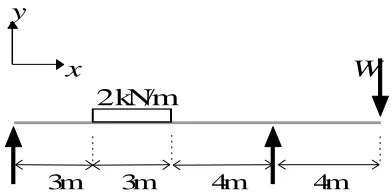
The first Mathematica session for the students was a quick overview of the numeric, symbolic and graphical capabilities of the software. As a final exercise, the students were invited to “apply” their fresh knowledge to a typical loaded beam problem, such as they meet in their initial engineering course on structures. The “structural feel” idea prompted an emphasis not on the mathematics of the problem—which is given to them in full—but on estimating important structural quantities as a load (W, below) is varied, using whatever combination of graphical, numerical and symbolic methods
2 Dr David Lloyd-Smith, to whom we express our thanks.
they choose. These quantities include the point of maximum displacement along the beam, and the point of “contraflexure” (i.e. where the curvature changes sign).
The students were presented with the situation shown in Figure 1, where the up-arrows denote fixed supports, there is a distributed load between x = 3 and x =6, and W is a variable point load:
y
x W 2 kN/m
3m 3m 4m 4m
Figure 1: The loaded beam problem in Civil Engineering.
The students were given the solution for small deflections of the beam. This is conventionally written by engineers in the form:
EIy W x Wx x
x Wx
5
34 22275 33000460 250
3 3
250
3 6 2700014
10 60 3 4 4 3 ( ) ( ) ( ) ( ) ( )( )
The “flexural stiffness” constant EI is typically around 107 so the deflections are very small, of order mm for y when x is of order m (Figure 2).
Figure 2: Graphs of beam displacement (for W ranging from 0 to 4 kN).
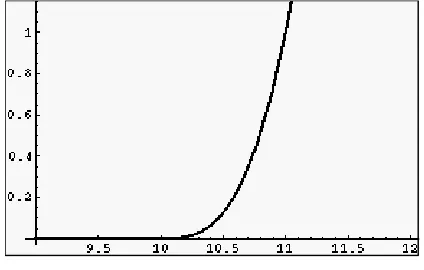
Figure 3: The ramp function “(x10)3”.
While this notational shift is implicit in much of the spoken and written language used with the students, it is made explicit, indeed it must be made explicit, in the Mathematica expression for y which the students are given:
y = (1/EI)*(5(-22275+4W)x/3 + (33000-4W)x3
/60 -
(250/3)*If[x<3,0,(x-3)4
] + (250/3)*If[x<6,0,(x-6)4
] +
(27000+14W)*If[x<10,0,(x-10)3
]/60)
the functions serve in the structural analysis: that the terms containing ramp functions have zero effect on the beam displacement until x reaches a threshold value.
We don’t want to overstate the importance of a small episode, but it does point up the fact that mathematics is not a passive agent. In use, mathematics becomes a means of making sense of the underlying engineering principles. But reciprocally, the mathematics itself is shaped by its application—it takes on meanings which are derived from the setting in which it is used.
Incidentally, we discovered one other curious (to us) phenomenon: in situations like this, the beam’s weight is often negligible in magnitude relative to the other forces in the problem. So the weight is abstracted into the form of a distributed load (pressure). In effect, the beam is abstracted to an “ideal structure” defined only by its geometry, flexibility and material strength.
The Rainbow Bridge
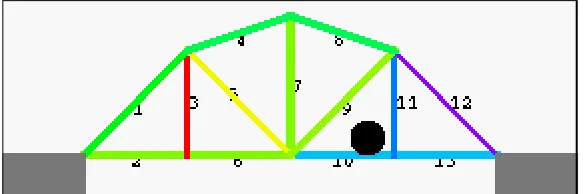
Figure 4: Frame from a “bridge movie”; a test load (black disc) moves across a
(2-D) bridge, whose struts change colour according to the magnitude of the force
caused by the test load (the numbers just index the struts for reference).
Again in the interests of “structural feel”, the students are not required to understand the Mathematica details of how the animation is generated, nor the mathematical details of how the strut forces are calculated (which involves the solution of systems of linear equations). What they do have control over are the magnitude of the test load and the “colour function” which maps a numerical force value onto a range of output colours. They are asked to consider how to design a colour function which yields the most useful information about what is going on in the bridge as the test load moves across it, and to design a function which would allow them to detect the maximum safe load that can cross a bridge given a maximum safe force for any strut.
of the mathematical processes whilst keeping visible the very useful results of that process. Second, the students are invited to engage in an interplay between bottom-level Mathematica programming—defining colour functions—and high-level visualisation. For example, the “maximum safe load” question demands some kind of piecewise-defined function along the lines of (taking 35000 N as the max. safe force in a strut):
overloadFun[force_]:=If[Abs[force]>35000,
GrayLevel[1], (*safe load exceeded – output white*)
Hue[0.8*Abs[force]/35000] (*else output a colour spectrum*)
]
This process of making and criticising representations (i.e. the colour function mappings) is not conventionally recognised as mathematical work, at least not for non-expert, beginning students. But, we think that it reflects a kind of mathematical thinking that has a great deal to do with having a good structural feel. (And we think that it has a strong relationship with diSessa et al’s [6] idea of “meta-representational competence”).
Discussion: Designing for visibility in a mathematical
software environment
In this section, we want to consider the visibility of mathematical calculations in three different software packages—Mathcad, Mathematica and Maple—as well as how, and to what degree, different teachers of engineering mathematics are choosing to make mathematics visible whilst using those packages with students. Insight into the latter was gained from the proceedings of a recent workshop on the use of mathematical software packages in undergraduate engineering education4. This happened to allow us some rather intriguing views on the relationship between epistemology and visibility—in other words, how the intentions of the designer are translated into the conceptual mathematical models developed by the user/learner. As we shall see, the relationship is not straightforward.
Clearly, all the various software manufacturers are interested in appealing to as large an audience of mathematics users as possible, and their “box top” slogans express this: Mathcad—“the worldwide standard for technical calculations”; Mathematica— “the world’s only fully integrated technical computing system”; Maple—“complete mathematics and visualisation system”. But if one looks inside the box, we think that the different epistemologies of engineers and (applied) mathematicians can be made out in the software designs.
Mathematica and Maple are examples of “computer algebra systems”, and represent what an applied mathematician might expect of “computer mathematics”:
4
Organised by METRIC at Imperial College, June 1998. Proceedings are available from
comprehensive sets of symbolic, numerical and graphical functions, expressed in a precise, extensible mathematics-like programming language.
Mathcad is a package very much designed for, and commercially targeted at, engineers. It works rather like a “sketchpad” combination of word processor, spreadsheet and mathematical (mostly numerical) toolbox: inputs and results can be placed quite freely on the screen/page, but they are causally connected behind the scenes. It is interesting to trace the evolution of Mathcad over its past three or four versions. As usual, more functions, menus and palettes have appeared, but a couple of developments seem more indicative of a particular design philosophy: the first is the way that Mathcad’s developers are acquiring the electronic rights to many of the standard engineering data books, and making them available as $200 “electronic library” add-ons to the basic system. Mathcad is data-oriented, and proud of it.
Second, there is a “symbolic toolbox”, that performs a selection of symbolic algorithms, which has grown in mathematical coverage with each new version (in fact, it is a portion of the Maple “mathematics engine” running in the background). We presume that this growth depends not least on the fact that enough users have requested a particular symbolic function to be added. Also, presumably, the developers of Mathcad have to pay the developers of Maple more to use more symbolic functions, which implies a certain conservatism on the part of the former.
However, from the viewpoint of a mathematician, this haphazard growth process could seem pretty worrying. Mathematicians make strong distinctions between symbolic and numerical procedures, so much so that the latter are often treated as a separate field of the discipline (i.e. numerical analysis). This is natural, too; surely it’s the business of mathematicians to make such distinctions?
The message that we take from this comparison of perspectives is that visibility is not a simple issue: it depends on what designers, and users, think “mathematics” is. While it is no surprise that engineers and mathematicians see the function of mathematics differently, it is perhaps more surprising that they may not be thinking about the same mathematics: if that is true, it raises some difficult questions about the nature of applied mathematics itself, and surely indicates that the metaphor of application is, at best, limited.
Should it be the business of engineers to make the same distinctions as mathematicians—to work with the same mathematical epistemology? In particular, do engineering students get the most appropriate mathematical training by following traditional mathematics courses which give pride of place to symbolic techniques, and relegate numerical methods to second place? For example, a speaker at the workshop, a teacher of civil engineering students, declared that a particular bugbear of his is having to re-orientate students who have been taught in school that integration is primarily about backward differentiation (a symbol-oriented view), and secondly about the practical, often numerical, process of determining areas under curves.
difficult to get to grips with it if you’re not willing to think in explicit mathematical terms. Either way, the educator has to come to terms with the design choices that the software developers have made: which mathematical aspects are visible enough, which need to be made more visible, or indeed less visible (as in our rainbow bridge example above).
Summing up, it is clear that the epistemological decisions built into software design far from determine the user’s activities. Epistemological structures shape and are shaped by what the user does, but these are not straightforwardly linked.
Conclusions
We have presented our examples of mathematics teaching and educators’ discussion with the aim of challenging the traditional view of mathematics: that it is either studied in its own right or must inevitably be viewed as a succession of recipes, preferably wrapped in computational dressing. The former view may be attractive to mathematicians, but it has consistently failed engineering and science students. On the other hand, it seems increasingly likely that the latter view will render invisible crucial parts of the scientific and technological endeavour, in ways which relegate mathematics only to the privileged few who design the programs. This is, we think, an increasingly problematic issue, and one which is facing all those whose work involves—implicitly or explicitly—mathematical knowledge and techniques.
practice, overturning the traditional roles of mathematicians as makers of models, and other people in the design and production process as consumers of models:
General-purpose IT tools such as spreadsheets, and mathematically based environments and workbenches such as Mathcad and Matlab have made it easier for engineers, dealers, salesmen, managers and others to construct their own models and refine them for specific applications. When time is of the essence, the value of these tools lies in the rapid prototyping they allow: initial modelling ideas can be investigated by the potential users, and the resulting interaction often leads to an improved match between the model and the users’ requirements. Modern graphical user interfaces … can be designed to make even the most sophisticated special-purpose models accessible to the people who need to use them, helping to remove the “ivory tower” and “back room” images that have sometimes been attached to mathematicians in the past. [7, p. 25]
Clayton’s insight may be crucial for effective university mathematics teaching in the future. The perennial debate over whether mathematics should be taught by mathematicians or by engineers looks increasingly anachronistic in the light of technological change, and modern industrial working practice. We think it is more instructive to examine the potential of mathematical technology to change the relationships between mathematicians and engineers, and to connect both people, and the knowledge domains in which they work, in new ways.
other, and perhaps to our students) we see this as a mathematical opportunity: in contrast, leaving this issue (and the mathematics) invisible must, we think, be a source of difficulty.
References
[1] Wolfram, S. , 1996, The Mathematica Book, third edition (Cambridge University Press).
[2] Sutherland, R. and Pozzi, S., 1995, The Changing Mathematical Background of Undergraduate Engineers: A review of the issues, The Engineering Council (London).
[3] LMS, IMA and RSS, 1995, Tackling the Mathematics Problem, a joint report by the London Mathematical Society, Institute for Mathematics and its Applications, and the Royal Statistical Society.
[4] Cox, W., Norris, W. T. and Penny, J. E. T., 1995, Mathematics in engineering teaching at university—a practitioner’s dilemma, in Mathematical Education of Engineers, edited by L. R. Mustoe and S. Hibberd (Oxford University Press), pp. 251-266.
[5] Wilkinson, T. S., 1995, Mathematics for engineers: an industrial view, in Mathematical Education of Engineers, edited by L. R. Mustoe and S. Hibberd (Oxford University Press), pp. 3-14.
[6] diSessa, A., Hammer, D., Sherin, B., & Kolpakowski, T., 1991, Journal of Mathematical Behavior, 10(2), 117-160.