Foundations of Reconfigurable PUFs
Jonas Schneider and Dominique Schr¨oder Saarland University
Abstract. A Physically Unclonable Function (PUF) can be seen as a source of randomness that can be challenged with a stimulus and responds in a way that is to some extent unpredictable. PUFs can be used to provide efficient solutions for common cryptographic primitives such as identi-fication/authentication schemes, key storage, and hardware-entangled cryptography. Moreover, Brzuska et al. have recently shown, that PUFs can be used to construct UC secure protocols (CRYPTO 2011). Most PUF instantiations, however, only provide a static challenge/response space which limits their usefulness for practical instantiations. To overcome this limitation, Katzenbeisser et al. (CHES 2011) introduced Logically Reconfigurable PUFs (LR-PUFs), with the idea to introduce an “up-date” mechanism that changes the challenge/response behaviour without physically replacing or modifying the hardware.
In this work, we revisit LR-PUFs. We propose several new ways to characterize the unpredictability of LR-PUFs covering a broader class of realistic attacks and examine their relationship to each other. In addition, we reconcile existing constructions with these new characterizations and show that they can withstand stronger adversaries than originally shown. Since previous constructions are insecure with respect to our strongest unpredictability notion, we propose a secure construction which relies on the same assumptions and is almost as efficient as previous solutions. This work appeared as part of the Bachelor thesis of Jonas Schneider submitted at Saarland University on September 11, 2013.
Keywords:Physically Unclonable Functions, Logically Reconfigurable, Tamper-resistance.
1
Introduction
To overcome this limitation, Katzenbeisser et al. [8] introduced Logically Recon-figurable PUFs (LR-PUFs), with the idea to introduce an “update” mechanism that allows to change the input/output behaviour of a PUF. In this work, we revisit LR-PUFs presenting several ways to characterize the unpredictability, we examine their relationship to each other, and we show that previous constructions can withstand stronger adversaries than originally shown.
1.1 Background and Related Work
Physically Unclonable Functions were proposed as Physical One-Way Func-tions [12]. They consist of a physical device which can be challenged with a stimulus and responds in a way that is to some extent unpredictable.
– The PUF provides unpredictable, but robust responses. This means the response for a given challenge does not vary beyond a typically low bound, but it should be not be possible to predict the response for a stimulus that has not yet been applied.
– The PUF is not clonable, i.e., one cannot produce a device which exhibits the same response behavior. This goes even as far as not being able to recreate the same behavior if one has physical access to the device itself and not just a list of challenge-response pairs.
State
PUF
Query c Response r
Reconfiguration
Logic LR-PUF
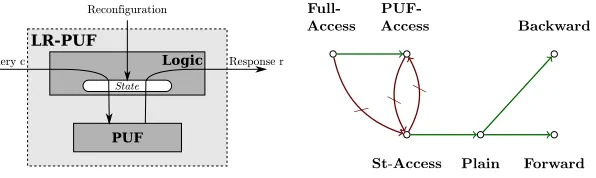
Fig. 1Schematic of a generic Logically Reconfigurable PUF construction.
Full-Access
PUF-Access
St-Access Plain Forward Backward
6 6
6
Fig. 2The relations between the unpredictability notions we introduce.
The tamper-evidence property forbids most PUF designs to have a stimulus-response behavior which is anything but static. In applications where PUFs serve as physical tokens for e.g., access control this can be a disadvantage. Consider for example that the PUF-token should be transferable to a different person. The traditional PUF designs do not allow this, unless the new owner of the PUF should be allowed to carry the same credentials as the previous owner. Thus, there have been efforts to construct reconfigurable PUFs, the first being Controlled Physical Random Functions [6], and a more recent one being Reconfigurable PUFs, short rPUFs [9].
Both of these approaches have their own limitations. Controlled PUFs effec-tively limit the PUF response space a single user can draw from, thereby lessening security. Physically reconfigurable rPUFs require a potentially costly physical reconfiguration process, and there are no guarantees regarding the effectiveness of that process.
A solution which aims to sidestep these limitations are Logically Reconfig-urable PUFs (LR-PUFs) [8]. In this approach, reconfiguration leaves the physical device untouched and is instead performed on a piece of state, which is stored together with the PUF. The stimulus mechanism of the PUF is encapsulated in a query algorithm, which processes challenges by entangling them in some way with the current state of the device. SeeFigure 1for a visual representation of the LR-PUF concept. The idea is a combination of the state and the challenge to perform alogical reconfiguration, in which a new state is chosen instead of altering the actual physical device. This preserves the original input/output characteristics of the PUF, but does not require physical manipulation of the device.
1.2 Applications
PUFs have a wide range of applications such as key extraction and authentica-tion [18,15,16,17], remote attestation [15], and tamper-proof and fault injection resilient implementations of cryptographic primitives [14, 3, 1]. Most of these applications assume that the PUFs are somewhat ideal in the sense that they support large challenge and/or response spaces. Since most of the known PUF instantiations do not fulfil these properties, LR-PUFs seem to be better suited. Another application of LR-PUFs are electronic fare systems for public transport as suggested in [8]. In this setting, an access token is equipped with an LR-PUF, that serves to authenticate the passenger at the entry points to the transport system and can be used to secure a credit stored on the token. The reconfiguration capability of the device enables the easy reuse of tokens, as reconfiguration of the LR-PUF is (ideally) equivalent to physically replacing the device without causing the cost of a new device.
part of the device, making the key dependent on the unique properties of the PUF in each device. This prevents cloning of the software to a new device, as the key on a cloned device will be generated differently. The reconfigurability is used in the event of a software update, to prevent downgrading to an older version of the software. In this event, a new key to encrypt the updated software is derived, and the old software version will no longer be useful, because the old key can no longer be retrieved from the LR-PUF.
1.3 Contribution
We revisit the LR-PUFs as introduced in [8] and present several ways to chara-terize the unpredictability notion. We reconsider existing constructions with respect to these new measures, and we propose a novel construction that is secure w.r.t. our strongest notion of unpredictability. In the following, we discuss each contribution more in detail.
Definitions We introduce four different notions of unpredictability. The first one is calledPlain-unpredictability and it is a natural extension of backward/forward-unpredictability of [8]. The basic idea of this definition is to allow the adversary to reconfigure the PUF several times. The second notion, called St-Access-unpredictability, removes the assumption that the state is stored in a tamper-evident manner and allows the adversary to directly write the state. The third notion, calledPUF-Access-unpredictability, models the case where the adver-sary manages to bypass the query and reconfiguration logic and where it gains direct access to the PUF. The fourth notion, calledFull-Access-unpredictability, combinesPUF-Access-unpredictability andSt-Accessunpredictability in the sense that the adversary has direct access to the PUF and is allowed to set the state maliciously. Perhaps surprisingly there is an obstacle when trying to compare the power of state-setting adversaries to PUF-access adversaries. The issue is that a PUF-access adversary might be able to completely precompute the behavior of an LR-PUF given the current state, which makes both notions incomparable. A visual representation of these relations is given in Figure 2, where an arrowA→B denotes, that notionA implies notion Band an arrow A6→Bmeans that notionAdoes not imply notionB.
tamper-evident manner. On the negative side we show that both constructions are not secure against adversaries that have direct access to the PUF. In fact, our result here is more general, showing that any LR-PUF cannot satisfy this notion where access to the underlying PUF makes the query and reconfiguration algorithms completely predictable to the adversary.
Construction We propose a simple LR-PUF construction that is Full-Access-unpredictable. Our scheme can be seen as a randomized variant of the “speed-optimized” construction from [8] with the difference being that our reconfiguration algorithm samples a fresh state st upon reconfiguration and it evaluates the underlying PUF on w ← Hash(st || c). This construction relies on the same computational assumptions as the scheme of [8], it is almost as efficient, but it satisfies bothFull-Access- andSt-Access-unpredictability.
1.4 Outline
In Section 2we give some background by reviewing a formalization of Physically Unclonable Functions and present our formalization of LR-PUFs. Section 3 introduces the new unpredictability notions we propose and the relations among them.Section 4contains the specification of a construction which achieves the strongest of our unpredictability notions.
2
Logically Reconfigurable PUFs
2.1 Notations
In this paper, we will consider only PPT algorithms, some of which will have access to a PUF (seesection Bfor a short discussion of the implications of PUF access on computational hardness assumptions). LetAbe such an algorithm. We denote withy←$A(x) thaty is the output that was (possibly probabilistically)
computed byAon inputx. IfAis a deterministic algorithm, we writey← A(x) to mean that y is the deterministic output of Aon input x. The core of our definitions is formed by experiments and if EXAMPLEis such an experiment we write “EXAMPLE=x” to mean that upon finishing, the experimentEXAMPLE outputs x. For two bit strings x, y ∈ {0,1}n let further dis(x, y) denote the
Hamming distance ofxandy.
2.2 Physically Unclonable Functions
Definition 1 (Physically Unclonable Functions). Let ρbe the dimension of the range of the PUF responses of the PUF family, and letdnoisebe a bound on
the PUF’s noise. A pairP = (S,E)is a family of(ρ, dnoise)-PUFs if it satisfies
the following properties:
Index Sampling. Let Iλ be an index set. The sampling algorithm S outputs,
on input the security parameter 1λ, an indexid∈ Iλ. We do not require that
the index sampling can be done efficiently. Each index id∈ Iλ corresponds
to a set Did of distributions. For each challenge c ∈ {0,1}λ, Did contains
a distribution Did(c) on {0,1}ρ(c). We do not require that Did has a short
description or an efficient sampling algorithm.
Evaluation. The evaluation algorithm Egets as input a tuple(1λ,id, c), where c∈ {0,1}λ. It outputs a response r∈ {0,1}ρ(λ)according to distribution D
id.
It is notrequired thatE is a PPT algorithm.
Bounded Noise. For all indices id∈ I, for all challengesc∈ {0,1}λ, we have
that when running E(1λ,id, c)twice, then for any two outputs r
1, r2 that are
produced the Hamming distancedis(r1, r2)is smaller thandnoise(λ).
Unpredictability of PUFs Loosely speaking, a PUF is unpredictable if it is difficult to predict the response of the PUF to a given, previously unknown challenge. This intuition is formalized in an experiment where the adversary can adaptively query the PUF on challenges of its choice and wins if it can predict the response to a fresh challenge of its choice, within the bound dnoise. Fresh
means that the adversary did not query the PUF on this challenge.
Definition 2 (PUF-Unpredictability). A family of PUFs P = (S,E)is un-predictable if for any PPT algorithm A the probability that the experiment PREPA(λ)evaluates to 1 is negligible (in the security parameter λ), where
ExperimentPREPA(λ) id←S(1λ)
(c∗, r∗)← AE(id)
r←E(c∗)
Return 1 iffdis(r, r∗)≤dnoise andc∗ is fresh.
For the sake of simplicity we use this game based definition of unpredictability. A formulation with respect to entropy contained in the PUF responses is given in [4]. A comprehensive and more in-depth game-based formulation of PUF properties is found in [2].
2.3 Definition of Logically Reconfigurable PUFs
Definition 3 (Logically Reconfigurable PUFs).Let P= (S,E)be a family of (ρ, dnoise)-PUFs. A logically reconfigurable PUF (LR-PUF) with black-box
access toP is a tuple of efficient algorithmsL= (SetupS,E,QueryE,RcnfE), which satisfies the following properties
Setup. TheSetupalgorithm takes as input the security parameter1λ. It outputs
an indexid∈ I, determining the underlying PUF fromP and an initial state st∈ {0,1}`(λ) of the LR-PUF. We require that `(λ)≥λ.
Query mechanism. The Queryst algorithm takes as input a challenge c ∈ {0,1}λ and outputs a response r∈ρ(λ).
Reconfiguration. TheRcnfst algorithm updates the state of the LR-PUF to a
new statest0∈ {0,1}`(λ) which is (possibly probabilistically) computed from
the old state st. The new state is also output.
The three algorithms may interact with the underlying PUF family via the oracles EandS. We will often omit giving the oracle access explicitly. Additionally, we assume that the noise of the LR-PUF responses is bounded in the same way as the noise of the underlying PUF’s responses.
Remark 1. The setup algorithm of almost all constructions in this paper is the same and consists of the following steps.Setup(1λ) generates the underlying PUF
id←$S(1λ), chooses a stringst←${0,1}`(λ)uniformly at random, and outputs
(id,st). In the following, unless stated otherwise, all constructions will use this standard setup algorithm.
Unpredictability of LR-PUFs Ideally, an LR-PUF in one specific state should be as unpredictable as its underlying physical PUF, so the internal state of the LR-PUF can be seen as a mapping from LR-PUF queries to PUF queries that is ideally a permutation. Reconfiguration then constitutes a “shuffling” of this mapping, such that a completely new permutation is reached. To formalize this, the authors of [8] propose two complimentary notions of unpredictability: Forward-unpredictability: The reconfiguration changes the mapping in such
a way, that knowledge about the previous state does not enable an adversary to predict the challenge-response behavior for the reconfigured LR-PUF. Backward-unpredictability: The reconfiguration reveals no additional
infor-mation about the old internal state, i.e., after reconfiguration an adversary should not be able to predict the challenge-response behavior for the old state.
We provide a formal characterization of these properties as derivatives of our plain unpredictability notion (seeDefinition 4).
3
New Notions of Unpredictability
3.1 Multiple Reconfigurations
In [8], the unpredictability experiments revolve around a single reconfiguration process. However, an adversary might witness several reconfigurations and thereby deduce some information about the influence of the state on the LR-PUFs behavior. This motivates our first unpredictability definition, which is an extension of the backward/forward-unpredictability properties to multiple reconfigurations of the LR-PUF. To this end, we provide the adversary access to a reconfiguration oracle, which invokes the reconfiguration algorithm.
LetRcnf denote the reconfiguration oracle for an LR-PUF L with current state st. The oracleRcnf accepts two kinds of inputs:⊥, upon whichRcnfst is
invoked, andst0 upon which the internal state ofLis set tost0. The latter input functionality allows the adversary to program the state and is only available to state-setting adversaries (see Appendix 3.2). LetS denote the list of states the adversary obtains over the course of an experiment, be it throughSetupor the oracleRcnf. Further, let Querydenote the query oracle, which takes as input a statestand a challengecand returnsQueryst(c) to the adversary. The adversary can only invoke the query oracle with states stored inS.
Definition 4 (Plain-Unpredictability).An LR-PUFL= (Setup,Queryst,Rcnfst)
is unpredictable if for any PPT adversaryAthe probability that the experiment PLAINLA(λ) evaluates to 1 is negligible (in the security parameterλ), where
ExperimentPLAINLA(λ) (id,st)←Setup(1λ)
(st∗, c∗, r∗)← AQuery,Rcnf(⊥)(1λ,st) r←Queryst∗(c∗)
Output 1 iff dis(r, r∗)≤dnoise andc∗ was not previously queried toQuery(st∗,·)andst∗∈ S.
Remark 2. We can obtain the backward- and forward-unpredictability notions de-scribed in [8] by considering restricted adversaries that invokeRcnf(⊥) only once, setting and obtaining the new statest0, in the following only queryQuery(st0,·). Corollary 1. LetL be aPlain-unpredictable LR-PUF, thenLis also backward-and forward-unpredictable.
Separation of Plain- and Backward/Forward-Unpredictability In what follows we show thatPlain-unpredictability is strictly stronger than the previous notions. LetBackwardLA(λ) (resp.ForwardLA(λ)) denote PrhPLAINLA(λ) = 1i whereAis a backward-unpredictability adversary (resp. forward-unpredictability adversary) as described above. We separate the security notions with the following two propositions.
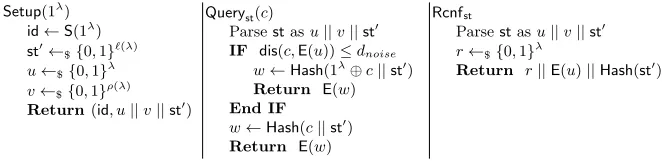
The basic idea of our counterexample is to let the adversary learn a prediction by calling the reconfiguration oracle. This prediction, however, only helps him in combination with the evaluation oracle, that outputs the evaluation on a point different from the challenge, if the query contains a specific prediction. More precisely, we store a pair (u, v) in the state. Then we modify the query algorithm, whose input is a challengec, such that it evaluates the PUF on 1λ⊕ckst0
if c=E(u). Clearly, in our construction the attacker can never invoke the query oracle onuand thus, cannot exploit this part directly. However, whenever the attacker queries the reconfiguration oracle, it obtains this answer through the state.
Proof.LetP = (S,E) be an unpredictable PUF in the sense ofDefinition 2, i.e.,
for any PPT adversaryAthere is a negligible functionε0(λ) with Pr[PREPA(λ) = 1] =ε0(λ). UsingP we construct a new LR-PUFL= (Setup,Query,Rcnf), where the algorithms are defined inFigure 3.
Setup(1λ)
id←S(1λ)
st0←${0,1}`(λ) u←${0,1}λ v←${0,1}ρ(λ) Return(id, u||v||st0)
Queryst(c)
Parsestasu||v||st0 IF dis(c,E(u))≤dnoise
w←Hash(1λ⊕c||st0 )
Return E(w)
End IF w←Hash(c||st0)
Return E(w)
Rcnfst
Parsestasu||v||st0 r←${0,1}λ
Return r||E(u)||Hash(st0)
Fig. 3 This construction is backward-unpredictable, but notPlain-unpredictable.
First, we show thatL retains backward-unpredictability. Suppose thatAis an adversary against its backward-unpredictability. Recall thatAreceives the initial statest0= (u0||v0||st00),and it may invoke the query oracle adaptively
on that state. In the next step the PUF is reconfigured, after which the adversary can again ask the query oracle on challenges of its choice. The new state is st1= (u1||v1||st01).Eventually, the adversary outputs its prediction (c∗, r∗) for
the initial statest0, succeeding if the prediction is valid and for a fresh challenge c∗.
Let PrePA(λ) := Pr[PREPA(λ) = 1] and let bad denote the event, that the adversary in the first query phase issues a query ˆcwith ˆc=E(u0). In this event,
the adversary will receive a response for a challenge it did not issue, namely ˆ
r=Queryst0 1λ⊕ˆc
. Upon reconfiguration, it will be revealed to the adversary that
dis(ˆc=v1,E(u0))≤dnoise,
giving it the opportunity to output (st0,1λ⊕ˆc,ˆr) as a succeeding prediction.
Becauseu0 is drawn at random from the challenge space of the underlying PUF
Consider the case that the event bad does not happen. In this case, the construction’sQueryalgorithm behaves identical to theQuery algorithm of the speed optimized constructionspeedfrom [8]. Here we can use thatspeedwas shown to be Backward-unpredictable in [8]. Let BackwardspeedA be the probability that PLAINspeedA (λ) = 1.
Lemma 1 (Proposition 1, [8]). If the underlying PUFP is unpredictable to adversaries that issue polynomially many queries, then thespeed construction is Backward-unpredictable to these adversaries.
The difference in the reconfiguration algorithm does not harm this claim, as the same proof works with the minor modification that the reduction against the unpredictability ofP must issue one additional query to it’s PUF oracle during the reconfiguration phase. UsingLemma 1it follows:
Backward
L
A(λ)−Backward
speed
A (λ)
=
Pr
h
PLAINLA(λ) = 1|badiPr [bad] + PrhPLAINLA(λ) = 1|¬badi(1−Pr [bad]) −PrhPLAINspeedA (λ) = 1i
= Pr [bad] + Pr [bad]BackwardspeedA (λ)≤PrePA(λ) +PrePA(λ)BackwardspeedA (λ) ≤negl(λ).
As mentioned aboveLleaks information about the challenge-response-behavior of the previous state upon reconfiguration, thus enabling an attacker to make a valid prediction if it is able to query the old state again. Specifically we construct an adversary A which makes 1 query to Query, invokes Rcnf once and for which Pr[PLAINA(λ) = 1] = 1. Upon receiving the security parameter and the initial state st0 = u0 || v0 || st00, A immediately invokes Rcnf
receiv-ing st1 = r || E(u0) || Hash(st00). Given c0 := E(u0), the adversary can call
Query(st0, c0) to receiver∗=Queryst0(1
λ⊕c0).
Athen returns (st0,1λ⊕c0, r∗). This will be a valid output, sinceAhas never
queriedQuery(st0,·) on 1λ⊕c0.
Proposition 2. If collision-resistant hash functions relative to a PUF (cf. Ap-pendix B) exist, then there exist forward-unpredictable LR-PUFs, which are not Plain-unpredictable.
The proof is analogous to the one ofProposition 1, as the same construction describe there is also forward-unpredictable and is thus omitted.
3.2 State-setting Adversaries
the state, even though the internal physical PUF is tamper-evident. Therefore, we propose the following unpredictability notion, in which an adversary can set the internal state of the LR-PUF. As mentioned above, this is formalized via the type of inputs to the reconfiguration oracleRcnfwhich are arbitrary states that are to be set as the new state of the LR-PUF.
Definition 5 (St-Access-Unpredictability).An LR-PUFL= (Setup,Queryst, Rcnfst)is unpredictable for a state-setting adversary if for any PPT adversary
Athe probability that the experimentST-ACCESSLA(λ)evaluates to 1 is negligible (in the security parameterλ), where
ExperimentST-ACCESSLA(λ) (id,st)←Setup(1λ)
(st∗, c∗, r∗)← AQuery,Rcnf(1λ,st) r←Queryst∗(c∗)
Output 1 iff dis(r, r∗)≤dnoise andc∗ was not previously queried toQuery(st∗,·)andst∗∈ S.
The state-setting adversary can be thought of as bypassing the reconfiguration algorithm, thus security against state-setting adversaries should be considered a property of theQuery mechanism.
Remark 3. It is easy to see that an LR-PUF construction satisfying this notion of unpredictability must also bePlain-unpredictable (Definition 4). Any adver-sary againstPlain-unpredictability is also a valid adversary in the ST-ACCESS-unpredictability experiment, which simply does not invoke the reconfiguration oracle on an input other than⊥.
Corollary 2. LetL= (Setup,Queryst,Rcnfst)beSt-Access-unpredictable. Then
L is alsoPlain-unpredictable.
The inverse relationship does, however, not hold.
Proposition 3. There existPlain-unpredictable LR-PUF constructions, which are not St-Access-unpredictable.
Proof.To show the separation, we consider a construction which has a
“vul-nerable” state, i.e., a state which does not support a secure reconfiguration. A state-setting adversary can then prepare the LR-PUF to have that state and get an advantage through the defective reconfiguration algorithm. An adversary without state-setting capabilities, however, would have to wait for that state to occur in a chain of honest reconfigurations to get any advantage, as long as the reconfiguration is working correctly for any other state.
LetL0 = (Setup0,Query0st,Rcnf0st) be aPlain-unpredictable LR-PUF. Using L0 we define L ..= (Setup,Query0
st,Rcnfst), where the algorithms are defined
in Figure 4.
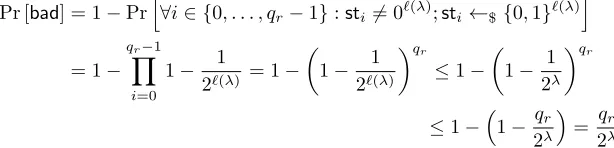
Letbaddenote the event that the state of the LR-PUF will become (st0||r) withst0=rin an experiment whereRcnfis queried at mostqrtimes. In this case,
Setup(1λ)
(id,st)←Setup0(1λ)
st0←${0,1}ρ(λ) Return (id,st0||0ρ(λ))
Rcnfst0||r
IFst0=rTHEN
st0←${0,1}ρ(λ)
r←Query0st0(0λ) ELSE
st0←${0,1}ρ(λ)
r←${0,1}ρ(λ) Return st0||r
Fig. 4 This construction isPlain-unpredictable, but not St-Access-unpredictable.
Let st0, . . . ,stqr−1 be the states which are generated in the experiment. Then,
we calculate the probability that this event happens as
Pr [bad] = 1−Prh∀i∈ {0, . . . , qr−1}:sti 6= 0`(λ);sti←${0,1}`(λ)
i
= 1−
qr−1 Y
i=0
1− 1
2`(λ) = 1−
1− 1 2`(λ)
qr
≤1−
1− 1 2λ
qr
≤1−1−qr 2λ
= qr 2λ
LetAbe an adversary against thePlain-unpredictability of L. Unless the event badoccurs, Ais playing in the Plain-unpredictability experiment ofL0. This means, unlessbadoccurs, Lis asPlain-unpredictable asL.
BecauseAis a PPT algorithm, there is a polynomial bound on the number of reconfiguration queriesAcan make. Thus the probability of the eventbadis negligible inλ. This means:
Plain
L0
A(λ)−PlainLA(λ)
=
Pr[bad] + (1−Pr[bad])Plain
L
A(λ)−PlainLA(λ)
=
Pr[bad]−Pr[bad]Plain
L A(λ)
≤Pr[bad]≤
qr
2λ ≤negl(λ).
Because we have assumedL0 to bePlain-unpredictable, this shows thatLis Plain-unpredictable.
The construction is notST-ACCESS-unpredictable, since the adversary may set the LR-PUF state to 0λand by invoking Rcnf(⊥) subsequently, learn a new
statest0 and the responserfor the query 0λ in that state.
3.3 Direct Access Adversaries
the real world, however, it might be that case that the attacker finds a way to stimulate the physical PUF directly, circumventing the control logic of the LR-PUF. In what follows, we remove this assumption by giving the adversary direct access to the embedded PUF as well.
Definition 6 (PUF-Access-Unpredictability). An LR-PUF L = (Setup, Queryst,Rcnfst) is unpredictable for an adversary with direct PUF access if
for any PPT adversary Athe probability that the experimentPUF-ACCESSLA(λ) evaluates to 1 is negligible (in the security parameterλ), where
ExperimentPUF-ACCESSLA(λ) (id,st)←Setup(1λ)
(st∗, c∗, r∗)← ARcnf(⊥),E(1λ,st)
Set LR-PUF state tost∗ usingRcnf(st∗) st0 ←Rcnfst∗
r←Queryst0(c∗)
Output 1 iff dis(r, r∗)≤dnoise.
Because an LR-PUF construction might rely solely upon the PUF itself to perform reconfiguration and querying, an adversary that has access to the PUF may be able, given the current state of the PUF, to compute challenge-response pairs for all the following states the LR-PUF will have.
Proposition 4. If collision-resistant hash functions relative to a PUF exist, then there exists a Plain-unpredictable LR-PUF construction, which is not PUF-Access-unpredictable.
Proof.Consider the speed-optimized construction given in [8]. We will later show,
that this construction isSt-Access-unpredictable (cf.Proposition 9). Because St-Access-unpredictability impliesPlain-unpredictability, the construction is alsoPlain-unpredictable. The construction is notPUF-ACCESS-unpredictable, since an attackerAwhich has access to a PUF evaluation oracleEcan simulate bothQueryandRcnf, thus enabling the creation of valid challenge-response pairs,
while bypassing theQueryandRcnf oracles.
Perhaps surprisingly there is an obstacle when trying to compare the power of state-setting adversaries to PUF-access adversaries. As described above, a PUF-access adversary might be able to completely precompute the behavior of an LR-PUF given the current state. Thus the definition of PUF-Access-unpredictability demands the adversary predict a challenge response pair not for the state, which it finally outputs, but for the state which results from the reconfiguration based on that state. This excludes bypassing theRcnf oracle and enables the definition to capture the unpredictability gain provided by theRcnf algorithm.
i) There exists an LR-PUF which isPUF-Access-unpredictable but not St-Access-unpredictable.
ii) If collision-resistant hash functions w.r.t. PUFs exist, there exist LR-PUFs, which areSt-Access-unpredictable but notPUF-Access-unpredictable.
The proof of this proposition can be found inAppendix A.
3.4 Full Access Adversaries
A combination of the previous scenarios provides the PUF access adversary with the possibility to set the internal state. This is intuitively the strongest notion, as it provides the adversary with essentially complete control over the LR-PUF during the query phase of the experiment.
Definition 7 (Full-Access-Unpredictability). An LR-PUF L = (Setup, Queryst,Rcnfst)is unpredictable for a state-setting adversary with PUF accessif
for any PPT adversaryAthe probability that the experiment FULL-ACCESSLA(λ) evaluates to 1 is negligible (in the security parameterλ), where
ExperimentFULL-ACCESSLA(λ) (id,st)←SetupS,E(1λ)
(st∗, c∗, r∗)← ARcnf,E(1λ,st)
Set LR-PUF state tost∗ usingRcnf(st∗) st0 ←Rcnfst∗
r←Queryst0(c∗)
Output 1 iff dis(r, r∗)≤dnoise.
Remark 4. AsFull-Access-unpredictability is an immediate extension of PUF-Access-unpredictability, it is easy to see the following corollary is true.
Corollary 3. Let L be aFull-Access-unpredictable LR-PUF. Then L is also PUF-Access-unpredictable.
However, thePUF-Access-unpredictability adversary is strictly weaker than the state-setting Full-Access-unpredictability adversary.
Proposition 6. There are LR-PUF constructions which are PUF-Access-unpredictable, but not Full-Access-unpredictable.
Proof.LetL0= (Setup0,Query0st,Rcnf
0
st) be aPUF-Access-unpredictable
LR-PUF withρ(λ) =`(λ). Using L0 we defineL..= (Setup,Query0
st,Rcnfst), where
the algorithms are defined inFigure 5.
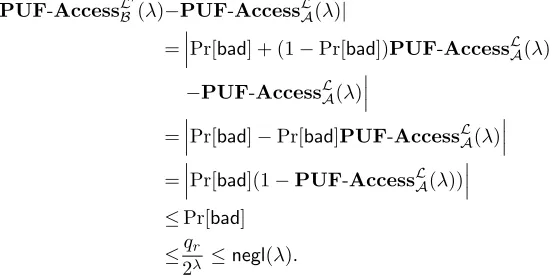
Letbaddenote the event that the state of the LR-PUF will at some point become (st0||r) withst0=rin an experiment withqrinvocations ofRcnf. Again,
as thePUF-Access-unpredictability adversary can only reconfigure the PUF honestly, it holds that
Setup(1λ)
(id,st)←Setup0(1λ)
st0←${0,1}ρ(λ) Return(id,st0||0ρ(λ))
Rcnfst0||r
IFst0=rTHEN
st0..= 0ρ(λ)
r←Query0st0(0λ)
ELSE
st0←${0,1}ρ(λ)
r← {0,1}ρ(λ) Returnst0||r
Fig. 5 This construction isPUF-Access-unpredictable but not Full-Access-unpredictable.
So a reduction against thePUF-Access-unpredictability of the underlying LR-PUFL0, that simply forwards all the oracle queries to its own challenger provides a perfect simulation of the PUF-Access-unpredictability challenger unlessbadoccurs. Thus, for an arbitraryPUF-AccessadversaryA,
|PUF-AccessLB0(λ)−PUF-AccessLA(λ)| =
Pr[bad] + (1−Pr[bad])PUF-Access
L A(λ) −PUF-AccessLA(λ)
=
Pr[bad]−Pr[bad]PUF-Access
L A(λ)
=
Pr[bad](1−PUF-Access
L A(λ))
≤Pr[bad] ≤qr
2λ ≤negl(λ).
The construction is notFull-Access-unpredictable, since a state-setting adver-sary can learn a valid query for a reconfigured state, by choosing a state with st0 =r.
Since Full-Access-unpredictability implies PUF-Access-unpredictability and we because have seen thatSt-Access- and PUF-Access-unpredictability do not imply each other (seeProposition 5),Full-Access-unpredictability can also not follow fromSt-Access-unpredictability.
Corollary 4. There exists a St-Access-unpredictable LR-PUF construction, which is not secure w.r.t. Full-Access-unpredictability.
4
Construction
reconfiguration algorithm chooses a fresh state uniformly at random (instead of computing it as the hash of the old state). Afterwards, we show that the reconfiguration algorithm must be randomized in order to achieve our strongest notion of unpredictability.
Queryst(c)
w←Hash(st||c)
y←E(w) Returny
Rcnfst
st←${0,1}`(λ) Returnst
Fig. 6 ThefullLR-PUF construction.
Theorem 1. The fullconstruction (Figure 6) is Full-Access-unpredictable.
Proof.LetAbe a PPTFull-Access-adversary against full. At the end of the
experimentFULL-ACCESSfullA(λ), this adversary will output a triple (st∗, c∗, r∗) and will win if r∗ =Queryst0(c∗), wherest0 is obtained by invoking Rcnfst∗. If
Acan be sure that full will be queried withc∗ on some specific state ˆst it can easily predict the responser∗ using the PUF-oracleE. Thus, fix ˆst∈ {0,1}`(λ)
and letstate-hitdenote the event that ˆstis the output ofRcnfst∗. Because infull,
the Rcnfst algorithm draws the new state independently from the old one and at
random it holds that
Pr[state-hit] = Pr[st= ˆst;st←$Rcnfst∗()]
= 1
2`(λ) ≤
1 2λ.
In the case that the newly reconfigured device does not have the state desired by the adversary, letpredict denote the event that the adversaries prediction is valid even for this state. Then
Pr[predict] = Pr[r=r∗;r←E(Hash(st||c∗)),st←${0,1}`(λ)]
= Pr[r=r∗;r←E(Hash(c)), c←${0,1}`(λ)+λ]
≤PrePA(λ).
Pulling the two cases together yields the overallFull-Access-predictability offull:
Full-AccessfullA(λ) = Pr[state-hit] + (1−Pr[state-hit]) Pr[predict] ≤ 1
2λ +Pre P A(λ).
Proposition 7. Thefull construction is St-Access-unpredictable.
Proof.As the construction’sQueryalgorithm is the same as thespeed-construction’s
(seeFigure 7), and theRcnf-algorithm cannot be used in any advantageous way by an adversary, the construction is St-Access-unpredictable as long as the speed-construction isSt-Access-unpredictable. This is shown inProposition 9.
5
Conclusion
In this paper, we have reconsidered the concept of Logically Reconfigurable PUFs, an extension of the PUF primitive with applications in embedded devices for access control or object tracking. We have given a formal definition of LR-PUFs and presented several new notions of unpredictability, which help to classify constructions according to the scenarios they could be employed in. An evaluation of two previously given construction has shown these constructions to withstand stronger adversaries than initially shown. Finally, we have given a new construction that can handle the strongest adversaries defined in this work and we have seen that these notions create an interesting separation between such constructions that rely on deterministic reconfiguration algorithms and such that randomize reconfiguration.
Acknowledgements
Dominique Schr¨oder was supported by the German Federal Ministry of Educatio-nand Research (BMBF) through funding for the Center for IT-Security, Privacy and Accountability (CISPA – www.cispa-security.org) and also by an Intel Early Career Faculty Honor Program Award. Finally, we thank the reviewers for their valuable comments.
Bibliography
[1] K. D. Akdemir, Z. Wang, M. Karpovsky, and B. Sunar. Design of crypto-graphic devices resilient to fault injection attacks using nonlinear robust codes. In M. Joye and M. Tunstall, editors,Fault Analysis in Cryptography, Information Security and Cryptography, pages 171–199. Springer Berlin Heidelberg, 2012.
[3] F. Armknecht, R. Maes, A.-R. Sadeghi, B. Sunar, and P. Tuyls. Memory leakage-resilient encryption based on physically unclonable functions. In M. Matsui, editor,ASIACRYPT 2009, volume 5912 ofLNCS, pages 685–702, Tokyo, Japan, Dec. 6–10, 2009. Springer, Berlin, Germany.
[4] C. Brzuska, M. Fischlin, H. Schr¨oder, and S. Katzenbeisser. Physically uncloneable functions in the universal composition framework. In P. Rogaway, editor,CRYPTO 2011, volume 6841 ofLNCS, pages 51–70, Santa Barbara, CA, USA, Aug. 14–18, 2011. Springer, Berlin, Germany.
[5] I. Eichhorn, P. Koeberl, and V. van der Leest. Logically reconfigurable pufs: Memory-based secure key storage. InProceedings of the sixth ACM workshop on Scalable trusted computing, pages 59–64. ACM, 2011.
[6] B. Gassend, D. Clarke, M. van Dijk, and S. Devadas. Controlled physical random functions. InIn Proceedings of the 18th Annual Computer Security Conference, 2002.
[7] J. Katz and Y. Lindell. Introduction to Modern Cryptography. CRC Press, Boca Raton, Fla, 2008.
[8] S. Katzenbeisser, ¨U. Ko¸cabas, V. van der Leest, A.-R. Sadeghi, G. J. Schrijen, H. Schr¨oder, and C. Wachsmann. Recyclable PUFs: Logically reconfigurable PUFs. In B. Preneel and T. Takagi, editors,CHES 2011, volume 6917 of LNCS, pages 374–389, Nara, Japan, Sept. 28 – Oct. 1, 2011. Springer, Berlin, Germany.
[9] K. Kursawe, A. Sadeghi, D. Schellekens, B. Skoric, and P. Tuyls. Recon-figurable physical unclonable functions - enabling technology for tamper-resistant storage. InHardware-Oriented Security and Trust, 2009. HOST ’09. IEEE International Workshop on, pages 22–29, 2009.
[10] R. Maes and I. Verbauwhede. Physically unclonable functions: A study on the state of the art and future research directions. In A.-R. Sadeghi and D. Naccache, editors,Towards Hardware-Intrinsic Security, Information Security and Cryptography, pages 3–37. Springer Berlin Heidelberg, 2010. [11] R. Ostrovsky, A. Scafuro, I. Visconti, and A. Wadia. Universally composable
secure computation with (malicious) physically uncloneable functions. In T. Johansson and P. Q. Nguyen, editors,Advances in Cryptology – EURO-CRYPT 2013, volume 7881 ofLecture Notes in Computer Science, pages 702–718. Springer Berlin Heidelberg, 2013.
[12] R. S. Pappu. Physical one-way functions. PhD thesis, 2001.
[13] U. R¨uhrmair, J. S¨olter, and F. Sehnke. On the foundations of physical unclonable functions. Cryptology ePrint Archive, Report 2009/277, 2009.
http://eprint.iacr.org/.
[14] A.-R. Sadeghi, I. Visconti, and C. Wachsmann. PUF-Enhanced RFID Security and Privacy. In Secure Component and System Identification (SECSI), Cologne, Germany, Apr. 2010.
[16] G. E. Suh and S. Devadas. Physical unclonable functions for device authen-tication and secret key generation. InProceedings of the 44th annual Design Automation Conference, DAC ’07, pages 9–14, New York, NY, USA, 2007. ACM.
[17] P. Tuyls and L. Batina. RFID-Tags for Anti-counterfeiting. In D. Pointcheval, editor,Topics in Cryptology – CT-RSA 2006, volume 3860 ofLecture Notes in Computer Science, pages 115–131. Springer Berlin Heidelberg, 2006. [18] B. ˇSkori´c, P. Tuyls, and W. Ophey. Robust key extraction from physical
uncloneable functions. In J. Ioannidis, A. Keromytis, and M. Yung, editors, Applied Cryptography and Network Security, volume 3531 ofLecture Notes in Computer Science, pages 407–422. Springer Berlin Heidelberg, 2005.
A
Proof of
Proposition 5
Proof.Both subproofs will recycle constructions from previous proofs.
Let us first showi). In the proof ofProposition 3we have seen a construction, which isPlain-unpredictable but notSt-Access unpredictable. We will now show that the same construction (construction Figure 4) is not only Plain-unpredictable but evenPUF-Access-unpredictable as long as the underlying LR-PUF is alsoPUF-Access- and not only Plain-unpredictable. In this case, it is possible to perform the same reduction ofPUF-Access-unpredictability of the construction to PUF-Access-unpredictability of the underlying LR-PUF as before forPlain-unpredictability, with the addition that PUF-Oracle queries will be forwarded to the challenger for PUF-Access-unpredictability of the underlying LR-PUF. The claim then follows.
For the proof ofii), consider again the speed-optimized construction speed. In Proposition 9we will show that this construction isSt-Access-unpredictable. It is, however, not PUF-Access-unpredictable since the reconfiguration
algo-rithm is deterministic (seeSection 4).
B
PUFs and Collision-Resistant Hash Functions
As some of the LR-PUF constructions we will discuss use collision resistant hash functions, we will first have to define this primitive.
Definition 8 (Hash function). Let`:N→Nbe a polynomial. A pair of PPT
algorithms(Gen,Hash)is called a hash function if:
Gen. Takes as input a security parameter 1λ and returns an index idfrom some
index setIλ.
What follows is the usual definition of collision resistance against a PPT adversary [7], modified to account for possible advantages an adversary might have through PUF Access. For a discussion of the possible complexity theoretic implications of PUF access, please refer to [4,11].
Definition 9 (Collision resistance w.r.t. PUFs). Let P= (S,E)be a PUF family. A hash function is called collision-resistant with respect to P, if for all PPT algorithms A that have black-box access to P the probability that the experimentCOLLPA evaluates to 1 is negligible, where
ExperimentCOLLPA(λ) id←Gen(1λ)
(x, x0)← AS,E(id)
Return 1 iffHash(x) =Hash(x0)andx6=x0.
B.1 PUFs and Asymptotic Security
From a practitioners perspective, the asymptotic formulation of unpredictability presented in this paper can seem problematic, as it does not quantify exactly how much security a given construction provides. In [13] there is also an argument made against asymptotic security claims about PUFs which suggests that such claims are not meaningful. The core of the argument is that PUFs are finite functions and an adversary could just have a hard-coded table of challenge response pairs for a given PUF. We believe this criticism is not applicable in our case, as we define PUFs as families of functions from which one is sampled in the unpredictability experiment. As the probability is also taken over the randomness of this sampling process, it is unlikely that the adversary will have the lookup tablefor this specific PUF hard-coded. As discussed in [4] it is not clear, that such assumptions still hold in the presence of adversaries that have access to a PUF. Therefor, we restrict the use of hash functions in our constructions to those which are still collision-resistant, even in the presence of PUF-power adversaries. We believe this assumption is well-founded, as intuitively a PUF does not provide an obvious advantage in finding collisions for a hash function. Additionally one could make an empirical argument for the validity of the assumption. If PUFs could provide an advantage in solving computational problems believed to be intractable for PPT algorithms, there should be real world adversaries that would use this advantage.As we do not currently know of such real world adversaries it does not seem far fetched to assume that PUFs are “safe” with respect to computational hardness assumptions. This is the approach taken in [11].
C
Deterministic Reconfiguration Algorithms
Proposition 8. A LR-PUF construction L = (Setup,Queryst,Rcnfst), where
Rcnfst is deterministic cannot achieve PUF-Access-unpredictability.
Proof. Let L = (Setup,Queryst,Rcnfst) be a construction where Rcnfst is
de-terministic. An adversary in the PUF-Access-unpredictability experiment can proceed as follows: Upon receiving the initial statest, the adversary can compute the reconfiguration itself, giving it access to the next statest0without invoking the reconfiguration oracle. Thus, Acan precompute-challenge response pairs (c∗, r∗) for st0 using the PUF-Oracle. It can then output (st, c∗, r∗) as its prediction. BecauseRcnfis deterministic, the challenger will also compute st0←Rcnfst and
the prediction (c∗, r∗) will be valid for that state.
AsPUF-Access-unpredictability is implied byFull-Access-unpredictability, the following corollary follows immediately.
Corollary 5. An LR-PUF constructionL= (Setup,Queryst,Rcnfst), whereRcnfst
is deterministic cannot achieve Full-Access-unpredictability.
Of course, these claims exclude LR-PUF constructions which involve more than one PUF, as the PUF-Access- andFull-Access-unpredictability experiments only provide access to a single underlying PUF. It is, however, straightforward to extend the definition to multiple PUFs. This can also be intuitively motivated, as a multi-PUF construction, which does not secure access to one of the employed PUFs is unlikely to secure access to the other PUFs.
Remark 5. As generation of proper randomness on an highly embedded system such as a public transport access token seems impractical, this result establishes that the Full-Access-unpredictability notion might not be achievable for all application scenarios. However, in scenarios, where reconfigurations occur in-frequently the negative effect of randomness that comes from a weak source is likely to be tolerable. Additionally, if the degree of sophistication of the device is high enough, there could already be a circuit in the device implementing a hash function such as SHA-2, which may be used to extract some randomness in a heuristic fashion.
D
Revisiting Earlier Constructions
Based on the newly proposed unpredictability notions it is worthwhile to revisit the original LR-PUF constructions given in [8]. We show that they provide unpredictability in more adverse settings than originally demonstrated.
D.1 Speed-Optimized-Construction
Queryst(c)
w←Hash(st||c)
y←E(w) Returny
Rcnfst
st←Hash(st) Returnst
Fig. 7 The speed-optimized constructionspeedfrom [8].
formal description of the algorithms is shown in the left part of Figure 7. As the reconfiguration algorithm is deterministic, this construction cannot achieve PUF-Access- or Full-Access-unpredictability (see Section 4), however, we can show that it isSt-Access-unpredictable, which is an improvement on the unpredictability result given in [8].
Proposition 9. Thespeed construction isSt-Access-unpredictable.
Proof.The proof of St-Access-unpredictability of the construction is similar
to the security proof of the speed-optimized construction from [8], reducing St-Access-unpredictability to the unpredictability of the underlying PUF and collision-resistance of the hash function. LetAbe aSt-Access-unpredictability adversary againstL and assume w.l.o.g. thatAnever asks the same query twice. After fixingAand its randomness, it is easy to see thatAfalls into one of two categories:
– Afinds a collision forHash, i.e., the prediction ofAhas the form (st∗, c∗,rˆ), where ˆr=E(w) andw=Hash(st∗||c∗) =Hash( ˆst||ˆc) for some challenge ˆc thatAhas queried for a state ˆstduring the experiment.
– A’s prediction has a fresh response, i.e., it has the form (st∗, c∗, r∗) where Hash(st∗ ||c∗)6=Hash( ˆst||cˆ) for all challenges ˆc that Ahas made and all states ˆst∈ S.
To see that the construction is St-Access-unpredictable, consider the same reductionBto the underlying PUF’s unpredictability and the collision-resistance of the hash function that was used to showBackward-unpredictability of the construction in [8]. Assuming that A is a successful St-Access-adversary, B keeps a statestlocally and forwardsA’s queries to its own oracles, while storing the queries in a list. AsAis successful, the reduction can be used to find a valid prediction of the underlying PUF or a collision for the hash function, both of which violate the assumptions about the underlying primitives. The additional reconfiguration oracle that theSt-Accessadversary has access to is not an issue forB, it can be simulated by updating the internal state sttoHash(st).
Query(c)
FORj= 0ton wj←Hash(st||c||j)
yj←E(wj)
End FOR
Return(y0|| . . . ||yn)
Rcnf(st)
st←Hash(st) Returnst
Fig. 8 The area-optimized construction areafrom [8].
D.2 Area-Optimized-Construction
Beside the speed-optimized construction, [8] also propose an area-optimized construction, in which a small-range PUF is stimulated repeatedly on different sub-challenges derived from the original challenge. The sub-challenge responses are then assembled to one larger response to the original challenge. The formal description is given in the right part of Figure 7. We will now see that the constructioncan beSt-Access-unpredictable, but the degree of unpredictability depends on the choice of underlying PUF and the iteration countn. Note, that a noise bounddnoise on the full response means that the underlying PUF should
not produce responses that are noisier than dnoise n .
Proposition 10. If there exist collision-resistant hash functions with respect to PUFs, and the underlying PUF is unpredictable, then the area-construction is St-Access-secure.
Proof. Consider a successful St-Access-unpredictability adversary against
the area-construction. W.l.o.g. we assume that this adversary never asks the same query twice. Such an adversary can only be successful if it can break the collision-resistance property of the employed hash function or predict the underlying PUF. There are two extreme cases and many mixed ones. The first extreme case is that the adversary finds a challenge c∗ such that for a set of previous challenges c1, . . . , cn and states st1, . . . ,stn and all j ∈ {1, . . . , n}
Hash(st∗||c∗ ||j) =Hash(stj ||cj||j), i.e., the adversary can findncollisions
for the hash function. The other extreme case is that the adversary issues a valid prediction tuple (st∗, c∗, r∗) where for all j ∈ {1, . . . , n}, there is no collision, which means the adversary has predicted the underlying PUF on n fresh challenges. In between these extreme cases are those in which for somej, there is a colliding pair (stj, cj) which is known to the adversary and for the
Then we can formulateSt-AccessareaA (secparam) =F(n) as a recurrence relation:
F(i) =
(
Coll(i) + (1−Coll(i))PrePA(λ)F(i−1), ifi >0,
1, otherwise
Using the bound forColl(i) we can boundF(i):
F(i)≤PrhCOLLHashA = 1i+PrePA(λ)F(i−1).
Inductively it can be shown that for allm∈N,
F(m)≤PrhCOLLHashA = 1i
m−1
X
i=0
PrePA(λ)i
!
+PrePA(λ)m.
AsSt-AccessareaA (λ) =F(n), where nis the iteration count of construction’s loop, it follows that
St-AccessareaA (λ)≤PrhCOLLHashA = 1i
n−1
X
i=0
PrePA(λ)i
!
+PrePA(λ)n.