Improved Inner-product Encryption with
Adaptive Security and Full Attribute-hiding
Jie Chen1,?, Junqing Gong2,??, and Hoeteck Wee3,? ? ?
1 East China Normal University [email protected]
2 ENS de Lyon, Laboratoire LIP (U. Lyon, CNRS, ENSL, INRIA, UCBL) [email protected]
3 CNRS and ENS, PSL [email protected]
Abstract. In this work, we propose two IPE schemes achieving both adaptive security and full attribute-hiding in the prime-order bilinear group, which improve upon the unique existing result satisfying both features from Okamoto and Takashima [Eurocrypt ’12] in terms of efficiency.
– Our first IPE scheme is based on the standardk-LINassumption and has shorter master public key and shorter secret keys than Okamoto and Takashima’s IPE under weakerDLIN=2-LINassumption.
– Our second IPE scheme is adapted from the first one; the security is based on theXDLIN assumption (as Okamoto and Takashima’s IPE) but now it also enjoys shorter ciphertexts.
Technically, instead of starting from composite-order IPE and applying existing transformation, we start from an IPE scheme in a very restricted setting but already in theprime-ordergroup, and then gradually upgrade it to our full-fledged IPE scheme. This method allows us to integrate Chenet al.’s framework [Eurocrypt ’15] with recent new techniques [TCC ’17, Eurocrypt ’18] in an optimized way.
1 Introduction
Attribute-based encryption (ABE) is an advanced public-key encryption system supporting fine-grained access control [31,20]. In an ABE system, an authority publishes a master public keympkfor encryption and issues secret keys to users for decryption; a ciphertext for messagemis associated with an attributexwhile a secret key is associated with a policy f, a boolean function over the set of all attributes; when f(x)=1, the secret key can be used to recover messagem. The basic security requirement for ABE ismessage-hiding: an adversary holding a secret key with f(x)=0 cannot infer any information aboutmfrom the ciphertext; furthermore, this should be ensured when the adversary has more than one such secret key, which is called
collusion resistance.
In some applications, an additional security notionattribute-hiding[10,22] is desirable, which concerns the privacy of attributexinstead of messagem. In the literature, there are two levels of attribute-hiding: (1)
weakattribute-hiding is against an adversary who holds multiple secret keys withf(x)=0; (2)full attribute-hiding is against an adversary holding any kind of secret keys including those with f(x)=1. Nowadays we have seen many concrete ABE schemes [20,30,7,26,24,33,25,9,18,19,21]. Based on the seminaldual system method[32], we even reached generic frameworks for constructing and analyzing ABE [4,35,11,2,5, 3,6,12] in bilinear groups. Many of them, including both concrete ABE schemes and generic frameworks, have already achieved weak attribute-hiding [9,18,19,21,11,12].
However it is much harder to obtain ABE with the full attribute-hiding feature. In fact, all known schemes only support so-called inner-product encryption (IPE), in which both ciphertexts and secret keys ?School of Computer Science and Software Engineering. Supported by the National Natural Science Foundation of China (Nos.
61472142, 61632012, U1705264) and the Young Elite Scientists Sponsorship Program by CAST (2017QNRC001). Homepage: http://www.jchen.top
??Supported in part by the French ANR ALAMBIC Project (ANR-16-CE39-0006).
? ? ?Supported in part by the European Union’s Horizon 2020 Research and Innovation Programme under grant agreement 780108
are associated with vectors and the decryption procedure succeeds when the two vectors has zero inner-product. Furthermore, almost all of them are selectively or semi-adaptively secure which means the adver-sary has to choose the vectors associated with the challenge ciphertext (called challenge vector/attribute) before seeing mpkor before seeing any secret keys [10, 22,29,36]. Both of them are much weaker than the standardadaptive security(i.e., the one we have mentioned in the prior paragraph) where the choice can be made at any time. (Note that Wee achievedsimulation-basedsecurity in [36].) What’s worse, some schemes [10, 22] are built on the composite-order group, on which group operations are slower and more memory space is required to store group elements. The best result so far comes from Okamoto and Takashima [27]: the IPE scheme is adaptively secure and fully attribute-hiding based on external decisional linear assumption4(XDLIN) in efficient prime-order bilinear groups.
1.1 Our Results
In this work, we propose two IPE schemes in prime-order bilinear groups achieving both adaptive security and full attribute-hiding, which improve upon Okamoto and Takashima’s IPE scheme [27] in terms of space efficiency:
– Our first construction is proven secure under standardk-Linear (k-LIN) assumption. When instantiating withk =2 (i.e., DLIN assumption), it enjoys shorter master public key and secret keys under weaker assumption than Okamoto and Takashima’s IPE, but we have slightly larger ciphertexts. With parameter
k =1 (i.e., SXDH assumption), we can also achieve shorter ciphertexts but at the cost of basing the security on a stronger assumption.
– Our second construction is proven secure under theXDLINassumption, which is stronger thanDLIN
assumption. This gives another balance point between (space) efficiency and assumption. Now we can get better efficiency than Okamoto and Takashima’s IPE in terms of master public key, ciphertext and secret keys without sacrificing anything — Okamoto and Takashima also worked withXDLIN.
A detailed comparison is provided in Table1.
Table 1.Comparison among our two IPE schemes and Okamoto and Takashima’s IPE [27]. All schemes are built on an asymmetric prime-order bilinear group (p,G1,G2,GT,e:G1×G2→GT). In the table,|G1|,|G2|,|GT|denote the sizes of group elements in
G1,G2,GT, respectively.
scheme |mpk| |ct| |sk| assumption
OT12 [27] (12n+16)|G1| + |GT| (5n+1)|G1| + |GT| 11|G2| XDLIN
Sec.3.4 ((2k2+k)n+3k2+2k)|G1| +k|GT| ((2k+1)n+k+1)|G1| + |GT| (3k+2)|G2| k-LIN
(10n+16)|G1| +2|GT| (5n+3)|G1| + |GT| 8|G2| DLIN
(3n+5)|G1| + |GT| (3n+2)|G1| + |GT| 5|G2| SXDH
Sec.4.4 (8n+14)|G1| +2|GT| (4n+3)|G1| + |GT| 7|G2| XDLIN
1.2 Our Technique in Composite-Order Groups
As a warm-up, we present a scheme in asymmetric composite-order bilinear groups. Here, we will rely on composite-order groups whose order is the product offour primes; this is different from the settings of
adaptively secure ABE schemes and selectively secure full attribute-hiding inner product encryption where it suffices to usetwoprimes.
The scheme. Assume an asymmetric composite-order bilinear groupG=(N,GN,HN,GT,e:GN×HN →
GT) where N = p1p2p3p4. Let g1,h14 be respective random generators of subgroups Gp1,Hp1p4. Pick
α,u,w1, . . . ,wn←ZN. We describe an IPE scheme forndimensional space overZNas follows.
mpk : g1,g1u,g
w1
1 , . . . ,g
wn
1 ,e(g1,h14)α
sky : hα+(y1w1+···+ynwn)r
14 ,h14r
ctx : g1s,gs(u·x1+w1)
1 , . . . ,g
s(u·xn+wn)
1 ,H(e(g1,h14)αs)·m
(1)
wherex=(x1, . . . ,xn)∈ZnN andy=(y1, . . . ,yn)∈ZnN. The construction is adapted from Chenet al.IPE [11] (without attribute-hiding feature) by embedding it into groups with four subgroups. This allows us to carry out the proof strategy introduced by Okamoto and Takashima [27], which involves a non-trivial extension of the standard dual system method [32]. We only give a high-level sketch for the proof below but show the complete game sequence in Fig1for reference.
As is the case for adaptively secure ABE [32,35], we will rely on the following private-key one-ciphertext one-key fully attribute-hiding inner product encryption scheme in the proof of security. Here,g3,h3denote the respective generators for the subgroups of orderp3.
sky : hα+y1w1+···+ynwn 3
ctx : gu·x1+w1
3 , . . . ,g
u·xn+wn 3 ,g3α·m
(2)
Note that the scheme satisfies (simulation-based) information-theoretic security in the selective setting, which immediately yields (indistinguishability-based) adaptive security via complexity leveraging.
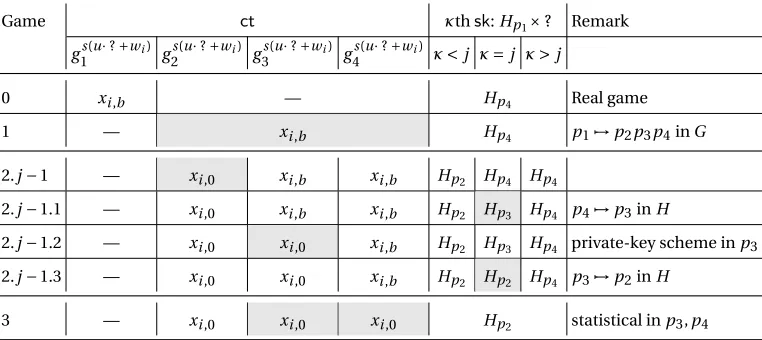
In the proof of security (outlined in Fig1), we will first switch the ciphertext to having just ap2p3p4 -component via the subgroup decision assumption. At the beginning of the proof, all the secret keys will have ap4-component, and at the end, all the secret keys will have ap2-component; throughout, the secret keys will also always have a p1-component but no p3-components at the beginning or the end. To carry out the change in the secret keys fromp4-components top2-components, we will switch the keys one by one. For the switch, we will introduce ap3-component into one secret key and then invoke security of the
above private-key one-ciphertext one-key scheme in thep3-subgroup. It is important here that throughout the hybrids, at most one secret key has ap3-component.
1.3 Our Technique in Prime-Order Groups
Assume a prime-order bilinear group G = (p,G1,G2,GT,e : G1×G2 → GT) and let [·]1, [·]2, [·]T denote the entry-wise exponentiation onG1,G2,GT, respectively. Naively, we simulate a composite-order group whose order is the product of four primes using vectors of dimension 4k “in the exponent” underk-LIN
assumption. That is, we replace
g1,h147→[A1]1, [B14]2
whereA1 ←Z4pk×k,B14←Z4pk×2k. However, the resulting IPE scheme is less efficient than Okamoto and Takashima’s scheme [27]. Instead, we will show that it suffices to use
Game ct κthsk:Hp1×? Remark
gs(u·?+wi)
1 g
s(u·?+wi)
2 g
s(u·?+wi)
3 g
s(u·?+wi)
4 κ<j κ=j κ>j
0 xi,b — Hp4 Real game
1 — xi,b Hp4 p17→p2p3p4inG
2.j−1 — xi,0 xi,b xi,b Hp2 Hp4 Hp4
2.j−1.1 — xi,0 xi,b xi,b Hp2 Hp3 Hp4 p47→p3inH
2.j−1.2 — xi,0 xi,0 xi,b Hp2 Hp3 Hp4 private-key scheme inp3
2.j−1.3 — xi,0 xi,0 xi,b Hp2 Hp2 Hp4 p37→p2inH
3 — xi,0 xi,0 xi,0 Hp2 statistical inp3,p4
Fig. 1.Game sequence for composite-order IPE. In the table,x0=(x1,0, . . . ,xn,0) andx1=(x1,1, . . . ,xn,1) are the challenge vectors;
b∈{0, 1} is the secret bit we hope to hide against the adversary. The gray background highlights the difference between adjacent games. The column “ct” shows the structure of the challenge ciphertext on four subgroups whose generators areg1,g2,g3,g4, while the next column gives the subgroup where every secret keys lie in. In the last column, the notation “p17→p2p3p4inG” is indicating the subgroup decision assumption stating thatGp1≈cGp2p3p4.
Then, with the correspondence by Chenet al.[11,16,13]:
α 7→k∈Zkp+1 u,wi 7→U,Wi∈Z(pk+1)×(2k+1) ∀i∈[n]
s 7→s∈Zkp, r 7→r∈Zkp
g1s 7→[s>A>1]1, hr14 7→[B14r]2 g1sw 7→[s>A>1W]1, h14w r 7→[WB14r]2
(4)
we have the following prime-order IPE scheme:
mpk: [A>]1, [A>U]1, [A>W1]1, . . . , [A>Wn]1, [A>k]T
sky: [k+(y1·W1+ · · · +yn·Wn)B14r]2, [B14r]2
ctx: [s>A>1]1, [s>A>1(x1·U+W1)]1, . . . , [s>A>1(xn·U+Wn)]1, [c>k]T·m
(5)
Note that, with matricesA1∈Z(pk+1)×kandB∈Z(2pk+1)×k, we only simulate two and three subgroups, respec-tively, rather than four subgroups; meanwhile some of them are simulated as low-dimension subspaces. Although it has become a common optimization technique to adjust dimensions of subspaces, it is not direct to justify that we can work with less subspaces. In fact, these optimizations are based on elaborate investigations of the proof strategy sketched in Section1.2. In the rest of this section, we explain our method leading to the optimized parameter shown in (3).
Our Translation. We start from an IPE scheme in a very restricted setting and then gradually upgrade it to our full-fledged IPE scheme in theprime-ordergroup. In particular, we follow the roadmap
private-key one-key IPE −−−−−→Step 1
[11,13] private-key IPE
Step 2
−−−−−→
[11,36] public-key IPE
The private key one-key IPE corresponds to scheme (2) overp3-subgroup (cf.Game2.j−1.2in Fig1). In Step 1,
just after we change ciphertext in proof of scheme (1) (cf. Game2.0 to Game2.q and Game3 in Fig 1). In
Step 2, we move from private-key to public-key setting with the compiler in [36], which is related to the change of ciphertext at the beginning of the proof (cf.Game1in Fig1). By handling these proof techniques
underlying the proof sketched in Section1.2(cf. Fig1) one by one as above, we are able to integrate Chenet al.’s framework [11] with recent new techniques [36,13] in an optimized way.
Private-key IPE in One-key Setting. We start from aprivate-keyIPE where the ciphertext is created frommsk
rather thanmpk. We also consider a weakerone-keymodel where the adversary can get only one secret key. Pickα,u,w1, . . . ,wn←RZpand let messagem∈Zp. We give the following private-key IPE overZp:
msk:α,u,w1, . . . ,wn
sky:α+(y1·w1+ · · · +yn·wn)
ctx:x1·u+w1, . . . ,xn·u+wn,α·m
(6)
Analogous to scheme (2), the scheme satisfies (simulation-based) information-theoretic security in the selective setting (cf. [36]). By the implication from simulation-based security to indistinguishability-based security and standard complexity leveraging technique, we have the following statement: For adaptively chosenx0=(x1,0, . . . ,xn,0)∈Znp,x1=(x1,1, . . . ,xn,1)∈Znp andy=(y1, . . . ,yn)∈Znp satisfying either〈x0,y〉 6= 0∧ 〈x1,y〉 6=0 or〈x0,y〉 = 〈x1,y〉 =0 and for allb∈{0, 1}, we have
{ x1,b ·u+w1, . . . , xn,b ·u+wn, y1·w1+ · · · +yn·wn} ≡{ x1,1−b ·u+w1, . . . , xn,1−b ·u+wn, y1·w1+ · · · +yn·wn}
(7)
Note that the statement here is different from that used in Fig1(wherexi,0is in the place ofxi,1−b). Looking ahead, this choice is made to employ the “change of basis” technique when moving from one-key to multi-key model (see the next paragraph).
Private-key IPE in Multi-key Setting. To handle multiple keys revealed to the adversary, we employ Chen
et al.’s prime-order generic framework5 [11] based on the dual system method [32] to scheme (6). The framework works with prime-order finite cyclic groupGon which thek-LINassumption holds. Let [·] denote the entry-wise exponentiation onG. In order to avoid collusion of multiple secret keys, we will re-randomize each secret key [8,34,31] using fresh vectord←span(B1) whereB1←Z(pk+1)×k, which supports standard dual system method [32] with a hidden subspaceB2←Zkp+1. For this purpose, we need to do the following “scalar to vector” substitutions:
u∈Zp7→u∈Zp1×(k+1) and wi∈Zp7→wi∈Zp1×(k+1) ∀i∈[n].
Then the re-randomization is done by multiplyinguand eachwiin secret keys bydand moving them from
ZptoG. This yields the following private-key IPE:
msk:α,u,w1, . . . ,wn
sky: [α+(y1·w1+ · · · +yn·wn)d], [d] where d←span(B1)
ctx:x1·u+w1, . . . ,xn·u+wn, [α]·m
(8)
To carry out the non-trivial extension by Okamoto and Takashima [27] which involves three subgroups of
HN (cf. game sequence fromGame2.0toGame2.q), we increase the dimension of vectorsu,w1, . . . ,wn,din
secret keys by k (i.e., from k+1 to 2k+1) as in [13] such that the support of dcan accommodate three subspaces defined by
(B1,B2,B3)←Z(2pk+1)×k×Z2pk+1×Z(2pk+1)×k
where B1,B2,B3 play the roles similar to p4, p2, p3-subgroup respectively. Following the proof strategy in [13] and statement (7) for the one-key scheme (6), we can change secret keys and the challenge ciphertext revealed to the adversary into the following form:
sky: [α+(y1·w1+ · · · +yn·wn)d], [d] where d←span(B1, B2 )
ct∗:x1,b·u(1)+ x1,1−b·u(2) +x1,b·u(3)+w1, . . . ,xn,b·u(1)+ xn,1−b·u(2) +xn,b·u(3)+wn, [α]·m whereu(1)(resp.u(2),u(3)) is a random vector orthogonal tospan(B2,B3) (resp.span(B1,B3),span(B1,B2)). Finally, by the “change of basis” commonly appeared in the proof with dual pairing vector space [23,27] (and a simple statistical argument), we claim thatct∗has the same distribution as
x1,0·u0+x1,1·u1 +w1, . . . , xn,0·u0+xn,1·u1 +wn, [α]·m
whereu0,u1←Zp1×(2k+1). This means thatct∗hidesband scheme (8) is fully attribute-hiding.
Note that the support of randomnessd(after the change) isspan(B1,B2) rather thanspan(B2), which simulates p2-subgroup in the composite-order scheme (1). This is crucial to derive more efficient IPE scheme but slightly complicates the final argument above where “change of basis” technique has to be used to deal withxi,b·u(1)interplaying withB1-component insky.
(Public-key) IPE scheme. To upgrade our private-key IPE to public-key IPE, we will employ the “private-key to public-“private-key” compiler in [36]. The compiler relies on bilinear groups (p,G1,G2,GT,e:G1×G2→GT) in which thek-LIN assumption holds. In detail, we do the following “vector to matrix”/“scalar to vector”
substitution for entries inmskand secret keys:
u,w1, . . . ,wn∈Zp1×(2k+1)7→U,W1, . . . ,Wn∈Z(pk+1)×(2k+1) α∈Zp7→k∈Zkp+1
and publish them as parts ofmpkin the form of
[A>U]1, [A>W1]1, . . . , [A>Wn]1, [A>k]T where A←Z(pk+1)×k.
In the ciphertext, we translateu,w1, . . . ,wninto [c>U]1, [c>W1]1, . . . , [c>Wn]1wherec←span(A) and translate
[α]2into [c>k]T. Finally, secret keys are now moved to groupG2. This results in the following IPE scheme:
mpk: [A]1, [A>U]1, [A>W1]1, . . . , [A>Wn]1, [A>k]T
sky: [k+(y1·W1+ · · · +yn·Wn)d]2, [d]2 where d←span(B1)
ctx: [c>]1, [x1·c>U+c>W1]1, . . . , [xn·c>U+c>Wn]1, [c>k]T·m where c←span(A)
(9)
Note that the translation does not involve (B1,B2,B3) we just introduced.
To prove the security of the resulting public-key IPE scheme, we first show that we can change the support ofcfromspan(A) toZpk+1by the following statement implied by thek-LINassumption:
( [A]1, [c←span(A)]1)≈c( [A]1, [c←Zkp+1]1).
Since (A|c) is full-rank with overwhelming probability, we can see that
g
are distributed independently. Then the security of scheme (9) can be reduced to that of private-key scheme (8) by observations: (i) mskg is necessary for generating mpk in scheme (9); (ii) we can view a
ciphertext in scheme (9) as a ciphertext of our private-key IPE scheme under master secret keymsk∗; (iii) a secret key in scheme (9) can be produced from a secret key of private-key IPE scheme (8) under master secret keymsk∗with the help ofmskg.
How to Shorten the Ciphertext. The ciphertext size of our IPE scheme (9) mainly depends on the width of matrixUand Wi, which is further determined by the dimensions of subspaces defined byB1,B2,B3. Therefore, in order to reduce the ciphertext size, we employ the “dimension compress” technique used in [16]. The basic idea is to let B1 and B3 “share some dimensions” and finally decrease the width ofU
andWi, the cost is that we have to use theXDLINassumption. Compared with our first scheme, a qualitative difference is that the private-key variant now works with bilinear maps. This is not needed when we work with thek-LINassumption in the first scheme.
Organization. The paper is organized as follows. In section2, we review some basic notions. The next two sections, Section3and Section4, will be devoted to our two IPE schemes, respectively. In both sections, we will first develop a private-key scheme and then transform it to the public-key version as [36].
2 Preliminaries
Notation. LetAbe a matrix overZp. We usespan(A) to denote the column span ofA, usebasis(A) to denote a basis of span(A), and use (A1|A2) to denote the concatenation of matricesA1,A2. Byspan(A>), we are indicating the row span ofA>. We let In be then-by-n identity matrix and0 be a zero matrix of proper size. Given an invertible matrixB, we useB∗to denote its dual satisfyingB>B∗=I.
2.1 Inner-product encryption
Algorithms. An inner-product encryption (IPE) scheme consists of four algorithms (Setup,KeyGen,Enc,Dec):
Setup(1λ,n)→(mpk,msk). The setup algorithm gets as input the security parameterλand the dimension
nof the vector space. It outputs the master public keympkand the master keymsk.
KeyGen(msk,y)→sky. The key generation algorithm gets as inputmskand a vectory. It outputs a secret
keyskyfor vectory.
Enc(mpk,x,m)→ctx. The encryption algorithm gets as inputmpk, a vectorxand a messagem. It outputs a ciphertextctxfor vectorx.
Dec(ctx,sky)→m. The decryption algorithm gets as a ciphertextctxforxand a secret keyskyfor vectory
satisfying〈x,y〉 =0. It outputs messagem.
Correctness. We require that for all vectorsx,ysatisfying〈x,y〉 =0 and allm, it holds that Pr[Dec(ctx,sky)=m]=1,
Security. For a stateful adversaryA, we define the advantage function
AdvIPE
A (λ) :=
¯ ¯ ¯ ¯ ¯ ¯ ¯ ¯ ¯ ¯ ¯ ¯ ¯ Pr
b=b0:
(mpk,msk)←Setup(1λ,n);
(x0,x1,m0,m1)←AKeyGen(msk,·)(mpk);
b←R{0, 1};ct∗←Enc(mpk,x b,mb);
b0←AKeyGen(msk,·)(ct∗)
−1 2 ¯ ¯ ¯ ¯ ¯ ¯ ¯ ¯ ¯ ¯ ¯ ¯ ¯
with the following restrictions on all queriesythatAsubmitted toKeyGen(msk,·):
– ifm06=m1, we require that〈x0,y〉 6=0∧ 〈x1,y〉 6=0;
– ifm0=m1, we require that either〈x0,y〉 6=0∧ 〈x1,y〉 6=0 or〈x0,y〉 = 〈x1,y〉 =0.
An IPE scheme isadaptively secureandfully attribute-hiding if for all PPT adversaries A, the advantage
AdvIPE
A (λ) is a negligible function inλ.
Private-key IPE. In a private-key IPE, theSetupalgorithm does not outputmpk; and theEncalgorithm takes
mskinstead ofmpkas input. The adaptive security and full attribute-hiding can be defined analogously except that A only gets ct∗ and has access to KeyGen(msk,·). The advantage function is denoted by
AdvIPE*
A (λ). Accordingly, we may call the standard IPEpublic-key IPE.
2.2 Prime-order groups and matrix Diffie-Hellman assumptions
A group generatorGtakes as input security parameterλand outputs group descriptionG=(p,G1,G2,GT,e), wherepis a prime ofΘ(λ) bits,G1,G2andGT are cyclic groups of orderp, ande:G1×G2→GT is a non-degenerate bilinear map. We require that group operations inG1,G2andGT as well the bilinear mapeare computable in deterministic polynomial time with respect toλ. Letg1∈G1,g2∈G2andgT=e(g1,g2)∈GT be the respective generators. We employ theimplicit representationof group elements: for a matrixMover
Zp, we define [M]1=g1M, [M]2=g2M, [M]T =gTM, where exponentiations are carried out component-wise. GivenAand [B]2, we letA¯[B]2=[AB]2; for [A]1and [B]2, we lete([A]1, [B]2)=[AB]T.
We reivew the matrix Diffie-Hellman (MDDH) assumption onG1[14]. TheMDDHk,`assumption onG2
can be defined analogously and it is known thatk-LIN⇒MDDHk,`[14].
Assumption 1 (MDDHk,`Assumption) Let`>k≥1. We say that theMDDHk,`assumption holds with respect toGif for all PPT adversariesA, the following advantage function is negligible inλ.
AdvMDDHk,`
A (λ) := |Pr[A(G, [M]1, [Ms]1)=1]−Pr[A(G, [M]1, [u]1)=1]| whereG←G(1λ),M←Zp`×k,s←Zkpandu←Z`p.
We also use the external decisional linear (XDLIN) assumption onG2[1]:
Assumption 2 (XDLINAssumption) We say that theXDLINassumption holds with respect toGif for all PPT adversariesA, the following advantage function is negligible inλ.
AdvXDLIN
A (λ) := |Pr[A(G,D,T0=[a3(s1+s2)]2)=1]−Pr[A(G,D,T1←G2)=1]| whereG←G(1λ)and D=( [a1,a2,a3,a1s1,a2s2]1, [a1,a2,a3,a1s1,a2s2]2)with a1,a2,a3,s1,s2←Zp.
3 Construction fromk-LINassumption
3.1 Preparation
Fix parameters`1,`2,`3≥1 and let`:=`1+`2+`3. We use basis B1←Z`×`1
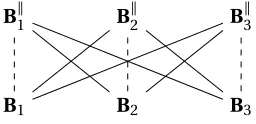
and its dual basis (B∥1,B∥2,B∥3) such thatB>iBi∥=I(known asnon-degeneracy) andB>iBj=0ifi6=j(known as
orthogonality), as depicted in Fig2.
B1 B2 B3
B∥1 B∥2 B∥3
Fig. 2.Basis relations. Solid lines mean orthogonal, dashed lines mean non-degeneracy.
Assumption. We review theSDGB2
17→B1,B2 assumption [15,17,13] as follows. By symmetry, one may permute
the indices for subspaces.
Lemma 1 (MDDH`1,`1+`2 ⇒ SD
G2
B17→B1,B2). Under the MDDH`1,`1+`2 assumption in G2, there exists an
effi-cient sampler outputting random ([B1]2, [B2]2, [B3]2) (as described above) along with base basis(B∥3) and
basis(B∥1,B∥2)(of arbitrary choice) such that the following advantage function is negligible inλ.
AdvSD
G2
B17→B1,B2
A (λ) := |Pr[A(G,D, [t0]1)=1]−Pr[A(G,D, [t1]1)=1]| where
D:=( [B1]2, [B2]2, [B3]2,basis(B∥1,B∥2),basis(B∥3) ) t0←span(B1),t1←span(B1,B2).
Facts. With basis (B1,B2,B3), we can uniquely decomposew∈Z1p×`as
w=P
β∈[3]w(β) where w(β)∈span(B∥β
> ).
In the paper, we use notationw(β)to denote the projection ofwontospan(B∥β>) and definew(β1β2)=w(β1)+
w(β2)forβ
1,β2∈[3]. Furthermore, we highlight two facts: (1) Forβ∈[3], it holds thatwBβ=w(β)Bβ; (2) For
allβ∗∈[3], it holds that
©
w(β∗), {w(β)}β6=β∗ª≡© w∗ , {w(β)}β6=β∗ª whenw←Z1p×`andw∗←span(B∥β∗
> ).
3.2 Step One: A Private-key IPE in Prime-order Groups
Our first prime-order private-key IPE is described as follows. We use the basis described in Section3.1with (`1,`2,`3)=(k, 1,k). As mentioned in Section1.2, we do not need bilinear map for this private-key IPE.
However, for our future use in Section3.4, we describe the IPE in bilinear groups and note that only one of source groups (i.e.,G2) is used.
– Setup(1λ,n): RunG=(p,G1,G2,GT,e)←G(1λ). SampleB1←Z(2pk+1)×kand picku,w1, . . . ,wn←Z1p×(2k+1), α←Zp. Output
– KeyGen(msk,y): Lety=(y1, . . . ,yn)∈Znp. Sampler←Zkpand output
sky=(K0=[α+(y1·w1+ · · · +yn·wn)B1r]2,K1=[B1r]2) – Enc(msk,x,m): Letx=(x1, . . . ,xn)∈Znpandm∈G2. Output
ctx=(C1=x1·u+w1, . . . ,Cn=xn·u+wn,C=[α]2·m)
– Dec(ctx,sky): Parsectx=(C1, . . . ,Cn,C) andsky=(K0,K1) fory=(y1, . . . ,yn)∈Znp. Output
m0=C·((y1·C1+ · · · +yn·Cn)¯K1)·K0−1. Correctness. For allx,y∈Znpsatisfying〈x,y〉 =0, we have
((y1·C1+ · · · +yn·Cn)¯K1)·K0−1
=[(y1·(x1·u+w1)+ · · · +yn·(xn·u+wn))B1r]2·[α+(y1·w1+ · · · +yn·wn)B1r]−21
=[〈x,y〉 ·uB1r]2·[(y1·w1+ · · · +yn·wn)B1r]2·[α]−21·[(y1·w1+ · · · +yn·wn)B1r]−21=[α]−21 where the last equality follows from the fact that〈x,y〉 =0. This readily proves the correctness.
3.3 Security of Private-key IPE
We will prove the following theorem.
Theorem 1. Under the k-LINassumption, the private-key IPE scheme described in Section3.2is adaptively secure and fully attribute-hiding (cf. Section2.1).
Following [35,11], we can reduce the casem06=m1to the casem0=m1by arguing that an encryption for
mb is indistinguishable with an encryption form0. Therefore it is sufficient to prove the following lemma form0=m1.
Lemma 2. For any adversary A that makes at most Q key queries and outputs m0 = m1, there exists adversariesB1,B2,B3such that
AdvIPE*
A (λ)≤Q·Adv SDGB2
17→B1,B3
B1 (λ)+Q·Adv
SDGB2
37→B3,B2
B2 (λ)+Q·Adv
SDGB2
17→B1,B3
B3 (λ)
andTime(B1),Time(B2),Time(B3)≈Time(A).
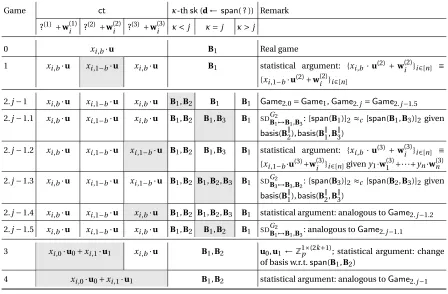
Game sequence. We prove Lemma2via the following game sequence, which is summarized in Fig3.
– Game0is the real game in which the challenge ciphertext forxb=(x1,b, . . . ,xn,b) is of the form
x1,b·u+w1, . . . ,xn,b·u+wn, [α]2·m0.
Hereb←{0, 1} is a secret bit.
– Game1is identical toGame0except that the challenge ciphertext is
x1,b·u(13)+ x1,1−b·u(2) +w1, . . . ,xn,b·u(13)+ xn,1−b·u(2) +wn, [α]2·m0.
We claim thatGame1≡Game0. This follows from facts that (1) secret keys will not revealw(2)1 , . . . ,w(2)n ; (2) for allx0,x1∈Zpnandu(2)∈span(B∥2
>
), it holds that
{ xi,b·u(2) +w(2)i }i∈[n]≡{ xi,1−b·u(2) +w(2)i }i∈[n]
whenw(2)1 , . . . ,w(2)n ←span(B∥2
>
Game ct κ-thsk(d←span( ? )) Remark
?(1)+w(1)i ?(2)+w(2)i ?(3)+w(3)i κ<j κ=j κ>j
0 xi,b·u B1 Real game
1 xi,b·u xi,1−b·u xi,b·u B1 statistical argument: {xi,b·u(2)+w(2)i }i∈[n] ≡ {xi,1−b·u(2)+w(2)i }i∈[n]
2.j−1 xi,b·u xi,1−b·u xi,b·u B1,B2 B1 B1 Game2.0=Game1,Game2.j=Game2.j−1.5 2.j−1.1 xi,b·u xi,1−b·u xi,b·u B1,B2 B1,B3 B1 SDGB2
17→B1,B3: [span(B1)]2≈c[span(B1,B3)]2given
basis(B∥2),basis(B∥1,B∥3)
2.j−1.2 xi,b·u xi,1−b·u xi,1−b·u B1,B2 B1,B3 B1 statistical argument: {xi,b·u(3)+w(3)i }i∈[n] ≡ {xi,1−b·u(3)+w(3)i }i∈[n]giveny1·w(3)1 +· · ·+yn·w(3)n 2.j−1.3 xi,b·u xi,1−b·u xi,1−b·u B1,B2 B1,B2,B3 B1 SDGB2
37→B3,B2: [span(B3)]2≈c[span(B2,B3)]2given
basis(B∥1),basis(B∥2,B∥3)
2.j−1.4 xi,b·u xi,1−b·u xi,b·u B1,B2 B1,B2,B3 B1 statistical argument: analogous toGame2.j−1.2 2.j−1.5 xi,b·u xi,1−b·u xi,b·u B1,B2 B1,B2 B1 SDGB2
17→B1,B3: analogous toGame2.j−1.1
3 xi,0·u0+xi,1·u1 xi,b·u B1,B2 u0,u1←Z1p×(2k+1); statistical argument: change of basis w.r.t.span(B1,B2)
4 xi,0·u0+xi,1·u1 B1,B2 statistical argument: analogous toGame2.j−1
Fig. 3.Game sequence for private-key IPE based onk-LINassumption. The gray background highlights the difference between adjacent games. Here,B1,B2,B3play a role similar to thep4,p2,p3-subgroups in Fig1.
– Game2.jforj∈[0,q] is identical toGame1except that the firstjsecret keys are
[α+(y1·w1+ · · · +yn·wn)d]2, [d]2 where d←span(B1,B2) .
We claim thatGame2.j−1≈cGame2.jforj∈[q] and give a proof sketch later.
– Game3is identical toGame2.qexcept that the challenge ciphertext is
x1,0·u(12)0 +x1,1·u(12)1 +x1,b·u(3)+w1, . . . , xn,0·u0(12)+xn,1·u(12)1 +xn,b·u(3)+wn, [α]2·m0.
whereu0,u1 ←Zp1×(2k+1). We claim that Game2.q ≡Game3. This follows from the “change of basis”
technique used in dual pairing vector spaces [23,28]. In particular, we argue that
( xi,b z}|{ u(1),
xi,1−b z}|{
u(2))≡(u(12)0 ,u(12)1 )
whenu,u0,u1and basisB1,B2are chosen at random. Here we use the fact that randomnessdin secret keys reveals no information about the basis ofspan(B1,B2). See Lemma5for more details.
– Game4is identical toGame3except that the challenge ciphertext is
x1,0·u0+x1,1·u1 +w1, . . . , xn,0·u0+xn,1·u1 +wn, [α]2·m0
in which the adversary has no advantage in guessingb. We claim thatGame3≡Game4. The proof is
similar to that forGame1≡Game0. See Lemma6for more details.
– Game2.j−1.1is identical toGame2.j−1except that thejth secret key is
[α+(y1·w1+ · · · +yn·wn)d]2, [d]2 where d←span(B1,B3) .
We claim thatGame2.j−1.1≈cGame2.j−1. This follows from theSDGB2
17→B1,B3assumption stating that
[t←span(B1)]2≈c[t←span(B1,B3)]2 given [B1]2, [B2]2, [B3]2,basis(B2∥),basis(B∥1,B∥3).
In the reduction, we sampleα←Zp,w1, . . . ,wn←Z1p×(2k+1)and pick
u(13)←span((B∥1|B∥3)>) and u(2)←span(B∥2>)
usingbasis(B∥1,B∥3) andbasis(B∥2), respectively. The challenge ciphertext is generated using {xi,b·u(13)+xi,1−b·u(2)+wi}i∈[n];
the jth secret key is created fromw1, . . . ,wn and [t]2while the remaining keys can be generated using
[B1]2and [B2]2along withα,w1, . . . ,wn. See Lemma7for more details.
– Game2.j−1.2is identical toGame2.j−1.1except that the challenge ciphertext is
x1,b·u(1)+x1,1−b·u(2)+ x1,1−b·u(3) +w1, . . . ,xn,b·u(1)+xn,1−b·u(2)+ xn,1−b·u(3) +wn, [α]2·m0.
We claim thatGame2.j−1.2≡Game2.j−1.1. This follows from facts that: (1)u(3)andw(3)i are only revealed
from the challenge ciphertext and thejth secret key; (2) for allx0,x1andywith the restriction that (a) 〈x0,y〉 = 〈x1,y〉 =0; or (b)〈x0,y〉 6=0∧ 〈x1,y〉 6=0, it holds that
(
ct
z }| {
x1,b·u(3)+w(3)1 , . . . ,xn,b·u(3)+w(3)n ,
sk
z }| {
y1·w(3)1 + · · · +yn·w(3)n ) ≡(x1,1−b·u(3) +w(3)1 , . . . , xn,1−b·u(3) +w(3)n ,y1·w(3)1 + · · · +yn·w
(3)
n ). See Lemma8for more details.
– Game2.j−1.3is identical toGame2.j−1.2except that thejth secret key is
[α+(y1·w1+ · · · +yn·wn)d]2, [d]2 where d←span(B1,B2,B3) .
We claim thatGame2.j−1.3≈cGame2.j−1.2. This follows from theSDGB327→B3,B2assumption stating that
[t←span(B3)]2≈c[t←span(B2,B3)]2 given [B1]2, [B2]2, [B3]2,basis(B1∥),basis(B∥2,B∥3).
In the reduction, we sampleα←Zp,w1, . . . ,wn←Z1p×(2k+1)and pick
u(1)←span(B∥1>) and u(23)←span((B∥2|B∥3)>)
usingbasis(B∥1) andbasis(B∥2,B∥3), respectively. The challenge ciphertext is generated using {xi,b·u(1)+xi,1−b·u(23)+wi}i∈[n]
thejth secret key is created fromα,w1, . . . ,wnand [B1], [t]2while the remaining keys can be generated
using [B1,B2]2along withα,w1, . . . ,wn. See Lemma9for more details.
– Game2.j−1.4is identical toGame2.j−1.3except that the challenge ciphertext is
x1,b·u(1)+x1,1−b·u(2)+ x1,b·u(3) +w1, . . . ,xn,b·u(1)+xn,1−b·u(2)+ xn,b·u(3) +wn, [α]2·m0.
We claim thatGame2.j−1.4≡Game2.j−1.3. The proof is identical to that forGame2.j−1.2≡Game2.j−1.1. See
– Game2.j−1.5is identical toGame2.j−1.4except that thejth secret key is
[α+(y1·w1+ · · · +yn·wn)d]2, [d]2 where d←span(B1,B2) .
We claim thatGame2.j−1.5≈cGame2.j−1.4. The proof is identical to that forGame2.j−1≈cGame2.j−1.1. See
Lemma11for more details. Note thatGame2.j−1.5=Game2.j.
3.4 Step Two: From private-key to public-key
We describe our prime-order full-fledged IPE, which is derived from our private-key IPE in Section3.2via the “private-key to public-key” compiler [36].
– Setup(1λ,n): RunG=(p,G1,G2,GT,e)←G(1λ). SampleA←Z(pk+1)×k,B1←Z(2pk+1)×kand pick
U,W1, . . . ,Wn←Z(pk+1)×(2k+1) and k←Zkp+1. Output
mpk=(G, [A>]1, [A>U]1, [A>W1]1, . . . , [A>Wn]1, [A>k]T) and msk=(k,W1, . . . ,Wn,B1).
– KeyGen(msk,y): Lety=(y1, . . . ,yn)∈Znp. Sampler←Zkpand output
sky=(K0=[k+(y1·W1+ · · · +yn·Wn)B1r]2,K1=[B1r]2) – Enc(mpk,x,m): Letx=(x1, . . . ,xn)∈Znpandm∈GT. Samples←Zkpand output
ctx=(C0=[s>A>]1, {Ci=[s>A>(xi·U+Wi)]1}i∈[n],C=[s>A>k]T·m)
– Dec(ctx,sky): Parsectx=(C0,C1, . . . ,Cn,C) andsky=(K0,K1) fory=(y1, . . . ,yn). Output
m0=C·e(y1¯C1· · ·yn¯Cn,K1)·e(C0,K0)−1.
Correctness. For allx,y∈Znpwith〈x,y〉 =0, we have
e(y1¯C1· · ·yn¯Cn,K1)·e(C0,K0)−1
=e([y1·s>A>(x1·U+W1)]1· · ·[yn·s>A>(xn·U+Wn)]1, [B1r]2)·e([s>A>1]1, [k+(y1·W1+ · · · +yn·Wn)B1r]2)−1
=[〈x,y〉 ·s>A>UB1r]T·[s>A>(y1·W1+ · · · +yn·Wn)B1r]T·[s>A>k]−T1·[s>A>(y1·W1+ · · · +yn·Wn)B1r]−T1 =[s>A>k]−T1
where the last equality follows from the fact that〈x,y〉 =0. This readily proves the correctness.
Security. We will prove the following theorem.
Theorem 2. Under the k-LIN assumption, the IPE scheme described above is adaptively secure and fully attribute-hiding (cf. Section2.1).
For the same reason as in Section3.3, we prove the lemma for them0=m1, which shows that the security of the IPE described above is implied by that of our private-key IPE in Section3.2and theMDDHkassumption.
Lemma 3. For any adversary A that makes at most Q key queries and outputs m0 = m1, there exists adversariesB0,Bsuch that
AdvIPE
A (λ)≤AdvMDDHB0 k(λ)+Adv
IPE*
B (λ)
We prove Lemma3via the following game sequence.
– Game0is the real game in which the challenge ciphertext forxb=(x1,b, . . . ,xn,b) is of the form [c>]1, [c>(x1,b·U+W1)]1, . . . , [c>(xn,b·U+Wn)]1,e([c>]1, [k]2)·m0 where c←span(A).
Hereb←{0, 1} is a secret bit.
– Game1is identical toGame0except that we pickc←Zkp+1when generating the challenge ciphertext. We claim thatGame1≈cGame0. This follows from theMDDHkassumption:
[c←span(A)]1≈c[c←Zkp+1] given [A]1.
In the reduction, we sample k,U,W1, . . . ,Wn and B1. The master public key mpk and the challenge ciphertext are simulated using k,U,W1, . . . ,Wn along with [A]1, [c]1; all secret keys can be created
honestly. See Lemma12for more details.
It remains to show that the advantage in guessingb ∈{0, 1} inGame1 is negligible. This follows from the
security of our private-key IPE in Section3.2. ForAandc, define
A>U=
e
U∈Zpk×(2k+1) A>Wi=Wei∈Zkp×(2k+1) A>k=ek∈Zkp c>U=u∈Zp1×(2k+1) c>Wi=wi∈Z1p×(2k+1) c>k=α∈Zp We can then rewritempkas
[A>]1, [Ue]1, [W1e ]1, . . . , [Wen]1, [ek]T; the challenge ciphertext (inGame1) becomes
[c>]1, [x1,b·u+w1]1, . . . , [xn,b·u+wn]1,e([1]1, [α]2)·m0.
Assume that (A|c) is full-rank which occurs with high probability and defineT=³Ac>>
´−1
, we haveWi=T
³ e
Wi
wi ´
andk=T¡ek
α
¢
, a secret key can be rewritten as
T¯
[ek+(y1·We1+ · · · +yn·Wen)d]2
[α+(y1·w1+ · · · +yn·wn)d]2
, [d]2.
Observe that the underlined parts are exactly the ciphertext and secret keys of our private-key IPE in Section 3.2; and (Ue,Wei,ke), (u,wi,α) are distributed uniformly and independently. This means we can simulate mpkhonestly and transform a ciphertext/secret key from our private-key IPE to its public-key counterpart usingA,c,Ue,Wei,ek. This is sufficient for the reduction from the public-key IPE to private-key
IPE. See Lemma13for more details.
3.5 Lemmas for Private-key IPE
LetAdvxbe the advantage function with respect toAinGamex. We prove the following lemma for the game sequence in Section3.3.
Lemma 4 (Game0≡Game1).Adv0(λ)=Adv1(λ).
Proof. It is sufficient to prove that, for allu←Z1p×(2k+1), it holds that
(
sk
z }| {
w1B1, . . . ,wnB1,
ct
z }| {
whenw1, . . . ,wn←Z1p×(2k+1). By the facts shown in Section3.1, it is implied by the statement that, for all
u(2)∈span(B∥2>), it holds that
{xi,b·u(2)+w(2)i }i∈[n]≡{w(2)i }i∈[n]≡{xi,1−b·u(2)+w(2)i }i∈[n]
whenw(2)1 , . . . ,w(2)n ←span(B∥2
>
). This completes the proof. ut
Lemma 5 (Game2.q≡Game3).Adv2.q(λ)=Adv3(λ). Proof. We simulateGame2.q as follows:
Setup. We alternatively prepare basis (B1,B2,B3) as follows: Sample B1e ,B3←Z (2k+1)×k
p ,B2e ←Z2pk+1 and
compute dual basisBe∥1,Be∥2,B∥3as usual. PickR←GLk+1(Zp) and define
(B1|B2)=(B1e |B2e )R and (B∥1|B∥2)=(Be∥1|Be∥2)R∗.
This does not change the distribution of basis. We then sampleα,u,w1, . . . ,wnhonestly.
Key queries. On inputy=(y1, . . . ,yn), output
[α+(y1·w1+ · · · +yn·wn)d]2, [d]2 where d←span(B1e ,B2e ).
Although we sampledusingeB1,B2e , the vector is uniformly distributed overspan(B1,B2) as required and
our simulation is perfect.
Ciphertext. On input (x0,x1,m0,m1) with m0 =m1, we create the challenge ciphertext honestly using
(B∥1,B∥2,B∥3). That is, we pickb←{0, 1} and output
x1,b·v0+x1,1−b·v1+x1,b·u(3)+w1, . . . ,xn,b·v0+xn,1−b·v1+xn,b·u(3)+wn, [α]2·m0
whereu(3)←span(B∥3>) and
v0=u(1)←span(B∥1>) and v1=u(2)←span(B∥2>). Observe that, we have a 2-by-(k+1) matrixVof rank 2 such that
—v0— —v1—
=V(B∥1|B∥2)>= VR−1 | {z } uniformly overZ2×(k+1)
p
(Be∥1|Be∥2)>.
SinceRis independent of other part of simulation,VR−1are uniformly distributed overZ2p×(k+1)and thus it is equivalent to samplev0,v1←span((Be∥1|Be∥2)>) when creating the challenge ciphertext. This leads to the
simulation ofGame3(with respect toB1e ,B2e ,B3). ut
Lemma 6 (Game3≡Game4).Adv3(λ)=Adv4(λ).
Proof. The proof is similar to that for Lemma4, except that we work withu(3),u(3)0 ,u(3)1 ,w(3)i instead. ut
Lemma 7 (Game2.j−1≈cGame2.j−1.1).There exists adversaryB1withTime(B1)≈Time(A)such that
|Adv2.j−1.1(λ)−Adv2.j−1(λ)| ≤Adv
SDGB2
17→B1,B3
B1 (λ).
Proof. This follows from theSDGB2
17→B1,B3assumption stating that
[t←span(B1)]2≈c[t←span(B1,B3)]2 given [B1]2, [B2]2, [B3]2,basis(B∥2),basis(B∥1,B∥3).
Setup. Sampleα←Zp,w1, . . . ,wn←Z1p×(2k+1). Implicitly sampleuby picking
u(13)←span((B∥1|B∥3)>) and u(2)←span(B∥2>) usingbasis(B∥1,B∥3) andbasis(B∥2), respectively.
Key Queries. On theκth queryy=(y1, . . . ,yn), output
[α+(y1·w1+ · · · +yn·wn)d]2, [d]2 where d←
span(B1,B2)κ<j;
t κ=j;
span(B1) κ>j;
using [B1]2, [B2]2and [t]2
Ciphertext. On input (x0,x1,m0,m1) withm0=m1, pickb←{0, 1} and output
x1,b·u(13)+x1,1−b·u(2)+w1, . . . ,xn,b·u(13)+xn,1−b·u(2)+wn, [α]2·m0.
Observe that, when t is uniformly distributed over span(B1), the simulation is identical to Game2.j−1;
otherwise, whentis uniformly distributed overspan(B1,B3), the simulation is identical toGame2.j−1.1. This
proves the lemma. ut
Lemma 8 (Game2.j−1.1≡Game2.j−1.2).Adv2.j−1.1=Adv2.j−1.2.
Proof. By complexity leveraging and the facts shown in Section3.1, it is sufficient to prove the following statement: for allx0,x1andy(corresponding to the jth key query) satisfying that (a)〈x0,y〉 = 〈x1,y〉 =0; or (b)〈x0,y〉 6=0∧ 〈x1,y〉 6=0, it holds that
(
ct
z }| {
x1,b·u(3)+w(3)1 , . . . ,xn,b·u(3)+w(3)n ,
sk
z }| {
y1·w(3)1 + · · · +yn·w(3)n ) ≡(x1,1−b ·u(3)+w(3)1 , . . . , xn,1−b ·u(3)+w(3)n ,y1·w(3)1 + · · · +yn·w
(3)
n )
whenu(3),w(3)1 , . . . ,w(3)n ←span(B∥3 >
). By the linearity, it in turn follows from the following statement
{x1,b·u+w1, . . . ,xn,b·u+wn, y1·w1+ · · · +yn·wn} ≡{ x1,1−b ·u+w1, . . . , xn,1−b ·u+wn, y1·w1+ · · · +yn·wn}
whereu,w1, . . . ,wn←Zp. This follows from the statistical argument for allx=(x1, . . . ,xn) which is implicitly used in the proof of Wee’s simulation-based selectively secure IPE [36]: by programming ˜wi=xi·u+wifor alli∈[n], we have
{x1·u+w1, . . . ,xn·u+wn, y1·w1+ · · · +yn·wn}
≡{ ˜w1, . . . , ˜wn, (y1·w1˜ + · · · +yn·w˜n)−u·(x1y1+ · · · +xnyn) }
which means that the left-hand side distributions for all vectorxnot orthogonal toyare identical (since
uhides the information about the inner-product) and so do all vectorxorthogonal toy. This immediately
proves the above statement and thus proves the lemma. ut
Lemma 9 (Game2.j−1.2≈cGame2.j−1.3).There exists adversaryB2withTime(B2)≈Time(A)such that
|Adv2.j−1.3(λ)−Adv2.j−1.2(λ)| ≤Adv
SDGB2
Proof. This follows from theSDGB2
37→B3,B2assumption stating that
[t←span(B3)]2≈c[t←span(B2,B3)]2 given [B1]2, [B2]2, [B3]2,basis(B1∥),basis(B∥2,B∥3).
On input [B1]2, [B2]2, [B3]2,basis(B∥1),basis(B∥2,B3∥) and [t]2, the adversaryB2works as follows: Setup. Sampleα←Zp,w1, . . . ,wn←Z1p×(2k+1). Implicitly sampleuby picking
u(1)←span(B∥1>) and u(23)←span((B∥2|B∥3)>) usingbasis(B∥1) andbasis(B∥2,B∥3), respectively.
Key Queries. On theκth queryy=(y1, . . . ,yn), output
[α+(y1·w1+ · · · +yn·wn)d]2, [d]2 where d←
span(B1,B2) κ<j;
t+span(B1) κ=j;
span(B1) κ>j;
using [B1]2, [B2]2, and [t]2.
Ciphertext. On input (x0,x1,m0,m1) withm0=m1, pickb←{0, 1} and output
x1,b·u(1)+x1,1−b·u(23)+w1, . . . ,xn,b·u(1)+xn,1−b·u(23)+wn, [α]2·m0.
Observe that, when t is uniformly distributed over span(B3), the simulation is identical to Game2.j−1.2;
otherwise, whentis uniformly distributed overspan(B2,B3), the simulation is identical toGame2.j−1.3. This
proves the lemma. ut
Lemma 10 (Game2.j−1.3≡Game2.j−1.4).Adv2.j−1.3=Adv2.j−1.4.
Proof. The proof is identical to that for Lemma8(Game2.j−1.1≈cGame2.j−1.2). ut Lemma 11 (Game2.j−1.4≈cGame2.j−1.5).There exists adversaryB3withTime(B3)≈Time(A)such that
|Adv2.j−1.5(λ)−Adv2.j−1.4(λ)| ≤Adv
SDGB2
17→B1,B3 B3 (λ).
Proof. The proof is analogous to that for Lemma7(Game2.j−1≈cGame2.j−1.1), except that: on thejth query y=(y1, . . . ,yn), we output
[α+(y1·w1+ · · · +yn·wn)d]2, [d]2 where d←t+span(B2) .
using [B2]2and [t]2. ut
3.6 Lemmas for Public-key IPE
LetAdvxbe the advantage function with respect toAinGamex. We prove the following lemma for the game sequence in Section3.4.
Lemma 12 (Game0≡Game1).There exists adversaryB0withTime(B0)≈Time(A)such that
|Adv1(λ)−Adv0(λ)| ≤AdvBMDDHk
0 (λ).
Proof. This follows from theMDDHkassumption stating that
[c←span(A)]1≈c[c←Zkp+1] given [A]1.
Setup. Samplek←Zkp+1,U,W1, . . . ,W←Zp(k+1)×(2k+1)andB1←Zp(2k+1)×k. Output ( [A>]1, [A>U]1, [A>W1]1, . . . , [A>Wn]1, [A>k]T) using [A]1.
Key Queries. On queryy=(y1, . . . ,yn), output
[α+(y1·w1+ · · · +yn·wn)d]2, [d]2 where d←span(B1). Ciphertext. On input (x0,x1,m0,m1) withm0=m1, pickb←{0, 1} and output
[c>]1, [c>(x1,b·U+W1)]1, . . . , [c>(xn,b·U+Wn)]1,e([c>]1, [k]2)·m0.
Observe that, whencis uniformly distributed overspan(A), the simulation is identical toGame0; otherwise,
whencis uniformly distributed overZkp+1, the simulation is identical toGame1. This proves the lemma. ut Lemma 13 (Advantage inGame1).There exists adversaryBwithTime(B)≈Time(A)such that
Adv1(λ)≤AdvIPEB *(λ). Proof. We construct the adversaryBas below:
Setup. Sample (A,c)←Zp(k+1)×k×Zkp+1and computeT=
³
A>
c>
´−1
. Since (A|c) is full-rank which occurs with high probability,Tis well-defined. Pick
e
U,We1, . . . ,Wen←Z
k×(2k+1)
p and ek←Zkp
and output
mpk=( [A>]1, [Ue]1, [W1e ]1, . . . , [Wen]1, [ke]T).
Key Queries. On inputy, adversaryBforwards the query to its environment and receives (K0,K1). Compute
e
K0=[ke]2·((y1·W1e + · · · +yn·Wen)¯K0)
and output
sky=¡T¯
e K0
K0
,K1 ¢
.
Ciphertext. On input (x0,x1,m0,m1), adversaryBsends query (x0,x1, 1, 1) to its environment and receives (C1, . . . ,Cn,C). Create the challenge ciphertext as
[c>]1, [C1]1, . . . , [Cn]1,e([1]1,C)·m0.
The adversary B outputsA’s guess bit. By the observation in Section3.4,mpk is simulated perfectly; if (K0,K1) is a private-key IPE secret key, secret keys we computed is for our public-key IPE; if (C1, . . . ,Cn,C) is a private-key IPE ciphertext forb=0, the ciphertext we created is a public-key IPE ciphertext forb=0; this
also holds forb=1. This readily proves the lemma. ut
4 Construction fromXDLINassumption
4.1 Correspondence
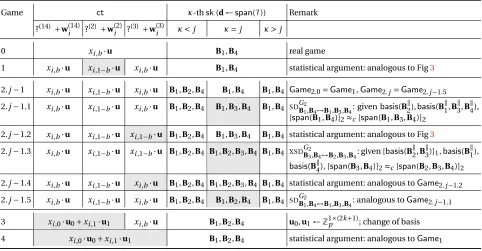
Applying the technique in [16] to our private-key IPE in Section3.2, we basically overlap span(B1) and
span(B3) so that the total dimension decreases. Technically, we work with basis
B1←Z`×`1
p ,B2←Z`p×`2,B3←Zp`×`3,B4←Z`p×`4 where`1,`2,`3,`4≥1 and`:=`1+`2+`3+`4, and follow the correspondence:
Sec3.1 this section
B17→(B1|B4)
B27→B2
B37→(B3|B4)
(10)
saying thatB1 and B3 used in Section 3 are replaced by (B1|B4) and (B3|B4), respectively, whose spans interact atspan(B4). Analogous to Section3.1, we can define its dual basis (B∥1,B∥2,B∥3,B∥4) and decompose
w∈Z1p×`asw(1)+w(2)+w(3)+w(4).
Assumptions. With the correspondence (10), the assumptionSDGB2
17→B1,B3used in Section3.3will be replaced
bySDGB2
1,B47→B1,B3,B4 defined as follows.
Lemma 14 (MDDH`1+`4,`1+`3+`4⇒SD
G2
B1,B47→B1,B3,B4).Under theMDDH`1+`4,`1+`3+`4 assumption in G2, there
exists an efficient sampler outputting random ([B1]2, [B2]2, [B3]2, [B4]2) along with base basis(B∥2) and
basis(B∥1,B3∥,B∥4)(of arbitrary choice) such that the following advantage function is negligible inλ.
AdvSD
G2
B1,B47→B1,B3,B4
A (λ) := |Pr[A(G,D, [t0]1)=1]−Pr[A(G,D, [t1]1)=1]| where
D:=( [B1]2, [B2]2, [B3]2, [B4]2,basis(B∥2),basis(B1∥,B∥3,B∥4) ), t0←span(B1,B4),t1←span(B1,B3,B4).
The proof is analogous to that for Lemma1(cf. [13]). Also, we replace SDGB2
37→B3,B2 assumption in Section 3.3 with external subspace decision assumption
XSDGB2
3,B47→B2,B3,B4defined as below.
Assumption 3 (XSDGB2
3,B47→B2,B3,B4) We say thatXSD
G2
B3,B47→B2,B3,B4 assumption holds if there exists an efficient
sampler outputting random([B1]2, [B2]2, [B3]2, [B4]2)along with basebasis(B∥1),basis(B∥4)and[basis(B∥2,B∥3)]1 (of arbitrary choice) such that the following advantage function is negligible inλ.
AdvXSD
G2
B3,B47→B2,B3,B4
A (λ) := |Pr[A(G,D, [t0]1)=1]−Pr[A(G,D, [t1]1)=1]| where
D:=( [B1]2, [B2]2, [B3]2, [B4]2,basis(B∥1), [basis(B∥2,B∥3)]1,basis(B∥4) ), t0←span(B3,B4),t1←span(B2,B3,B4).
We note that we do not give out basis(B∥2,B∥3,B∥4) as usual; instead, basis(B∥4) on Zp and [basis(B∥2,B∥3)]1
![Table 1. Comparison among our two IPE schemes and Okamoto and Takashima’s IPE [G27]. All schemes are built on an asymmetricprime-order bilinear group (p,G1,G2,GT ,e : G1 × G2 → GT )](https://thumb-us.123doks.com/thumbv2/123dok_us/7975167.1322468/2.612.100.512.485.593/table-comparison-schemes-okamoto-takashima-schemes-asymmetricprime-bilinear.webp)