On Oblivious Amplification of Coin-Tossing Protocols
∗
Nir Bitansky
†Nathan Geier
‡November 13, 2019
Abstract
We consider the problem of amplifying two-party coin-tossing protocols: given a protocol where it is possible to bias the common output by at mostρ, we aim to obtain a new protocol where the output can be biased by at most ρ? < ρ. We rule out the existence of a natural type of amplifiers called oblivious amplifiers for every ρ? < ρ. Such amplifiers ignore the way that the underlyingρ-bias protocol works and can only invoke an oracle that provides ρ-bias bits.
We provide two proofs of this impossibility. The first is by a reduction to the im-possibility of deterministic randomness extraction from Santha-Vazirani sources. The second is a direct proof that is more general and also rules outs certain types of asym-metric amplification. In addition, it gives yet another proof for the Santha-Vazirani impossibility.
∗This work was supported in part by ISF grant 18/484, and by Len Blavatnik and the Blavatnik Family
Foundation.
†Tel Aviv University,[email protected]. Member of the Check Point Institute of Information Security.
Supported also by the Alon Young Faculty Fellowship.
1
Introduction
Hardness amplification is a foundational problem in cryptography: given a cryptographic primitive that isweakly secure in some sense, we would like to make it strongly secure. Two famous examples of such amplification procedures are Yao’s amplification of weak one-way functions into strong ones and Yao’s Xor lemma for amplifying unpredictability [Yao82]. Other examples of primitives with known amplification procedures include public-key en-cryption [DNR04, LT13], oblivious transfer [DKS99, Wul08], commitments [DKS99, HR08] and cryptographic arguments [Hai13].
Coin-Tossing Protocols. We consider amplification of coin-tossing protocols [Blu81]. Such protocols allow two parties to jointly toss an unbiased coin, such that even if one party is malicious and diverges from the protocol, it cannot significantly bias the outcome. Concretely, a ρ-bias coin-tossing protocol is such that a cheating party cannot force the common outcome to be any specific bitb with probability greater than 1/2 +ρ.
It is common knowledge that coin-tossing protocols against unbounded (or evenPSPACE) adversaries cannot have biasρ <1/2. Accordingly, the common definition addresses efficient adversaries. Here coin-tossing protocols with negligible bias have been long known assuming way functions [Blu81, HILL99, Nao91]. In fact, a long line of work shows that one-way functions are, in fact, necessary provided that the bias is at most ρ < 1/2− Ω(1) [IL89, MPS10, HO14, BHT18]. Whether one-way functions are necessary for any non-trivial bias ρ <1/2−1/poly(n) (or even for some ρ= 1/2−o(1)) remains an open problem.
Amplifying Coin Tossing. A coin-tossing amplifier should take a coin-tossing protocol
π with (non-trivial) biasρ < 1/2 and transform it into a new coin-tossing protocol π? with
smaller bias ρ? < ρ. One specific way for obtaining coin-tossing amplifiers is to first derive
from the protocol π a one-way functionfπ, and then construct optimal coin tossing fromfπ.
Indeed, following the known results mentioned above this would work for any
negl(n)< ρ? < ρ <1/2−Ω(1) .
In this work, we ask whether there exist “more direct” amplification procedures, which we call oblivious amplifiers. Such amplifiers completely ignore the way that the underlying protocolπworks, they only obtain oracle access to the result — the adversary can adaptively bias the resulting bit of each oracle invocation as long as the bias is bounded by ρ. The amplifier is required to satisfy an information theoretic guarantee: unbounded attackers cannot bias the common output of the new protocol π∗ by more than ρ∗ < ρ. Addressing unbounded attackers is a natural choice as we wish to avoid computational assumptions (certainly, one-way functions, which would trivialize the problem).
We find the model of oblivious amplifiers quite natural and similar to other settings, such as Yao’s Xor lemma [Yao82], where amplifiers satisfy an information theoretic guarantee. In particular, constructing such amplifiers seems like a natural route toward fully understanding the complexity of coin tossing. In particular, the existence of such efficient amplifiers for
would completely resolve the question, showing that any non-trivial coin tossing is equivalent to one-way functions.
1.1
Results
We show that oblivious coin-tossing amplifiers do not exist.
Theorem 1.1(Informal). There do not exist oblivious coin-tossing amplifiers for anyρ∗ < ρ.
Our theorem can further be extended to rule out oblivious amplification of weak coin tossing [BHT18] that essentially requires that one side cannot bias toward 0 and the other cannot bias toward 1. (See Remark 2.2.)
A More General Lower Bound. We give two proofs of the above theorem. The first is by a simple reduction to the impossibility of deterministic randomness extraction from Santha-Vazirani sources [SV86]. We also give a direct proof that provides a more general lower bound. In particular, we quantify the tradeoff between improving the potential bias caused by specific partyAtoward a specific bitb, at the account of making it worst for other party B and bit 1−b. This also rules out oblivious amplification for asymmetric notions of coin tossing where we allow different bounds on the bias for the two parties. The tradeoff is explained in the technical overview below and expressed in Figure 2.
The alternative proof also gives yet another proof of the Santha-Vazirani impossibility for deterministic extraction (in addition to several existing proofs [SV86, RVW04, ACM+17]).
1.2
Technical Overview
We now give a brief overview of our proofs.
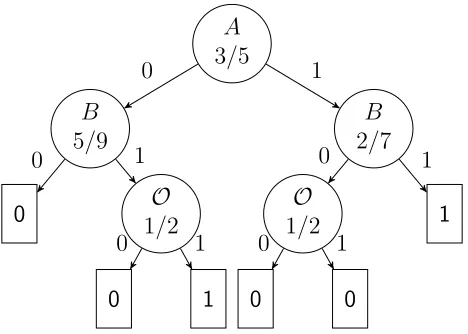
Modeling Protocols as Trees. We model any possible amplifier protocol π? as a full binary tree. The correspondence is natural: the root corresponds to the beginning of the protocol before any message is sent. Every inner node in the tree is either
• Controlled by one of the two parties A or B, meaning that it is this party’s turn to send a message, without loss of generality, a single bit.
• Representing an oracle call to the underlying protocol π resulting in a common bit.
Whenever a message is sent or an oracle call is made, we move in accordance to the left or right child, until reaching a leaf labeled by the common outcome of the protocol. Here the execution ends.
A
3/5
B
5/9
0 0
O 1/2
0 0
1 1 1
0
B
2/7
O 1/2
0 0
0 1 0
1 1 1
Figure 1: An example of a protocol represented by a tree. Each node specifies which party should send a bit as well as the distribution of this bit (when the party is honest). Alter-natively, the parties may invoke the oracle and obtain a joint bit. The adversary may take control of one of the parties and arbitrarily replace its distributions; it can also replace the oracle call distributions provided that they remain ρ-biased.
The above model does not explicitly capture protocols where honest parties may store private coins through the interaction. However, we can transform any private-coin protocol to a protocol in the above model by considering parties that do not explicitly keep private randomness; instead, in every node they resample their private randomness conditioned on the execution transcript so far and answer according to that string. The transformation has no effect on the distribution of transcript and in particular on the outcome bit. However, the transformation may make the new protocol inefficient. This is not an issue as our lower bound will in fact hold for inefficient protocols as well.
A Reduction to Deterministic Santha-Vazirani Extractors. In their seminal work, Santha and Vazirani considered the problem of extracting a statistically uniform bit from a sequence of biased random bitsX=X1, . . . , Xnsuch thatXi has bounded biasρconditioned
on any fixing of X1, . . . , Xi−1. Such random sources X are called Santha-Vazirani Sources.
They proved that there exist no deterministic extractors for such sources, namely, for any deterministic Boolean function E, there exists a Santha-Vazirani source such that E(X) is far from uniform. In fact, they proved that E(X) is ρ-biased.
Indeed, this bares similarity to the setting of oblivious coin-tossing amplification where the ρ-biased input bits naturally correspond to oracle calls to π. The gap between the two models is that a coin-tossing oblivious amplifier further allows interaction between two
randomized parties. To bridge this gap, we prove that any oblivious amplifier can be turned into a non-interactive oblivious amplifier.
To convey the basic idea, imagine that we have an amplifier tree where the root belongs to party A (namely, it sends the first message). We argue that at least one of its left or right subtrees also has bias at most ρ?, and thus we can reduce one round of interaction. In
chosen the worse subtree in order to bias the outcome by more than ρ?. We then observe
that at least one of the subtrees must be such that an adversary controllingB cannot bias by more than ρ?. Indeed, the bias caused by an adversary controllingB in the original protocol is just a convex combination of the its bias in the two corresponding subtrees.
The Second Proof and a More General Lower Bound. Our second proof of the theorem pours more light on the tradeoff between how much each party can bias the protocol towards a specific bit. We first give a correspondence between protocols and points on the plane. For a protocol π, letxπ be the maximum probability a malicious A∗ (controlling A)
can force output 0 and yπ be the maximum probability a malicious B∗ can force output
1. We assign the protocol π coordinates (xπ, yπ). Considering the tree representing the
protocol π, the point in the plane corresponding to the protocol π is determined by the points corresponding to its children themselves as protocols, as well as the operation at its root. (This is roughly done following a similar argument to the one used above, where we either take the maximum of two subtrees, or a convex combination thereof.)
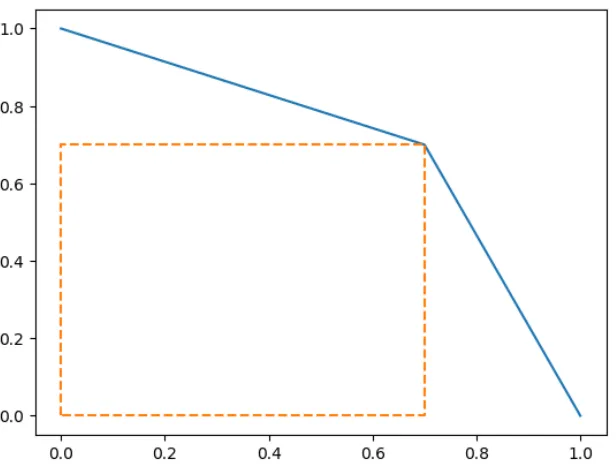
Our basic Theorem 1.1 and its proof show that all points corresponding to protocols lie outside the axis-aligned square given by x= 0, y = 0, x = 0.5 +ρ, y = 0.5 +ρ. Our more general analysis, shows a more accurate picture — all points lie above a certain piecewise linear f (See Figure 2). In a bit more detail, we prove by induction on the depth of the tree that the point corresponding to every protocol lies above the function f, by showing closure of points above f to each of the operations that may appear at the root, and also that protocol leaves (the base case) lie above f. When considering a non-leaf protocol, we get from the induction that the sub-protocols rooted at its children lie above f, and since the set of points above f is closed under the operation at the protocols’ root, the point corresponding to the protocol itself also lies above f.
This more general result shows that we cannot hope to improve the xπ-value of the
oracle without strictly hurting its yπ-value, and furthermore gives some lower bound g(∆x),
for every 0≤∆x ≤xπ, on how muchyπ must increase in order to reduce xπ by ∆x.
Organization
In Section 2, we define the relevant notion of oblivious amplifiers and their correspondence to trees. In Section 3, we prove the main impossibility result by a reduction to the impossibility of deterministic Santha-Vazirani extraction. In Section 4, we give our alternative (direct) proof leading to a more general lower bound.
2
Definitions
Throughout the paper, we denote by Ber(p) the Bernoulli distribution with parameter p, namely, the value 1 gets probability pand 0 gets 1−p.
Figure 2: For the sake of this illustration, we set ρ= 0.2. The X-axis represents the ability of a maliciousA∗ to bias the common output toward 0, and theY-axis represents the ability of a maliciousB∗ to bias the common output toward 1. While our basic Theorem 1.1 argues that all protocols lie outside the dotted square, our more general theorem shows that they in fact lie above the piece-wise linear function represented by the continuous line.
• Every leaf is labeled with either ”0” or ”1”, which represent the common output of the protocol upon reaching that leaf.
• Every inner node v is labeled with ”(Pv, qv)” where
1. Pv ∈ {A, B,O} represents whether it is A’s turn to speak, B’s turn to speak, or
an oracle call.
2. In an honest execution, the bit sent after reaching that node should be distributed according to Ber(qv). If Pv = O then qv must be 0.5, otherwise qv may be an
arbitrary probability.
Execution. An execution of the protocol follows a path along the tree, starting at the root and going left/right in accordance to the bits sent, when 0 means left and 1 means right, until reaching a leaf which determines the common output of that execution.
Adversarial behavior. A malicious party can ignoreqv when it is their turn to speak and
send an arbitrarily distributed bit instead. Also, whenever the oracle is called, the malicious party may change the output distribution of that call from Ber(0.5) to Ber(qv) for any qv
such that |qv −0.5| ≤ρ. Note that qv may depend on all the bits sent up to that call
honest B. Next, define Opt(π, A∗, b) := max
A∗ π(A
∗, b), where the maximum is taken over all
adversarial behaviorsA∗ of A. π(B∗, b) andOpt(π, B∗, b) are defined symmetrically for B.
Definition 2.3 ((α, β)-oblivious coin-tossing amplifier). A common-output two-party pro-tocolπ with oracle access to α-biased bits is an (α, β)-oblivious coin-tossing amplifier if
max
P∗,b Opt(π, P
∗
, b)≤0.5 +β ,
where P∗ ∈ {A∗, B∗} and b ∈ {0,1}. In addition, we require that the expected output of π
over an honest execution is 0.5.
Remark 2.1. Actually, for the lower bound, we do not use the fact that the expected output ofπover an honest execution is 0.5. We note that bounded biases already makes coin-tossing protocols non-trivial.
Remark 2.2. We may also consider the notion of (α, β)-oblivious weak coin-tossing ampli-fiers, which aim to produce a β-bias weak coin tossing (CT) protocol instead of standard
β-CT. In the weak CT setting, we know in advance that A∗ aims to bias the result toward 0 while B∗ aims to bias the result toward 1. We only need to bound their ability to bias the output in their chosen direction. The difference is in the requirement
max
P∗,b Opt(π, P
∗
, b)≤0.5 +β ,
which is replaced with
max{Opt(π, A∗,0), Opt(π, B∗,1)} ≤0.5 +β .
3
Impossibility of Oblivious Amplifiers
In this section, we state and prove our main result regarding the impossibility of non-trivial oblivious coin-tossing amplifiers.
Theorem 3.1 (main). For every common-output two-party protocol π with oracle access to
ρ-biased bits, either Opt(π, A∗,0)≥ 0.5 +ρ or Opt(π, B∗,1) ≥0.5 +ρ. In particular, there do not exist (α, β)-oblivious coin-tossing amplifier, for any β < α.
Toward proving the theorem, we first analyze in Section 3.1 the best possible (unbounded) attacks. Then in Section 3.2, we give the reduction to the impossibility of deterministic extraction from Santha-Vazirani sources.
3.1
The Optimal Attacks
Letπbe a common-output two-party protocol with oracle access toρ-biased bits, and denote its root by r. Also, denote by π0 and π1 the protocols rooted at the left and right children
of r. The best strategy of a maliciousA∗ to make the protocolπ output 0 is to bias the first bit b as much as possible towards arg maxz∈{0,1}Opt(πz, A∗,0), and after b is sent continue
to recursively apply the best strategy at the resulting child. The best strategy of a malicious
• If r is labeled with ”A, p”, then A can completely bias the bit while B cannot change its distribution at all, so
Opt(π, A∗,0) = max
z∈{0,1}Opt(πz, A ∗
,0)
Opt(π, B∗,1) =Ez∼Ber(p)[Opt(πz, B∗,1)]
• Ifr is labeled with ”B, p”, then B can completely bias the bit while A cannot change its distribution at all, so
Opt(π, A∗,0) =Ez∼Ber(p)[Opt(πz, A∗,0)]
Opt(π, B∗,1) = max
z∈{0,1}Opt(πz, B ∗
,1)
• Ifr is labeled with ”O”, then both A and B can bias the bit by at most ρ, so
Opt(π, A∗,0) = (0.5−ρ)· min
z∈{0,1}Optz(π, A ∗
,0) + (0.5 +ρ)· max
z∈{0,1}Opt(πz, A ∗
,0)
Opt(π, B∗,1) = (0.5−ρ)· min
z∈{0,1}Opt(πz, B ∗
,1) + (0.5 +ρ)· max
z∈{0,1}Opt(πz, B ∗
,1)
• Ifr is a leaf labeled with ”0”, then
Opt(π, A∗,0) = 1
Opt(π, B∗,1) = 0
• Ifr is a leaf labeled with ”1”, then
Opt(π, A∗,0) = 0
Opt(π, B∗,1) = 1
3.2
Reduction to Deterministic Santha-Vazirani Extraction
The following theorem states that allowing interaction does not help in creating more secure protocols, in the sense that it does not allow us to generate a better protocol, in either
Opt(π, A∗,0) or Opt(π, B∗,1), than protocols already existing without interaction.
Theorem 3.2. For every common-output two-party protocol π with oracle access toρ-biased bits, there exists a common-output two-party protocol π0 with oracle access to ρ-biased bits, with no inner nodes labeled by either ”A, p” or ”B, p”, and such that Opt(π0, A∗,0) ≤ Opt(π, A∗,0) and Opt(π0, B∗,1)≤Opt(π, B∗,1)
Proof. We show how given any protocol π with ”A, p”/”B, p” turns, we can strictly reduce its number of ”A, p”/”B, p” turns without increasing its cheating probabilities Opt(π, A∗,0) and Opt(π, B∗,1). In essence, we show that for every inner node labeled with ”A, p”/”B, p” there exists a child such that replacing the subtree rooted at that node with the subtree rooted at its child results a protocol that is only harder to cheat in, for both A∗ towards 0 and B∗ towards 1. In more detail: First, we pick some arbitrary inner node of π labeled with either ”A, p” or ”B, p”. Denote this node by N, and its left and right children by N0
and N1, respectively. IfN is labeled by ”A, p” we choose z := arg minb∈{0,1}Opt(Nb, B∗,1),
otherwise choose z := arg minb∈{0,1}Opt(Nb, A∗,0). We take π and replace in it the subtree
rooted at N with the subtree rooted at Nz. Essentially, we fixed the bit sent at node N to
always be z, instead of letting A/B choose it. We make two observations:
1. Both Opt(Nz, A∗,0)≤Opt(N, A∗,0) and Opt(Nz, B∗,1)≤Opt(N, B∗,1).
To see this, assume w.l.o.g that N is labeled with ”A, p” (symmetrical argument for ”B, p”). We have that Opt(N, A∗,0) = maxb∈{0,1}Opt(Nb, A∗,0) and in particular
Opt(N, A∗,0)≥Opt(Nz, A∗,0). Also, since we have that
Opt(N, B∗,1) = Eb∼Ber(p)[Opt(Nb, B∗,1)]
and we chose z := arg minb∈{0,1}Opt(Nb, B∗,1) in case N is labeled with ”A, p”, then
Opt(N, B∗,1)≥Opt(Nz, B∗,1).
In other words, at Nz it is both harder for A∗ to cheat towards 0 and for B∗ to cheat
towards 1.
2. Let π and T be protocols, N be some node of π, and π0 be the protocol resulted by replacing in π the subtree rooted at N with T. If Opt(T, A∗,0) ≤ Opt(N, A∗,0) then Opt(π0, A∗,0)≤Opt(π, A∗,0) and similarly if Opt(T, B∗,1)≤Opt(N, B∗,1) then
Opt(π0, B∗,1)≤Opt(π, B∗,1). The reason for this is that the valueOpt(R, A∗,0) of an inner node R, for all three operations (”A, p”,”B, p”,”O”), is a monotone function of the valuesOpt(R0, A∗,0), Opt(R1, A∗,0) of its children. By not increasing the (A∗,
0)-value of some node, you cannot increase the (A∗,0)-value of its father, which in turn will not increase the (A∗,0)-value of its father and so on.
In other words, by taking a protocol and replacing the sub-protocol run at some partial transcript with another sub-protocol where it is not easier forA∗/B∗ to cheat towards 0/1, we result a protocol where it is not easier for A∗/B∗ to cheat towards 0/1.
Combining these observations, we reach the conclusion that by taking a protocol and repeat-edly getting rid of its ”A, p”/”B, p” nodes by replacing the subtree rooted at them with the subtree rooted at a correctly chosen child of theirs, we can get rid of all the ”A, p”/”B, p” turns without increasing the cheating probabilities ofA∗ towards 0 and of B∗ towards 1.
Definition 3.1 (SV Source). For 0 ≤ ρ ≤ 0.5, a source X = X1, . . . , Xn of length n
(A random variable taking values in {0,1}n) is a Santha-Vazirani (SV) source with bias ρ
if for every i ∈ [n] and every x1, . . . , xi−1 ∈ {0,1}, the bias of Xi conditioned on X1 =
x1, . . . , Xi−1 =xi−1 is at most ρ. That is,
Theorem 3.3 ([SV86], [RVW04]). For every function f : {0,1}n → {0,1} and every 0 ≤
ρ ≤ 0.5 there exists an SV source X = X1, . . . , Xn of length n and bias ρ such that f(X)
has bias at least ρ.
We remark that this version of the statement is taken from Reingold, Vadhan and Wigder-son [RVW04], and that differently from them we refer to the bias as the distance from 0.5 and not double that amount.
The following theorem implies that there are no non-trivial oblivious coin-tossing amplifiers comprised solely of oracle calls.
Theorem 3.4. For every common-output two-party protocol π with oracle access toρ-biased bits and no inner nodes labeled by either ”A, p” or ”B, p”, either Opt(π, A∗,0)≥0.5 +ρ or
Opt(π, B∗,1)≥0.5 +ρ
In fact, in a protocol with no ”A, p”/”B, p” turns there is no longer a difference between
Aand B so eitherOpt(π, A∗,0) =Opt(π, B∗,0)≥0.5 +ρorOpt(π, A∗,1) =Opt(π, B∗,1)≥ 0.5 +ρ
Proof. Letn be an upper bound on the number of oracle calls made byπ in any execution. We can think w.l.o.g of π as always making exactly n oracle calls, with results denoted by
o1, . . . , on, and then outputtingf(o1, . . . , on) for some functionf. The impossibility result of
deterministic extraction from Santha-Vazirani sources, Theorem 3.3, guarantees that there exists an SV source X = X1, . . . , Xn of length n and bias ρ such that f(X) has bias at
least ρ. Therefore, if the malicious party can make sure the oracle calls’ output distribution is X, they can succeed in biasing the output of π by at least ρ. (If it is towards 0 then
Opt(π, A∗,0) ≥ 0.5 +ρ and if it is towards 1 then Opt(π, B∗,1) ≥ 0.5 +ρ). The malicious party can make sure the oracle calls’ output distribution is X by doing it bit-by-bit: After 0 ≤ i ≤ n−1 calls with results x1, . . . , xi they ask the next oracle call to be distributed
according to Xi+1|X1 = x1, . . . , Xi = xi, and their request from the ρ-biased bit oracle is
legal by the definition of SV sources with bias ρ.
Combining Theorem 3.2 and Theorem 3.4, Theorem 3.1 follows.
4
A More General Lower Bound
In this section, we give a direct proof by induction which gives some insight on the possible relations between Opt(π, A∗,0) and Opt(π, B∗,1) and the trade-offs we can get between them.
We correspond every protocol with a point on the plane using Opt(π, A∗,0) as the x -coordinate andOpt(π, B∗,1) as they-coordinate. Our main theorem translates into showing that all protocol points lie outside or on the axis-aligned square with boundaries x = 0.5 +
that all points lie abovef := min1− 00..55+−ρρ·x,00..5+5−ρρ− 00..5+5−ρρ·x, which is both closed under
all operations (now the induction works) and lies above the square (so it implies what we want, and more). See Figure 2 for a graphic representation of the square and f.
Theorem 4.1. For every common-output two-party protocol π with oracle access toρ-biased bits, we have that Opt(π, B∗,1)≥min(1−00..55+−ρρ·Opt(π, A∗,0), 00..5+5−ρρ− 00..5+5−ρρ·Opt(π, A∗,0))
Equivalently, if we take `1 to be the line between (0,1) and (0.5 +ρ,0.5 +ρ)
so`1 isy = 1−
0.5−ρ
0.5 +ρ ·x
and `2 to be the line between (0.5 +ρ,0.5 +ρ) and (1,0)
so`2 isy =
0.5 +ρ
0.5−ρ −
0.5 +ρ
0.5−ρ ·x
then the point (Opt(π, A∗,0), Opt(π, B∗,1)) lies above (not strictly) at least one of `1, `2.
Corollary 4.1. Theorem 3.1 follows
Proof. Since both`1and`2are strictly decreasing (negative slope) and pass through the point
(0.5 +ρ,0.5 +ρ), thenx <0.5+ρimplies`1(x), `2(x)>0.5+ρ. ThusOpt(π, A∗,0)<0.5+ρ
implies Opt(π, B∗,1)≥min (`1(Opt(π, A∗,0)), `2(Opt(π, A∗,0)))>0.5 +ρ
Proof of Theorem 4.1. Proof by induction on the depth.
Leaves labeled with ”0” lie on`2 and leaves labeled with ”1” lie on`1.
Ifπ is not a leaf, denote its root byr, byπ0 and π1 the protocols rooted at the left and right
children of r, and let f := min(`1, `2). Also, denote
x0, y0 =Opt(π0, A∗,0), Opt(π0, B∗,1)
x1, y1 =Opt(π1, A∗,0), Opt(π1, B∗,1)
x0, y0 =Opt(π, A∗,0), Opt(π, B∗,1)
We assume (induction hypothesis) that y0 ≥ f(x0), y1 ≥ f(x1) and want to show that
y0 ≥f(x0). There are three types of operations to consider:
• Ifr is labeled with ”A, p”
x0 y0
=
max(x0, x1)
(1−p)·y0+p·y1
• Ifr is labeled with ”B, p”
x0 y0
=
(1−p)·x0+p·x1
max(y0, y1)
• Ifr is labeled with ”O”
x0 y0
=
(0.5−ρ)·min(x0, x1) + (0.5 +ρ)·max(x0, x1)
(0.5−ρ)·min(y0, y1) + (0.5 +ρ)·max(y0, y1)
We may assume without loss of generality that the points (x0, y0),(x1, y1) lie on f and
not strictly above it, namely, that y0 = f(x0), y1 = f(x1). This is true because y0 is
non-decreasing in y0, y1 in all three operations, so if y0 ≥f(x0) for y0 = f(x0), y1 =f(x1), then
we also have that y0 ≥f(x0) for any y0 ≥f(x0), y1 ≥f(x1).
(Note that f(x0) is unaffected by changes toy0, y1)
Let (x0, y0),(x1, y1) be any two points on f. Since `1 and `2 are decreasing, f is also
decreasing. Let i= arg maxz∈{0,1}xz, so we have that xi > x1−i and yi < y1−i.
• The first operation gives us (x0, y0) = (xi,(1−p)·y0+p·y1), and since
y0 = (1−p)·y0+p·y1 > yi = min z∈{0,1}yz
for every 0< p <1, we have y0 > yi =f(xi) = f(x0).
• The second operation gives us (x0, y0) = ((1−p)·x0+p·x1, y1−i), and since
x0 = (1−p)·x0+p·x1 > x1−i = min z∈{0,1}xz
for every 0< p <1, we have f(x0)< f(x1−i) = y1−i =y0.
• The third operation gives us
x0 y0
=
(0.5−ρ)·x1−i+ (0.5 +ρ)·xi
(0.5−ρ)·yi+ (0.5 +ρ)·y1−i
We separate into two cases:
1. Both (x0, y0) and (x1, y1) lie on either `1 or `2. Denote this common line by `.
Notice that every convex combination of (x0, y0),(x1, y1) also lies on `, and in
particular
x0.5+ρ
y0.5+ρ
= (0.5−ρ)·
x0
y0
+ (0.5 +ρ)
x1
y1
=
(0.5−ρ)·x0+ (0.5 +ρ)·x1
(0.5−ρ)·y0+ (0.5 +ρ)·y1
lies on`. Sincex1−i = min(x0, x1) and xi = max(x0, x1), we have that
x0 = (0.5−ρ)·x1−i+ (0.5 +ρ)·xi ≥(0.5−ρ)·x0+ (0.5 +ρ)·x1 =x0.5+ρ
Sinceyi = min(y0, y1) and y1−i = max(y0, y1), we have that
y0 = (0.5−ρ)·yi+ (0.5 +ρ)·y1−i ≥(0.5−ρ)·y0+ (0.5 +ρ)·y1 =y0.5+ρ
Overall, we conclude thatf(x0)≤`(x0)≤`(x0.5+ρ) =y0.5+ρ≤y0.
2. One of (x0, y0),(x1, y1) lies on`1 and the other lies on `2. The lines`1, `2 intersect
at (0.5 +ρ,0.5 +ρ) and the slope of`2 is steeper, so we can conclude that
f(x) = min(`1, `2) =
(
`1(x) x≤0.5 +ρ
and that x1−i <0.5 +ρ < xi. We have that
y0 = (0.5−ρ)·yi+ (0.5 +ρ)·y1−i = (0.5−ρ)·`2(xi) + (0.5 +ρ)·`1(x1−i) =
= (0.5−ρ)·
0.5 +ρ
0.5−ρ −
0.5 +ρ
0.5−ρ ·xi
+ (0.5 +ρ)·
1− 0.5−ρ 0.5 +ρ ·x1−i
=
= 0.5 +ρ−(0.5 +ρ)·xi+ 0.5 +ρ−(0.5−ρ)·x1−i =
= 1 + 2ρ−((0.5 +ρ)·xi+ (0.5−ρ)·x1−i) = 1 + 2ρ−x0
Therefore, the point (x0, y0) lies on the liney = 1 + 2ρ−x which we will denote by `. Notice that ` also passes through (0.5 +ρ,0.5 +ρ), and that the slope of
` is steeper than that of `1 but more moderate than that of `2, and thus `1 ≤ `
forx≤0.5 +ρ, and `2 ≤` for x≥0.5 +ρ, and overallf(x)≤`(x). This implies
that f(x0)≤`(x0) = y0.
References
[ACM+17] Per Austrin, Kai-Min Chung, Mohammad Mahmoody, Rafael Pass, and Karn
Seth. On the impossibility of cryptography with tamperable randomness. Algo-rithmica, 79(4):1052–1101, 2017.
[BHT18] Itay Berman, Iftach Haitner, and Aris Tentes. Coin flipping ofAny constant bias implies one-way functions. J. ACM, 65(3):14:1–14:95, 2018.
[Blu81] Manuel Blum. Coin flipping by telephone. In Allen Gersho, editor, Advances in Cryptology: A Report on CRYPTO 81, CRYPTO 81, IEEE Workshop on Communications Security, Santa Barbara, California, USA, August 24-26, 1981., pages 11–15. U. C. Santa Barbara, Dept. of Elec. and Computer Eng., ECE Report No 82-04, 1981.
[DKS99] Ivan Damg˚ard, Joe Kilian, and Louis Salvail. On the (im)possibility of basing oblivious transfer and bit commitment on weakened security assumptions. In Jacques Stern, editor,Advances in Cryptology - EUROCRYPT ’99, International Conference on the Theory and Application of Cryptographic Techniques, Prague, Czech Republic, May 2-6, 1999, Proceeding, volume 1592 of Lecture Notes in Computer Science, pages 56–73. Springer, 1999.
[DNR04] Cynthia Dwork, Moni Naor, and Omer Reingold. Immunizing encryption schemes from decryption errors. In Christian Cachin and Jan Camenisch, editors, Ad-vances in Cryptology - EUROCRYPT 2004, International Conference on the Theory and Applications of Cryptographic Techniques, Interlaken, Switzerland, May 2-6, 2004, Proceedings, volume 3027 of Lecture Notes in Computer Science, pages 342–360. Springer, 2004.
[HILL99] Johan H˚astad, Russell Impagliazzo, Leonid A. Levin, and Michael Luby. A pseu-dorandom generator from any one-way function. SIAM J. Comput., 28(4):1364– 1396, 1999.
[HO14] Iftach Haitner and Eran Omri. Coin flipping with constant bias implies one-way functions. SIAM J. Comput., 43(2):389–409, 2014.
[HR08] Shai Halevi and Tal Rabin. Degradation and amplification of computational hardness. In Ran Canetti, editor,Theory of Cryptography, Fifth Theory of Cryp-tography Conference, TCC 2008, New York, USA, March 19-21, 2008., volume 4948 of Lecture Notes in Computer Science, pages 626–643. Springer, 2008.
[IL89] Russell Impagliazzo and Michael Luby. One-way functions are essential for com-plexity based cryptography (extended abstract). In 30th Annual Symposium on Foundations of Computer Science, Research Triangle Park, North Carolina, USA, 30 October - 1 November 1989, pages 230–235. IEEE Computer Society, 1989.
[LT13] Huijia Lin and Stefano Tessaro. Amplification of chosen-ciphertext security. In Thomas Johansson and Phong Q. Nguyen, editors,Advances in Cryptology - EU-ROCRYPT 2013, 32nd Annual International Conference on the Theory and Ap-plications of Cryptographic Techniques, Athens, Greece, May 26-30, 2013. Pro-ceedings, volume 7881 of Lecture Notes in Computer Science, pages 503–519. Springer, 2013.
[MPS10] Hemanta K. Maji, Manoj Prabhakaran, and Amit Sahai. On the computational complexity of coin flipping. In 51th Annual IEEE Symposium on Foundations of Computer Science, FOCS 2010, October 23-26, 2010, Las Vegas, Nevada, USA, pages 613–622. IEEE Computer Society, 2010.
[Nao91] Moni Naor. Bit commitment using pseudorandomness. J. Cryptology, 4(2):151– 158, 1991.
[RVW04] Omer Reingold, Salil Vadhan, and Avi Wigderson. A note on extracting ran-domness from santha-vazirani sources. Unpublished manuscript, 2004.
[SV86] Miklos Santha and Umesh V. Vazirani. Generating quasi-random sequences from semi-random sources. J. Comput. Syst. Sci., 33(1):75–87, 1986.
[Wul08] J¨urg Wullschleger. Oblivious-transfer amplification. PhD thesis, Universit¨at Z¨urich, 2008.