The Sum Can Be Weaker Than Each Part
Ga¨etan Leurent1 and Lei Wang2
1
Inria, France,[email protected] 2
Nanyang Technological University, Singapore,[email protected]
Abstract. In this paper we study the security of summing the outputs of twoindependent hash functions, in an effort to increase the security of the resulting design, or to hedge against the failure of one of the hash functions. The exclusive-or (XOR) combinerH1(M)⊕H2(M) is one of the two most classical combiners, together with the concatenation combiner H1(M)kH2(M). While the security of the concatenation of two hash functions is well understood since Joux’s seminal work on multicollisions, the security of the sum of two hash functions has been much less studied. The XOR combiner is well known as a good PRF and MAC combiner, and is used in practice in TLS versions 1.0 and 1.1. In a hash function setting, Hoch and Shamir have shown that if the compression functions are modeled as random oracles, or evenweakrandom oracles (i.e.they can easily be inverted – in particularH1 andH2 offer no security),H1⊕H2 is indifferentiable from a random oracle up to the birthday bound. In this work, we focus on the preimage resistance of the sum of two narrow-pipe n-bit hash functions, following the Merkle-Damg˚ard or HAIFA structure (the internal state size and the output size are bothn bits). We show a rather surprising result: the sum of two such hash functions, e.g. SHA-512⊕Whirlpool, can never providen-bit security for preimage resistance. More precisely, we present a generic preimage attack with a complexity of ˜O(25n/6). While it is already known that the XOR combiner is not preserving for preimage resistance (i.e.there might be
someinstantiations where the hash functions are secure but the sum is not), our result is much stronger: foranynarrow-pipe functions, the sum is not preimage resistant.
Besides, we also provide concrete preimage attacks on the XOR combiner (and the concatenation combiner) when one or both of the compression functions are weak; this complements Hoch and Shamir’s proof by showing its tightness for preimage resistance.
Of independent interests, one of our main technical contributions is a novel structure to controlsimultaneously the behavior of independent hash computations which share the same input message. We hope that breaking the pairwise relationship between their internal states will have applications in related settings.
Keywords:Hash functions, combiners, XOR combiner, preimage attack.
1
Introduction
takes an arbitrary length input and produces an n-bit output or digest. Hash functions are used in many setting with various security requirements; the general expectation is that a hash function should behave like a random function from {0,1}∗ to{0,1}n. More concretely, the main security notions expected from a
hash function are:
Collision resistance. It should be hard to find two messagesM 6=M0 with H(M) =H(M0).
Second-preimage resistance. Given a messageM, it should be hard to find M06=M withH(M) =H(M0).
Preimage resistance. Given a target hash valueH, it should be hard to find M withH(M) =H.
Since generic collision attacks require 2n/2 work, and generic preimage attacks require 2n work, a secure hash function should have the same level of resistance.
In order to build more secure hash functions, or to protect oneself against future cryptanalysis advances, such as the devastating attacks of Wang et al.
against the SHA family [37,36], a practical countermeasure might be to combine two different hash functions. The goal is that the combined hash function can only be broken when both components are weak. In particular, this reasoning was used by the designers of SSL [11] and TLS [5], who combined MD5 and SHA-1 in various ways. More precisely, the Key Derivation Function of TLS v1.0/v1.1 uses a sum of HMAC-MD5 and HMAC-SHA-1.3The designers explain [5]: “In order to make the PRF as secure as possible, it uses two hash algorithms in a way which should guarantee its security if either algorithm remains secure.”
There are two classical hash function combiners: the concatenation combiner H1(M)kH2(M) and the XOR combinerH1(M)⊕H2(M). In a seminal work [17], Joux showed that the concatenation combiner with narrow-pipe hash functions offers much less security than could be expected: it has 2nbits of output, but essentially offers the same security as ann-bit hash function. In this work, we carry a similar analysis for the XOR combiner. Previous work has shown that it is indifferentiable from a random oracle up to the birthday bound [14], even if the initial functions are weak; in particular, it has optimal collision resistance ofn/2 bits. However, we show that the preimage security is much less than one might expect, with a generic preimage attack with complexity ˜O(25n/6).
Since the goal of a combiner is to keep some security even if one of the functions is found to be weak, it is natural that the two hash functionsH1 and H2are independent in practice. Throughout this paper the two hash functions used in a combiner are always assumed to be independent without specifying it explicitly4.
3
We note that this MD5/SHA-1 combiner has been replaced by primitives based on single hash function (e.g., SHA-256) since TLS v1.2 [6].
4
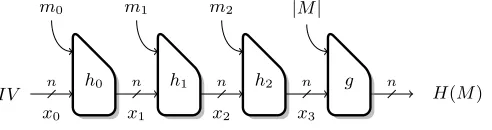
Iterated hash function. In this paper we consider iterated hash functions, following the Merkle-Damg˚ard construction [27,4] or the more general HAIFA construction [2], as shown in Figure 1. We focus on narrow-pipe designs, i.e.we assume that the internal state size is the same as the output sizen. The message M is first split into blocksm0, . . . m`, and the hash function iterates a series of
compression functions hi over an internal statex, with the initial value denoted
asIV. Finally, the hash value is computed with a finalization function g:
x0=IV xi+1=hi(xi, mi) H(M) =g(x`+1,|M|)
In the following, we assume that the compression function is the same at every step (∀i, hi=h) in order to simplify the notations, but it is straightforward to
apply the attack with the corresponding function at each step.
h0
n
m0
x0
h1
n
m1
x1
h2
n
m2
x2 x3
H(M)
n n
|M|
IV g
Fig. 1.Iterated hash function.
1.1 Related works
Combiners have been studied in several different settings. For generic attacks, the compression functions are modeled as random functions, in order to devise attacks that don’t use any weakness of the compression functions. On the other hand, some work assumes that the compression function is aweak random oracle (that can easily be inverted), and prove that some constructions are still secure in this model. Finally, more theoretical work focus on the notion ofrobustness,
i.e.the existence of a reduction from attacks on the hash functions to attacks on the combiner.
Analysis of the concatenation combiner. The concatenation combiner H1(M)kH2(M) is probably the most studied one. In 2004, Joux [17] described surprising attacks on the concatenation of two narrow-pipe hash functions using multicollisions: while the output size is 2nbits, the concatenation can at most providen/2-bit security for collision resistance andn-bit security for preimage resistance5. In particular, the concatenation is not security-amplifying. On the other hand, the concatenation combiner is robust for preimages and collisions, which gives a matching lower bound for generic attacks.
5
Later, Hoch and Shamir [14] evaluated the security of the concatenation combiner with two weak hash functions. More precisely, the two hash functions are narrow-pipe Merkle-Damg˚ard, and the compression functions are modeled as weak random oracles (as defined by Liskov [21]),i.e., the adversary is given additional interfaces to receive (random) preimages of the compression functions. They have proven that in this model, the concatenation combiner is still indifferentiable from a random oracle withn/2-bit security, implying (at least) the same security bound for collision resistance and preimage resistance. The bound is matched by Joux’s attack for collisions, but there is a gap with Joux’s attack for preimages, with complexity 2n, which might be interesting to investigate further.
Mendelet al.analyzed some dedicated instantiations of the concatenation combiner [25], in particular using the hash function MD5. We omit the details and refer interested readers to [25].
Analysis of the XOR combiner. The XOR combiner has received less analysis. The work of Hoch and Shamir [14] actually proves the security of the XOR combiner as an intermediate result: it is also indifferentiable from a random oracle up to 2n/2 queries in the weak random oracle model. In particular, this proves that there are no generic attacks with complexity smaller than 2n/2. For collision resistance, the bound is tight, since it is matched with the generic birthday attack bound. On the other hand, for preimage resistance, there exists a gap between then/2-bit proven bound and then-bit expected ideal security bound.
To the best of our knowledge, no preimage attacks have been shown against the XOR combiner. Therefore, the preimage security of the XOR combiner against generic attacks is still an open problem, and will be the main topic of our work. We will also consider the preimage security of the XOR combiner with weak hash functions, and study the tightness of Hoch and Shamir’s bound.
Robust combiners. In the last years, the general problem of combining two (or more) hash functionsH1andH2 has been extensively studied from a theoretical point of view. These works focus on the notion of arobust combiner: a robust combiner is secure with respect to propertyαas long as one of the underlying hash functions is secure forα. It can be shown that the concatenation combiner is a robust combiner for collision-resistant hash functions and for MACs, while the XOR combiner is robust for PRFs and for MACs [20]. More advanced combiners have been constructed in order to be robust for multiple properties simultaneously [8,9,10]. The notion was mostly studied via the black-box reduction model. A series of results have showed that robust combiners for collision resistance and preimage resistance cannot have an output length significantly shorter than the sum of the output length of the underlying hash functions [3,32,33,28]. Since the XOR combiner is length preserving, this shows that it is not robust for collision resistance and preimage resistance.
Mittel-bach introduced the idealized random oracle model [29]. He gives a construction of a short output combiner with optimal collision and preimage security in this model6(assuming that one of the functions is ideal): Cryptophia’s short combiner uses the sum of two hash functions with some pre-processing of the messages (to allow non-independent functions).
More generally, we point out that a combiner being non-robust does not necessarily mean there is an attack. The non-robustness results only show that the security of the combiner cannot be proved with areduction from the security of the hash functions. In particular, the XOR combiner is not robust for collision-resistance, or even collision-resistance preserving. However, Hoch and Shamir’s work proves that there are no generic collision attacks on this construction, either with ideal compression function, or even with weak compression functions. This arguably makes the XOR a useful combiner for collision resistance. Regarding preimage security, the non-robustness result does not imply that the XOR of two concrete hash functions is weak, and the simplicity and short output of this construction still make it quite attractive.
1.2 Our results
In this work, we study the preimage security of the XOR combiner, the main remaining open problem for classical combiners. We show that, surprisingly, the sum of two narrow-pipen-bit hash functions can never achieve n-bit security for preimage resistance. More precisely, we find a generic preimage attack with a complexity of ˜O(25n/6). It does not exploit any structural weakness of the compression functions and hence is applicable even if the compression functions are two ideal random oracles. Thus, even if the two hash functions are n-bit secure for preimage resistance, the XOR combiner is at most 5n/6-bit secure for primage resistance. In other words,the sum can be weaker than each part.
The attack is based on a novel technique to break the pairwise relationship between the internal states of the two hash functions. More precisely, the two hash functionsH1andH2share the same input message, and hence the internal states of their iterative compression function computations are related. We control the computation chains ofH1andH2simultaneously by constructing a new message structureM, and two sets of internal states AforH1 andBforH2such that: for any valueAfromAand any valueB fromB, we can derive a message MA,B
fromMsuch thatH1(MA,B) producesAandH2(MA,B) producesB. Hence we
can select states from Aand B independently. After that, we use a birthday match to find a message blockm, a valueAfromAand a valueB fromBsuch that h1(A, m)⊕h2(B, m) is equal to the target hash digest, where h1 andh2 are the compression functions ofH1 andH2respectively. Finally we derive the messageMA,B fromM, and outputMA,Bkmas a preimage of the target hash
digest.
6
Our preimage attack is also applicable to Cryptophia’s short combiner [29,26]. This construction has been proven to provide optimal collision and preimage resistance, assuming that at least one of the initial functions is a monolithic random oracle, but our attack does not violate the security proof, because we use the fact that both functions have an iterative structures with an n-bit internal state. Still, this shows that with many practical hash functions, the combiner will be weaker that the initial functions. Our results also show that the XOR combiner and Cryptophia’s combiner are not robust in the semi-black-box model introduced by Mittelbach [29]7, even with independant hash functionsH1and H2.
Our analysis on the XOR combiner is also interesting for dedicated hash function design. The hash function family RIPEMD [7] is based on a compression function with two parallel lanes, added together at the end of each compression function. Interestingly, RIPEMD-160 has been quite resilient to cryptanaly-sis [24,34,22,23], and are still considered secure. Several more recent designs use parallel lanes in a similar way (combining them at the end of each compression function call), such as HAS-V [31], FORK [15] and LANE [16]. It might be tempting to use parallel lanes during the full iteration, and to combine them only at the end. Indeed, the designers of SHA-V [12] used this approach: the 160-bit version of SHA-V has two parallel lanes, combined at the end with a modular sum. This is equivalent to summing two different hash functions, and hence our attack can be applied to SHA-V.
Another contribution of this paper is to present concrete preimage attacks on the XOR combiner with one or both weak hash functions (defined in [21]). The complexity of our attacks is ˜O(2n/2). Furthermore, the attack can be extended to the concatenation combiner with two weak hash functions under the same complexity. It can be seen that these attacks match the bound of Hoch and Shamir’s security proof [14], and hence fulfill the gaps pointed out in Section 1.1. It implies the tightness of Hoch and Shamir’s proof on the classical combiners with weak hash functions for preimage resistance.
Finally, we would like to highlight the technical interests of this paper. We devise a novel structure named interchange structure to simultaneously control two (or more) hash lanes with the same input message, and succeed in further relaxing the pairwise relation between the internal states of lanes. It is indeed a step of technical advance compared with previous extensive studies on this topic, and hence will hopefully have applications or lead to new technical development in related settings. We refer to the open discussions in Section 7 for more details.
7
1.3 Notations and roadmap in the rest of paper
We use the following notations: H1, H2: hash functions
IV1,IV2: initial values forH1 andH2, respectively
h1, h2 : compression functions ofH1 andH2, respectively h∗1, h∗2 : compression functions iterated over several blocks
(in particular, Hi(M) =h∗i(IVi,M))
m : message block
M : message chunk (n/2 blocks) M : long message (several chunks) aj, bk : chains for H1 andH2, respectively
aj denotes a generic chain, whileaj0 denotes a particular chain
Aj, Bk : end points of the chains
n : hash function output size
Roadmap. Section 2 provides an overview of our generic preimage attack on the XOR combiner. Sections 3, 4, and 5 elaborate the attack procedure step by step in details. Section 6 presents the applications and extensions of the attack. Finally we conclude the paper and discuss future directions in Section 7.
2
Overview of the attack
We first give an overview of the techniques and the structures used in the attack, while more detailed descriptions will be given in the following sections.
The main idea is to consider several chains of internal states reached by processing a common messageM from different starting points (note that the messageM is not fixed in advance, but will be determined when building the structure). More precisely, the messageM is denoted as theprimary message, and divided in several chunks:M =M0kM1k. . .(as discussed later, a chunk will consist of several message blocks). We denote chains of internal states forH1asaj,
and the individual states of the chain asai
j, withh∗1(aij, Mi) =aij+1. Similarly, we
denote chains for H2 asbk, withh∗2(bik, Mi) =bik+1. When considering both hash
functions, message blockMi leads from the pair of states (aij, bik) to (a i+1
j , b i+1
k ),
which is denoted:
(aij, b i k)
Mi
(aij+1, bik+1).
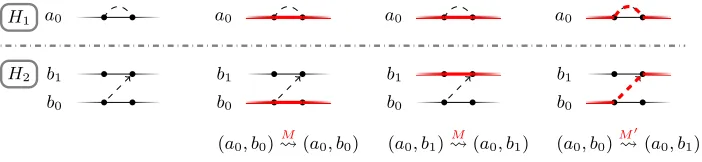
Switch structure. Next we build special structures calledswitches in order to jump between chains in a controlled way. A switch allows to jump from a specific pair of chains (aj0, bk0) to a different pair of chains (aj0, bk1) using a secondary
message chunkMi0, in addition to the normal transitions using chunkMi of the
primary message M:
(aij, bik) Mi
(aij+1, bik+1) : normal transition for each chain
(aij0, bik0)Mi0
(aij+1
0 , b i+1
In order to simplify the notations, we often omit the chunk index, in order to show only the chains that are affected by the switch.
The main message chunk Mi and the secondary message chunk Mi0 are
determined when building the switch, and the main message defines the next state of all the chains. We note that the secondary message chunkMi0should only be used when the state is (aij0, bik
0). A simple example is depicted in Figure 2.
H1
H2 a0
b1
b0
a0
b1
b0
(a0, b0) M
(a0, b0) a0
b1
b0
(a0, b1) M
(a0, b1) a0
b1
b0
(a0, b0) M0
(a0, b1)
Fig. 2.A single switch: jump from (a0, b0) to (a0, b1) by usingM0(dashed lines) instead ofM (solid lines).
Alternatively, a switch can be designed to jump from (aj0, bk0) to (aj1, bk0).
We defer the details of the construction to Section 3; it can be built with a complexity of ˜O(2n/2).
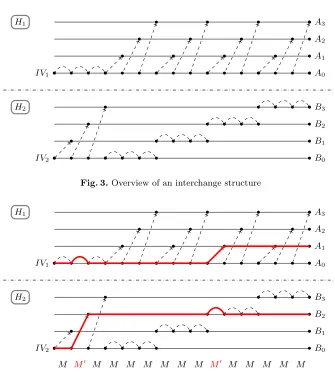
Interchange structure. By combining several simple switches, we can build an interchange structure with starting points IV1 andIV2 and ending points
Aj, j= 0. . .2t−1 and
Bk, k= 0. . .2t−1 , so that we can select a message
ending in any state (Aj, Bk). Figure 3 shows one possible way to build such a
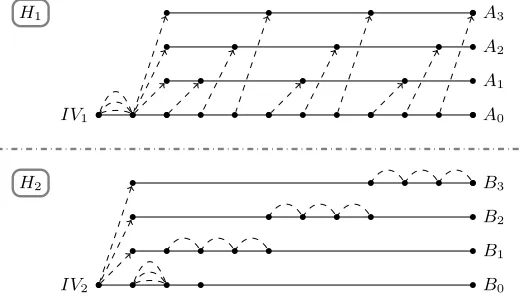
structure, and Figure 4 shows how to select a given message in the structure. An interchange structure with 2tchains for each function requires about 22tswitches.
Since we can build a switch for a cost of ˜O(2n/2), the total structure is built with ˜
O(22t+n/2) operations.
Preimage search. Finally, we can use an interchange structure with ending points
Aj, j = 0. . .2t−1 and
Bk, k = 0. . .2t−1 , to build a preimage
attack as follows. LetH denote the target value. We select a random message block m, and we compute two lists by evaluating the compression functions after the interchange structure:
A0j =h1(Aj, m), j= 0. . .2t−1 andBk0 =
H ⊕h2(Bk, m), k = 0. . .2t−1 . We expect a match between the lists with
probability 22t−n. After about 2n−2t random choices of m, we get a match (j∗, k∗):
IV1
IV2 H1
H2
B0 A0
B1 A1
B2 A2
B3 A3
Fig. 3.Overview of an interchange structure
IV1
IV2 H1
H2
B0 A0
B1 A1
B2 A2
B3 A3
M M0 M M M M M M M M0 M M M M M
Fig. 4.Using of the interchange structure to reach output (A1, B2)
Therefore, we can construct a preimage of H by concatenating the message leading to (Aj∗, Bk∗) in the interchange structure, and the blockm(we ignore the finalization function in this section).
The complexity of the preimage search is about 2n−t evaluations of the compression function, using an interchange structure with 2tend-points.
Complexity analysis. Building the interchange structures requires about 22t+n/2 evaluations of the compression function, while the preimage search requires about 2n−t. The optimal complexity is reached when both steps take
3
The switch structure
We now explain how to build the switch structure at the core of our attack. This construction is strongly based on the multicollision technique of Joux [17].
Given statesai j0,b
i k0 andb
i
k1, we want to build message chunks Mi andMi
0
in order to have the following transitions:
(aij0, bik0)Mi
(aij+1
0 , b i+1
k0 ) (a i j0, b
i k1)
Mi
(aij+1
0 , b i+1
k1 ) (a i j0, b
i k0)
Mi0
(aij+1
0 , b i+1
k1 ).
The main message chunkMi is used to define the next state of all the remaining
chains, while the secondary message chunk Mi0 will be used to jump from chains
(aj0, bk0) to (aj0, bk1). We note that Mi
0 will only be used when the state is
(ai j0, b
i
k0). In particular,Mi andMi
0 must satisfy:
aij+1
0 =h
∗ 1(a
i
j0, Mi) =h
∗ 1(a
i j0, Mi
0)
bik+1
1 =h
∗
2(bik1, Mi) =h
∗
2(bik0, Mi
0)
bik+1
0 =h
∗ 2(b
i
k0, Mi)6=b i+1
k1
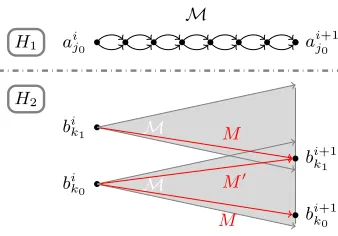
We first build a multicollision forh∗1, starting from stateai
j0,i.e.a large setM
of 2n/2messages that all reach the same stateai+1
j0 (∀M ∈ M, h
∗
1(aij0, M) =a i+1
j0 ).
As shown by Joux, this can be done efficiently by sequentially building n/2 collisions.
Next, we evaluateh∗2(bi
k0, M) andh
∗
2(bik1, M) for all the messagesM in the set
M. With high probability there is match between the sets of values8. We denote the colliding messages asMi andMi0, so that we haveh∗2(bik0, Mi
0) =h∗
2(bik1, Mi).
Finally we compute the missing chains using the messagemi:aij+1=h∗1(aij, mi),
bik+1=h∗2(bik, mi). With high probability all the chains reach distinct values; if
this is not the case, we restart the construction with a new multicollision. The full algorithm is shown as Algorithm 1, and illustrated by Figure 5; it requires aboutn/2·2n/2evaluations of the compression functions.
4
The interchange structure
Let us now describe the combination of switch structures into an interchange structure. The goal of this structure is to select the final value of theH1 com-putation and theH2 computation independently. More precisely, the structure defines two sets of final valuesAj andBk, and a set of messagesMjk such that:
(IV1, IV2) Mjk
(Aj, Bk).
In order to build this structure, we initialize the first chains witha00=IV1, b00=IV2, and set the other starting points randomly. Then, we use switches to
8
H1
H2
aij0 a
i+1
j0
M
bik0
bi
k1 M
M
bik+1
1
M0 M
bik0+1 M
Fig. 5.Building a switch structure. First,M andM0 are selected fromMto generate a collision (defining the newbk1), thenbk0 is evaluated usingM.
jump for an already reachable pair (aj0, bk0) to a different pair (aj0, bk1) (or to
(aj1, bk0), respectively). By using 2
2t−1 switches, we can make all pairs reachable.
There are many way to combine the switches; a simple one can be described as follow:
1. first, build switches from (a0, b0) to each of the (a0, bk)’s;
2. then for eachk, build a series of switches from (a0, bk) to all the (aj, bk)’s.
In order to reach the chains (aj, bk), one would activate thek-th switch in the
first part to jump from (a0, b0) to (a0, bk), and then the j-th switch in thek-th
series of the second part to jump from (a0, bk) to (aj, bk). This structure is shown
in Figure 3 and a pseudo-code description is given by Algorithm 2, where the Interchangefunctions builds the structure, and theSelectMessagefunction extracts the message reaching (aj, bk).
The structure can be somewhat optimized using the fact that the extra chains have no prespecified initial values. We show how to take advantage of this in Appendix A, using multicollision structures in addition to the switch structures. However, this doesn’t change significantly the complexity: we need (2t−1)(2t−1)
switches instead of 22t−1. In total, we need aboutn/2·22t+n/2evaluations of the compression functions to build a 2t-interchange structure.
We believe that a 2t-interchange structure based on switches will need at least Θ(22t) switches, because every switch can only increase the number of reachable pairs (aj, bk) by one. As shown in Appendix A some switches can be saved in
the beginning but it seems that new ideas would be needed to reduce the total complexity belowΘ(22t+n/2).
5
Preimage Attack
Finally, we describe the full preimage attack. We first build an interchange structure with 2tchains for each ofH
1andH2. We denote the ending points as
Algorithm 1Building a single switch
functionSwitch(h1, h2, a, b, b0) x←a
M ←∅
for0≤i < n/2do
(m, m0)←Collision(h1, x)
M ←(M km)∪ (M km0) x←h1(x, m)
end for
H ← {}
forM∈ Mdo
y←h∗2(b, M)
H[y]←M
end for forM∈ Mdo
y←h∗2(b
0
, M)
if H[y] existsthen returnM,H[y]
end if end for end function
functionCollision(h, x)
H ← {}
loop
m←$ y←h1(x, m)
if H[y] existsthen returnm,H[y]
else
H[y]←m
end if end loop end function
messageMjk to reach any state (Aj, Bk). When adding a message blockmto
one of the messagesMjkin the interchange structure, the output of the combiner
can be written as:
H1(Mjkkm)⊕H2(Mjkkm) =g1(h1(Aj, m), `+ 1)⊕g2(h2(Bk, m), `+ 1),
whereg1 andg2are the finalization functions ofH1andH2, respectively, and ` is the length of the messages in the structure.
In order to reach a target valueH, we select a random blockm, and we evaluate
Algorithm 2Building and using aT-interchange structure
functionInterchange(h1, h2, IV1, IV2) a0←IV1,b0←IV2
for1≤k < T do
ak←$,bk←$ end for
for1≤j < T do
(M, M0)←Switch(h1, h2, a0, b0, bj)
M ←MkM;M0←M0kM0
for0≤k < T do
ak←h∗1(ak, M)
bk←h∗2(bk, M) end for
end for
for1≤j < T do for1≤i < T do
(M, M0)←Switch(h2, h1, bj, a0, ai)
M←MkM;M0←M0kM0
for0≤k < T do
ak←h∗1(ak, M)
bk←h∗2(bk, M) end for
end for end for
return(M,M0)
end function
functionSelectMessage(M,M0, j, k) µ←M
if k6= 0then
µ[k−1]←M0[k−1]
end if if j6= 0then
µ[(k+ 1)·(T−1) +j−1]←M0[(k+ 1)·(T−1) +j−1]
end if returnµ
end function
1), k= 0. . .2t−1 . If there is a match (j∗, k∗) between the two lists, we have:
A0j∗=B0k∗⇔g1(h1(Aj∗, m), `+ 1) =H⊕g2(h2(Bk∗, m), `+ 1)
⇔H1(Mjkkm)⊕H2(Mjkkm) =H.
For a random choice ofm, we expect that a match exists with probability 22t−n,
and testing it requires about 2toperations9. We will have to repeat this procedure
9
2n−2ttimes on average, therefore the total cost of the preimage search is about
2n−tevaluations ofh
1andh2.
As explained in the previous section, building a 2t-interchange structure
requires aboutn/2·22t+n/2operations. Usingt=n/6 we balance the two steps of the attack, and reach the optimal complexity of aboutn/2·25n/6 operations for the preimage attack.
5.1 Message length and memory complexity
The attack uses messages of length n/2·22t, and the memory complexity of
the attack10 is also n/2·22t. The optimal choice t = n/6 gives messages of
length n/2·2n/3. The memory requirement is probably not an issue11 for an attacker that can spend time 25n/6, but the message length can be a problem with some hash functions that don’t accept long inputs. For instance SHA-256 is only defined for message with less than 264bits (i.e.255 blocks).
In this case, one can apply the attack with a smaller value oft: this reduces the length of the messages, at the cost of more time spent in the preimage search step. For instance, we can mount a preimage attack against SHA-256⊕BLAKE-256 with complexity 2232 usingt= 24, while the optimal attack withn= 256 would cost only 2220.3. Similarly, our attack applied to SHA-512⊕Whirlpool has a complexity of 2461, rather than 2434.7.
6
Applications and Extensions
The attack works identically if the hash functions use the HAIFA mode rather than the plain Merkle-Damg˚ard iteration. Also it can easily be extended to H1(M)H2(M) wheredenotes an easy to invert group operation (for instance, a modular addition rather than the exclusive or). The attack can also be extended to hash functionsH1 and/orH2 using an internal check-sum, such as the GOST family of hash functions, using pairs of blocks with a constant sum.
6.1 Application to the sum of wide-pipe hash functions
The attack can also be used when the internal state size` is larger than the output sizen. The complexity of building a 2t-interchange structure is related to `as `/2·22t+`/2. On the other hand, the complexity of the meet-in-the-middle preimage search is related tonas 2n−t. The optimal complexity is`/2·22n/3+`/6 by matching the two complexities witht=n/3−`/6. Therefore our attack can be applied as long as `+ 6 log(`) ≤ 2n holds. For instance, we can compute preimages of SHA-224⊕BLAKE-224 with complexity roughly 2199.
10We only need to store the messagesM andM0
11
6.2 Application to Cryptophia’s short combiner
Our attack can also be applied to Cryptophia’s short combiner, as proposed by Mittelbach [29], and to the revised version of Mennink and Preneel [26]. This combiner computes the sum of two hash functions with some pre-processing of the message, to allow non-independent functions:
C(M) =H1 m˜11k. . .km˜ 1
`
⊕H2 m˜21k. . .km˜ 2
`
˜
m1j =H1(0kl1kmj⊕k1)⊕H2(0kl2kmj⊕k2)
˜
m2j =H1(1kl1kmj⊕k1)⊕H2(1kl2kmj⊕k2)
wherek1, k2, l1, l2is a randomly chosen key. The security proof in the ideal model shows thatCis optimally preimage resistant if at least one of the hash functions is ideal.
However, if bothH1 and H2 are narrow-pipe, we can apply our preimage attack with complexity ˜O(25n/6). This does not violate the security proof because we need both functions to be narrow-pipe, hence not n-bit ideal12. From a practical point of view, though, it shows that in many cases (e.g. using SHA-512 and Whirlpool) the combiner isweaker than the initial functions.
6.3 Improvements using weaknesses of the hash functions
If H1 or H2 has known cryptographic weaknesses, more efficient attacks are possible. More precisely, if the compression function of one of the hash functions can be inverted13 in time 2t, then we can find a preimage of H
1⊕H2 with complexity only ˜O(2(n+t)/2).
The attack is presented using the case, where (at least) one compression function is modeled as a weak compression function defined in [21], as an exam-ple. Without loss of the generality, we assume the compression function of H2, h2(x, y) =z, is such a weak compression function, which is a random oracle with two additional interfaces as below.
• Backward interface. On a query (?, y, z), it returns either a valuexuniformly chosen from all the values satisfyingh2(x, y) =z, or⊥if no suchxexists.
• Bridging interface. On a query (x,?, z), it return either a value y uniformly chosen from all the values satisfyingh2(x, y) =z, or⊥if no suchy exists.
Note that the inversion of compression functionh2 takes unit time and hence the attack againstH1⊕H2 takes time ˜O(2n/2). The procedure is detailed as follows, which is also illustrated in Figure 6.
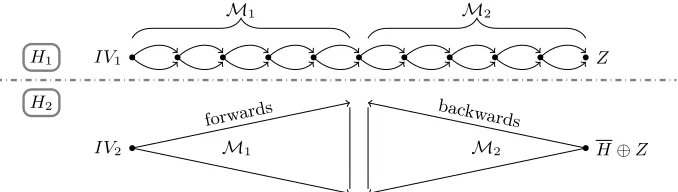
Let the target hash digest be denoted as H. We firstly build an n-block long multicollision onH1 following Joux’s approach [17]. Let the final output
12A large multi-collisions can be built with a cost of roughly 2n/2 in a narrow-pipe
function, but costs almost 2nfor an ideal hash function. 13
be denoted as Z. It contains a set of up to 2n messages that link IV
1 to Z on H1. We split every n-block long multicolliding message into halves, and collect the first half n/2-block long messages as a set M1and the second half as another set M2. Hence for any message M1 ∈ M1 and anyM2∈ M2, the concatenated messageM1kM2linksIV1toZ onH1. Secondly, for the messages M2∈ M2, we use the additional backward interface ofh2to carry out backward computations fromH⊕Z, and get valuesX such thath∗2(X, M2) =H⊕Z. We store (X, M2) in a tableTX. On average TX contains 2n/2 elements.14 Finally,
for each messageM1 ∈ M1, we iteratively compute h2 forward from IV2, and get an internal stateY. We match Y to the elements inTX. A match implies
that concatenated M1kM2 linksIV2 toH ⊕Z, and in turn is a preimage of H1(M1kM2)⊕H2(M1kM2) = Z⊕H ⊕Z = H. The success probability of finding such a match is not negligible since there are 2n/2 X’s and Y’s. The complexity is aroundn·2n/2that is ˜O(2n/2) by ignoring the polynomial factors.
H1
H2
IV1 Z
backwards
H⊕Z IV2
forwards
M1 M2
M1 M2
Fig. 6.Preimage attack on the XOR combiner with a weakH2
Moreover, the above preimage attack can be extended to the concatenation combinerH1kH2 if both H1 andH2 are weak by a minor modification. This shows that the proof of Hoch and Shamir [14] is tight for preimage resistance. Here we mainly highlight the modifications. Let the target hash digest beH1kH2, whereH1is fromH1and H2 fromH2. After we build the multicollision onH1 and let the output internal state be denoted as Z, we link Z toH1 by using the bridging interface of h1 to receive a message msuch that h1(Z, m) =H1. This gives us a set of messages linkingIV1to H1 onH1. Also note that for the backward computations onH2, the starting value should beH2. The rest of the attack procedure remains the same. Hence it is easy to get that the complexity is also ˜O(2n/2).
14
6.4 Extension to the sum of three or more hash functions
The attack can be extended to the sum of three or more hash functions. In order to attack the sum ofk functions, two different strategies are possible: either we use a simpler structure that only gives two degrees of freedom, and fixesk−2 functions to a constant value, or we build an interchange structure to control all thekfunctions independently.
Controlling only two functions. The easiest way to extend the attack is to use a single chain in thek−2 extra hash functions. The procedure to build a switch is modified in order to use multicollisions for k−1 functions instead a simple multicollisions for one function; this costs O(nk−1·2n/2) using Joux’s method [17].
As in the basic attack, we needO(t2) switches to generate a 2t-interchange
for two functions, and the preimage search costsO(2n−t); the optimal complexity
is thereforeO(nk−1·25n/6) witht=n/6.
Controlling all the functions. Alternatively, we can build a more complex interchange structure in order to control all the functions independently. When attacking three functions, we will use the switch structure to jump from chains (aj0, bk0, cl0) to (aj0, bk0, cl1) (or (aj0, bk1, cl0) or (aj1, bk0, cl0), respectively). We
need 23t−1 switches in the interchange structure to reach all the 23t triplets of chains (a switch makes only one new triplet reachable). Each switch is built using a 2n/2-multicollision on two functions, which can be built for a cost ofO(n2·2n/2) following Joux’s technique [17]. Therefore we can build a 2t-interchange for a cost ofO(n2·23t+n/2). More generally, for the sum ofk hash functions, we can build an interchange structure forkfunctions for a cost ofO(nk−1·2kt+n/2).
In the preimage search phase, we generateklists of size 2t, and we need to
detect efficiently whether we can combine then to generate a zero sum. This problem can be solved using a algorithm similar to Wagner’s generalized birthday algorithm [35]. Ifk= 2κ, we find a solution with probabilityO(2n−(κ+1)·t) for a
cost of O(k·2t). Therefore the preimage search costsO(k·2n−κt). Withk= 4
(i.e.κ= 2), this yields a complexity ofO(n3·25n/6). However, this approach is less efficient than the previous one fork= 3 and fork >4.
To summarize, attacking the sum ofkhash functions (k≥2) costsO(nk−1· 25n/6). Controlling chains independently in more than two hash function might be useful for further work, but it doesn’t improve the preimage attack on the sum ofkhash functions.
7
Conclusion and open discussions
easier to break than the initial functions. Since most practical hash functions are narrow-pipe (e.g.SHA-1, SHA-256, SHA-512, Whirlpool, RIPEMD, GOST, BLAKE, Skein...), the XOR combiner will usually provide a weaker security than the component hash functions.
Moreover, we would like to discuss a few directions for future work.
On controlling multiple hash lanes. Since 2004, several generic attacks have been found against narrow-pipe hash functions, such as the multicolli-sion attack[17], the long-message second preimage attack[19] and the herding attack[18]. There has been extensive work to extend these attacks to more com-plex constructions with several computation chains, such as the concatenation H1(M)kH2(M) and the cascadeH2(H1(M), M).
As in our present work, the essential difficulty in those attacks comes from the fact that several lanes of computation share the same input message, and hence their outputs are related. If an adversary considers a na¨ıve set of messages, the set of outputs gives random pairs ofn-bit values{(Ai, Bi) :i∈ I}: selecting a value
for the first entry of the pair gives a single candidate for the second entry, and the adversary is essentially working with a 2n-bit state. Previous works [30,13,1] have developed various message structures (mostly based on multicollision and diamond structures), in order to relax this relation. They mainly result in a set of messages Msuch that the corresponding outputs are in a more structured set{(A, Bi) :i∈ I}: the first entry is a constant valueA, but several optionsBi
can be selected for the second entry. For any value (A, Bi), it is then possible
to select a message inMso that the first lane reachesA, while the second lane reachesBi. This allows to modify the value of the second lane without affecting
the first lane.
Our result is quite stronger: with the interchange structure we have a set of message such that the corresponding outputs are a set{(Ai, Bj) :i∈ I, j∈ J },
wherebothlanes have several options that can be selected independently. We hope that our technique will have applications or lead to new technical development in related settings, e.g., the open problem of generic second preimage attacks (with long messages) on the concatenation hash or on the Zipper hash [21].
Acknowledgements
The authors would like to thank the anonymous referees for their helpful comments. Lei Wang is supported by the Singapore National Research Foundation Fellowship 2012 (NRF-NRFF2012-06).
References
1. Andreeva, E., Bouillaguet, C., Dunkelman, O., Kelsey, J.: Herding, Second Preimage and Trojan Message Attacks beyond Merkle-Damg˚ard. In: Jr., M.J.J., Rijmen, V., Safavi-Naini, R. (eds.) Selected Areas in Cryptography. Lecture Notes in Computer Science, vol. 5867, pp. 393–414. Springer (2009)
2. Biham, E., Dunkelman, O.: A Framework for Iterative Hash Functions - HAIFA. IACR Cryptology ePrint Archive, Report 2007/278 (2007)
3. Boneh, D., Boyen, X.: On the Impossibility of Efficiently Combining Collision Resistant Hash Functions. In: Dwork, C. (ed.) CRYPTO. Lecture Notes in Computer Science, vol. 4117, pp. 570–583. Springer (2006)
4. Damg˚ard, I.: A Design Principle for Hash Functions. In: Brassard, G. (ed.) CRYPTO. Lecture Notes in Computer Science, vol. 435, pp. 416–427. Springer (1989) 5. Dierks, T., Allen, C.: The TLS Protocol Version 1.0. RFC 2246 (Proposed Standard)
(Jan 1999),http://www.ietf.org/rfc/rfc2246.txt, obsoleted by RFC 4346, up-dated by RFCs 3546, 5746, 6176
6. Dierks, T., Rescorla, E.: The Transport Layer Security (TLS) Protocol Version 1.2. RFC 5246 (Proposed Standard) (Aug 2008),http://www.ietf.org/rfc/rfc5246. txt, updated by RFCs 5746, 5878, 6176
7. Dobbertin, H., Bosselaers, A., Preneel, B.: RIPEMD-160: A Strengthened Version of RIPEMD. In: Gollmann, D. (ed.) FSE. Lecture Notes in Computer Science, vol. 1039, pp. 71–82. Springer (1996)
8. Fischlin, M., Lehmann, A.: Multi-property Preserving Combiners for Hash Functions. In: Canetti, R. (ed.) TCC. Lecture Notes in Computer Science, vol. 4948, pp. 375– 392. Springer (2008)
9. Fischlin, M., Lehmann, A., Pietrzak, K.: Robust Multi-property Combiners for Hash Functions Revisited. In: Aceto, L., Damg˚ard, I., Goldberg, L.A., Halld´orsson, M.M., Ing´olfsd´ottir, A., Walukiewicz, I. (eds.) ICALP (2). Lecture Notes in Computer Science, vol. 5126, pp. 655–666. Springer (2008)
10. Fischlin, M., Lehmann, A., Pietrzak, K.: Robust Multi-Property Combiners for Hash Functions. J. Cryptology 27(3), 397–428 (2014)
11. Freier, A., Karlton, P., Kocher, P.: The Secure Sockets Layer (SSL) Protocol Version 3.0. RFC 6101 (Historic) (Aug 2011),http://www.ietf.org/rfc/rfc6101.txt 12. Her, Y.S., Sakurai, K.: A Design of Cryptographic Hash Function Group with
Variable Output-Length Based on SHA-1. Technical report of IEICE. ISEC 102(212), 69–76 (July 2002),http://ci.nii.ac.jp/naid/110003298501/en/
15. Hong, D., Chang, D., Sung, J., Lee, S., Hong, S., Lee, J., Moon, D., Chee, S.: A New Dedicated 256-Bit Hash Function: FORK-256. In: Robshaw, M.J.B. (ed.) FSE. Lecture Notes in Computer Science, vol. 4047, pp. 195–209. Springer (2006) 16. Indesteege, S.: The lane hash function. Submission to NIST (2008),http://www.
cosic.esat.kuleuven.be/publications/article-1181.pdf
17. Joux, A.: Multicollisions in Iterated Hash Functions. Application to Cascaded Constructions. In: Franklin, M.K. (ed.) CRYPTO. Lecture Notes in Computer Science, vol. 3152, pp. 306–316. Springer (2004)
18. Kelsey, J., Kohno, T.: Herding Hash Functions and the Nostradamus Attack. In: Vaudenay, S. (ed.) EUROCRYPT. Lecture Notes in Computer Science, vol. 4004, pp. 183–200. Springer (2006)
19. Kelsey, J., Schneier, B.: Second Preimages on n-Bit Hash Functions for Much Less than 2n Work. In: Cramer, R. (ed.) EUROCRYPT. Lecture Notes in Computer Science, vol. 3494, pp. 474–490. Springer (2005)
20. Lehmann, A.: On the Security of Hash Function Combiners. Ph.D. thesis, TU Darmstadt (2010)
21. Liskov, M.: Constructing an Ideal Hash Function from Weak Ideal Compression Functions. In: Biham, E., Youssef, A.M. (eds.) Selected Areas in Cryptography. Lecture Notes in Computer Science, vol. 4356, pp. 358–375. Springer (2006) 22. Mendel, F., Nad, T., Scherz, S., Schl¨affer, M.: Differential attacks on reduced
RIPEMD-160. In: Gollmann, D., Freiling, F.C. (eds.) ISC 2012. Lecture Notes in Computer Science, vol. 7483, pp. 23–38. Springer (2012)
23. Mendel, F., Peyrin, T., Schl¨affer, M., Wang, L., Wu, S.: Improved Cryptanalysis of Reduced RIPEMD-160. In: Sako, K., Sarkar, P. (eds.) ASIACRYPT (2). Lecture Notes in Computer Science, vol. 8270, pp. 484–503. Springer (2013)
24. Mendel, F., Pramstaller, N., Rechberger, C., Rijmen, V.: On the collision resistance of RIPEMD-160. In: Katsikas, S.K., Lopez, J., Backes, M., Gritzalis, S., Preneel, B. (eds.) ISC 2006. Lecture Notes in Computer Science, vol. 4176, pp. 101–116. Springer (2006)
25. Mendel, F., Rechberger, C., Schl¨affer, M.: MD5 Is Weaker Than Weak: Attacks on Concatenated Combiners. In: Matsui, M. (ed.) ASIACRYPT. Lecture Notes in Computer Science, vol. 5912, pp. 144–161. Springer (2009)
26. Mennink, B., Preneel, B.: Breaking and Fixing Cryptophia’s Short Combiner. In: Gritzalis, D., Kiayias, A. (eds.) CANS. Lecture Notes in Computer Science (2014) 27. Merkle, R.C.: One Way Hash Functions and DES. In: Brassard, G. (ed.) CRYPTO.
Lecture Notes in Computer Science, vol. 435, pp. 428–446. Springer (1989) 28. Mittelbach, A.: Hash Combiners for Second Pre-image Resistance, Target Collision
Resistance and Pre-image Resistance Have Long Output. In: Visconti, I., Prisco, R.D. (eds.) SCN. Lecture Notes in Computer Science, vol. 7485, pp. 522–539. Springer (2012)
29. Mittelbach, A.: Cryptophia’s Short Combiner for Collision-Resistant Hash Functions. In: Jr., M.J.J., Locasto, M.E., Mohassel, P., Safavi-Naini, R. (eds.) ACNS. Lecture Notes in Computer Science, vol. 7954, pp. 136–153. Springer (2013)
32. Pietrzak, K.: Non-trivial Black-Box Combiners for Collision-Resistant Hash-Functions Don’t Exist. In: Naor, M. (ed.) EUROCRYPT. Lecture Notes in Computer Science, vol. 4515, pp. 23–33. Springer (2007)
33. Rjasko, M.: On Existence of Robust Combiners for Cryptographic Hash Functions. In: Vojt´as, P. (ed.) ITAT. CEUR Workshop Proceedings, vol. 584, pp. 71–76. CEUR-WS.org (2009)
34. Sasaki, Y., Wang, L.: Distinguishers beyond Three Rounds of the RIPEMD-128/-160 Compression Functions. In: Bao, F., Samarati, P., Zhou, J. (eds.) ACNS. Lecture Notes in Computer Science, vol. 7341, pp. 275–292. Springer (2012)
35. Wagner, D.: A Generalized Birthday Problem. In: Yung, M. (ed.) CRYPTO. Lecture Notes in Computer Science, vol. 2442, pp. 288–303. Springer (2002)
36. Wang, X., Yin, Y.L., Yu, H.: Finding Collisions in the Full SHA-1. In: Shoup, V. (ed.) CRYPTO. Lecture Notes in Computer Science, vol. 3621, pp. 17–36. Springer (2005)
37. Wang, X., Yu, H.: How to Break MD5 and Other Hash Functions. In: Cramer, R. (ed.) EUROCRYPT. Lecture Notes in Computer Science, vol. 3494, pp. 19–35. Springer (2005)
A
Optimized Interchange Structure
We now describe an optimized attack using only (2t−1)(2t−1) switches rather
than 22t−1. The attack also requires multicollision structures, as introduced by
Joux[17].
We replace the first 2t−1 switches with a 2t-multicollision inH
1, and we use those messages to initialize all thebk chains in H2. We can also optimize the first series of switches inH2in the same way: we build a 2t-multicollision in H2starting fromb0, and we use those messages to initialize theaj chains in H1. This is illustrated by Figure 7, and the detailed attack is given as Algorithm 3.
IV1
IV2 H1
H2
B0 A0
B1 A1
B2 A2
B3 A3
Algorithm 3OptimizedT-interchange structure
functionInterchange(h1, h2, IV1, IV2, T) a0←IV1,b0←IV2
M0←MultiCollision(h1, a0)
for0≤k < T do
bk←h∗2(b0,M0[k])
end for
a0←h∗1(a0,M0[0])
M1←MultiCollision(h2, b0)
for1≤k < T do
ak←h∗2(a0,M1[k])
end for
a0←h∗2(a0,M1[0]) b0←h∗1(b0,M1[0])
for2≤j < T do for1≤i < T do
(M, M0)←Switch(h2, h1, bj, a0, ai)
M←MkM;M0←M0kM0
for0≤k < T do
ak←h∗1(ak, M)
bk←h∗2(bk, M) end for
end for end for
return(M0,M1,M,M0)
end function
functionSelectMessage(M0,M1,M,M0, j, k)
if j= 0then
returnM0[k]k M1[0]kM
else if k= 0then
returnM0[0]k M1[j]kM
else
µ←M
µ[(k−1)·(T−1) +j−1]←M0[(k−1)·(T−1) +j−1]
returnM0[k]k M1[0]kµ
end if end function
functionMultiCollision(h, x)
M ← {}
for0≤i < n/2do
(m, m0)←Collision(h, x) x←h(x, m)
M ←(M km)∪ (M km0)
end for returnM