A local view on the role of friction and shape
MatthiasSchröter1,
1Institute for Multiscale Simulation, Friedrich-Alexander-University (FAU), 91052 Erlangen, Germany
Abstract.Leibniz said "Naturam cognosci per analogiam": nature is understood by making analogies. This statement describes a seminal epistemological principle. But one has to be aware of its limitations: quantum mechanics for example at some point had to push Bohr’s model of the atom aside to make progress. This article claims that the physics of granular packings has to move beyond the analogy of frictionless spheres, towards local models of contact formation.
On earth solid assemblies of granular particles are by far the most frequent phase of granular matter; we en-counter granular packings everywhere from our kitchen cabinet to civil engineering textbooks. In order to make their handling, transport, and storage more efficient, we strive for a theory that predicts their mechanical proper-ties, such as shear and bulk modulus or yield stress, start-ing from a few state variables only. Efforts to develop such a theory often start by modeling granular packings as an assembly of frictionless spheres. This is a rather unsuit-able starting point, for a number of reasons:
1. All granular particles are frictional.
2. Frictional particles have lower isostatic numbers than frictionless particles.
3. Granular physics happens at volume fractions inac-cessible to frictionless particles.
4. The volume fraction of soft particles can be changed by compression. The volume fraction of frictional particles is changed by changing their geometry. 5. Friction is one reason for history dependence in
granular systems.
6. Real world granular media are rarely spherical. Shape adds complexity, e.g. to history dependence.
These six theses are also the outline for the follow-ing sections. They are intended to provoke discussions with a sizeable subgroup of the theoretically or numeri-cally working scientists. Many experimentalists, applied scientist, and engineers might find them, at least in part, well-known. For simplicity, we will discuss in the follow-ing only monodisperse spheres; except for section 6.
1 All granular particles are frictional.
Contrary to other particulate systems, such as foams or emulsions, the constituents of granular media are solid particles. This implies that their surface is geometrically
e-mail: [email protected]
2 μm 2 μm
a) b)
c)
d)
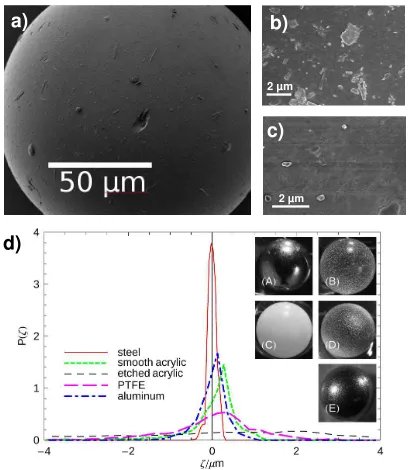
Figure 1. Granular particles are rough particles. a) Scanning Electron microscope (SEM) image of a factory-new soda-lime glass bead. Image by courtesy of Karina Sand. b)SEM image of the asperities on the surface of a new soda-lime glass bead.
c)After 30900 flow pulses in a water fluidized bed, abrasion has removed many of the surface asperities, resulting in a measurable difference in packing properties. Images b) and c) are taken from [1]. d)Histograms of surface roughnessξof spherical particles measured with a profilometer. The inset shows images of the corresponding particles: (A) steel, (B) smooth acrylic, (C) PTFE, (D) solvent-etched acrylic, (E) aluminum. Reproduced from [2].
a) b)
Figure 2. Friction increases the number of mechanically stable configurations. In both images the center Styrofoam sphere is only hold in place by the tangential forces at the contacts. Neither arrangement would be possible with frictionless spheres. In fact, under gravity the only mechanically stable configuration of three frictionless spheres is the perfect vertical alignment.
the Amontons-Coulomb law:
Ft≤μFn (1)
FnandFtare the normal and tangential components of the contact force, andμis the static coefficient of friction.
All granular media consist of frictional particles. Even hydrogel spheres, which consist of up to 99.5% water, have a friction coefficient of≈0.01 [4, 5]. Moreover, while it is possible to relax all tangential forces in a packing by vibrating it at small amplitudes and high frequencies [6], this will also compactify the packing to values falling into the range of frictionless packings, thereby bypassing the interesting granular physics as discussed in section 3.
In loose granular systems, such as e.g. granular gases, the dynamics is more controlled by collisions than con-tacts. Friction changes the way particles exchange mo-mentum during collisions, but this seems to be often only a higher order perturbation. Granular packings on the other hand consist of enduring contacts, here the existence of friction changes the physical picture completely:
First, the presence of tangential forces provides addi-tional ways to satisfy the force and torque balance, which will be discussed more quantitatively in section 2. This leads to a massive increase of the number of mechanically stable states; figure 2 gives a simple example. Most gran-ular packings studied in nature or experiment are looser than the loosest packing that can be created without fric-tion. The consequences of this will be discussed in sec-tions 3 and 4.
Secondly, equation 1 is an inequality. For a given nor-mal force at a contact it allows for a whole range in tangen-tial force, as shown in figure 3. The actual tangentangen-tial force will be a consequence of how the contact was formed. This property is one of the reasons for the so called history-dependence of granular matter, which will be discussed further in section 5.
2 Frictional particles have lower isostatic
numbers than frictionless particles.
For any granular packing to be solid, the average number of contacts a particle forms with its neighborsZhas to be at least so large that all degrees of freedom (DOF) of the
Figure 3.The contact forces of a sphere in a wedge depend on the preparation history. Each of the blue, red, or green pairs of contact forces can balance the weight of the sphere (black arrow). Which one is realized depends how the sphere was placed.
particle can be fixed. This minimal value, the so called isostatic contact numberZiso, does depend on the dimen-sion, shape, and most importantly friction of the particles considered.
In the absence of friction, the rotational DOF of a per-fect sphere are not relevant and only the three translational DOF have to be blocked by the contacts. At each contact there exists one normal force, which is however “shared” between the two particles which means that each contact blocks on average only 0.5 DOF per particle. A packing of frictionless spheres needs therefore to have at leastZ0
iso=6 contacts to be mechanically stable.
If we assumeμ=∞, then each contact has 3 indepen-dent force components (one normal and two tangential), which fix 1.5 constraints per particle. On the other hand, we now also have to consider the rotational DOF which results in 6 DOF per particle. The isostatic number in the presence of infinite frictionZμisois therefore 4.
The inequalityZ0
iso >Z μ
isoholds for all particle shapes and in 2 and 3 dimensions [7]. One consequence is the massive increase in the number of mechanically stable packings of frictional particles, as discussed in the next section. Another consequence is that granular packings are typicallyhyperstatic i.e. their actual contact number is larger than the minimum number needed for stability: Z > Zisoμ . From this follows that for a given spatial con-figuration of particles, there exists a multitude of possible force networks that will all satisfy the boundary conditions of the system [8]. This property is intimately connected to the history dependent behavior discussed in section 5.
Figure 4.Most granular packing are also hyperstatic when fully mobilized contacts are taken into account. In disc packings both Z (x-axis) and the number of fully mobilized contacts (y-axis) changes with pressure andμ. However, only in the limit of van-ishing pressure the system will approach isostaticity (solid line). From [9].
3 Granular physics happens at volume
fractions inaccessible to frictionless
particles.
The consequences of the lower isostatic contact number of frictional particles are best discussed using the the concept of the configurational entropyScon fof the packings.Scon f was first introduced by Sam Edwards [13, 14], it is propor-tional to the logarithm of the the number of mechanically stable packing configurations that fit in a given volume and support given boundary conditions. As we are interested in the thermodynamic limit, we will discuss hereScon f as a function of the global volume fractionφg. More
specif-ically, we are interested in a comparison of the upper and lower bounds of φg between whichScon f becomes non-zero for both frictional and frictionless systems.
The main results of this discussion are summarized in figure 5. But a word of caution is necessary: Theφgvalues
of the upper and lower bounds are well supported by the numerical and experimental work discussed below. But the functional form ofScon fconnecting these boundaries is speculative and only supported by the heuristic arguments given below.
Moreover, we are only interested in packings that ex-ist in a thermodynamic sense. This excludes both pack-ings crystallizing in FCC and HCP configurations at vol-ume fractions above φg ≈ 0.65 [15–21]1 and the
“tun-neled crystal” packings atφg=0.49 [22]. Neither of these two configurations are extensive, i.e. their number does not grow exponentially with the number of particles in the sys-tem. Which means that in the thermodynamic limit their entropy is zero.
1Readers familiar with equilibrated hard sphere systems might
ex-pect crystallization to occur in the rangeφg ≈0.494−0.61. However, these systems are driven by the entropy increase due to newly gained vi-brational DOF. These DOF do not exist in athermal granular packings where all particles are permanently in contact.
!" #$
%
&
Figure 5. A schematic how the configurational entropyScon f
of a sphere packing depends on the friction coefficientμand the confining pressurep. The solid magenta line indicates the config-urational entropy of an amorphous hard sphere gas i.e. a "pack-ing" with non overlapping particles but no requirements on the mechanical stability or number of contacts. The solid blue and dashed cyan line represent packings with an approximate real world value ofμand the dotted red line corresponds to friction-less particles. While the points withScon f =0 are well supported
by experiments and simulations, the actual shape of the different curves is speculative.
An important upper bound on Scon f is the configu-rational entropy SHS of an amorphous hard sphere gas where the only remaining condition for a valid configu-ration is that particles do not overlap. Mechanical stabil-ity and consequentiallyZ do not matter. In figure 5 this boundary is indicated by a solid magenta line. The pres-sure of a hard sphere gas diverges at the so called Glass Close Packing (GCP) point withφGCP≈0.65 [20, 21, 23]. From which follows that the system runs out of non-overlapping configurations andSHS goes to zero.
3.1 Frictionless sphere packings:0.635< φg <0.65
AsSHS is an upper limit for any sphere packing,Scon f of a frictionless packing also needs to go to zero atφGCP ≈ 0.65. For any smaller value ofφg,Scon f has to be smaller thanSHS because we now additionally require an isostatic number of contacts. In fact, the set of mechanically sta-ble configurations should be of measure zero compared to hard sphere gas: there are infinite more possibilities of two spheres to be not in contact compared to the one configu-ration where they are. Luckily, we know thatScon f is still extensive. This was shown for soft frictionless disk and sphere systems of different sizes by dividing the total ac-cessible phase space volume by that of an average basin of attraction [24, 25].
The total range ofScon f 0 is shown as a red dotted line in figure 5. There is still some debate [7, 21, 26, 27] if the onset of mechanical stability happens for frictionless spheres at the so called Jamming point ofφJ ≈ 0.64 or slightly below atφg ≈ 0.635. However, it is known that
frictionless spheres will depend on the preparation history. For an extended discussion and further references see [28].
3.2 Frictional sphere packings:0.55< φg <0.65
All mechanically stable configuration of frictionless par-ticles will stay valid if we allow for additional tangential forces. ThereforeScon f of frictional packings will always be larger than its frictionless counterpart. BecauseSHS is also an upper bound to frictional systems, GCP will still be the upper limit for uncompressed packings.
The lower boundary, commonly referred to as Random Loose Packing (RLP), is however considerably lower than in frictionless systems: As mentioned in the last section, the inequalityZ0
iso> Z μ
isoholds for all particle shapes and in 2 and 3 dimensions. Moreover, as Z can be gener-ically expected to decrease monotongener-ically with decreas-ing φg (i.e. larger average separation between particles),
the onset of mechanical stability will happen at a lower volume fraction for frictional particles. The actual value ofφRLPdoes depend on pressure [29, 30] and the friction
coefficient[2, 30]: the higherμthe smaller isφRLP. For the
experimentally common values ofμ ≈ 0.5 and vanishing pressure,φRLPapproaches 0.55 [2, 29–33].
In figure 5 the solid blue and the dashed cyan line representScon f of sphere packing with a finite value of
μand either zero or finite confining pressure p. Besides the points withScon f =0, the shape of the curves is specu-lative as there are few analytical or experimental results on how Scon f depends on φg. What we do understand
is that for any given value ofφg,Scon f will grow mono-tonically withμbecause allowing larger tangential forces will never destabilize any existing packing, but allow for new, additional configurations [34]. Moreover, we can use the Widom insertion method in combination with experi-mental or numerical packings to obtain an upper bound on Scon f [35]. However, a lower bound would be more help-ful. Finally, under certain additional assumptions,Scon f can be computed from the volume fluctuations of a re-peatedly driven granular packing [36–38]. However, the results obtained this way do not agree with each other.
Another way of assessing the shape ofScon f(φg) is to
consider experimental preparation protocols and to use the additional assumption that the state the system will end up in is the most likely one: the one with the highest value of Scon f under the given circumstances. For example, pack-ing prepared by slow sedimentation in an almost density matched fluid (i.e. in the limit p → 0) will always end up atφRLP [2, 29, 30]. Which indicates that Scon f has a maximum at RLP forp=0, cf. the blue line in figure 5.
Without density matching (i.e. at a finite static pres-sure) and with an increased sedimentation speed (mean-ing that the settl(mean-ing particles will transfer more momentum on the already existing packing), the most likely packing fraction moves up toφ ≈ 0.6 [1]. The cyan dashed line in figure 5 represents the idea that this becomes the new maximum inScon f. Which can be rationalized by assum-ing that configurations with less excess contacts compared to an isostatic packing are more likely to not posses a force
network capable of supporting the increased stress at the boundaries. φ ≈ 0.6 is incidentally also the value for the onset of dilatancy, which is discussed in the next subsec-tion.
Finally, getting the system to compactify to values of
φg above 0.6 requires repeated driving under confining
gravitational pressure, either by flow pulses [1] or mechan-ical taps [39, 40]. This indicates that these states become more and more unlikely which agrees with the idea that Scon f goes to zero forφgapproaching GCP.
But the main point of this section is untouched by this discussion of the shape ofScon f: The range of volume frac-tions of mechanically stable packings isseven times larger for frictional particles than for frictionless particles.
3.3 Dilatancy in frictional packings
Most of the interesting physics of granular packings hap-pens at intermediate values ofφg (i.e. between RLP and
GCP); these volume fractions are inaccessible to friction-less packings. A good example is dilatancy: If a dense granular packing is sheared (at a finite hydrostatic pres-sure), it will expand [41]. However, dilatancy does not oc-cur in sufficiently loose samples; those will instead com-pactify.
Now if dense packings expand during shear and loose packings collapse, there will be an intermediate density, usually termed Dilatancy Onset (DO) or critical state, where the volume fractionφDOstays constant during shear. Due to effects like shear banding the exact determination ofφDOis not straightforward, but most experiments point toφDO≈0.6 for frictional spheres at comparatively small confining pressures [42–47]
Dilatancy is closely related to a phenomenon labeled shear-jamming [48–50]. Forφg> φDOone can start from a hard sphere gas configuration (experiments are done in horizontal two-dimensional system and therefore effec-tively in the absence of gravity), shear it at a constant volume and arrive at a mechanically stable configuration. This protocol is indicated as a blue arrow in figure 5. Be-lowφDOthis is not possible.
One way of interpretingφDO is to see it as a "natural attractor" for all sheared systems starting at other volume fractions. This interpretation agrees well with the idea of Scon f being maximal atφDO≈0.6.
4 The volume fraction of frictional
particles is controlled by their geometry.
The exact value ofφgof a frictionless packing at zero
pres-sure does depend on the preparation history [20, 21, 28, 51]. However, the scaling laws of these packings are nor-mally studied by preparing pressure free packings with a given protocol and then increasingφgby compressing this
packing [7, 26].
the close-by particles which will form contacts when com-pressed. This slope leads to an equation forZ:
Z(φg)=Z0iso+c(φg−φiso)0.5 (2)
Hereφisois the volume fraction of the uncompressed, iso-static packing and the constantcdepends on the dimension and polydispersity of the system. For compressed friction-less packings such as emulsions and foams [52], equation 2 is indeed a good description.
However, real world granular particles are normally not very squishy; they change their volume fraction by isobarically changing their packing geometry not by com-pression. We all intuitively know this from kitchen physics: if we want to fill more grains into a storage con-tainer we do not compress them with a piston, but we tap the container a couple of times on the counter top to change its packing structure.
For a more quantitative example lets compare two glass spheres (Young’s modulus=70 GPa, diameter=250
μm) which are either uncompressed at the upper surface or compressed below a 1 m high column of other glass spheres. Using Hertz law we can derive that this increase in pressure will deform the sphere by approximately 10 nm at each contact. This deformation is an order of magnitude smaller than the vertical surface roughness of typical glass spheres[53]. Assuming that the sphere is compressed sym-metrically, this corresponds to a change in volume fraction of 7×10⁻⁵compared to the uncompressed sphere. This il-lustrates that the large range of 0.55< φg<0.65 available
to frictional sphere packings can not be explored by com-pression.
Please note that granular experiments can be per-formed in a way to test frictionless models. E.g. the compression of frictional but sufficiently soft photoelas-tic discs (with a Young’s modulus of 4MPa [54]) can be used to verify equation 2 [54] or study glassy behavior [55]; provided that the tangential forces are relaxed by ad-ditional tapping or vibration. These experiments do how-ever not prove that frictionless models describe generic frictional particles.
4.1 Friction with your neighbors? Think locally!
BecauseZ andφg are in frictional packings not
simulta-neously controlled by the globally defined parameter pres-sure, the idea expressed in equation 2 of a functionZ(φg) runs into an epistemological problem. Contacts are formed at the scale of individual particles and their neighbors. At this scale the globalφgis not only undefined; due to local
volume correlations [56, 57] it would even be impossible for a particle scale demon to computeφgby averaging over
the volume of the neighboring particles.
What is needed for the theoretical description of fric-tional particles is an ansatz which explainsZ using only locally defined (i.e. on a particle level) parameters [58– 61]. The most important [61] of these local parameters is the local volume fraction φl which describes by how much free volume an individual particle is surrounded.φl is computed by dividing the volume of the particle by the
3 4 5 6 7 8
local contact number Z
l
a)
3 4 5 6 7 8
0.50 0.55 0.60 0.65 0.70
local contact number Z
l
local volume fraction φl Song et al.
frictionless Jamming
b)
Figure 6.Understanding contact numbers in sphere packings re-quires a local approach.a)The average local contact numberZl
of individual spheres, measured by X-ray tomography and aver-aged in local volume fractionφl bins of size 0.02. Data
corre-sponds to 15 different sphere packings with global volume frac-tionsφg in the range from 0.56 to 0.625. Within experimental
scatter,Zldepends only onφl, not onφg. b)The red dots
cor-respond to a bin-wise average of all data shown in panel a. The local mean field theory by Songet al.(eq. 3, no fit parameter) provides a fair description of the data. This can not be said about the local interpretation of the scaling law for frictionless, com-pressed spheres (eq. 2, one fit parameter). From [61].
volume of its Voronoi cell (a tessellation method assign-ing all points in space to the closest particle). However, for a complete local description more parameters such as the shape of the Voronoi cells [62] or the fabric anisotropy [63] are needed.
Figure 6 substantiates this claim for the necessity of local theories. Panel a shows that the number of contacts Zlan individual particle will form does only depend on its ownφl, not theφgvalue of the packing it resides in. Figure 6 b) demonstrates thatZlcan be well explained by the local theory presented in [31], which predicts:
Z = 2 √
3φl 1−φl
(3)
A local reinterpretation of equation 2 for frictional systems (φgbecomesφl,Ziso0 becomesZμiso,φisobecomes
φRLP) fails to describe the experimental data.
5 Friction is one reason for history
dependence in granular systems.
4.2
6.3 1.8
volume fraction
taps
b)
II
I
a)
volume fraction
strain
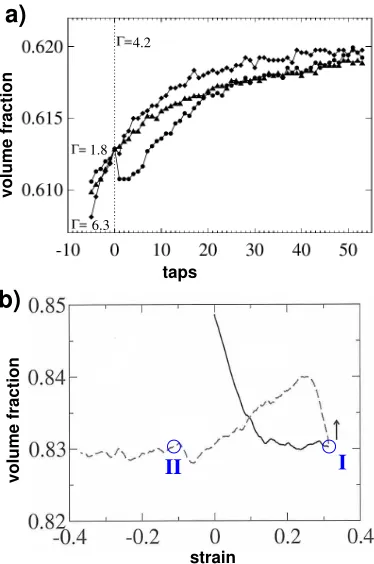
Figure 7. History dependence in granular systems. a) Three samples of glass beads are compactified to the same value of φg=0.613 using three different initial tapping strengths. At this
point (vertical dotted line) the tapping strength is set to the same value of 4.2 g in all three experiments. The system does however respond differently depending on its preparation history. From [64]. b)Volume fraction alone is not sufficient to characterize dilatancy onset. In this contact dynamics simulations an initially dense system of discs has been sheared long enough to dilate to its critical state (solid line). When then the shear direction is reversed (dashed line), the system responds first by compaction before it dilates again. This implies that the packings at points I and II have identical volume fractions but respond differently to shear in the same direction. From [65].
respond either differently to an external excitation, or they differ in some of their not immediately obvious mechani-cal properties.
An example of the first type is shown in figure 7a: three samples are compactified to the same volume frac-tionφ0but using three different driving strengthsΓi. When these samples atφ0are then driven with the same strength
Γ0, their response depends on the pastΓi, notΓ0[64].
Sim-ilar results can be obtained for periodically shearing glass spheres in a parallelepiped shear cell [66] or going to large strains in a simple shear cell (fig. 7b) [65].
Examples of the second type of history dependence in-clude how the pressure distribution below a sandpile de-pends on its preparation history: If the sand rained down from a large sieve, the maximum pressure at the bottom plate will be below the tip; which is the point with the largest column of sand on top. However, if the sand flowed out of a small funnel opening, which means that the pile grew from many downhill avalanches, the maximum
pres-sure at the bottom plate will be at a ring with a diameter of roughly one third of the total pile diameter [67]. An sim-ilar example is the history dependence that exists in the so called Janssen effect: The pressure at the bottom of a cylindrical column filled with grains will be lower than the total weight of the grains because tangential forces at the sidewalls carry a part of the load. The amount of this re-duction will again depend on the preparation history [68]. Finally it has also been shown numerically, that the num-ber of contacts formed in a packing depends on the prepa-ration history [69].
History dependence does also exist in frictionless packings (see [28, 51] for a novel approach how the jam-ming volume fraction can be used as a state variable to characterize the history). However, most of the examples listed above seem to require friction. Either because the extra degrees of freedom allow variability in the contact number or the geometric fabric formed by the contacts (pressure distribution at the sand pile bottom, shear re-sponse at critical state). Or because the memory of a pre-vious state can be encoded as a particular configuration in the force phase space spanned by hyperstaticity (Janssen). In all examples discussed here the apparent identity of the initial states has only been established in terms of global variables such as shape of the sample andφg. In
fact, in all these cases history dependence can also be viewed as another name for: "we do not know all relevant parameters which characterize the system".
6 Granular matter is rarely spherical.
Most of the readers will have heard some variant of the "spherical cow in vacuum" joke [72]. But in fact there are not only good reasons for theorists to use spheres as a first approximation, also numerical scientists appreci-ate the easy collision detection algorithm coming with spheres. And experimentalist like spheres because they are the only monoschematic particles (all particles have the same shape) which are easily available in large quanti-ties. Being monoschematic is a big advantage during im-age processing where the a priori knowledge of their shape helps to identify the individual particles [73].
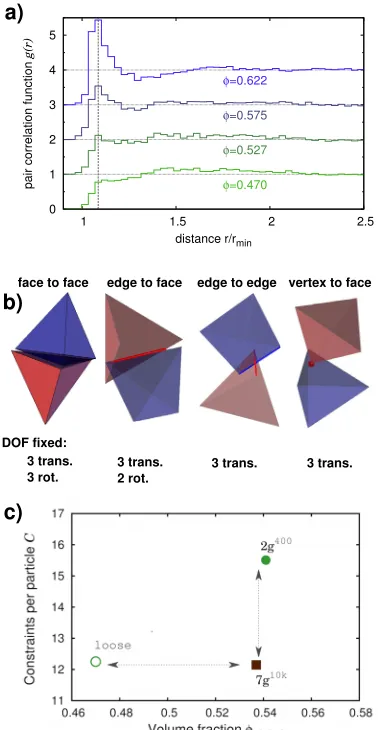
Still, real world granular materials are basically al-ways non-spherical in shape. This adds additional com-plexity which every theory suitable for practical purposes will need to take into account. Figure 8 discusses some of this complexity using packings of tetrahedra as an ex-ample. Contrary to spheres, tetrahedra can form four dif-ferent types of contacts, cf. figure 8b. This has important consequences for the pair correlation function shown in figure 8a. Because perfectly aligned face-to-face contacts are less frequent than slightly shifted face-to-face or low angle face-to-edge contacts, the closest possible distance between two particles isnotthe most likely contact con-figuration [70]. The different shape of the first peak of
face to face edge to face edge to edge vertex to face 0
1 2 3 4 5
1 1.5 2 2.5
pair correlation function
g(r)
distance r/rmin φ=0.470
φ=0.527 φ=0.575 φ=0.622
DOF fixed: 3 trans. 3 rot.
3 trans. 3 trans. 3 trans.
2 rot.
b)
a)
c)
Figure 8.Packings of tetrahedra differ from sphere packings.a)
The pair correlation functions of experimental tetrahedra pack-ings shows that contrary to spheres the shortest possible distance rmin(approximately 0.408 times the side-length) is not the most likely distance between individual particles (indicated by a ver-tical dashed line) [70]. Offsets have been added for improved readability. b)Tetrahedra form four different types of contacts, which block different numbers of translational and rotational de-grees of freedom. For the purpose of defining a distance to iso-staticity we need to determine the total number of constraints per particleCblocked by the combination of all four contact types.
c)Isostaticity corresponds toC = 6 (each tetrahedra has three rotational and three translational DOF). Even the loosest tetra-hedra packings have twice the constraint number needed for iso-staticity, which means that tetrahedra packings are much more hyperstatic than sphere packings. Moreover do tetrahedra pack-ings exhibit a strong history dependence. Using different tapping protocols it is possible to create pairs of packing which differ strongly in only one of the two variablesCandφg[71].
Experimentally, one way of moving away from the spherical cow paradigm is to take advantage of the quickly improving 3D printing technology to create large samples of monoschematic but non-spherical particles [75, 76]. Al-ternatively, we can directly use natural materials such as sand and improve our 3D image processing to obtain
trust-worthy segmentation results [77]. Additionally, there is also progress towards theories for non-spherical particles [59, 60].
Conclusion
Frictionless spheres are a great model for emulsions, foams, glasses, and colloids. They give reasonable results for granular gases and describe even glassy behavior in driven granular systems. But africtionless granular pack-ingis a a self-contradicting statement, describing a theo-retical model that for the most part has outlived its useful-ness.
Acknowledgments
The ideas in this article have taken shape in many invalu-able discussions with colleagues: Vasili Baranau, Karen Daniels, Max Neudecker, Charles Radin, Fabian Schaller, Gerd Schröder-Turk, Harry Swinney, Brian Tighe, Song-Chuan Zhao.
References
[1] M. Schröter, D.I. Goldman, H.L. Swinney, Phys. Rev. E71, 030301 (2005)
[2] G.R. Farrell, K.M. Martini, N. Menon, Soft Matter6, 2925 (2010)
[3] F.P. Bowden, D. Tabor,Friction(Anchor Books, Gar-den City, 1973)
[4] J.A. Dijksman, H. Zheng, R.P. Behringer, inPowders
&Grains(2013), Vol. 1542 ofAIP Conf. Proc., pp. 457–460
[5] J. Dijksman,private communication(2017)
[6] G.J. Gao, J. Blawzdziewicz, C.S. O’Hern, M. Shat-tuck, Phys. Rev. E80, 061304 (2009)
[7] M. van Hecke, J. Phys.: Condens. Matter22, 033101 (2010)
[8] B.P. Tighe, J.H. Snoeijer, T.J.H. Vlugt, M.v. Hecke, Soft Matter6, 2908 (2010)
[9] K. Shundyak, M. van Hecke, W. van Saarloos, Phys. Rev. E75, 010301 (2007)
[10] L.E. Silbert, D. Erta¸s, G.S. Grest, T.C. Halsey, D. Levine, Phys. Rev. E65, 031304 (2002)
[11] H.P. Zhang, H.A. Makse, Phys. Rev. E72, 011301 (2005)
[12] S. Henkes, M. van Hecke, W. van Saarloos, Euro-phys. Lett.90, 14003 (2010)
[13] S.F. Edwards, R.B.S. Oakeshott, Physica A 157, 1080 (1989)
[14] A. Mehta, S.F. Edwards, Physica A157, 1091 (1989) [15] A.V. Anikeenko, N.N. Medvedev, Phys. Rev. Lett.
98, 235504 (2007)
[16] C. Radin, J. Stat. Phys.131, 567 (2008)
[17] Y. Jin, H.A. Makse, Physica A389, 5362 (2010) [18] S.C. Kapfer, W. Mickel, K. Mecke, G.E.
[19] N. Francois, M. Saadatfar, R. Cruikshank, A. Shep-pard, Phys. Rev. Lett.111, 148001 (2013)
[20] V. Baranau, U. Tallarek, Soft Matter10, 3826 (2014) [21] V. Baranau, U. Tallarek, Soft Matter10, 7838 (2014) [22] S. Torquato, F.H. Stillinger, J. App. Phys. 102,
093511 (2007)
[23] G. Parisi, F. Zamponi, Rev. Mod. Phys. 82, 789 (2010)
[24] D. Asenjo, F. Paillusson, D. Frenkel, Phys. Rev. Lett. 112, 098002 (2014)
[25] S. Martiniani, K.J. Schrenk, J.D. Stevenson, D.J. Wales, D. Frenkel, Phys. Rev. E93, 012906 (2016) [26] C.S. O’Hern, L.E. Silbert, A.J. Liu, S.R. Nagel,
Phys. Rev. E68, 011306 (2003)
[27] M. Pica Ciamarra, M. Nicodemi, A. Coniglio, Soft Matter6, 2871 (2010)
[28] N. Kumar, S. Luding, Granul. Matter18, 58 (2016) [29] G.Y. Onoda, E.G. Liniger, Phys. Rev. Lett.64, 2727
(1990)
[30] M. Jerkins, M. Schröter, H.L. Swinney, T.J. Senden, M. Saadatfar, T. Aste, Phys. Rev. Lett.101, 018301 (2008)
[31] C. Song, P. Wang, H.A. Makse, Nature 453, 629 (2008)
[32] L.E. Silbert, Soft Matter6, 2918 (2010)
[33] G.W. Delaney, J.E. Hilton, P.W. Cleary, Phys. Rev. E 83, 051305 (2011)
[34] Y. Srebro, D. Levine, Phys. Rev. E68, 061301 (2003) [35] V. Baranau, S.C. Zhao, M. Scheel, U. Tallarek,
M. Schröter, Soft Matter12, 3991 (2016)
[36] C. Briscoe, C. Song, P. Wang, H.A. Makse, Phys. Rev. Lett.101, 188001 (2008)
[37] S. McNamara, P. Richard, S.K. de Richter, G. Le Caer, R. Delannay, Phys. Rev. E80, 031301 (2009)
[38] S.C. Zhao, M. Schröter, Soft Matter10, 4208 (2014) [39] E.R. Nowak, J.B. Knight, E. Ben-Naim, H.M. Jaeger,
S.R. Nagel, Phys. Rev. E57, 1971 (1998)
[40] P. Ribière, P. Richard, P. Philippe, D. Bideau, R. De-lannay, Eur. Phys. J. E22, 249 (2007)
[41] B. Andreotti, Y. Forterre, O. Pouliquen, Granular Media(Cambridge University Press, 2013)
[42] M. Schröter, S. Nägle, C. Radin, H.L. Swinney, Eu-rophys. Lett.78, 44004 (2007)
[43] A.J. Kabla, T.J. Senden, Phys. Rev. Lett.102, 228301 (2009)
[44] N. Gravish, P.B. Umbanhowar, D.I. Goldman, Phys. Rev. Lett.105, 128301 (2010)
[45] P. Umbanhowar, D.I. Goldman, Phys. Rev. E 82, 010301 (2010)
[46] J. Métayer, D.J. Suntrup III, C. Radin, H.L. Swinney, M. Schröter, Europhys. Lett.93, 64003 (2011) [47] N. Mueggenburg, Phys. Rev. E85, 041305 (2012) [48] D. Bi, J. Zhang, B. Chakraborty, R.P. Behringer,
Na-ture480, 355 (2011)
[49] J. Ren, J.A. Dijksman, R.P. Behringer, Phys. Rev. Lett.110, 018302 (2013)
[50] H.A. Vinutha, S. Sastry, Nature Phys.12, 578 (2016) [51] S. Luding, Nature Phys.12, 531 (2016)
[52] G. Katgert, M. van Hecke, Europhys. Lett.92, 34002 (2010)
[53] S. Utermann, P. Aurin, M. Benderoth, C. Fischer, M. Schröter, Phys. Rev. E84, 031306 (2011) [54] T.S. Majmudar, M. Sperl, S. Luding, R.P. Behringer,
Phys. Rev. Lett.98, 058001 (2007)
[55] C. Coulais, R.P. Behringer, O. Dauchot, Soft Matter 10, 1519 (2014)
[56] F. Lechenault, F.d. Cruz, O. Dauchot, E. Bertin, J. Stat. Mech.2006, P07009 (2006)
[57] S.C. Zhao, S. Sidle, H.L. Swinney, M. Schröter, Eu-rophys. Lett.97, 34004 (2012)
[58] T. Aste, M. Saadatfar, T.J. Senden, J. Stat. Mech.: Theory and Exp.2006, P07010 (2006)
[59] A. Baule, R. Mari, L. Bo, L. Portal, H.A. Makse, Nat. Commun.4, 2194 (2013)
[60] A. Baule, H.A. Makse, Soft Matter10, 4423 (2014) [61] F.M. Schaller, M. Neudecker, M. Saadatfar, G.W.
Delaney, G.E. Schröder-Turk, M. Schröter, Phys. Rev. Lett.114, 158001 (2015)
[62] G.E. Schröder-Turk, W. Mickel, M. Schröter, G.W. Delaney, M. Saadatfar, T.J. Senden, K. Mecke, T. Aste, Europhys. Lett.90, 34001 (2010)
[63] F. Radjai, inPowders&Grains(2009), Vol. 1145 of AIP Conf. Proc., pp. 35–42
[64] C. Josserand, A.V. Tkachenko, D.M. Mueth, H.M. Jaeger, Phys. Rev. Lett.85, 3632 (2000)
[65] F. Radjaï, S. Roux, inThe Physics of Granular Me-dia, edited by H. Hinrichsen, D.E. Wolf (Wiley-VCH, Weinheim, 2004), pp. 165–187
[66] M. Nicolas, P. Duru, O. Pouliquen, Eur. Phys. J. E3, 309 (2000)
[67] L. Vanel, D. Howell, D. Clark, R.P. Behringer, E. Clément, Phys. Rev. E60, R5040 (1999)
[68] L. Vanel, E. Clément, Eur. Phys. J. B11, 525 (1999) [69] I. Agnolin, J.N. Roux, Phys. Rev. E 76, 061302
(2007)
[70] M. Neudecker, S. Ulrich, S. Herminghaus, M. Schröter, Phys. Rev. Lett.111, 028001 (2013) [71] N.N. Thyagu, F. Schaller, S. Weis, M. Neudecker,
M. Schröter, arXiv:1501.04472 (2015)
[72] https://www.youtube.com/watch?v=oUwlEdz42xo (2013)
[73] S. Weis, M. Schröter, submitted to Rev. Sci. Instr. (2017), http://arxiv.org/abs/arXiv:1612.06639 [74] A.J. Liu, S.R. Nagel, Ann. Rev. Cond. Matt. Phys.1,
347 (2010)
[75] A.G. Athanassiadis, M.Z. Miskin, P. Kaplan, N. Ro-denberg, S.H. Lee, J. Merritt, E. Brown, J. Amend, H. Lipson, H.M. Jaeger, Soft Matter10, 48 (2013) [76] C. Scholz, S. D’Silva, T. Pöschel, New J. Phys.18,
123001 (2016)