Nat. Hazards Earth Syst. Sci., 18, 3089–3108, 2018 https://doi.org/10.5194/nhess-18-3089-2018 © Author(s) 2018. This work is distributed under the Creative Commons Attribution 4.0 License.
How do changes along the risk chain affect flood risk?
Ayse Duha Metin1, Nguyen Viet Dung1, Kai Schröter1, Björn Guse1,3, Heiko Apel1, Heidi Kreibich1, Sergiy Vorogushyn1, and Bruno Merz1,2
1GFZ German Research Centre for Geosciences, Section Hydrology, 14473 Potsdam, Germany 2Institute of Earth and Environmental Science, University of Potsdam, 14476 Potsdam, Germany 3Department of Hydrology and Water Resources Management, Kiel University, Kiel, Germany
Correspondence:Ayse Duha Metin ([email protected]) Received: 25 May 2018 – Discussion started: 12 June 2018
Revised: 18 October 2018 – Accepted: 7 November 2018 – Published: 19 November 2018
Abstract.Flood risk is impacted by a range of physical and socio-economic processes. Hence, the quantification of flood risk ideally considers the complete flood risk chain, from atmospheric processes through catchment and river system processes to damage mechanisms in the affected areas. Al-though it is generally accepted that a multitude of changes along the risk chain can occur and impact flood risk, there is a lack of knowledge of how and to what extent changes in influencing factors propagate through the chain and finally affect flood risk. To fill this gap, we present a comprehen-sive sensitivity analysis which considers changes in all risk components, i.e. changes in climate, catchment, river system, land use, assets, and vulnerability. The application of this framework to the mesoscale Mulde catchment in Germany shows that flood risk can vary dramatically as a consequence of plausible change scenarios. It further reveals that compo-nents that have not received much attention, such as changes in dike systems or in vulnerability, may outweigh changes in often investigated components, such as climate. Although the specific results are conditional on the case study area and the selected assumptions, they emphasize the need for a broader consideration of potential drivers of change in a comprehen-sive way. Hence, our approach contributes to a better under-standing of how the different risk components influence the overall flood risk.
1 Introduction
Globally, floods affect more people than any other natural hazard, and the global average annual flood loss has been es-timated to amount to more than USD 100 billion (UNISDR,
2015). Flood risk is defined as the likelihood of losses and depends on three factors: hazard, exposure, and vulnerability (IPCC, 2012; UNISDR, 2013). Hazard is related to physical processes, with the potential to cause harm ranging from at-mospheric via catchment processes to river routing, whereas exposure refers to the elements at risk of flooding. Vulnera-bility is defined as the susceptiVulnera-bility of the elements at risk to be adversely affected. Typically, exposure is quantified as the number of people and the assets in flood-prone areas, and vulnerability is represented as the damage ratio, i.e. the de-gree to which elements at risk are damaged given hazard im-pacts. Consequently, flood risk assessments ideally need to consider the entire flood risk chain from the atmospheric pro-cesses through the catchment and river system propro-cesses to the damage mechanisms in the affected areas.
It is now well acknowledged that flood risk can change substantially in time since all three risk factors are dynamic (e.g. Kreibich et al., 2017). The causes of these changes are manifold; they range from human-induced climate change and natural climate variability on decadal or centennial timescales to changes in vulnerability that may act on much shorter timescales (Merz et al., 2010). The spatial and tempo-ral interdependencies among hazard, exposure, and vulnera-bility and interactions within these risk chain compartments should be considered in flood risk assessment (Merz et al., 2014; Vorogushyn et al., 2017).
pre-paredness, and organizational emergency management. Con-versely, they emphasized that different risk drivers act simul-taneously; for instance structural measures can be comple-mented by non-structural measures.
Another approach to understand changes in flood risk is loss normalization using observed damage data (e.g. Visser et al., 2014). Time series of flood damages usually show increasing trends. To separate the effect of socio-economic development, the original loss time series are corrected for growth in population and wealth, and for inflation. For example, Barredo (2009) normalized losses of large river floods aggregated at the scale of 31 European countries be-tween 1970 and 2006. Since the normalization removed the increasing trend in the original loss values, this study sug-gested that socio-economic development was the dominant driver of increasing flood damage in Europe. Similar conclu-sions have been drawn from other loss normalization stud-ies for weather-related hazards (IPCC, 2012; Neumayer and Barthel, 2011; Bouwer, 2011; Visser et al., 2014).
Other data-based studies attempted to understand the in-fluence of single drivers. For instance, Bubeck et al. (2012) surveyed 752 households along the Rhine and found that the implementation of private mitigation measures developed gradually over time with severe floods leading to a stepwise increase in mitigation. They concluded that an improved pre-paredness triggered by a severe flood in 1993 led to substan-tial damage reduction during a second flood with similar haz-ard characteristics in 1995. A survey of 1200 households af-fected by the Elbe flood in 2002 in Germany suggested that private precautionary measures reduced the damage to the buildings and their contents on the order of 50 % for the most effective measures, i.e. flood-adapted use and adapted inte-rior fittings (Kreibich et al., 2005).
Although data-based approaches have helped to better un-derstand flood risk changes, it is hard to conceive how the causes of flood risk changes and their relative contributions could be deciphered from empirical data only. A major prob-lem is the superposition of several drivers of risk changes. It is easily conceivable that adaptation measures, such as im-proved early warning systems, strengthened flood protection, or better private precaution, have masked the effect of climate change (Handmer et al., 2012; Di Baldassarre et al., 2015; Jongman et al., 2015; Mechler and Bouwer, 2015). Hence, conclusions from normalization studies, such as there is no evidence for the effect of human-induced climate change on the loss trend (e.g. Barredo, 2009), need to be taken with care. Another limitation of data-based approaches results from the lack of reliable loss data. Loss data are often not available or are available only for standard economic sectors in developed countries, and large uncertainties reside in re-ported or reconstructed loss records (Handmer et al., 2012; Merz et al., 2010; Wirtz et al., 2014).
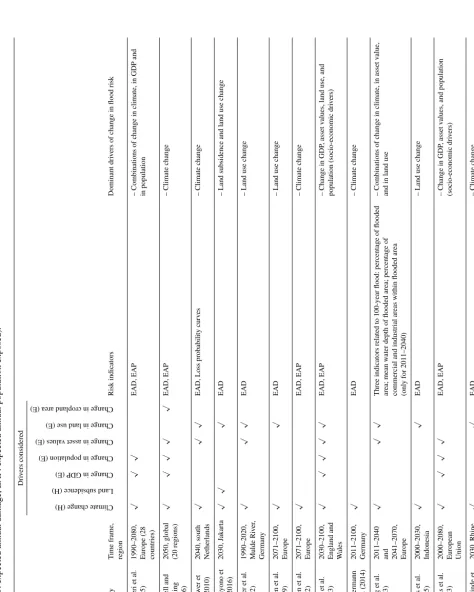
Simulation-based approaches offer the advantage that the contributions of different drivers can be estimated via sce-nario runs. Table 1 compiles simulation-based studies that
investigated past or future changes in river flood risk. The various studies that addressed changes in flood hazard only, for instance as a consequence of climate and land use change, are not included. This selection of studies results from a comprehensive literature search using the following search terms (both in combination and separately) in the ISI Web of Knowledge database: flood risk, change, damage, climate, and socioeconomic scenarios in October 2017. The identi-fied articles were checked for forward and backward cita-tions. We would like to point out that studies focussing on the uncertainties in estimation of hazard, exposure, vulnera-bility, and their effect on risk estimates were not in the focus of this review.
Table 1 shows that all studies addressed climate change. Other changes in flood hazard have not been investigated, with the exception of land subsidence by Budiyono et al. (2016). Almost all studies look at changes in exposure, most often in terms of land use change. Changes in asset val-ues are also addressed frequently. In terms of risk indicators, the majority of studies are limited to EAD (expected annual damage).
There is no unanimous conclusion across these simulation-based studies. The results highly depend on the case study and the drivers and scenarios selected. Yet, 5 out of 13 studies conclude that climate change was the dominant driver lead-ing to an increase in flood risk. The other studies indicate different drivers and combinations as more dominant. (For a detailed assessment of these studies see the Supplement.)
Although there is a wealth of studies on how and why flood hazard has changed in the past and might change in the future (IPCC, 2012), studies on changes in flood risk are scarce. Data-based approaches are strongly limited due to data availability and methodological problems. Simulation-based studies on changes in flood risk have been limited to climate and land use change and have primarily focussed on future scenarios rather than understanding past changes. Other drivers of risk, such as flood protection measures, have been neglected. This gap is particularly severe in terms of the effects of changes in vulnerability (Merz et al., 2014; Mechler and Bouwer, 2015). Our systematic literature search did not result in a single simulation-based study which in-cluded changes in vulnerability. We can conclude that knowl-edge about the underlying processes and their contribution to changes in flood risk is still scarce (UNISDR, 2015; Kreibich et al., 2017), and there is a lack of comprehensive studies that take into account the whole spectrum of drivers.
mate change, implementation of reservoirs in the catchment, flood protection along the rivers, land use change, change in asset values, and changes in the vulnerability of flood-affected objects. For each of the six factors, two scenarios with increasing and decreasing change with symmetric devi-ation from a baseline scenario are derived. Hence, the sensi-tivity analysis consists of 729 (36) scenarios.
This sensitivity analysis is combined with the derived flood risk analysis (DFRA) proposed by Falter et al. (2015). DFRA consists of an end-to-end flood risk assessment based on continuous simulation. A model chain representing the catchment, river network, and damage processes is driven by a multi-site stochastic weather generator. DFRA is an exten-sion of the derived flood frequency analysis based on con-tinuous simulation, which has found increasing attention re-cently (e.g. Haberlandt and Radtke, 2014). A major advan-tage of DFRA is that all processes, from the flood-triggering precipitation to the damage, are simulated in a spatially con-sistent way, respecting the spatial dependence of the different processes. Another advantage is the derivation of flood risk directly from the damage time series, generated by the model chain, instead of the discharge time series.
The sensitivity analysis is performed for the Mulde catch-ment in Germany, which was severely hit by flooding in 2002 and 2013. We use the model chain implemented and cali-brated by Falter et al. (2015) for the Mulde catchment. A to-tal of 4000 years of spatial weather fields at daily resolution are generated and used to force the model chain, resulting in daily and spatially explicit fields of streamflow, inundation, and damage throughout the catchment. From these datasets, the risk curve (or loss-probability curve) and EAD are cal-culated. Introducing the change scenarios for the six factors leads to 729 damage time series of 4000 years, which again are used to calculate the flood risk.
The paper is structured in six sections. Section 2 describes the study area. Section 3 introduces the simulation model chain and the approach used in the sensitivity analysis in-cluding the change scenarios. Section 4 presents the results of the sensitivity analysis including sub-basin and sub-annual variations. Sections 5 and 6 provide discussions and conclu-sions.
2 Study area
Our study area, the Mulde catchment (7115 km2), is a sub-basin of the Elbe River in Germany, which is one of the largest rivers in central Europe. The Mulde River drains the northern part of the Ore Mountains. The Mulde and its ma-jor tributaries have a length of around 380 km. The catch-ment elevation varies between 52 m and 1213 m a.s.l. (above sea level). Approximately 10 % of the catchment area is cov-ered by urban structures. Anhalt-Bitterfeld, located down-stream in the Mulde catchment, and Zwickau, located up-stream, have been selected as two districts for more
de-Figure 1.Study area of the Mulde catchment, including the main tributaries, reservoirs, and river gauges. The inset shows the location of the catchment within Germany.
tailed analyses (Fig. 1). The annual precipitation ranges from 500 to 1100 mm. Although the majority of floods in the Mulde catchment occur in winter, extreme floods tend to oc-cur in summer due to widespread and intensive precipitation. Reservoirs in the Mulde catchment (14 of them have a stor-age capacity greater than 1 million m3) are generally used for drinking water supply, but they also have the storage capacity for flood protection (Schädler et al., 2012).
associ-A. D. Metin et al.: How do changes along the risk chain affect flood risk? 3093
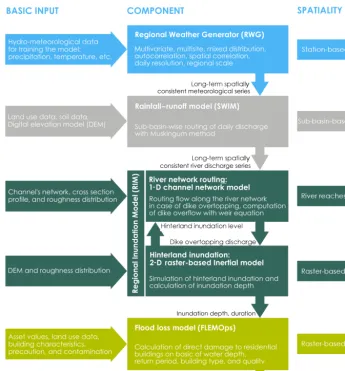
Figure 2.Flood risk model chain: regional flood model (RFM).
ated with high damages is the primary reason for selecting it as the study area.
3 Methods
3.1 Flood risk simulation model chain
To simulate the complete flood risk chain, the Regional Flood Model (RFM) is used. RFM consists of a weather generator, rainfall–runoff model, 1-D channel routing model, 2-D hin-terland inundation model, and flood loss estimation model for residential buildings. The results of one model are used as input for the next model. Figure 2 shows the model chain and gives the most important information on the input data and the characteristics of the different modules. Details about the model chain are given in Falter et al. (2015). The computa-tional demand of the different modules is as follows: 8 % Re-gional Weather Generator (RWG) (coverage: Germany+), 10 % Soil and Water Integrated Model (SWIM), 80 %
Re-gional Inundation Model (RIM), 2 % FLEMOps. Please note that RIM runs on a mixed infrastructure of CPU+GPU. The other components run on CPU only.
The model set-up follows the concept of derived flood risk analysis based on continuous simulation proposed by Falter et al. (2015). A weather generator provides spatially consis-tent meteorological fields which propagate through the entire model chain. In our study, the chain is run on a daily time step for 40 realizations of 100 years resulting in a total time series of 4000 years. Risk estimates are then derived directly from the time series of damage generated by the model chain.
floodplain and damage processes. Hence, spatial consistency of losses across the catchment is also taken into account. A further advantage is that risk is estimated using the space– time fields of damage. Hence, this approach follows the def-inition of risk, in which risk is understood as the probability of exceeding a given damage. In contrast, traditional flood risk analyses use the probability of discharge as a proxy for the probability of damage. For a comprehensive discussion see Falter et al. (2015).
Note that our model set-up is the same as in Falter et al. (2015). The only difference is that we consider reservoirs in the rainfall–runoff module. The different modules along the risk model chain are described in the following.
3.1.1 Regional Weather Generator RWG
The meteorological input is obtained from the multisite, mul-tivariate weather generator RWG (Regional Weather Gener-ator) proposed by Hundecha et al. (2009) and further devel-oped by Hundecha and Merz (2012). This model is designed to generate synthetic weather at the regional scale, i.e. several tens of thousands to hundreds of thousands of square kilome-tres. It creates daily time series of climatic variables at multi-ple sites in two steps: generation of daily precipitation series through a multivariate autoregressive model (which uses a mixed gamma and generalized Pareto distribution) and gen-eration of daily maximum, minimum, and mean temperature and solar radiation using Gaussian distribution. Both temper-ature and solar radiation depend on the state of precipitation. The weather generator is set up for the whole of Germany, including the upstream areas of the Elbe, Danube, and Rhine catchments outside of Germany. It is used to generate long synthetic meteorological data considering daily climate ob-servations for the period from 1951 to 2003 at 528 climate stations.
All the single-site input parameters (six parameters of the mixed gamma–Pareto distribution for non-zero precipitation and two parameters of the Gaussian distribution for the other variables) have been estimated for each of 528 stations of the dataset and for each of the 12 months separately. The RWG has been successfully tested and validated for the re-production of daily and longer-term statistics of the six cli-matic variables at individual sites and the reproduction of the temporal and spatial pattern observed in the dataset. The val-idation results illustrate that the RWG is capable of generat-ing long-term synthetic meteorological fields, capturgenerat-ing both regular and extreme events well. The detailed description of the implementation of the RWG would be extensive. Hence, for the sake of simplicity and balance of the paper structure, it will not be elaborated here. The readers are referred to Fal-ter et al. (2015) for more details.
3.1.2 Rainfall–runoff model SWIM
The semi-distributed hydrological model SWIM (Soil and Water Integrated Model; Krysanova et al., 1998) simulates the hydrological cycle on a daily basis. SWIM uses three levels of spatial disaggregation: the river basin is divided into sub-basins which are further subdivided into hydrotopes. Water fluxes are computed at the hydrotope level, then aggre-gated on the sub-basin level. SWIM routes total runoff from sub-basin to sub-basin using the Muskingum routing method. In this study, the Mulde catchment was divided into 77 sub-catchments based on Shuttle Radar Topography Mis-sion digital elevation maps provided by the Federal Agency for Cartography and Geodesy in Germany (BKG). Hydro-topes were formed using soil and land use data from the soil map of Germany (BÜK 1000 N2.3) from the Bunde-sanstalt für Geowissenschaften und Rohstoffe, the European Soil Database map from the European Commission’s Land Management and Natural Hazards unit, and the CORINE (Coordinated Information on the Environment) land cover map.
To be able to assess the sensitivity of flood risk to the im-plementation of reservoirs, we added a reservoir component in SWIM. The specific operational strategy for each reservoir depends on a number of considerations. For example, after the disastrous flood in 2002, the storage reserved for flood retention has been increased at the expense of other purposes such as water supply for some reservoirs in Germany. The operational rules for reservoirs are expected to vary in time and from reservoir to reservoir based on local considerations. Further, it may be difficult to reconstruct them for reservoirs which have been in operation for decades. In this SWIM ver-sion, a simplified routine was integrated for simulating the retention effect of reservoirs automatically. Each modelled reservoir is linked to the sub-basin in which it is located and only the volume dedicated for flood control is implemented. When the flow at the sub-basin node exceeds the 100-year discharge (H Q100), the streamflow beyond this threshold is
stored in the reservoir; i.e. the hydrograph is cut atH Q100,
as long as the required storage volume is available. When the flow falls below the threshold value ofH Q100, the
reser-voir starts releasing water so that the flow maintains the level ofH Q100 as long as the active volume allows. If the
stor-age capacity is filled before the inflow discharge falls be-lowH Q100, excess flow is routed downstream. Reservoirs
operated in this way are very effective in reducing the peaks of extreme flood events. In total, 25 reservoirs (Fig. 1) within the Mulde catchment are integrated in the SWIM model set-up. The necessary information for reservoirs such as loca-tions and flood storage capacities of reservoirs was adapted from the Sächsisches Landesamt für Umwelt und Geolo-gie (2002).
A. D. Metin et al.: How do changes along the risk chain affect flood risk? 3095
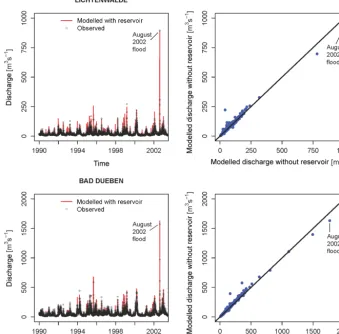
Figure 3.Model performance of SWIM at selected gauging stations.
and objective function mNSE (based on the modified Nash– Sutcliffe efficiency measure giving more emphasis on higher flow) mentioned in Falter et al. (2015). The calibration and validation periods remain the same as well (calibration: from 1 Janunary 1981 to 31 December 1989; validation: from 1 Ja-nunary 1951 to 31 December 2003 excluding the calibra-tion period). The calibracalibra-tion and validacalibra-tion results illustrate an improvement in this new model set-up compared to the version used in Falter et al. (2015). At the upstream sta-tion Lichtenwalde, Nash–Sutcliffe values of 0.81 (calibra-tion) and 0.83 (valida(calibra-tion) are achieved for the new set-up against 0.77 and 0.81 for the old one. At the downstream Mulde station Bad Düben, the corresponding values are 0.89 and 0.86 against 0.89 and 0.83. Overall, a modest differ-ence in model performance between the two model set-ups is found looking at the obtained Nash–Sutcliffe efficiency val-ues and the plots in Fig. 3. However, with the new set-up, the SWIM model is able to represent the cut-off process of the extreme flood events due to the implementation of reservoirs. The modelled peak flow of the August 2002 flood fits well to the observed peak flow (Fig. 3).
3.1.3 Regional Inundation Model RIM
Hin-terland inundation processes are simulated with a 2-D raster-based model raster-based on the inertia implementation of Bates et al. (2010). The 2-D inundation model was implemented in CUDA Fortran on graphical processor units to increase the computational speed.
River cross-section profiles, dike heights and locations, and Manning’s roughness values are necessary for setting up the 1-D model. The main data source for the geomet-ric characteristics is the 10 m resolution digital elevation model (DEM) supplied by the BKG. Additionally, informa-tion on channel width and dike locainforma-tion was obtained from the digital basic landscape model (Base DLM) provided by the BKG. The river profiles were manually extracted perpen-dicular to the flow direction with about 500 m in spacing. Since the resolution of DEM 10 m tends to provide too low of dike heights and additional dike information is not avail-able, a threshold was introduced as a global correction value for the minimum dike height. Following the study of Falter et al. (2015), the minimum height was assumed to be 1.8 m. The Manning’s coefficient ofn=0.03 was adopted constant over the entire river network. The 2-D raster-based model uses a 100 m resampled computational grid from DEM 10 m, which was found to be an acceptable compromise for representation of inundation characteristics and computation time (Falter et al., 2013).
Falter et al. (2015) validated the 1-D hydrodynamic model at five gauging stations (Fig. 1) in the Mulde catchment with observed data over the period 1951–2003. Although there was a tendency to underestimate the number of observed peak flows exceeding the bankfull depth, the general perfor-mance was acceptable. Validation of hinterland inundation is harder due to the lack of information about inundation depth and extent. In our study area, observed inundation is only available for the extreme flood of August 2002, provided by the German Aerospace Center (DLR). While inundation ar-eas are simulated well for the ar-eastern tributary Freiberger Mulde, only around 50 % of the flood extent is correctly sim-ulated for the entire catchment due to neglected dike breaches in the model chain. Although there is an underestimation of inundation extents, the model is suitable to assess changes in risk for the mesoscale Mulde catchment. The actual damage estimates for the catchment area are not primarily targeted for this study. Details can be found in Falter et al. (2015).
3.1.4 Flood loss estimation model FLEMOps
The Flood Loss Estimation Model for the private sec-tor (FLEMOps) is used to calculate direct economic dam-age to residential buildings for each inundation event using the maximum water level information provided by RIM. The base version of FLEMOps uses five inundation depth classes, three building types, two building quality classes, three water contamination classes, and three private precaution classes as inputs (Thieken et al., 2008). Due to the fact that less damage occurs if people are regularly affected by flood, the advanced
version additionally considers the return period of the inun-dation at the flooded buildings as a damage-influencing fac-tor (Elmer et al., 2010, 2012). FLEMOps provides the dam-age ratio, i.e. the relative damdam-age. The monetary damdam-age is calculated by multiplying the damage ratio with the asset val-ues of the exposed elements.
FLEMOps uses spatially detailed information about as-set values, building types, and building quality. All gridded input data were resampled to 100 m spatial resolution. The damage calculation is carried out for 100×100 m2cells and then aggregated to the level of municipalities. Asset values of the regional stock of residential buildings were charac-terized considering standard construction costs (BMVBW, 2005). These asset values were spatially distributed accord-ing to the CORINE land cover classes 111 (continuous ur-ban fabric) and 112 (discontinuous urur-ban fabric). Municipal-scale information on building type and quality was provided by Infas Geodaten GmbH (2009). The composition of build-ing types is defined usbuild-ing a cluster centre approach. In total five clusters are defined differentiating the share of single-family houses, semi-detached/detached houses, and multi-family houses. Average building quality is aggregated to two classes: high quality and medium/low quality (Thieken et al., 2008). The flooding impact is characterized by inundation depth and return period of peak flows. The latter is calculated at the SWIM sub-basin level by fitting a generalized extreme value distribution to the annual maximum discharge series obtained from 4000 years of continuous SWIM simulation. In addition to inundation depth, return period, building type, and quality, contamination (none, medium, and heavy) and private precaution (none, good, and very good) are also taken into account in the damage model. The overall effect of con-tamination and private precaution is quantified by scaling factors. Building type and quality are assessed on a munic-ipality level; further municipal asset data are disaggregated with the help of a dasymetric mapping approach. Loss es-timation is carried out on a raster level by determining loss ratio by the inundation depth in that cell and the underlying municipality, which is linked to a building type and quality (Thieken et al., 2008).
A. D. Metin et al.: How do changes along the risk chain affect flood risk? 3097
Figure 4.Conceptual scheme of combinations for six components (atmosphere, catchment, river system, land use, asset values, and vulner-ability). For each component, there is one baseline (denoted by 1) and two symmetric change scenarios (denoted by 0 and 2).
set-up with reservoirs, although simulated affected residen-tial areas in the two set-ups are similar for the flood event in August 2002.
3.2 Sensitivity analysis
3.2.1 Outline of the sensitivity analysis
We investigate the sensitivity of risk to changes in the flood risk chain components. To represent the entire flood risk chain, we analyse the effects of changes in the following six components: atmosphere (A), catchment (C), river sys-tem (R), exposure related to land use (EL), exposure related to asset values (EA), and vulnerability (V).
The most comprehensive approach for understanding model sensitivity is global sensitivity analysis in which re-gression methods and screening-based, variance-based, and meta-modelling approaches are widely used (van Griensven et al., 2006; Pianosi et al., 2016; Song et al., 2015). Global sensitivity analysis evaluates the effects of all input parame-ters and their combinations on the output based on a large number of model runs. However, this approach cannot be combined with the derived flood risk analysis based on con-tinuous simulation in our case study due to the massive com-putational time that would be required. Therefore, we use a much less demanding approach, the logic tree approach, to identify the contribution of each component to changes in flood risk and to understand interaction effects by analysing all possible combinations.
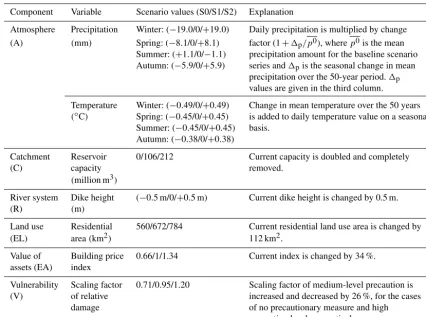
For each component, we limit the sensitivity analysis to three scenarios, a baseline scenario and two symmetric change scenarios. The baseline scenario represents the cur-rent state. The change scenarios represent plausible devia-tions from the baseline. This set-up leads to 729 (36) scenar-ios. The combinations of six components are shown in Fig. 4. The variables that are changed for each component and their values for the baseline and change scenarios are de-scribed in the following sections and summarized in Table 2.
It has to be noted that for a given component different types of changes would be possible. We have focussed our analy-sis on those types of changes that we consider most impor-tant for flooding in our study region. For example, changes in catchment hydrology are represented by changes in reservoir storage. Other changes, such as changes in agricultural prac-tice possibly leading to changes in infiltration behaviour and runoff coefficients, are not considered. Further, the amount of change assumed for each component reflects another subjec-tive choice. Finally, it should be noted that the change sce-narios do not necessarily change the flood risk in the same direction. For example, scenario 2 of the catchment compo-nent represents increased flood retention capacity and hence reduced flood risk. Conversely, scenario 2 of the vulnerability component assumes lower precaution compared to the base-line scenario and hence higher flood risk.
Each of the 729 scenarios consists of a continuous, spa-tially distributed simulation of the entire risk chain for 4000 years. From these resulting space–time fields of dam-age, two risk indicators are analysed, namely the risk curve and the expected annual damage (EAD). The risk curve is obtained by plotting losses against their probability of occur-rence. EAD is calculated by integrating over the risk curve. In this paper, we provide the results in aggregated form for the complete Mulde catchment, although the spatially explicit modelling set-up allows the derivation of the sensitivity for each sub-catchment.
3.2.2 Change in climate
temper-Table 2.Baseline and change scenarios for the sensitivity analysis. For each component the variables that are changed in the sensitivity analysis and their scenario values (S1: baseline; S0, S2: change scenarios) are given.
Component Variable Scenario values (S0/S1/S2) Explanation
Atmosphere Precipitation Winter: (−19.0/0/+19.0) Daily precipitation is multiplied by change (A) (mm) Spring: (−8.1/0/+8.1) factor (1+1p/p0), wherep0is the mean
Summer: (+1.1/0/−1.1) precipitation amount for the baseline scenario Autumn: (−5.9/0/+5.9) series and1pis the seasonal change in mean
precipitation over the 50-year period.1p
values are given in the third column.
Temperature Winter: (−0.49/0/+0.49) Change in mean temperature over the 50 years (◦C) Spring: (−0.45/0/+0.45) is added to daily temperature value on a seasonal
Summer: (−0.45/0/+0.45) basis. Autumn: (−0.38/0/+0.38)
Catchment Reservoir 0/106/212 Current capacity is doubled and completely
(C) capacity removed.
(million m3)
River system Dike height (−0.5 m/0/+0.5 m) Current dike height is changed by 0.5 m.
(R) (m)
Land use Residential 560/672/784 Current residential land use area is changed by
(EL) area(km2) 112 km2.
Value of Building price 0.66/1/1.34 Current index is changed by 34 %. assets (EA) index
Vulnerability Scaling factor 0.71/0.95/1.20 Scaling factor of medium-level precaution is
(V) of relative increased and decreased by 26 %, for the cases
damage of no precautionary measure and high
precaution level, respectively.
ature, the change factor was added to the daily temperature time series of the baseline scenario (Table 2). The change factors were derived from observed changes in mean sea-sonal precipitation and temperature across Germany and are roughly representative for the past 50 years (Umweltbunde-samt, 2017a, b). Scenario A2 represents a warmer climate and A0 a colder climate.
3.2.3 Change in catchment hydrology
Flood generation may be affected by a variety of mecha-nisms. Examples are land use changes, such as conversion of agricultural areas into settlements or changes in infiltra-tion behaviour due to soil compacinfiltra-tion as a consequence of more heavy machinery. We limit our analysis to changes in flood retention storage in reservoirs, which we consider to be the most important influence for the catchment component. Flood control by reservoirs is one of the dominant flood risk management strategies in Germany. In upstream sub-basins of the Mulde catchment, a flood retention capacity of around 106 million m3has been implemented from 1825 to 2001 by constructing 25 reservoirs.
The baseline scenario C1 considers these 25 reservoirs. They were integrated into SWIM at their locations shown in
Fig. 1. As change scenarios, we consider the catchment with-out reservoirs (scenario C0) and with double storage capacity (scenario C2). In the latter case, we doubled the storage vol-ume for each of the 25 reservoirs at the respective sub-basin. 3.2.4 Changes in the river system
For the river system, we focus on the effects of dikes on flood risk because dikes are the most extensively used flood pro-tection measure along rivers in Germany. The baseline sce-nario R1 represents the current situation with the existing dikes.
A. D. Metin et al.: How do changes along the risk chain affect flood risk? 3099 3.2.5 Land use change
Since the flood risk model chain used in this study considers only damage to private households, we limit the effect of land use change to residential areas. The baseline scenario (EL1) considers the CORINE land cover classes 111 (continuous urban fabric) and 112 (discontinuous urban fabric) for the year 2012. Land use change scenarios were created based on increase in residential areas between the years 1990 and 2012 by randomly changing the state of single pixels. The change scenario EL2 is based on the increase in area of two land cover classes from 672 to 784 km2 between 1990 and 2012 for which the change area was added to baseline scenario. To obtain the symmetric change scenario EL0, the same change in area (112 km2) was subtracted from the situation in 2012. Pixels (100×100 m2) of the classes 111 and 112 were as-signed to residential land cover classes and all other classes were assigned to non-residential land cover classes (i.e. agri-cultural areas and semi-natural areas).
3.2.6 Change in asset values
For the baseline scenario (EA1), the building values from Kleist et al. (2006) for the year 2000 were converted to 2012 to be consistent with the baseline land use map. This conver-sion was based on the building price index (BPI), which rep-resents the growth in construction prices compared to a ref-erence year for Germany (Baupreisindex – BPI, DESTATIS, 2012). In agreement with the change scenarios for land use, we generated the change scenarios for asset values by scal-ing the baseline scenario with the relative change in BPI be-tween 1990 and 2012. Hence, the change scenario EA2 rep-resents a situation with a 34 % increase in asset values, and EA0 represents a 34 % decrease compared to EA1.
3.2.7 Change in vulnerability
Vulnerability of private households is influenced by a vari-ety of dimensions such as social, economic, and institutional, and it is challenging to quantify the relation between these dimensions and the damage ratio (Merz et al., 2010). There-fore, in the present study, we focus on the economic dimen-sion of vulnerability. To represent changes in vulnerability, we use FLEMOps, which was derived from comprehensive surveys of flood damage in Germany (Thieken et al., 2008; Elmer et al., 2010). These surveys show that, in addition to flood and building characteristics, contamination and precau-tion are significant factors in determining the damage. Since contamination is in many cases imposed externally on house-holds, for example by contamination through sewage water, we focus our analysis on the effects of precaution.
The three vulnerability scenarios are defined by scaling the relative damage according to the level of precaution at the household level. For medium contamination, the scaling fac-tors are 1.20 and 0.71 for “no precautionary measures” and
“very good precautionary measures”, respectively (Büchele et al., 2006). Hence, the change scenario V2 with a scal-ing factor of 1.20 represents a situation without precaution-ary measures, and V0 a situation with very good precau-tion (scaling factor 0.71). To obtain symmetrical changes, the scaling factor of the baseline scenario V1 is set to 0.95.
4 Results
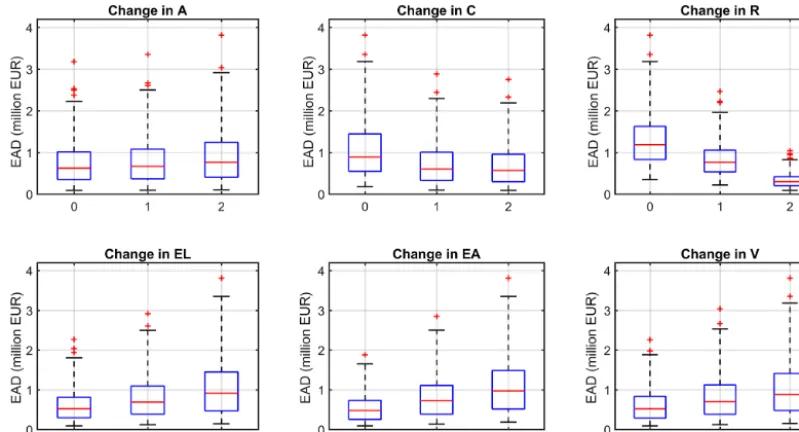
4.1 Sensitivity of flood risk at the catchment scale The impact of each component on flood risk is illustrated in Fig. 5 in terms of EAD, aggregated to the whole Mulde catchment. Changes in each risk component are represented by three box plots, whereas each box plot is derived from 243 scenarios for the change scenarios 0, 1, and 2 of that risk component.
One of the most striking results is observed for the change in the river system. The median values for different dike heights are EUR 1.2 million, 0.8 million, and 0.3 million for scenarios 0, 1, and 2, respectively. Hence, there is a very strong reduction in EAD with dike heightening. The maxi-mum EAD value for the high-dike scenario is EUR 1.1 mil-lion, which is very low compared to the EAD values obtained across all scenarios. Another remarkable result is the rather small increase in the median values for changes in the at-mosphere (A) from scenarios 0 to 2 (from EUR 0.6 million to 0.8 million), despite the realistic assumptions on aver-age changes in climate variables. This result indicates that changes in climate might not be the dominant ones along the risk chain, contrary to the prevailing perception. Although our model does not capture complex change patterns such as changes in duration of wet spells or clustering of events, we believe this would not dramatically change the magnitude of climate-induced changes. For the catchment (C) compo-nent, the median value for scenarios without a storage capac-ity (C0) is EUR 1 million, while it is around EUR 0.6 million for scenarios with both baseline storage capacity and dou-ble storage capacity. This non-symmetry in the effects of the catchment component is explained by the specific implemen-tation of the reservoir capacity: implementing a capacity of 106 million m3reduces the EAD significantly, but doubling this reservoir capacity at the same locations does not fur-ther reduce the risk substantially because the reservoir ca-pacity in the baseline scenario is already sufficient to capture floods aboveH Q100. For changes in land use (EL) and in
vulnerability (V), median values of EAD increase from sce-narios 0 to 2 (from EUR 0.5 million to 0.9 million). Similar increases are obtained for the component asset values (EA). These results imply that the assumed changes in land use, asset values, and vulnerability have considerable impacts on flood risk, only topped by the change in dike heights.
Figure 5. Box plots of EAD, aggregated at the catchment scale, for changes in six components: atmosphere (A), catchment (C), river system (R), land use (EL), asset values (EA), and vulnerability (V). The box plots show the median values (red lines), the 25th and 75th per-centiles (top and bottom of boxes), and the range (whiskers). Outliers are shown by “+”.
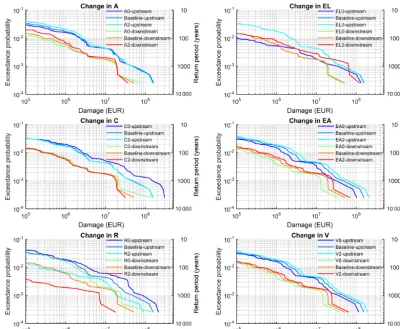
of changes in risk components across the whole spectrum of probabilities, whereas the EAD gives aggregated informa-tion. For each component, the baseline scenario is compared to the two symmetric scenarios, whereas only the respective component is changed and all other components are fixed at their baseline state. The upper left plot in Fig. 6 shows the effect of change in the atmosphere (A). Differences among the risk curves are only visible for high-probability events, whereas for extreme events the risk curves are similar for dif-ferent climate scenarios. This is explained by the interplay of the flood regime in the Mulde catchment and the seasonal variations applied in the climate change scenarios. Most of the floods occur in winter; however, the most extreme events tend to occur in summer. Since the change scenarios, based on past observations, assume a strong increase in precipita-tion in winter and almost no change in summer (see Table 2), climate change manifests itself mainly for high-probability events.
Changes in catchment (C) have the opposite effect on the risk curves, i.e. they affect only low-probability events. This is a consequence of the threshold process applied in the reservoir implementation in which the 100-year dis-charge (H Q100) is used to cut off the extreme flood flow. The
reduction in EAD is modest compared to the effect of other components, such as dike heightening. This can be explained by the small contribution of extreme events to EAD. Merz et al. (2009) have shown that EAD is dominated by “high probability–low damage” events and that “low probability– high damage” events play a small role because their low probabilities overcompensate for their high damages. They have further argued that extreme events are more important
for the affected societies than is expressed by their contribu-tion to EAD. Hence, EAD is rather insensitive to changes in reservoir capacity in our case study, and the use of EAD as a risk indicator might undervalue the risk-reducing effect of reservoirs. This discussion also provides a note of caution on a higher level: the relative contribution of different compo-nents to changes in risk varies across the probability spec-trum, and changes that affect mainly low-probability events may be undervalued by EAD, which has been used almost exclusively in the studies to date (Table 1).
Changes in the river system (R) and in land use (EL) have a substantial impact across the whole probability spectrum, whereas the impact of changes on asset values (EA) and on vulnerability (V) tends to increase from high-probability to low-probability events.
4.2 Sensitivity of flood risk for selected upstream and downstream locations
A. D. Metin et al.: How do changes along the risk chain affect flood risk? 3101
Figure 6.Risk curves, for damages aggregated to the catchment scale, for changes in six components: atmosphere (A), catchment (C), river system (R), land use (EL), asset values (EA), and vulnerability (V) under baseline conditions. Baseline represents baseline scenarios for each component, which is denoted by A1C1R1EL1EA1V1. All change scenarios vary only in the respective component. For example, A0 means A0C1R1EL1EA1V1.
large reservoir. However, doubling the capacity of this reser-voir does not result in risk changes. At the downstream re-gion influenced by several river branches, aggregated impact from various reservoirs upstream is observed. It seems that for very large events doubling of reservoir capacity still ex-erts a small impact on the risk downstream. Change in river system (R) strongly impacts risk both upstream and down-stream. While the difference between scenarios with low dike height (R0) and baseline dike height (R1) is small up-stream, there is a significant difference in the risk curves be-tween these scenarios at the downstream location for high-probability events. One potential reason for this is the influ-ence of topography on the number of exposed asset values. It is likely that under the assumption of equal value per exposed asset unit, steep upstream and flat downstream reaches are af-fected differently by the same flood magnitudes. In flat down-stream areas changes in dike heights result in great differ-ences of damage values since more assets are flooded. From the risk curves of different land use scenarios, it should be
of the residential buildings added in EL1, which are not ex-posed to floods. The last two components, change in asset values (EA) and vulnerability (V), have a similar impact on the risk curves at both upstream and downstream locations.
For the downstream district, abrupt (vertical) changes in the risk curves are observed around 500-year or greater re-turn period events. In fact, events around this abrupt change have different peaks corresponding to different return periods but they show similar flood volumes. Therefore, they result in similar inundation depths and similar damage values for different probabilities.
4.3 Seasonal effects on changes in risk curves
To understand the temporal pattern of changes in risk, risk curves for summer and winter seasons are illustrated in Fig. 8. Only the results for the atmosphere, catchment, and river system components are shown because they directly af-fect the peak flows in different seasons. It can be concluded that events in the summer season cause higher losses for the same return periods. We can observe different sensitivities in the winter and summer seasons. First, for change in at-mosphere (A), differences among change scenarios are ob-served throughout the whole probability range in the winter season. In summer, changes are very small. This is related to the much larger variation in precipitation values in winter compared to summer (Table 2). Second, change in catchment system (C) affects the risk curve for events with return peri-ods higher than 500 years in winter, while differences can be observed already for the 100-year event in summer. This can be explained by the reservoir operation rule and the magni-tude of events in different seasons. For example, the 100-year event in summer and the 800-year event in winter are of a similar magnitude corresponding to the 100-year flood of the annual time series, which is the threshold for reservoir op-eration. Finally, differences in risk curves across the whole probability range are visible for change in river system (R) for both seasons.
4.4 Relative influences of different components on flood risk
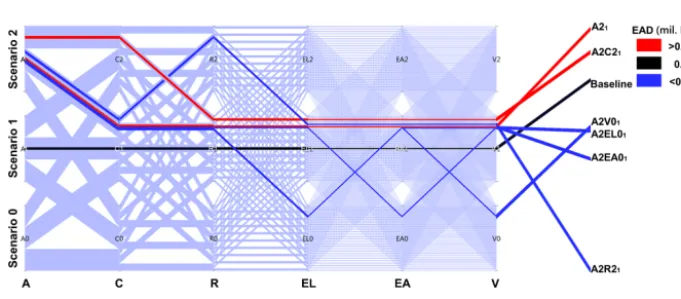
For a better visualization of the combined or opposed effects of different risk components on EAD, parallel-coordinate plots are used in Figs. 9–11. These plots consist of seven parallel axes whereas the first six axes represent the differ-ent risk compondiffer-ents, i.e. from left to right, changes in atmo-sphere (A), catchment system (C), river system (R), land use (EL), assets (EA), and vulnerability (V). The seventh axis shows EAD obtained from different combinations of risk components: the scenarios are indicated by 0, 1, and 2 on the parallel coordinates, and each combination of components is represented by a different colour. In this way, combinations of risk components that result in a certain EAD interval are easily visualized.
In Fig. 9 a subset of change scenarios is highlighted that re-sults in very high EAD values above EUR 2.5 million. It is in-teresting to note that all these scenarios contain the low-dike height scenario (R0). As soon as another river system sce-nario (R1 and R2) is selected, EAD falls below EUR 2.5 mil-lion. Increasing the dike height seems to be the most effective measure to keep the damage below a predefined threshold ir-respective of changes in other risk components.
In order to understand the impact of climate change on EAD, the baseline scenario for all components and six dif-ferent combinations with a warmer climate scenario (A2) are analysed (Fig. 10). Particularly, we looked which other com-ponents can offset the effect of the atmospheric component. Under the fixed A2 scenario, five scenario combinations are highlighted, each time altering a different component from its baseline value. For instance, in order to understand the re-lation between atmosphere and catchment changes, we com-pared the baseline scenario and the scenario of a warmer cli-mate and increased storage capacity (A2C21), for which
sub-script 1 denotes that all other components are kept in their baseline state. Scenario A2C21causes an increase in EAD
compared to the baseline EAD value, meaning that climate change has a more dominant impact than catchment changes. Consequently, one could argue that changes in catchment system cannot compensate for the impact of climate change under the selected assumptions. In the case of river system changes, the A2R21 scenario decreases EAD to the value
of EUR 0.3 million, compared to the baseline scenario of EUR 0.7 million. Hence, increased dikes can offset the ad-verse effect of the warming climate on flood risk. Changes in land use, asset values, and vulnerability (A2EL01, A2EA01,
A2V01) result in EAD below the baseline scenario, thus
compensating for the effect of climatic changes.
To compensate for the adverse effects of climatic changes, management options in all other risk chain components can be adopted. They are, however, associated with different im-plementation costs, a different degree of feasibility, or vary-ing public acceptance. For instance, increase in dike heights along extended river networks can be very costly. Construc-tion of addiConstruc-tional reservoirs might adversely affect the eco-logical state of the river or be simply not feasible. We thus ex-plored the set of scenarios, in which changes in the catchment and river systems were kept constant. Asset values were kept at the baseline level or were allowed to increase. By changing the land use and vulnerability values, the EAD was retained in the range from EUR 0.5 million to 2 million (Fig. 11). Un-der these assumptions, it is possible to restrain the effect of climate change and increasing asset values on flood risk with-out implementing technical flood protection measures.
5 Discussion
A. D. Metin et al.: How do changes along the risk chain affect flood risk? 3103
Figure 7.Risk curves for changes in six components, atmosphere (A), catchment (C), river system (R), land use (EL), asset values (EA), and vulnerability (V), under baseline conditions at districts Zwickau (upstream) and Anhalt-Bitterfeld (downstream).
Figure 8.Risk curves for changes in three components, atmosphere (A), catchment system (C), and river system (R), under the baseline conditions for winter (blue colours) and summer (red colours).
risk chain is generally missing. Taking into account all risk components allowed us to explore the effect of changes in the individual risk chain components and their mutual inter-actions.
To the authors’ knowledge, this study is the most compre-hensive analysis on the influences of different drivers of flood risk, including hazard, exposure, and vulnerability drivers. The combination of sensitivity analysis with the DFRA
Figure 9.Parallel-coordinate plot showing combinations of flood risk components that result in a certain EAD interval. From left to right, the six parallel coordinates represent changes in the flood risk components (A, C, R, EL, EA, and V), and the parallel coordinate on the right-hand side shows EAD (million EUR) obtained from different combinations of risk component scenarios. Change scenarios are indicated by 0, 1, and 2 on the parallel coordinates. Each highlighted scenario is represented by a different colour.
Figure 10.Parallel-coordinate plot representing the baseline scenario (Scenario 1) for all components and six combinations of flood risk components with a warmer climate scenario (A2): A21, A2C21, A2R21, A2EL01, A2EA01, and A2V01, where subscript “1” shows that all
other unwritten components are in their baseline condition.
an impact on the damage. The impact of climate change is mostly visible for high-probability flood events. This was ex-plained by seasonal variations in precipitation change among scenarios in combination with the specific flood regime of the Mulde catchment.
The presented results are subject to limitations related to the flood risk chain model and the subjective assumptions for the reasonable change scenarios. Each model along the risk chain has limitations and uncertainties. For instance, water level calculation in the 1-D hydrodynamic model strongly depends on river geometry estimated by the simplified river cross sections. Neglected dike breaches (only overflow is considered) are another limitation in the representation of hy-draulic processes. Further, flood damage estimation is sen-sitive to inundated areas and exposed assets, both based on coarse DEMs. High uncertainties also pertain to flood
dam-age modelling; they can have a larger contribution to uncer-tainties in risk estimates than unceruncer-tainties in hydrological and hydraulic components (Apel et al., 2009; de Moel and Aerts, 2011; Vorogushyn et al., 2012). More detailed discus-sion on limitations of the flood risk model chain can be found in Falter et al. (2016).
A. D. Metin et al.: How do changes along the risk chain affect flood risk? 3105
Figure 11.Parallel-coordinate plot representing EAD for change in land use (EL) and vulnerability (V) under fixed baseline catchment and river system scenarios and increasing atmosphere and asset values.
risk, we consider this assumption acceptable, as this study does not attempt to evaluate flood risk under various climate projections available to date. In the catchment change sce-narios, we used large changes such as doubling the reservoir storage capacity. Yet, we observed comparatively small ef-fects for the particular case study area given the implemented operation rules. Scenarios for river system were determined based on possible changes in dike heights adopted from the literature. Conditional on our assumptions, change in dike height is able to compensate for the risk-increasing impact of other components. In the land use change scenarios, the selection of the time period as well as the spatial distribu-tion of changes in individual pixels is obviously subjective. The latter can potentially be overcome by considering multi-ple scenarios of spatial distribution of changes in pixel state in relation to distance to the river and thus propensity for inundation. In the vulnerability scenarios, we only focussed on the impact of private precautionary measures. Other as-pects, such as awareness and preparedness, can also alter vul-nerability. However, between the disastrous floods in 2002 and 2013 in Germany, private households and companies substantially adopted precautionary measures (Kreibich et al., 2017). Therefore, our scenarios are reasonable to repre-sent changes in vulnerability.
These subjective assumptions do not influence the main conclusion of our study, namely the need to analyse changes in flood risk by considering the whole range of drivers. This effort is still to be undertaken to fully understand the risk and to devise appropriate measures for risk reduction going beyond technical flood protection and focussing only on ad-verse consequences of climatic changes. Using the proposed blue print, the effect of different measures under more elabo-rated and specific assumptions can be explored at other sites, possibly accompanied by cost-benefit analyses.
6 Conclusions
In this study, a comprehensive sensitivity analysis was per-formed considering six different components related to haz-ard, exposure, and vulnerability. The sensitivity analysis was combined with the “derived flood risk analysis based on con-tinuous simulation (DFRA)” proposed by Falter et al. (2015). This framework was applied to the mesoscale Mulde catch-ment in Germany in order to explore the effects of plausible changes in flood risk chain components on risk estimates and to understand interactions among different components.
floods higher than the 100-year event are influenced by the reservoirs, and the fact that EAD is typically dominated by the contribution of smaller floods.
Although the results are specific to the case study and de-pend to some extent on our choices in the implementation of this framework, some general conclusions can be derived.
The risk, quantified as EAD, varied by a factor of 40, from EUR 0.1 million to 4 million, across the range of change sce-narios. This is a very high variation given the fact that our change scenarios represent possible changes that can occur within a few decades. This result points to the significant volatility that can be associated with flood risk. It under-scores the necessity to monitor changes in risk regularly.
Our literature analysis revealed that past studies on changes in flood risk have almost exclusively focussed on effects of climate change and land use change. Our analysis demonstrates that other components that have been neglected can be even more important. Hence, the study calls for more comprehensive analyses of changes in flood risk.
The effects of external drivers, i.e. drivers which cannot be controlled within the catchment (in our case climate change and increase in asset values), can be offset by internal fac-tors. This points to the options of local stakeholders to coun-teract flood risk growth due to climate change and economic growth by flood risk management.
Almost all past studies on changes in flood risk have used EAD as a risk indicator. Since EAD is typically dominated by the contribution of small and medium floods, management options which reduce the damage for large floods are penal-ized by this limitation to EAD. A more comprehensive in-vestigation, e.g. by considering effects across the risk curve, seems necessary.
Data availability. The data used in this paper are not publicly accessible; however, the authors can be con-tacted by email ([email protected], [email protected],[email protected]) for help in acquiring such data.
Supplement. The supplement related to this article is available online at: https://doi.org/10.5194/nhess-18-3089-2018-supplement.
Author contributions. BM conceived and supervised the study. BM, ADM, NVD, and SV developed the concept. NVD, KS, and ADM performed simulations. ADM analysed the results. ADM pre-pared the paper with contributions from all the co-authors. All au-thors made a substantial contribution to the interpretation of results and provided important ideas to further improve the study.
Competing interests. The authors declare that they have no conflict of interest.
Acknowledgements. We would like to acknowledge funding from the European Union’s Horizon 2020 research and innovation programme under the Marie Skłodowska-Curie grant agreement no. 676027. We further thank the two anonymous referees for their constructive comments that helped to improve this paper.
The article processing charges for this open-access publication were covered by a Research
Centre of the Helmholtz Association.
Edited by: Joaquim G. Pinto
Reviewed by: two anonymous referees
References
Alfieri, L., Burek, P., Feyen, L., and Forzieri, G.: Global warming increases the frequency of river floods in Europe, Hydrol. Earth Syst. Sci., 19, 2247–2260, https://doi.org/10.5194/hess-19-2247-2015, 2015.
Apel, H., Aronica, G. T., Kreibich, H., and Thieken, A. H.: Flood risk analyses – How detailed do we need to be?, Nat. Hazards, 49, 79–98, https://doi.org/10.1007/s11069-008-9277-8, 2009. Arnell, N. W. and Gosling, S. N.: The impacts of climate change on
river flood risk at the global scale, Climatic Change, 134, 387– 401, https://doi.org/10.1007/s10584-014-1084-5, 2016. Barredo, J. I.: Normalised flood losses in Europe: 1970–
2006, Nat. Hazards Earth Syst. Sci., 9, 97–104, https://doi.org/10.5194/nhess-9-97-2009, 2009.
Bates, P. D., Horritt, M. S., and Fewtrell, T. J.: A simple inertial formulation of the shallow water equations for efficient two-dimensional flood inundation modelling, J. Hydrol., 387, 33–45, https://doi.org/10.1016/j.jhydrol.2010.03.027, 2010.
BMVBW: Normalherstellungskosten 2005, available at: http:// www.bki.de/ (last access: 6 April 2017), 2005.
Bouwer, L. M.: Have Disaster Losses Increased Due to Anthro-pogenic Climate Change?, B. Am. Meteorol. Soc., 92, 39–46, https://doi.org/10.1175/2010BAMS3092.1, 2011.
Bouwer, L. M., Bubeck, P., and Aerts, J. C. J. H.: Changes in future flood risk due to climate and development in a Dutch polder area, Global Environ. Change, 20, 463–471, https://doi.org/10.1016/j.gloenvcha.2010.04.002, 2010. Bubeck, P., Botzen, W. J. W., Kreibich, H., and Aerts, J. C.
J.: Long-term development and effectiveness of private flood mitigation measures: An analysis for the German part of the river Rhine, Nat. Hazards Earth Syst. Sci., 12, 3507–3518, https://doi.org/10.5194/nhess-12-3507-2012, 2012.
Büchele, B., Kreibich, H., Kron, A., Thieken, A., Ihringer, J., Oberle, P., Merz, B., and Nestmann, F.: Flood-risk mapping: Contributions towards an enhanced assessment of extreme events and associated risks, Nat. Hazards Earth Syst. Sci., 6, 483–503, https://doi.org/10.5194/nhess-6-485-2006, 2006.
Budiyono, Y., Aerts, J. C. J. H., Tollenaar, D., and Ward, P. J.: River flood risk in Jakarta under scenarios of future change, Nat. Haz-ards Earth Syst. Sci., 16, 757–774, https://doi.org/10.5194/nhess-16-757-2016, 2016.
A. D. Metin et al.: How do changes along the risk chain affect flood risk? 3107
Nat. Hazards, 58, 407–425, https://doi.org/10.1007/s11069-010-9675-6, 2011.
DESTATIS: Preise. Verbraucherpreisindex für Deutschland – Lange Reihen ab 1948–Dezember 2011, Wiesbaden, 19 pp., 2012. Di Baldassarre, G., Viglione, A., Carr, G., Kuil, L., Yan, K.,
Brandimarte, L., and Blöschl, G.: Debates - Perspectives on socio-hydrology: Capturing feedbacks between physical and social processes, Water Resour. Res., 51, 4770–4781, https://doi.org/10.1002/2014WR016416, 2015.
Duan, Q., Sorooshian, S., and Gupta, V.: Effective and Efficient Global Optimization for Conceptual Rainfall-Runoff Models, Water Resour. Res., 28, 1015–1031, 1992.
Elmer, F., Thieken, A. H., Pech, I., and Kreibich, H.: Influence of flood frequency on residential building losses, Nat. Hazards Earth Syst. Sci., 10, 2145–2159, https://doi.org/10.5194/nhess-10-2145-2010, 2010.
Elmer, F., Hoymann, J., Düthmann, D., Vorogushyn, S., and Kreibich, H.: Drivers of flood risk change in residen-tial areas, Nat. Hazards Earth Syst. Sci., 12, 1641–1657, https://doi.org/10.5194/nhess-12-1641-2012, 2012.
Falter, D., Vorogushyn, S., Lhomme, J., Apel, H., Gouldby, B., and Merz, B.: Hydraulic model evaluation for large-scale flood risk assessments, Hydrol. Process., 27, 1331–1340, https://doi.org/10.1002/hyp.9553, 2013.
Falter, D., Schröter, K., Dung, N. V., Vorogushyn, S., Kreibich, H., Hundecha, Y., Apel, H., and Merz, B.: Spatially coherent flood risk assessment based on long-term continuous simula-tion with a coupled model chain, J. Hydrol., 524, 182–193, https://doi.org/10.1016/j.jhydrol.2015.02.021, 2015.
Falter, D., Dung, N. V., Vorogushyn, S., Schröter, K., Hundecha, Y., Kreibich, H., Apel, H., Theisselmann, F., and Merz, B.: Continuous, large-scale simulation model for flood risk as-sessments: Proof-of-concept, J. Flood Risk Manage., 9, 3–21, https://doi.org/10.1111/jfr3.12105, 2016.
Feyen, L., Barredo, J. I., and Dankers, R.: Implications of global warming and urban land use change on flooding in Europe, in: Water and urban development paradigms, edited by: Feyen, J., Shannon, K., and Neville, M., Taylor & Francis Group, London, UK, 217–225, 2009.
Feyen, L., Dankers, R., Bódis, K., Salamon, P., and Barredo, J. I.: Fluvial flood risk in Europe in present and future climates, Cli-matic Change, 112, 47–62, https://doi.org/10.1007/s10584-011-0339-7, 2012.
Haberlandt, U. and Radtke, I.: Hydrological model calibration for derived flood frequency analysis using stochastic rainfall and probability distributions of peak flows, Hydrol. Earth Syst. Sci., 18, 353–365, https://doi.org/10.5194/hess-18-353-2014, 2014. Hall, J. W., Evans, E. P., Penning-Rowsell, E. C., Sayers, P.
B., Thorne, C. R., and Saul, A. J.: Quantified scenarios anal-ysis of drivers and impacts of changing flood risk in Eng-land and Wales: 2030–2100, Environ. Hazards, 5, 51–65, https://doi.org/10.1016/j.hazards.2004.04.002, 2004.
Handmer J., Honda, Y., Kundzewics, N., Arnell, N., Benito, G., Hat-field, J., Mohamed, I., Peduzzi, P., Wu, S., Sherstyukov, B., Taka-hashi, K., and Yan, Z.: Changes in impacts of climate extremes: human systems and ecosystems, in: Managing the Risks of Ex-treme Events and Disasters to Advance Climate Change Adapta-tion. A Special Report of Working Groups I and II of the Inter-governmental Panel on Climate Change (IPCC), Cambridge
Uni-versity Press, Cambridge, UK, and New York, NY, USA, 231– 290, 2012
Hoekstra, A. Y. and Kok, J. L.: Adapting to climate change: A com-parison of two strategies for dike heightening, Nat. Hazards, 47, 217–228, https://doi.org/10.1007/s11069-008-9213-y, 2008. Hundecha, Y. and Merz, B.: Exploring the
relation-ship between changes in climate and floods using a model-based analysis, Water Resour. Res., 48, 1–21, https://doi.org/10.1029/2011WR010527, 2012.
Hundecha, Y., Pahlow, M., and Schumann, A.: Modeling of daily precipitation at multiple locations using a mixture of distri-butions to characterize the extremes, Water Resour. Res., 45, W12412, https://doi.org/10.1029/2008WR007453, 2009. INFAS Geodaten GmbH: Database Das DataWherehouse, Bonn,
2009.
IPCC: Managing the Risks of Extreme Events and Disasters to Ad-vance Climate Change Adaptation, in: A Special Report of Work-ing Groups I and II of the Intergovernmental Panel on Climate Change, edited by: Field, C. B., Barros, V., Stocker, T. F., Qin, D., Dokken, D. J., Ebi, K. L., Mastrandrea, M. D., Mach, K. J., Plattner, G.-K., Allen, S. K., Tignor, M., and Midgley, P. M., Cambridge University Press, Cambridge, UK, and New York, NY, USA, 582 pp., 2012.
Jongman, B., Winsemius, H. C., Aerts, J. C. J. H., Coughlan de Perez, E., van Aalst, M. K., Kron, W., and Ward, P. J.: Declining vulnerability to river floods and the global benefits of adaptation, P. Natl. Acad. Sci. USA, 112, E2271–E2280, https://doi.org/10.1073/pnas.1414439112, 2015.
Kleist, L., Thieken, A. H., Köhler, P., Müller, M., Seifert, I., Borst, D., and Werner, U.: Estimation of the regional stock of residential buildings as a basis for a comparative risk assess-ment in Germany, Nat. Hazards Earth Syst. Sci., 6, 541–552, https://doi.org/10.5194/nhess-6-541-2006, 2006.
Kreibich, H., Thieken, a. H., Petrow, T., Müller, M., and Merz, B.: Flood loss reduction of private households due to building precautionary measures – lessons learned from the Elbe flood in August 2002, Nat. Hazards Earth Syst. Sci., 5, 117–126, https://doi.org/10.5194/nhess-5-117-2005, 2005.
Kreibich, H., Di Baldassarre, G., Vorogushyn, S., Aerts, J. C. J. H., Apel, H., Aronica, G. T., Arnbjerg-Nielsen, K., Bouwer, L. M., Bubeck, P., Caloiero, T., Chinh, D. T., Cortès, M., Gain, A. K., Giampá, V., Kuhlicke, C., Kundzewicz, Z. W., Llasat, M. C., Mård, J., Matczak, P., Mazzoleni, M., Molinari, D., Dung, N. V., Petrucci, O., Schröter, K., Slager, K., Thieken, A. H., Ward, P. J., and Merz, B.: Adaptation to flood risk: Results of inter-national paired flood event studies, Earth’s Future, 5, 953–965, https://doi.org/10.1002/2017EF000606, 2017.
Krysanova, V., Müller-Wohlfeil, D. I., and Becker, A.: Develop-ment and test of a spatially distributed hydrological/water quality model for mesoscale watersheds, Ecol. Model., 106, 261–289, https://doi.org/10.1016/S0304-3800(97)00204-4, 1998. Lung, T., Lavalle, C., Hiederer, R., Dosio, A., and Bouwer,
L. M.: A multi-hazard regional level impact assessment for Europe combining indicators of climatic and non-climatic change, Global Environ. Change, 23, 522–536, https://doi.org/10.1016/j.gloenvcha.2012.11.009, 2013. Mechler, R. and Bouwer, L. M.: Understanding trends and
vul-nerability the missing link?, Climatic Change, 133, 23–35, https://doi.org/10.1007/s10584-014-1141-0, 2015.
Merz, B., Elmer, F., and Thieken, A. H.: Significance of “high probability/low damage” versus “low probability/high damage” flood events, Nat. Hazards Earth Syst. Sci., 9, 1033–1046, https://doi.org/10.5194/nhess-9-1033-2009, 2009.
Merz, B., Kreibich, H., Schwarze, R., and Thieken, A.: Review article “Assessment of economic flood damage”, Nat. Hazards Earth Syst. Sci., 10, 1697–1724, https://doi.org/10.5194/nhess-10-1697-2010, 2010.
Merz, B., Aerts, J., Arnbjerg-Nielsen, K., Baldi, M., Becker, A., Bichet, A., Blöschl, G., Bouwer, L. M., Brauer, A., Cioffi, F., Delgado, J. M., Gocht, M., Guzzetti, F., Harrigan, S., Hirschboeck, K., Kilsby, C., Kron, W., Kwon, H. H., Lall, U., Merz, R., Nissen, K., Salvatti, P., Swierczynski, T., Ulbrich, U., Viglione, A., Ward, P. J., Weiler, M., Wilhelm, B., and Nied, M.: Floods and climate: Emerging perspectives for flood risk assess-ment and manageassess-ment, Nat. Hazards Earth Syst. Sci., 14, 1921– 1942, https://doi.org/10.5194/nhess-14-1921-2014, 2014. Muis, S., Güneralp, B., Jongman, B., Aerts, J. C. J. H., and
Ward, P. J.: Flood risk and adaptation strategies under cli-mate change and urban expansion: A probabilistic analy-sis using global data, Sci. Total Environ., 538, 445–457, https://doi.org/10.1016/j.scitotenv.2015.08.068, 2015.
Neumayer, E. and Barthel, F.: Normalizing economic loss from nat-ural disasters: A global analysis, Global Environ. Change, 21, 13–24, https://doi.org/10.1016/j.gloenvcha.2010.10.004, 2011. Petrow, Th., Merz, B., Lindenschmidt, K.-E., and Thieken, A. H.:
Aspects of seasonality and flood generating circulation patterns in a mountainous catchment in south-eastern Germany, Hydrol. Earth Syst. Sci., 11, 1455–1468, https://doi.org/10.5194/hess-11-1455-2007, 2007.
Pianosi, F., Beven, K., Freer, J., Hall, J. W., Rougier, J., Stephenson, D. B., and Wagener, T.: Sensitivity analy-sis of environmental models: A systematic review with practical workflow, Environ. Model. Softw., 79, 214–232, https://doi.org/10.1016/j.envsoft.2016.02.008, 2016.
Rojas, R., Feyen, L., and Watkiss, P.: Climate change and river floods in the European Union: Socio-economic consequences and the costs and benefits of adaptation, Global Environ. Change, 23, 1737–1751, https://doi.org/10.1016/j.gloenvcha.2013.08.006, 2013.
Sächsisches Landesamt für Umwelt und Geologie: Stauanlagen-verzeichnis 2002, Talsperren, Wasserspeicher und Hochwasser-rückhaltebecken im Freistaat Sachsen, available at: https://www. umwelt.sachsen.de/lfug (last access: 19 December 2016), 2002. Schädler, G., Berg, P., Düthmann, D., Feldmann, H., Ihringer,
J., Kunstmann, H., Liebert, J., Merz, B., Ott, I., and Wagner, S.: Flood Hazards in a Changing Climate, Technical Report, CEDIM-report, Karlsruhe, available at: https://www.cedim. kit.edu/download/Flood_Hazards_in_a_Changing_Climate.pdf (last access: 16 November 2018), 2012.
Schröter, K., Kunz, M., Elmer, F., Mühr, B., and Merz, B.: What made the June 2013 flood in Germany an exceptional event? A hydro-meteorological evaluation, Hydrol. Earth Syst. Sci., 19, 309–327, https://doi.org/10.5194/hess-19-309-2015, 2015. Song, X., Zhang, J., Zhan, C., Xuan, Y., Ye, M., and Xu,
C.: Global sensitivity analysis in hydrological model-ing: Review of concepts, methods, theoretical
frame-work, and applications, J. Hydrol., 523, 739–757, https://doi.org/10.1016/j.jhydrol.2015.02.013, 2015.
Te Linde, A. H., Bubeck, P., Dekkers, J. E. C., De Moel, H., and Aerts, J. C. J. H.: Future flood risk estimates along the river Rhine, Nat. Hazards Earth Syst. Sci., 11, 459–473, https://doi.org/10.5194/nhess-11-459-2011, 2011.
Thieken, A. H., Olschewski, A., Kreibich, H., Kobsch, S., and Merz, B.: Development and evaluation of FLEMOps - A new Flood Loss Estimation MOdel for the private sector, WIT Trans. Ecol. Environ., 118, 315–324, https://doi.org/10.2495/FRIAR080301, 2008.
Thieken, A. H., Kienzler, S., Kreibich, H., Kuhlicke, C., Kunz, M., Mühr, B., Müller, M., Otto, A., Petrow, T., Pisi, S., and Schröter, K.: Review of the flood risk management system in Germany after the major flood in 2013, Ecol. Soc., 21, 51, https://doi.org/10.5751/ES-08547-210251, 2016.
Umweltbundesamt: Trends der Niederschlagshöhe, available at: https://www.umweltbundesamt.de/sites/default/files/medien/ 384/bilder/dateien/2_tab_lineare-trends-ns_2017-05-03.pdf (last access: 24 May 2018), 2017a.
Umweltbundesamt: Trends der Lufttemperatur, available at: https://www.umweltbundesamt.de/sites/default/files/medien/ 384/bilder/dateien/4_tab_lineare-trends-lufttemperatur_ 2017-05-03.pdf (last access: 24 May 2018), 2017b.
UNISDR: Global Assessment Report 2013, UNISDR, Geneva, 2013.
UNISDR: Making Development Sustainable: The Future of Dis-aster Risk Management. Global Assessment Report on DisDis-aster Risk Reduction, United Nations Office for Disaster Risk reduc-tion (UNISDR), Geneva, Switzerland, 2015.
van Griensven, A., Meixner, T., Grunwald, S., Bishop, T., Diluzio, M., and Srinivasan, R.: A global sensitivity analysis tool for the parameters of multi-variable catchment models, J. Hydrol., 324, 10–23, https://doi.org/10.1016/j.jhydrol.2005.09.008, 2006. Visser, H., Petersen, A. C., and Ligtvoet, W.: On the
re-lation between weather-related disaster impacts, vulnerabil-ity and climate change, Climatic Change, 125, 461–477, https://doi.org/10.1007/s10584-014-1179-z, 2014.
Vorogushyn, S., Lindenschmidt, K. E., Kreibich, H., Apel, H., and Merz, B.: Analysis of a detention basin impact on dike failure probabilities and flood risk for a channel-dike-floodplain system along the river Elbe, Germany, J. Hydrol., 436–437, 120–131, https://doi.org/10.1016/j.jhydrol.2012.03.006, 2012.
Vorogushyn, S., Bates, P. D., de Bruijn, K., Castellarin, A., Kreibich, H., Priest, S., Schröter, K., Bagli, S., Blöschl, G., Domeneghetti, A., Gouldby, B., Klijn, F., Lammersen, R., Neal, J. C., Ridder, N., Terink, W., Viavattene, C., Viglione, A., Za-nardo, S., and Merz, B.: Evolutionary leap in large-scale flood risk assessment needed, Wiley Interdiscip. Rev. Water, 5, e1266, https://doi.org/10.1002/wat2.1266, 2017.
Wirtz, A., Kron, W., Löw, P., and Steuer, M.: The need for data: Natural disasters and the challenges of database management, Nat. Hazards, 70, 135–157, https://doi.org/10.1007/s11069-012-0312-4, 2014.