Scholarship@Western
Scholarship@Western
Electronic Thesis and Dissertation Repository
4-28-2017 12:00 AM
MACHS: Mitigating the Achilles Heel of the Cloud through High
MACHS: Mitigating the Achilles Heel of the Cloud through High
Availability and Performance-aware Solutions
Availability and Performance-aware Solutions
Manar Jammal
The University of Western Ontario
Supervisor
Professor Abdallah Shami
The University of Western Ontario
Graduate Program in Electrical and Computer Engineering
A thesis submitted in partial fulfillment of the requirements for the degree in Doctor of Philosophy
© Manar Jammal 2017
Follow this and additional works at: https://ir.lib.uwo.ca/etd
Part of the Computer and Systems Architecture Commons, Digital Communications and Networking Commons, Software Engineering Commons, Systems Architecture Commons, and the Theory and Algorithms Commons
Recommended Citation Recommended Citation
Jammal, Manar, "MACHS: Mitigating the Achilles Heel of the Cloud through High Availability and Performance-aware Solutions" (2017). Electronic Thesis and Dissertation Repository. 4548. https://ir.lib.uwo.ca/etd/4548
This Dissertation/Thesis is brought to you for free and open access by Scholarship@Western. It has been accepted for inclusion in Electronic Thesis and Dissertation Repository by an authorized administrator of
Cloud computing is continuously growing as a business model for hosting information
and communication technology applications. However, many concerns arise regarding the
quality of service (QoS) offered by the cloud. One major challenge is the high
availabil-ity (HA) of cloud-based applications. The key to achieving availabilavailabil-ity requirements is to
develop an approach that is immune to cloud failures while minimizing the service level agreement (SLA) violations.
To this end, this thesis addresses the HA of cloud-based applications from different
per-spectives. First, the thesis proposes a component’s HA-ware scheduler (CHASE) to
man-age the deployments of carrier-grade cloud applications while maximizing their HA and
satisfying the QoS requirements. Second, a Stochastic Petri Net (SPN) model is proposed
to capture the stochastic characteristics of cloud services and quantify the expected
avail-ability offered by an application deployment. The SPN model is then associated with an
extensible policy-driven cloud scoring system that integrates other cloud challenges (i.e.
green and cost concerns) with HA objectives. The proposed HA-aware solutions are ex-tended to include a live virtual machine migration model that provides a trade-off between
the migration time and the downtime while maintaining HA objective. Furthermore, the
thesis proposes a generic input template for cloud simulators, GITS, to facilitate the
cre-ation of cloud scenarios while ensuring reusability, simplicity, and portability. Finally, an
availability-aware CloudSim extension, ACE, is proposed. ACE extends CloudSim
simu-lator with failure injection, computational paths, repair, failover, load balancing, and other
availability-based modules.
Keywords: Cloud computing, High availability, Virtual machines, Dependability analy-sis, Petri Net, Load balancing, Component-based architecture, Scheduling, Live migration,
Failover, CloudSim, Criticality, Redundancy, Interdependency, Computational path,
Open-Stack, JSON, Eclipse GMF.
This thesis contains the following manuscripts that have been submitted, accepted, and published.
1. M. Jammal, A. Kanso, and A. Shami, “High Availability-Aware Optimization Di-gest for Applications Deployment in Cloud,” IEEE International Conference on Communications (ICC), June 2015.
2. M. Jammal, A. Kanso, and A. Shami, “CHASE: Component High-Availability Scheduler in Cloud Computing Environment,”IEEE International Conference on Cloud Computing (CLOUD), June 2015.
3. A. Kanso, M. Jammal, and A. Shami, Component High Availability Scheduler, P44248 US1, October 2014.
4. M. Jammal, A. Kanso, P. Heidari, and A. Shami, “A Formal Model for the Avail-ability Analysis of Cloud Deployed Multi-Tiered Applications,”IEEE International Symposium on Software Defined Systems, April 2016.
5. M. Jammal, A. Kanso, P. Heidari, and A. Shami, “Availability Analysis of Cloud Deployed Applications,” IEEE International Conference on Cloud Engineering, April 2016.
6. A. Kanso, P. Heidari, and M. Jammal, High availability multi-component cloud application placement using stochastic availability models, P48033US1, November 2015.
7. M. Jammal, A. Kanso, P. Heidari, and A. Shami, “Scrutinize High Availability-aware Deployments Using Stochastic Petri Net Model and Cloud Scoring Selection Tool,”Submitted to IEEE Transactions on Services Computing, November 2016. 8. M. Jammal, H. Hawilo, A. Kanso, and A. Shami, “Mitigating the Risk of Cloud
Services Downtime Using Live Migration and High Availability-Aware Placement,”
IEEE International Conference on Cloud Computing Technology and Science (Cloud-Com), December 2016.
9. M. Jammal, H.Hawilo, A. Kanso, and A. Shami, “GITS: Generic Input Template for CloudSim and Cloud Simulators,” Submitted to Elsevier Future Generation Com-puter Systems, 2017.
10. M. Jammal, H.Hawilo, A. Kanso, and A. Shami, “ACE: Availability-aware CloudSim Extension,”Submitted to IEEE Transactions on Cloud Computing, 2017.
The following co-authors provided experimental and technical support for the studies listed above:
• A. Shami supervised the development of the work and provided technical expertise, opinion, and perspective based on his experience as a professor at Western Univer-sity. He supervised the work done in Chapter 2, Chapter 3, Chapter 4, Chapter 5, and Chapter 6.
• A. Kanso supervised the development of the work and provided technical exper-tise, opinion, and perspective based on his experience as a researcher at Ericsson, Montreal and as a senior software engineer at IBM Watson Center, NY, USA. He supervised to the work done in Chapter 2, Chapter 3, Chapter 4, Chapter 5, and Chapter 6.
• H. Hawilo provided technical opinion on the design of GITS and ACE and helped in the manuscripts preparation and review based on his experience as a Ph.D. student at Western University. He contributed to the work done in Chapter 4, Chapter 5, and Chapter 6.
• P. Heidari provided technical expertise on Petri Nets, helped in designing the cloud scoring tool, and helped in analyzing Petri Net results based on her expertise as a Postdoctoral researcher at Ericsson, Montreal and Western University. She con-tributed to the work done in Chapter 3.
to the memory of my grandfather, Ahmad.
Doing my Ph.D. has been a turning point for me. It is true that pursuing Ph.D. studies is a challenging step, but it is worth working for. During this journey, I have learned to hold on regardless of obstacles. This would not have been possible without the support and help of great people. I am grateful for all of them!
First, I would like to thank my supervisor Prof. Abdallah Shami. He has been very support-ive since the days I began working with him in the OC2 group. I would like to express my sincere appreciation for the motivation and guidance he gave me during my Ph.D. studies. His immense knowledge and guidance helped me in all the research work. Prof. Shami has supported me not only by providing a research supervision, but he was there for me as a mentor and friend especially during the rough moments of this thesis. Thanks to him I also had the opportunity to work with Ericsson Research, Montreal where I had the chance to meet wonderful people there! Here, I would like to express my sincere gratitude to Dr. Ali Kanso for his encouragement to keep up the hard work. With his knowledge, he guided me through my thesis and made sure that I am always on the “right track”. I am very grateful for the invaluable discussions, suggestions, and meetings. Above all, thanks for having him as a mentor whom I can always count on his support.
Special thanks to my thesis and advisory committee members Prof. Ben Liang, Prof. Hanan Lutfiyya, Prof. Jagath Samarabandu, Prof. Aleksander Essex, and Prof. Serguei Primak for taking the time to read the thesis and for their invaluable comments and feedback.
Special thanks to Prof. Abdelouahed Gherbi for his support and insightful advice on my re-search career. I would like to thank Prof. Armin Zimmermann for his technical insights on TimeNET. Many thanks to my previous supervisors, Prof. Ayman Youssef, Prof. Youssef Harkouss, and Mohamad Youssef, for their continual encouragement.
A very special word of gratitude to the administrative staff at Western Engineering, in particular, Stephanie Tigert and Chris Marriott.
A good support is a key to survive “Azkaban” (Grad school), and I was lucky to have won-derful friends along the way. Special thanks to my friend and labmate, Elena Uchiteleva. During Ph.D., there is always stressing moments and obstacles that get in the way, but that is where you always have that person as Elena who is there to support you, believe in you, and show you that it is all worth it. Many thanks also to Amani Dahab, Amna Zeid, Abdel-rahmein Zeid, and Sami Fayoumi, my amazing friends and second family. Thanks Amani
for your continual support, warmth words, and delicious food! My friends, Farah Kazan, Zeinab McHeimech, Sara Mantach, Anas Ibrahim, Tarek Menkad, Widad Hanin, Jad Atwi, Fuad Shamieh, Ali El Takch, and Hoda Sbeity, thanks for being very supportive and caring.
I would like to extend my sincerest thanks to the wonderful IEEE London team and par-ticularly the IEEE London Women In Engineering Group. Volunteering with you is a life-changing experience. I am very thankful to have the opportunity to meet and work with remarkable people like you. Special thanks to the outstanding volunteer, Murray MacDon-ald. I have never met someone who is so much dedicated to his volunteer work as Murray. He is an amazing and supportive person. Elena Uchiteleva, Maike Luiken, Ana Luisa Tre-jos, Rebecca Jevnikar, Hassan Hawilo, Joanne Moniz, Iram Raza, Anas Ibrahim, Wafaa Anani, and Lotfieh Albarazi: you are the best team! I have learned from you how giving back to the community is so much rewarding and fun.
I would like to extend special thanks to my Western friends and labmates for their mo-tivating and thoughtful words they gave throughout this journey. I am grateful to meet supportive peers like you; Alexandra L’Heureux, Philip Kurowski, Mohamed Abu Sharkh, Karim Hammad, Brad de Vlugt, Mohamed Kalil, Anas Saci, Mohamed Noor, Trevor Craw-ford, Khalim Amjad Meerja, Mohamed Hussein, Khaled Al Hazmi, Abdallah Moubayed, Emad Aqili, Sara Zimmo, Maysam Mirahmdi, Aidin Reyhani-Masouleh, Taranpreet Singh, and Abdulfattah Noorwali.
I would never have completed this thesis without the assistance of my amazing family and in-laws; in particular, Aunt Leila, Maryam, Gaby, and Aunt Randa. Thank you for your love, encouragement, and support in all my pursuits. The big thank is to my cousin, sister, best friend, and inner voice, Mira Kamal. Words cannot express how grateful I am for having you. You have been with me throughout every step of my life. Thanks for al-ways believing in me, cheering me up, and being there for me when I most needed you. I would have never made it through my thesis without your energetic messages, inspirational quotes, funny jokes, and best recipes (although I did not have the chance to try them all)! “You are my Nemo. If you ever get lost in the big ocean, I will find you”.
I finish my acknowledgment with my basic source of energy: my beloved husband, Hassan Hawilo. I have spent some time to figure out how to extend my heartfelt thanks to you. Hassan has been living every single minute of my Ph.D., and without whom, I would not have had the strength to decide on undertaking this journey. It is your support and encour-agement to follow my dreams that made me whom I am today and inspired me when I got weary. Thank you for supporting in the first place my decision to travel and for everything you have done to make my dream comes true. Your unconditional love, care, and patience throughout my lengthy working hours have allowed me to complete this thesis. Yet, during this period; we had the chance to spend every moment of every day for the last four years not only in the same apartment but also in the same lab insomuch that now we had our
own language. Thank you for the sleepless nights and for all the times we spent discussing universe wonders and arguing about different existence and behavioral theories. Above all, thanks for being my best friend, gut-knowing, listener, financial manager, best comedian, for keeping things going smoothly, and always showing how proud you are of me! I un-doubtedly would not have done this without you.
This work is partially supported by the Natural Sciences and Engineering Research Council of Canada (NSERC-STPGP 447230) and Ericsson Research.
On a final note, “Happiness can be found even in the darkest of times if only one remem-bers to turn on the light” Albus Dumbledore.
I am grateful to all of you for making this journey memorable!
Abstract . . . ii
Co-Authorship . . . iii
Dedication . . . v
Acknowledgements . . . vi
Table of Contents . . . ix
List of Tables . . . xiii
List of Figures . . . xiv
Acronyms . . . xvii
1 Introduction . . . 1
1.1 Thesis Outline . . . 3
1.2 Thesis Contributions . . . 4
1.2.1 Chapter 2 contributions . . . 5
1.2.2 Chapter 3 contributions . . . 6
1.2.3 Chapter 4 contributions . . . 7
1.2.4 Chapter 5 contributions . . . 8
1.2.5 Chapter 6 contributions . . . 8
2 CHASE: Component High Availability-Aware Scheduler in Cloud Computing
Environment . . . 12
2.1 Introduction . . . 12
2.2 System Modelling and Schematization . . . 14
2.2.1 Cloud infrastructure model . . . 17
2.2.2 Cloud application model . . . 18
2.2.3 Cloud-Application integration . . . 19
2.3 Design and Implementation . . . 19
2.3.1 Criticality analysis . . . 21
2.3.2 Mathematical formulation . . . 22
2.3.3 CHASE: Component HA-aware scheduler . . . 25
2.4 MILP Evaluation . . . 29
2.4.1 Availability analysis . . . 31
2.4.2 Computational complexity . . . 32
2.4.3 OpenStack filter scheduler . . . 32
2.4.4 Results . . . 33
2.5 CHASE Evaluation . . . 37
2.5.1 Small-Scale network setup . . . 37
2.5.2 Large-Scale network . . . 41
2.6 Prototype Implementation . . . 44
2.7 Related Work . . . 46
2.7.1 Replication approaches . . . 46
2.7.2 Diversified geographical sites and failover approaches . . . 47
2.8 Conclusion . . . 49
3 Scrutinize High Availability-aware Deployments Using Stochastic Petri Net Model and Cloud Scoring Selection Tool . . . 54
3.1 Introduction . . . 54
3.2 Modeling High Availability in Cloud . . . 57
3.2.1 Failure types and distributions . . . 57
3.2.2 Multi-tier applications in the cloud: . . . 59
3.2.3 Stochastic Petri Nets in the cloud: . . . 60
3.3 Cloud Scoring System . . . 62
3.3.1 Motivation: . . . 62
3.3.2 Cloud scoring approach: . . . 65
3.4 Approach . . . 67
3.4.1 Cloud model . . . 69
3.4.2 SCPN model building blocks . . . 71
3.4.3 Transformation of UML object diagram to SCPN model . . . 79
3.4.4 Deployment scoring selection system . . . 80
3.5 Case Study . . . 85
3.5.1 SCPN evaluation and results . . . 86
3.5.2 Scoring selection system evaluation and results . . . 90
3.6 Related Work . . . 94
3.6.1 Availability analysis using Petri Net models . . . 94
3.6.2 Scoring and selection of cloud deployments . . . 96
3.7 Conclusion . . . 98
4 Mitigating the Risk of Cloud Services Downtime Using Live Migration and High Availability-Aware Placement . . . 109
4.1 Introduction . . . 109
4.2 Related Work . . . 110
4.3 Approach . . . 113
4.3.1 HA-aware placement . . . 113
4.3.2 Live VM migration . . . 118
4.4 Case Study . . . 123
4.4.1 HA-aware deployments analysis . . . 123
4.4.2 Live migration preliminary results . . . 124
4.5 Conclusion . . . 125
5 GITS: Generic Input Template for CloudSim and Cloud Simulators . . . 131
5.1 Introduction . . . 131
5.2 Related Work . . . 133
5.2.1 Industry-based cloud orchestration and specifications . . . 133
5.2.2 Research-Based cloud orchestration and specifications . . . 135
5.3 Motivation . . . 137
5.3.1 CloudSim simulator . . . 137
5.3.2 Component-Based architecture . . . 138
5.3.3 Issues and contributions . . . 139
5.4 GITS Framework . . . 142
5.4.1 GITS UML model . . . 142
5.4.2 GITS JSON file . . . 145
5.4.3 GITS graphical interface . . . 150
5.4.4 GITS transformation algorithm . . . 154
5.5 GITS Testbed and Evaluation . . . 156
5.6 Conclusion . . . 160
6 ACE: Availability-aware CloudSim Extension . . . 168
6.1 Introduction . . . 168
6.2 Related Work . . . 172
6.2.1 Cloud simulators . . . 172
6.2.2 Scheduling approaches in distributed systems . . . 174
6.3 Background and Motivation: . . . 176
6.3.1 CloudSim simulator . . . 176
6.3.2 Outages and fault tolerant approaches . . . 178
6.3.3 Scheduling in the cloud . . . 181
6.3.4 Cloud model . . . 182
6.4 ACE Design . . . 184
6.4.1 ACE modules . . . 185
6.4.2 ACE building blocks . . . 193
6.5 ACE Evaluation . . . 196
6.5.1 ACE configuration . . . 197
6.5.2 Results . . . 200
6.6 Conclusion . . . 209
7 Conclusion . . . 219
7.1 Thesis Summary . . . 220
7.1.1 Chapter 2 summary . . . 220
7.1.2 Chapter 3 summary . . . 221
7.1.3 Chapter 4 summary . . . 221
7.1.4 Chapter 5 summary . . . 222
7.1.5 Chapter 6 summary . . . 222
7.2 Thesis Future Work . . . 222
7.2.1 Elasticity and storage mechanisms . . . 223
7.2.2 Multi-objective cloud management system . . . 224
7.2.3 Container Management Framework . . . 224
Curriculum Vitae . . . 226
2.1 Variable notations. . . 22
2.2 Evaluation parameters. . . 33
2.3 Availability improvement among different delay types using CHASE and RAS. . . 44
3.1 Time function of DC model transitions. . . 72
3.2 Time function of server model transitions. . . 72
3.3 Time function of VM model transitions. . . 73
3.4 Time function of container model transitions. . . 74
3.5 Time function of Load balancer model transitions. . . 76
3.6 Time function of component model transitions. . . 79
3.7 Different MTTF, MTTR, and processing time. . . 86
3.8 DC evaluation metrics of the first case. . . 90
3.9 DC distances of the first case. . . 91
3.10 Deployment distances of the first case. . . 91
3.11 Optimal deployments of the first case. . . 92
3.12 DC carbon metrics in 2013 used in the second case. . . 92
3.13 DC distances of the second case. . . 92
3.14 Deployment distances of the second case. . . 93
3.15 Optimal deployments of the second case. . . 93
6.1 Different HA metrics distribution . . . 198
6.2 Computing metrics . . . 198
1.1 Overview of the thesis contributions. . . 3
2.1 Example of an application deployment in the cloud. . . 14
2.2 UML class diagram of CHASE cloud model. . . 15
2.3 Flowchart of CHASE approach. . . 25
2.4 Capacity algorithm of CHASE. . . 26
2.5 Delay Tolerance algorithm of CHASE. . . 27
2.6 Availability algorithm of CHASE. . . 28
2.7 Interdependency algorithm of CHASE. . . 29
2.8 Redundancy algorithm of CHASE. . . 30
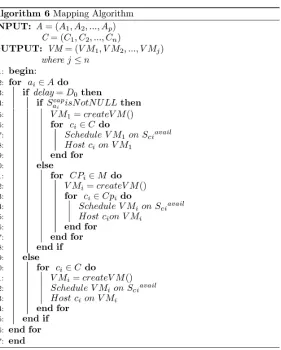
2.9 Mapping algorithm between cloud infrastructure and cloud applications. . . 31
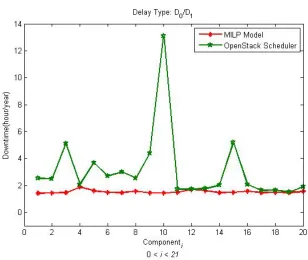
2.10 Downtime of each application’s component using MILP and OpenStack scheduler forD0/D1 delay type. . . 34
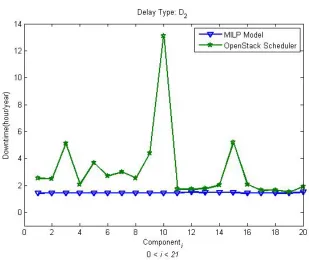
2.11 Downtime of each application’s component using MILP and OpenStack scheduler forD2 delay type. . . 35
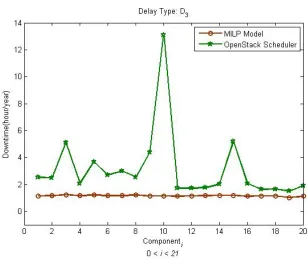
2.12 Downtime of each application’s component using MILP and OpenStack scheduler forD3 delay type. . . 36
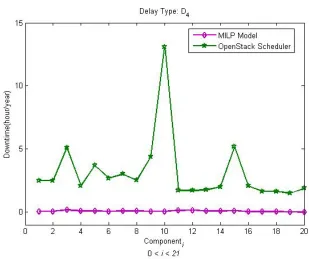
2.13 Downtime of each application’s component using MILP and OpenStack scheduler forD4 delay type. . . 37
2.14 Availability improvement for each application’s components among delay zones using MILP model. . . 38
2.15 Downtime of each application’s component in small-scale network forD0/D1 delay type. . . 39
2.16 Downtime of each application’s component in small-scale network forD2 delay type. . . 39
2.17 Downtime of each application’s component in small-scale network forD3 delay type. . . 40
2.18 Downtime of each application’s component in small-scale network forD4 delay type. . . 40
2.19 Downtime of each application’s component in large-scale network forD0/D1 delay type. . . 41
2.20 Downtime of each application’s component in large-scale network forD2 delay type. . . 42
2.21 Downtime of each application’s component in large-scale network forD3 delay type. . . 42
2.22 Downtime of each application’s component in large-scale network forD4
delay type. . . 43
2.23 Architecture of CHASE prototype. . . 45
2.24 A screenshot of CHASE GUI. . . 46
3.1 SPN model and scoring selection approach. . . 56
3.2 Example of three-tier web application. . . 60
3.3 Different energy challenges and solutions in cloud DCs. . . 63
3.4 The overall SCPN approach. . . 68
3.5 The UML model for a cloud deployment. . . 69
3.6 Data center, server, VM, and container sub-SCPN models. . . 71
3.7 Load balancer SCPN model. . . 75
3.8 Component SCPN model. . . 78
3.9 Transformation algorithm to generate the SCPN model. . . 81
3.10 Scoring selection algorithm. . . 82
3.11 SCPN model of a three-tier Amazon web application running in a cloud environment. . . 84
3.12 Service availability of different deployments and different MTTRs. DCs have similar MTTF. . . 87
3.13 Service availability of different deployments and different MTTRs. DCs have different MTTF (x; 1.5x; 2x). . . 88
3.14 Service availability of different deployments and different MTTRs. DCs have different MTTF (x; 2x; 3x). . . 88
3.15 Served requests for different processing time. Request arrival rate is ‘a’. . . 89
4.1 HA-aware deployments analysis approach. . . 116
4.2 HA-based comparative analysis of placement algorithms in terms of the number of served requests. . . 123
4.3 The downtime of each migrated VM for different migration mechanisms. . 125
5.1 UML class diagram of GITS cloud model. . . 141
5.2 HA solution state model. . . 143
5.3 Effect of redundancy model on failover time. . . 144
5.4 JSON-based cloud infrastructure template. . . 146
5.5 JSON-based provider-user mapping template. . . 147
5.6 JSON-based cloud application template. . . 149
5.7 Eclipse GMF overview. . . 151
5.8 GITS tool palette. . . 152
5.9 GITS graphical editor. . . 153
5.10 GMF2JSON approach. . . 154
5.11 JSON2UML2CloudSIM approach. . . 155
5.12 Cloud scenario created using GITS. . . 156
5.13 Evaluation of GITS cloud scenario in CloudSim. . . 158
5.14 Example of GITS encoding to XML schema. . . 159
6.1 Different cloud challenges. . . 169
6.2 Different emerging technologies. . . 170
6.3 CloudSim architecture. . . 177
6.4 CloudSim class diagram. . . 178
6.5 Different roles in the cloud model. . . 181
6.6 ACE model (Using Eclispe Ecore representation). . . 185
6.7 ACE graphical editor. . . 186
6.8 ACE JSON template. . . 187
6.9 Example of three-tier web application. . . 188
6.10 Flowchart of the HA-aware placement algorithm in ACE. . . 189
6.11 ACE load balancing module. . . 190
6.12 ACE architecture and different modules. . . 192
6.13 Different building blocks of ACE. . . 193
6.14 Impact of redundancy models on the number of the served requests for automatic request generation. . . 199
6.15 Number of served requests for static request generation and different re-dundancy models. . . 200
6.16 Impact of the redundancy models on the request’s response and waiting times.201 6.17 Impact of the number of failure injections on the request number for differ-ent redundancy models. . . 202
6.18 Impact of the number of failure injections on the request’s response and waiting times. . . 204
6.19 Availability of each deployed component. . . 205
6.20 ACE scalability: Number of request processed using ACE for different redundancy models. . . 205
6.21 ACE time complexity for dynamic requests generation. . . 207
6.22 ACE time complexity for static requests generation. . . 208
AaaS Application as a Service
AAD Adaptive Anomaly Detection
ACE Availability-aware CloudSim Extension
AFT Adaptive Fault Tolerance
AL Allowed Workload
API Application Programming Interface
App Application
AWS Amazon Web Services
AZ Availability Zone
BPEL Business Process Execution Language
BPMN Business Process Model and Notation
BSP Bulk Synchronous Parallel
CAMP Cloud Application Management for Platforms
CAPEX Capital Expenditure
CBA Component-based Architecture
CC Cloud Computing
CDN Content Delivery Network
CDO Cloud Deployment Option
CHASE Component High Availability Scheduler
CL Current Load
CLI Command-Line Interface
CMS Cloud Management System
COP21 21st Conference of the Parties
CORBA Common Object Request Broker Architecture
COTS Commercial off The Shelf
CoW-B Copy-on-Write-Basic
CRM Customer Relationship Management
DB Database
DC Data Center
DCN Data Center Network
DCOM Distributed Component Object Model
DeC Dependent Component
DES Discrete Event Simulator
DHCP Dynamic Host Configuration Protocol
DOM Document Object Model
DSL Domain Specific Language
DSPN Deterministic Stochastic Petri Net
EC2 Elastic Compute Cloud
ECE Energy and Carbon-Efficient
EMF Eclipse Modeling Framework
FCFS First Come First Serve
FE Front End
FFA Functional Failure Analysis
GDM Graphical Definition Model
GEF Graphical Editing Framework
GHG Greenhouse Gas
GITS Generic Input Template for Cloud Simulators
GMF Graphical Modeling Framework
GSPN Generalized Stochastic Petri Net
GUI Graphical User Interface
HA High Availability
HIPAA Health Insurance Portability and Accountability Act
HOT Heat Orchestration Template
HTTPS Hypertext Transfer Protocol Secure
IaaS Infrastructure as a Service
ICT Information and Communications Technology
IFT Intermediate Data Fault Tolerant
IoT Internet of Things
IT Information Technology
JAR Java Archive
JSON JavaScript Object Notation
LoB Lines Of Business
M2M Model-to-Model Transformation
M2T Model-to-Text Transformation
MILP Mixed Integer Linear Programming
MTBF Mean Time Between Failure
MTTF Mean Time To Failure
MTTR Mean Time To Repair
MVC Model-View-Controller
NFV Network Function Virtualization
NP Non-deterministic Polynomial Time
NRDC Natural Resources Defense Council
OASIS Organization for the Advancement of Structured Infor-mation Standards
OL Overload Factor
OLB Opportunistic Load Balancing
OPEX Operational Expenditure
OS Operating System
PaaS Platform as a Service
PHA Preliminary Hazard Analysis
PM Physical Machine
PNs Petri Net
PUE Power Usage Effectiveness
QoE Quality of Service Experience
QoS Quality of Service
RAM Random-access memory
RAS Redundancy-Agnostic Scheduler
RBD Reliability Block Diagram
RDS Relational Database Service
ROI Return On Investment
RU Relative Average Utilization
SaaS Software as a Service
SC Sponsor Component
SCPN Stochastic Colored Petri Net
SDN Software Defined Networking
SLA Service Level Agreement
SMI Service Management Index
SOA Service Oriented Architecture
SOAP Simple Object Access Protocol
SPN Stochastic Petri Net
SPOF Single Point Of Failure
SRN Stochastic Reward Net
SSaaS Simulating a Software as a Service
SUMO Simulation of Urban Mobility
TCO Total Cost of Ownership
TDM Tooling Definition Model
TOSCA Topology and Orchestration Specification for Cloud Applications
UML Unified Modelling Language
VE Virtual Environment
VM Virtual Machine
WSDL Web Services Description Language
XaaS Everything as a Service
XML Extensible Markup Language
YAML Yet Another Markup Language
Chapter 1
Introduction
Today, cloud computing is one of the groundbreaking technologies that have transformed
the landscape to support new businesses with dynamic and changing workforce and
de-mands. It is becoming the lifeblood of most telecommunication network services and
information technology (IT) software applications [1] [2]. With the development of the
cloud market, it can be seen as an opportunity for information and communications
tech-nology (ICT) companies to deliver communication and IT services over any fixed or
mo-bile network with high performance and secure end-to-end quality of service (QoS) for end
users [3]. Although cloud computing provides benefits to different players in its ecosystem
and makes services available anytime, anywhere and in any context, many concerns arise
regarding the performance and quality of the services offered by the cloud. One major
concern for the enterprises is the high availability (HA) of cloud-based applications where
business is expected to be running in the occurrence of any disruptive incident or sudden
failure. Since these applications are hosted by a virtual environment (virtual machines
(VMs) or containers) residing on servers, their availability depends on that of the hosts
[4] [5] [6]. When a hosting server fails, its VMs/containers and their applications become
inoperative. The absence of application protection plan has a tremendous effect on
busi-ness continuity and IT enterprises. Outages can happen even on the well-managed cloud
platforms. For example, Amazon has faced an outage due to a “human typo” on Feb. 28,
2017, which has affected many services and websites including Quora, Sailthru
newslet-ter provider, Business Insider, Slack filesharing, and various connected Innewslet-ternet of things
(IoT) hardware [7]. Also, on Feb. 1, 2017, GitLab has reported data loss due to accident
deletion, which has caused the permanent loss of “six hours’ worth” of data [8]. With the
growing reliance on the cloud services and data centers (DCs), it is necessary to understand
the direct and indirect impact of outages on the enterprises. According to Aberdeen Group,
larger ones [9]; excluding reputation damage that can be significantly greater in the longer
term. At the same time, a Disaster Recovery Preparedness Council survey has released that
27% of the enterprises have obtained a disaster readiness passing state [10]. In addition,
the Ponemon Institute study shows that the average cost of a DC outage has increased 38%
since 2010 (from $505,502 in 2010 to $740,357 in 2016) [11]. It is not always easy to
place a direct cost on downtime. Angry customers and bad publicity are all costly, but not
directly measured in currency. This also includes:
• Damage to mission-critical applications, marketplace reputation, and other assets
• Loss of trustworthiness among stakeholders and customers
• Cost to repair affected operational processes that handle the “core business and value
chain”
• Regulatory and legal effect, such as litigation cost
The number of active Facebook users has grown to 1.5 billion, which requires an immune
system to ensure data delivery anytime and anywhere [11]. Besides, Business Insider (BI)
Intelligence research determines that the number of globally shipped smartphones is
ex-pected to be above 1.5 billion [12]. Additionally, International Data Corporation (IDC)
expects that the IoT market will reach $1.7 trillion in 2020 [13]. These developments
and new technologies means more data and business opportunities are emerging. This
will cause a spurt growth in the cloud, which is expected to play a critical role to handle
these high data undertow, emerging technologies, and new market demands. However, the
Ponemon study indicates that the downtime costs is still rising, and the outages reasons
are similar to what they were few years ago. At the same time, many enterprises require
continuous availability of their resources and services. The key solution to these issues is
to develop a highly available system that protects services, avoids downtime, and maintains
business continuity. Achieving this mandate involves designing and development of
mul-tiple management systems for high availability including redundancy, failover, and other
HA practices. This thesis provides an approach that is immune to failure while
satisfy-ing other quality of service (QoS) requirements. It proposes a pragmatic methodology to
address the high availability in the cloud. This methodology consists of deployment and
design phases. Fig. 1.1 summarizes the thesis contributions. It starts with designing an
Figure 1.1: Overview of the thesis contributions.
model to assess different HA-aware deployments of applications’ components. It then
pro-vides a cloud scoring selection solution that integrates the HA-aware approach with other
challenges facing the cloud including energy and various performance measures. The
the-sis also provides a live VM migration as another HA-aware approach that can be triggered
for load balancing, overload, or pre-disaster recovery objectives. At the design phase, this
thesis alleviates the portability and orchestration challenges of cloud-based applications
and provides a generic input template for cloud systems. It also proposes availability aware
extension to CloudSim, well-defined cloud simulator, to mitigate the configuration settings
challenges of modeling and simulating HA-aware mechanisms in real-cloud platforms.
1.1
Thesis Outline
This thesis is organized as follows. Chapter 2 provides a novel HA-aware scheduling
tech-nique, CHASE, that maximizes applications availability while satisfying different
func-tionality constraints. This problem is formulated as a mixed integer linear programming
(MILP) optimization model, which is associated with a heuristic solution, CHASE. The
proposed approach envisions the cloud model as a cloud provider and user and integrates
them through a virtualization layer. It also performs a criticality analysis to prioritize the
deploy-ments, CHASE captures different redundancy and interdependency constraints and other
HA measures. It is evaluated on a 3-tier web application and is designed to
communica-tion with the cloud management system, OpenStack. Chapter 3 defines the different types
of cloud failures and provides an availability-centric analysis model using Stochastic Petri
Net (SPN). The SPN model captures the different elements of the cloud model and their
workflow. It then assesses different applications deployment in terms of HA while
mod-eling the requests, load balancing, failures, failover, and interdependency practices. The
proposed SPN model provides HA-aware guidelines for cloud scheduling solution. It is
also associated with an extensible scoring selection system that integrates HA objectives
with other performance and QoS norms in the cloud. In this chapter, the scoring
sys-tem selects the optimal HA-aware deployment while satisfying green and cost objectives.
Chapter 4 provides design considerations to implement an HA-aware deployment solution.
It also provides a comparative study to select best availability assessment model. It then
proposes a live VM migration approach to ensure data delivery upon unforeseen failures
(i.e., natural disasters). The proposed migration approach is formulated as a MILP model
that minimizes migration time and downtime. Chapter 5 provides GITS, a generic input
template for different cloud simulators. GITS alleviates the portability and orchestration
issues facing the cloud. For this purpose, the chapter models the cloud in terms of
function-ality measures and HA features and provides a JavaScript Object Notation (JSON) schema
to facilitate the creation of cloud scenarios and experiments reusability. Chapter 6
pro-vides ACE, availability-aware CloudSim extension. ACE extends CloudSim simulator to
support HA measures and allows the modeling and evaluation of multiple HA mechanisms
in a cloud-based environment. To that end, ACE provides a mapping of the JSON
tem-plate to the CloudSim environment, supports dynamic request generations, injects failure,
recovers/repairs them, and provides other HA-aware features.
1.2
Thesis Contributions
1.2.1
Chapter 2 contributions
Cloud schedulers that are agnostic of the intricacies of the tenant’s application may result
in suboptimal placements. In these placements, redundant components may be placed too
close to each other rendering their existence obsolete because a single failure can affect
them all, or the delay constraints can be violated, hindering the application functionality.
With this in mind, the main contributions of this chapter are the following:
1. This chapter proposes CHASE, a novel component’s HA-aware scheduling
tech-nique, which maximizes the availability of applications without violating service
level agreements (SLAs) with the end-users. For this purpose, the scheduling is
formulated as a MILP model associated with a heuristic solution.
2. CHASE captures at an abstract level details of both the applications and the cloud
infrastructure. When analyzing availability, the cloud topology should be defined to
pinpoint the single points of failure (SPOF) or possible bottlenecks that might affect
the data processing and availability. Using a unified modelling language (UML),
CHASE starts by modeling the applications with their functional and non-functional
requirements. Then it considers the cloud infrastructure model to be a constrained
solution space where a mapping between applications, VMs, and servers are
gen-erated to maximize the availability. With this model, we start with a specific cloud
infrastructure and a set of requested applications, and we end up by generating an
interface between the provider and user side using VM mappings.
3. Using CHASE, prior criticality analysis is conducted on applications to differentiate
between mission-critical and standard applications and consequently, schedule them
based on their impact on the execution environment and business functionality.
4. CHASE implements different approaches that deploy redundant models and failover
solutions. These practices are achieved through geographically distributed
redun-dant applications’ deployments without violating the interdependency requirements.
This allows the elimination of single point of failure caused at the level of VM,
clus-ter, or cloud.
5. CHASE overcomes the challenges of maintaining HA-aware application’s
deploy-ment and compromises between different functionality, failover, affinity, and
6. CHASE prototype is designed to perform scheduling in a real cloud setting. The
scheduler communicates with the OpenStack cloud management system where
cer-tain capabilities of the existing filters of the OpenStack Nova scheduler complement
with CHASE HA filters. The scheduling tool is composed of several complementary
modules: I/O module, the graphical user interface (GUI) that is populated from an
instance of the designed cloud application UML model, OpenStack Nova database,
and the scheduler, CHASE.
1.2.2
Chapter 3 contributions
This chapter is divided to two sub-problems:
Dependability Analysis: It is not enough to provide an HA-aware solution that can miti-gate failures and maintain certain availability baseline, but it is necessary to assess such
solution and its resiliency to any failure modes. A formal and analytical stochastic model
is needed for both the tenants and providers to quantify the expected availability offered
by an application deployment. Therefore, the main contributions of this chapter are the
following:
1. This chapter proposes a Stochastic Petri Net model (SPN) that captures the
stochas-tic characterisstochas-tics of the cloud services and translates them into elements of an
avail-ability model.
2. Using linear temporal logic, the SPN model captures the stochastic nature of failures
according to different probability distribution functions.
3. The SPN model also captures the cloud elements (DCs, servers, and VMs/containers)
and the correlation aspect of their failures.
4. The SPN model envisions the functional workflow between the components of
multi-tiered applications (queuing and request forwarding) as well as the high
avail-ability mechanisms they employ (load balancing and redundancy schemes).
5. Finally, the model assesses and quantifies the expected availability of the cloud
services and their deployments in geographically distributed DCs.
Performance-aware cloud deployments: Although the SPN model provides generic guide-lines to maintain HA of cloud applications, there are still a few concerns with respect to
impacts of running the applications in the cloud are an integral part of incorporated
respon-sibility, where both the cloud providers and tenants intend to reduce. If multiple
deploy-ment options can satisfy the HA requiredeploy-ment, the question remains, how can we choose
the deployment that satisfies the other providers and tenants requirements? For instance,
choosing DCs with low carbon emissions can both reduce the environmental footprint and
potentially earn carbon tax credits that lessen the operational cost. Therefore, the main
contributions of this chapter are the following:
1. This chapter provides a solution that integrates the HA constraints with the other
cloud challenges. It couples the above SPN model with a cloud scoring system
that selects the optimal deployment according to predefined policies, such as lower
operational expenditure (OPEX), low carbon footprint, and/or other norms.
2. The scoring policies requirements are integrated with functionality and availability
constraints to select best placements of application components.
3. The scoring selection system envisions user needs and assesses DCs capabilities to
weight the best HA-aware deployments and select the optimal ones accordingly.
4. The proposed scoring system is extensible and depends on the capabilities and
pref-erences offered by the cloud providers such as green and cost criteria to evaluate
cloud DC.
1.2.3
Chapter 4 contributions
The workload of the cloud-based might vacillate due to growth of its applications or
varia-tion in its resources’ demands. This might generate hotspots that downgrade the QoS of the
applications and affect the service level agreements with the clients. Therefore, the main
contributions of this chapter are the following:
1. This chapter provides various guidelines to design an HA-aware solution for a cloud
system starting with system modeling, followed with a deployment solution up to a
dependability analysis model.
2. This chapter also proposes live migration approach, a different fault tolerant
tech-nique to ensure the delivery of services upon a sudden failure, a virtual machine
3. The live migration approach is formulated as a MILP optimization model that
pro-vides a trade-off between the migration time and the downtime. It employs the
iterative pre-copy mechanism to perform the VMs migration.
4. The migration approach minimizes the migration and downtime not only based on
the number of dirtied pages in the iterative stage but also depending on an optimal
placement of the virtual machines.
1.2.4
Chapter 5 contributions
The creation of cloud scenarios is time-consuming and requires error-prone programming
efforts, and consequently, the scenarios will be non-reusable and only feasible for
experi-enced programmers. Additionally, it is necessary to ensure that the applications, core of
the cloud model, are well orchestrated to fully realize the cloud capabilities. With this in
mind, the main contributions of this chapter are the following:
1. This chapter provides a generic input template for cloud simulators, GITS. The
template captures the specification of complex application behavior, cloud
infras-tructure, HA measures, and other SLA requirements.
2. GITS facilitates the creation of cloud scenarios in different cloud simulators in
gen-eral and CloudSim in particular.
3. GITS supports HA features including HA measures (failure, recovery, and repair
times), redundancy models, failover practices, and different failure types.
4. GITS ensures simplicity, reusability, and portability through defining different
mod-ules of the template including a UML module that captures system requirements, a
user Eclipse Graphical Modeling Framework (GMF) module for scenarios
visual-ization, Parser module, and a human readable module that uses JavaScript Object
Notation (JSON) templating.
5. GITS is an extensible template that can be easily modified to meet OpenStack Heat
template, Extensible Markup Language (XML), or other cloud schema.
1.2.5
Chapter 6 contributions
In the interconnected globe where service delivery is the measure of a success, high
avail-ability is an indispensable area that cannot be negotiated for enterprises migrating to the
and applications. To design an HA-aware solution, cloud systems must be designed to
han-dle planned and unplanned outages of the cloud infrastructure and applications, whether it
is a failure at the granularity of a single software instance or an entire data center.
How-ever, the platform configuration settings can have a significant impact on the effectiveness
of the HA-aware approaches used to mitigate the impact of failures. To this end, simulation
tools can be used to evaluate availability solutions and assess a cloud resiliency against
fail-ures. CloudSim is a well-known and highly utilized cloud simulator that enables seamless
modeling, simulation, and experimenting of scheduling and allocation policies of
large-scale cloud platforms. It allows designing and evaluating of new scheduling and allocation
policies. However, CloudSim does not support HA properties, such as redundancy,
fail-ure/recovery rates, and HA-aware scheduling. With this in mind, the main contributions of
this chapter are the following:
1. This chapter provides a modular availability-aware solution CloudSim extension,
ACE.
2. ACE defines an HA-aware cloud architecture to capture the abstract level of the
cloud model and its HA measures.
3. ACE implements a graphical modeling interface and a JavaScript Object Notation
(JSON) template to ensure simplicity, repeatability, and reusability of cloud
config-urations and applications deployments.
4. ACE provides dynamic and static generation of requests and can determine the
ap-plications computational path and their protection group to ensure successful
com-pletion of request.
5. ACE embeds an HA-aware deployment solution that generates placement for
cloud-based applications cloud applications while maximizing their availability and
mini-mizing SLA violations.
6. ACE provides a fair load-balancing approach for requests distribution among the
different applications tiers.
7. For availability assessment, ACE injects failure, supports failover to redundant
com-ponents, and repairs faulty nodes to evaluate cloud system resiliency.
8. ACE provides the extensions needed to simulate the expected availability of an
References
[1] M.A. Sharkh, M. Jammal, A. Shami, and A. Ouda, “Resource allocation in a network-based cloud computing environment: design challenges,”IEEE Communications Magazine,vol. 51, no.11, pp. 46-52, November 2013.
[2] Microsoft, “The Economics of the Cloud,” http://www.microsoft.com/en-us/ news/presskits/cloud/docs/the-economics-of-the-cloud.pdf,
Novem-ber 2010. [SeptemNovem-ber 14, 2014]
[3] ITU, “Cloud Computing Benefits from Telecommunication and ICT Perspectives,”http:// www.itu.int/dms_pub/itu-t/opb/fg/T-FG-CLOUD-2012-P7-PDF-E.pdf, February 2012. [September 14, 2014]
[4] L. Grit, D. Irwin, A. Yumerefendi, and A. Chase, “Virtual Machine Hosting for Networked Clusters: Building the Foundations for Autonomic Orchestration,”in 2nd International Work-shop on Virtualization Technology in Distributed Computing,2006.
[5] D. Jayasinghe, C. Pu,et al., “Improving Performance and Availability of Services Hosted on IaaS Clouds with Structural Constraint-Aware Virtual Machine Placement,” in IEEE Interna-tional Conference on Services Computing (SCC),pp. 72-79, July 4-9, 2011.
[6] J. Dean and L. Barroso, “The Tail at Scale,”Communications of the ACM,vol. 56, no. 2, pp. 74-80, February 2013.
[7] Tech Crunch, “Amazon AWS S3 outage is breaking things for a lot of websites and apps,” https://techcrunch.com/2017/02/28/amazon-aws-s3-outage-is-breaking-things-for-a-lot-of-websites-and-apps/, February 28, 2017.
[March 4, 2017]
http://www.thewhir.com/web-hosting-news/gitlabs-not-alone-aws-google-and-other-clouds-can-lose-data-too?
utm_source=feedburner&utm_medium=feed&utm_campaign=Feed%3A+ thewhir+%28theWHIR.com+-+Daily+Web+Hosting+News%2C+Features% 2C+Blogs+and+more%29, February 8, 2017. [February 15, 2017]
[9] Aberdeen Group, “Why Mid-Sized Enterprises Should Consider Using Disaster Recovery-as-a-Service,” http://www.aberdeen.com/Aberdeen-Library/7873/AI-disaster-recovery-downtime.aspx, April 2012. [August 25, 2016]
[10] Disaster Recovery Preparedness Council, “The State of Global Disaster Recovery Prepared-ness,” Annual Report,https://drbenchmark.org/wp-content/uploads/2014/ 02/ANNUAL_REPORT-DRPBenchmark_Survey_Results_2014_report.pdf,
2014.
[11] Ponemon Institute, “Cost of Data Center Outages,” http://files.server-rack-online.com/2016-Cost-of-Data-Center-Outages.pdf, January 2016.
[September 9, 2016]
[12] Business Insider, “This year’s smartphone shipments might be worse than we previously thought,” http://www.businessinsider.com/idc-lowers-smartphone-shipment-predictions-again-2016-9, September 2016. [January 8, 2017]
Chapter 2
CHASE: Component High Availability-Aware
Scheduler in Cloud Computing Environment
2.1
Introduction
Cloud computing (CC) aims at transforming the data centers’(DCs) resources into virtual
services, where tenants can access anytime and anywhere on a pay-per-use basis. CC
promises flexible integration of the compute capabilities for on-demand access through
the concept of virtualization [3] [4]. Using this concept, a cohesive coupling between the
cloud provider’s infrastructure and the cloud tenant’s requirements is achieved using virtual
machines (VMs) mappings [5]. VMs are used to manage software services and allocate
re-sources for them while hiding the complexity from end-users. However, uncertainties are
raised regarding the high availability (HA) of cloud-hosted applications.
HA is a crucial requirement for multi-tier applications providing services for a broad range
of business enterprises. Planned and unplanned outages can cause failure of 80% of critical
applications [6]. According to [7], outages in DCs have tremendous financial costs varying
between $38,969 and $1,017,746 per organization. With these complexities, an HA-aware
plan that leverages the risks of applications’ or hardware’s outage, upgrade, and
mainte-nance is necessary. This plan should consider different factors that affect the application’s
deployment in a cloud environment and the business continuity. Therefore, it is important to
develop an HA-aware scheduler for the cloud tenants’ applications. This scheduler should
implement different patterns and approaches that deploy redundancy models and failover
The content of this chapter have been published [1] and [2].
solutions. Single points of failure caused at the level of VM, server, rack, or DC can be
eliminated by distributing the deployment of the application’s components across
multi-ple availability zones. However, if this placement does not consider the other functional
requirements constraining the interdependencies between different application’s
compo-nents, it can jeopardize the application’s stability and availability.
This work aims to demonstrate the effect of application’s placement strategy on the HA of
the services provided by the virtualized cloud to its end users. To attain this objective, the
cloud provider and user are modelled as a unified modeling language (UML) class diagram
[1] [2]. This work puts the cloud UML model into practice as the basis for our model-driven
approach to automatically transform the model information into an HA-aware scheduling
technique and design its prototype in an OpenStack environment. Also, we propose a novel
scheduling technique that looks into the applications’ criticality, interdependencies, and
re-dundancies between application’s components, their failure scopes, their communication
delay tolerance, and resource utilization requirements. The technique examines not only
mean time to failure (MTTF) to measure the component downtime and consequently its
availability, but the analysis is based on the mean time to repair (MTTR), recovery, and
outage tolerance times as well. To this end, a mixed integer linear programming (MILP)
model is developed as an optimal solution for components’ scheduling in small-scale
net-work [1]. For large-scale systems, the MILP model is associated with an HA-aware
sched-uler for applications’ components, CHASE, as the heuristic solution [2].
The HA-aware scheduler is compared to the MILP model and OpenStack Nova scheduler
in a small data center network [1] [2]. As for large networks, it is compared to greedy
HA-agnostic and redundancy-HA-agnostic schedulers. Evaluation results show that the proposed
solution improves the component’s availability while satisfying the delay and capacity
re-quirements.
The main contributions of this work are to:
• Capture all the functionality and availability constraints that affect application’s
place-ment.
• Reflect availability constraints not only by the failure rates of application’s
compo-nents and scheduled servers, but also by functionality requirements, which generate
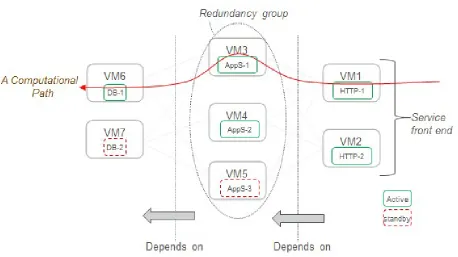
Figure 2.1: Example of an application deployment in the cloud.
• Consider various interdependencies and redundancies among application’s
compo-nents.
• Examine multiple failure scopes that might affect the component itself, its execution
environment, and its dependent components.
This chapter is organized as follows. Section 2.2 describes the cloud UML model.
Sec-tion 2.3 defines the HA-aware deployment problem and the proposed soluSec-tion. SecSec-tion 2.4
and Section 2.5 describe the simulation environment and the evaluation results of the MILP
model and CHASE. CHASE-OpenStack implementation is discussed in Section 2.6.
Fi-nally, the related work and conclusion are presented in Section 2.7 and Section 2.8.
2.2
System Modelling and Schematization
At the infrastructure as a service (IaaS) level, the cloud provider may offer a certain level of
availability for the VMs assigned to the tenants. However, this does not guarantee the HA
of the applications deployed in these VMs. For instance, Amazon EC2 has offered recently
year [8]. Moreover, the cloud provider is not responsible for the monetary losses caused
by the outage. Hence, ensuring the HA of the services becomes a joined responsibility
between the cloud provider and user. The provider should offer the VM placement that
accounts for the requirements of the tenants’ application. As for the cloud tenants, they
have to deploy their applications in an HA manner, where redundant standby components
can take over the workload when a VM or a server fails. To illustrate this point, we
con-sider the example of a multi-tier HA Web-server application consisting of three component
types: the front-end has the HTTPS servers, which handle static user requests and forward
dynamic ones to the App servers that dynamically generate HTML content. The users’
information is stored in the back-end databases (DBs). Fig. 2.1 illustrates a potential
HA-aware deployment of our application example. At the front-end, multiple active (stateless)
HTTPS servers are deployed on V M1 and V M2. They share the requests’ load in such
a way that if one fails, the other would serve its workload. Most likely, this will incur a
performance degradation. The (stateful) App server has a (2+1) redundancy model with
one standby backing up the two active ones. At the back-end, one active database serves
all the requests, and it is backed up by one standby. The functional dependency among the
different component types is clearly visible.
The notion of acomputational pathis defined as the path that a user’s request must follow through a chain of dependent components until its successful completion. For instance,
in order to process a dynamic request, at least one active HTTPS server, App server, and
database must be healthy. The components of each type are deployed in a redundant manner
forming aredundancy group. Upon failure, each component can have a different impact on the global service depending on how many active replicas it has. It is necessary to note that
the architecture of the web-application’s components (i.e. the number of tiers and the
inter-dependency between the application’s components) is defined before triggering CHASE.
The cloud can be modeled in terms of the cloud tenant’s applications and the cloud provider
infrastructure deployed in geographically distributed DCs housing various physical servers.
We believe that a HA-aware scheduling in the cloud should consider details of both the
applications and the cloud infrastructure. Therefore, the configurations of the cloud
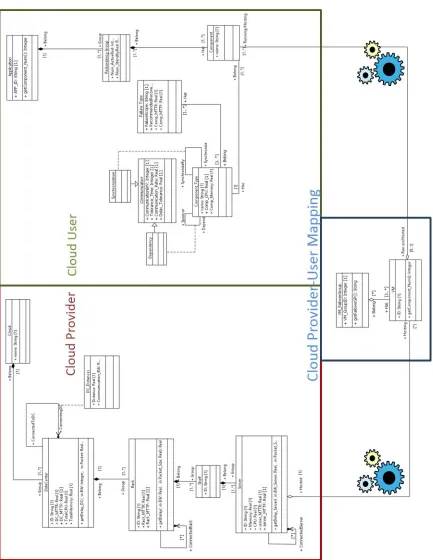
in-frastructure and applications are described in the UML class diagram shown in Fig. 2.2.
information required for scheduling the applications in cloud environment. Once the
re-lationships are extracted from the existing diagram, they are translated into a java code.
At runtime, the classes are instantiated to give the scheduler objects representing domain
classes. Then CHASE performs the scheduling based on an instance of this UML model.
It is necessary to note that different Eclipse integration plugins can be used to integrate the
UML model with the generated code and enable round-tripping engineering [9] [10].
2.2.1
Cloud infrastructure model
The proposed cloud architecture is captured in the UML class diagram. At the root level,
the cloud consists of data center networks distributed across various geographical areas.
Each data center consists of multiple racks communicating through aggregated switches.
Each rack has a set of shelves housing a large number of servers, which can have
dif-ferent capacities and failure rates. Servers residing on the same rack are connected with
each other through the same network device (the top of the rack switch). Finally, the VMs
are hosted on the servers. This tree structure determines the network delay constraints, and
consequently, the delay between the communicating applications. This architecture divides
the cloud into five different latency zones, which will be further discussed in Section 2.3.
In the proposed tree structure, each node i has its own failure rate (λ) and MTTR. The MTTF and MTTR parameters divide the intra- and inter- data center networks into
avail-ability zones. We are assuming that the availavail-ability availof the host h depends not only on itsλand MTTR, but on that of corresponding DC and rack Ras well. Thus, a request is successfully processed if the corresponding component, its host, and its parent rack and
DC are all healthy. With this in mind, the cloud infrastructure is considered a series system
[11]. In the case of failure (i.e. natural disaster as the worst case scenario) and to minimize
the number of false negatives, it is assumed that the cloud infrastructure can resume its
nor-mal activity after the execution of the repair mechanism(s) of the faulty node(s) (i.e. after
passing of the MTTR(s)). Thus, each hosth can be seen as(DC, R, S) and is associated with a weight parameter,avail. In this scenario, it is assumed that a DC repair mechanism happens gradually; first, the DC is repaired followed by the recovery of its racks and then
its corresponding servers. With this assumption, the false negatives (i.e. a node is
the highestavailis selected as a candidate placement for application’s component(s). The
availis calculated as follows:
availh= M T T Fh
M T T Fh+M T T Rh (1)
where
M T T Fh= λ 1
DC+λR+λs
M T T Rh=M T T RDC +M T T RR +M T T RS
It is necessary to note that theavailparameter is only used to differentiate between different hosts and prune the ones with the low MTTF and high MTTR values.
2.2.2
Cloud application model
Applications are typically developed using a component based architecture where each
application is made up of one or more components. The application combines its
compo-nents’ functionalities to provide a higher level of service [12] [13]. To maintain availability
requirements, each component can have one or more redundant components. The primary
component and its redundant ones are grouped into a dynamic redundancy group. In this
group, each component is assigned a specific number of active and standby redundant
com-ponents. As shown in the UML model, each redundancy group is assigned to at most one
application, which consists of at least one redundancy group.
As for the component, it belongs to one component type. A component type represents an
executable software deployment. From this perspective, the component represents a
run-ning instance of the component type. Components of the same type have the same attributes
defined in the component type class, such as computational resources (CPU and memory)
attributes.
Each component can be configured to depend on other components. The dependency
re-lation is captured at the type level and can be configured using the delay tolerance, outage
tolerance, and communication bandwidth attributes. The delay tolerance determines the
minimum required latency to maintain communication between sponsor and dependent
components. As for the outage tolerance or tolerance time, it is the time that the dependent
the relation between redundant components that need to synchronize their states.
Finally, each component type is associated with at least one failure type. The list of
fail-ure types determines the failfail-ure scope of each component type, its MTTF, MTTR, and
recommended recovery.
2.2.3
Cloud-Application integration
Each component of the application model is scheduled on a server in the cloud provider
model using VM mappings. Each VM can be hosted on one server and can have at least
one component instance running in it. Sudden failure events can occur to cloud-application
such as natural disaster, network or runtime failures [14]. In order to deal with these events,
the inoperative VMs are switched off, and a failover group takes over the control. The
failover group consists of at least one VM, which is a redundant VM of the inoperative
one.
As mentioned earlier, the proposed HA-aware scheduling technique searches for the
op-timum physical server to host the requested component. Whenever a server is scheduled,
a VM is mapped to the corresponding component and to the chosen server. Therefore, a
component can reside on that VM.
2.3
Design and Implementation
The tenant’s application is specified as a partial instance of the UML class diagram, where
the cloud tenant describes the components forming the application and their requirements.
The HA-aware scheduling technique performs a criticality analysis to start scheduling the
components with the highest priority. Then it applies a sequence of filters that starts by
sifting out the servers that do not satisfy the functional requirements and then selects the
ones that maximize the availability constraints.
The proposed technique provides an efficient and highly available allocation by satisfying
the following constraints:
1) Capacity Constraints:These are functional constraints, which are satisfied by search-ing for servers that meet the resource needs of each application. In the proposed
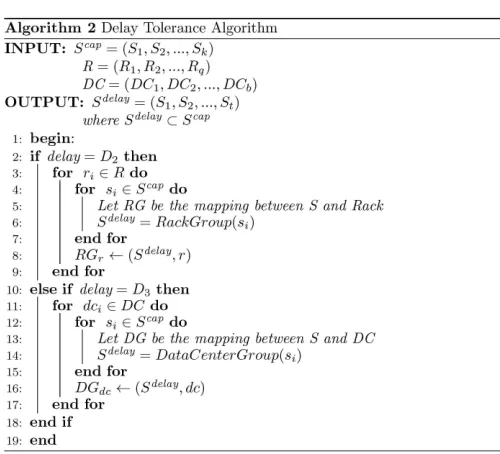
2) Network Delay Constraints: Using these constraints, another list of servers is gen-erated. These servers satisfy the latency requirements to avoid service degradation
between communicating applications. It is assumed that the delay requirements are
divided into five delay types (i.e., latency zones) as follows:
a) D0 Type: Requires that all communicating components should be hosted on the same VM and consequently on the same server.
b) D1 Type:Requires that all the communicating components should be hosted on the same server.
c) D2 Type:Requires that all the communicating components should be hosted on the same rack.
d) D3 Type:Requires that all the communicating components should be hosted on the same DC.
e) D4 Type: Requires that all the communicating components can be hosted across different data centers but must be within the same cloud.
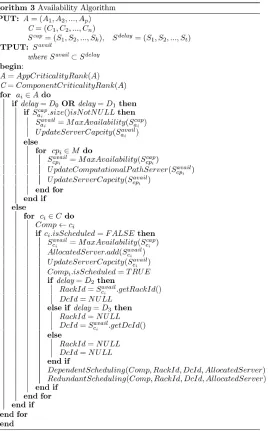
3) Availability Constraints: These constraints prune the candidate servers generated by the capacity and delay constraints to select the ones that maintain a high level
of application’s availability. In order to maximize the HA of an application, three
sub-constraints should be satisfied:
a) Failure Rate Constraint: It determines that the selected server should maxi-mize component’s availability. In order to satisfy this constraint, the model
searches for the server with maximum MTTF and minimum MTTR.
When-ever it is found, then theM T T FcAof the componentCafter being hosted can be calculated as follows:
M T T FcA = 1
λc +λh
(2)
b) Dependency Constraint: This constraint is divided into two sub-constraints:
Co-location Constraint: This is valid whenever the tolerance time of the de-pendent component is lower than the recovery time of its sponsor. When the
dependent component cannot tolerate the absence of its sponsor, then the
its failure rate, both dependent and sponsor should share same server.
Anti-location Constraint:: It requires that the dependent component and its sponsor should be placed on different servers. This is valid whenever the
tol-erance time of the dependent component is greater than the recovery time of
its sponsor. By considering this case, the MTTF of the application will be
maximized because of its inverse proportionality relation withλ.
c) Redundancy Constraint:It basically prevents redundant components of a pri-mary one from residing on the same server and requires that they should be
placed far away from each other as the delay constraints allow.
With these constraints, we develop a MILP model and CHASE that minimize components’
downtime while finding the optimal physical server to host them.
2.3.1
Criticality analysis
Performing criticality analysis to applications is a significant step in any emergency or
dis-aster recovery plan. For instance, the contingency plan in Health Insurance Portability and
Accountability Act (HIPAA) requires to “assess the relative criticality of specific
appli-cations and data...” because they are not equally critical [15]. This is also applicable in
HA-aware scheduling, where the highly critical components are given the priority to reside
on more reliable servers. In the example shown in Fig. 2.1, there is only one active instance
of the DB; therefore, its failure affects all the incoming requests. This gives the DB a higher
impact where the failure of one instance of DB server affects half the requests.
Each component has its own MTTF (failure rate) and MTTR, and therefore its failure can
cause either an outage(o)of the application or a degradation(d) of the service. LetNf ail be the failure occurrence. The criticality value of a component is the product of the
com-ponent’s unreliability and the number of occurrence of comcom-ponent’s failure [16]. The
criti-cality escalates when the failure scope of the component affects not only itself but also its