ISSN 2286-4822 www.euacademic.org
Impact Factor: 3.1 (UIF) DRJI Value: 5.9 (B+)
Multicasting in Adhoc Networks Using MAODV
Protocol
ALI MUSTAFA SAAD ZAHID
COMSATS Institute of Information Technology Attock, Pakistan
AHMED QADDUS AAMIR ALI RAZA
Bahria University, Islamabad Pakistan
Abstract:
This paper represent a MAODV (Multicast Ad-hoc On-Demand Distance Vector Protocol) as a multicast routing protocol, it is an extension of AODV which is used for unicasting only. In this research we have evaluated its performance and multicast tree information. Our results show the change in delivery ratio, delay and the overhead in the implementation of this protocol.
While implementing MAODV protocol we have used the environment of FEDORA 8 and a network simulator version NS 2.26 and at the same time it is also implemented and tested in the environment of window vista using CYGWIN.
Key words: ADHOC NETWORKS, MANETS, AODV, MAODV, MULTICASTING
1. Introduction
without and pre-existing infrastructure [1].
In wider area adhoc networks are multi-hop wireless networks and there are many issues which are still challenge and need to be solved (e.g. location management, mobility, security, integrity and etc)[1][2].There are different types of adhoc networks available according to the different ranges like BAN, PAN, LAN and WAN [1][3].
Adhoc networks are very much appealing to a big extent because of the challenge of maintaining a communication between source and destination [2]. Even in the hard condition when the intermediary node are untrustworthy in participating data in the forward route and swap by the nodes all along the other path [1,3]. So it is not easy to a keep the single source and multiple destinations for data transmission. The known significance of multicast as a mean to decrease the bandwidth utilization for mass distribution of data, and the serious need to communicate in short supply bandwidth over wireless media, it is normal that multicast routing should receive some attention for ad hoc networks [8].
Multicasting in the environments of Manets is the most challenging task because networks is the collection of dynamic nodes which are rapidly changing their position and the same time keep changing their topologies[2].We can say topologies are temporary in it and the nodes are connected with each other through a very unreliable low bandwidth links[3].
The meaning of reliability varies application to application but when we are talking about mobile adhoc networks then we means all data packets are delivered[2,3].the sending order of the data packets are maintained and the goal of achieving total number of data packet is achieved[3].
disconnected from the network for unpredictable slice of time[4]. The only thing on which we can concentrate in Manets to achieve reliability is the maximum packet delivery ratio [3,4].
As I explained above that reliable multicasting is a big challenge in mobile adhoc networks because of the dynamic characteristic of the network only structuring a multicast distribution wouldn’t be enough for achieving the desired results and output[5].we need to adopt a alternative path with it which includes the Broadcasting and Dedicated unicast communication for the network[5,6].
The multicast protocols make paths to other hosts on demand. This idea is based on a query-response mechanism same to reactive unicast routing protocols. In the query phase, a node explores the whole environment [4]. Once the query reaches to its destination, the response phase is entered and establishes the path for the multicasting [3].
There comes two structures of multicasting ,the tree based multicasting and mesh based multicasting ,the previous studies and research showed that mesh implementation is much better than the tree structure in generating the results[3][4].
in performance evolution but on the other hands there are many other factors which make mesh structure much complex to implement like to manage the mesh structure of nodes, nodes mobility, time out for unpredictable time, structure less and etc[6].In my research I find that maximum PDR is a challenging task in Manets but my research and simulation improve the performance of tree based structure by using the broadcast of data and by varying the number of senders and the receivers [5].it is very difficult to evaluate the exact number of packets received by receiver and how many packets are lost[5,6].
2. Simulation Environment
Parameters Set in Implementation of MAODV: Number of Nodes: Nodes varies from 20 to 50.
Simulation Area: Area Varies from 300*150 to 1500*300 Number of Scenarios: 7
Simulation Time: 300 to 900 Seconds
Node movement Speed: 0 m/s, 1 m/s and 20 m/s. Packet Size: 256
Traffic: 1, 5, 10, 20 and 50 Kbytes/sec. Antenna Range: 100, 150, 200, 250, 500 m
2.1. Scenarios and CBR:
There are total 7 scenarios which we tested in the implementation of MAODV and set the following parameters in it
Nodes = 20 to 50 Pause Time = 0.00 Max speed = 1.00 to 2.00 Max x = 300.00 to 1500.00 Max y = 150.00 to 300.00
And about the CBR I have made twenty different combinations by varying number of sender and receiver.
For example
1 sender --- 20 receivers 2 senders --- 40 receivers 5 senders --- 10 receivers ---
10 senders --- 30 receivers
My simulation atmosphere consists of 50 mobile nodes wandering in a 1500 meters x 300 meters space for 300 seconds of imitation time. The radio communication range is 250 meters. Scenario files are used to determine which nodes are act as receivers or sources and decide when they join or leave a group. In the beginning of the simulation a multicast member node joins the multicast group (approx first 30 seconds) and remains as a member till the whole simulation. Multicast sources start and stop sending packets in the same fashion but using dissimilar arbitrarily generated mobility scenarios. I use only one multicast group for the entire experiments.
Every mobile node moves arbitrarily at a fixed average speed according to a “random waypoint model”. Each node begins its movement from an arbitrary location to a arbitrary destination with a randomly selected speed. When the target is reached, a different random destination is targeted after a break. If we change the pause time it way effect the relative speeds of the mobile nodes. In our experiments we set the pause time to zero to make a harsher mobility situation.
To investigate the protocol MAODV, we perform couples of experiments to discover the performance and behavior of MAODV with changing in different parameters: node mobility, number of senders and receivers, multicast group size and etc etc.
2.2. Number of Senders
I changed the number of sender in the multicast group to examine the protocol scalability to source nodes and the effect results in traffic load. MAODV, maintain just one group leader for the multicast group that send periodic Group Hellos in the network. In this way, it is extra scalable.
3. Results & Simulation
Simulation of MAODV:
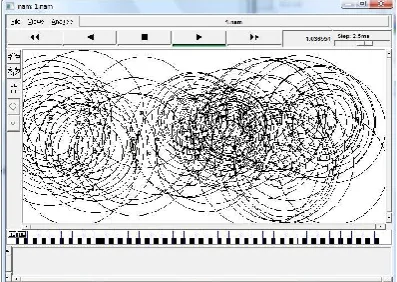
Figure 1 is a simulation representation of MAODV with scenario number and total number of sender and receiver.
Figure 1: Simulation of Scenario 1 in cygwin
In the above diagram it is clearly visible that total numbers of senders are 10 nodes and total receiving nodes are 30 and at that time scenario 1 is running and generating simulation results in trace file. Similarly every scenario run in the same manner and generates its trace file which is further converted in to graph to analyze the behavior of every node at different instant of time.
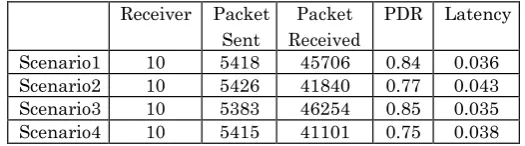
After simulating the MAODV multiple scripts and scenarios we get the results in table 1.Which clearly shows the packet delivery ratio & latency. Also it gives us information about the total number of send and receives data packets to the destination.
Receiver Packet Sent
Packet Received
PDR Latency
Scenario1 10 5418 45706 0.84 0.036
Scenario2 10 5426 41840 0.77 0.043
Scenario3 10 5383 46254 0.85 0.035
Scenario5 10 5410 39084 0.72 0.033
Scenario6 10 5425 44718 0.82 0.040
Scenario7 10 5429 32622 0.60 0.030
Table 1: Final results of MAODV simulation.
In these scenarios, I evaluate the performance of MAODV for different traffic: 1, 5, 10, 20 and 50 Kbytes/sec. I calculate the PDR (Packet Delivery Ratio) and the Latency for it. PDR is the ratio of the number of packets sent to the number of packets received and shows the consistency of the protocol. Latency is the measure of average end-to-end packet delay.
3.1 NAM Presentation of MAODV:
Figure 2: Heavy traffic passing in a MAODV amongst the nodes
Figure 3: Medium traffic flowing in MAODV multicasting
Figure 4: Light Traffic in the multicast network
3.2 Graphical Representation of Different
Parameters in MAODV
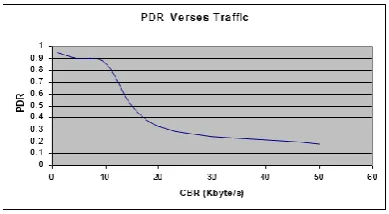
Fig. 5 shows the rigorous PDR downfall as the traffic increases in MAODV.
When the packets keep on generating at some stage the packet delivery ratio become declining. As the time goes the amount of the data packets is keep on increasing which creates the bottleneck in network which is the big problem in the Manets environment.
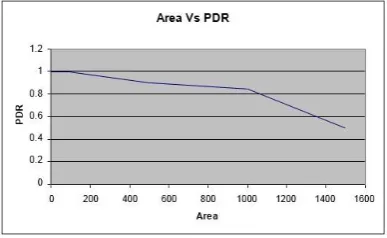
Figure 6: Area vs. PDR
Fig. 6 shows that the PDR of MAODV is healthier for small areas up to 1000.
As the node in the mobile adhoc network is moving from on place to another in highly dynamic manner. The distance among the nodes in increases which take longer time to reach the packets to the destination .therefore most of nodes experience lower packet delivery ratio that is “number of packets that received on destination.
Fig. 7 shows that the PDR of MAODV is improved for node pace up to 10m/sec.
Speed play very vital role in Manets that is why we call Manets as dynamic networks. as the nodes is moving in very high speed with respect to another node, eventually the distance between the node increase in a drastically manner. therefore most of nodes experience lower packet delivery ratio that is “number of packets that received on destination”.this concept follow the well know relation s=vt. Where s is the distance, v is the velocity and t is time.
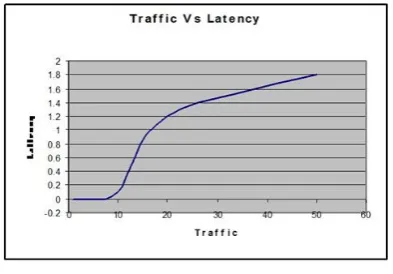
Figure 8: Traffic vs. Latency
Fig. 8 indicates that MAODV protocol has tremendously small latency for traffic up to 10 Kbytes/sec and then for heavier traffic MAODV outperforms.
As the traffic increases the nodes experience the delay because wireless is shared medium. It supports well up to some extent because every device (node) get separate channel. after every channel allocate to every devices that if the new nodes want to send information to another node it will wait until any of the channel will release therefore the delay in communication is produced .the above graph depicts the same scenario which is implemented in the same environment motion above.
is mostly far above the ground under low mobility for only some (1 or 2 senders), consequential in PDRs of approximately 98% and latencies of a hardly any tens of milliseconds. By exploring the trace files in further detail, I come to know that the sole shared tree, with all the operation to keep its hard state, become the log jam and a bottle neck in our all high mobility scenario and for a big amount of multicast sender.
By observing at the network effectiveness, scenarios with comparatively few multicast receivers produce more overhead than scenarios with various multicast receivers, so the charge of structuring and maintaining the multicast tree is amortized over an amplified quantity of packets delivery. Though by using only one shared multicast tree being built and maintained, the overhead grows comparatively slow as we increase the amount of multicast senders.
4. Conclusion
result shows that tree- based on-demand protocol like MAODV lakes in availability of multiple paths
After examining and concluding the experimental results of implementation of different scenarios of MAODV I find that it perform better than any other protocol for the traffic over 10KB/sec.
While talking about the simulation area size MAODV achieved better PDR for the smaller area but if the area size increases it effect the PDR ratio and some time it drops the ratio but in mean while it achieves the best time delay and latency.
4.1. Future Work
We can improve the performance of MAODV by different ways like its tree based on a hard structure, require explicit control messages for the maintenance purposes, all data is flowing through a shared tree and have only a single path for unicasting by the destination, so if we overcome the above mentioned two issues, hard structure and a shared tree it will amongst one of the best ever protocol for multicasting because of its simplicity, easy implementation and reliability of data sending.
BIBLIOGRAPHY:
Chandra, Ranveer, Venugopalan Ramas Ubramanian, Kenneth P. Birman. Anonymous Gossip: Improving Multicast
Reliability in Mobile Ad-Hoc Networks, 2. [4]
Ilyas, M. The hand book of Adhoc wireless networks. CRC Press, 1-3. [1]
Kunz, Thomas. Reliable multicasting in Adhoc networks, 26-27. [3]
_______. http://kunz-pc.sce.carleton.ca/thesis/maodv- ns-2.26.pdf.[5]
Perkins, Charles E. Ad hoc Networking. Addison-Wesley Press, p. 8 . [8]
Vasiliou, Alexandros and Anastasios A. Economides. 2005. “Evaluation of Multicasting Algorithms in Manets.”
Proceedings of World Academy of Science,
Engineering and Technology. 5: 1. [7]
Zhu, Yufang and Thomas Kunz. 2004. “MAODV