Driver Eye Tracking Over Iot
G.Sangeetha & M.Ravi
1. M. Tech Scholar, Department of Electronics and Communication Engineering, sudheer reddy college of engineering & technology for women
2. Associate Professor, Department of electronic communication engineering, sudheer reddy college of engineering & technology for women
Abstract— Naturalistic driving studies have shown that a driver’s allocation of visual attention away from the road is a critical indicator of accident risk. Such work would suggest that a real-time estimation of driver’s gaze could be coupled with an alerting system to enhance safety when the driver is overly distracted or inattentive High precision eye tracking that includes an estimate of pupil orientation in the vehicle is costly and difficult. From an image processing perspective alone, difficulties involve the unpredictability of the environment, presence of sunglasses occluding the eye, rapid changes in ambient lighting including situations of extreme glare resulting from reflection, partial occlusion of the pupil due to squinting, vehicle vibration, image blur, poor video resolution etc. For example, in, a state-of-the-art algorithm for detecting pupils in the presence of specula reflection achieves only 83% accuracy. In, an accuracy of 87% is achieved for a camera that is positioned off-axis, as it likely may need to be located inside a vehicle. Costs of high resolution recording equipment and other computational requirements further enhance the difficulty of developing practical, deployable solutions. Since pupil detection for eye tracking is often unreliable in real world conditions, the natural question we ask is: how well can we do without it? This is the question that motivated our efforts and makes this work distinct from a large body of literature on gaze estimation. We do not assume that the head pose vector is the same as the gaze vector (i.e., eye pose plus head pose).Most of the automobile accidents are caused by distracted driving. Passively monitoring driver’s eyes can help in detecting state of mind and alertness of driver and thus can reduce risk of accidents. Proposed system includes three main parts 1) Arduino Uno 2) USB web based camera 3) Eyes off the road and fatigue detection
Keywords: Eye gaze tracking, automobile safety, driver monitoring system, head pose estimation, arduino,wifi.
1.1 INTRODUCTION
Naturalistic driving investigations have demonstrated that a driver's portion of visual consideration far from the street is a basic pointer of mishap hazard. Such work would propose that a constant estimation of driver's look could be combined with an alarming framework to improve wellbeing when the driver is excessively diverted or preoccupied
High accuracy eye following that
incorporates a gauge of understudy introduction in
the vehicle is exorbitant and troublesome. From a picture handling point of view alone, challenges include the flightiness of nature, nearness of shades impeding the eye, quick changes in encompassing lighting including circumstances of extraordinary glare coming about because of reflection, fractional impediment of the student because of squinting, vehicle vibration, picture obscure, poor video determination and so forth. For instance, in, a cutting edge calculation for identifying understudies within the sight of specula reflection accomplishes just 83% precision. In, a precision of 87% is accomplished for a camera that is situated off-hub, maybe as it likely ought to be situated inside a vehicle. Expenses of high determination recording hardware and other computational prerequisites additionally improve the trouble of creating
reasonable, deployable arrangements. Since
understudy identification for eye following is regularly problematic in certifiable conditions, the normal inquiry we ask is: how well would we be able to manage without it? This is the issue that persuaded our endeavors and makes this work unmistakable from a vast assortment of writing on look estimation. We don't expect that the head act vector is a similar like the look vector (i.e., eye posture in addition to head posture).
PROBLEM STATEMENT
The fundamental point of eye stare
Diversion is specified as fundamental driver in 78% of accidents and 65% of close crashes in NHTSA (National Highway Traffic Safety Administration) think about (2013).Distraction is a main consideration in over 20% of all mishaps including fatalities and genuine wounds
1.2 PROJECT OBJECTIVE
The vast majority of the car crashes are
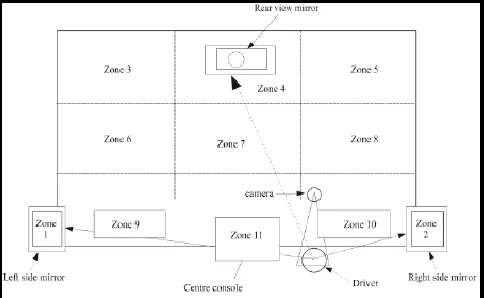
caused by diverted driving. Inactively observing driver's eyes can help in recognizing perspective and sharpness of driver and along these lines can lessen danger of mishaps. Proposed framework incorporates three fundamental parts 1) Arduino Uno 2) USB online camera 3) Eyes off the street and weariness discovery. Camera introduced on auto dashboard tracks components of driver continuously. Camera interfacing done trough matlab programming and eye stare estimation. Calculation is actualized on Arduino uno board to make a minimal implanted framework. Distinctive zones are characterized which incorporates the side mirrors, the back view reflect, the instrument board, and diverse zones in the windshield as focuses few of which are eyes off the street focuses. In light of calculation yield if driver's eyes are off the street or eyes are shut because of exhaustion at that point as needs be message and bell notices are given to driver over IOT..
If any other features like head pose estimation is combined with eye gaze tracking can give better accuracy than eye gaze tracking alone especially in cases where spectacles and sunglasses are used by driver [3]. The detection of driver distraction mostly depends on the classification technique [2]. Support Vector Machine (SVM) classifier is widely used for gaze estimation. One or more features are used to design SVM. Real time Hidden Markov Models (HMMs) are also used in some approaches. But SVM are more common and accurate with average accuracy of 82%.
B. Eye gaze tracking methods
The concept of eye-gaze tracking and estimation is hot research topic in last few years. Eye-gaze tracking methods can be categorized into two approaches.
Appearance based model: It use the position of the pupils and general shape of the eyes and relative to the eye corners for finding the point of gaze [8]. A pre-trained model of the appearance and shape of the eye region is fitted to a sequence of image frames. Feature based model: These methods use
characteristics of the eye to identify a set of features like contours, eye corners of NIR illuminators (LEDs) [7]. They can be further divided into model-based methods and regression based. The eye-model-based techniques use the geometrical model of the eye along with NIR light sources. In regression based method, vector between the pupil center and corneal reflections is mapped and tracked geometrically with a polynomial regression function to find gaze coordinates on a virtual screen.
C. Head pose estimation methods
The methods for head orientation can be categorized into four categories [9].
Methods based on shape features with eye position: These methods analyze the geometric arrangement of facial features to determine the head orientation e.g. AAM (Active appearance model) [8].
face such as nose, eyes, and face contour. Thus this method is simpler [6].
Methods based on texture features: These methods identify driver’s face in the image and analyzes intensity pattern to determine the head orientation. Many learning techniques such as KPCA, PCA, LDA, and kernel discriminate analysis (KDA) are used to extract texture features. These features are then classified to obtain head orientation [11].
Methods based on hybrid features: These methods based on hybrid features combine texture and shape features to determine the head orientation. Initial head orientation is determined using texture based features and detailed head orientation is found by using 3-D face model tracking and fitting [6]. III. SYSTEM DESCRIPTION
REQUIRED COMPONENTS
HARDWARE TOOLS 1. Arduino Uno Controller 2. Power Supply
3. Lcd Display 4. Alarms (Buzzer)
5. Usb Web Camera 6. Esp8266 (Wifi Module)
SOFTWARE REQUIREMENTS
1. ARDUINO IDE SOFTWARE 2. EMBEDDED CPP
3. MATLAB
C. Facial feature tracking
D. Eye gaze tracking and estimation
Driver eye gaze is constantly changing during driving depending on surrounding conditions. Thus detecting eyes is not sufficient. Eyes need to be tracked in real time. Continuously Adaptive Mean Shift (CAMSHIFT) algorithm is used for real time eye tracking. Pupils of the eyes are tracked.
E. Head pose estimation
Drivers tend to change their head pose while driving. 3D head pose estimation is required to recognize in which direction driver is looking. 3D Head pose is estimation is proposed by combining Active Appearance Models (AAM) and Pose from Orthography and Scaling with ITerations (POSIT). Out of the three Euler angles only yaw and pitch angles are extracted and used and not roll angle. Yaw and pitch angles are sufficient to detect head pose direction.
F. Eyes off the road detection and fatigue detection Similar to concept used in [3] [6] [9], Different zones are defined in the car as shown in fig.3. Zones are defined in point of view of a driver with left hand drive system. 11 different gaze zones representing the dashboard, the centre console, the rear-view mirror, two side mirrors and six zones on the windshield. These defined zones cover most of the possible gaze directions involved in real-world driving.
TABLE II Shows different on the road and off the road points. Driver’s gaze direction lies in which area depends on the combination of eye gaze estimation and head pose estimation calculations. SVM Classifier is defined for different combinations of eye and head pose directions. Then it is decided whether driver gaze lies in off the road and accordingly alerts are generated.
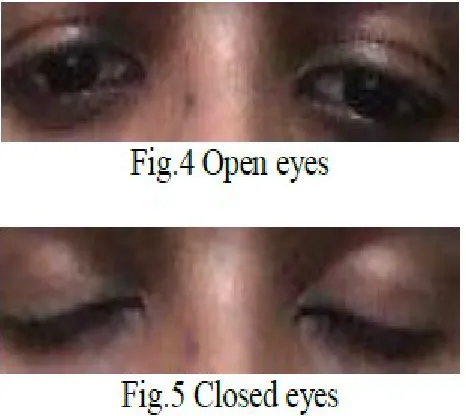
defined. But there are several relations. There is a relation eye movement, eye closure and fatigue. Eye movement is used to detect drowsiness i.e. fatigue. If closed eyes are detected longer than 3 seconds then driver is supposed to be in drowsy state and wake up alert is generated.
IV. RESULTS AND DISCUSSIONS
A. Facial feature tracking and fatigue detection OpenCV allows user to select us region of interest (ROI). In this region of interest is eye region. Eyes are detected with a rectangular box. System is also able to detect eyes when wearing spectacles. Open and close eyes are detected by system. Images shown are the rectangular extraction of the eye area from face.
Fig 6 shows the open eyes are detected. Both left and right eyes are detected with their x and y coordinate positions. Also for straight view face its showing correct head position.
B. Face detection and Eye tracking
Face detection and eye detection can be observed in fig 8
Eye pupil tracking is shown by blue circles and face is shown by a yellow square.
The principle objective of this proposed display is to distinguish the driver eye status while driving by utilizing
USB web camera trough IOT. This model continually checking or following the driver eye status and in the event that he close the eyes the model gives alarm through ringer and furthermore it show message and LCD. Camera introduced on auto dashboard tracks elements of driver progressively. Camera interfacing done trough matlab programming and eye stare estimation. Calculation is actualized on Arduino uno board to make a smaller inserted framework. Diverse zones are characterized which incorporates the side mirrors, the back view reflect, the instrument board, and distinctive zones in the windshield as focuses few of which are eyes off the street focuses. In light of calculation yield if driver's eyes are off the street or eyes are shut because of weakness at that point in like manner message and ringer notices are given to driver over IOT.
REFERENCES
[1] Gregory A. Maltz , “Eye gaze user interface and caliberation method,” US patent 20140049452, Feb 20, 2014.
[2] Y. Liao; S. E. Li; W. Wang; Y. Wang; G. Li; B. Cheng, "Detection of Driver Cognitive Distraction: A Comparison Study of Stop-Controlled Intersection and Speed-Limited Highway," in IEEE Transactions on Intelligent Transportation Systems , vol.PP, no.99, pp.1-10`, Jan 2016.
[3] F. Vicente, Z. Huang, X. Xiong, F. De la Torre, W. Zhang and D. Levi, "Driver Gaze Tracking and Eyes Off the Road Detection System," in IEEE Transactions on Intelligent Transportation Systems, vol. 16, no. 4, pp. 2014-2027, Aug. 2015.
[4] O. Stan, L. Miclea and A. Centea, "Eye-Gaze Tracking Method Driven by Raspberry PI Applicable in Automotive Traffic Safety," Artificial Intelligence, Modelling and Simulation (AIMS), 2014 2nd International Conference on, Madrid, 2014, pp. 126-130, Nov 2014.
[5] Dasgupta, Anjith George, S. L. Happy, and Aurobinda Routray, “A Vision-Based System for Monitoring the Loss of Attention in Automotive
Drivers,” IEEE Transactions on Intelligent
Transportation Systems, vol. 14, no. 4, pp.1825-1838, December 2013.
[6] Xianping Fu, Xiao Guan, Eli Peli, Hongbo Liu, and Gang Luo “Automatic Calibration Method for Driver’s Head Orientation in Natural Driving Environment”, IEEE Transactions on Intelligent Transportation Systems, vol. 14, no. 1, pp.303-312 March 2013.
[7] S. Bazrafkan, A. Kar and C. Costache, "Eye Gaze for Consumer Electronics: Controlling and commanding intelligent systems.," in IEEE Consumer Electronics Magazine, vol. 4, no. 4, pp. 65-71, Oct. 2015.
[8] F. Lu, T. Okabe, Y. Sugano, and Y. Sato, “Learning gaze biases with head motion for head pose-free gaze estimation,” Image Vis. Comput ., vol. 32, no. 3, pp. 169–179, 2014.
[9] S. J. Lee, J. Jo, H. G. Jung, K. R. Park and J. Kim, "Real-Time Gaze Estimator Based on Driver's Head Orientation for Forward Collision Warning System," in IEEE Transactions on Intelligent Transportation Systems, vol. 12, no. 1, pp. 254-267, March 2011 [10] Mohamad S, Muhammad.P., Mohsen.S., Mahmood F., “A Review on Driver Face Monitoring Systems for Fatigue and Distraction Detection”, International Journal of Advanced Science and Technology Vol.64 (2014), pp.73-100.