• No results found

A Comparative Study to Assess the Knowledge Regarding Postnatal Care among Primiparous And Multiparous Mothers At Postnatal Ward Of Smgs Hospital, Jammu (J&K)

N/A
N/A
Protected

Academic year: 2020

Share "A Comparative Study to Assess the Knowledge Regarding Postnatal Care among Primiparous And Multiparous Mothers At Postnatal Ward Of Smgs Hospital, Jammu (J&K)"

Copied!
10
0
0

Loading.... (view fulltext now)

Full text

(1)

International Journal of Research

Available at https://edupediapublications.org/journals

p-ISSN: 2348-795X Volume 04 Issue-17

December 2017

A Comparative Study to Assess the Knowledge Regarding

Postnatal Care among Primiparous And Multiparous Mothers At

Postnatal Ward Of Smgs Hospital, Jammu (J&K)

Jyoti Kapoor& Dr. Rita

*M. Sc Nursing (Obstetrics & Gynaecological Nursing) Govt. Medical College, Bakshi Nagar, Jammu Jammu &Kashmir (India)

**M.B.B.S, MS, Lecturer Department of Gynecology/Obstetrics, SMGS Hospital, Jammu (J&K) Email: [email protected]

Abstract:

Postnatal care is one of the most important physical and maternal health care for not only prevention of impairment and disabilities but also for reduction in maternal mortality. Lack of knowledge regarding postnatal care may lead the mother to wide range of postpartum problems. Present study was under taken to assess knowledge regarding postnatal care among primiparous and multiparous mothers at postnatal ward of SMGS Hospital, Jammu (J&K).The sample consisted of 60 mothers, 30 were primiparous and 30 were multiparous. Convenient sampling technique was used to select the sample. Socio-demographic profile and Structured knowledge questionnaire was used to collect data from the subjects. The results of the study revealed that there was significant difference between knowledge score regarding postnatal care in primiparous and multiparous mothers. The association of knowledge score regarding postnatal care with selected socio-demographic variables showed that only source of information had significant association with knowledge score of primiparous mothers. There was no significant association between knowledge score of multi-parous women with the selected socio-demographic variables.

Key Words: Postnatal care, Knowledge,

Primiparous, Multiparous.

1.

Introduction:

Mother and children represent more than half of the total population in our country. Delivery of a new baby is one of the happiest times in one women’s life. But it is also presents both physical and emotional challenges. Motherhood is a joy full stage as she is the only one capable to bring forth the new life.1

Postnatal period is the time just after delivery and through the first six weeks of life and the period is called puerperium. Puerperium is period following childbirth during which body tissues, specially the pelvic organs revert back approximately to the pre-pregnant state both anatomically and physiologically.2 The immediate postpartum period most often occur in the hospital setting, where the majority of women remain for approximately 2 days after a vaginal delivery and 3-5 days after a cesarean delivery. The period is used to make sure the mother is stable and to educate her in the care of her baby especially the first time mother.3

(2)

International Journal of Research

Available at https://edupediapublications.org/journals

p-ISSN: 2348-795X Volume 04 Issue-17

December 2017

categorized to different categories such as external, internal and mental care. For a new mother, she has to make sure the takes good care of herself in these three aspects in order to avoid postnatal complications.4

Postnatal care is defined as the systematic examination of the mother and the baby and appropriate advice given to the mother during post-partum period. It is done at least twice during puerperium.5 Lack of knowledge regarding postnatal care may lead the mother to wide range of post-partum problems, common problems experienced by the mothers include post-partum infections, including uterine, bladder, or kidney infections, excessive bleeding after delivery, pain in the incision area, vaginal discharge, breast problems such as swollen breasts, infection and clogged dust, marks, hemorrhoids and constipation, urinary or fecal incontinence, depression.6

In order to prevent all these problems, prompt postnatal care is very essential after the delivery of the baby till the six week. During this period the care is essential not only for the mother but also for the child. The general postnatal home based care include provision of adequate rest and ambulance, diet, sleep, care of the breast, importance of postnatal exercise, family planning advice and guidance, importance postnatal check up for the mother and adequate breastfeeding and newborn care.7

Postnatal care is necessary to ensure that no complication have developed to the women after child birth. It is important that mother and their partners are informed of what normally happens during this period, and that make can compromise the health of the mother or the newborn. Post-partum maternal health care influences the health of both mother and their children. Postnatal care includes various

components like Breastfeeding, Newborn care, Family planning, Post-natal complications and Post-natal diet etc.8

Objectives of the study

1. To assess the knowledge regarding postnatal care among primiparous mothers.

2. To assess the knowledge regarding postnatal care among multiparous mothers.

3. To compare the knowledge score regarding postnatal care among primiparous and multiparous mothers.

4. To determine the association of knowledge score with selected socio-demographic variables.

2. Methodology

For the present study, Quantitative research approach and Comparative Survey design was used. The research setting was postnatal ward of SMGS hospital, Jammu (J&K). The sample consisted of 60 postnatal mothers comprises of 30 primiparous and 30 multiparous mothers. Convenient sampling

technique was used to select the sample. Prior to the data collection procedure the formal permission was obtained from the Superintendent of the hospital.

(3)

International Journal of Research

Available at https://edupediapublications.org/journals

p-ISSN: 2348-795X Volume 04 Issue-17

December 2017

was taken from the subjects. The data gathered was analyzed and calculated by percentage, mean and standard deviation.

Description of tool:

Part A: socio-demographic variables - It includes items like age (in yrs), education, occupation, religion, dietary habit, type of family, family income, source of information.

Part B: self structured knowledge questionnaire to assess the knowledge regarding postnatal care. It consists of 44

items which include the questionnaire on selected components of postnatal care with score 1 for correct answer and 0 for wrong answer.

Level of knowledge Score

Inadequate Below 50%

Moderate 50 -75%

Adequate Above

75%

3.Results

Table 1- Frequency and percentage distribution of socio-demographic variables of primiparous and multiparous mothers

N=60

Sr. no.

Socio-demographic Variable

Primiparous mothers

(N=30) Multiparous mothers (N=30) Frequency

(f)

Percentage (%)

Frequency (f)

Percentage (%)

1. Age (in yrs)

a) 20-23 b) 24-27 c) 28- 31 d) >-31

7 21 2 0

23.3 70 67 0

5 13 9 3

16.6 43.3 30 10 2. Education

a) Illiterate b) Primary c) Secondary d) Graduate e) Post graduate

7 3 12 5 3

23.3 10 40 16.7 10

2 2 10 14 2

6.6 6.6 33.3 13.3 6.6 3. Occupation

a) Housewife b) Laborer c) Private job d) Govt. job

26 0 3 1

86.7 0 10 3.3

24 2 3 1

(4)

Available at https://edupediapublications.org/journals

p-ISSN: 2348-795X Volume 04 Issue-17

December 2017

4. Religion

a) Sikh b) Hindu c) Muslim d)Christian

29 1 0 0

96.7 3.3 0 0

23 5 1 1

76.6 16.6 3.3 3.3 5. Dietary habit

a) Vegetarian b) Non-vegetarian

22 8

73.3 26.7

18 12

60 40 6. Type of family

a) Joint family b) Nuclear

16 14

53.5 46.7

20 10

66.6 33.3 7. Family income

per month(in Rs.) a) < 5000

b) 5001- 10,000 c) 10,001- 15,000 d) > 15,000

11 12 2 4

36.7 4.0 6.7 13.3

13 10 5 2

43.3 33.3 16.6 6.6 8. Sourceof

information

a) T.V, Newspaper b) Family, friends c) Nurse

d) Doctor

20 5 4 1

66.7 16.7 13.3 3.3

19 4 4 3

63.3 13.3 13.3 10

Table 1 reveals socio-demographic variables of the primi-parous and multi-parous women. In context to primiparous mothers, maximum were in age group of 24-27 were educated up to

secondary, housewives from Sikh

religion. Maximum primiparous mothers were vegetarian and from joint family, having family income between 5001-10,000 and source of information was TV, Newspaper.

In context to multiparous mothers, maximum were in age group of 24-27 were graduates, housewives and belonged to Sikh religion. Maximum multiparous were vegetarians, also from joint family having income between 5001-10,000 and TV/ newspapers were source of income.

Table 2- Frequency and percentage distribution of level of knowledge of primiparous mothers regarding postnatal care

N=30

Sr. No Level of knowledge Frequency (f)

Percentage (%)

Mean SD

1. Inadequate (> 50%) 28 93.33

2. Moderate (50-75%) 2 6.66 16.73 3.7

(5)

Available at https://edupediapublications.org/journals

p-ISSN: 2348-795X Volume 04 Issue-17

December 2017

Table 2 reveals the level of knowledge of primiparous mothers regarding postnatal care that shows maximum mothers 28(93.33%) had inadequate knowledge, 2(66.6%) moderate knowledge regarding postnatal care. The

average mean for the level of knowledge of primiparous women was 16.73 and S.D. was 3.7 regarding postnatal care.

Hence, primiparous mothers had inadequate knowledge regarding postnatal care.

Table 3- Frequency and percentage distribution of level of knowledge of multiparous mothers regarding postnatal care

N=30

Sr. no Level of knowledge Frequency (f)

Percentage (%)

Mean SD

1. Inadequate (>50%) 23 76.6

2. Moderate (50-75%) 7 23.3 16.8 4.56

3. Adequate (>75%) 0 0

Table 3 reveals the level of knowledge of multiparous mothers regarding postnatal care that shows maximum 23(76.6%) multiparous mothers had inadequate knowledge, 7(23.3%) had moderate knowledge regarding postnatal

care. The average mean for the level of knowledge of multi-parous women was 16.8 and S.D. was 4.56 regarding postnatal care.

Hence, multi parous mothers had inadequate knowledge regarding postnatal care.

Table 4 Mean percentage distribution of primiparous and multiparous mothers regarding components of postnatal care.

N=60

Sr. no Components of postnatal Care

Primiparous (n=30) Percentage (%)

Multiparous (n=30) Percentage (%)

1. Breastfeeding 40 20

2. Newborn care 40.7 39.25

3. Postnatal complications 31.85 28.14

4. Family planning 30 28.75

5. Postnatal diet 35 36.25

Table 4 reveals the area-wise mean percentage of primiparous and multiparous mothers regarding various components of postnatal care. In primiparous mothers area-wise mean

(6)

Available at https://edupediapublications.org/journals

p-ISSN: 2348-795X Volume 04 Issue-17

December 2017

area of postnatal complications, (30%) in the area of family planning.

In multiparous women area-wise mean percentage was (39.25%) in the area of newborn

care, (36.25%) in the area of postnatal diet, (28.75%) in the area of family planning, (28.14%) in the area of postnatal complications, (20%) in the area of breastfeeding.

Table 5- Comparison of level of knowledge of primiparous and multiparous mothers regarding postnatal care

N=60

Sr. No

Postnatal mothers Mean SD t-value df

1. Primiparous 16.73 3.7 -0.06 58

2. Multiparous 16.8 4.56

Table 5 reveals comparison of level of knowledge of primiparous and multiparous mothers regarding postnatal care. Unpaired t- test was applied to check the statistical significance. In primi-parous women knowledge score mean & S.D was 16.73 ± 3.7 and in multi-parous women knowledge score mean & S.D

was 16.8 ± 4.56. The obtained ‘t’ value was -0.06. So tabulated ‘t’ value was more than calculated ‘t’ value (p<0.05). H0 is rejected and

the alternative hypothesis is accepted.

Hence, it is concluded that there was significant difference in knowledge score of primiparous and multiparous mothers.

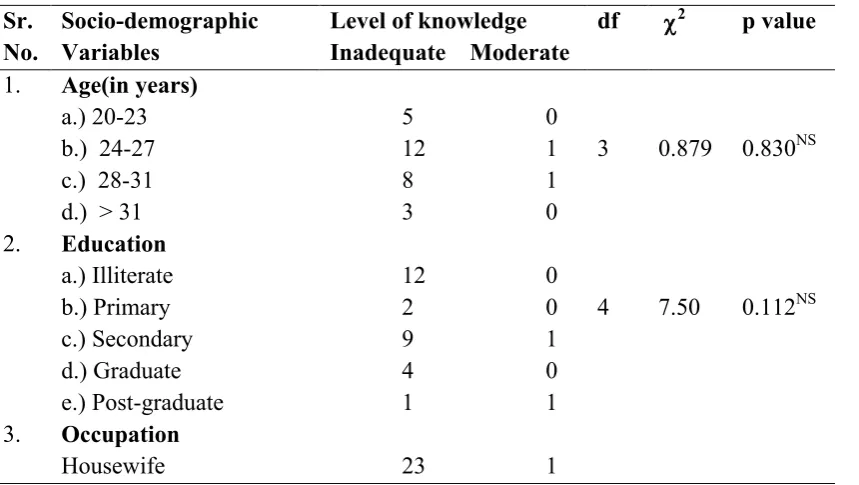
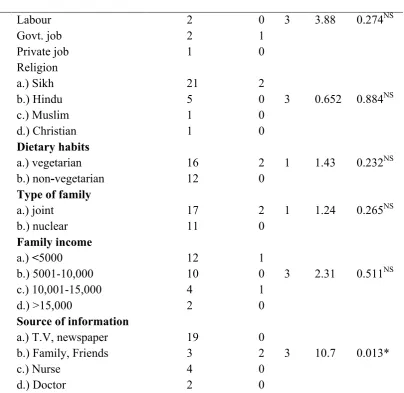
Table 6 - Association of knowledge score of primiparous mothers with selected socio-demographic variables

N=30 Sr.

No.

Socio-demographic Variables

Level of knowledge Inadequate Moderate

df 2 p value

1. Age(in years)

a.) 20-23 b.) 24-27 c.) 28-31 d.) > 31

5 0

12 1

8 1

3 0

3 0.879 0.830NS

2. Education

a.) Illiterate b.) Primary c.) Secondary d.) Graduate e.) Post-graduate

12 0

2 0

9 1

4 0

1 1

4 7.50 0.112NS

3. Occupation

(7)

Available at https://edupediapublications.org/journals

p-ISSN: 2348-795X Volume 04 Issue-17

December 2017

Labour Govt. job Private job

2 0

2 1

1 0

3 3.88 0.274NS

4. Religion a.) Sikh b.) Hindu c.) Muslim d.) Christian

21 2

5 0

1 0

1 0

3 0.652 0.884NS

5. Dietary habits

a.) vegetarian b.) non-vegetarian

16 2

12 0

1 1.43 0.232NS

6. Type of family

a.)joint b.) nuclear

17 2

11 0

1 1.24 0.265NS

7. Family income

a.) <5000 b.) 5001-10,000 c.) 10,001-15,000 d.) >15,000

12 1

10 0

4 1

2 0

3 2.31 0.511NS

8. Source of information

a.) T.V, newspaper b.) Family, Friends c.) Nurse

d.)Doctor

19 0

3 2

4 0

2 0

3 10.7 0.013*

*Significant at p<0.05, NS= Non-significant Table 6 reveals the association of knowledge score regarding postnatal care with selected socio-demographic variables. Chi square test was applied and the test revealed that source of information have significant association with

knowledge score of primiparous mothers regarding postnatal care and there is no significant association between knowledge score of primiparous women with other socio-demographic variables.

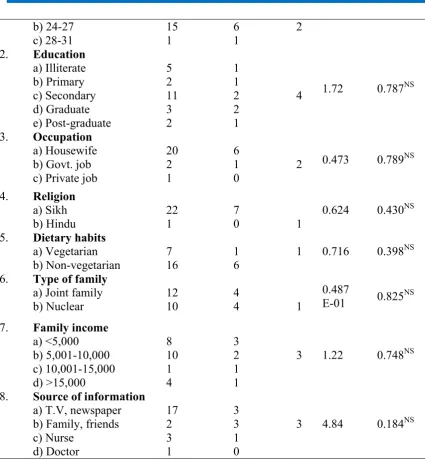
Table 7- Association of knowledge score of multiparous mothers with selected socio-demographic variables

N=30

Sr. no.

Socio-demographic Variable

Level of knowledge

Inadequate Moderate

df χ2 p value

1. Age(in years)

(8)

Available at https://edupediapublications.org/journals

p-ISSN: 2348-795X Volume 04 Issue-17

December 2017

b) 24-27

c) 28-31 15 1 6 1 2

2. Education

a) Illiterate b) Primary c) Secondary d) Graduate e) Post-graduate

5 2 11 3 2

1 1 2 2 1

4 1.72 0.787NS

3. Occupation

a) Housewife b) Govt. job c) Private job

20 2 1

6 1

0 2

0.473 0.789NS

4. Religion

a) Sikh b) Hindu

22 1

7

0 1

0.624 0.430NS

5. Dietary habits

a) Vegetarian b) Non-vegetarian

7 16

1 6

1 0.716 0.398NS

6. Type of family

a) Joint family

b) Nuclear 12 10 4 4 1

0.487

E-01 0.825

NS

7. Family income

a) <5,000 b) 5,001-10,000 c) 10,001-15,000 d) >15,000

8 10 1 4

3 2 1 1

3 1.22 0.748NS

8. Source of information

a) T.V, newspaper b) Family, friends c) Nurse

d) Doctor

17 2 3 1

3 3 1 0

3 4.84 0.184NS

NS= Non-significant

Table 7: reveals the association of knowledge score regarding postnatal care with selected socio-demographic variables. Chi square test was applied and the t test revealed that there is no significant association between knowledge score of multi-parous women with selected socio-demographic variables.

4. Discussion

Objective1: To assess the knowledge regarding postnatal care among primiparous mothers.

(9)

Available at https://edupediapublications.org/journals

p-ISSN: 2348-795X Volume 04 Issue-17

December 2017

(30%) in the area of family planning. These findings are consistent with a comparative study conducted to assess the knowledge among primiparous and multiparous mothers which showed that the assessment of knowledge of primiparous mothers was (42.46%). Area wise mean % was (55.37%) postnatal diet, (47.20%) newborn care and (21.88%) family planning.9 Another study conducted to assess the knowledge, attitude and practices of postnatal care among postnatal mothers. The findings showed that 92% of mothers had no knowledge regarding postnatal care.10 A descriptive study on breastfeeding revealed that 31.4% were exclusively breastfeeds.11

Objective2: To assess the knowledge regarding postnatal care among multi-parous mothers.

The findings of the study showed that 7(23.3%) of multiparous mothers had moderate knowledge and 23(76.6%) had inadequate knowledge regarding postnatal care. In multiparous mothers area-wise mean percentage was (39.25%) in the area of newborn care, (36.25%) in the area of postnatal diet, (28.75%) in the area of family planning, (28.14%) in the area of postnatal complications, (20%) in the area of breastfeeding. The findings of the study are consistent with a study conducted between primiparous and multiparous mothers to assess the knowledge and practices of postnatal care which revealed the mean percentage of response was (61.86%). Area wise mean % was (66.62%) postnatal diet, (72.79%) newborn care and (40%) family planning with regard to item-wise analysis the highest % of score in multi-parous mothers (96.66%) was observed.9 Another study conducted results revealed that 72% of multiparous women had good knowledge regarding postnatal care.13 One more

study conducted whose results show that exclusive breast feeding rate was 26%.14

Objective3: To compare the knowledge score regarding postnatal care among primiparous and multiparous mothers.

Unpaired t-test was applied to check the statistical significance. In primi-parous mothers knowledge score mean & S.D was 16.73 ± 3.7 and in multiparous mothers knowledge score mean & S.D was 16.8 ± 4.56. The obtained ‘t’value is -0.06. So tabulated ‘t’ value was more than calculated ‘t’ value (p<0.05). Hence,H0 was rejected and the alternate

hypothesis was accepted. The study findings are consistent with the study conducted between primiparous and multiparous mothers to assess the knowledge and practices of postnatal care which revealed that using unpaired ‘t’ test a very high score (p<0.001) difference was found in knowledge score of primiparous and multiparous mothers.12

Objective4: To find the association of knowledge score regarding postnatal care with selected socio-demographic variables.

Chi square test was applied and the test revealed that source of information have significant association with knowledge score of primi-parous mothers regarding postnatal care and there is no significant association between knowledge score of primi-parous mothers with other socio-demographic variables. There is no significant association between knowledge score of multi-parous mothers with the selected socio-demographic variables.

5.Conclusion

(10)

Available at https://edupediapublications.org/journals

p-ISSN: 2348-795X Volume 04 Issue-17

December 2017

appropriate advice given to the mother during post-partum period. The components of postnatal care are: Breastfeeding, newborn care, postnatal diet, family planning and postnatal complications. The present study highlights that the level of knowledge in maximum primiparous and multiparous mothers was inadequate. Results showed that there was a significance difference between the knowledge score of primiparous and multiparous mothers regarding postnatal care. Awareness programmes are required to improve knowledge on the different aspects of postnatal care. Further studies can be conducted to make more clear views and to plan for future on reproductive rights and to utilize the reproductive health services by people.

REFERENCES

1. World Health Orgnasation. A postnatal care for the mother and newborn practical guide, maternal and newborn health/ safe motherhood unit.2001. 2. Postnatal Definition. [online]. [cited

2011 Oct 20] Available from: http//www.answer.com”.

3. Chelmon D. Normal and Abnormal Puerperium. [online].[Cited 2011 oct

18]; Available

from:URL:http://emedicine.medscape.co m

4. Titaley C R, Dibley M J, et al. Factors associated with non-utilization of postnatal care services in Indonesia. Journal of Epidemiology and Community health. 2009; 6(3):827-31.

5. DC Dutta’s. A text book of obstretics. Hiralal Konar. Postnatal care.1983; Ed 7: 153.

6. Postpartum problems on Medicine [online].[cited 2011 Oct 15]; Available from:http://www.medicinenet.com 7. Postnatal care [online].[cited 2011 Oct

20];Available from: URL:http://www. seasonsindia.com

8. The importance of Pre- and Post-natal Care [online].[cited on 2011 Oct 15];

Available from:

URL:http://leefrancesemery.hubpages.c om

9. Ramaiah P. A comparative study between primi-parous and multi-parous mothers to assess knowledge and practice regarding postnatal care. Journal of nursing care.2015; 27-9. 10.Sharma A et al. A study was conducted

to assess knowledge, attitude and practices of postnatal care among postnatal mothers. Journal of Obstetrics and gynaecology.2013;24-27.

11.AC Komarsson, Monica OB et al. A descriptive study to assess the

knowledge about

breastfeeding.2008;7(2).

12.Timilsina S, Dhakal R. A descriptive study to assess the knowledge, attitude, practice and problem of postnatal mothers regarding breastfeeding. 2015; 1(4):87-92.

Figure

Table 1 reveals socio-demographic variables of the primi-parous and multi-parous women
Table 5 reveals comparison of level of knowledge of primiparous and multiparous mothers regarding postnatal care
Table 7- Association of knowledge score of multiparous mothers with selected socio-demographic variables
Table 7: reveals the association of knowledge

References

Related documents

We conducted a secondary analysis of whole countrynational DHS data from in nine countries on the association between place and attendance at birth, and maternal

: Heavy metals analysis, phytochemical, phytotoxic and anthelmintic investigations of crude methanolic extract, subsequent fractions and crude saponins from Polygonum hydropiper L.

However, they cover some classes of mathematical programs with equilibrium constraints (see []), bilevel minimization problems (see []), variational inequalities (see

From Countercultures to Suburban Cultures: Frank Zappa after 1968..

If the extent of interaction between the genetic (eg, polymorphisms in TNF- α , IL-6 , and CRP genes), biochemical (eg, serum levels of TNF- α , IL-6, and CRP), and

Ranking Italian Universities and Other Research Institutions Taking Into. Account Public

Due to the high noise level of the large prototype Micromegas during the testbeam campaign the spatial resolution determined using the centroid method for position reconstruction

Reading carefully text in Social Media or Network helps us to improve our pronunciation, if we confront new words, not aware of pronunciation, we can use