Issues in the design, construction and use of Language Resources (LR) for
Endangered Languages (ELs)
Monica Ward
School of Computer Applications Dublin City University, Dublin 9, Ireland
Abstract
Growth in the development of Human Language Technologies (HLT) means that it is easier to document and archive languages than has been the case in the past. This is especially important in the Endangered Language (EL) context where it is imperative to document the language while its remaining speakers are still alive. This paper outlines the additional constraints that prevail when documenting languages in the EL context and how Computer Assisted Language Learning (CALL) development can help in language documentation exercises. It also highlights the importance of the management of the Language Resources (LR) once they have been procured, including the need to provide different access rights to the material depending on the EL community requirements. A forward looking, flexible technology is essential to ensure that current LR are not made obsolete by changes in technology and XML technologies offer a suitable platform in this regard. The paper presents a case study of the development of CALL materials for Nawat, an EL of El Salvador and the ensuing language documentation benefits that arose from the project.
1.
Introduction
Growth in the development of Human Language Technologies (HLT) means that it is easier to document and archive languages than has been the case in the past. This is especially important in the Endangered Language (EL) context where it is imperative to document the language now while its remaining speakers are still alive. This paper looks at the benefits of language documentation efforts in general. It considers the potentially conflicting goals of linguists, who want to document a language, and the EL community who may wish to develop language teaching material. The development of CALL materials is one possible solution. Language documentation in the EL context is more challenging than the non-EL one. This paper considers the additional constraints that prevail in the EL situation and the extra factors that must be considered when procuring Language Resources (LR) in the EL context.
Once the resources have been obtained, it is important to manage them correctly. This involves using appropriate storage technology and implementing an agreed upon access strategy to the resources, which will vary from community to community and also on the nature of the material. Finally, a case study of the development of CALL materials for Nawat, an EL of El Salvador, is presented. This example demonstrates that using good data management techniques, combined with careful planning can result in a system that goes some way to satisfying the needs of both linguists and the EL community.
2.
Human Language Technologies (HLT),
Language Resources and Endangered
Languages (ELs)
Growth in the development of Human Language Technologies (HLT) means that it is easier to document and archive languages than has been the case in the past. Audio files can be digitally recorded and stored. Written texts can be stored and accessed in various different ways. Hand-written manuscripts or drawings can be scanned and
preserved. Technological advances also make it easier to gather language material. Audio recording equipment is light, small and eminently portable. Field trips can be more flexible and spontaneous as the equipment can be carried by one person rather than a team of support staff. They can be less stressful as recordings can be "tidied-up" later if mistakes, gaps or other unwanted items occur. Furthermore, the pressure to get a recording perfect before leaving a field site is decreased as items can be recorded several times as the cost of the raw material (e.g. mini-discs) is usually not significant.
2.1.
Language Documentation and Endangered
Languages (ELs)
These improvements in HLT hold for most of the world's languages. In the case of the world's Endangered Languages (ELs), there are more than just documentation and archiving possibilities. An Endangered Language is one that is in danger of disappearing, usually because it has been replaced as the language in common use within a community (Unesco, 1993). Most of its speakers are elderly and the language will disappear with the death of the last remaining speaker. There may be potentially conflicting goals between a (field) linguist and the EL community. The linguist is interested in documenting the language before it disappears and would like to record the language as comprehensively as possible. Hale (1992) refers to the onus on linguists to do precisely this and Crystal (2000) remarks on the changed emphasis in the fieldwork under taken by linguists today. Gerdts (1998) refers to the role of the linguist in language revitalisation programmes (see FEL (1998) for other related articles). However, the EL community members may prefer to avail of the linguist's services to develop language teaching material (rather than scholarly documentation) for the community, to enable them to pass on the language to their children. There is a middle ground and that is to use HLT to develop Computer Assisted Language Learning (CALL) materials for these ELs.
up till now no one has worked on the development of an online, interactive CALL system for Nawat. The Nawat CALL project was one of the few occasions that the community had a chance to work symbiotically with an outside researcher.
The development of CALL material is a non-trivial task (and a comprehensive summary is outside the scope of this paper, see Levy (1997)). CALL usually requires a multi-disciplinary team that includes a linguist, a pedagogical expert and a technical specialist. In the EL situation, often none of these specialists are available. Thus, use was made of a software template (developed by Ward (2001)) which allows the development of CALL materials for ELs. It takes into account the additional constraints faced by ELs. In the case of Nawat, there were up to 7 different alphabets that had been used to write the language (Campbell, 1985; Lemus, 1997). One informant (informant A) was literate in one alphabet, while the other informant (informant B) was semi-literate (but struggled with written material). Informant A was used to working in an office, so the recording environment presented no difficulties. However, informant B was not used to sitting down in an office and this had to be taken into account during the recording sessions by providing breaks and allowing the informants to chat and walk around if they wanted. The informants were also given the chance to listen to the recordings to make them more comfortable with the process.
Once the information had been gathered, it was processed and prepared off-site. Subsequently, back in the field, the material was revised by the informants to check its correctness and its Spanish translation. The software template stores language data in XML data files and the audio files in mp3 format, while image files are stored in .jpg and .gif formats. Each file (be it text, audio or image) follows a standard naming convention. Text files are organised into lessons and each lesson has three sections. The template automatically generates language lessons, with links to entire conversations or single phrases from each conversation. The template also enables a CD version and a printed version of the materials to be produced.
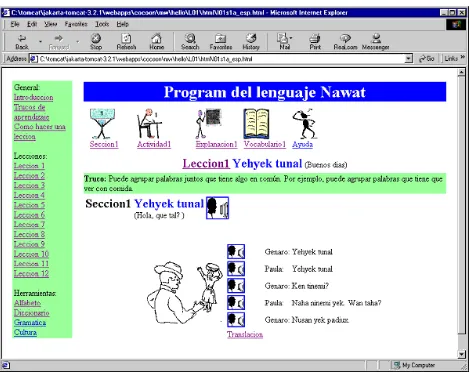
Figure 1 shows a sample screen from the Nawat language learning courseware. It shows the conversation and the links to the audio files for the entire conversation and each phrase of the conversation. The bar on the left-hand side of the screen provides links to pages for the other lessons, the alphabet, a multi-media dictionary, grammar notes and cultural information. The courseware was developed in both Spanish and English.
In summary, the development of CALL materials for Nawat meant that audio conversations (and their textual equivalents), a guide to the alphabet, an online dictionary and grammar information were procured and placed online for the first time. This is an example of how a CALL project can result in positive outcomes for the competing needs of a linguist (language documentation) and the EL community (teaching materials).
5.
Conclusion
Improvements in Human Language Technologies (HLT) mean that it is now easier to document and archive Language Resources (LR). This is especially useful in the context of Endangered Languages (ELs), where the limited numbers of remaining speakers means that LR must be procured and stored now, rather than at some unspecified date in the future. One interesting option to marry the potentially conflicting goals of linguists and EL communities is to develop Computer Assisted Language Learning (CALL) materials for the ELs.
ELs present additional constraints on LR documentation efforts. These include lack of previous knowledge or documentation on the language, the lack of a writing system or the proliferation of different writing systems, the acquisition environment and the familiarity of the informants with the technology being used. Another issue is the need to verify the material with the informants after it has been processed and transferred to a different medium (e.g. on the computer). An important issue in the EL context is that informants may wish to place access restrictions on the LR (e.g. to restrict access to members of the community or to common rather than sacred texts).
Given that many ELs will have disappeared in the near future, it is imperative that the LR are managed correctly and with a view to future use. Thus, storage technologies that are flexible and can adapt to changing formats (e.g. XML technologies) should be used to avoid obsolescence of LR. It is important that the LR be produced in different formats to cater for different audiences and it must be remembered that EL communities may not have computer access and thus the materials should also be made available in a printed format. Finally, a case study is presented of the development of CALL materials (and inherent language documentation) for Nawat (or Pipil), an EL of El Salvador.
6.
References
Bender, B., 1971. Micronesian Languages. Current Trends in Linguistics 8: 426-65.
a transition to democracy in El Salvador? Boulder: Westview Press (Woodrow Wilson Center current studies on Latin America)
Byrne, Hugh. 1996. El Salvador's civil war: a study of revolution. Boulder: Lynne Rienner Publishers.
Campbell, L., 1985. The Pipil language of El Salvador. Berlin: Mouton.
Crystal, D., 2000. Language Death. Cambridge: Cambridge University Press
Day, R., 1985. The Ultimate Inequality: Linguistic Genocide. In Wolfson and Manes (Eds). Language of Inequality, Berlin: Mouton
Gerdts, D. B., 1998. The Linguist in Language Revitalization Programmes. In: What Role for the Specialist? Foundation for Endangered Languages II Proceedings (Edinburgh 1998)
Grimes, B., 2000. Ethnologue: Languages of the world. SIL International. Available at:
http://www.ethnologue.com/web.asp [Accessed 16
October 2001]
Hale, K., 1992. On Endangered Languages and the safeguarding of diversity. Language, V68. No 1. Lemus, J., 1997. Alfabeto pipil: una propuesta. In:
Estudios Lingüísticos. El Salvador: CONCULTURA. Levy, M., 1997. Computer-Assisted Language Learning
(Context and Conceptualization). Oxford: Oxford University Press.
LEW, 2000. Linguistic Exploration Workshop: Web-Based language Documentation and Description. Available at:
http://www.ldc.upenn.edu/exploration/expl2000
[Accessed 20 November, 2001]
LEW, 2001. Linguistic Exploration Workshop: Linguistic Databases. Available at:
http://www.ldc.upenn.edu/annotation/database/
[Accessed 20 November, 2001]
Maffi, L., 1999. Report on Language Maintenance and Death: reports from the field and strategies for the new millennium, Workshop, University of Illinois, 1999. Available at: http://www.terralingua.org/uillinois.html
[Accessed 20 November, 2001]
Milroy, J., Milroy, L., Hartly, S. and Walshaw, D., 1994. Glottal Stops and Variation and Change in British English. Language Variation and Change 6:327-357 Mühlhäusler, P., 1996. Linguistic Ecology. London:
Routledge.
Unesco, 1993. Unesco Red book on Endangered
Languages. Available at :
http://www.helsinki.fi/~tasalmin/nasia_index.html
[Accessed 27 March, 2002]
Ward, M., 2001. Nawat courseware. Available at: http://www.compapp.dcu.ie/~mward/nawat.html
[Accessed 31 October 2001]
XML, 2001. World Wide Web Consortium. Available at:
http://www.w3.org [Accessed 27March, 2002]
Whalen, D., 2001. Report on the SALSA Special Colloquium on Archiving Language Materials in Web-Accessible Databases: Ethical Challenges, Sunday, 22 April, 2001. Available at: