Identifying Verb Arguments and their Syntactic Function in the Penn Treebank
Alexandra Kinyon, Carlos A. Prolo
Department of Computer and Information Science University of Pennsylvania
200 South 33rd Street, Philadelphia, PA, 19104-6389, USA (kinyon,prolo)@linc.cis.upenn.edu
Abstract
In this paper, we present a tool that allows one to automatically extract verb argument-structure from the Penn Treebank as well as from other corpora annotated with the Penn Treebank release 2 conventions. More specifically, we examine each possible sequence of tags, both functional and categorial and determine whether such a sequence indicates an obligatory argument, an optional argument or a modifier. We argue that this approach is more fine-grained and thus more satisfactory than the existing approaches which have aimed at determining argumenthood in the Penn Treebank. The goal of this work is to provide a set of sufficiently general and fine-grained rules as well as an implementation which will be reusable and freely available to the research community.
1.
Motivation
The Penn Treebank (PTB), a 1 million word syntacti-cally and morphosyntactisyntacti-cally annotated corpus for English (Marcus et al., 1993) is an invaluable tool for computational linguists, that may be used to develop probabilistic tools (e.g., (Collins, 1997)) and extract grammars (e.g., (Chen and Vijay-Shanker, 2000; Xia, 2001)), among other things. It may also be used to extract lexical resources, such as a verb lexicon documenting each verb’s subcategorization frame. As such, it is crucial in the PTB to correctly be able to distinguish verb arguments from verb adjuncts, and to correctly identify the syntactic function of each argument. Unfortunately, even though the version of the Penn Tree-bank known as “release 2” (Marcus et al., 1994) is supposed to encode such subcategorization information, with the ad-dition of “function tags” such as “TMP” (constituent con-veying temporal information), “PRD” (predicative), “CLR” (constituent closely related to the verb head), extracting verb subcategorization frames from the PTB is still nowa-days not straightforward, especially when tags are com-bined into complex sequences such as “UCP-LOC-CLR”, “S-TTL-PRD” or “SBAR-TMP-PRD”, which mix category with several kinds of “pseudo-functional” information.
As a result of the lack of simple mapping between PTB syntactic tags and more traditional syntactic functions such as subject, object and indirect object, each researcher who wishes to obtain such subcategorization information has to develop their own set of rules, often as a “small” auxiliary task of a project whose main purposes are of a distinct na-ture. Hence, these rules are often limited in number, and not general enough to be re-used for other applications.
For example, (Collins, 1997) devotes a small paragraph to this topic, explaining that verb complements are con-stituents not bearing one of the tags ADV, VOC, BNF, DIR, EXT, LOC, MNR, TMP, CLR, and PRP. These rules may work well for (Collins, 1997)’s purpose, but are not ade-quate to reuse for other potential applications because they:
are not fine grained enough;
do not take into consideration the sometimes complex interaction between function tags;
do not distinguish optional and compulsory arguments.
(Chen and Vijay-Shanker, 2000), (Xia, 2001) and other works on grammar extraction share similar problems, since their concern is to come up with a parameterizable system for grammar extraction, and not so much with the particu-lar parameters that would be adequate to extract verb argu-ments from the treebank.
In this paper, we describe a tool which implements fine-grained rules that identify the arguments of each verb oc-currence in the Penn Treebank , along with their functions, including optional arguments. In the first part of this paper, we motivate the need for fine-grained rules, which take into account the complex interaction between all the tags in the Penn Treebank and allow one to distinguish the notion of optional argument. In the second part of this paper, we give an overview of the tool, explain the methodology we use and provide a few output samples. In the third part of this paper, we give detailed rules to determine for each given se-quence of tags whether it refers to an adjunct or to an oblig-atory or optional argument. Moreover, in the latter case, we explain which “traditional” syntactic function is assigned to a given tag sequence. We also indicate which lexical items should appear as a “co-anchor”, e.g., the prepositions selected by verbs taking a prepositional complement.
2.
General observations
2.1. Need for fine-grained rules
If one develops too quickly a small set of rules to distin-guish arguments from adjuncts in the Penn Treebank, one runs the risk of not being fine-grained enough. For ex-ample, the rules from (Collins, 1997) are not fine-grained enough because, for instance, they fail to capture the fact that “to investors” is an argument of “went” in (1).
(1) (S (NP-SBJ (DT The) (NN rest)) (VP (VBD went)
(PP-DIR (TO to)
(NP (NP (NNS investors)) (PP-DIR (IN from)
(NP (NP (NNP France)) (CC and)
2.2. Interaction between category and function tags
Each potential verb argument in the Penn Treebank is annotated with a categorial tag (NP, PP, etc.), along with one or more function tags.
On the one hand, the role of a given function tag varies depending on which categorial tag it is associated with. For instance NP-CLR tends to denote a fixed phrase such as “took place” in (2), whereas PP-CLR tends to denote a compulsory argument (see (4) below).
(2) (S (NP-SBJ (PRP$ their)
(NN meeting)) (ADVP-TMP (RB never) ) (VP (VBD took)
(NP-CLR (NN place))))
Hence it is not sufficient to consider function tags alone when retrieving the arguments of a verb. One must also ex-amine the interaction between categorial and function tags. Moreover, function tags interact among themselves. For example, the function tag LOC, for “location”, tends to de-note an adjunct when combined to the tag for prepositional phrases (PP-LOC). But when the functional tag PRD (for “predicative”) is also present, then the judgement definitely switches to argumenthood, whith the constituent marked PRD having a predicative syntactic function. So, in (3), “in the front row” is a predicative argument of “was”. In fact, the function PRD exhibits a rather simple interaction with other function tags. It can simply be viewed as domi-nating the whole sequence: when a tag PRD is present, the constituent is a predicative argument.
(3) (S (NP-SBJ (PRP$ his)
(NN family)) (VP (VBD was)
(PP-LOC-PRD (IN in) (NP (DT the)
(NN front) (NN row)))))
But things are not always that simple. Let us consider for instance the interaction between the function tags CLR and LOC. The combination PP-CLR tends to denote an obligatory argument1, whereas the sequence PP-LOC tends
to denote an adjunct. Both cases appear in (4).
(4) (S (NP ‘‘PS of New Hampshire shares’’)
(VP (VBD closed)
(NP-TMP (NN yesterday) ) (PP-CLR (IN at)
(NP (NP ($ $) (CD 3.75) (-NONE- *U*)) ...))
(PP-LOC (IN in) (NP (NNP New)
(NNP York) (NNP Stock) (NNP Exchange) (JJ composite) (NN trading)))))
1
But see Section 4.2 for PP introduced by the preposition “as”.
However, the combination PP-LOC-CLR, denotes nei-ther a compulsory argument, nor an adjunct. Ranei-ther, PP-LOC-CLR tends to denote an optional argument, as in (5). So neither LOC, nor CLR seems to dominate a sequence of function tags. Rather, each contributes to some extent to the final judgment on argumenthood.
(5) (S (NP-SBJ-1 (NNP Avalon)
(CC and) (NNS others)) (VP (VBD invested)
(NP (QP ($ $) (CD 14) (CD million)) (-NONE- *U*)) (PP-LOC-CLR (IN in)
(NP (NNP Athena)
(NNP Neurosciences) (NNP Inc.)))
...))
Hence, in order to retrieve verb subcategorization frames, one must not only examine the interaction between categorial tags and function tags, but also the (sometimes complex) interaction between all the possible combinations of function tags.
2.3. Canonical subcategorization and syntactic alternations
Deciding whether a given sequence is a compulsory or an optional argument is delicate and often depends on the surface realization of a verb and of its arguments and on the potential syntactic alternations that the construction has undergone. For instance, “(PP-LOC-CLR in Ohio)”, in a clause in the active voice such as in (6), seems to be an op-tional argument, but it looks more like a compulsory argu-ment when the clause is in the passive voice, as in (7), since (8) is ungrammatical. In what follows, the subcategoriza-tion of a verb is examined for the canonical realizasubcategoriza-tion of its arguments. The interaction between argumenthood con-straints and syntactic alternations (e.g., passive) is beyond the scope of this work.
(6) The company based its headquarters in Ohio.
(7) The headquarters of the company are based in Ohio.
(8) * The headquarters of the company are based.
2.4. Optional argumenthood
Existing rules for determining argumenthood in the PTB ignore the notion of optional argument : in (9), “These Japanese companies” is clearly an optional argument of the verb “provide”.
(9) But the different business system would make it hard for Dentsu to ...
(VP (VB provide)
(NP-BNF these Japanese companies) (NP the same kind of services
3.
Overview of our Subcategorization
Extraction tool
3.1. Methodology
In order to develop this tool, we first had to define which verbs in the PTB should receive a subcategorization: these are the verbs that are dominated by a verbal phrase (VP). This statement, which seems at first very trivial, allows one to avoid assigning a subcategorization frame to verbs which appear inside a noun phrase, such as in “(NP the/DT Dutch/NNP publishing/VBG group/NN)”. It also prevents one from assigning a subcategory to auxiliary verbs and to modals. A distinctive case are the gerunds and past par-ticiples when introducing a prepositional phrase, such as “including” in (10), generally regarded as prepositions, Al-though they seem to preserve selectional properties from their usage as a verb we currently do not assign them a sub-categorization frame either2
(10) (S (NP-SBJ Four ... surviving workers) (VP (VBP have)
(NP asbestos-related diseases) (, ,)
(PP (VBG including)
(NP three with ... diagnosed cancer))))
For each of the verbs which receive a subcategory, sub-ject extraction is easy since it is marked by the tag SBJ. As for other potential complements (i.e. all the right siblings of a verb inside a VP), in order to develop fine-grained rules, we examined by hand the 150+ different sequences of syn-tactic tags in the PTB that appear assigned to a right sibling of a verb inside a verbal phrase (e.g., “NP”, “NP-TMP”, “NP-TMP-CLR”, etc.).
For each of these sequences, we established whether the sequence was assigned to a modifier, an argument, or op-tional argument, occasionally using some addiop-tional struc-tural contextual information to help disambiguate the par-ticular sequence. When the tag was overwhelmingly as-signed to an argument (optional or compulsory), we also mapped it to one of the following traditional syntactic func-tions:
Subject: as in “(NP-SBJ John) eats an apple.”
Predicative: “John is (NP-PRD a hockey player).”
Direct-Object: “John sees (NP-DirObj Mary).”
Second-Object: used for “dative objects” or “bene-factives”, e.g., “John gave (NP-SecondObj Mary) a book.”
LocDirObject: used for elements that are arguments, despite their “locational” or “directional” nature, as in “The plane goes LocDirObj from Denver) (PP-LocDirObj to Dallas).” (cf. the ungrammaticality of “* The plane goes”).
Indirect-Object: used for other prepositional argu-ments, as in “John thinks (PP-IndirectObj about Mary)”.
2Notice this is not dissimilar to other genuine cases of
selec-tional relation across categories, e.g., nouns that take arguments often have the same or related selectional restrictions as their verb counterparts (cf. “account”).
Currently, we assign syntactic functions essentially to the constituents of the following categories: NP, PP, ADVP, ADJP. Syntactic functions are not assigned yet to sentential complements (S and SBAR), except for the functions sub-ject and predicative. Lexical co-anchors are not assigned syntactic functions either (e.g. prepositions or particles se-lected by a verb, elements of a fixed phrase such as “hand” in “go hand in hand”).
The output we obtain may be partially or totally lexical-ized : e.g., the program indicates which particular preposi-tion introduces a PP complement.
The work we present just aims at adding information one would expect to find in the Penn Treebank. There seems to be no easy way to perform a serious evaluation of our result. One reason is the lack of annotated material to compare our output with. Existing subcategorization lex-icons for English verbs tend not to establish the distinction between optional and compulsory arguments. Moreover, mapping subcategorization frames from one source (e.g. a dictionary) to another (e.g. our output) for evaluation pur-pose is a non trivial task if one wants to provide reliable and meaningful evaluation figures.3
The main problem with the evaluation, however, which was clear from a manual examination of the output we have performed, is that the boundary between adjuncthood and argumenthood is very fuzzy. Hence some constituent that our program has marked as obligatory argument could be judged as being optional argument or even adjunct, with different degrees of confidence. One such example is pro-vided in (11), concerning the role of the PP “in its Micronite cigarette filters”, that our tool extracted as an optional argu-ment. In general, we prefered to favor argumenthood over adjuncthood when in doubt. Our motivation is that it is po-tentially easier for users to get rid of information they judge superfluous, rather than to reconstruct information that is missing.
(11) Lorillard Inc. , the unit of New York-based Loews Corp. that makes Kent cigarettes , stopped using cro-cidolite in its Micronite cigarette filters in 1956.
Another source of errors in the output is due to original annotation errors. When possible, we have tried to have the program “bypass” some recurring annotation errors. For example, when the complementizer “that” is incorrectly tagged as a determiner, a sentential complement introduced by “that” is nonetheless generally correctly identified as long as it is inside an S or an SBAR constituent. Parti-cles for particle verbs are generally correctly identified as such, even when they are not marked PRT. In a few cases, the original annotation errors could not be detected though. One such case is when a verb has been mistagged as an ad-jective. The program then quite obviously fails to identify it and assign a subcategorization frame to it.
3.2. Output samples
The program may output a verb lexicon where each verb is associated a subcategorization frame indicating
ar-3
A form of asbestos once used * * to make Kent cigarette filters has caused a high percentage of cancer deaths among a group of workers exposed * to it more than 30 years ago , researchers reported 0 *T*.
(a) PTB sentence
########## #VB: used #Subj: NP-SBJ
#Arguments: NP#dirObj//VPinf(to) ##########
#VB: make #Subj: NP-SBJ #Arguments: NP#dirObj// ##########
#VB: caused #Subj: NP-SBJ #Arguments: NP#dirObj// ##########
#VB: exposed #Subj: NP-SBJ
#Arguments: NP#dirObj//PP-CLR#IndirectObj(to)// ##########
#VB: reported #Subj: NP-SBJ
#Arguments: SBAR([that])//
(b) Verb entries
Figure 1: Sample output of a verb subcategorization lexicon
( (S
(NP-SBJ#Subject
(NP (NNP Lorillard) (NNP Inc.) ) (, ,)
(NP
(NP (DT the) (NN unit) ) (PP (IN of)
(NP
(ADJP (JJ New) (JJ York-based) ) (NNP Loews) (NNP Corp.) )) (SBAR
(WHNP-2 (WDT that) ) (S
(NP-SBJ#Subject (-NONE- *T*-2) ) (VP (VBZ makes)
(NP#DirObj (NNP Kent) (NNS cigarettes) ))))) (, ,) )
(VP (VBD stopped) (VP#[ing] (VBG using)
(NP#DirObj (NN crocidolite) ) (PP-LOC-CLR##LocDirObj (IN in)
(NP (PRP$ its) (NN Micronite) (NN cigarette) (NNS filters) ))
(PP-TMP (IN in) (NP (CD 1956) )))) (. .) ))
Figure 2: Sample output of the “aumented” treebank: Com-pulsory and optional arguments are respectively marked # and ##, followed when appropriate by a syntactic function.
guments and their syntactic function (optional arguments appear between brackets). A sample is shown in Figure 1.
The program may also output an augmented version of the treebank, with obligatory verb arguments indicated with the symbol #, and optional arguments indicated with ##, followed possibly by a syntactic function. Such an output sample is shown in Figure 2.
4.
The extraction rules
In order to extract a subcategorization frame for a given verb, and determine which elements are arguments, we look
at the canonical positions. For instance, when a trace oc-cupies the canonical position of an argument in the tree-bank, the sequence of tags assigned to that trace will be used to determine argumenthood.4In (12), we deduce from
the presence of the NP trace that “exposed” takes a direct object, producing the output in (13).
(12) (NP (NP (DT a) (NN group) ) (PP (IN of)
(NP (NP (NNS workers) ) (RRC (VP (VBN exposed)
(NP (-NONE- *) ) (PP-CLR (TO to)
(NP (PRP it) )) (ADVP-TMP (NP (QP (RBR more)
(IN than) (CD 30) ) (NNS years) ) (IN ago) ))))))
(13) ########## #VB: exposed #Subj: NP-SBJ
#Arguments: NP#DirObj//PP-CLR#PrepObj(to)// ##########
Here are the extraction rules we have used.
4.1. Noun Phrases
The following tag sequences denote compulsory argu-ments: NP, NP-PRD, NP-TTL, NP-TTL-PRD, NP-CLR-LOC, NP-DIR, NP-LOC-PRD, CLR, NP-TMP-PRD, SBARQ-NOM.
The following tag sequences denote optional argu-ments: NP-BNF, NP-EXT, NP-LOC-CLR
The following tag sequences denote adjuncts: NP-ADV, NP-MNR, NP-TMP, NP-LOC, NP-VOC
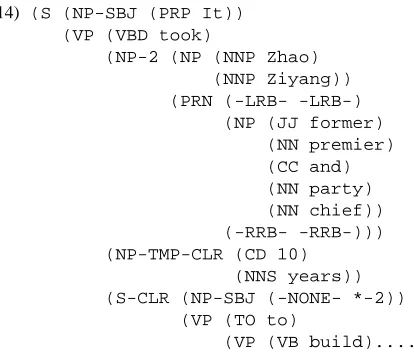
Example: “10 years” is obligatory argument in 14.
(14) (S (NP-SBJ (PRP It))
(VP (VBD took)
(NP-2 (NP (NNP Zhao) (NNP Ziyang)) (PRN (-LRB- -LRB-)
(NP (JJ former) (NN premier) (CC and) (NN party) (NN chief)) (-RRB- -RRB-))) (NP-TMP-CLR (CD 10)
(NNS years)) (S-CLR (NP-SBJ (-NONE- *-2))
(VP (TO to)
(VP (VB build)....
NP-SBJs in candidate positions for internal arguments are discarded as such. They are related to the occurrence of subject extraposition. The sequence NP-CLR denotes idioms (or at least a “fixed” phrase) and requires scanning of the tree for one or more lexical co-anchor(s) (as in (15) and (16)).
4This does not imply that we take a stand on the theoretical
(15) Newsweek ,trying to keep pace with rival Time mag-azine , announced new advertising rates for 1990 ...
(16) ########## #VB: keep #Subj: NP-SBJ
#Arguments: NP-CLR(pace)//PP-CLR#IndirectObj(with)// #########
4.2. Prepositional Phrases
Whenever a prepositional phrase is considered to be an argument of a verb, the preposition selected by the verb is also retrieved by scanning the treebank tree, and is noted as a “co-anchor”.
The following tag sequences denote compulsory argu-ments: CLR-LOC, DIR-CLR, LOC-PRD, PP-PRD, PP-PRD-LOC, PP-TMP-PP-PRD, PP-PUT.
The following tag sequences denote optional argu-ments: PP-BNF, PP-DTV, PP-DIR, PP-EXT, PP-LOC-CLR.
The following tag sequences denote adjuncts: PP-LOC, PP-MNR, PP-PRP, PP-TMP.
In addition, some PP had to be treated with more fine-grained structural rules. For instance, the sequence PP-CLR denotes an optional argument when it is introduced by the preposition as, and denotes a compulsory argument when it is introduced by another preposition.
Similarly, bare PPs, that is, those marked only “PP” without any other function tags, are hard to account for. After careful observation of the data, we concluded that:
A PP occuring right after a comma is an adjunct.
A PP introduced by the preposition “by” co-occuring with a verb marked passive is not argument.5
A PP introduced by the preposition “by”, with a verb not marked passive, and whose immediate left sibling is marked PRD is an adjunct.
All other bare PPs are compulsory arguments, and the preposition is retrieved as a co-anchor.
Examples: “By today’s standards” in (17) is introduced by by and preceded by a predicative, hence adjunct; “By roughly half” in (18) is a bare PP argument of shrink.
(17) (S (NP-SBJ (DT The) (NNS computers) )
(VP (VBD were)
(ADJP-PRD (JJ crude) ) (PP (IN by)
(NP (NP (NN today) (POS ’s)) (NNS standards)))))
(18) (VP (VBD shrank)
(PP (IN by)
(NP (RB roughly) (DT half)))
5
It is not adjunct either, since it is the logical suject of a passive with Agent, for which the annotation LGS has been forgotten. So the extraction program simply ignores it.
4.3. Adjectival Phrases
The following sequences of tags denote a compulsory argument: ADJP-CLR, ADJP-PRD, ADJP-MNR.
Bare ADJPs, that is, ADJPs with no other function tags, are adjuncts when they are immediately preceded by a comma, and compulsory argument otherwise.
All the other sequences of tags occuring with an ADJP are adjuncts (e.g., ADJP-LOC, ADJP-ADV).
Example: “private” is an argument in (19).
(19) Of course it’s better...
(S-1 (NP-SBJ (-NONE- *)) (VP (TO to)
(VP (VB sell)
(ADJP-MNR (JJ private)))))
4.4. Adverbial Phrases
The following sequences of tags denote compulsory arguments: LOC-CLR, PRD-LOC, ADVP-LOC-PRD, ADVP-PRD, PRD, ADVP-TMP-CLR,ADVP-MNR-CLR.
ADVP-EX denotes optional argument.
The following sequences of tags denote adjuncts: ADVP, LOC, MNR, PRP, ADVP-TMP, ADVP-LOC-ADVP-TMP, ADVP-LOC-TPC, ADVP-MNR-TMP, ADVP-PRD-ADVP-MNR-TMP, ADVP-CLR-MNR.
Finally, for the following sequence of tags, one needs to scan the treebank to find a lexical co-anchor: ADVP-CLR, DIR, DIR-CLR, PRD-LOC, ADVP-PUT, ADVP—PRT.
Example: “recklessly” is a compulsory argument of be-have in (20).
(20) (SBAR (RB even) (IN if)
(S (NP-SBJ (PRP they)) (VP (VBD behaved)
(ADVP-MNR-CLR (RB recklessly))))) ...
4.5. Particles
Particles are marked as lexical co-anchors. It is also worthy to note that a lot of annotation errors and incoher-ences are encountered with particles: some are correctly marked RP (e.g. “(VP (VBP show) (PRT (RP up)))”), but some are annotated IN, (e.g. “(VP (VBG lying) (PRT(IN down)))”), others are marked RB (e.g. “(VP (VB Sit) (PRT (RB down)))”). In some cases, the particle is marked RP, but the constituent PRT is not present. In other cases, nei-ther the PRT, nor the RP are marked (e.g., “(VBN turned) (ADVP-DIR (RB away))”). Hence, particles have been re-trieved with great care, not only with rules specifically aim-ing at indicators of particles (i.e. PRT and RP), but also with rules detecting co-anchors in adverbial phrases, etc. (21) shows an example of particle extraction which is not next to the verb.
(21) Filling out detailed forms about these individuals... (VP (MD would)
(VP (VP (VB tip)
4.6. Sentential complements : S and SBAR
The following tag sequences denote adjuncts: S-ADV, S-ADV, LOC, MNR, SBAR-PRP, SBAR-TMP, S-SBAR-PRP, S-MNR.
The following tag sequences denote compulsory verb arguments: SBAR-PRD, S-PRD, SBAR-CLR, SBAR, SBAR-LOC-PRD, S-PRP-CLR, SBARQ, S-CLF, SQ.
A reasonable characterization of a sentential comple-ment requires more information than for other categories, since the verb extends its selectional requirements to as-pects of the internal structure of the sentential complement, such as the complementizer that introduces the clause (if any), or whether the complement is to be realized as a finite or non-finite clause, whether a non-finite clause is to be in-troduced by “to” or not, etc. In the following examples we summarize the kind of information provided by our tool. We recover the complementizer introducing the sentential complement: in (22), the sentential complement of “worry” is extractetd as “SBAR(whether)”, indicating the selection for the complementizer “whether”. Selection for the plementizer “that” may occur in two forms: either the com-plementizer is overtly realized, as in (23), in which case the sentential complement of “argue” is extractetd as “SBAR-PRD(that)”, indicating the selection for an overt comple-mentizer “that”; or covert as in (24), i.e., the complemen-tizer is not overtly realized (expressed in the annotation by the null element “(-NONE- 0)”). In the latter case, the com-plementizer “that” is enclosed in brackets in the reported subcategorization expression, indicating its optionality. So, the internal complement of “explained” in (24) is reported as “SBAR([that])”. In (25) the complement of “is” is given as “S-PRD(VPinf(to))”, indicating the selection for an “to”-infinitival sentential complement. An important case is de-picted through the example in (26). The complement of “wait” is reported as “SBAR(PP(for) VPinf(to))”, which summarizes the selection for a structure under the SBAR that ressembles a PP introduced by “for”, followed by a VP introduced by “to”.
(22) You do n’t even have (S (NP-SBJ (-NONE- *-1) )
(VP (TO to) (VP (VB worry)
(SBAR (IN whether)
(S (NP-SBJ (DT the) (NN ad) ) (VP (VBZ is)
(ADJP-PRD (JJ truthful))))))))
(23) The finding probably will support those who ... (S (NP-SBJ (-NONE- *T*-6) )
(VP (VBP argue) (SBAR (IN that)
(S (NP-SBJ (DT the) (NNP U.S.) ) (VP (MD should)
(VP (VB regulate)
(NP (NP (DT the) (NN class)) (PP (IN of)
(NP (NN asbestos))) ...))))))))
(24) (S (S-TPC-2 (NP-SBJ-1 More common chrysotile fibers) (VP (VP (VBP are)
(ADJP-PRD (JJ curly))) (CC and)
... (, ,)
(NP-SBJ (NNP Dr.) (NNP Mossman)) (VP (VBD explained)
(SBAR (-NONE- 0)
(S (-NONE- *T*-2))))
(25) (S (NP-SBJ-1 (NP (NNP Mr.) (NNP Lane) (POS ’s)) (JJ final) (NN purpose))
(VP (VBZ is) (RB n’t)
(S-PRD (NP-SBJ (-NONE- *-1) ) (VP (TO to)
(VP (VB glamorize) (NP (NP (DT the)
(NNP Artist) (POS ’s)) (NN vagabond)
(NN existence) ))))))
(26) (S (NP-SBJ (DT That)) (VP (VBZ permits)
(S (NP-SBJ (PRP them)) (VP (TO to)
(VP (VB wait) (SBAR (IN for)
(S (NP-SBJ (NNS prices)) (VP (TO to)
(VP (VB rise))))))))))
4.7. A word on coordination
Standard coordination is simply marked by the embed-ding of two constituents of the same category. When VPs are coordinated, as illustrated in (27), they share the same subject but each verb will have its own list of internal argu-ments. In the example both verbs would have “NP-SBJ” as subject, whereas for internal arguments, “vary” would take “NP-DirObj”, and “go” would take “PP-CLR(after)”. V coordination may appear annotated in two ways: it may be annotated as VP coordination, with argument labels domi-nating traces, in which case the process is as mentioned for VP coordination; or it may be appear as in (28). In this case we can safely assign the same subcategorization verb to all coordinated verbs.
(27) (S (NP-SBJ (NN portfolio) (NNS managers) ) (VP (MD can)
(VP (VP (VB vary)
(NP (NNS maturities) )) (CC and)
(VP (VB go)
(PP-CLR (IN after)
(NP the highest rates))))))
(28) They could ... (VP (VB accept)
(CC and) (VB hire) (NP (JJR more)
(NN labor)) (PP-DIR-CLR (IN from)
(PP (JJ outside) (NP (NNP Japan)))))
When one deals with the coordination not of VPs but of some internal argument of the verb, one may have to scan each member of the coordination for potentital co-anchors, even in the case where the members are of the same cate-gory. (29) illustrates that point : a coordination of PPs is argument of the verb. Each PP has to be scanned indepen-dently in order to find the prepositions introducing each of them i.e., resulting in two reported frames: one in which the PP argument is reported as “PP-IndirectObj(around)”, the other in which it is reported as “PP-IndirectObj(at)”.
(29) (VP (VBZ puts)
(NP (DT the) (NN dollar)) (PP-PUT (PP (IN around)
(NP (CD 1.8200) (NNS marks))
(PP-TMP at the end of November) (CC and)
(PP (IN at)
The problem is more complex when the coordinated constituents are of different category (marked UCP in the PTB terminology, for “Unlike Coordinated Phrase”), as in (30), where the two alternative internal arguments would be “NP-DirObj” and “SBAR(that)”.
(30) (S (NP-SBJ (NN Compound) (NNS yields)) (VP (VBP assume)
(UCP (NP (NP (NN reinvestment) ) (PP (IN of)
(NP (NNS dividends)))) (CC and)
(SBAR (IN that)
(S (NP-SBJ (DT the) (JJ current) (NN yield))
(VP continues for a year))))))
One last problem is that coordinations, while mostly perceived as distributive, may occasionally have to be in-terpreted in a cumulative way. For instance in a sentence such as “John gives used appliances and to local charities” the correct analisys would assign two internal arguments to “gives” under a single subcategorization frame (as opposed to two frames as the previous examples). We do not handle such cumulative analises. (31) shows a rare such example from the PTB, for which our current analysis fails.
(31) (S (NP-SBJ (DT The) (NN turf) ) (ADVP-TMP (RB recently) ) (VP (VBZ has)
(VP (VBN ranged)
(PP-CLR (PP (IN from) (NP (NNP Chile) )) (PP (TO to)
(NP (NNP Austria) )) (PP (TO to)
(NP (NNP Portugal) ))))))
4.8. Assigning a syntactic function
The function subject is assigned to any sequence, marked SBJ in the treebank6.
The function predicative is assigned to any sequence marked PRD (NP-PRD, ADVP-PRD, S-PRD, SBAR-PRD, NP-TTL-PRD, etc.). It is also assigned to the follow-ing tag sequences: ADJP-CLR (as in “It ended (ADJP-CLR-Predicative unchanged)”), ADVP-MNR-CLR (“be-have recklessly”), ADVP-TMP-CLR, ADVP-CLR-MNR and NP-ADV.
The function direct object is assigned essentially to NPs, more specifically to: NP, NP-TTL (“Have you read (NP-TTL-DirObj ’killing a mockingbird’)”). It is also as-signed to ADJP (“This means (ADJP-DirObj confronta-tional)”) and ADJP-MNR (“to sell (ADJP-MNR-DirObj private)”).
The functionLocDirObj is assigned essentially to PPs, more specifically to: DIR (“go from X to Y”), PP-EXT (“X grew by 12%”), PP-CLR-LOC (“X arrived (PP-CLR-LOC-LocDirObj at the station)”), PP-DIR-CLR, and PP-LOC-CLR (“locate X (PP-LOC-CLR-LocDirObj in the statio)”). It is also assigned to ADJP-ADV (“This machine operates (ADJP-ADV-LocDirObj fully loaded)”), ADVP-EXT (“The average number of options traded has surged (EXT-LocDirObj nearly tenfolds)”), ADVP-LOC-CLR, NP-TMP-CLR (“It took (NP-TMP-CLR 10
6
Only one subject is marked for each verb, so subject coordi-nations, traces etc. are ignored if the verb in question has already been assigned a subject
years) to ...”)7, NP-EXT (“X grew (NP-EXT-LocDirObj 12 %)”), NP-LOC-CLR (“X lived (NP-LOC-CLR-LocDirObj there)”).
The function Second Object is assigned to any tag se-quence bearing a tag -BNF- or -DTV- (i.e. BNF, PP-DTV, NP-BNF).
The function Indirect Object is essentially assigned to PPs, more specifically: PP-CLR (“talk (PP-CLR about X)”), PP-PUT and PP.
The following non sentential tag sequences are not as-signed a syntactic function because they denote either a lexical co-anchor or part of a fixed phrase : ADVP-CLR (“looking CLR(forward) PP-CLR(to)”), ADVP-DIR, ADVP-DIR-CLR, ADVP-PUT, ADVP—PRT, NP-CLR (“take effect”), and NP-MNR-NP-CLR.
These assignation of syntactic functions work fairly well in practice, but could :
1. be further refined;
2. be extended to sentential complements.
5.
Conclusion
We have presented a set of sufficiently general and fine-grained rules as well as an implementation which will be reusable and freely available to the research community to extract verb arguments from the Penn-Treebank. We hope that these rules will be enriched over time, and that more rules will be added in order to :
Extend the assignation of syntactic functions to sen-tential complements
Extract non verbal arguments (e.g. noun arguments)
This implementation is currently used in work on gram-mar extraction. In addition to this rule-based approach to annotate verb arguments in the PTB, we are also cur-rently investigating the use of a decision-tree approach (which could prove useful to functionally annotate unseen sequences such as the output of a parser).
6.
References
J. Chen and K. Vijay-Shanker. 2000. Automated extraction of TAGs from the Penn Treebank. In IWPT-00.
M. Collins. 1997. Three generative, lexicalised models for statistical parsing. In ACL-97, Madrid.
M. Marcus, B. Santorini, and M.A. Marcinkiewicz. 1993. Building a large annotated corpus of english: the Penn Treebank. In Computational Linguistics, 19:2.
M. Marcus, G. Kim, M.A. Marcinkiewicz, R. MacIntyre, A. Bies, M. Ferguson, K. Katz, and B. Schusberger. 1994. The Penn Treebank: Annotating predicate-argument structure. In Proceedings of the DARPA Hu-man Language Technology Workshop.
F. Xia. 2001. Automatic grammar generation from two perspectives. Ph.D. thesis, Univ. of Pennsylvania.
7These constructions are not direct object because they do not