Coreference Resolution Evaluation Based on Descriptive Specificity
Franc¸ois Trouilleux
y, ´
Eric Gaussier
, Gabriel G. B`es
y, Annie Zaenen
Xerox Research Centre Europe 6, Chemin de Maupertuis. 38240 Meylan, France
y
Groupe de recherche dans les industries de la langue (GRIL) UFR-LACC, Universit´e Blaise-Pascal, Clermont 2 34, avenue Carnot. 63037 Clermont-Ferrand - France
Abstract
This paper introduces a new evaluation method for the coreference resolution task. Considering that coreference resolution is a matter of linking expressions to discourse referents, we set our evaluation criteron in terms of an evaluation of the denotations assigned to the expressions. This criterion requires that the coreference chains identified in one annotation stand in a one-to-one correspondence with the coreference chains in the other. To determine this correspondence and with a view to keep closer to what human interpretation of the coreference chains would be, we take into account the fact that, in a coreference chain, some expressions are more specific to their referent than others. With this observation in mind, we measure the similarity between the chains in one annotation and the chains in the other, and then compute the optimal similarity between the two annotations. Evaluation then consists in checking whether the denotations assigned to the expressions are correct or not. New measures to analyse errors are also introduced. A comparison with other methods is given at the end of the paper.
Identifying expressions which, in a text, denote the same discourse referent is usually considered a key process in automatic information extraction. However, the ques-tion of how to evaluate coreference resoluques-tion systems has sometimes been an issue: after the publication by Vilain et al. (1995) of a new evaluation scoring scheme for the Message Understanding Conferences, Popescu-Bellis et al. (1998) and Bagga et al. (1998) each proposed new eval-uation methods. In this paper, we, in turn, propose a new evaluation method for the coreference resolution task.
A coreference chain is defined by the property the ex-pressions it contains have to denote a specific discourse referent (1). Our evaluation method so aims at evaluat-ing coreference resolution with respect to this property, the problem being to evaluate whether the discourse ref-erents associated with the expressions are the correct ones (2). From this setting of coreference resolution evaluation in terms of denotation assignment, one derives some con-straints on the way two annotations should correspond; in particular, we observe that the fact that some expressions in a coreference chain are more specific to their referent than others has to be taken into account (3). The implementa-tion of our evaluaimplementa-tion method meets our requirements by computing the optimal similarity between the coreference chains in two annotations using a linear combination of Dice coefficients over some subsets of coreference chains (4). The recall and precision measures then express a parison of two sets of denotation assignments. Three com-plementary measures for errors analysis are also proposed (5). Finally, we show how our evaluation method relates with existing ones (6).
1.
Definitions
We call “referential chains” the sets of expressions which, in a text, denote the same discourse referent. Given
a text
T
, the relation between referential chains and dis-course referents is such that for each referential chainRC
, there exists a unique discourse referentDR
, such that:RC =
fx
jx is an expression denoting DR in T
gA referential chain may be a singleton. In the sentence John loves Mary, for instance, the setf
John
g(the set ofexpres-sions denoting “John” in this text) is a referential chain. Given a text, the coreference resolution task consists in identifying the referential chains which contains at least two elements. We call such sets “coreference chains”.
Let us use as a metalanguage to designate discourse ref-erents a system of index of the form
o
i, withi
a different number for different discourse referents.1 In the followingtext, expressions which belong to a coreference chain are surrounded with square brackets and followed by an index which represents the discourse referent denoted by the ex-pression.
During a joint news conference with Mandela, [Clinton]o1 defended [his]o1 decision not to
make a direct apology to African Americans for [slavery]o2, even though [he]o1 came close to
apologizing to Africans for [it]o2.
Figure 1: Example text.
This text contains two coreference chains. Let us use se-quences of the form
A
oi, withA
an upper-case letter, torefer to the referential chain denoting the discourse referent
o
i. For our example text, letK
o1 andK
o2 be thecoref-1The string
erence chains containing the expressions which denote the discourse referents
o1
ando2
, respectively.2K
o1=
f
Clinton;his;he
gK
o2=
f
slavery;it
gIncidentally, one may also remark that the example text also contains a number of singleton referential chains; the set
f
Mandela
g, for instance, is one of them.2.
Evaluation criterion
It is important to note that when dealing with corefer-ence chains we are concerned with “the relationship which holds between a text and the world it denotes”.3 As it
ap-pears in our definition of a referential chain, what character-izes the expressions in a coreference chain is their property to denote a specific discourse referent. For instance, the two coreference chains in our example text are characterized by the following five statements:
Clinton
denoteso1
his
denoteso1
he
denoteso1
slavery
denoteso2
it
denoteso2
Considering that the crucial point in coreference resolution is the property that expressions have to denote a specific referent, we propose an evaluation scheme which will aim at evaluating whether expressions have been given the cor-rect denotation or not. The problem will be, for every ex-pression
e
in a coreference chain, to find out whether the statement “e
denotes the discourse referento
i” is correct. We will call a statement of this form a “denotation assign-ment”.Mapping expressions to discourse referents (i.e. assign-ing a denotation to them) is, we believe, the expected result of the whole coreference resolution process, from which one expects to be able to collect the information given about each discourse referent in various pieces of the text.
3.
Correspondence between key
and response
In the general case, the practical issue of evaluation in linguistics is the comparison of two annotations of a text. One of the two annotations is considered to be correct (the “key”); the correctness of the other annotation (the “respon-se”) is to be evaluated against the key.
In our case, key and response each contain a set of de-notation assignments. We will say that a dede-notation assign-ment “
e
1 denoteso1
” in the response is correct if the keycontains the denotation assignment “
e
1denoteso2
” ando1
and
o2
point to the same discourse referent. The problem, now, is to say whethero1
ando2
are the same: given a set of discourse referents in the key and a set of discourse referents in the response, we have to tell which discourse referent of the key corresponds to which discourse referent of the response, and vice-versa.2
Kstands for “key”, as we will consider this interpretation of the text as the key against which a responseRwill be evaluated.
3
We are paraphrasing Dowty (1981).
In order to figure out what the correspondence between the discourse referents of the key and the discourse refer-ents of the response is, we will take advantage of the fact that discourse referents originate in discourse itself. How-ever, before we come to that point, let us set a constraint on the correspondence.
3.1. One-to-one correspondence
From the setting of our evaluation criterion in terms of an evaluation of denotation assignments, one may derive the following observation:
Observation 1. Given
e
1ande
2two expressionsin a text
T
and givenA
andB
two coreference chain annotations ofT
, ife
1ande
2belong to thesame referential chain (i.e. a coreference chain) in one annotation and
e
1ande
2belong to twodis-tinct referential chains (of any kind) in the other, then
e
1ande
2 cannot both have been assigned acorrect denotation in the two annotations.
Let us suppose annotation
A
contains the following coreference chain (with integers referring to expressions):A
o1=
f
1;2;3;4;5;6;7
gand the expressions in
A
o1appear to belong to three distinctchains in annotation
B
:B
o1 0=
f
1;2
gB
o20
=
f3;4
gB
o30
=
f5;6;7
gIf the key annotation is
A
, then the seven expressions have the common property of denoting a specific discourse refer-ent. Among the denotation assignments made in annotationB
, we have:1 denotes
o1
03 denotes
o2
05 denotes
o3
0If one considers one of these statements to be correct, then one has to consider the other two to be wrong. More gener-ally, in this case, the denotation assignments can be correct for the expressions of one and only one coreference chain in
B
, i.e. only one of the three discourse referentso1
0,
o2
0,
o3
0may correspond to
o1
.Conversely, if
B
is the key, the denotation assignments for the expressions inA
o1can only be correct for theex-pressions in one and only one of the three subsets of
A
o1corresponding respectively to
B
o1 0,B
o2 0,
B
o3
0, i.e. either
o1
corresponds too1
0, or to
o2
0, or to
o3
0To sum up, our evaluation criterion requires a one-to-one correspondence between the discourse referents in the key and the discourse referents in the response.
3.2. Descriptive specificity
Up to now, we have been talking about discourse ref-erents as if we did have direct access to these hypothetical entities in our two annotations, but discourse referents only exist insofar as the human annotator says they exist. Given a text, the human annotator associates expressions to dis-course referents and thus identifies referential chains; but we are left with only the result of the process, namely sets of expressions. However, one may consider that the result itself may in turn be interpreted by the human annotator, i.e. given coreference chains, a human being will be able to associate discourse referents to them. As interpreting the result of a process is precisely the goal of evaluation, we have to consider how this result would be interpreted by a human interpretor.
Suppose a human observator is given a coreference chain and asked to tell what this referent is, for instance:
A
o1=
f
US President Bill Clinton;his;
the president;he
gThis observator will unambiguously recognize
o1
, describ-ing it as somethdescrib-ing like “Bill Clinton, the man who is cur-rently president of the United States”.From this example, one may observe that the different expressions in a coreference chain contribute in different ways to the identification of the referent. The expression US President Bill Clinton in itself would have been enough to identify the referent, while, on the contrary, given just the expressions the president, his and he, identifying the referent is impossible: in order to be interpreted, these three expressions need to be related to a context by an anaphoric relation.
As another example, let us assume that some ence resolution algorithm identifies the following corefer-ence chain in the Figure 1 example text:
R
o1 0=
f
Mandela;his;he
gGiven this chain, one would say that these expressions de-note “Mandela”, whereas the expressions in
K
o1 denote“Clinton”. As a consequence, we will say that the two pro-nouns
his
andhe
have not been assigned the correct deno-tation.It must be noted that we do not consider that Man-dela has been assigned an incorrect denotation. Rather, we would say that
R
o10corresponds to the singleton referential
chain f
Mandela
gin the key. In order to associate adis-course referent to a referential chain, we need to interpret at least one expression of the chain. It is clear that, for that expression, the denotation assignment is trivial and it fol-lows that for a referential chain
RC
of cardinalityx
, there arex
;1
denotation assignments to evaluate. This numbercorresponds to the minimal number of “coreference links” which are needed to build the referential chain.4
4Note that in the case of a singleton referential chain, this
num-ber is 0. There is nothing to evaluate.
Being more general, we consider that expressions in a coreference chain may be – at least partially – organized into a hierarchy depending on their descriptive specificity with respect to the discourse referent they denote. As a rule, the most specific expressions in a coreference chain will be the ones which will allow the identification of the discourse referent denoted by the chain. So, with a view to get closer to what a human interpretation of the result would be, we require that coreference resolution evaluation take into account the descriptive specificity of expressions with respect to their referents when it comes to building the correspondence between the discourse referents of the key and those of the response.
4.
Computing the correspondence
Our method for comparing the coreference chains of two annotations is divided up into two main steps: in the first step, we look for the optimal (in a sense described be-low) correspondence between the coreference chains in one annotation and the coreference chains in the other. The cor-respondence we are looking for is, we insist, the one which will allow us to consider that two coreference chains in cor-respondence may be safely interpreted as denoting the same discourse referent – from which one will be able to eval-uate the denotation assignments proposed in the response against the ones given in the key.
4.1. Similarity between Coreference Chains
To establish an optimal correspondence between coref-erence chains in two annotations, we need to define a sim-ilarity measure between them. Following observation 1 above, such a similarity should be based, even though par-tially, on the number of expressions the coreference chains have in common. However, since all the expressions in a coreference chain do not contribute in the same way to the identification of the referent, we introduce a hierarchy on the expressions according to their descriptive specificity by partitioning each coreference chain
S
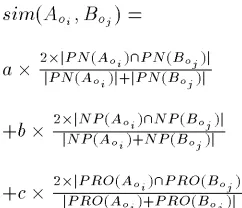
into subsets. In this article, and for the sake of simplicity, we assume that the task is restricted to coreference between noun phrases, and consider a partition into three subsets, namely, from the most to the less specific, the set of proper names, PN(S), the set of noun phrases with a lexical head, NP(S), and the set of pronouns and possessives, PRO(S). However, our approach and our system are not restricted to specific expressions and partitions.5Given two coreference chains,
A
o i andB
o
j, we require
our similarity measure to comply to the following condi-tions:
i. if
A
oi andB
oj are identical, then their similarity is 1.If they have no element in common, then their similar-ity is 0
ii. the similarity between
A
oiandB
oj should benormal-ized by the length (i.e. the number of expressions) of
A
o iandB
o j
5Actually, up to five categories may be used in the current
pri-One notes that two coreference chains have been identified:
R
o10
=
fMandela;his;he
gR
o2 0=
f
AfricanAmericans;Africans
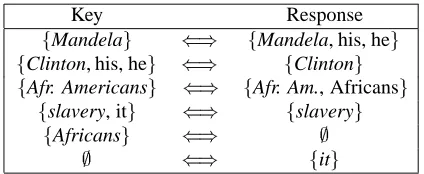
gThe correspondence between this response and the key is given in Figure 3 below. For each pair of coreference chains in correspondence, we select an expression belonging to the two sets to represent their common referent. We also select a representative expression for each chain associated with the empty set. All these representative expressions (in ital-ics) correspond to the trivial denotation assignment evoked earlier (section 3).
Key Response
fMandelag () fMandela, his, heg fClinton, his, heg () fClintong fAfr. Americansg () fAfr. Am., Africansg
fslavery, itg () fslaveryg fAfricansg () ;
; () fitg
Figure 3: Correspondence example
From this correspondence, one derives the following deno-tation assignments. In the key:
his denotes “Clinton” he denotes “Clinton” it denotes “slavery”
and in the response:
his denotes “Mandela” he denotes “Mandela”
Africans denotes “African Americans”
leaving aside trivial denotation assignments such as Man-dela denotes “ManMan-dela”.
5.1. Recall and precision
The denominator in the recall measure is the total num-ber of denotation assignments in the key (
possible
). The denominator in the precision measure is the total number of denotation assignments in the response (actual
). As for a given referential chainA
oi, the number of denotationas-signment isj
A
oij;
1
, we have:possible =
P oi(
j
K
oij;
1)
actual =
P oj(
j
R
oj j;
1)
It is possible that the maximum correspondence maps some coreference chains in the key and/or in the response to an empty set. The empty set is not a referential chain: both the sum for
possible
andactual
are based only on the dis-course referents associated to the referential chains of each of the two annotations in turn.Recall and precision are then defined in a standard way:
recall =
P oi
(
j
K
oi \C
(K
o i
)
j;
1)
Poi
(
jK
o i
j;
1)
precision =
P o
j
(
jR
oj \C
(R
oj
)
j;1)
Poj
(
jR
oj j;
1)
Even though written differently, the numerators in the re-call and precision measures correspond to the same num-ber, namely the number of correct denotation assignments. A denotation assignment
DA
in the response is correct if it exists in the key. There is no such denotation assignment in our example, so both recall and precision are equal to: 0/3 = 0. This score reflects the idea that the two pronouns his and he do not refer to Mandela and African Americans and Africans are not the same people; in all aspects, the response annotation is wrong.5.2. Substitution, over- and undergeneration
One may want to analyse further the errors in an anno-tation, which can be done in our system using three mea-sures inspired by the ones developed for the MUC Named Entity Task (Chinchor, 1995): “overgeneration”, “under-generation” and “substitution”. To obtain these measures, we count the number of
incorrect
,spurious
andmissing
denotation assignments.A denotation assignment “
e
idenoteso
i” in the responseis incorrect if there exists in the key a denotation assign-ment “
e
i denoteso
j” ando
j is different fromo
i. Theex-pression had to be included in a coreference chain, but it has not been included in the correct one. In our example, the denotation assignments
his denotes “Mandela” he denotes “Mandela”
are incorrect. The two pronouns should have been included in the referential chain denoting “Clinton”.
A denotation assignment “
e
idenoteso
i” in the responseis spurious if there is no denotation assignment to
e
iin thekey. The expression has been taken by the correspondence mechanism as the representative expression of a key ref-erential chain which is mapped to the empty set in the re-sponse. To a spurious denotation assignment corresponds the failure to identify a discourse referent. In our example, the denotation assignment in the response
Africans denotes “African Americans”
is spurious. As a consequence of this spurious coreference link, the discourse referent denoted by Africans in the key is not identified in the response.
A denotation assignment “
e
i denoteso
i” in the key ismissing in the response if there is no denotation assign-ment to
e
i in the response. The expression has been takenby the correspondence mechanism as the representative ex-pression of a response referential chain which is mapped to the empty set. To a missing denotation assignment cor-responds the identification in the response of a discourse referent which does not exist in the key. In our example, the denotation assignment in the key
is missing in the response. As a consequence of this miss-ing coreference link, the response states that it denotes a discourse referent which does not exist in the key.
The sum of incorrect, spurious and missing denotation assignments constitutes the total number of errors
E
:E = incorrect + spurious + missing
This number is the denominator in the substitution, over-generation and underover-generation measures. The numbers of incorrect, spurious and missing denotation assignments are the numerator in the substitution, overgeneration and un-dergeneration measures, respectively. For our example, we obtain the following values:
substitution = incorrect=E = 2=4 = 0:5
overgeneration = spurious=E = 1=4 = 0:25
undergeneration = missing=E = 1=4 = 0:25
As a whole, these three measures aim at giving information about the capacity a system has to identify the expressions which should be included in a coreference chain, regardless of which coreference chain they should be in. High over-generation indicates a tendency to include in coreference chains expressions which should not. High undergeneration indicates a tendency not to include in coreference chains expressions which should. High substitution indicates that the expressions which should be included in coreference chains are well identified, but are included in the wrong coreference chains.
6.
Discussion
Having detailed our evaluation method for the corefer-ence resolution task, we now compare it with three exist-ing methods: the scorexist-ing scheme developed by Vilain et al. (1995) for the MUC-6 coreference task, Popescu-Bellis et al.’s “Exclusive Core MR” method (1998) and Bagga et al.’s B-CUBED algorithm (1998).
6.1. Toy examples
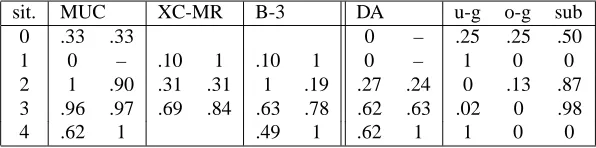
In order to better understand the different evaluation methods, it will be useful to have the scores they produce on some (fictitious) examples: first, our example text (Fig-ure 1) and the corresponding response (Fig(Fig-ure 2), then four different response scenarios for the MUC-6 walkthrough article.6
The MUC-6 walkthrough article is a Wall Street Jour-nal text for which a key annotation of coreference chains is supplied. The key annotation contains 15 coreference chains with a total of 147 expressions. 50 of these 147 ex-pressions are pronouns; these are spread out into 5 of the 15 coreference chains. We will assume the following four situations:
1. each of the 147 expressions belong to a singleton refer-ential chain in the response (no coreference resolution is done);
6Some of these scenario have originally been proposed by
Popescu-Bellis et al. (1998).
2. the 147 expressions are grouped into a unique corefer-ence chain
R
o10in the response;
3. the 97 non-pronominal expressions are correctly grou-ped into 15 coreference chains which correspond to the 15 chains in the key and the 50 pronouns are grouped into an extra 16th coreference chain
R
o160;
4. the 97 non-pronominal expressions are correctly grou-ped into 15 coreference chains which correspond to the 15 chains in the key but the system does not at-tempt to interpret the 50 pronouns, so that each of them belongs to singleton referential chain.
The recall and precision measures output by each method for each of these situations are given in Table 1. Integers in the first column refer to the five situations (0 for our exam-ple text, 1 to 4 for the four walkthrough article situations). The next four columns give the recall and precision mea-sures (left and right, respectively) for each method.7 The last column gives the undergeneration, overgeneration and substitution measures output by our system. In some cases, we are unable to provide the values for XC-MR and B-3. The symbol “–” indicates that the denominator of the pre-cision measure is 0.
6.2. Vilain et al.
The scoring scheme developed by Vilain et al. (1995) for the MUC-6 coreference task is grounded on the idea of coreference links. A coreference chain
A
oi is an
equiva-lence set defined byj
A
oi
j;
1
coreference links. The basicidea is to count as errors only the minimal number of links to be added between coreference chains in each of the an-notations in order to make them identical. Let us assume we have two coreference chain annotations
A
andB
, con-taining the following coreference chains, respectively:A
o1=
f
1;2;3;4;5
gB
o 10
=
f
1;2;3
gB
o 20
=
f4;5
gThe coreference chain
A
o1 is defined by four coreferencelinks and the two coreference chains
B
o 10 and
B
o2
0 by two
and one link, respectively. In order to have the two anno-tations correspond, one would just need to add one corefer-ence link between
B
o1 0 and
B
o 2
0: this missing link
consti-tute the only error according to Vilain et al.’s scheme. This error is a recall error if
A
is the key and a precision error ifB
is the key.The Vilain et al. scoring scheme, in our view, mixes up two different aspects of coreference resolution: the identi-fication of the expressions which should be included in a coreference chain, on the one hand, and the inclusion of these expressions in the proper coreference chains. This is apparent in the difference between the scores produced for situations 3 and 4: when the system groups together the 50 pronouns (3) instead of leaving them as singletons (4), the MUC score significantly increases both in recall and preci-sion, while in our system, only precision is affected.
7
sit. MUC XC-MR B-3 DA u-g o-g sub
0 .33 .33 0 – .25 .25 .50
1 0 – .10 1 .10 1 0 – 1 0 0
2 1 .90 .31 .31 1 .19 .27 .24 0 .13 .87 3 .96 .97 .69 .84 .63 .78 .62 .63 .02 0 .98
4 .62 1 .49 1 .62 1 1 0 0
Table 1: Recall and precision scores according to different methods
In other words, the MUC scoring scheme gives some credit to the fact that the expressions which should be in-cluded in a coreference chain have been recognized, regard-less of what discourse referents the expressions are said to denote. Our evaluation method distinguishes the two as-pects: the capacity a system has to recognize the expres-sions which should be included in coreference chains is captured by the three error analysis measures. As a rule, as texts often contain some large coreference chains, to high values for the substitution measure, will correspond fairly high scores with the MUC method (this is the most manifest in situation 2).
We would argue that the MUC scoring scheme is biased by a focus on the coreference resolution process rather than on the coreference resolution result. In particular, “the re-call (resp. precision) error terms are found by calculating the least number of links that need to be added to the re-sponse (resp. the key) in order to have the [coreference chains] align.” The evaluation in MUC so appears to be set in terms of “what do I need to do in order to get the correct result?”, and not in terms of “is the result I obtain correct or not?”. It might very well be the case that on some oc-casions little would have to be done in order to change the result from quite wrong to fairly correct, but this should be a distinct issue. We believe that the evaluation method we propose allow this distinction: recall and precision analy-ses the result and three separate measures are used for error analysis.
One may add that our method also avoids a shortcom-ing of the MUC scorshortcom-ing scheme pointed out by Bagga et al. (1998), namely that this scheme “penalizes the preci-sion numbers equally for all type of errors”. As we rely on a one-to-one correspondence, an errant coreference link which group together two large coreference chains will lead to lower scores than an errant link between a large and a small coreference chain.
6.3. Popescu-Bellis et al.
Popescu-Bellis et al. (1998), arguing that the results output by Vilain et al.’s method may be “counterintuitive” in some cases, proposed “three new methods for evaluating reference resolution”, among which the second one, called “Exclusive Core-MRs”, bears strong similarities with ours. The authors determine a one-to-one correspondence be-tween the coreference chains of the two annotations and count a recall error if an expression belonging to
K
oi doesnot belong toC
(K
oi
)
in the response, and a precision errorif an expression belonging to
R
oj in the response does notbelong toC
(R
oj
)
.The method used by Popescu-Bellis et al. to derive their
correspondence can be seen as a special case of our method: by setting
a = b = c = 1
and removing the denomina-tors in our similarity measure, and by using the heuristic presented above, one arrives at the same correspondence. In this respect, our method presents the advantage of for-malizing an optimal correspondence between annotations. Moreover, we make use of descriptive specificity to find the optimal correspondence, thus ensuring that chains in cor-respondence can be interpreted as denoting the same dis-course referent. This property is not necessarily true for other correspondences. For example, given the response proposed for our example text (Figure 2), the method de-signed by Popescu-Bellis et al. will identify the following correspondence for the chains containing the expressions Clinton and Mandela in the two annotations:Key Response
fMandelag () ;
fClinton, his, heg () fMandela, his, heg
; () fClintong
Figure 4: Exclusive Core-MR Correspondence
It appears that the “Exclusive Core-MR” method does not guarantee, contrary to our descriptive specificity based method, that the chains in correspondence can be inter-preted as denoting the same discourse referent.
One may also note that, while we determine the number of denotation assignments to be evaluated as the cardinal number of a coreference chain minus one, thus discarding trivial denotation assignments, Popescu-Bellis et al. does give some credit to these assignments, so that the recall score in his scheme cannot be 0.8 This explains the dif-ferences between the XC-MR and DA scores in situations 1 and 3 even though both systems yield the same correspon-dence.
6.4. Bagga et al.
In order to correct the shortcoming, mentioned above, in the scoring scheme developed by Vilain et al. (1995), Bagga et al. (1998) proposed a measure, called B-CUBED, which integrates two new ideas:
1. each expression receives a score for recall and preci-sion
2. the overall recall and precision scores are based on a weighted average of scores for each expression and/or each class.
8
The first point allows to consider an expression within the coreference chain it is placed in as a whole, and thus to normalize its contribution with respect to the length of the chain. This has the effect of differentiating different error types in terms of precision. The second point, on the other hand, is barely mentioned by the authors, who seem to re-tain a scheme assigning equal weights to each expression and/or coreference chain.
It is certainly possible to make use of the relative de-scriptive specificity of expressions, within B-CUBED, by assigning them different weights in the computation of the overall recall and precision. Thus, links between noun phrases, proper names and pronouns can be treated differ-ently, and the emphasis can be put on a certain type of ex-pressions for a particular task. However, B-CUBED still aims at evaluating coreference links between expressions, regardless of the discourse referent they denote, and thus suffers from the same weaknesses as Vilain et al.’s scoring scheme.
7.
Conclusion
In this paper, we have introduced a new evaluation scheme for coreference resolution, which, rather than set-ting the problem in terms of linking expressions together, sets it in terms of assigning a denotation to expressions. In order to keep closer to what human interpretation of the re-sults would be, we take into account the descriptive speci-ficity of expressions, thus providing ourselves with an ac-cess to discourse referents. Having this acac-cess to discourse referents, we are then able to determine the correspondence between two coreference chain annotations with respect to their denotation, from which the correctness of the denota-tions assigned to expressions may then be evaluated. We would argue that this method, contrary to previously pro-posed methods, offers a clearer distinction between an eval-uation with respect of the expected result of coreference resolution (recall and precision) and an evaluation of the coreference resolution process (error analysis measures).
In any case, our proposition may illustrate the fact that when a different light is cast on a particular object, this ob-ject might look different.
8.
Acknowledgements
Thanks to Pierre Isabelle for very useful comments on this paper. F. Trouilleux’ s work is partly supported by a grant from the Association nationale de la recherche tech-nique (CIFRE 050/98).
9.
References
Ahuja, R. K., T. L. Magnanti, and J. B. Orlin, 1993. Network Flows - Theory, Algorithms, and Applications. Prentice Hall.
Bagga, A. and B. Baldwin, 1998. Algorithms for scor-ing coreference chains. In Proceedscor-ings of the LREC’98 Workshop on Linguistic Coreference. Granada, Spain. Chinchor, N. and G. Dunga, 1995. Four scorers and seven
years ago. The scoring method for MUC-6. In Proceed-ings of the Sixth Message Understanding Conference (MUC-6). San Francisco: Morgan Kaufmann.
Dowty, D., R. Wall, and S. Peters, 1981. Introduction to Montague Semantics. Dordrecht, Holland: D. Reidel Publishing Company.
Grishman, R. and B. Sundheim (eds.), 1995. Proceedings of the Sixth Message Understanding Conference (MUC-6). San Francisco: Morgan Kaufmann.
Hirshman, L. and N. Chinchor, 1998. MUC-7 corefer-ence task definition. version 3.0. In Proceedings of the Seventh Message Understanding Conference (MUC-7). http://www.muc.saic.com/: Science Applications Inter-national Corporation.
Passoneau, R., 1997. Applying reliability metrics to co-reference annotation. Technical Report CUCS-017-97, Columbia University, Department of Computer Science. Popescu-Bellis, A., 1999a. ´Evaluation num´erique de la
r´esolution de la r´ef´erence: critiques et propositions. Traitement Automatique des Langues, 40(2):117–142. Popescu-Bellis, A., 1999b. L’´evaluation en g´enie
linguis-tique: un mod`ele pour v´erifier la coh´erence des mesures. Langues: Cahiers d’´etudes et de recherche franco-phones, 2:151–162.
Popescu-Bellis, A. and I. Robba, 1998. Three new methods for evaluating reference resolution. In Proceedings of the LREC’98 Workshop on Linguistic Coreference. Granada, Spain.