The Extended Lexicon: Language Processing as Lexical Description
Roger Evans
Natural Language Technology Group Computing Engineering and Mathematics
University of Brighton, UK [email protected]
Abstract
In this paper we introduce an approach to lexical description which is sufficiently powerful to support language processing tasks such as part-of-speech tagging or sentence recognition, traditionally consid-ered the province of external algorith-mic components. We show how this ap-proach can be implemented in the lexi-cal description language, DATR, and pro-vide examples of modelling extended lex-ical phenomena. We argue that applying a modelling approach originally designed for lexicons to a wider range of language phenomena brings a new perspective to the relationship between theory-based and empirically-based approaches to language processing.
1 The Extended Lexicon
A lexicon is essentially a structured description of a set of lexical entries. One of the first tasks when developing a lexicon is to decide what the lexical entries are. This task has two dimensions: what kind of linguistic object does a lexical entry de-scribe, and what does it say about it. So for exam-ple, one might decide to produce a lexicon which describes individual word instances, and provides the orthographic form and part-of-speech tag for each form. It is the first of these dimensions that is most relevant to the idea of the Extended Lexicon. Conventionally, there are two main candidates for the type of linguistic object described by a lexi-con: word forms (such assings,singing,sang1), corresponding to actual words in a text and lex-emes (such asSING,WALK,MAN), describing ab-stract words, from which word forms are somehow derived. Choosing between these two candidates
1Typographical conventions for object types:
ABSTRACT,
LEXEME,wordform,instance,code.
Figure 1: A simple inheritance-based lexicon
might be a matter of theoretical disposition, or a practical consideration of how the lexicon is pop-ulated or used.
In the Extended Lexicon, we introduce a third kind of linguistic object, called word instances (or just instances), consisting of word forms as they occur in strings (sequences of words, typically sentences). For example, a string such asthe cats sat on the mat contains two distinct instances of the wordthe. the cats slept contains further (dis-tinct) instances of theandcats. However the in-stances in a repetition ofthe cats sat on the mat
are the same as those in the original (because in-stances are defined relative to strings, that is, string types not string tokens).
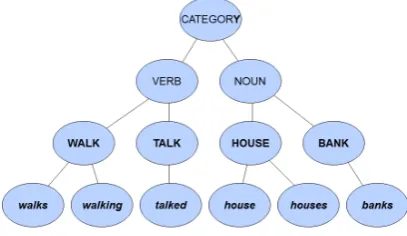
So in an extended lexicon, the lexical entries are word instances, and the lexicon itself is a struc-tured description of a set of word instances. In or-der to explore this notion in more detail, it is help-ful to introduce a more specific notion of a ‘struc-tured description’. We shall use an inheritance-based lexicon, in which there are internal abstract ‘nodes’ representing information that is shared by several lexical entries and inherited by them. Fig-ure 1 shows the structFig-ure of a simple inheritance-based lexicon with some abstract high-level struc-ture (CATEGORY, VERB, NOUN), then a layer of lexemes (WALK, TALK,HOUSE,BANK), and be-low that a layer of word forms (walks, walking,
talked, house, houses, banks, as well as many more). Thus the word form walks inherits in-formation from the lexemeWALK, which inherits from abstract node VERB and then abstract node CATEGORY.
Figure 2: A lexicon with instance nodes
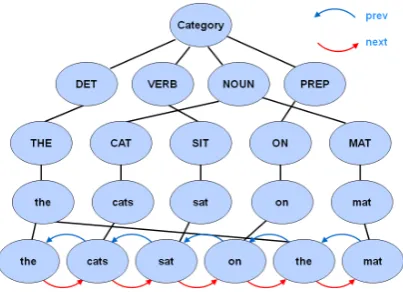
Adding instances to this model is in principle very easy: one just creates a further layer of nodes below the word forms. The word instances are now the lexical entries, and the word form nodes are abstractions, representing information shared by all instances of the form. Figure 2 shows a first pass at adding an instance layer to a lexicon supporting the string the cats sat on the mat, by adding new nodes for each instance in the string. However, what is missing from this figure is any representation of the string as a whole – noth-ing distnoth-inguishes the two instance nodesthefrom each other, or indeed from their parent word form nodethe, and nothing identifies them as members of a specific string. One way this information could be added is simply by stipulating it: each instance node could have a feature whose value is the string, and another whose value is the index in the string of the current instance. However, in the Extended Lexicon, we adopt a structural solution, by linking the instance nodes of a string together into a chain, using inheritance linksprev (‘pre-vious’) andnextto inherit information from this instance’s neighbours in the string. Diagrammati-cally, we represent this as in figure 3.
To summarise, in the Extended Lexicon model, a lexicon is an inheritance-based structured de-scription of a set of word instances. This notion simultaneously captures and combines two impor-tant modelling properties: first, that instances of the same word share properties via an abstract word form node, and second that the lexicon
im-Figure 3: A simple Extended Lexcion, with in-stance nodes linked into a chain
plicitly encodes word strings, as maximal chains of linked instances.
2 The Extended Lexicon in DATR
2.1 DATR in brief
DATR (Evans and Gazdar, 1996) is a lexical de-scription language originally designed to model the structure of lexicons using default inheritance. The core descriptive unit in DATR is called a node, which has a unique node name (capitalised) and has associated with it a set of definitional path equations mapping paths (sequences of features) onto value definitions.
DOG:
<cat> == noun <form> == dog.
Figure 4: DATR description – version 1
Figure 4 is a simple example of DATR code. This fragment defines a node calledDOGwith two path equations, specifying that the (syntactic) category isnoun, and the (morphological) form isdog.
NOUN:
<cat> == noun <form> == "<root>". DOG:
<> == NOUN:<> <root> == dog.
Figure 5: DATR description – version 2
Figure 5 provides a slightly more complex def-inition. In this version, there is an abstract node,
NOUN, capturing information shared between all nouns and a new definition for<form>which is defined to be the same as the path<root>. DOG
de-and hence<form>. Second, these assertions do not need to make direct reference to other lexical definitions – they are entirely local toA. Finally, these assertions do not alter the definition of the instance nodes – the only properties unique to an instance node are its parent node and its previous and next instance nodes.
This last point has considerable practical im-portance. In the Extended Lexicon the number of lexical entries (instances) is unbounded, since the number of possible word strings is unbounded. This is not significant problem as long as it is pos-sible to provide an effective procedure for spec-ifying instance definitions for any desired string dynamically. But this is straightforward: for each string create instance nodes such as shown in fig-ure 7 with unique (but arbitrary) names for each node. The definition of each of these nodes re-quires only the names of the previous and next instance nodes and the name of the parent word form node. The former are known to the specifi-cation algorithm, and various conventions are pos-sible for locating the word form node; in figure 7 we assume the word form itself, capitalised, is the name of the node.
3 Examples
3.1 Part of speech tagging
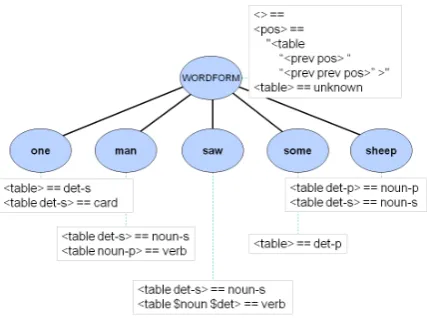
A more challenging task is part-of-speech (POS) tagging. Conventionally, POS taggers are config-ured as applications which are applied to texts and use either rule-based algorithms (eg (Brill, 1992)) or statistical algorithms (eg (Garside, 1987)) to provide POS tags for each word in the text. In the Extended Lexicon approach, POS tagging is conceived as a sequence of inferences required to determine the value of the feature path<pos>for a given instance node. As before, the definition is provided entirely by abstract nodes. Figure 9 presents a simple abstract lexicon with five word form nodes and one common root node. Each node is annotated with DATR code to support sim-ple POS tagging.
The definition of the <pos> path is provided at the root node, WORDFORM, and inherited by all other nodes. It defines <pos> to be the value"<table "<prev pos>" "<prev prev pos>" >". In other words, to determine
posuse the lookup tabletable, indexed with the
posof the previous two words. The lookup tables are defined on a per-word form basis, but inherit
Figure 9: POS tagging
the default definition (the value unknown) from the root when not specified. Finally the root node also specifies a catch-all empty value (<> == ) for unspecified paths (including <prev> paths fromWord1).
With just these definitions, the lexicon defines
<pos> values for the word form nodes without access to any context (so the<prevpaths return nothing). The<pos> for oneisdet-s (singu-lar determiner), for man, saw, and sheep, it is
unknown(inherited from WORDFORM), and for some, it isdet-p. The tables vary this behaviour for instances according to previous context: one becomes acardif preceded by adet-s,manis anoun-sif preceded by adet-s, and averbif preceded by anoun-p.sawmakes use of the full context: if preceded bydet-sit is anoun, but it is averbif preceded by a noun and before that a determiner4.someis always a plural determiner, andsheeptakes its number from the preceding de-terminer.
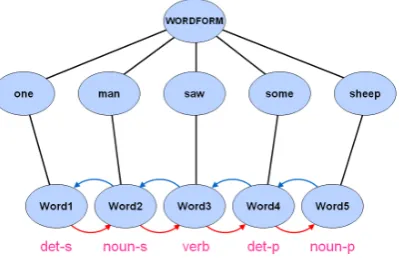
Figures 10 and 11 show what happens when we add word instances, linked together into strings. The two strings, one man saw some sheep and
some sheep man one saw, use exactly the same ab-stract definitions, but derive different POS values for each word.
In this example, it is interesting to note that the POS inference model is specified in one place. It could easily be changed, for example to index on the previous three parts-of-speech, or to use word forms instead of parts-of-speech etc., and could be overridden with a specialised definition for sub-classes of words (for example, open class versus
Figure 10: POS mapping for one man saw some sheep
Figure 11: POS mapping forsome sheep man one saw
closed class words). In addition the table defini-tions can take advantage of both the longest sub-path principle (ignoring previous context they do not care about), and the inheritance hierarchy to produce compact yet highly detailed POS map-pings.
3.2 Syntactic recognition
Similar techniques can also be applied to the task of syntactic recognition, which we exemplify for the case of regular languages (Hopcroft and Ull-man, 1979)5. A simple approach is to take a context-free grammar for a regular language and transform it into left-regular form, where every rule has a rightmost lexical daughter and at most one other non-lexical daughter. Figure 12 illus-trates the process for a simple context-free gram-mar. The key steps are expanding any non-lexical final daughters, introducing new non-terminals to make rules binary, and weeding out redundant pro-ductions.
In this form, the grammar rules can be
trans-5The techniques described in this paper are at least pow-erful enough to recogniseanbn, a non-regular language.
Figure 12: Transforming a grammar into left-regular form
formed into lexical features. For example, the ruleS → NP VIcan be interpreted as “VI com-pletes an S if the previous word comcom-pletes an NP”. This can be captured by introducing a path
<completes $cat>(for any non-terminal cat-egory$cat), which is true for an instance node if that instance is the final lexical item of the cor-responding non-terminal. Then the feature defi-nitions in figure 13 correspond to the application of the rules. The root node specifies that by de-fault all <completes> paths are false. The word form nodes have two kinds of definitions: for lexical categories or unary productions, simply set the corresponding<completes>pathtrue. For binary productions, this instance completes the parent category if the previous instance com-pletes the left daughter.
Figure 13: The grammar implemented as recogni-tion features
Figure 14: Recognising phrases in john saw the man
4 Discussion
The examples above show some of the potential for the Extended Lexicon approach: with a quite small change to the notion of a lexical entry, sub-stantive language processing tasks can be con-strued as lexical description. Lexical description languages like DATR were designed to bring or-der to a domain, the lexicon, which exhibits quite a lot of apparent disorder – many regularities, but also sub-regularities, irregularities, strange corner-cases etc..6 In the Extended Lexicon we bring those descriptive techniques to bear on language processing tasks more broadly, implicitly claim-ing that grammar is less orderly than grammar-ians sometimes suggest. Of course, statistical approaches to language processing have similar goals: statistical techniques are a powerful tool for modelling ‘messy’ systems. And indeed many properties of our model have statistical echoes: in-heritance relations which provide symbolic ana-logues of backing off or smoothing etc. In the POS example above, the processing task was mapped to a table lookup distributed across a lexical hier-archy. An interesting next step would be to learn that table from corpus data, identifying how much context was required for different situations, how to generalise effectively from individual cases etc. This would be empirically-based but purely sym-bolic NLP.
The approach taken here has some similari-ties to various forms of Dependency Grammar
6
More recent work on lexical description, such as LMF (Francopoulo et al, 2006) andlemon(McCrae et al, 2012), is more concerned with representation and standardisation of surface lexical entries rather than deeper lexical generalisa-tions, and uses less powerful inference mechanisms such as description logics.
(Mel’cuk, 1988), in particular because it does not include an explicit notion of phrase structure, in the grammatical sense. However, the Extended Lexicon is intended as a modelling tool, rather than a linguistic theory, and it has no explicit no-tion of dependency, or any kind of relano-tionship be-yond word adjacency.
Construction Grammar is a family of linguis-tic theories with a common theme that they do not make a sharp distinction between lexicon and grammar. Instead, they have a single framework which can represent words, phrases and sentences and can easily combine idiosyncratic phenomena with regular compositional processes. A recent manifestation of Construction Grammar, Sign-Based Construction Grammar, or SBCG (Boas and Sag, 2012), uses the unification-based type-theoretic framework of HPSG (Pollard and Sag, 1994) to provide a formal foundation for Con-struction Grammar. Although this framework is essentially monostratal in a similar way to the Ex-tended Lexicon, it is far from lexically-oriented, making use of a considerable range of grammati-cal description mechanisms to constrain the over-all behaviour of the system, in the same way that HPSG does. In essence it has absorbed the lexicon back into the grammar, rather than vice versa.
5 Future directions
The examples presented here are hugely simpli-fied. In current work the Extended Lexicon ap-proach is being applied to Text Mining and Senti-ment Analysis, with a more sophisticated layered treatment of the relationships between instances. The core principle remains the same: that lan-guage can be described in terms of the behaviour of word instances and word adjacency relations, out of which the behaviour of whole sentences emerges.
References
Hans Boas and Ivan A. Sag (eds.). 2012. Sign-Based Construction Grammar. CSLI Publications, Stan-ford.
Eric Brill. 1992. “A simple rule-based part of speech tagger”. In Proceedings of the third conference on Applied Natural Language Processing (ANLC ’92). Association for Computational Linguistics, Strouds-burg, PA, USA,
Roger Evans and Gerald Gazdar. 1996 “DATR: a Language for Lexical Knowledge Representation.”
Computational Linguistics, 22(2), pp. 167–216.
Gil Francopoulo, Monte George, Nicoletta Calzolari, Monica Monachini, Nuria Bel, Mandy Pet, and Claudia Soria 2006 “Lexical markup framework (LMF).” International Conference on Language Re-sources and Evaluation – LREC 2006Genoa
Roger Garside. 1987. “The CLAWS Word-tagging System.” In: R. Garside, G. Leech and G. Samp-son (eds), The Computational Analysis of English: A Corpus-based Approach. Longman, London.
John E. Hopcroft and Jeffrey D. Ullman. 1979. Intro-duction to Automata Theory, Languages, and Com-putation. Addison-Wesley.
John McCrae, Guadalupe Aguado-de-Cea, Paul Buite-laar, Philipp Cimiano, Thierry Declerck, Asunción Gómez-Pérez, Jorge Gracia, Laura Hollink, Elena Montiel-Ponsoda, Dennis Spohr and Tobias Wunner, 2012. “Interchanging lexical resources on the se-mantic web.” Language Resources and Evaluation, 46(4). pp. 701–719 Springer
Igor A. Mel’cuk. 1988. Dependency Syntax: Theory and Practice. State University of New York Pres, Albany, NY.