Representing General Relational Knowledge in ConceptNet 5
Robert Speer and Catherine Havasi
MIT Media Lab
20 Ames St., Cambridge MA 02139 [email protected], [email protected]
Abstract
ConceptNet is a knowledge representation project, providing a large semantic graph that describes general human knowledge and how it is expressed in natural language. This paper presents the latest iteration, ConceptNet 5, including its fundamental design decisions, ways to use it, and evaluations of its coverage and accuracy.
Keywords:ConceptNet, common sense, semantic networks
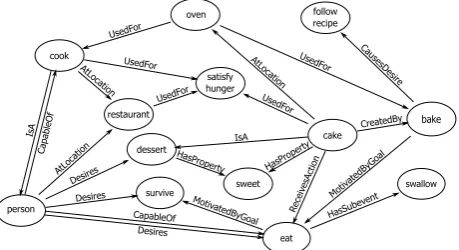
Figure 1: A high-level view of the knowledge ConceptNet has about a cluster of related concepts.
1.
Introduction
ConceptNet is a knowledge representation project, provid-ing a large semantic graph that describes general human knowledge and how it is expressed in natural language. The scope of ConceptNet includes words and common phrases in any written human language. It provides a large set of background knowledge that a computer application work-ing with natural language text should know.
These words and phrases are related through an open do-main of predicates, describing not just how words are lated by their lexical definitions, but also how they are re-lated through common knowledge. For example, its knowl-edge about “jazz” includes not just the properties that de-fine it, such asIsA(jazz, genre of music); it also includes incidental facts such as
• AtLocation(jazz, new orleans)
• UsedFor(saxophone, jazz), and
• plays percussion in(jazz drummer, jazz).
A cluster of related concepts and the ConceptNet assertions that connect them is visualized in Figure 1.
ConceptNet originated as a representation for the knowl-edge collected by the Open Mind Common Sense project (Singh et al., 2002), which uses a long-running interactive
Web site to collect new statements from visitors to the site, and asks them target questions about statements it thinks may be true. Later releases included knowledge from sim-ilar websites in other languages, such as Portuguese and Dutch, and collaborations with online word games that automatically collect general knowledge, yielding further knowledge in English, Japanese, and Chinese.
ConceptNet gives a foundation of real-world knowledge to a variety of AI projects and applications. Previous versions of ConceptNet (Havasi et al., 2007) have been used, for ex-ample, to build a system for analyzing the emotional con-tent of text (Cambria et al., 2010), to create a dialog system for improving software specifications (Korner and Brumm, 2009), to recognize activities of daily living (Ullberg et al., 2010), to visualize topics and trends in a corpus of unstruc-tured text (Speer et al., 2010), and to create public infor-mation displays by reading text about people and projects from a knowledge base (Havasi et al., 2011).
ConceptNet provides a combination of features not avail-able in other knowledge representation projects:
• Its concepts are connected to natural language words and phrases that can also be found in free text.
• It includes not just definitions and lexical relation-ships, but also the common-sense associations that or-dinary people make among these concepts. Its sources range in formality from dictionaries to online games.
• The concepts are not limited to a single language; they can be from any written language.
• It integrates knowledge from sources with varying lev-els of granularity and varying registers of formality, and makes them available through a common repre-sentation.
signs to that edge. The more positive the weight, the more solidly we can conclude from these sources that the asser-tion is true; a negative weight means we should conclude from these sources that the assertion isnottrue.
As in previous versions of ConceptNet, an assertion that re-ceives a negative weight is not an assertion whose negation is true. It may in fact be a nonsensical or irrelevant asser-tion. To represent a true negative statement, such as “Pigs cannot fly”, ConceptNet 5 uses negated relations such as
/r/NotCapableOf.
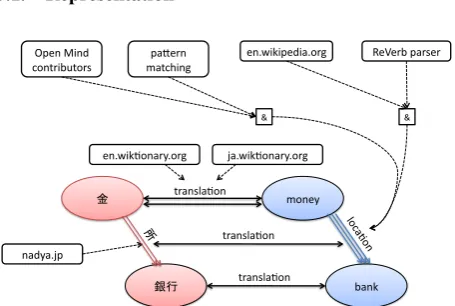
Conjunctions are necessary to assign credit appropriately to the multi-part processes that create many assertions. For example, an OMCS sentence may be typed in by a hu-man contributor and then interpreted by a parser, and we want the ability to examine the collected data and deter-mine whether the human is a reliable data source as well as whether the parser is. As another example, relations mined from Wikipedia using ReVerb depend on both the reliability of Wikipedia and of ReVerb.
3.2. Relations
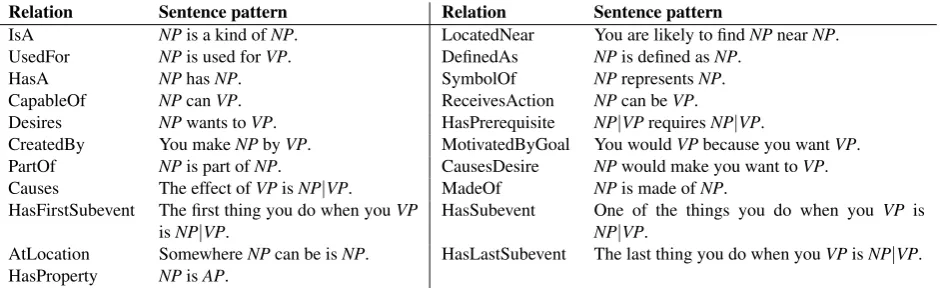
In addition to free-text relations, the standard interlingual relations we identify in ConceptNet appear in Table 1.
3.3. Granularity
The different knowledge sources that feed ConceptNet 5 represent concepts at different levels of granularity, espe-cially in that concepts can be ambiguous or disambiguated. Concepts are often ambiguous when we acquire them from natural-language text. Other concepts are explicitly dis-ambiguated by a resource such as WordNet or Wiktionary. ConceptNet 5 contains, for example, the ambiguous node
/concept/en/jazz. A source such as Wiktionary might define it as a noun, yielding the more specific con-cept /concept/en/jazz/n, and it may even distin-guish the word sense from other possible senses, yielding
/concept/en/jazz/n/musical_art_form. These URLs do not represent the same node, but the nodes they represent are highly related. This indicates that when we add a way to query ConceptNet 5, de-scribed in Section 4.1., we need to structure the index so that a query for /concept/en/jazz also matches
/conceptnet/en/jazz/n/musical_art_form.
3.4. Normalizing and aligning concepts
ConceptNet deals with natural-language data, but it should not store the assertion that “a cat is an animal” in a com-pletely different way than “cats are animals”. Therefore, we represent each concept usingnormalizedversions of the concept’s text. The process for creating a normalized con-cept differs by language. Some examples are:
• running, in English:/c/en/run
• correr, in Spanish:/c/es/corr
• rennen, in Dutch:/c/nl/renn
• run (baseball), a disambiguated English word:
/c/en/run/n/baseball
Normalization inherently involves discarding information, but since ConceptNet 3, we have ensured that this informa-tion is stored with the asserinforma-tion and not truly discarded. Ev-ery edge that forms evEv-ery assertion is annotated with how it was expressed in natural language. That information is important in some applications such as generating natural-language questions to ask, as the AnalogySpace system (Speer et al., 2008) does with ConceptNet data; it is also very important so that if we change the normalization pro-cess one day, the original data is not lost and there is a clear way to determine which new concepts correspond to which old concepts.
The normalization process in English is an extension of WordNet’s Morphy, plus removal of a very small number of stopwords, and a transformation that undoes CamelCase on knowledge sources that write their multiple-word concepts that way. In Japanese, we use the commonly-used MeCab algorithm for splitting words and reducing the words to a dictionary form (Kudo et al., 2004), and in many European languages we use the Snowball stemmer for that language (Porter, 2001) to remove stop words and reduce inflected words to a common stem.
3.5. URIs and Namespaces
An important aspect of the representation used by Concept-Net 5 is that it is free from arbitrarily-assigned IDs, such as sequential row numbers in a relational database. Every node and edge has a URI, which contains all the informa-tion necessary to identify it uniquely and no more.
Concepts (normalized terms) are the fundamental unit of representation in ConceptNet 5. Each concept is repre-sented by a URI that identifies that it is a concept, what language it is in, its normalized text, and possibly its part of speech and disambiguation. A concept URI looks like
/c/en/run/n/basement.
The predicates that relate concepts can be multilingual re-lations such as/r/IsA: this represents the “is-a” or “hy-pernym” relation that will be expressed in different ways, especially when the text is in different languages.
Processes that read free text, such as ReVerb, will produce relations that come from natural language and cannot be aligned in any known way with our multilingual relations. In this case, the relation is in fact another concept, with a specified language and a normalized form. In the text “A bassist performs in a jazz trio”, the relation is/c/en/ perform_in.
The fact that interlingual relations and language-specific concepts can be interchanged in this way is one reason we need to distinguish them with the namespaces /r/ and
/c/. The namespaces are as short as possible so as to not waste memory and disk space; they appear millions of times in ConceptNet.
extrac-Relation Sentence pattern Relation Sentence pattern
IsA NPis a kind ofNP. LocatedNear You are likely to findNPnearNP. UsedFor NPis used forVP. DefinedAs NPis defined asNP.
HasA NPhasNP. SymbolOf NPrepresentsNP.
CapableOf NPcanVP. ReceivesAction NPcan beVP. Desires NPwants toVP. HasPrerequisite NP|VPrequiresNP|VP.
CreatedBy You makeNPbyVP. MotivatedByGoal You wouldVPbecause you wantVP. PartOf NPis part ofNP. CausesDesire NPwould make you want toVP. Causes The effect ofVPisNP|VP. MadeOf NPis made ofNP.
HasFirstSubevent The first thing you do when youVP
isNP|VP.
HasSubevent One of the things you do when you VP is
NP|VP.
AtLocation SomewhereNPcan be isNP. HasLastSubevent The last thing you do when youVPisNP|VP. HasProperty NPisAP.
Table 1: The interlingual relations in ConceptNet, with example sentence frames in English.
tion rules such as /s/rule/reverb, human contrib-utors such as /s/contributor/omcs/rspeer, and curated projects such as/s/wordnet/3.0.
An assertion URI contains all the information necessary to reconstruct that assertion. For example, the assertion that “jazz is a kind of music” has the URI/a/[/r/IsA/,/ c/en/jazz/,/c/en/music/]. By using the special path components/[/and/]/, we can express arbitrary tree structures within the URI, so that the representation even includes assertions about assertions. The advantage of this is that if multiple branches of ConceptNet are devel-oped in multiple places, we can later merge them simply by taking the union of the edges. If they acquire the same fact, they will assign it the same ID.
Edge IDs also take into account all the information that uniquely identifies the edge. There is no need to represent this information in a way from which its parts can be recon-structed; doing so would create very long edge IDs, which are unnecessary because edges are the lowest level of data the parts of every edge are right there in the edge’s data structure. Instead, edge IDs are the hexadecimal SHA-1 hash of all the unique components, separated by spaces: its assertion URI, its context, and its conjoined sources in Uni-code sorted order. The 160-bit SHA-1 hash provides more than enough room to be unique over even a large number of edges, is shorter than the data contained in the edge it-self, and can be queried to get an arbitrary subset of edges, which is very useful for evaluation.
4.
Storing and accessing ConceptNet data
As ConceptNet grows larger and is used for more purposes, it has been increasingly important to separate the data from the interface to that data. A significant problem with Con-ceptNet 3, for example, was that the only way to access it was through the same Django database models that created it.
ConceptNet 5 fully separates the data from the interface. The data in ConceptNet 5 is a flat list of edges, available in JSON or as tab-separated values. A flat file is in fact the most useful format for many applications:
• Many statistics about ConceptNet can be compiled by iterating over the full list of data, which neither a
database nor a graph structure is optimized for.
• A subset of the information in each line of the flat file is the appropriate input for many machine learn-ing tools.
• A flat file can be easily converted to different formats using widely-available tools.
• A CSV flat file can be used as a spreadsheet.
• It is extremely easy to merge flat files. It is sometimes sufficient simply to put them in the same directory and iterate over both. If deduplication is needed, one can use highly optimized tools to sort the lines and make them unique.
However, a flat file is not particularly efficient for querying. A question such as “What are the parts of a car?” involves a very small proportion of the data, which could only be found in a flat file by iterating over the entire thing. Thus, we build indexeson top ofConceptNet 5.
4.1. Indexes
Currently, we index ConceptNet 5 with a combination of Apache Solr and MongoDB. We provide access to them through a REST API, as well as transformations of the data that a downstream user can import into a local Solr index or MongoDB database. The Solr index seems to be the most useful and scalable, and its distributed queries make it simple to distribute it between sites, so it is the primary index that we currently use. For example, we can maintain the main index while our collaborators in Taiwan maintain a separate index, including up-to-date information they have collected, and now a single API query can reach both.
Using the Solr server, we can efficiently index all edges by all lemmas (normalized words) they contain and prefixes of any URIs they involve. A search for rel:/r/PartOf
and end:/c/en/wheel OR end:/c/en/wheel/*
4.2. Downloading
ConceptNet’s usefulness as a knowledge platform depends on its data being freely available under a minimally restric-tive license, and not (for example) tied up in agreements to use the data only for research purposes. ConceptNet 5 can be downloaded or accessed through a Web API at its web site, http://conceptnet5.media.mit.edu, and may be redistributed or reused under a choice of two Creative Commons licenses.
The flat files containing ConceptNet 5 data are avail-able at: http://conceptnet5.media.mit.edu/ downloads/
Python code for working with this data, transforming it, and building indexes from it is maintained on GitHub in the “conceptnet5” project: https://github.com/ commonsense/conceptnet5.
5.
Evaluation
To evaluate the current content of ConceptNet, we put up a website for 48 hours that showed a random sample of the edges in ConceptNet. It showed the natural language form of the text (which was machine-generated in the cases where the original data was not in natural language) and asked people to classify the statement as “Generally true”, “Somewhat true”, “I don’t know”, “Unhelpful or vague”, “Generally false”, and “This is garbled nonsense”. Peo-ple were invited to participate via e-mail and social media. They were shown 25 results at a time. We got 81 responses that evaluated a total of 1888 statements, or 1193 if “Don’t know” results are discarded.
All participants were English speakers, so we filtered out statements whose surface text was not in English. State-ments that translate another language to English were left in, but participants were not required to look them up, so in many cases they answered “Don’t know”.
We have grouped the results by dataset, distinguishing edges that come from fundamentally different sources. The datasets are:
• Existing ConceptNet: statements previously col-lected by Common Sense Computing Initiative projects, which can be found in ConceptNet 4.
• WordNet: connections from WordNet 3.0.
• Wiktionary, English-only: monolingual informa-tion from the English Wikinforma-tionary, such as synonyms, antonyms, and derived words.
• Wiktionary, translations: translations in Wiktionary from some other language to English. As these are nu-merous compared to other sources, we kept only 50% of them.
• DBPedia: Triples from DBPedia’s
instance types en dataset. As these are numerous compared to other sources, we kept only 25% of them.
• Verbosity: Statements collected from players of Ver-bosity on gwap.com.
• ReVerb: Filtered statements extracted from ReVerb parses of a corpus of Wikipedia’s front-paged articles.
• GlobalMind translations: translations of entire as-sertions between languages.
We also separated outnegative edges, those which previ-ous contributors to ConceptNet have rated as not true, con-firming that most of them are rated similarly now.
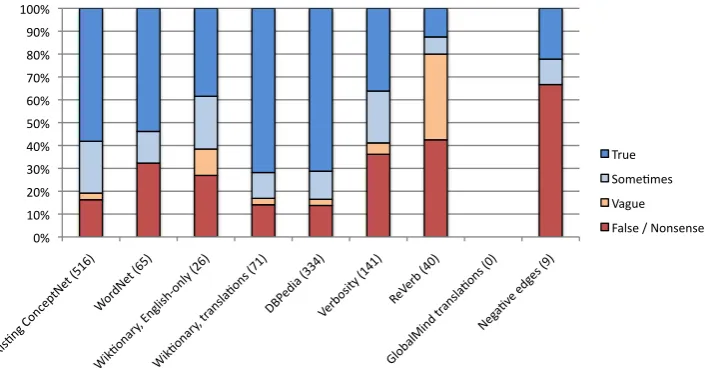
The breakdown of results appears in Table 2. Their relative proportions are graphed in Figure 3.
We can see that people often answered “Don’t know” when faced with very specific knowledge, which is to be expected when presenting expert knowledge to arbitrary people. In-terestingly, existing ConceptNet data was rated better than WordNet data; perhaps WordNet edges inherently form as-sertions that sound too unnatural, or perhaps our English-language glosses of them are at fault. The processes of ex-tracting translations from Wiktionary and triples from DB-Pedia performed very well, while the ReVerb data – faced with the hardest task, extracting knowledge from free text – did poorly. The few negative-score edges were mostly rated as false, as expected, though 3 out of 9 of the respondents to them disagreed.
All the examples of higher-level assertions that translate as-sertions between languages were rated as “Don’t know”. A more complete evaluation could be performed in the future with the help of bilingual participants who could evaluate translations.
6.
References
Junia Anacleto, Henry Lieberman, Marie Tsutsumi, Vania Neris, Aparecido Carvalho, Jose Espinosa, and Silvia Zem-Mascarenhas. 2006. Can common sense uncover cultural differences in computer applications? In
Pro-ceedings of IFIP World Computer Conference, Santiago,
Chile.
S¨oren Auer, Christian Bizer, Georgi Kobilarov, Jens Lehmann, Richard Cyganiak, and Zachary Ives. 2007. DBpedia: A nucleus for a web of open data. In Karl Aberer, Key-Sun Choi, Natasha Noy, Dean Allemang, Kyung-Il Lee, Lyndon Nixon, Jennifer Golbeck, Pe-ter Mika, Diana Maynard, Riichiro Mizoguchi, Guus Schreiber, and Philippe Cudr´e-Mauroux, editors,The
Se-mantic Web, volume 4825 ofLecture Notes in Computer
Science, pages 722–735. Springer Berlin / Heidelberg.
Kurt Bollacker, Colin Evans, Praveen Paritosh, Tim Sturge, and Jamie Taylor. 2008. Freebase: a collaboratively cre-ated graph database for structuring human knowledge.
InProceedings of the 2008 ACM SIGMOD international
conference on Management of data, SIGMOD ’08, pages
1247–1250, New York, NY, USA. ACM.
Erik Cambria, Amir Hussain, Catherine Havasi, and Chris Eckl. 2010. SenticSpace: Visualizing opinions and sentiments in a multi-dimensional vector space. In
Knowledge-Based and Intelligent Information and
Martin F. Porter. 2001. Snowball: A language for stemming algorithms. Published online at http://snowball.tartarus.org/texts/introduction.html, October. Accessed 2011-10-24.
Push Singh, Thomas Lin, Erik T. Mueller, Grace Lim, Trav-ell Perkins, and Wan L. Zhu. 2002. Open Mind Com-mon Sense: Knowledge acquisition from the general public. InOn the Move to Meaningful Internet Systems, 2002 - DOA/CoopIS/ODBASE 2002 Confederated
Inter-national Conferences DOA, CoopIS and ODBASE 2002,
pages 1223–1237, London, UK. Springer-Verlag. Robert Speer, Catherine Havasi, and Henry Lieberman.
2008. AnalogySpace: Reducing the dimensionality of common sense knowledge. Proceedings of AAAI 2008, July.
Robert Speer, Catherine Havasi, Nichole Treadway, and Henry Lieberman. 2010. Finding your way in a multi-dimensional semantic space with Luminoso. In Proceed-ings of the 15th International Conference on Intelligent
User Interfaces.
Jonas Ullberg, Silvia Coradeschi, and Federico Pecora. 2010. On-line ADL recognition with prior knowledge.
InProceeding of the 2010 conference on STAIRS 2010:
Proceedings of the Fifth Starting AI Researchers’
Sym-posium, pages 354–366, Amsterdam, The Netherlands,
The Netherlands. IOS Press.
Mark van Assem, Antoine Isaac, and Jacco von Ossen-bruggen. 2010. Wordnet 3.0 in RDF. Published on-line at http://semanticweb.cs.vu.nl/lod/wn30/, Septem-ber. Accessed 2011-10-24.
Luis von Ahn, Mihir Kedia, and Manuel Blum. 2006. Ver-bosity: a game for collecting common-sense facts. In
Proceedings of the SIGCHI conference on Human
Fac-tors in computing systems, CHI ’06, pages 75–78, New