The relation between direct participation, organizational
commitment and turnover:
A test of the mediating role of organizational justice and Leader-member
exchange
Dirk Paul van Beem; 9807136
The relation between direct participation, organizational
commitment and turnover:
A test of the mediating role of organizational justice and Leader-member
exchange
A Master Thesis for the University of Twente
Study:
Industrial Engineering and Management (Technische Bedrijfskunde)
Supervisors:
Prof. Dr. J.C. Looise
Summary
This study examined the relation between satisfaction with direct participation, organizational commitment and turnover intention. The study was conducted among the employees of the University of Twente in The Netherlands. Because of the scarcity of properly educated personnel on the job market, reducing turnover intentions is important for the university. In the HRM-field a link has been suggested between direct participation and organizational commitment, organizational commitment is though to reduce turnover intention. From the literature followed that reciprocity in the relation between employees and the supervisor, who is the face of the organization (an HR agent), plays an important role in the relation between satisfaction with direct participation and organizational commitment. Organizational justice, consisting of the dimensions distributive justice, procedural justice, informational justice and interpersonal justice, and Leader-Member Exchange (LMX) were introduced to provide a better understanding of the relationship between satisfaction with direct participation and employee commitment to the organization. These factors are hypothesized as mediating variables in the relation between satisfaction with direct participation and organizational commitment. The relation between the supervisor and the employee also gets specific attention in the written personnel policy of the university, as well as direct participation by means of formal and informal meetings.
A questionnaire consisting of 96 items was developed to measure the variables. Then the questionnaire was emailed to employees of four faculties of the university: 1) the faculty of Engineering technology (CTW), 2) the faculty of Electrical Engineering, Mathematics and Computer Science (EWI), 3) the faculty of Behavioral Sciences (GW), 4) the School of Management and Governance (MB). The questionnaire included two dimensions for distributive justice, one focused on the degree to which employees have influence in (changes in) their function (DJCF), and another focused on personnel policies and practices, where respondents were asked to compare their situation with their colleagues’ (DJPP).
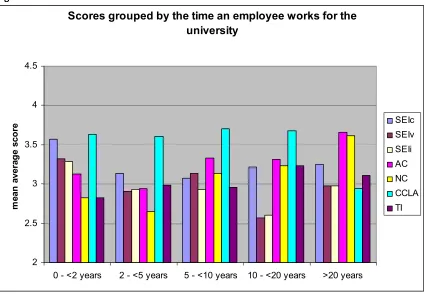
The analysis showed low scores (a three on a scale of five) for all variables; expect for informational an interpersonal justice, LMX and low alternative calculative commitment. These variables scored a four. Higher scores for satisfaction with direct participation were given by employees younger than 35 years old, employees who worked for less than two years for the university and employees who worked for less than two years in the present function. Employees who worked for the university for less than five years gave lower ratings for affective commitment and normative commitment. Employees with fixed-term employment contracts gave higher ratings for satisfaction with voice and influence and distributive justice (CF) and lower rating for affective and normative commitment. Turnover intention was highest for employees who work for the university between ten and twenty years and for employees who work in their present function between ten and twenty years.
Table of contents
Foreword___________________________________________________ 7
1
Introducing the subject of the study ________________________ 8
1.1 Introduction __________________________________________________________ 8
1.2 An exploration of the HRM field _________________________________________ 8
1.3 An exploration of direct participation, commitment and turnover intention_________ 9
1.4 Relevance of the study ________________________________________________ 10
1.5 Conclusion__________________________________________________________ 11
2
Literature study _______________________________________ 12
2.1 Introduction _________________________________________________________ 12
2.2 Participation_________________________________________________________ 12
2.3 Commitment ________________________________________________________ 14
2.3.1 Targets of commitment ____________________________________________________ 15 2.3.2 Bases of Commitment _____________________________________________________ 15 2.3.3 Commitment and turnover intention __________________________________________ 17
2.4 Extending the field ___________________________________________________ 17
2.4.1 Towards a reciprocal relation________________________________________________ 18 2.4.2 Leader-Member Exchange (LMX): the relation between a subordinate and the supervisor 19 2.4.3 Organizational Justice _____________________________________________________ 20
2.5 The research model ___________________________________________________ 23
2.6 Conclusion__________________________________________________________ 24
3
The organization: the University of Twente _________________ 26
3.1 Introduction _________________________________________________________ 26
3.2 The University of Twente ______________________________________________ 26
3.3 The personnel policy __________________________________________________ 27
4
Research design _______________________________________ 29
4.1 Introduction _________________________________________________________ 29
4.3 Measures ___________________________________________________________ 30
5
Analysis & results ______________________________________ 33
5.1 Introduction _________________________________________________________ 33
5.2 Data Exploration _____________________________________________________ 33
5.3 Moderator analysis ___________________________________________________ 39
5.3.1 Gender _________________________________________________________________ 39 5.3.2 Age____________________________________________________________________ 40 5.3.3 Faculty _________________________________________________________________ 42 5.3.4 How long do you work for the university? _____________________________________ 43 5.3.5 The time an employee works in his or her present function_________________________ 45 5.3.6 Function ________________________________________________________________ 48 5.3.7 Salary scale _____________________________________________________________ 51 5.3.8 Fixed-term contracts and indefinite contracts ___________________________________ 51 5.3.9 A division in part-time and full-time employees _________________________________ 54
5.4 Analyzing the relations ________________________________________________ 54
5.4.1 The supposed mediation effects of organizational justice and LMX __________________ 55 5.4.2 The relation between organizational commitment and turnover intention ______________ 57
5.5 Justice perception of four specific procedures ______________________________ 58
6
Conclusions and recommendations________________________ 65
6.1 Introduction _________________________________________________________ 65
6.2 Conclusions _________________________________________________________ 65
6.2.1 General conclusions _______________________________________________________ 65 6.2.2 The moderator analysis ____________________________________________________ 65 6.2.3 The hypotheses___________________________________________________________ 66 6.2.4 Conclusions and discussion _________________________________________________ 68 6.2.5 Four procedures __________________________________________________________ 70
6.3 Recommendations for the University of Twente_____________________________ 70
6.4 Suggestions for further research _________________________________________ 71
References _________________________________________________ 73
Literature _________________________________________________________________ 73
Visited websites ____________________________________________________________ 80
Foreword
In November 2006 I started with this study in an attempt to finish my study industrial engineering and management. The assignment was supervised by Prof. Dr. J.K. Looise and Dr. N. Torka, both employees of the department Operations, Organization and Human Resources (OOHR) at the School of Management and Governance, a faculty at the University of Twente.
The field of participation and commitment was completely new to me when I started this assignment. I had no idea of the complexity of the matter. The initial idea was to study the relation between direct participation and commitment, but during the process it seemed necessary to extend the field to turnover intention as well. Also the initial idea of a qualitative approach did not make it through to the end. In May of 2006 the switch was made to a qualitative approach to speed up the work.
I would like to take this opportunity to thank everyone who helped me with this study, most of all my supervisors, who showed a great deal of patience.
Enschede, August 26th 2007
1 Introducing the subject of the study
1.1 Introduction
This chapter provides a short overview of the field of HRM and, more specific, the place that participation, commitment and turnover intention have in this field. This overview provides a preliminary global research question. The last paragraph describes the relevance of the study.
1.2 An exploration of the HRM field
Because of an increase in competition, companies all around the world have to make better use of all the resources they have (e.g. Delaney & Huselid, 1996; De Nijs, 1998). An important way to improve performance of a company is to “unleash” the performance of the workforce. Pfeffer (1994) came with a list of sixteen best practices to do this and to gain competitive advantage. Twelve of these practices are already common practice in the Netherlands since the 1970s, due to for example the role of legislation, and the possibilities for achieving competitive advantages are limited (Boselie, Paauwe & Jansen, 2001). In stead of looking at best practices alone, effects of HRM-practices may depend on their context, the business strategy, and there are interaction effects on for example high involvement management on performance (Wood, 1999). Strauss (1998) suggests that good management of workers not only satisfies the needs of the organization, it also meets the needs of the workers and it has influences on the society as a whole. Also, participation of workers in the process of decision making, leads to higher levels of commitment and therefore to a higher worker and organization performance (Beer, Spector, Lawrence, Quinn Mills & Walton, 1985; Guest, 1997). However, the link between the two is not yet fully understood, partly because most research focuses on participation or commitment in relation to performance, in stead of the direct link between participation and commitment. It is, for example, not yet known what forms of participation lead to different forms of commitment, also knowledge lacks about what the crucial factors are in the process.
black box, in that it remains unclear what the critical factors are in the process. Guest admits that this is the case: “… we need to use a greater range of outcome measures if only to understand how and why HRM has an impact on financial results” (Guest, 1997, p. 274).
1.3 An exploration of direct participation, commitment and
turnover intention
Participation is an important subject in the HRM literature. In their model of the Human Resource System, Beer and colleagues (1985) place ‘Employee Influence’ in the center of the HRM policies, representing the central role that employee involvement should have. In The Netherlands and also in the rest of Europe indirect forms of participation (e.g. works councils, trade unions) are an established form of employee influence, but there is also an increase of direct participation practices (Gill & Krieger, 1999; Looise & Drucker, 2003). However, this increase in direct participation does not reduce representative participation practices as is sometimes suggested (for example by Marchington and Wilkinson, 2005). Instead, there is a neutral relation between direct and indirect participation; the amount of direct participation does not seem to influence the amount of indirect participation and vice versa (Gill & Krieger, 1999). The idea of upcoming direct participation fits into the development of the use of more flexible and individualized employer-employee relations (e.g. Looise & Van Riemsdijk, 2001). Goodijk & Sorge (2005, p. 8-9) predict that more direct participation will reduce employee’s commitment to the company and increases commitment to e.g. work. However, research on the matter (by e.g. Looise & Drucker, 2003; Torka, 2003) does not fully support this statement. As stated in the pervious paragraph, higher levels of organizational commitment might be interesting for organizations, because there are some beneficial effects, like an increase of effort displayed by the employees (Randall, 1990), a better work environment (Dundon, Wilkinson, Marchington, Ackers, 2005, on task performance in quality circles and autonomous work groups (Latham, Winters, Locke, 1994) and turnover (e.g. Vandenberghe, Bentein & Stinglhamber, 2004; Benson 2006).
This study tries to reveal new information about the link between direct participation and employee commitment and whether this leads to lower turnover intentions. There is an insufficient amount of time to either conduct a longitudinal survey to measure changes in commitment or to measure the performance changes in organizations because of changes in participation of commitment. Therefore the global question focuses on the relation between different forms of direct participation and the levels of commitment:
What factors influence the relation between direct participation and commitment What factors influence the relation between direct participation and commitment What factors influence the relation between direct participation and commitment
What factors influence the relation between direct participation and commitment and which and which and which and which of these variables is most the most important predictor of turnover int
of these variables is most the most important predictor of turnover intof these variables is most the most important predictor of turnover int
1.4 Relevance of the study
As stated before, participation plays a central role in the HRM field. But commitment also benefits society, according to Matieu and Zajac (1990, p. 171), they state it like this:
“… a society as a whole tends to benefit from employees’ organizational commitment in terms of lower rates of job movement and perhaps higher national productivity or work quality or both.”
Many companies in the Netherlands experience a shortage of personnel at the moment (CWI, 2007). Especially personnel with the proper education are hard to find, so trying to keep good personnel within the organization is one of the key goals for HR-managers. To study how employees might be retained by organizations, it is necessary to closely investigate and understand the relation between direct participation and commitment (Ramsey, 1993). This study wants to contribute to the knowledge of this relation, especially on what some of the most important factors in the relation are and whether it really relates with turnover intentions.
Commitment is not something that is present in some people and not in others, and organizations can not take advantage of it through recruitment and selection – by hiring predisposed committed employees – alone; in contrast it might be more effective to manage the experiences the employees endure following entry (Steers, 1977; Irving & Meyer, 1994; Masterson, Lewis, Goldman & Taylor, 2000). People come to work in organizations with certain needs, desires, skills, etcetera, and they expect a work environment where they can utilize these abilities (Steers, 1977). By providing such a work environment, organizations can increase the likelihood of increasing their employees’ commitment. Of course, this management of employee commitment requires knowledge and understanding of the commitment process. Purcell & Hutchinson describe the purpose of HR-practices and how they are supposed to lead to improved performance in ‘The People Management Performance Chain’.
The chain shows how one factor is supposed to lead to another. It shows that direct participation practices (actual practices) lead to certain forms and levels of employee attitudes (e.g. employee commitment and turnover intentions). Employee attitudes then lead eventually to employee behavior that is, hopefully, more valuable for the organization and, finally, preferred behaviors will increase unit or organizational performance. Among other factors, more committed employees are said to be more extrinsically motivated, they are more
Intended practices
Unit level outcomes Actual
practices
Perceptions of practices
Employee attitudes
Employee behavior
Figure 1.4 Figure 1.4Figure 1.4
likely to use their creativity and innovativeness in a positive way for the organization and are less likely to display behaviors like for example withdrawal or lateness (Mathieu & Zajac, 1990). The figure also shows that measuring actual practices and performance alone, will not give us a better understanding of the entire chain; the steps in between also need to be studied. It would be too much to deal with the entire chain in this study; the focus will be primarily on the relation between the third and fourth aspect of the chain.
The study was conducted among employees of the University of Twente. Universities have very specific demands for their employees. For example every professor must be promoted (i.e. possess the title of “doctor” or have a PhD degree). Individuals with PhD degrees can only be trained by universities. Attracting employees with this high level of education on a labor market where these employees are difficult to find and educate possible future employees are two of the key concerns of the university (University of Twente, 2003). It is therefore of great importance for the university to have some insights of the turnover intentions of its employees and to find some motives for these intentions.
1.5 Conclusion
2 Literature study
2.1 Introduction
This chapter deals with a literature study of the relevant topics. The first two paragraphs of this chapter deal with definitions of the terms direct participation and commitment. Then in the third paragraph, the two are brought together to show how they are related. To understand the relation between the two, the concepts of organizational justice and Leader-Member Exchange will be introduced. Finally the research model and the hypotheses will be proposed.
2.2 Participation
A wide variety of definitions can be found in the literature about participation. Baloff and Doherty (1989) speak of participation as “joint decision making”, suggesting that we should speak of participation when a decision is not taken by one individual. Strauss (2006) puts more emphasis on the employees and defines participation as “a process that allows employees to exercise some influence over their work and the conditions under which they work”. For Strauss, participation refers to giving employees actual influence, not just a feeling of influence. Cotton, Vollrath, Froggatt, Lengnick-Hall and Jennings (1988) conducted a meta-analysis of 91 empirical studies on the basis of which they classify five characteristic dimensions of participation.
1) Formal - informal participation. Formal participation is an “explicitly recorded, system of rules, and agreements imposed on or granted to the organization”. Three bases of legitimization of for formal participation treatments can be distinguished: 1) legal bases, like clauses in a country’s constitution, in national or regional laws; 2) contractual bases, like collective bargaining agreements on a national, sector, company of shop floor level; 3) management policies. Informal participation is a “nonstatutory, consensus emerging among interacting members”, these become legitimized through practice and evolving norms or customary procedures (Dachler & Wilpert, 1978).
2) Direct – indirect participation. Direct participation concerns the immediate personal involvement of members of an organization; indirect participation on the other hand means a mediated involvement of organization members (Dachler & Wilpert, 1978) 3) Level of influence. Marchington & Wilkinson (2005) call this the degree of participation.
(1969) and, finally, to six by an European research group called IDE in 1981 (Heller, 1998b). The continuum ranges from “(1) not involved … (2) informed beforehand, (3) informed beforehand and can give opinion, (4) opinion is taken into consideration, (5) take part in decision with equal weight … (6) decide on my own” (Heller, 1998a, 1435). 4) Content. Marchington & Wilkinson (2005) call this the range of participation. Locke and
Schweiger (1979) defined four categories for describing participation outcomes in term of the content of the decisions involved: 1) routine personnel functions (e.g. hiring, training), 2) work itself (e.g. task assignment, job design), 3) working conditions (e.g. hours of work, placement of equipment), 4) company policies (e.g. profit sharing, capital investments).
5) Short-term versus long-term. The commitment of the organization members can be affected by the duration of the participation process. Cotton at al. (1988) argue that individuals in short-term participation processes may be less committed than individuals involved in long-term participation processes, that may take several weeks or months.
Managers can have a variety of reasons to implement participative structures. For example because of societal change; employees demand to be involved (Goodijk & Sorge; 2005). There are also ‘negative’ motives for participation e.g. to increase management control (Baloff & Doherty; 1989) or to marginalize trade unionism in the workplace (Kochan, McKersie & Chalykoff, 1986). Strauss (1998) gives three broad reasons to support participation: humanistic, power-sharing and organizational efficiency. The humanistic argument enhances human dignity through e.g. personal growth and job satisfaction. Advocates of the power-sharing-argument support participation out of moral and ideological reasons. They favor a more equal distribution of power in the organization and support democratic decision making. The third is an economic argument. Participation leads to a more effective organization, because, for example, participation leads to better decision, higher more committed employees and better motivation. All these dimensions of participation can have many different shapes in companies. Some examples are given by Beer (1985): quality circles, self management groups, speak up or feedback programs, special councils, sensing groups, open-door policy, task forces of employee groups, employee relations personnel and ombudsmen, attitude surveys. Dundon, Wilkinson, Marchington & Ackers (2005) give other examples: electronic media, two-way communications suggestions schemes, attitude surveys, project teams.
1) satisfaction with communication, 2) satisfaction with voice, and 3) satisfaction with influence
There is a tendency only to consider worker perceptions of EIP practices themselves rather than analyze the relationship between the experience of EIP and worker views on broader aspects of work and organization (e.g. Marchington et al., 1992; Cotton, 1993; Bryson, 2004). However, seeking direct links between EIP and organizational outcomes is difficult: mediating factors exist between employee and organizational performance. Purcell and Georgiadis (2006) argue that to seek direct links between EIP and performance outcomes is a mistake and that we should instead focus on the links between employee experience of EIP and their attitudes to work. Marchington (1993) points out that when line managers are not enthusiastic and committed enough to implement participation in the organization, participation might not work at all. This is interesting since in forming experience on participation and attitudes, managers play in important role; Purcell & Hutchinson (2007) speak of a ‘symbiotic relationship’ between front line managers and HR practices. Line managers should in turn be supported by top management; they need to be properly trained and they need to have enough resources (e.g. financial, manpower or time) to implement participation practices (Torka, Van Woerkom & Looise, 2007). The manager should provide his or her subordinates with sufficient information, especially when this information involves unfavorable consequences (Folger & Bies, 1989). The role of the supervisors and/or managers will be discussed in greater detail in paragraph 2.4.2.
Paragraph 2.4 deals with how direct participation and commitment are related. As will be shown no simple relation exists. First however, in the next paragraph commitment will be discussed in greater detail.
2.3 Commitment
2.3.1 Targets of commitment
To start with the latter: the focus. Employee organizational commitment can be directed towards nearly anything, from entities to behaviors (Meyer & Herscovitch, 2001). The organizational focus receives the most attention in the organizational literature (e.g. Steers, 1977; Allen & Meyer, 1990; Meyer, Allen & Gellatly, 1990; Mayer & Schoorman 1992; Cohen & Kirchmeyer 1995; Somers, 1995). However, it was argued that the organization was “an abstraction that is represented in reality by co-workers, supervisors, subordinates, customers, and other groups and individuals that collectively comprise the organization” (Reichers, 1985, 472). For example, an employee can be also by committed to his task, or his colleagues. Becker (1992) was able to distinguish three foci of commitment that are important to employees: the global organization, the supervisor and the work group. In a more recent study focused on Dutch companies, Torka (2003) interviewed members of a Dutch metal company and she found four main foci of commitment: the work, the colleagues, an organization and the department. These foci are not the only ones, others may also exist, for example the commitment towards implementation of decisions (Korsgaard, Schweiger & Sapienza, 1995). Becker and Billings (1993) stated that the foci of commitment should match the area of interest, for example: “a company having problems due to low cooperation within work groups should attempt to heighten commitment to the supervisor and co-workers, rather than to top management or the organizational overall”. Later studies (by e.g. Vandenberghe, Bentein, Stinglhamber, 2004) found these same relations, for example, when employees felt that they were supported by their organization, they rewarded that with commitment to the organization.
2.3.2 Bases of Commitment
Commitment can be accompanied by three different bases. These bases describe the nature of the commitment bond towards the focus. Though in the literature many bases were described, recent literature focuses on affective commitment, calculative commitment and normative commitment. Literature studies show that these basis can indeed be seen in practice as distinct basis of commitment (e.g. Gellatly, Meyer, Luchak, 2006; Dawley, Stephens, Stephens, 2005). These bases will be discussed below.
Affective commitment Affective commitment Affective commitment Affective commitment
The first to be mentioned here reflects an affective or emotional attachment and is called affective commitment. When a person has an affective commitment, he or she has the desire to follow a course of action. Antecedents of this form of commitment are for example personal characteristics, job characteristics, work experiences and structural characteristics (Mowday, Porter, Steers, 1982). Meyer & Allen (1991) summarized the literature on these antecedents and found among many other factors, that (a person’s need for) autonomy, decentralization of decision making and participation in decision making are all linked to affective commitment.
found that good predictors of affective commitment were the earlier work experiences, and the employer can facilitate optimal working conditions. Meyer, Stanley, Hercovitch & Topolnytsky (2002) found a strong positive correlation between affective commitment and overall job satisfaction and job involvement. Somers (1995) found that higher levels of affective commitment relate negatively with absenteeism, and affective combined with normative commitment relates positively with the intent to remain. Interesting in this respect is the concept of Perceived Organizational Support (POS) (Eisenberger, Steven, Rexwinkel, Lynch, Rhoades, 2001). They state that, in accordance to the principle of reciprocity, workers ‘reward’ POS with affective commitment towards the company.
Calculative commitment Calculative commitment Calculative commitment Calculative commitment
The second form is called continuance commitment. A person wants to continue the relation with an organization, because the costs of leaving the organization are too high or he or she has no alternatives. Torka (2003) calls this form calculative commitment, because this gives a better description of the employee as a calculating individual. In this paper, this term is adopted. Calculative commitment might consist of two different sub-constructs, one based on the degree of personal sacrifice associated with leaving the organization, “High Sacrifices”, and one based on a lack of alternatives, “Low Alternatives” (McGee & Ford, 1987). The costs and investments are not actual costs, the perceptions by employees of these costs are important. Meyer, Allen & Gellatly (1990) suggest that employees who experience high calculative commitment, have a long term employment relation with their employer might want to rationalize and justify (affective commitment) their relation; in that case calculative commitment can encourage affective commitment. However, the studies that link calculative commitment to tenure give mixed results (Meyer & Allen, 1991). Calculative committed employees may show more effort in doing their task, since they are aware that they do not have any alternative (Van Breukelen, 1996).
Normative Commitment Normative Commitment Normative Commitment Normative Commitment
The literature study so far leads to the first hypothesis:
1. Satisfaction with employee influence is positively related to organizational commitment. The strongest relations exist between satisfaction with employee influence and affective and normative commitment, a weaker relation with calculative commitment.
2.3.3 Commitment and turnover intention
When employees have a high turnover intention, it does not automatically mean that they will actually leave the organization – intentions may or may not lead to behavior, it was found in a meta-analysis by Bluedorn (1982) that there were actually many significant positive relationships between leaving intentions and actual leaving behavior. To explain turnover intention, several authors related it to organizational commitment (e.g. Vandenberghe, Bentein & Stinglhamber, 2004; Benson 2006). Geurts, Schaufeli & Rutte (1999) found that organizational commitment fully mediated the relation between perceived inequity and turnover intention. Meyer and Allen (1991) suggest that high levels for each of the commitment bases might lead to lower turnover (intentions). Meyer et al. (2002) confirmed this, all dimensions on commitment bases correlated negatively with turnover intention. Hypothesis this leads to the following hypothesis:
2. Affective, normative and calculative commitment are negatively related to turnover intention
2.4 Extending the field
which participation takes place, in stead the perceived quality of direct participation must be taken into account.
The influence of direct participation on commitment is the central issue in this study. To understand the relation better, it is necessary to see that the relation is a reciprocal one in nature. This will be shown in the next paragraph.
2.4.1 Towards a reciprocal relation
Torka, Van Woerkom and Looise (2007) studied the factors that determine the success of direct employee involvement and direct participation, following a qualitative approach. They conducted interviews among a group of 60 employees of three Dutch companies. They found that ‘Direct Employee Involvement Quality’ (DEIQ) depends on the factors top management support, direct supervisor’s knowledge and skills, decent policies for direct employee involvement, and workforce characteristics. Like in the work of Purcell and Hutchinson (2007) the HR-function plays an important role in the relationship between these factors. In a reciprocal relation each partner shapes the other to some extent (Levinson, 1965). Also in this case there is a reciprocal relation where the employer has to give something to the employee to get their commitment: when employees feel they are supported by their organization, the felt obligation to care about the organization’s welfare and to act in the organization’s behalf is increased (Eisenberger, Armeli, Rexwinkel Lynch & Rhoades, 2001). The reciprocal nature of the relation will be explained below in greater detail.
Organizations often try to manage employee attitude and behavior using HR-policies and HR-practices, but it may not be these structures that have the greatest impact on employee behavior (Marks, 2001). An important part in employee commitment is the employees’ perceptions of the commitment of the organization towards the employees by the employees. This is called employer’s commitment (Torka, Van Riemsdijk & Looise, 2007). Employer’s commitment is mediated through organization’s agents, who act as an intermediary between the employer and employee. Agents can be for example supervisors, top managers, HR-managers. The idea that agents have an important role in mediating policies and practices with personnel goes back a long way. In 1965, Levinson mentioned the idea that an organizational agent, e.g. the supervisor, is the personification of the organization in the eyes of the employees, and also the reciprocity of their relationship. Later research confirmed this thesis (e.g. Skarlicki & Folger, 1997), if supervisors treat their employees with respect, the employees, in turn, will be more tolerant towards unfair behavior by the ‘organization’. One of the interesting points of Torka at al. (2007) was that HR-policies do not have to be all-excellent, in stead – in the Dutch context – fair and just HR-policies and HR-practices were the most important factors for employers being perceived as committed by their employees. Thus, employees’ judgments of HR-practices, is determined for a great deal by the fairness perceived by the employees.
discussed. This theory deals with interactions between supervisors and subordinates. Secondly the concept of organizational justice will be introduced. This deals with (perceived) the concept of organizational fairness.
2.4.2 Leader-Member Exchange (LMX): the relation between a subordinate and the supervisor
out-group, characterized by low trust, interaction, support and rewards. Previous literature showed that in-group members had a greater agreement regarding mutually experienced events and out-group members, in comparison to in-group members, are less inclined to spend time on decision-making, are less likely to volunteer for special assignments and for extra work and receive lower performance ratings by superiors (Dienesch & Liden, 1986). Furthermore, once subordinates are in-group members, they seem somewhat more willing to tolerate unfair pay distributions and procedures (Skarlicki & Folger, 1997). Perceived Quality of Direct Participation is related for the most part by (positive perceptions of) leadership behavior, and that leads directly to affective commitment (Purcell & Hutchinson, 2007). Also other studies report the positive relation form LMX to affective commitment (e.g. Wayne, Shore & Liden, 1997; Gerstner & Day, 1997). Other research has shown that people, who are in-group members, are more committed to the group (Tyler, 1989). Also high LMX quality is negatively related to turnover (Gerstner & Day, 1997) and turnover intentions (Vecchio & Gobdel, 1984). This leads to the second hypothesis:
3. Leader Member Exchange mediates the relation between employees’ influence satisfaction, and is related to all forms of commitment, most strongly correlated to affective commitment and less strongly correlated to normative and calculative commitment.
2.4.3 Organizational Justice
Organizational justice is an important factor in understanding the way in which people organizations function and it is intimately connected to the way decisions are being made and the way leaders interact with their subordinates (Tatum, Eberlin, Kottraba & Bradberry, 2003). Perceptions of justice can for example be formed when supervisors treat employees fairly when compared to others (Karregat & Steensma, 2005). When employees feel they are not being treated fairly, they will ‘compensate’ this by displaying unfavorable attitudes such as lower job satisfaction (Karregat & Steensma, 2005). The Research on organizational justice started with two forms of justice (e.g. Walker, Lind & Thibaut, 1979; Folger, 1987): distributive Justice and procedural Justice. Later, the model was expanded with two additional forms of justice (Colquitt J.A., Conlon D.E., Wesson M.J., Porter C.O.L.H. & Ng K.Y. 2001): Interpersonal justice and informational Justice. Colquitt (2001) showed that organizational justice is indeed best conceptualized as four distinct dimensions. The four forms of justice will be discussed in greater detail.
Distributive Distributive Distributive Distributive jjjjusticeusticeustice ustice
measurement of the construct is provided by Leventhal (1976), pointed towards changes in function, and this is later validated by Colquitt et al. (2001). Employees compare their efforts and outcomes, e.g. autonomy, salary (Geurts, 1994), to those of others in order to determine their distributive fairness perceptions, employees who felt involved in their job had higher fairness perceptions and were less likely to leave the organization (Van Yperen, Hagedoorn & Geurts, 1996). From the literature, is also becomes apparent that when fairness perceptions are high, employees are more tolerant in the case that certain outcomes of decision processes are not in their advantage (Colquitt & Chertkoff, 2002; Timmer, 2004). Also, when employees are allowed to have a voice in allocation decisions, they perceive the outcomes as fairer than when they are not allowed to be able to exercise influence (Folger, 1987). Finally DJ is related, though less strongly than procedural justice, to organizational commitment (Cohen-Charash & Spector, 2001).
Thus the following can be hypothesized:
4. Distributive justice mediates the relation between employees’ influence satisfaction especially influence, and commitment and it is more highly correlated with affective commitment than to normative commitment and calculative commitment.
Procedural j Procedural j Procedural j Procedural justiceusticeusticeustice
relation work can be found in the work of Cohen-Charash & Spector (2001), who suggested that fair procedures lead to people feel obliged to the organization. This might meant that procedural commitment leads to higher levels of normative commitment to the organization. The mere presence of procedures does not influence fairness perceptions, employees’ impressions of the fairness of their interactions with their supervisors is responsible for that (Moorman, 1991). PJ leads to enhanced leader evaluation (Colquitt, 2001; Alexander & Ruderman, 1987; McFarlin & Sweeney, 1992).
The results are presented in the following hypothesis:
5. Procedural justice mediates the relation between employees’ influence satisfaction, especially voice, and is more strongly related to affective commitment and less strongly related to normative and calculative commitment.
Interpersonal Justice and Informational Justice Interpersonal Justice and Informational Justice Interpersonal Justice and Informational Justice Interpersonal Justice and Informational Justice
The third and fourth forms of justice, Interpersonal justice (IPJ) and informational justice (IJ), are occasionally called interactional justice (IAJ). Research on IPJ and IJ is not yet very extensive, because these forms are relatively new. Interactional justice was previously a part of procedural justice, but Bies & Moag (1986) separated these when they focused on the interpersonal treatment when procedures are implemented. It was argued that interactions between people and the fairness of procedures should not be measured in the same variable (e.g. Greenberg 1990). IAJ is positively related to Organizational Citizenship Behavior (OCB). OCB is a work-related behavior, not related to the formal organizational reward system, and promote the effective functioning of the organization (Moorman, 1991). Also IAJ is related to organizational commitment, but not as strongly as PJ (Cohen-Charash & Spector, 2001). Supervisors should show adequate sensitivity and concern towards employees, this means treating them with dignity and respect. As a result, those employees seem more willing to tolerate the combination of an unfair pay distribution and unfair procedures that would otherwise maximally contribute to retaliatory tendencies (Skarlicki & Folger; 1997).
things that do not need to be promised over and over again, but it is about things that are self-evident, such as rules about interpersonal behavior.
As with IPJ, informational justice (IJ) was initially also a part of procedural justice (Greenberg, 1990). It was later argued that IJ is about the explanations provided to people that convey information about why procedures were used in a certain way or why outcomes were distributed in a certain fashion, and that it should also be a distinct form of justice (Colquitt et al., 2002). For this form of justice, the quality of the information given to employees and the way the information is presented are central issues. Good quality of information received by management and supervisors leads to higher IJ, and higher IJ leads to better relations to management (Kernan & Hanges, 2002). Colquitt and Chertkoff (2002) found that giving an explanation to employees for a decision taken in an organization, increases judgments of procedural and distributive fairness in case that the selected decisions by the employees were not upheld by the organization. Giving explanations for decisions that upheld the participants’ decisions did not increase fairness judgments. This means that organizations’ agents can increase perceived fairness when explaining outcomes that are both unfavorable and unexpected. It is not so that giving explanations as such, increases also task motivation; the expectations that employees have play an important role.
This leads to two hypotheses of interpersonal and informational justice:
6. Interpersonal justice mediates the relation between employees’ influence satisfaction especially voice and influence, and is more strongly related to affective commitment and less strongly related to normative and calculative commitment
7. Informational justice mediates the relation between employees’ influence satisfaction especially communication, and is more strongly related to affective commitment and less strongly related to normative and calculative commitment
When the forms of justice are compared, Colquitt at al. (2001) found that the first two dimensions, distributive and procedural justice, and the last two forms of justice are highly correlated. Furthermore, justice perceptions do not depend on gender, race, educational level and tenure (Cohen-Charash & Spector, 2001). From the above, it becomes apparent that Justice has a meditative effect on the linkage from direct participation to organizational commitment.
2.5 The research model
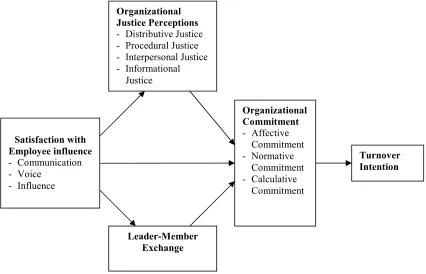
part moderated by the workforce characteristics, such as tenure or functional level (Torka, Van Woerkom & Looise, 2007). The main question was how direct participation relates to commitment and to turnover intention. The analysis of this question leads to the insight that to understand this relation the concepts of justice and leader-subordinate interaction are vital. The relations found can be visualized in the following model:
In this model the organizational commitment mind-set, consisting of affective, normative and calculative commitment, is displayed on the right hand side, satisfaction with employee influence on the left hand side. The model visualizes the supposed mediating roles of organizational justice, LMX on the link between satisfaction with employee influence and organizational commitment, and the relation between organizational commitment and turnover intention.
2.6 Conclusion
From the literature discussed in this chapter can be concluded that reciprocity between employees and the supervisor, who is the face of the organization, plays an important role in the relation between direct participation and organizational commitment. Organizational justice and Leader-Member Exchange (LMX) were introduced to provide a better
Figure 2.5-1: Research Model
Satisfaction with Employee influence
- Communication - Voice
- Influence
Organizational Justice Perceptions
- Distributive Justice - Procedural Justice - Interpersonal Justice - Informational
Justice
Leader-Member Exchange
Organizational Commitment
- Affective Commitment - Normative
Commitment - Calculative
Commitment
3 The organization: the University of Twente
3.1 Introduction
This chapter provides a description of the organization where the study takes place: the University of Twente in The Netherlands. The focus in the description will be on the personnel policy of the university (see pargraph 3.3), however first a more general description will be provided in paragraph 3.2.
3.2 The University of Twente
The University of Twente (UT) is situated in Enschede, The Netherlands and was founded n 1961. It is the only campus university in The Netherlands. The university had 7849 students registered in 2006, a fast growing number, considering in 2002 the number of registered students was 6583. In total 2326 employees were employed by the university in 2006, the average age was 40.1 years, the average number of years an employee works for the university is 9.4 years. The mission of University of Twente concentrates on education of excellent quality and research must be recognized on an international level and all derived activities that stimulate the economic and social environment of the region (Universiteit Twente, Jaarverslag 2006).
The university is bound by the national collective labor agreement. This is a national legislation that regulates for example (minimum) payment, working conditions and sick leave. An automated system, Academic Job Ranking (Universitait Functie Ordenen) was designed to determine the functional levels and functional profiles of individual employees, in this way determining also the salary of that person.
3.3 The personnel policy
The personnel policy of the University of Twente is written down in “Nota Personeelsbeleid 2003-2007” and in the “Nota focus in HRM beleid”. The information in this chapter is based on these reports. Recently the university was confronted with a number of changes in its environment. One of these changes is the adaptation of a new system of education. Recently The Netherlands adopted an international structure of Bachelor and Master studies. The new system means an extension of target groups; new students must be recruited not only through the traditional channels, also international students need to be recruited. Also quality of education and the possibility for freedom of choice for students are central issues in this new structure. Also through a change of the cost structure, the Dutch government intends to encourage universities to increase quality. These changes can be characterized by five points:
- A new dynamics in research and education
- Competition will be based on quality
- Flexibility in relation to demands from the environment
- International orientation (mainly Europe)
- Attract more resources from the private sector (market orientation)
Governmental cutbacks have lead to reorganizations in the university. One of the measures was a decrease in the number of faculties. The number of faculties was decreased to five. Also
University Board
Institute
Director
Institute council
Faculty
Dean
Faculty council
Service
Director
Service council University council
the personnel policy was reevaluated. In several meetings employees were asked for their opinion. Several points that came up in the meeting were an increase of mobility, improve the quality of supervisors, more uniformity on working conditions and the possibility for flexible rewards.
Based on the data above the personnel policy is characterized by two terms: development and flexibility. In order to let people develop the university monitors employees’ progression. In this manner employees can be provided with the proper development possibilities. Increasing flexibility means for example that employees can be given different contract forms for instance to combine a job at the university with a job somewhere else. Also the flexible reward systems need to be more transparent. Finally the supervisor needs to pay attention to the amount of work pressure that older employees experience.
The development of supervisors is central in the HRM-policy. There are formal meetings for supervisors and subordinate to discuss personal and work related matters, but also a supervisor must be open to informal meetings with subordinates. Supervisors need to set an example for their subordinates, for example in personal development issues.
4 Research design
4.1 Introduction
This chapter deals with the research design. Paragraph 4.2 gives a description of the method used for the study. Paragraph 4.3 deals with the measurement issues that are relevant for this study.
4.2 Research Method
A survey was conducted among employees of the University of Twente. The questionnaire was distributed among scientific personnel and non-scientific personnel. Four out of five faculties participated in the study:
- Faculty of Engineering technology (CTW); 324 employees,
- Faculty of Electrical Engineering, Mathematics and Computer Science (EWI); 706 employees,
- Faculty of Behavioral Sciences (GW); 265 employees,
- School of Management and Governance (MB); 402 employees.
The questionnaire was developed and distributed among the employees of the four faculties through email. As soon as the dean of a faculty expressed his willingness to cooperate, one contact person in each of the faculties sent the email to all the employees of that faculty. In the email employees were asked to fill in an online questionnaire by clicking on a hyperlink. The questionnaire was hosted by www.thesistools.com, an online service that provides a free opportunity for students to host questionnaires onlins. The mail was sent in Dutch only. The questionnaire existed of 96 items. The 96 items are on the subjects of satisfaction with employee involvement, organizational commitment, organizational justice leader-member exchange and turnover intention. Also nine items about employee characteristics were included.
4.3 Measures
In this paragraph the measurements per subject will be discussed. The entire questionnaire is presented in the appendix; in the remainder of this report the question will sometimes be referred to using number, these number can be found in this list in the appendix as well. Except for the employee characteristics, all items were scored on a 5-point Likert scale, ranging from 1 (low) to 5 (high).
Employee characteristics Employee characteristics Employee characteristics
Employee characteristics; items 1; items 1; items 1; items 1----9999
Nine items were included to determine the nature of the respondents. These items were the following:
- item 1: gender; male or female
- item 2: age; categories: < 25 years; 25 years - <35 years; 35 years - <45 years; 45 years - <55 years; >55 years
- item 3: the faculty where the respondent works; response options: CTW, EWI, GW and MB
- item 4: the time a respondent works for the University; categories: <2 years; 2 - <5 years; 5 - <10 years; 10 - <20 years; >20 years
- item 5: the respondent’s present function; OBP (support personnel); PhD; lecturer; researcher; university lecturer (UL); senior university lecturer (SUL); professor
- item 6: when the respondent stated he or she is OBP (support personnel), they were asked for their salary scale; response options: 1,2,…..15
- Items 7: the time a respondent works in his of her present function; categories <2 years; 2 - <5 years; 5 - <10 years; 10 - <20 years; >20 years
- Item 8: tenure; indefinite contract or fixed-term contract - Item 9: doe the respondent work full-time of part-time
The functions were taken from the personnel department from the University of Twente. Seven functional levels are distinguished: OBP (non-scientific personnel), PhDs, lecturers, researchers, university lecturers (UL), senior university lectures (SUL) and professors.
Satisfaction with employee inv Satisfaction with employee inv Satisfaction with employee inv
Satisfaction with employee involvement (SEI)olvement (SEI)olvement (SEI)olvement (SEI); items 10; items 10; items 10----21; items 10 212121
Organizational Justice Organizational Justice Organizational Justice
Organizational Justice; items 22; items 22; items 22----57; items 22 575757
Distributive justice was measured in two dimensions. The first dimension (items 22-25) consists of four items. The scale is a specification of distributive justice as developed by Leventhal (1976). The scale includes the items ‘to what extent does your (outcome) reflect the effort you have put into your work?’ and ‘to what extent is your outcome appropriate for the work you have completed?’, ‘to what extent does your outcome reflect what you have contributed to the organization’ and ‘Is your (outcome) justified, given your performance?’. This scale specifically measures justice perceptions of matters that directly deal with (changes) in function or work. This dimension will be referred to as distributive justice, change in function (DJCF).
In the second distributive justice dimension respondents were asked to compare themselves with their colleagues on personnel policy and personnel practice issues, such as salary, work variation and support. Seven items (no. 42 – 48) were developed by Geurts (1994), for example, two items (no. 49 – 50) were developed by Van Yperen, Hagedoorn & Geurts (1994) and three items (no. 51-53) were developed by Karregat & Steensma (2005). Respondents were asked to compare themselves with colleagues and give their opinion on whether they were better off (score five) or not (score one). Respondents’ judgments were asked on for example the following matters: ‘the amount of variation in your work’ (item 43), ‘the height of your work pressure’ (item 49) and ‘the quality of the physical work environment such as ergonomics, monitors, furniture and the arrangement of the work space’ (item 51).
Procedural justice was measured using seven items developed by Moorman (1991). These items include for example asking employees’ judgments of procedures designed to 1) collect accurate information necessary for making decisions and 2) provide opportunities to appeal or challenge the decision. These items were translated into Dutch by Professor Van den Bos. Informational justice was measured with two items from Bies & Moag (1986) (items 33 and 34), item 35 was added by the author, the last item is from Shapiro et al. (1994).
Interpersonal justice was a construction of five items. The first three (items 37, 38, 39) were developed by Bies & Moag (1986). In these items, respondents were asked whether their superiors treat them friendly, with dignity and with respect. The last two interpersonal justice items (no. 40, 41) were developed by Torka, Looise & Van Riemsdijk (2007). In these items, respondents were asked for their opinions to what extent they felt their supervisor was interested in personal and work related issues.
Also for items were included where the respondents were asked to judge four specific procedures (items 54-57). Three of these items (54, 55, and 56) were developed by Sweeney & McFarlin (1993). In these items respondents were asked to rate the judgment procedure (planning, progress and judgment cycle), the reward procedure and the promotion procedure (the procedure that is followed to obtain a function on a higher level). Item 57 is a new item, that was introduced to ask respondents to judge the selection procedure (the selection of new employees).
Leader Member Exchange Leader Member Exchange Leader Member Exchange
Leader Member Exchange (LMX) (LMX) (LMX) (LMX); items ; items ; items ; items 58585858----69696969
defense if I were “attacked” by others’, ‘I do work for my supervisor that goes beyond what is specified in my job description’ and ‘I admire my supervisor’s professional skills’.
Organizational Commitment Organizational Commitment Organizational Commitment
Organizational Commitment; items 70; items 70; items 70----92; items 70 9292 92
Organizational Commitment was measured using three dimensions, Affective Commitment (AC), Normative Commitment (NC) and Calculative Commitment (CC). Calculative commitment was again divided into Low Alternatives (CCLA) and High Sacrifices (CCHS). The dimensions were measured using items the items developed by Meyer and Allen (1991)
Turnover intention; items 93 Turnover intention; items 93 Turnover intention; items 93 Turnover intention; items 93----96969696
Turnover intention was measured using four items which were developed by Sanders (2002). One item that is included in this scale is for example ‘if it is up to me, I will still work for the UT in two years’ (item 94).
Possibility for comments Possibility for comments Possibility for comments Possibility for comments
5 Analysis & results
5.1 Introduction
In this chapter the results of the questionnaire will be presented and analyzed. Paragraph 5.2 provides an exploration of the data. Paragraph 5.3 analyses the moderator scores for each of the variables. Paragraph 5.4 analyzes the supposed relations. Finally, in paragraph 5.5, employees’ perceptions on four specific procedures within the organization are analyzed.
5.2 Data Exploration
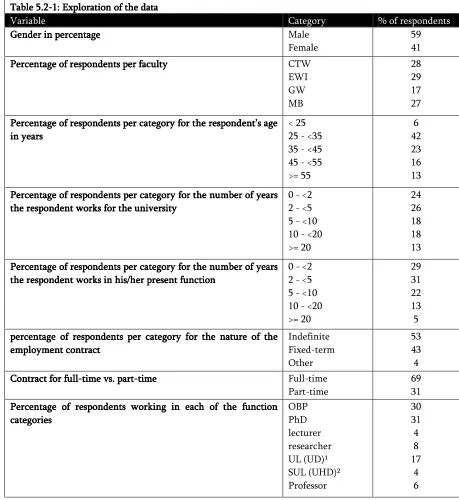
The data analysis will start with an exploration of the received data. The questionnaire was online from June 26th till July 25th. In this time-period 206 respondents completed the questionnaire, a response percentage of 12.1% (CTW: 16.7%; EWI: 7.9%; GW: 12.1%; MB: 12.9%). This percentage is rather low. Even though in the summer months the university is not closed completely, many employees go on holiday at this time of year. This was also a part of the feedback received by the contact persons at the faculties. So this might be the main reason for the low response rate. Also many employees at the university are non-Dutch speaking employees and therefore could not fill in the questionnaire, especially at the EWI faculty, where the response percentage is the lowest, many employees are non-Dutch. Many respondents started filling in the questionnaire did not complete it. A number of respondents (3) that did not complete the questionnaire stated that some questions were difficult to interpret and were too abstract. Finally some of the employees who received the questionnaire stated in the final ‘remarks section’ that they did not work at the university anymore, but still were interested in seeing the questionnaire. Finally, as one contact person from the faculty stated, employees receive request to cooperate in studies quite regularly, and therefore their willingness to cooperate might be low. To increase the response rate, a reminder email was sent one week after the first email was sent.
Table Table Table
Table 5.25.25.25.2----1111: : : : Exploration of the dataExploration of the dataExploration of the data Exploration of the data
Variable Category % of respondents
Gender in percentag Gender in percentagGender in percentag
Gender in percentageeee Male
Female
59 41 Percentage of respondents per faculty
Percentage of respondents per facultyPercentage of respondents per faculty
Percentage of respondents per faculty CTW
EWI
Percentage of respondents per category for the respondent’s age Percentage of respondents per category for the respondent’s age Percentage of respondents per category for the respondent’s age Percentage of respondents per category for the respondent’s age in years
Percentage of respondents per category for t Percentage of respondents per category for tPercentage of respondents per category for t
Percentage of respondents per category for the number of years he number of years he number of years he number of years the respondent works for the university
the respondent works for the universitythe respondent works for the university the respondent works for the university
0 - <2
Percentage of respondents per category for the number of years Percentage of respondents per category for the number of years Percentage of respondents per category for the number of years Percentage of respondents per category for the number of years the respondent works in his/her present function
the respondent works in his/her present functionthe respondent works in his/her present function the respondent works in his/her present function
0 - <2
Contract for fullContract for full
Contract for full----time vs. parttime vs. parttime vs. parttime vs. part----timetimetimetime Full-time Part-time
¹ : UL = University Lecturer; English translation for universitair docent (UD)
² : SUL = Senior University Lecturer; English translation for universitair hoofddocent (UHD)
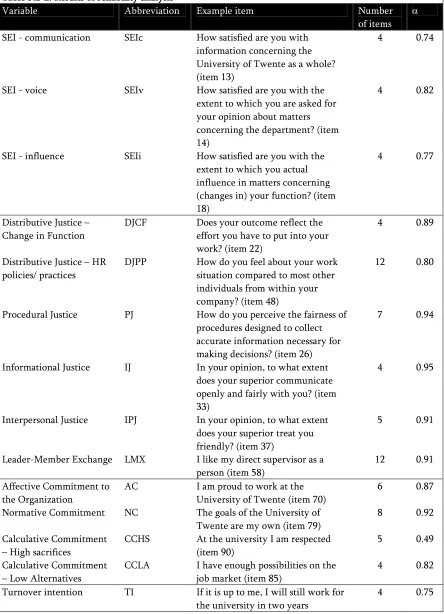
proposed by Nunnaly, except CCHS. The alpha value could be raised to 0.63 by removing items 91, 92 and 90 respectively. A higher alpha was not possible on the basis of these data. This means that, while 0.63 is lower than 0.7, that Calculative commitment for high sacrifices (CCHS) will not be included in the rest of the analysis. One of the items that measures turnover intention (item 94) had to be recoded. A score of five on the item actually meant a low intention to turnover. After recoding the variable that measures turnover intention is scored on a scale of 1… 5 with 1 meaning a low intention to turnover and 5 meaning a high intention to turnover. The value for alpha than is 0.75, which meets the criterion of 0.70 as proposed by Nunnaly (1978).
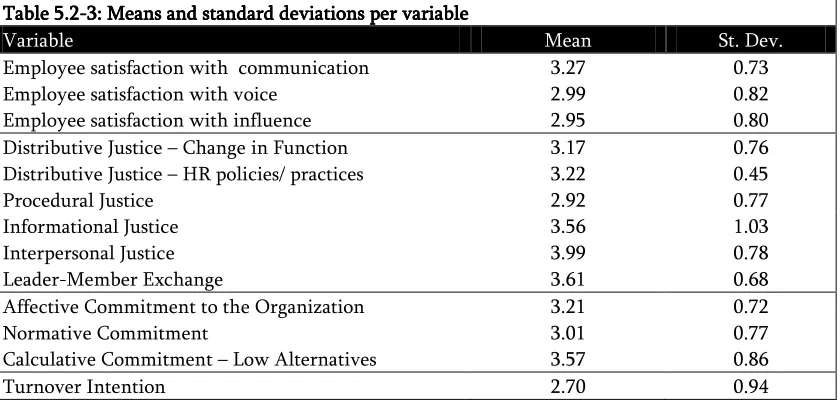
Table 5.2-3 contains the means and the standard deviations per variable. When rounded to one digit, most variables score a three. This means that some employees are satisfied and others are not, whereas in the case of informational justice, interpersonal justice, Leader-Member Exchange and calculative commitment low alternatives score a four, which means that on average employees are satisfied with these items. Turnover intention scores the lowest, however, when rounded to one digit, it is still a three.
Table Table Table
Table 5.25.25.25.2----2222: : : : ResultsResultsResults of reliability analysisResults of reliability analysis of reliability analysis of reliability analysis
Variable Abbreviation Example item Number
of items α
SEI - communication SEIc How satisfied are you with
information concerning the University of Twente as a whole? (item 13)
4 0.74
SEI - voice SEIv How satisfied are you with the
extent to which you are asked for your opinion about matters concerning the department? (item 14)
4 0.82
SEI - influence SEIi How satisfied are you with the
extent to which you actual influence in matters concerning (changes in) your function? (item 18)
4 0.77
Distributive Justice – Change in Function
DJCF Does your outcome reflect the
effort you have to put into your work? (item 22)
4 0.89
Distributive Justice – HR policies/ practices
DJPP How do you feel about your work
situation compared to most other individuals from within your company? (item 48)
12 0.80
Procedural Justice PJ How do you perceive the fairness of
procedures designed to collect accurate information necessary for making decisions? (item 26)
7 0.94
Informational Justice IJ In your opinion, to what extent
does your superior communicate openly and fairly with you? (item 33)
4 0.95
Interpersonal Justice IPJ In your opinion, to what extent
does your superior treat you friendly? (item 37)
5 0.91
Leader-Member Exchange LMX I like my direct supervisor as a person (item 58)
12 0.91
Affective Commitment to the Organization
AC I am proud to work at the
University of Twente (item 70)
6 0.87
Normative Commitment NC The goals of the University of
Twente are my own (item 79)
8 0.92
Calculative Commitment – High sacrifices
CCHS At the university I am respected (item 90)
5 0.49
Calculative Commitment – Low Alternatives
CCLA I have enough possibilities on the job market (item 85)
4 0.82
Turnover intention TI If it is up to me, I will still work for the university in two years
Table Table Table
Table 5.25.25.25.2----3333: : : : Means and standard deviations per variableMeans and standard deviations per variableMeans and standard deviations per variableMeans and standard deviations per variable
Variable Mean St. Dev.
Employee satisfaction with communication 3.27 0.73
Employee satisfaction with voice 2.99 0.82
Employee satisfaction with influence 2.95 0.80
Distributive Justice – Change in Function 3.17 0.76
Distributive Justice – HR policies/ practices 3.22 0.45
Procedural Justice 2.92 0.77
Informational Justice 3.56 1.03
Interpersonal Justice 3.99 0.78
Leader-Member Exchange 3.61 0.68
Affective Commitment to the Organization 3.21 0.72
Normative Commitment 3.01 0.77
Calculative Commitment – Low Alternatives 3.57 0.86
Turnover Intention 2.70 0.94
High sacrifice calculative commitment was not included as a variable in this study; however, the scores on the items might prove useful for the university. Therefore the mean scores and standard deviations are presented in Table 5.2-5. In the table can be seen that the mean scores are quite low. The score on the first item is 1.95; employees feel that they can earn more money somewhere else. Also the respondents to not find their terms of employment better than those of most other employees; the score on the second item is 2.72.
Table Table Table
Table 5.25.25.25.2----5555: Scores on Calculative Commitment High Sacrifices items: Scores on Calculative Commitment High Sacrifices items: Scores on Calculative Commitment High Sacrifices items: Scores on Calculative Commitment High Sacrifices items item
item item
item MeanMeanMeanMean Std. DeviationStd. Deviation Std. DeviationStd. Deviation At this university, I can earn more money than with other
At this university, I can earn more money than with other At this university, I can earn more money than with other At this university, I can earn more money than with other employ