More Semantic Links in the SIMPLE-CLIPS Database
Nilda Ruimy, Antonio Toral
Istituto di Linguistica ComputazionaleConsiglio Nazionale delle Ricerche Via Moruzzi, 1 – 56124 Pisa - Italy {nilda.ruimy, antonio.toral}@ilc.cnr.it
Abstract
Notwithstanding its acknowledged richness, the SIMPLE semantic model does not offer the representational vocabulary for encoding some conceptual links holding between events and their participants and among co-participants in events. Although critical for boosting performance in many NLP application tasks, such deep lexical information is therefore only partially encoded in the SIMPLE-CLIPS Italian semantic database. This paper reports on the enrichment of the SIMPLE relation set by some expressive means, namely semantic relations, borrowed from the EuroWordNet model and their implementation in the SIMPLE-CLIPS lexicon. The original situation existing in the database, as to the expression of this type of information is described and the loan descriptive vocabulary presented. Strategies based on the exploitation of the source lexicon data were adopted to induce new information: a wide range of semantic ─ but also syntactic ─ information was investigated for singling out word senses candidate to be linked by the new relations. The lexicon enrichment by 5,000 new relations instantiated so far has therefore been carried out as a largely automated, low-effort and cost-free process, with no heavy human intervention. The redundancy set off by such an extension of information is being addressed by the implementation of inheritance in the SIMPLE-CLIPS database (Del Gratta et al., 2008).
1.
Introduction
In the SIMPLE semantic model (Lenci et al., 2000) whose
theoretical framework is the Generative Lexicon Theory (Pustejovsky, 1995, 1998, 2001), semantic relations linking word senses play a prominent role and have considerable expressive power. And yet, in our opinion, some conceptual links are still missing in the SIMPLE-CLIPS Italian semantic database which implements this model1.
A further enrichment of the relation network designed in the framework of the SIMPLE project is therefore being performed with a view to gaining a sharper understanding of the semantic links holding among word senses in a sentence. Such deep lexical information is critical for boosting performance in many NLP application tasks such as sense disambiguation, text understanding, information retrieval, summarization and question answering.
The expressive means to capture the missing links are borrowed from the EuroWordNet (EWN) model (Alonge, 1996; Vossen, 2002) which is implemented in the Italian Wordnet, namely ItalWordNet (IWN) (Roventini et al., 2003).
2.
The SIMPLE-CLIPS Database
By ‘SIMPLE-CLIPS database’, we refer to the semantic level of the four-layered computational lexicon for Italian language PAROLE-SIMPLE-CLIPS (Ruimy et al., 2002). The SIMPLE-CLIPS database consists of 57,000
1 The SIMPLE model was slightly enriched in the framework of
a follow-up project, the Italian government-funded project ‘Corpora e Lessici dell’Italiano Parlato e Scritto’ (CLIPS).
From now on, it will therefore be referred to as ‘the SIMPLE-CLIPS model’.
semantic entries structured in terms of a semantic type system: the SIMPLE-CLIPS ontology2. Out of the total
number of entries, 28,500 are fully encoded with the whole wealth of mandatory and optional semantic features and relations foreseen by the SIMPLE-CLIPS model; other 28,500 entries bear the main semantic information, namely ontological classification, type defining features and predicative representation3. The
addition of semantic relations presented in this paper further enriches the set of fully encoded entries.
To express conceptual links, the level of semantic description avails of the SIMPLE relation set whose core is the Extended Qualia Structure (EQS). In the EQS, each
of the four roles of the original Pustejovsky’s Qualia Structure (i.e. Formal, Constitutive, Agentive and Telic)
subsumes a set of semantic relations (60 in total) which allow to express fine-grained distinctions both for structuring the information regarding the componential aspect of word meanings and for accurately capturing the nature of the relationships holding among word senses, on both the paradigmatic and syntagmatic axes.
With its four independent hierarchies of relations, the EQS was designed as a flexible structure enabling a revision/extension process without corruption of the whole structure. Both the introduction of new relations in each of the hierarchies and the addition of further subtypes to existing relations were provided for in the design phase of the original model. The ongoing extension of the set of SIMPLE relations in order to account for further links is therefore an unproblematic issue and a licensed task.
2http://www.ilc.cnr.it/clips/Ontology.htm
3 The set of fully encoded entries was developed at ILC while
3.
Rationale of the Initiative
Notwithstanding the acknowledged richness of the SIMPLE-CLIPS model, some semantic relations are still too vaguely expressed or poorly encoded; some can only be represented indirectly while others are inexpressible through lack of appropriate descriptive vocabulary. This is in particular the case of some relevant conceptual links holding between events and their participants and among co-participants in events.
In the current context of the ongoing process towards standardization of lexical description, interoperability of electronic language resources and content interchange, the loan of the missing descriptive vocabulary from the EWN model was deemed a sensible approach. All the more since, though differing in some important respects (Ruimy, 2006)4, EWN and SIMPLE models present many
compatible aspects5.
The implementation of these new expressive means in the SIMPLE-CLIPS database contributes, in our view, to a further refinement of the SIMPLE-CLIPS model. It results in fact in enhancing the expressiveness of the semantic network and in backing up the informative power of the predicative representation.
The borrowed EWN semantic relations were implemented for Italian in the IWN lexical database ─
though neither extensively nor systematically. The examples provided in section 5, table 1. are taken from this resource.
4.
The Descriptive Vocabulary
This section has a twofold aim. It illustrates the EWN relations candidate to be acquired and accounts for the previous situation existing in the SIMPLE-CLIPS model with respect to the expression of similar information.
4.1 Involvement relations
The ‘involved’ relations, namely ‘involved_agent / patient / instrument / location / direction/ result’ were designed in the EWN model in order to link 2ndOrderEntities (i.e.
static or dynamic situations ─ denoted by nouns and verbs
─ adjectives and adverbs) to arguments realized as 1rst or 3rdOrderEntities (respectively, concrete and abstract entities) and lexicalized within the meaning of the events (Alonge, 1996).
In the SIMPLE-CLIPS database, the only one of these links already existing is the equivalent of the EWN relation ‘involved_instrument’, namely the constitutive relation ‘instrument’ which is used to encode typical means (taken in a broad sense).
By contrast, no relation exists to capture the link between an event and its agent (operare, chirurgo) [to operate,
surgeon] except for those morphologically derived from a verb, e.g. ‘agentverb’ (venditore, vendere) [seller, to sell].
The same holds for events and patients: no link exists
4 The two resources show, for example, a different ontological
framework and a different organization of lexical units.
5 It is worth reminding that EWN was one of the inspiration
sources for the SIMPLE model.
between curare and malato [to treat, patient] since the
‘patientverb’ relation only links morphologically derived units denoting patients to their base verb, as e.g. (impiegato, impiegare) [employee, to employ].
The ‘involved_result’ relation (ghiacciare, ghiaccio) [to
freeze, ice] linking resultative verbs and concrete or abstract entities has no equivalent in the SIMPLE-CLIPS database either.
Likewise, the ‘involved_location’ (nuotare, acqua) [to
swim, water], ‘involved_direction’ and subrelations6
(sbarcare, nave) [to disembark, ship] are not foreseen.
4.2 Role relations
The ‘role’ relations, namely ‘role_agent / patient / instrument / location / direction’, link 1rst or 3rdOrderEntities to 2ndOrderEntities. Similarly to their counterpart reversed relations ‘involved’, they are only partially provided for in the SIMPLE model.
The link holding between an agent entity and an event is indeed expressed in the SIMPLE-CLIPS database ─ and, in a sense, in a more fine-grained way ─ by different relations depending on the semantic type they contribute to characterize. For the sub-hierachy of the type ‘HUMAN’, the relations are the telic ones ‘is_the_activity_of’ (venditore, vendere) [seller, to sell] for the type PROFESSION; ‘is_the_ability_of’ (scultore, scolpire) [sculptor, to sculpt]
and ‘is_the_habit_of’ (bevitore, bere) [drinker, to drink] for
AGENT_OF_PERSISTENT_ACTIVITY; the agentive ones ‘agentive’ (assassino, uccidere) [murderer, to murder] and
‘agentive_ prog’ (studente, studiare) [student, to study]
for AGENT_OF_TEMPORARY_ACTIVITY. For the ANIMAL type hierarchy, the link between an agent and the event it is involved in is expressed by the constitutive relation ‘constitutive_ activity’ (cane, abbaiare) [dog, to bark].
On the contrary, the relationship holding between an entity and the event it is the patient of, e.g.: (malato, curare) [patient, to treat] is not accounted for.
The link holding between an instrument and the action it is used for, as well as the relation between a location and its typical function are too vaguely captured in the SIMPLE-CLIPS database via the same relation ‘used_for’ (ago, cucire) [needle, to sew]; ‘used_for’ (mattatoio, macellare) [abattoir, to slaughter]. Such relationships
could be more precisely rendered by the EWN relations ‘role_instrument’ and ‘role_location’ respectively. As to ‘role_direction’ and its subrelations, they have no equivalent in the SIMPLE-CLIPS database7. However,
for the time being, neither ‘involved_direction’ nor ‘role_direction’ will be imported to the SIMPLE-CLIPS model.
6 ‘involved_source_direction’ and ‘involved_target_direction’. 7 The information expressed in EWN by both
4.3 Co-role relations
Co-role relations link together co-participants in an event. Both relation members belong to 1rst or 3rdOrderEntities (Vossen, 2002). The EWN model foresees six different co-role relations ‘co_agent_patient’, ‘co_agent_ instrument’, ‘co_patient_instrument’, ‘co_agent_result’ ‘co_patient_result’, ‘co_instrument_result’ as well as the reverse ones. The ‘co_agent_instrument’ and ‘co_instrument_agent’ relations are the only one having an equivalent in the SIMPLE-CLIPS model, namely ‘uses’ (violinista, violino) [violinist, violin] and ‘used_by’
(violino, violinista).
Other types of link, such as ‘co_patient_instrument’ (legna, ascia) [wood, axe]; ‘co_agent_patient’;
(insegnante, alunno) [teacher, pupil]; ‘co_agent_result’
(pittore, dipinto) [painter, painting]; ‘co_patient_result’
(cute, tatuaggio) [skin, tattoo]; ‘co_instrument_result’
(fotocamera, fotografia) [camera, photo] and their reverse
relations are not expressed.
5.
Imported relations
The table below summarizes the expressive means offered by the two models. As regards the SIMPLE-CLIPS model, it emphasizes on the one hand the widespread existence of relations linking animate or inanimate entities to their inherent activity, function or purpose but, on the other, the almost total lack of links relating events to their participants. The table also highlights the imported relations, which will be illustrated in the next section. Light grey marked EWN relations were imported to the SIMPLE-CLIPS model; dark grey ones totally or partially substituted for overused or underspecified existing expressive means. Uncolored SIMPLE-CLIPS relations were maintained.
EWN/IWN SIMPLE-CLIPS
role_agent:doctor, to treat role_agent:painter, to paint role_agent:smoker, to smoke role_agent:killer, to kill role_agent:pedestrian, to walk role_agent:bird, to fly
is_the_activity_of: is_the_ability_of is_the_habit_of agentive agentive_prog constitutive_activity role_patient: patient, to treat
role_instrument: gun, to shoot used_for role_location: school, to teach used_for
role_result: steam, evaporation resulting_from
involved_agent:to teach, teacher involved_patient:to teach, pupil involved_location: to swim, water
involved_instrument:to hammer, hammer instrument
involved_result: to freeze, ice
co_agent_patient: teacher, pupil co_patient_agent: pupil, teacher
co_agent_instrument: guitar player, guitar uses co_instrument_agent: guitar, guitar player used_by co_patient_instrument: wood, axe
co_instrument_patient: axe, wood co_agent_result: painter, painting co_result_agent: painting, painter
co_patient_result: skin, tattoo co_result_patient: tattoo, skin co_instrument_result: camera, photo co_result_instrument: photo, camera
Table 1: Importing EWN relations in SIMPLE-CLIPS DB
6.
The Enrichment Process
The extraordinary richness of information of the SIMPLE-CLIPS model and the possibility offered by the lexicon management tool to investigate every single feature of the lexical data in the input lexicon have facilitated to a large extent the enrichment process. The pairs of word senses candidate to a new relation have in fact been automatically identified and extracted, through a weaving of queries and constraints which exploited not only the semantic information of the SIMPLE-CLIPS database but also the one contained in the syntactic layer of the whole PAROLE-SIMPLE-CLIPS lexicon.
Routines were then designed for automating both the insertion of additional links and the modification of existing ones.
In the following, examples concerning some of the imported relations are provided which give a flavour of how candidate entries were spotted and automatically handled.
6.1 Role relations
As observed in section 4.2., the SIMPLE-CLIPS ‘used_for’ relation, which was originally meant to encode the typical function of an instrument or device, has also been used, during the encoding phase, to express the typical function of a location, in absence of a specific relation. The import of the two new relations, ‘role_instrument’ and ‘role_location’, enabled us to differentiate and refine the existing encoding.
For the ‘role_instrument’ relation, all candidate entries were retrieved i) by constraining the target word sense of the SIMPLE-CLIPS ‘instrument’ relation to the semantic type INSTRUMENT and inverting the terms of the relation and ii) by constraining the word pairs linked by the ‘used_for’ relation to a semantic type belonging to the Artifact hierarchy for the first term and to PoS=V for the second one.
On the other hand, candidate entries for ‘role_location’ were retrieved by constraining the word pairs linked by the ‘used_for’ relation. The first term was constrained to the semantic types Location, Building or Artifactual_area and the second term to a verbal PoS.
By investigating and constraining existing data in this way, a total number of 1585 ‘role’ relations have been introduced so far.
6.2 Involved relations
Pred_diffendere_2:
‘Master’ link: difendere (V)
‘AgentNominalization’ link: difensore (N)
Through the ‘AgentNominalization’ link, 489verb-agent role filler pairs were retrieved, which were automatically assigned the ‘involved_agent’ relation.
Such a relation was also assigned to non deverbal agent nouns (hence, not retrievable through the predicate links) by reversing the terms of the existing SIMPLE-CLIPS relations which are used in the definition of HUMAN and ANIMAL-typed entities and correspond to the EWN ‘role_agent’, viz. ‘is_the_activity_of’, ‘is_the_ability_of’, ‘is_the_habit_of’, ‘agentive’, ‘agentive_prog’ and ‘constitutive_ activity’ (see section 4.2.), e.g.: ‘agentive’ (killer, uccidere) [killer, to kill] → ‘involved_agent’
(uccidere, killer). In this way, a set of 1239 additional
word pairs were handled straightforwardly.
As mentioned in section 4.1., in the SIMPLE-CLIPS database, the typical means (taken in a broad sense) used i) to perform an action; ii) for an event to take place; iii) in a particular domain of application were all encoded using the constitutive relation ‘instrument’. The acquisition of the EWN ‘involved_instrument’ relation has permitted to differentiate the types of means by encoding actions performed through more concrete means (proper instruments and vehicles) with the new relation, e.g.: ‘involved_instrument’ (martellare, martello) [to hammer,
hammer], volare, aeromobile [to fly, aircraft]; thus
dedicating the existing relation to 151 more generic means such as body part, substances etc., e.g.: ‘instrument’ (vedere, occhio) [to see, eye], (incollare, colla) [to glue, glue], (comprare, denaro) [to buy,
money].
6.3 Co-role relations
As to ‘co_role’ relations, a very small number of links
have been actually encoded so far, just as example types. However, a relevant number of candidate word pairs is being straightforwardly and automatically inferred from the ‘involved’ relations already instantiated. For example, considering the lexical entry for the event curare, the two
relations ‘involved_agent’ (curare, medico) [to treat,
doctor] and ‘involved_patient’ (curare, malato) [to treat,
patient] enabled to infer the ‘co_role’ relations: co_agent_patient’ (medico, malato) and ‘co_patient_agent’
(malato, medico).
Likewise, provided the result noun is a deverbal one, ‘co_agent_result’ and the reverse ‘co_result_agent’ relations can be automatically encoded by exploiting the ‘involved_result’ relation and substituting the first term of the relation for the semantic unit linked to the predicate by means of the ‘Agent Nominalization’ link, e.g.:
‘involved_result’ (acquistare, acquisto) [to buy, purchase]
Pred_acquistare_1:‘AgentNominalization’: acquirente Ù
‘co_agent_result’ (acquirente, acquisto) [buyer, purchase]
Before the new relations are instantiated, the candidate word pairs obviously undergo manual inspection to
discard possible errors imputable to the original encoding. It is worth observing here that exploiting existing data yields the additional benefit of a de facto checking of the
original lexical resource consistency.
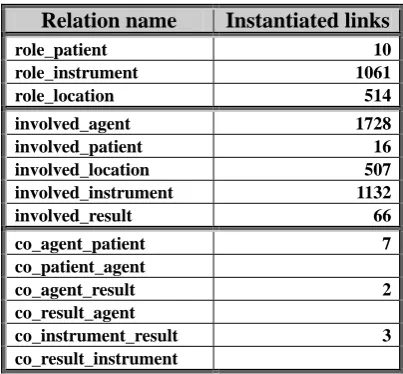
Table 2. provides figures about the new relations instantiated so far.
Relation name Instantiated links
role_patient 10
role_instrument 1061
role_location 514
involved_agent 1728
involved_patient 16
involved_location 507
involved_instrument 1132
involved_result 66
co_agent_patient 7
co_patient_agent
co_agent_result 2 co_result_agent
co_instrument_result 3 co_result_instrument
Table 2: New relations instantiated in SIMPLE-CLIPS DB
As illustrated in this section, the enrichment process has been essentially based so far on the exploitation of existing data, in particular on encoded SIMPLE-CLIPS relations, either by restricting their scope or by constraining and inverting their terms.
The instantiation of 5,046 new relations has therefore been carried out as a largely automated, low-effort and cost-free process, with no heavy human intervention.
7.
Avoiding redundancy
Clearly, such an extension of information has greatly increased the degree of information redundancy already existing in the SIMPLE-CLIPS database. As a matter of fact, for lack of inheritance computation in this database, every single property of each semantic unit ─ expressed either as features or semantic relations ─ had to be explicitly specified in the corresponding entry, although many of them, shared by a high number of word senses, could have been inherited from their ancestors’ entries. The fully encoded set of 28,500 entries originally required, for example, the instantiation of 63,700 semantic relations.
The expression of more than 5,000 new links has clearly determined a further exponential growth of information redundancy. For some word senses ─ such as, for example, high frequency activity verbs encoding the link to their typical agents ─ the size of the enriched entries is such that they are hardly manageable unless the information inheritance enters the picture.
Exploiting inheritance, only those properties that are peculiar of a particular word sense and crucial to capture its very meaning are overtly represented in its lexical entry, while the more generic ones are inherited from its ancestors’ entries.
Needless to say, the inheritance of properties is critically dependent on a high-quality encoding and in particular on a consistent instantiation of hyperonymic links. Its implementation required therefore a preliminary phase of ‘cleaning’ and harmonization of the lexical resource, particularly as regards the ‘isa’ relation.
In the input lexicon, the inheritance of semantic relations has allowed to prune more than 18% of relations from the descendant entries since they were inherited from their superordinate term entry.
In the enriched version of the lexicon, the positive impact of inheritance computation on the relations number is even more significant.
Let’s take, by way of example, the verb vendere (to sell),
which is linked to 67 word senses such as fioraio (florist) , libraio (bookseller) or panettiere (baker) by means of the
‘involved_agent’ relation. Among those lexical items are 5 more generic terms, viz. venditore (seller), commesso
(shop assistant), commerciante (dealer), artigiano
(craftsman) and fabbricante (producer) to which the other
62 are related as hyponyms. Thanks to the implementation of inheritance, the verb is only related to these 5 generic terms and 62 links are inherited.
Likewise, out of 66 shop-denoting nouns, 60 inherit from
their hyperonym negozio, bottega or mercato the
‘role_location’ relation whose target is vendere.
So, although vendere is involved (as source or target term)
in 274 semantic relations, only 31 links will be overtly represented while other 243 will be derived by inheritance.
8.
Conclusion
The expressive means imported from the EWN/IWN framework in order to model the relationships holding between events and their participants and among co-participants in events are intended to be extensively used in the SIMPLE-CLIPS database. A large number of new links between word senses are in fact being instantiated in the semantic lexicon. These very semantic relations were, by contrast, only scarcely and sporadically instantiated in the ItalWordNet lexical database whereas other semantic links ─ such as the synonymic and taxonomic ones ─ are very largely and consistently encoded.
The work undertaken and illustrated in this paper is therefore in no way a duplication of data that could have been simply imported from another lexical resource; it rather aims to enrich the Italian semantic lexicon with crucial additional information. Besides, the lexicon enrichment is being implemented at virtually no cost. It has in fact been demonstrated that, to a very large extent, the lexical items candidate to be linked by the new relations were easily identified in the source lexicon by investigating a wide range of data of semantic ─ and also
syntactic ─ nature and were then inexpensively captured. In a nutshell, we have reused and manipulated existing, high quality data to induce new information.
The PAROLE-SIMPLE-CLIPS source lexicon, which offers very rich information about single lexical units across various levels of linguistic description was, in our opinion, the ideal frame whereby these newly inserted relations could be profitably exploited, especially in combination with the wealth of already existing information. The last two descriptive layers of the lexicon, in particular, encode in fact outstanding data that characterize the syntactic and semantic behaviours of words, including semantic frames, their syntactic realizations and the link between both levels.
The imported relations obviously further enhance the semantic description of lexical units, by providing additional information and by allowing to restrict the scope of existing, overused relations. They also allow a more in depth view of their syntactic and semantic context. The information provided in the syntactic layer8, which
maps ─ through a network of correlations ─ onto the corresponding information supplied at the semantic level by the argument structure description (i.e. semantic role, ontological restriction and argument type of semantic arguments) is strengthened and backed up by the introduction of these new relations. Actually, the newly acquired information enables to move from the expression of combinatorial possibilities at the ontological level to their specification at the lexical level, e.g.: besides having the following information: (Pred_insegnare_1 (to teach): arg0: [HUMAN], arg1: [DOMAIN], arg2: [HUMAN]), the new one: ‘involved_agent’ (insegnare, insegnante) (teacher);
‘involved_patient’ (insegnare, studente) (student) further
specifies the lexical combinations.
The whole information represents a step forward towards a representation of knowledge à la FrameNet. Direct links
are in fact established among lemmas belonging to the same semantic frame. Such links supplement the information provided in the SIMPLE argument structure also by extending it to those adjuncts which are part of a semantic scenario and are crucial to the semantics of predicates.
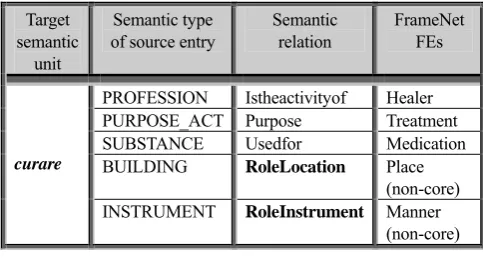
Tables 3 and 4 below illustrate the semantic relations in which the word sense curare (to cure, to treat) participates,
both as source or target term, in the enriched SIMPLE-CLIPS database, the new relations being marked in bold. In the last column are the corresponding Frame Elements (semantic arguments) of the frame ‘Cure’ in FrameNet. The relation between ‘to treat’ and Body_part or Affliction, two FrameNet FEs which are not represented in SIMPLE-CLIPS by semantic relations, are supplied by the selectional restrictions of the second argument of the predicate Pred_curare_1.
8 i.e. syntactic function, syntagmatic realization, syntactically
Source semantic
unit
Semantic relation Semantic type of target entry
FrameNet FEs
Isa ACT
Involved_agent PROFESSION Healer
Involved_patient HUMAN Patient
Involved_location BUILDING Place
(non-core)
curare
Purpose PURPOSE_ACT Motivation
(non-core)
Table 3: curare as source of semantic relations expressing
FrameNet FEs
Target semantic
unit
Semantic type of source entry
Semantic relation
FrameNet FEs
PROFESSION Istheactivityof Healer PURPOSE_ACT Purpose Treatment
SUBSTANCE Usedfor Medication
BUILDING RoleLocation Place (non-core)
curare
INSTRUMENT RoleInstrument Manner (non-core)
Table 4: curare as target of semantic relations expressing
FrameNet FEs
9.
References
Alonge A. ed. (1996). Definition of the links and subsets for verbs, EuroWordNet Project LE2-4003, Deliverable D006, WP4.1, final version, November 1996. http://dienst.isti.cnr.it/Dienst/UI/2.0/Describe/ercim.cn r.ilc/1996-TR-001?tiposearch=cnr&langver=
Del Gratta R., Ruimy N., Toral A., SIMPLE-CLIPS ongoing research: more information with less data by implementing inheritance, LREC 2008, Marrakech, Morocco. Proceedings.
Lenci A., Busa F., Ruimy N., Gola E., Monachini M., Calzolari N., Zampolli A. et al. (2000). SIMPLE Linguistic Specifications. LE-SIMPLE (LE4-8346), Deliv. D2.1 & D2.2. ILC and University of Pisa, Pisa, 404 pp.
http://www.ub.es/gilcub/SIMPLE/simple.html#Specifi cations
Pustejovsky J. (1995). The Generative Lexicon, The MIT
Press, Cambridge, MA.
Pustejovsky J., (1998). Specification of a Top Concept Lattice, ms., Brandeis University.
Pustejovsky J. (2001). Type Construction and the Logic of Concepts, In P. Bouillon and F. Busa (eds.), The Syntax of Word Meanings, Cambridge University Press, pp.
91--123.
Roventini A., Alonge, A., Bertagna, F., Calzolari, N., Cancila, J., Girardi, C., Magnini, B., Marinelli, R., Speranza, M., Zampolli, A. (2003). ItalWordNet: building a large semantic database for the automatic
treatment of Italian. In A. Zampolli, N. Calzolari, L. Cignoni, (eds.), Computational Linguistics in Pisa. Linguistica Computazionale, Special Issue, XVIII-XIX,
Pisa-Roma, IEPI. Tomo II, pp. 745--791.
Ruimy N., Monachini M., Distante R., Guazzini E., Molino S., Ulivieri M., Calzolari N., Zampolli A. (2002). CLIPS, A Multil-level Italian Computational Lexicon: a Glimpse to Data. LREC 2002. Las Palmas de Gran Canaria, Spain. Proceedings, Volume III, Paris,
The European Language Resources Association, pp. 792--79.
http://www.ilc.cnr.it/clips/Ruimy_LREC2002.pdf Ruimy N. (2006). Merging two Ontology-based Lexical
Resources. LREC 2006. Genoa, Italy, 24-25-26 May 2006. Proceedings, Paris, The European Language
Resources Association (ELRA). CD-ROM, pp. 1716--1721.
http://www.ilc.cnr.it/clips/Ruimy_LREC2006_1.pdf Ruimy N. (2007). Enhancing SIMPLE Semantic
Relations: A Proposal. In Zygmunt Vetulani (ed.), Proceedings of 3rd Language & Technology
Conference. Fundacja Uniwersytetu im A.
Mickiewicza, Poznań, pp. 119--123. http://www.ilc.cnr.it/clips/ltc-84-ruimy.pdf
Vossen P. editor 1998, EuroWordNet: A Multilingual Database with Lexical Semantic Networks, Kluwer Academic Publishers, Dordrecht.
Vossen P. ed. (2002). EuroWordNet General Document, version 3 final, July 2002, Amsterdam: Vrije Universiteit,