A SICK cure for the evaluation of compositional distributional semantic models
M. Marelli
1, S. Menini
1,2, M. Baroni
1, L. Bentivogli
2, R. Bernardi
1, R. Zamparelli
1 1University of Trento,2Fondazione Bruno Kessler[email protected], [email protected], [email protected], [email protected], [email protected], [email protected]
Abstract
Shared and internationally recognized benchmarks are fundamental for the development of any computational system. We aim to help the research community working on compositional distributional semantic models (CDSMs) by providing SICK (Sentences Involving Compositional Knowldedge), a large size English benchmark tailored for them. SICK consists of about 10,000 English sentence pairs that include many examples of the lexical, syntactic and semantic phenomena that CDSMs are expected to account for, but do not require dealing with other aspects of existing sentential data sets (idiomatic multiword expressions, named entities, telegraphic language) that are not within the scope of CDSMs. By means of crowdsourcing techniques, each pair was annotated for two crucial semantic tasks: relatedness in meaning (with a 5-point rating scale as gold score) and entailment relation between the two elements (with three possible gold labels: entailment, contradiction, and neutral). The SICK data set was used in SemEval-2014 Task 1, and it freely available for research purposes.
Keywords:Compositional Distributional Semantic Models, Data Sets, Semantic Relatedness, Textual Entailment
1.
Introduction
Distributional Semantic Models (DSMs) approximate the meaning of words with vectors summarizing their pat-terns of co-occurrence in corpora. Recently, several com-positional extensions of DSMs (Comcom-positional DSMs, or CDSMs) have been proposed, with the purpose of repre-senting the meaning of phrases and sentences by composing the distributional representations of the words they contain (Mitchell and Lapata, 2010; Baroni and Zamparelli, 2010; Grefenstette and Sadrzadeh, 2011; Socher et al., 2012). De-spite the ever increasing interest in the field, the develop-ment of adequate benchmarks for CDSMs, especially at the sentence level, is still lagging behind. Existing data sets, such as those introduced by Mitchell and Lapata (2008) and Grefenstette and Sadrzadeh (2011), are limited to a few hundred instances of very short sentences with a fixed struc-ture. While CDSMs could be evaluated on data sets devel-oped for other purposes, such as Semantic Text Similarity (STS)1or Recognizing Textual Entailment (RTE),2in these
settings CDSMs can only act as components of more com-plex systems, since they require dealing with issues, such as identifying multiword expressions, recognizing named entities, processing dates and digits, or accessing encyclo-pedic knowledge about individuals, that are orthogonal to the generic meaning representations that CDSMs are sup-posed to produce. At the same time, the challenging phe-nomena that CDSMs must handle for a satisfactory account of sentence-level semantics (e.g., contextual synonymy and other lexical variation phenomena, active/passive and other syntactic alternations, impact of negation, quantifiers and other grammatical elements) do not occur very frequently in theSTSandRTEdata sets, since the latter were designed for other purposes.
With these considerations in mind, we developed SICK
1http://www.cs.york.ac.uk/semeval-2012/
task6/
2http://www.nist.gov/tac/2011/RTE/
(Sentences Involving Compositional Knowledge), a data set aimed at filling this void. SICK includes a large number of sentence pairs that are rich in the lexical, syntactic and semantic phenomena that CDSMs are expected to account for, but do not require dealing with other aspects of exist-ing sentential data sets (multiword expressions, named en-tities, telegraphic language) that are not within the domain of compositional distributional semantics.
The SICK data set consists of around 10,000 English sen-tence pairs, each annotated for relatedness in meaning. The sentence relatedness score provides a direct way to eval-uate CDSMs, insofar as their outputs are meant to quan-tify the degree of semantic relatedness between sentences. Since detecting the presence of entailment is one of the tra-ditional benchmarks of a successful semantic system, each sentence pair is also annotated for the entailment relation between the two elements of the pair.
2.
Related Work
Starting from the assumption that understanding a sentence means knowing when it is true, being able to verify whether an entailment is valid is a crucial challenge of any compu-tational semantic system. The development of evaluation data sets on this task can help Computational Semantics make tangible progress.
A first interesting test suite of entailment problems,
FraCaS(Framework for Computational Semantics), was developed already in the mid-’90 by a group of formal se-manticists (Cooper et al., 1996), but a cleanly processable version of it has been made available only recently.3 The
data set contains entailment problems in which a conclu-sion has to be derived from one or more premises and not necessarily all premises are needed to verify the entailment. Premises and conclusions are simple, lab-made, English sentences involving semantic phenomena frequently
ad-3
quan-Original pair
S0a:A sea turtle is hunting for fish S0b:The turtle followed the fish
Normalized pair
S1a:A sea turtle is hunting for fish S1b:The turtle is following the fish
Expanded pair
S2a:A sea turtle is hunting for food S2b:The turtle is following the red fish
S3a:A sea turtle is not hunting for fish S3b:The turtle isn’t following the fish
S4a:A fish is hunting for a turtle in the sea S4b:The fish is following the turtle
Table 1: Example of output of data set creation process.
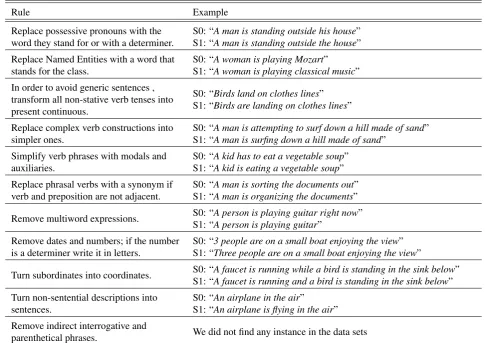
Rule Example
Replace possessive pronouns with the word they stand for or with a determiner.
S0: “A man is standing outside his house” S1: “A man is standing outside the house”
Replace Named Entities with a word that stands for the class.
S0: “A woman is playing Mozart” S1: “A woman is playing classical music”
In order to avoid generic sentences , transform all non-stative verb tenses into present continuous.
S0: “Birds land on clothes lines” S1: “Birds are landing on clothes lines”
Replace complex verb constructions into simpler ones.
S0: “A man is attempting to surf down a hill made of sand” S1: “A man is surfing down a hill made of sand”
Simplify verb phrases with modals and auxiliaries.
S0: “A kid has to eat a vegetable soup” S1: “A kid is eating a vegetable soup”
Replace phrasal verbs with a synonym if verb and preposition are not adjacent.
S0: “A man is sorting the documents out” S1: “A man is organizing the documents”
Remove multiword expressions. S0: “A person is playing guitar right now” S1: “A person is playing guitar”
Remove dates and numbers; if the number is a determiner write it in letters.
S0: “3 people are on a small boat enjoying the view” S1: “Three people are on a small boat enjoying the view”
Turn subordinates into coordinates. S0: “A faucet is running while a bird is standing in the sink below” S1: “A faucet is running and a bird is standing in the sink below”
Turn non-sentential descriptions into sentences.
S0: “An airplane in the air”
S1: “An airplane is flying in the air”
Remove indirect interrogative and
parenthetical phrases. We did not find any instance in the data sets
Table 2: Normalization rules
of 2000 sentences (S1). Each of these sentences was ex-panded to create up to three new sentences. In this step we applied syntactic and lexical transformations with pre-dictable effects in order to obtain, with respect to the nor-malized sentence,(i)a sentence with a similar meaning,(ii)
a sentence with a logically contradictory or at least highly contrasting meaning, and(iii)a sentence that contains most of the same lexical items, but has a different meaning.
To obtain sentences with a similar meaning (S2) we applied meaning preserving transformations, while to obtain sen-tences with a contradictory or strongly contrasting mean-ing (S3) we used “negative” transformations. Finally, in order to get a sentence with a different meaning using the same lexical items as much as possible (S4), a set of word-scrambling rules were applied ensuring that the resulting
sentence was still meaningful. A further requirement was that all the sentences created had the same overall syntac-tic complexity (see Table 1 for an example of a triplet of modified sentences produced for each original item).
The rationale behind this approach is that of building a data set so that understanding when two sentences have close meanings or entail each other crucially requires a compo-sitional semantics step, and not simply considering the in-dividual lexical items involved, the syntactic complexity of the two sentences, or world knowledge. The complete list of expansion rules is presented in Table 3.
Meaning Preserving Transformations
Rule Example
Turn active sentences into passive sentences and viceversa.
S1: “A man is driving a car”
S2: “The car is being driven by a man”
Replace words with near synonyms or similar words.
S1: “A young boy is jumping into water” S2: “A young kid is jumping into water”
S1:A man and two women in a darkened room are sitting at a table with candles
S2:A man and two women in a dark room are sitting at a table with candles
Add modifiers that do not radically alter the meaning of the sentence.
S1: “A deer is jumping a fence” S2: “A wild deer is jumping a fence” S1: “A woman is tapping her fingers”
S2: “A woman is tapping her fingers nervously”
Expand agentive nouns. S1: “A soccer player is kicking a ball into the goal”
S2: “A person who plays soccer is kicking a ball into the goal”
Turn compounds into relative clauses. S1: “A woman is using a sewing machine”
S2: “A woman is using a machine made for sewing”
Turn adjectives into relative clauses.
S1: “Two men are taking a break from a trip on a snowy road” S2: “Two men are taking a break from a trip on a road covered by snow”
Replace quantifiers with others that have a similar meaning.
S1: “The surfer is riding a big wave” S2: “A surfer is riding a big wave”
Meaning Altering Transformations
Rule Example
Insert or remove negations to produce contradictions.
S1: “The boy is playing the piano” S3: “The boy is not playing the piano”
Change determiners with their opposite.
{the, a, all, every, some, a few} ⇒ {no},
{no} ⇒ {every, each},{many} ⇔ {few},
{much} ⇔ {little}.
S1: “A dog is walking along a snowdrift” S3: “There is no dog walking along a snowdrift”
Replace words with semantic opposites.
S1: “The girl is spraying the plants with water” S3: “The boy is spraying the plants with water” S1: “A plane is taking off”
S3: “A plane is landing”
Scramble words: switch the arguments of a transitive verb, switch and mix
modifiers, exploit verb
transitive/intransitive alternations, exploit homonymy and polysemy.
S1: “The turtle is following the fish” S4: “The fish is following the turtle”
S1: “A man with a jersey is dunking the ball at a basketball game” S4: “The game of basketball consists of a ball being dunked by a man with a jersey”
Table 3: Expansion rules
for each normalized sentence in the data set, due to the dif-ficulty of getting meaningful sentences after changing the order of the words, especially in the case of very short sen-tences, which are frequent in the data set.
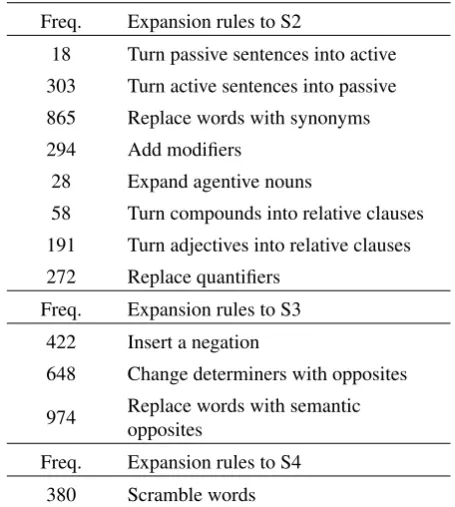
The fact that not all the transformations were always suit-able to the sentences results into an inhomogeneous distri-bution of the usage of the rules in the dataset. Table 4 shows the distribution of the expansion rules within the data set. Note that since it was possible to apply more than one rule
at the same time to expand a sentence, the sum of the fre-quency of each rule is higher than the number of the sen-tences we expanded.
3.3.
Generation of the SICK sentence pairs
expan-Freq. Expansion rules to S2
18 Turn passive sentences into active
303 Turn active sentences into passive
865 Replace words with synonyms
294 Add modifiers
28 Expand agentive nouns
58 Turn compounds into relative clauses
191 Turn adjectives into relative clauses
272 Replace quantifiers
Freq. Expansion rules to S3
422 Insert a negation
648 Change determiners with opposites
974 Replace words with semantic opposites
Freq. Expansion rules to S4
380 Scramble words
Table 4: Frequency of application of expansion rules
sion phase and with the other normalized sentence in the pair. Considering the example in Table 1, we paired each S1 with all the other seven sentences in the group. More-over, we added to the data set a number of pairs composed of completely unrelated sentences by randomly taking two sentences from two different pairs. For example:
-A sea turtle is hunting for fish
-A young woman is playing the guitar
We constructed in this way a set of around 10,000 new sen-tence pairs. To ensure the quality of the data set, all the sentences were checked for grammatical or lexical mistakes and disfluencies by a native English speaker. Our goal was to obtain sentences that sound natural to a native speaker despite all the restrictions adopted during the normalization and expansion phases.
The distribution of the SICK sentence pairs with respect to the transformations performed during data set creation is presented in Table 5, which summarizes the type of relation predicted to hold between the sentences in the pair, all the pairing combinations and their frequencies in the data set.6
We stress that we constructed the pairs by following the procedure outlined in order to generate a balanced distribu-tion of possible sentence reladistribu-tions. However, the ultimate assessment of semantic relatedness and entailment between sentence pairs is left to human judges, as illustrated in the next section.
6
The number of planned sentence pairs was 10,000 but at the end of the data set creation process 160 pairs had to be excluded: 126 pairs (1.3% of the set) were repeated more than once due to converging modifications in the normalization and expansion phases, and 34 (0.4%of the set) resulted in identical elements.
Expected relation N. of pairs
Similar meaning 4366 (44.4%)
S1aS2a, S1aS2b, S1bS2a, S1bS2b, S1aS1b
Opposite/contrasting meaning 3574 (36.3%)
S1aS3a, S1aS3b, S1bS3a, S1bS3b
Similar lexicon, different meaning 703 (7.1%)
S1aS4a, S1aS4b, S1bS4a, S1bS4b
Unrelated 1197 (12.2%)
Total 9840 (100%)
Table 5: Distribution of the SICK sentence pairs with re-spect to the transformations performed during data set cre-ation.
Figure 1: Example of the annotation task as displayed on the CrowdFlower interface.
3.4.
Relatedness and Entailment Annotation
Each pair in the SICK data set was annotated to mark(i)the degree to which two sentence meanings are related (on a 5-point scale), and(ii)whether one entails the other. Hu-man ratings were collected through a large crowdsourcing study, exploiting the CrowdFlower (CF) platform7to reach
the Amazon Mechanical Turk (MTurk) marketplace.8 Fig-ure 1 shows the double annotation task as it was displayed to MTurk contributors through the CF interface.
In order to clarify the task to non-expert participants, while avoiding biasing their judgments with strict definitions, the instructions described the task only through examples of relatedness and entailment, as shown below:
• A and B are completely unrelated:
– A: Two girls are playing outdoors near a woman
– B: The elephant is being ridden by the man
• A and B are very related:
– A: A man is cooking pancakes
– B: The man is cooking pancakes
• If A is true, then B is true:
– A: A dog is running in a field
– B: An animal is running in a field
7
www.crowdflower.com
Cooper, R., Crouch, D., Eijck, J. V., Fox, C., Genabith, J. V., Jaspars, J., Kamp, H., Milward, D., Pinkal, M., Poesio, M., and Pulman, S. (1996). Using the frame-work. Technical Report Technical Report LRE 62-051 D-16, The FraCaS Consortium.
Giampiccolo, D., Dang, H. T., Bernardo, M., Dagan, I., and Cabrio, E. (2008). The fourth pascal recognising textual entailment challenge. Inn Proceedings of the TAC 2008 Workshop on Textual Entailment.
Grefenstette, E. and Sadrzadeh, M. (2011). Experimen-tal support for a categorical compositional distributional model of meaning. In Proceedings of EMNLP, pages 1394–1404, Edinburgh, UK.
MacCartney, B. and Manning, C. D. (2007). Natural logic for textual inference. InACL Workshop on Textual En-tailment and Paraphrasing.
Marelli, M., Bentivogli, L., Baroni, M., Bernardi, R., Menini, S., and Zamparelli, R. (2014). Semeval-2014 task 1: Evaluation of compositional distributional se-mantic models on full sentences through sese-mantic re-latedness and textual entailment. InProceedings of Se-mEval 2014: International Workshop on Semantic Eval-uation. In press.
Mitchell, J. and Lapata, M. (2008). Vector-based models of semantic composition. InProceedings of ACL, pages 236–244, Columbus, OH.
Mitchell, J. and Lapata, M. (2010). Composition in distributional models of semantics. Cognitive Science, 34(8):1388–1429.
Negri, M., Marchetti, A., Mehdad, Y., Bentivogli, L., and Giampiccolo, D. (2012). Semeval-2012 Task 8: Cross-lingual Textual Entailment for Content Synchronization. InProceedings of the 6th International Workshop on Se-mantic Evaluation (SemEval 2012).
Negri, M., Marchetti, A., Mehdad, Y., Bentivogli, L., and Giampiccolo, D. (2013). Semeval-2013 Task 8: Cross-lingual Textual Entailment for Content Synchronization. InProceedings of the 7th International Workshop on Se-mantic Evaluation (SemEval 2013).
Snow, R., O’Connor, B., Jurafsky, D., and Ng, A. Y. (2008). Cheap and fast—but is it good?: evaluating non-expert annotations for natural language tasks. In Pro-ceedings of the Conference on Empirical Methods in Natural Language Processing, EMNLP ’08, pages 254– 263, Stroudsburg, PA, USA. Association for Computa-tional Linguistics.
Socher, R., Huval, B., Manning, C., and Ng, A. (2012). Se-mantic compositionality through recursive matrix-vector spaces. In Proceedings of EMNLP, pages 1201–1211, Jeju Island, Korea.