The BUCEADOR multi-language search engine for digital libraries
Jordi Adell
1, Antonio Bonafonte
1, Antonio Cardenal
2, Marta Ruiz
3,
Jos´e A.R. Fonollosa
1, Asunci´on Moreno
1, Eva Navas
4, Eduardo R. Banga
21Universitat Polit`ecnica de Catalunya,2
Universidad de Vigo
3Barcelona Media,4
University of the Basque Country
Abstract
This paper presents a web-based multimedia search engine built within the Buceador (www.buceador.org) research project. A proof-of-concept tool has been implemented which is able to retrieve information from a digital library made of multimedia documents in the 4 official languages in Spain (Spanish, Basque, Catalan and Galician). The retrieved documents are presented in the user language after translation and dubbing (the four previous languages + English). The paper presents the tool functionality, the architecture, the library and provides some information about the technology involved in the fields of automatic speech recognition, statistical machine translation, text-to-speech synthesis and information retrieval. Each technology has been adapted to the purposes of the presented tool as well as to interact with the rest of the technologies involved.
Keywords:multimedia search, multilingual search, speech recognition; machine translation, speech synthesis
1.
Introduction
There is a growing interest on digital libraries. There ex-ist a lot of databases containing multimedia content that could be useful for many people. For example: newspapers, book collections, TV documentaries, TV shows or news, etc. However, we cannot be aware of the existence of all of them. It is, most of the time, difficult to find relevant infor-mation within a library. In addition, the inforinfor-mation we are interested in might be in a foreign language that we do not understand.
The presented tool is aimed at solving these problems by making digital libraries accessible to everyone easily and in the user’s own language. We expect the search engine to find the information more relevant to the user, given the information supplied. If the information found is in a for-eign language, then it is desired that the system translates the media content into the user’s language, even if the items found are in the video format.
BUCEADOR is a project focused on advanced research in all core Spoken Language Technologies (SLT), (diariza-tion, speech recogni(diariza-tion, speech machine transla(diariza-tion, and text-to-speech conversion), and the successful joint inte-gration of all of them in a multilingual and multimodal information retrieval system. The project is supported by the Spanish Government. The research team is composed of four groups: Universitat Polit`ecnica de Catalunya, that coordinates the project, AhoLab group from the Basque Country University, University of Vigo and Barcelona Me-dia.
The goal of the project is to achieve improvements in all the SLT components and voice search applications to improve human-machine and human-to-human communi-cation among all the official languages spoken in Spain (Basque, Catalan, Galician, and Spanish), as well as be-tween these languages and English. As a result, the project provides research advances in each mentioned technology. Examples of such approaches are exploring new techniques for the diarization of speeches, incorporating confidence
measures for unconstrained conversational speech in auto-matic speech recognition, integrating linguistic knowledge in the statistical approach to spoken language translation, new acoustic and prosodic models for generating expres-sive speech in synthesis, and implementing new strategies for voice search information retrieval.
In order to show the achievements in the above men-tioned technologies and their successful joint integration, the project implements a show case consisting of a search engine for multilingual audiovisual contents. Specifically, broadcast news and debate programs from several TV chan-nels in all the official Spanish languages are utilized.
This paper describes the technologies developed in the project and focuses on the description of the demonstra-tion platform. A web based interface that lets a user enter a query as either text or in spoken form, as well as define the targeted modality of the results and the presentation lan-guage, has been designed and developed. Search results are presented in either their original form (text, audio, video) or converted to a textual or audio representation as requested. Search results can also be translated to a different language according to user preferences.
In section 2. a functional description of the overall system is presented. It includes some information about the global architecture. Section 3. describes the digital library which has been include in this proof-of-concept. Section 4. de-scribes the main speech and language engines integrated in the platform. The paper ends with a short summary.
2.
Overview of the Buceador Platform
can be long paragraphs or short news in a newspaper, or scenes in movies, or speaker turns in conversations.
Documents can be of four different types: text, audio, im-age or video. Each document of the database is analysed when uploaded to the platform. For all of them an XML descriptor is generated. It contains relevant information: document ID, database ID, text field, translation, gender, etc.
If a document is of audioor video media types, an auto-matic speech recognition (ASR) system is used to create textual information from it. If the document is oftext or
imagetypes, this step is skipped. Then, once the descrip-tion file, has the textual informadescrip-tion, a statistical machine translation (SMT) engine is used to translate the textual in-formation into all possible output languages and generates all possible translations. If the document is of media type
text, then the description file is completed with all possible translations. However, for video and audio media types, the translated text is converted into speech by a text-to-speech (TTS) system. In the case of video, the audio is inserted back into the video as a new stream. Therefore, videos are, in fact, dubbed into the user language.
Language technologies are used in distributed systems. The platform interact with them through Internet. Each partner of the project is responsible for several technologies and languages and are offered to the platform as REST web ser-vices.
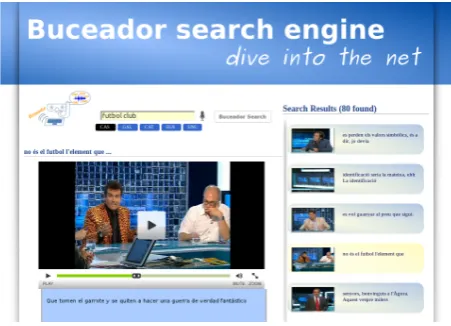
Search results are presented as a web page (see figure1). Audio, videos, texts and images are presented all together in order of relevance. Each document presented to the user contains information related to the database it comes from. The user can choose to access the content in both his or the original language. The platform also has the functionality of showing subtitles.
Figure 1: Buceador demonstration platform
For accessibility reasons the query can be performed by typing a query in a web text box but also by means of voice. The platform offers the possibility of choosing the language in which to make the query and record our own voice with the query. Then speech is sent to the available recognition systems via a REST web service. The answer of the ASR system is used to make the search in the library as it is done
when the query is typed by the user. The ASR system al-lows keywords queries. Keywords can be separated by a special words. The possible keywords allowed by the ASR system and their grammar are learnt from the databases up-loaded. So the system adapts itself to the content of the library.
The speech recognition API for the spoken queries is com-posed of a Java applet that runs inside a web page and of a PHP script located on the server side. This Java applet implements a push-on button for recording the audio and sending it to the recognition server. The PHP script is re-sponsible for calling the local recognition engine and send-ing back the transcription to the applet. The Java applet sends the audio file to the recognition server using POST method and waits for the response of the PHP script. Once the response file is received, the Java applet processes it and pass the results to the search engine.
The platform has been programmed in PHP,Javascriptand Java. PHP modules are used to access other web services and access information contained in the description files.
Javascriptis used to allow the user to change the presen-tation of the results: Switch subtitles on and off, navigate through the list of results, choose which token to see and choose its language. Most of the Javascript code relies on the jQuery library. A Java applet is used to record the speech for the query and a PHP module interacts with the service uploading the recorded speech and downloading the recognition results. The software produced to implement the platform will be distributed open-source to the commu-nity. Therefore anyone will be able to create their own web services and make the platform interact with them.
Figure 1 show a screen capture of the BUCEADOR plat-form. At the beginning, only the upper part appears, show-ing the input interface. The user selects the desired lan-guage (in the picture, Castilian Spanish) and enter the key-words either using the keyboard, in the text box, or clicking in the microphone symbol. If speech is used, the spoken words are shown in the text box. The multilingual library is search and all the relevant documents are shown in the right column. The most relevant or the selected one is shown in the center. If the documents are found in other language (in this case, in Catalan), the translated transcription and the dubbed audio are presented.
3.
Multimedia library
The multimedia library contain resources in official lan-guages spoken in Spain (Spanish, Basque, Catalan, Gali-cian).
For Galician language we used the Transcrigal-DB which is a database compiled on the University of Vigo during the last years. Transcrigal-DB (Garc´ıa et al., 2004) is com-posed of recordings of broadcast news programs emitted by the local Galician television (TVG) during years 2002, 2003, 2004, 2010 and 2011. The database contains record-ings of 65 news programs of nearly one hour of duration each.
The ETB database is a broadcast news audio database that includes the audio of the news programs of the Basque TV Network (ETB) corresponding to year 2010. It is formed by the documents that the journalists prepare and record for a news clip. The audio files contain also interviews and dubbed speech overlapped with the original voice. The files that have associated the corresponding orthographic tran-scription of the speech and include only one speaker have been selected to be included in the demo. In total there are 1302 files in Spanish and 1276 in standard Basque.
Agora-DB (Schulz and Fonollosa, 2009) is a Catalan broad-cast conversational speech database of the Agora program, that are debates on selected topics from politics, economy or society. Each broadcast follows a repeating format: the anchorman is initially presenting the current topic, followed by an introduction of invited participants featuring back-ground music. The main part features the debate between the invited participants, usually public figures. During the debate, public opinions are added, either as e-mails or faxes read by the anchorman, or telephone recordings played back again featuring background music. The debate gener-ally comprises spontaneous speech, whereas the introduc-tion of topic and participants features planned speech. Al-though the main language is Catalan, the recorded broad-casts contain a high proportion of Spanish speaking partic-ipants.
Also the documents from the bilingual newspaper El Peri´odico de Catalunya, included in ELDA catalog, have been added to the Buceador library. This documents are presented in the written form (either in original language or translated). In this case, the on-line TTS engines can be used to listen to the content.
4.
Speech and Language Engines
This section describes the different engines used for speech acquisition and speech and language processing.
4.1. Speech Acquisition
The speech recognition API for the spoken queries is com-posed of a Java applet that runs inside a web page and of a PHP script located on the server side. This Java applet implements a push-on button for recording the audio and sending it to the recognition server. The PHP script is re-sponsible for calling the local recognition engine and send-ing back the transcription to the applet. The Java applet sends the audio file to the recognition server using POST method and waits for the response of the PHP script. Once the response file is received, the Java applet processes it and pass the results to the search engine.
4.2. Speech Recognition
The speech recognition engines are used in two processes. First, it is used, after the diarization process, to recognize the audio channel in the multimedia sessions. This is done offline, every time that a new session is added to the digi-tal library. Speech recognition is also used to get the user keywords in case the user selects the spoken modality for entering the query.
For Spanish and Galician language BUCEADOR uses the decoder developed on the University of Vigo (Docio-Fernandez et al., 2006), which is based on the standard token-passing algorithm and includes LM look-ahead and a N-best re-scoring stage. The recognition is performed in five consecutive passes. First pass includes gender de-tection, acoustic segmentation, and a decoding pass using a trigram language model (LM) with 60K words and two-state demiphones with standard MFCC E D A parameter-ization. The second pass uses acoustic models obtained from unsupervised adaptation (MLLR and MAP). The N-Best lists obtained from this pass are re-scored using a gram LM. Finally, a new unsupervised adaptation and 5-gram re-scoring passes are performed. While the second pass gives relative improvements in WER between a 2% and 6%, (between one and five absolute points), the im-provements obtained by the remainder passes together are usually under a 1%.
The UPC recognition system used to transcribe the Catalan audiovisual database has been designed to operate in real time with vocabularies of over 250,000 words and n-gram language models of order 4. The acoustic analysis uses the standard MFCC parameters and the usual first and second time derivatives, while the acoustic HMM models are con-text dependent demiphones (Mari˜no et al., 2000) with a op-timized pool of tied Gaussian mixtures. The architecture of the decoder is based on the standard weighted finite state transducer (WFST) framework (Mohri et al., 2002) with additional network optimizations for the selected acoustic modeling.
Both systems are also used for the recognition of the queries, but in this case the language model is replaced by a dictionary of keywords. The multi-word keywords are se-lected automatically from the most frequents ones found in the transcription filtered with a POS-based templates. For instance, keywords with only non-content words are not in-cluded.
al-lows implementing a simple n-gram language model. The evaluation of AhoSR shows that its results are comparable and in some cases slightly better than the ones achieved us-ing HTK.
4.3. Speech Synthesis
There are several speech synthesis engines which are used for dubbing the multimedia documents to the user lan-guage. To avoid additional delays, this process is also done offline. Therefore, for each audiovisual document five au-dio channels are stored: original sound track and the other 4 languages from English, Spanish, Basque, Catalan and Galician.
For Spanish and Basque the AhoTTS is applied. AhoTTS is a multilingual TTS (Hern´aez et al., 2001) system devel-oped by the Aholab Signal Processing Group of the Uni-versity of the Basque Country for commercial and research purposes. The system has a modular architecture allow-ing developers to work on different modules of the system at the same time. It is composed of three main process-ing modules: the text processor, the lprocess-inguistic module and the synthesis engine. In addition, two databases are used: one dictionary containing morphological and phonetic in-formation about the words and the synthesis database that contains the recordings manipulated to generate the syn-thetic speech. The language dependent linguistic module extracts linguistic features from the input text. The acous-tic engine uses them to select previously trained statisti-cal models and generate a sequence of acoustic parameters (log-f0, Mel-cepstral coefficients, and maximum voiced frequency). Finally, a high quality vocoder, ahoCoder (Erro et al., 2011), constructs the synthetic speech signal from the aforementioned parameters. Currently the system works in Basque (Erro et al., 2010), Spanish (Sainz et al., 2010) and English. It is written in C/C++ and is fully functional both in Unix and Windows operating systems.
The Galician channel is produced by the TTS of the Uni-versity of Vigo. It is based on the classical unit selec-tion technique but with some improvements in intonaselec-tion modeling and the Viterbi search. Regarding intonation modeling, several candidate intonation contours are gen-erated by means of a unit-selection procedure and a com-bined search with the selection of the acoustic units takes place (Campillo et al., 2009). A recent implementation of this technique avoids the exponential growth of the com-putational load as the number of candidate intonation con-tours is increased (Campillo and Banga, 2011). The com-putational load is also reduced with some additional con-siderations about the cost functions (Campillo et al., 2011). The principles of the linguistic module for Galician are de-scribed in (Gonz´alez et al., 2008).
Ogmios (Bonafonte et al., 2006), the UPC TTS system pro-duces the Catalan audio channel. Ogmios is a multilingual research system with voices in several languages. It in-cludes many techniques either for text processing, prosody modeling and voice generation, including a unit selection back-end and an interface to HTS.
The English track is produced using Ogmios in the
front-end and AhoTTS for the backfront-end (Sainz et al., 2011).
4.4. Statistical Translation
The UPC n-ii translation engine provides translation be-tween Spanish, Catalan and English. n-iiis an N-gram-based approach which appeared in (Marino et al., 2006). It stemms from the Finite-State Transducers paradigm, and is extended to the log-linear modeling framework. A system following this approach deals with bilingual units, called tuples, which are composed of one or more words from the source language and zero or more words from the tar-get one. The N-gram-based systems allow for linguisti-cally motivated word reordering by implementing word or-der monotonization. For the pairs Spanish↔Catalan and Spanish↔English the translation models are estimated from parallel corpora. The translation from Catalan to En-glish uses Spanish as a pivot language.
With reference to the translator for the Galician-Spanish pair, the implementation of University of Vigo uses Moses in its phrase-based mode. It was difficult to get a parallel corpus of reasonable size due to the scarcity of bilingual resources for this pair of languages, but at present we are working with a parallel corpus of about twenty six million words in each language. At this time the BLEU for Spanish to Galician translation (the most difficult direction) is about 83%. Our present work is focused on improving this result by using additional linguistic information in the translation and language models.
Translation from and to Basque is a very challenging task which is out of scope for this project.
4.5. Information Retrieval
We have used SOLR (Ku, 2011), which is a high perfor-mance search server built using Lucene Core (Gospodnetic et al., 2009). For indexation and query retrieval, we have used standard preprocessing techniques such as tokenizing and lowercasing available in the same SOLR tool. Particu-larly, we have used:
1. TheStandardTokenizerFactoywhich is a good general purpose tokenizer that strips many extraneous charac-ters and sets token types to meaningful values.
2. TheLowerCaseFilterFactorywhich creates tokens by lowercasing all letters and dropping non-letters.
3. TheStopFilterFactorywhich discards common words specified in the stopwords.txt list. In our case, this list which contains Catalan prepositions and articles.
4. The WordDelimiterFactory which splits words into subwords and performs optional transformations on subword groups.
spk name agora 2007 03 05 a.spk
text Gabriel Masfurroll empresari fundador i presi-dent de USP Hospitals i exvicepresipresi-dent del Fut-bol Club Barcelona Bona nit
ini time 143123 fin time 148632
Table 1: Example of one file’s segment
filters are – notably when stemming synonyms with similar roots. It is useful to remove the duplicates to prevent idf (inverse document frequency) inflation at index time, or tf (term frequency) inflation at query time.
Table 1 shows and example of the file’s segment that we are indexing and its fields. The indexation fields contain speaker identification, file identification, starting and end-ing time in the file and content text in the different lan-guages. In the final application, the search is always done by content, which corresponds to the speaker discourse, in the user language.
5.
Summary
In this paper we have presented the demonstration platform of the Buceador project. The goal of the tool is to provide access to digital libraries that include audio, video, text and images breaking the language barrier. The user can get the information of the documents in the desired modality and language independently of the original format. Therefore, advanced speech technologies, machine translation and in-formation retrieval technologies are required. The paper also presents briefly the speech technologies developed in the Buceador project.
6.
Acknowledgment
The research leading to these results has been partially funded by the Spanish Government under grant TEC2009-14094-C00. (BUCEADOR project). It has also been sup-ported from the European Community’s Seventh Frame-work Programme (FP7/2007-2013) under grant agreement number 247762 (FAUST) and has received funding from the Spanish Ministry of Economy and Competivity through the Juan de la Cierva fellowship program.
7.
References
Antonio Bonafonte, Pablo D. Ag¨uero, Jordi Adell, Javier P´erez, and Asunci´on Moreno. 2006. Ogmios: The UPC text-to-speech synthesis system for spoken translation. InProc. of TC-Star Workshop, Barcelona, Spain, June.
F. Campillo and E.R. Banga. 2011. Multiple f0 contour parallel viterbi search for unit selection speech synthesis. Electronic Letters, 47(16):937–938.
F. Campillo, J. van Santen, and E.R. Banga. 2009. Integrating phrasing and intonation modelling using syntactic and mor-phosyntactic information. Speech Communication, 51(5):452– 465.
F. Campillo, I. Nozhov, and E.R. Banga. 2011. Segmentwise unit selection.Electronic Letters, 47(9):569–570.
L. Docio-Fernandez, A. Cardenal-Lopez, and C. Garcia-Mateo. 2006. TC-STAR 2006 automatic speech recognition evalua-tion: The uvigo system. InTC-STAR Workshop on Speech-to-Speech Translation, pages 145–150.
Daniel Erro, I˜naki Sainz, Eva Navas, and Inma Hern´aez. 2010. HMM-based speech synthesis in basque language using HTS. InActas de las VI Jornadas en Tecnolog´ıas del Habla, pages 67–70, Vigo, Spain, November.
Daniel Erro, I˜naki Sainz, Eva Navas, and Inma Hern´aez. 2011. Hnm-based mfcc+f0 extractor applied to statistical speech syn-thesis. InProc. of ICASSP, pages 4728–4731. IEEE.
C. Garc´ıa, J. Dieguez, L. Doc´ıo, and A. Cardenal. 2004. Tran-crigal: A bilingual system for automatic indexing of broad-cast news. InLREC2004: IV International Conference on Lan-guage Resources and Evaluation.
M Gonz´alez, E. R. Banga, F. Campillo, F M´endez, L. Rodr´ıguez Li˜nares, and G. Iglesias. 2008. Specific features of the galician language and implications for speech technology development. Speech Communication, 50:874– 887.
Otis Gospodnetic, Hatcher Erik, and Michael McCandless. 2009. Lucene in Action. Packt Publishing, 2nd ed. edition, June. Inma Hern´aez, Eva Navas, J.L. Murugarren, and Extebarria B.
2001. Description of the ahotts system for the basque language. InProc. of the 4th ISCA Speech Synthesis Workshop, Pitlochry, Scotland, August.
Rafal Ku. 2011. Apache Solr 3.1 Cookbook. Packt Publishing, 1st ed. edition, July.
I. Luengo, E. Navas, I. Odriozola, I. Saratxaga, I. Hern´aez, I. Sainz, and D. Erro. 2010. Modified LTSE-VAD algorithm for applications requiring reduced silence frame misclassifi-cation. InProc. of LREC Conf., pages 1539–1544, Valletta, Malta, May.
J.B. Marino, R.E. Banchs, J.M. Crego, A. de Gispert, P. Lambert, J.A.R. Fonollosa, and M.R. Costa-juss`a. 2006. N-gram-based machine translation. Computational Linguistics, 32(4):527– 549.
Jos´e B Mari˜no, Albino Nogueiras, Pau Pach`es-Leal, and Anto-nio Bonafonte. 2000. The demiphone: An efficient contextual subword unit for continuous speech recognition.Speech Com-munication, 32(3):187–197, October.
Mehryar Mohri, Fernando Pereira, and Michael Riley. 2002. Weighted finite-state transducers in speech recognition. Com-puter Speech & Language, 16, January.
I. Sainz, D. Erro, E. Navas, I. Hern´aez, J. S´anchez, I. Saratxaga, I. Odriozola, and I. Luengo. 2010. Aholab speech synthesizers for albayzin2010. InActas de las VI Jornadas en Tecnolog´ıas del Habla, pages 343–348, Vigo, Spain, November.
I˜naki Sainz, Daniel Erro, Eva Navas, Jordi Adella, and Antonio Bonafonte. 2011. BUCEADOR hybrid TTS for blizzard chal-lenge 2011. InProc. of The Blizzard Challenge 2011, Turin, Italy, September.
Henrik Schulz and Jos´e A. R. Fonollosa. 2009. A catalan broadcast conversational speech database. In I Joint SIG-IL/Microsoft Workshop on Speech and Language Technologies for Iberian Languages, Porto Salvo, Portugal, September. H. Van den Heuvel, K. Choukri, C. Gollan, A. Moreno, and