Precoded Circular Filterbank Multicarrier Communications: A
Study
DHONVAN SINDHU1 , DHONVAN SRINU2
2
Assistant Professor in ECE dept at Marri laxman reddy institue of technology and Management,Dundigal,Hyderabad,Telangana, India
Abstract:Future wireless communication systems are demanding a more flexible physical layer. GFDM is a block filteredmulticarrier modulation scheme proposed to add multiple degrees of freedom and to cover other waveforms ina single framework. This paper applies Walsh-Hadamardprecoding scheme to C-FBMC to exploit the frequency diversityin a multipath channel. The theoretical approximation for thebit error rate (BER) of the resultant scheme, abbreviated WHTC-FBMC, is derived. Its BER performance is also comparedto the performance of precoded GFDM.
Keywords-Precoding; GFDM; Flexibility; Low Complexity
I. INTRODUCTION
Fifth generation (5G) networks will face new challenges that will require a higher level of flexibility fromthe physical layer (PHY). 3D and 4k video will pushthe throughput and spectral efficiency. Tactile Internet [1] will demand latencies at least one order of magnitude smaller than what fourth generation (4G) canachieve. Machine type communication (MTC) [2] willrequire loose synchronization, low power consumptionand a massive number of connections. Wireless Regional Area Network (WRAN) [3] needs to cover wideareas to provide Internet access in low populated regions. The future mobile networks must have a flexiblePHY to address several different scenarios.Generalized Frequency Division Multiplexing (GFDM)[4] is a recent waveform that can be engineered toaddress various use cases. GFDM arranges the datasymbols in a time-frequency grid, consisting of Msubsymbols
and K subcarriers, and applies a circular prototype
filter for each subcarrier. GFDM can beeasily configured to cover other waveforms, such as Orthogonal Frequency Division Multiplexing (OFDM) [5]and Single Carrier Frequency Domain Multiple Access (SC-FDMA) [6] as corner cases.
The subcarrierfiltering can reduce the out-of-band (OOB) emissions,control peak to average power ratio (PAPR) and allows dynamic spectrum allocation. GFDM, with itsblock-based structure, can reuse several solutions developed for OFDM, for instance, the concept of a cyclicprefix (CP) to avoid inter-frame interference. Hence,frequency-domain equalization can be efficiently employed to combat the effects of multipath channelsprior to the demodulation process. With these features, GFDM can address the requirements of 5G networks.Filter-bank multicarrier (FBMC) modulation is another candidate for 5G networks [6]. The key feature of this technique isto separate the complex data symbols into real and imaginaryparts, and introduce a π/2 offset over consecutive real symbolson adjacent subcarriers and time slots. By this way, theorthogonality of subcarriers can be maintained in the real fieldwith pulse shapes being different from the rectangular window.
errorrate and implementation complexity over an AWGN channel.The authors conclude that GFDM and C-FBMC perform moreor less the same for small constellation sizes and when thenumber of symbols per packet is odd. As the constellationsize increases, C-FBMC performs significantly better thanGFDM. The authors in [8] provide extensive comparisons ofC-FBMC and other candidate waveforms for 5G. The paperalso proposes efficient implementations for the transceivers.However, to the best of the authors’ knowledge there isno study on precoding techniques for C-FBMC to harvestfrequency diversity in FSCs.This paper applies WHT to C-FBMC to improve its biterror rate (BER) performance over FSCs. In a FSC, theperformance of C-FBMC might be severely affected by afew bad subcarriers, which experience deep fade. To addressthis issue, an unitary precoder is widely used so that theinformation symbols are distributed on all subcarriers andthe information can still be recovered even when the channelseverely attenuates a subset of subcarriers. Among many typesof precoder, the WHT precoder is adopted in this paper sinceit has equal-magnitude elements and can be implemented withonly additions [9]. The theoretical approximation for the BERof the resultant scheme, WHT-C-FBMC, is derived. Its BERperformance is also compared to the performance of precodedGFDM.
II. RELATED WORK
The GFDM modulator and demodulator proposedin [4] require the complexity of the M-point DFT algorithm with additional K times complex multiplicationsover repeated chunks of M complex samples, resulting from a DFT operation. Even when the frequencyresponse of the demodulation filter is assumed to besparse, e.g. when roll-off is small and a ZF filter spanL can be smaller than the total number of subcarriers, the modem scheme presented in this paper isless complex than the solution proposed in [4]. Another obstacle for the implementation in [4] is that itis based M-point DFT operations and M is optimallychosen to be odd as shown in [18]. Hence, DFT of oddlength would need to be implemented which cannot beachieved by radix-2 FFT algorithms.Recently, an alternative formulation for low-complexityimplementation of GFDM modulators and demodulators was shown in [20]. The presented
algorithm relieson a block-diagonalization of the transmitter and receiver matrix by using a block-DFT matrix, whichcan be easily implemented by means of the FFT. Theachieved complexity statistics in [20] are comparable tothe ones presented in the present paper. However, [20]relies on a specific structure of the transmitter andreceiver filters, such that the diagonalization can beemployed. Fortunately, at the receiver, this structureis obeyed for MF, ZF and MMSE receiver filters. However, the solution is not general in the sense that anyfilter at the receiver can be employed with the algorithm.
III. METHOD OF SOLUTION
In the proposed WHT-C-FBMC system, the informationsymbols are processed in blocks, each involving K subcarriersand M time slots. Let sk,m = sRk,m + jsIk,m be the complexQAM data symbol associated with the kth subcarrier and mthtime slot. To enable offset QAM (OQAM) modulation, the real and imaginary parts of a complex QAM symbol are separatedand arranged in a K×2M matrix as follows:
………(1)
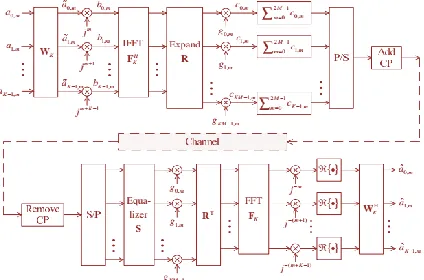
The block diagram of the WHT-C-FBMC transmitter is illustrated in Fig. 1, where the K data streams inputs are the Krows of matrix A. This structure is basically the polyphasestructure presented in [8], except that a WHT precoder isapplied to the input.The WHT is applied for each column of A as
̃ ……….(2)
where am is the mth column of A, WK is a K × K
WalshHadamard matrix and a˜m is the mth precoded
The polyphase structure [8] for the implementationof (5) as shown in Fig. 1 is the most efficientmethod and can be described clearly in matrix form.
Fig. 1: Equivalent complex baseband WHT-C-FBMC system
In this structure, bm is first transformed into the time domain by multiplying it with an inverse FFT matrix, FH K.Upsampling is performed by repeating the K×
1 transformedvector M times with the KM×K matrix
R. The resultedvector is pulse-shaped by point-wise multiplication with thecircularly shifted version of the prototype filter, which is Φmg
An approach to demodulate data is described in Fig. 1[8]. First, an equalizer S is applied to the received signaly to remove the effect of multipath interference. Then, theequalized vector is processed in dual to (7).To guarantee perfectreconstruction, in FBMC, the combined response of the transmit filter and received filter must be a Nyquist pulse [11]. Astandard square-root raise cosine (SRRC) filter fulfills such acondition and is widely employed for FBMC. More recently,[12] proves that a pulse satisfying the orthogonality conditionfor FBMC also satisfies the orthogonality condition for CFBMC.
IV. PERFORMANCE ANALYSIS
The main advantage of the precoding schemes presented in this section is that each subcarrier carries alinear combination of all data symbols from a given subsymbol. This procedure spreads the informationover all subcarriers, allowing the receiver to exploitfrequency diversity. Since the columns and rows ofthe precoding matrices are orthogonal to each
other,the data symbols can be recovered on the receiverside without self-interference introduced by the precoding operation.
V. CONCLUSION
To improve the BER performance of C-FBMC in a FSC, thispaper studies a precoded version of C-FBMC, called WHTC-C-FBMC, which uses the unitary Walsh-Hadamardprecodingmatrix. WHT-C-FBMC exploits the frequency diversity byaveraging the SNR
output over all subcarriers. A
theoreticalapproximation for the BER of WHT-C-FBMC has also beenas long as, which depends on the filter coefficients and channelgains.
REFERENCES
[1]. Fettweis, G.P.: The Tactile Internet: Applications and Challenges. IEEEVehicular Technology Magazine 9(1), 64{70 (2014).
[2]. Marsch, P., Raaf, B., Szufarska, A., Mogensen, P., Guan, H., Farber,M., Redana, S., Pedersen, K., Kolding, T.: Future mobilecommunication networks: Challenges in the design and operation.Vehicular Technology Magazine, IEEE 7(1), 16{23 (2012).
[3] N. Michailow, M. Matthe, I. S. Gaspar, A. N. Caldevilla, L. L.Mendes, A. Festag, and G. Fettweis, “Generalized frequency divisionmultiplexing for 5th
generation cellular networks (invited paper),” IEEETransactions on Communications, vol. 62, pp. 3045–3061, Sept. 2014.
[4] R. Datta, N. Michailow, M. Lentmaier, and G. Fettweis, “GFDMinterference cancellation for flexible cognitive radio phy design,” inProc. IEEE Vehicular Technology Conference, 2012.
[5] N. Michailow, L. Mendes, M. Matth´e, I. Gaspar, A. Festag, andG. Fettweis, “Robust WHT-GFDM for the next generation of wirelessnetworks,” IEEE Communications Letters, vol. 19, pp. 106–109, Jan.2015.
[7] X. Gao, W. Wang, X. G. Xia, E. K. S. Au, and X. You, “Cyclicprefixed OQAM-OFDM and its application to single-carrier FDMA,”IEEE Transactions on Communications, vol. 59, pp. 1467– 1480, May2011.
[8] H. Lin and P. Siohan, “Multi-carrier modulation analysis and WCPCOQAM proposal,” EURASIP Journal on Advances in Signal Processing, vol. 2014:79, 19 pages, 2014.
[9] Y.-P. Lin, S.-M.Phong, and P. P. Vaidyanathan, Filter Bank Transceiversfor OFDM and DMT Systems. Cambridge University Press, 2010.
[10] A. RezazadehReyhani, A. Farhang, and B. Farhang-Boroujeny, “Circularly pulse-shaped waveforms for 5G: Options and comparisons,” inIEEE Global Communications Conference (GLOBECOM), pp. 1–7, Dec.
[11] B. Farhang-Boroujeny and C. H. (George) Yuen, “Cosine modulatedand offset QAM filter bank multicarrier techniques: A continuoustime prospect,” EURASIP Journal on Advances in Signal Processing,vol. 2010, pp. 1–17, 2010.
[12] A. B. Uc¸ ¨unc¨u and A. ¨ O. Yilmaz, “Pulse shaping methods for ¨OQAM/OFDM and WCP-COQAM,” http://arxiv.org/abs/1509.00977,2015.
[13] D. Tse and P. Viswanath, Fundamentals of Wireless Communication.Cambridge University Press, 2005.
[14]. Michailow, N., Gaspar, I., Krone, S., Lentmaier, M., Fettweis, G.:Generalized Frequency Division Multiplexing: Analysis of an alternativemulti-carrier technique for next generation cellular systems. In: IEEEInternational Symposium on Wireless Communication Systems(ISWCS), pp. 171{175 (2012)
[15]. Matth´e, M., et al.: Influence of pulse shaping on bit error rateperformance and out of band radiation of generalized frequencydivision multiplexing. In: IEEE International Conference onCommunications Workshops (ICC), pp. 43{48 (2014)
[16]. Lin, H., Siohan, P.: Multi-carrier modulation analysis andWCP-COQAM proposal. EURASIP Journal on Advances in SignalProcessing 2014(79), 1371{1430 (2014)
[17]. Michailow, N., et al.: Generalized Frequency Division Multiplexing for5th Generation Cellular Networks. IEEE Transactions onCommunications 62(9), 3045{3061 (2014)
[18]. Matthe, M., Mendes, L.L., Fettweis, G.: Generalized FrequencyDivision Multiplexing in a Gabor Transform Setting. CommunicationsLetters, IEEE 18(8), 1379{1382 (2014)
[19]. Gaspar, I., et al.: LTE-compatible 5G PHY based on GeneralizedFrequency Division Multiplexing. In: 11th International Symposium onWireless Communications Systems (ISWCS), pp. 209{213 (2014)
[20]. Farhang, A., Marchetti, N., Doyle, L.E.: Low Complexity ModemDesign for GFDM. IEEE Transactions on Signal Processing PP(99),1{1 (2015). doi:10.1109/TSP.2015.2502546
BIODATA
AUTHOR1
Dhonvan Sindhu received her B.Tech in ECE in Kodada Institute of Technology and Science for women. Kodada. And P.G received in ECE (Embedded Systems) in Aravindaksha Educational Society’s Group of Institutions,Balemla, Suryapeta, SuryapetaDist. Telangana, India.
Dhonvan Srinu received his B.Tech in ECE ( Electronic and communication Engineering).at Vaagdevi College of Engineering , Warangal dist. Telangana. And P.G received in ECE (DECS)in VLSI System Design. Aurora College of Engineering , Nalgonda..Dist. Telangana, India. He is currently working as a assistant professor in ECE dept at
Marri laxman reddy institue of technology and