ISSN 2286-4822
www.euacademic.org DRJI Value: 5.9 (B+)
Ab-Initio calculations; structural, physical
properties, thermodynamic function and charges
for some Bio active compounds
MANAL ABED MOHAMMED SHATHA ABDULAMEER JAWAD ELIAS MOHAMMED ALAA ABDULZAHRA
Department of Chemistry College of Education for Pure Science University of Karbala, Iraq
Abstract:
Ab- Initio calculations have been used to identify the dimensional geometric ( lengths and angles bond) when the geometry of a balanced, functions thermodynamic, some physical properties, charge for some thiazolo derivatives compounds .
Calculation results have shown that the compound R-PH-Cl
is less activity because it has the high value of ΔE and
Electronegativity( χ ) and has high value of(Ѡ Electrophilicity) . But
the compound R-PH-OCH3 has highest value of all thermodynamic
functions (E0 , H0 , G0 , A0 , CV , CP ,S0), This difference in results come
according to the difference of substituted groups.
The results investigation Heat formation (ΔHf 0 (in kJ/mole)
by using (semi-empirical method PM3 model in MOPAC) for these
molecules and the results showed that the compound R-PH-F ) has
less value which means high thermal stability than the other’s.
Key words: DFT study, thiazolo compound, Electronegativity, hardness
anticancer therapeutic agents is one of the fundamental goals in medicinal chemistry. Cytotoxicity and genotoxicity of anticancer drugs to the normal cells are major problems in cancer therapy and engender the risk of inducing secondary malignancy [1,2].
Computational chemistry is the field that uses computer to predict molecular structure and reactivity[3] .The latter are now applied routinely to compute molecular properties in a wide variety of chemical applications, including pharmaceuticals and drug design, atmospheric and environmental chemistry , nanotechnology ,and materials science[4]. density functional theory, DFT” .It allows us to compute all properties of systems by the electron density , p (r) which is a function of three variables, , p (r)=f(x ,y , z)”[ 5,6]. Kohn and Sham showed that p can be expressed as contribution from each electron present in the molecule, and written: ( ) ∑ ( )
is called a Kohn – Sham orbital and is a solution of the Kohn – Sham equation , which closely resembles the form of Schrodinger equation. The Kohn – Sham equation is
[
( ) ( ) ( )] ( ) ( )
Thus ,the ( ) ( ) ( ) are refers to the interaction between
Computational details
In this work, there were investigated theoretically using the Density Functional Theory (DFT) calculation [15] at the B3LYP/6-311G(p, d) level of theory to get the optimized geometry . DFT calculations were carried out with Beck’s three-parameter hybrid model using the Lee–Yang–Parr correlation functional (B3LYP) method. Molecular geometries were fully optimized by Berny’s optimization algorithm using redundant internal coordinates. All optimized structures were confirmed to be minimum energy conformations [16,17].
RESULTS AND DISCUSSION
Geometrical parameter.
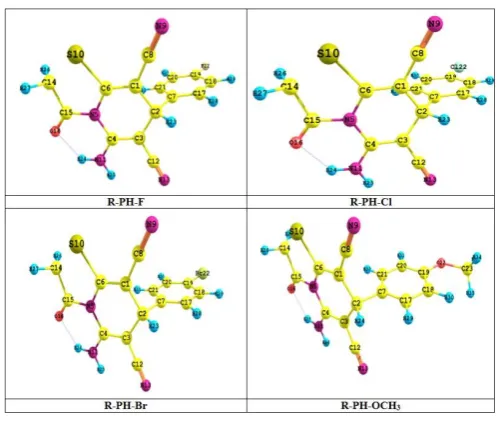
According to the results calculated and recorded in the (table 1and fig. 1) . Show that the bond (C19 –X22 ) X : F , Cl , Br,
-OCH3 in compound R-PH-F has high value compared to other
compounds studies it may be due to high electro – negative of F
atom with substituted group. , Whereas for the same bond length for the compound R-PH-OCH3has less value. And each
of bonds (C19 –C20 ) and (C19 –C18 ) the compound R-PH-OCH3
has high value than other compounds.
Also the change of the group substituted had effect on the value of the angles of the compounds studied in this research ,have shown calculation in the (table 1and fig. 1).
That the angles
C20C19C18 in compound R-PH-F has highvalue may be to the electro – negative of substituted group. Also
C17C18C19 the results showed that in compoundR-PH-OCH3 has high value.
Table 1: Calculated geometric parameters (bond lengths in Angstrom length angles in degree) of some thiazolo derivatives
R-PH-F R-PH-Cl R-PH-Br R-PH-OCH3
Para. Geo. Bond length and angle Para. Geo. Bond length and angle Para. Geo. Bond length and angle Para. Geo. Bond length and angle
R(17-18) 1.398 R(17-18) 1.398 R(17-18) 1.398 R(17-18) 1.400 R(17-28) 1.082 R(17-28) 1.082 R(17-28) 1.082 R(17-29) 1.083 R(18-19) 1.385 R(18-19) 1.388 R(18-19) 1.390 R(18-19) 1.397 R(18-29) 1.079 R(18-29) 1.079 R(18-29) 1.079 R(18-30) 1.079 R(19-20) 1.388 R(19-20) 1.391 R(19-20) 1.394 R(19-20) 1.403 R(19-22) 1.400 R(20-21) 1.395 R(20-21) 1.394 R(19-22) 1.391 R(20-21) 1.394 R(20-30) 1.079 R(20-30) 1.080 R(20-21) 1.388 R(20-30) 1.080 R(21-31) 1.082 R(21-31) 1.082 R(20-31) 1.080 R(21-31) 1.082 R(16-24) 1.883 R(16-24) 1.885 R(21-32) 1.083 R(16-24) 1.883 A(2-1-6) 122.3 A(2-1-6) 122.2 R(22-23) 1.453 R(10-14) 1.886 A(2-1-8) 117.5 A(2-1-8) 117.6 R(23-33) 1.085
A(7-17-18)
120.9 A(7-21-31)
120.0 A(7-21-31)
120.0 A(5-15-16) 125.2
A(7-17-28)
119.8 A(24-11-25)
120.4 A(24-11-25)
120.4 A(17-7-21) 118.5
A(7-21-20)
120.8 A(11-24-16)
130.5 A(11-24-16)
130.4 A(7-17-18) 121.3
A(7-21-31)
119.9 A(15-14-26)
109.8 A(15-14-26)
109.8 A(7-17-29) 119.7
A(24-11-25)
120.4 A(15-14-27)
109.6 A(15-14-27)
109.6 A(7-21-20) 120.9
A(11-24-16)
130.5 A(14-15-16)
121.5 A(14-15-16)
121.6 A(7-21-32) 119.8
A(15-14-26)
109.8 A(26-14-27)
109.8 A(26-14-27)
109.8 A(25-11-26)
120.5
A(15-14-27)
109.5 A(15-16-24)
102.3 A(15-16-24)
102.3 A(11-25-16)
130.5
A(14-15-16)
121.5 A(18-17-28)
119.2 A(18-17-28)
119.2 A(15-14-27)
109.8
A(26-14-27)
109.8 A(17-18-29)
120.8 A(17-18-29)
120.4 A(14-15-16)
121.4
A(26-14-10)
109.8 A(19-18-29)
120.6 A(19-18-29)
120.4 A(27-14-28)
109.8
A(17-18-19)
118.2 A(17-18-19)
118.6 A(17-18-19)
119.1 A(17-18-19)
Physical properties.
Depending on the Ab initio of method of calculation according to the density function theory (DFT) is calculate some physical properties of the molecules studied in this research; Dipole moments (μ in Debye) , energies (e V) of the high Occupied Molecular Orbital (EHOMO) and the Lower Unoccupied
Molecular Orbital (ELUMO) and according Koopmans theorem
(the negative EHOMO is equal to the ionization potential) the
calculation has been ionization energies (e V) , Also calculated the energy difference (ΔE , e V), And finally calculated (Molecular Hardness) (η) = ½( HOMO - LUMO), (Electron
Affinity) EA = - LUMO according Koopmans theorem for N
system of electrons[18-21], Electronegativity( χ ) according to Mullikan1934 [22] and Electrophilicity (Ѡ) according to Parr and co-workers 1999[23].
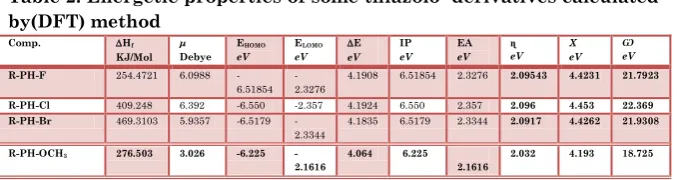
Shown this results (table :2)
that the compound R-PH-Cl is less activity because it has the high value of ΔE and Electronegativity( χ ) and has high value of(Ѡ Electrophilicity) .
Also, the MOPAC computational packages (semi-empirical method , PM3 model) employed to compute physical properties; heats of formation (ΔHf, kJ.mol-1)[24,25]. the results showed (Table 2) for the compound R-PH-F has less value which means high stability than the other’s.
Table 2: Energetic properties of some thiazolo derivatives calculated by(DFT) method Ѡ eV Χ eV ɳ eV EA eV IP eV E eV ELOMO eV EHOMO eV μ Debye Hf
KJ/Mol Comp. 21.7923 4.4231 2.09543 2.3276 6.51854 4.1908 -2.3276 -6.51854 6.0988 254.4721 R-PH-F 22.369 4.453 2.096 2.357 6.550 4.1924 -2.357 -6.550 6.392 409.248 R-PH-Cl 21.9308 4.4262 2.0917 2.3344 6.5179 4.1835 -2.3344 -6.5179 5.9357 469.3103 R-PH-Br 18.725 4.193 2.032 2.1616 6.225 4.064 -2.1616 -6.225 3.026 276.503 R-PH-OCH3 Thermodynamics functions
molecules along with the rotational constants, obtained in this study, where used to calculate the vibration and rotation contributions to the thermodynamic functions.
Thermodynamics functions standard and heat capacity for the studied molecules listed Table: 3 looking at the calculation results show that each of the thermodynamic functions (G0, A0, E0, H0) and (CV , CP )have the same gradient
values (different the group substitutes),
B > C > D > E > A
Table 3: Standard thermodynamics functions at 298.15oK of some thiazolo derivatives calculated by (DFT).
Cv KJ/mol.deg Cp KJ/mol.deg A0 KJ/mol S KJ/mol.deg G0 KJ/mol H0 KJ/mol E0 KJ/Mol Comp. 0.2949 0.303 255.4966 0.610 437.5619 619.6272 617.1484 R-PH-F 0.298 0.306 242.647 0.628 429.885 617.124 614.646 R-PH-Cl 0.2994 0.307 239.1211 0.633 428.0289 616.9368 614.4580 R-PH-Br 0.321 0.329 344.518 0.648 537.719 730.921 728.443 R-PH-OCH3 The Charges
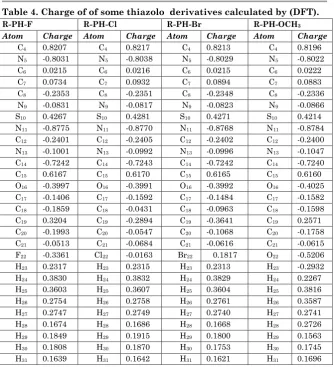
The Calculated for all charges atoms of the molecules studied according to the method (DFT) have shown calculation results of the charges (Table: 4) of carbon atom C19 in compound
R-PH-Br has high value of charge (the lowest density electronic), Perhaps the reason for this difference in electrical negative and molecular weight which increase the electronic density.
When the Nitrogen atoms (N9, N11) have high negative
charge value in compound R-PH-OCH3 can be used as a
Table 4. Charge of of some thiazolo derivatives calculated by (DFT).
R-PH-F R-PH-Cl R-PH-Br R-PH-OCH3
Atom Charge Atom Charge Atom Charge Atom Charge
C4 0.8207 C4 0.8217 C4 0.8213 C4 0.8196
N5 -0.8031 N5 -0.8038 N5 -0.8029 N5 -0.8022
C6 0.0215 C6 0.0216 C6 0.0215 C6 0.0222
C7 0.0734 C7 0.0932 C7 0.0894 C7 0.0883
C8 -0.2353 C8 -0.2351 C8 -0.2348 C8 -0.2336
N9 -0.0831 N9 -0.0817 N9 -0.0823 N9 -0.0866
S10 0.4267 S10 0.4281 S10 0.4271 S10 0.4214
N11 -0.8775 N11 -0.8770 N11 -0.8768 N11 -0.8784
C12 -0.2401 C12 -0.2405 C12 -0.2402 C12 -0.2400
N13 -0.1001 N13 -0.0992 N13 -0.0996 N13 -0.1047
C14 -0.7242 C14 -0.7243 C14 -0.7242 C14 -0.7240
C15 0.6167 C15 0.6170 C15 0.6165 C15 0.6160
O16 -0.3997 O16 -0.3991 O16 -0.3992 O16 -0.4025
C17 -0.1406 C17 -0.1592 C17 -0.1484 C17 -0.1582
C18 -0.1859 C18 -0.0431 C18 -0.0963 C18 -0.1598
C19 0.3204 C19 -0.2894 C19 -0.3641 C19 0.2571
C20 -0.1993 C20 -0.0547 C20 -0.1068 C20 -0.1758
C21 -0.0513 C21 -0.0684 C21 -0.0616 C21 -0.0615
F22 -0.3361 Cl22 -0.0163 Br22 0.1817 O22 -0.5206
H23 0.2317 H23 0.2315 H23 0.2313 H23 -0.2932
H24 0.3830 H24 0.3832 H24 0.3829 H24 0.2267
H25 0.3603 H25 0.3607 H25 0.3604 H25 0.3816
H26 0.2754 H26 0.2758 H26 0.2761 H26 0.3587
H27 0.2747 H27 0.2749 H27 0.2740 H27 0.2741
H28 0.1674 H28 0.1686 H28 0.1668 H28 0.2726
H29 0.1849 H29 0.1915 H29 0.1800 H29 0.1563
H30 0.1808 H30 0.1870 H30 0.1753 H30 0.1745
REFERENCES
[1] Panda, S. S. “Aqua Mediated Synthesis of Bio-active Compounds”; J. of Mini-Reviews in Medicinal Chemistry, 13, 784-801; 2013.
[2] Aydemir, N.; Bilaloglu, R., ”Genotoxicity of two anticancer drugs, gemcitabine and topotecan, in mouse bone marrow in vivo. Mutat.Res., 537, 43-51; 2003.
[3] Atkins, P.,Depaula , J .and Fridman,R.,” Quanta, Matter and Charge: A Molecullar Approach to Physical Chemists” , 1st ed. ,W.H. Freeman and company , New York, USA, 2009.
[4] Young C.,; J.of Comput. Chem.;”A practical guide for applying techniques to red-world problems”, st ed. , John Wiley and Sons, USA,2001.
[5] Jerzy, L. and Manoj, K.S., Practical Aspects of Computational Chemistry: Methods, Concepts and Applications , USA, 2009.
[6] David, S.S. and Janice ,A.S., Density Functional Theory :A practical Introduction , John Wiley and Sons, USA, 2009.
[7] Nalewajski, R.F. Density Functional theory; Fundamentals and Effective Potential , Springer , Germany, 1996.
[8] Wolfram, K. and Max. C.H., A Chemist’s Guide to Chemistry Functional Theory , 2nd edition, Wiley-VCH , Germany, 2001.
[9] Hohenberg, P. and Kohn, W., J. Phys. Res. 136(3B),PP864-871; 1964.
[10] Kohn, W. Sham, L., J.Phys.Rev.,140(4A), 1133-1138; 1965. [11] Young D C Computational chemistry: A practical guide for applying techniques to real world problems, John Wiley & Sons Inc, p. 42; 2001.
[12] Chis V﹐ Filip S, Miclaus V﹐ Pirnau A, Tanaselia C,
[15] Ahmed A., Yasser R., Elmurssi, M.;J.of theort.and Comput.Chem.,13(08), 2014.
[16] Toy M., Tank H.; J.of Theor.comput.Chem.,11(4), 2012. [17] Landers J., Gor G. Yu., V. Neimark;J.of Physicochem. Eng. Aspects, 437 , ,pp:3– 32, 2013.
[18] Moore C. E. ,"Ionization Potentials and Ionization Limits Derived from The Analyses of Optical Spectra", NSRDS-NBS, USA, 1970 .
[19] Vanfleteren D., Neck D. V., Ayers P. W., Morrison R. C. and Bultinck P.,The J. of Chemical Physics, 130,194104(1)-194104(10) , 2009.
[20] Hotop H. and Lineberger W. C., J. of Physical Chemistry, 4,539-576, (1975).
[21] Zhan C. G., J. A. Nicholsand ,D. A. Dixon, J. of Physical Chemistry A, 107,. 4184-4195, (2003).
[22] Mulliken R. S. , J.of Chemical Physics, 2, 782-793; 1934 . [23] Parr R. G., L. V. Szentpály and S. Liu, J. of the American Chemical Society, 121, 1922-1924; 1999 .
[24] Pearson R.G., "Chemical Hardness", Wiley-VCH, Germany; 1997.