Secure Biometric System for Plant Identification
Dr.M.N.Nachappa1, V. Sai Lakshmi 2.Professor and Head, School of CS and IT, Jain University, Bangalore1. 2. Graduate Student, Master of Computer Application, Jain University, Bangalore2.
Email:[email protected], [email protected].
Abstract— In the world, plant species cannot survive on their own from artificial disasters, it is the responsibility of human beings to protect plant species from such calamities. In order to meet that goal, it is necessary to classify the different plant species and prevent them from extinction. There are some species which are still unknown to humans. So it is essential to distinguish the different plant species and classify them into proper categories and protect them. Classification of plant species through automation is possible through methods like leaf recognition technique, it also helps in recognizing various diseases which can result in their extinction.
Keywords— Plant, Leaves, Biometrics, images, Scanning, Image processing.
1.INTRODUCTION
Biometrics refers to analysis to biological data. Biometric identification is a pattern recognition based classification system that recognizes an individual by determining its authenticity using a specific physiological or behavioural characteristic (biometric).
Fig:1.1 Types of biometrics
Even after several innovative advancements made in the field of botany, there are still a huge number of plants that
are yet to be discovered, identified and used. Today's ethno-botanists are combining regions of the world, looking for future medicines and agricultural products.
In contrast to number of commercially available biometric systems for human recognition in the market today, there is no such a biometric system for plant recognition, even though they have many characteristics that are uniquely identifiable at a species level. The goal of the study was to develop a plant species biometric using both global and local features of leaf images.
Plants can be identified based on their leaves, flowers, fruits or plant as a whole. Among all the modalities, leaves are considered as a major and promising modality for effective classification of plants. Plant identification is the determination of the identity of an unknown plant in comparison with previously collected specimen. The process of recognition connects the specimen with a botanical name. Once this connection is established, related details like name and other properties of the plant can be easily obtained. Plant identification is an important task because of concerns about climate change and the resultant changes in geographic distribution along with abundance of species. Development of new crops often depends on the incorporation of genes from wild relatives of existing crops and hence it is important to keep track of the distribution of all plant taxonomy.
Fig 1.2. Features of Leaf
In recent years, various approaches have been proposed for characterizing leaf images. Most of them were based on a global representation of leaf peripheral with Fourier descriptors, polygonal approximations and centroid-contour distance curve. Global representation of leaf shapes does not provide enough information to characterise species uniquely since different species of plants have similar leaf shapes. Others were based on leaf vein extraction using intensity histograms and trained artificial neural network classifiers. Leaf venation extraction is not always possible since it is not always visible in photographic images. Biometric authentication systems generally use a pattern recognition approach that verifies or identifies an individual’s authenticity of its uniquely identifiable physiological or behavioral characteristic, which is called a biometric. Verification systems either reject or accept the submitted claim of identity by comparing it with the pre-stored biometrics of the same individual while identification systems recognize an individual by searching the matching queried biometric in the entire database.
This project introduces image processing for plant leaf recognition. Leaf recognition technique works by identifying the patterns present on the leaf surface and based on the patterns the system can identify the species of the plants. Leaf recognition is limited to factors like climate and plant health because the external surface of the leaf can have change in color due to diseases or climate changes. The sample leaf images are taken from various places and plants using digital cameras. The computer can classify species of plants via the leaf images loaded from digital cameras. The images were pre-processed, and a number of features extracted in order to compare and identify a particular plant.
2.LITREATUREREVIEW
To recognize the different plant leaf digital images through their characteristic features, Arun kumar(2016) used several
feature extraction techniques like Gray Level Co- occurrence Method (GLCM), Statistical Features, Gabor Texture Features and Image Directionality features were examined and experimented. The main reason for studying such variant techniques was to identify which of the feature extraction techniques (which is also our one of the objectives for the present study), is most suitable for an identification of different plant species through their digital leaf images.
Trishen Munisami (2015) proposed Plant leaf recognition using shape features and colours histogram with k-nearest neighbour classifiers, The images were pre-processed and a number of features were extracted from them. They implemented their own k-Nearest Neighbour classifier. Each leaf image was then compared with every other leaf image in the database. They obtained an accuracy of 83.5% at the first stage. The next stage consisted of using information obtained from colour histograms in order to further differentiate between more difficult cases. This technique had a positive impact of about 4% on the recognition accuracy. They also discovered that increasing the number of species leads to a small decrease in the accuracy but increasing the number of leaves beyond a threshold of ten had no significant impact on the overall accuracy.
Vijaya Bylaiah (2014) proposed Leaf recognition and matching with Matlab, It confirms the importance of leaf length, width, area and perimeter since the results obtained by the feature selection method selected these features as the most discriminant ones and combined them with other morphological features increased the results to 85 %. Suvarna S(2013) proposed a machine based vision system for identification collection of plants in India. The Image Based Information Retrieval (IBIR) helps in getting information about the plant from its image. The IBIR assists the botanists and Ayurveda practitioners to retrieve the Information on a query image unlike similar images retrieved from IBIR. They have used IBIR to get the image from the database and the retrieved image is used for obtaining its relevant information. This is achieved through whole plant and its parts. The integration of IBIR has given a unique associated information.
results in terms of the qualitative and quantitative measures of the images.
According to Li et al. (2007), edge enhancement is an important operation which helps indetecting object boundaries and in subsequent steps of recognition and classification. It helps in differentiating the features by improving the visual quality perception of the image and provides insight into the shape and outline of objects and offers vital information to the Human Visual System (HVS).
3.METHODOLOGY
The identification of plant category from leaf image consists of four important steps, namely, acquisition, pre-processing, feature selection and recognition. All the steps involved are considered very important for the accuracy and efficiency of the identifier. The study proposes techniques to enhance each of these steps, so that the resulting system produces maximum advantage to plant identification through leaf recognition in terms of accuracy.
Fig 3.1:Process of leaf identification
3.1. Pre-processing
Leaf recognition process involves capturing of images. Image has to be captured using a 2D camera or a scanner. The equipment should be good enough to capture the external surface of the leaves crisp and clear. So that, veins or patterns on the leaves can be properly identified. High quality equipment is used for image capturing. Cameras capable of capturing high definition contents are used for this purpose. Once this process is over the captured image
in digital format will be forwarded to the system for further processing. Here 2D cameras can be used as the leaf surface is flat and at the same time the amount of details and algorithm complexity required for processing will be very less when compared to 3D image processing. The pre-processing stage has two tasks, those are denoising and segmentation.
A. Denoising
One of the fundamental challenges in the field of image processing and computer vision is image denoising, where the underlying goal is to estimate the original image by suppressing noise from a noise-contaminated version of the image. Image noise may be caused by different intrinsic (i.e., sensor) and extrinsic (i.e., environment) conditions which are often not possible to avoid in practical situations. Therefore, image denoising plays an important role in a wide range of applications such as image restoration, visual tracking, image registration, image segmentation, and image classification, where obtaining the original image content is crucial for strong performance. While many algorithms have been proposed for the purpose of image denoising, the problem of image noise suppression remains an open challenge, especially in situations where the images are acquired under poor conditions where the noise level is very high. Most of the denoising solutions mainly focuses on noise removal and ignore the edge and contrast details. Some methods apply separate algorithms for each of these three steps.
Fig 3.2. Image Denoising
B. Segmentation
But due to the varied color and texture property of leaf images, wavelets have the shortcoming of grouping regions that result in inaccurate segmentation. Therefore to solve this problem, texture, color or a fusion of these features were used for grouping regions.
The procedure of WCF consists of four steps. The first step focuses on extracting texture information. Texture features are obtained using wavelet decomposition, which decomposes the leaf image into four subbands. As maximum texture information is contained in LH (Low High) and HL (High Low) subbands, only these two coefficients are used to obtain texture features. Each of the pixels in these two subbands is grouped into four texture classes, namely, dominant energy in vertical direction, dominant energy in horizontal direction, smooth (insufficient energy in any orientation) and complex (no dominant orientation). A K-means clustering algorithm is used for this purpose and the categorization is based on the mean energy of the subbands.In the second step, a color transformation is performed to convert the RGB (Red Green Blue) color space to L*u*v color space and separate the L, u and v color components. The three color components together with the four texture classes and spatial coefficients (x,y) form the feature vector.
In the third step, an enhanced mean shift filtering algorithm, that integrates both color and texture features, is then applied. This step increases the discrimination between regions where the colors are similar but textures are different and improves the segmentation process.
Finally, in the fourth step, again a K-means clustering algorithm is used to segment the ROI region.
3.2. Feature Extraction and Selection
The main aim of the second phase is to convert the image data into a format that simplifies the process of matching between leaf images. This phase consists of two steps, namely, Feature Extraction and Feature Selection. The feature extraction step functions to discover various features that best represent a leaf image. As the number of features selected is normally very high, a feature selection algorithm is used in the second stage, to select the most prominent features.
A. Feature Extraction
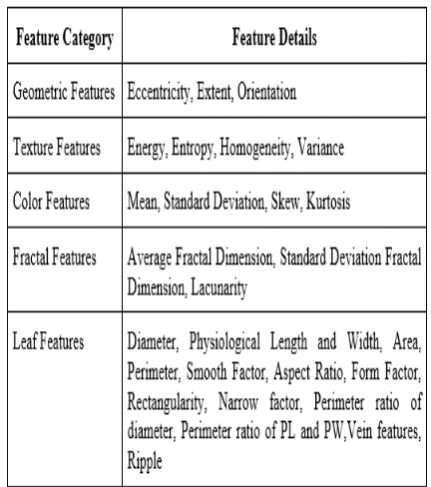
During feature extraction, five categories of features were extracted. They are geometric features, color features, texture features, fractal features and leaf related features. Most of the studies related to leaf recognition use only leaf, color and texture features. In this study, the geometric and fractal characteristics were also considered.
Fig 3.2. Feature Extraction
The five feature sets were first analyzed for their efficiency in plant identification through leaf recognition. The experiments revealed that the leaf feature set improved identification accuracy when compared with other four feature categories. Motivated by this fact and in search for further improvement possibilities towards accuracy.
B. Feature Selection
Usage of combined feature set increases the accuracy of recognition, but on the other hand it suffers from the curse of high dimensionality. Feature selection, a process of removing irrelevant and redundant features, is used to overcome this problem.
Feature selection is different from dimensionality reduction. Both methods seek to reduce the number of attributes in the dataset, but a dimensionality reduction method do so by creating new combinations of attributes, whereas feature selection methods include and exclude attributes present in the data without changing them.
3.3 Classification
different machine learning algorithms to form hybrid models have also been proposed. Most of these hybrid models combine two or more of predictive or descriptive algorithms in order to improve the performance of identification and recognition.
3.3. Leaf Matching
Leaf classification is accomplished by comparing the feature vector of unknown leaf sample with the feature vectors of known leaf samples stored in the knowledgebase using any proximity measure. An unknown leaf sample is assigned the class label associated with known leaf sample, which possess maximum similarity or minimum dissimilarity with unknown leaf sample.
4. RESULT ANALYSIS
Plant recognition is closely related to people’s life. The operation of the traditional plant identification method is complicated and is unfavorable for popularization. The rapid development of computer image processing and pattern recognition technology makes it possible for computer’s automatic recognition of plant species based on image processing.
The world of plants is very vast than the worlds of animals or birds or bugs. Each of these fields traditionally used field guide books, readily purchased, to enable vacationers, scouts or hikers to identify encountered species. Compendious online guides have been enabled by computers and databases. But the goal of this thesis is identifying plants by extracting features of leaves using Digital image processing. This technology can help future advancement in agriculture by implementing agri-robots to work which minimize the man power.
CONCLUSION
This project introduces image processing for plant leaf recognition. Leaf recognition technique works by identifying the patterns present on the leaf surface and based on the patterns the system can identify the species of the plants. Leaf recognition is limited to factors like climate and plant health because the external surface of the leaf can have change in color due to diseases or climate changes. The sample leaf images are taken from various places and plants using digital cameras. The computer can classify species of plants via the leaf images loaded from digital cameras. The images were pre-processed, and a number of features extracted in order to compare and identify a particular plant. We can reduce from all this work that this application, even if it works well, can’t be used as a completely reliable tool. It can only help to begin in this domain, for interested people, but we should not trust it if the life of someone is at risk
.
REFRENCES
[1] Petre Lameski, Plant Species Recognition Based on Machine Learning and Image Processing, November 2017. [2] Aby Joseph and Dr.Anitha H.B, Leaf Classification using image processing, March 2017.
[3] Zhaobin Wang, Huale Li, Review of Plant Identification Based on Image processing, July 2016
[4] Ross Lagerwall, SerestinaViriri, “Plant Classification using Leaf Recognition”.
[5] PravinH.Nikam, Joseph Kareparamban, ArunaJadhav and Vilasrao Kadam, “Future trends in standardization of Herbal drugs”, Journal of Applied Pharmaceutical Sciences.
[6] Arun Kumar, design and analysis of leaf recognition algorithms based on evolutionary image processing techniques [2016].
[7] Arbelaez, P. and Cohen, L. (2008) Constrained image segmentation from hierarchical boundaries, CVPR.
[8] Shazia Sultana, Mir Ajab Khan, Mushtaq Ahmad, AsghariBano, “Authentication of Herbal Medicine NEEM (Azadirachta Indica A. Juss.) By using Taxonomic and Pharmacognostic Techniques”